


Revelation 1:11
Bible text: King James Version (1769 Blayney text) · Public domain
Bible text: King James Version with Strong's numbers · Public domain
Bible text: Berean Standard Bible · Public domain
Bible text: American Standard Version (1901) · Public domain
Bible text: World English Bible, Messianic edition · Public domain
Bible text: Geneva Bible (1599) · Public domain
Bible text: Young's Literal Translation · Public domain
- λεγούσηςlegousēssayingG3004V-PAP-GSFVerb Present Active Participle Genitive Singular Feminine
- ἐγώegōI myselfG1473P-1NSPersonal pronoun Nominative 1st Singular
- ἐιμιeimiamG1510V-PAI-1SVerb Present Active Indicative 1st Singular
- τὸtotheG3588T-NSNDefinite article Nominative Singular Neuter
- ΑAAlphaG1N-NSN-LINoun Nominative Singular Neuter Indeclinable Letter
- καὶkaiandG2532CONJConjunction
- τὸtotheG3588T-NSNDefinite article Nominative Singular Neuter
- ΩŌOmegaG5598N-NSN-LINoun Nominative Singular Neuter Indeclinable Letter
- ὃhotheG3588T-NSMDefinite article Nominative Singular Masculine
- πρῶτοςprōtosfirstG4413A-NSM-SAdjective Nominative Singular Masculine Superlative
- καὶkaiandG2532CONJConjunction
- ὁhotheG3588T-NSMDefinite article Nominative Singular Masculine
- ἔσχατος·eschatoslastG2078A-NSM-SAdjective Nominative Singular Masculine Superlative
- καὶkaiandG2532CONJConjunction
- ὃhoWhatG3739R-ASNRelative pronoun Accusative Singular Neuter
- βλέπειςblepeisyou seeG991V-PAI-2SVerb Present Active Indicative 2nd Singular
- γράψονgrapsondo writeG1125V-AAM-2SVerb Aorist Active Imperative 2nd Singular
- εἰςeisinG1519PREPPreposition
- βιβλίονbibliona bookG975N-ASNNoun Accusative Singular Neuter
- καὶkaiandG2532CONJConjunction
- πέμψονpempsondo sendG3992V-AAM-2SVerb Aorist Active Imperative 2nd Singular
- ταῖςtaisto theG3588T-DPFDefinite article Dative Plural Feminine
- ἑπτὰheptasevenG2033A-NUIAdjective
- ἐκκλησίαιςekklēsiaischurchesG1577N-DPFNoun Dative Plural Feminine
- ταῖςtais<the>G3588T-DPFDefinite article Dative Plural Feminine
- ἐνeninG1722PREPPreposition
- Ἀσίᾳ·AsiaAsiaG773N-DSF-LNoun Dative Singular Feminine Location
- εἰςeistoG1519PREPPreposition
- ἜφεσονEphesonEphesusG2181N-ASF-LNoun Accusative Singular Feminine Location
- καὶkaiandG2532CONJConjunction
- εἰςeistoG1519PREPPreposition
- ΣμύρνανSmurnanSmyrnaG4667N-ASF-LNoun Accusative Singular Feminine Location
- καὶkaiandG2532CONJConjunction
- εἰςeistoG1519PREPPreposition
- ΠέργαμονPergamonPergamumG4010N-ASF-LNoun Accusative Singular Feminine Location
- καὶkaiandG2532CONJConjunction
- εἰςeistoG1519PREPPreposition
- ΘυάτειραThuateiraThyatiraG2363N-APN-LNoun Accusative Plural Neuter Location
- καὶkaiandG2532CONJConjunction
- εἰςeistoG1519PREPPreposition
- ΣάρδειςSardeisSardisG4554N-APF-LNoun Accusative Plural Feminine Location
- καὶkaiandG2532CONJConjunction
- εἰςeistoG1519PREPPreposition
- ΦιλαδέλφειανPhiladelpheianPhiladelphiaG5359N-ASF-LNoun Accusative Singular Feminine Location
- καὶkaiandG2532CONJConjunction
- εἰςeistoG1519PREPPreposition
- ΛαοδίκειανLaodikeianLaodiceaG2993N-ASF-LNoun Accusative Singular Feminine Location
English is a literal word-by-word gloss of the Greek, not the KJV's wording. Why?
This is the original text the KJV's translators worked from — each Greek word with its own literal English meaning in this verse, prepared by scholars at Tyndale House, Cambridge. The KJV translates whole sentences, not word by word, so its wording differs: one Greek word can become several English words, and the KJV may choose “charity” where the gloss reads “love”. Both are faithful — they answer different questions. For the KJV's own rendering, switch to the KJV text.
Details
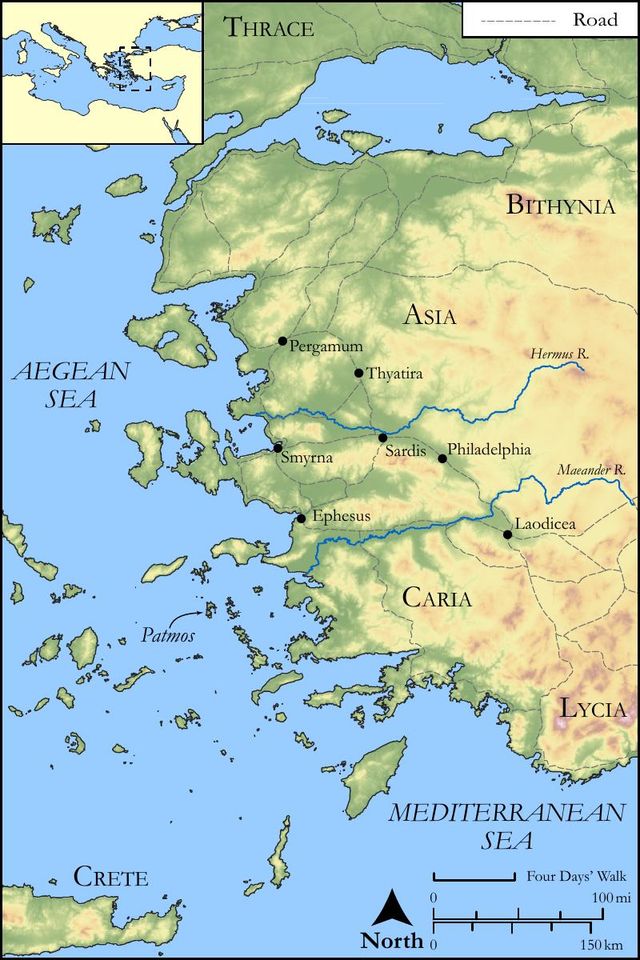
See on the biblical-era maps

Study this verse
Public-domain commentary
Matthew Henry
From his Commentary on the Whole Bible. Henry comments on passages, not single verses — this entry covers Revelation 1:9–20. His four-level outline is real structure in the source text, so it is rendered as structure.
We have now come to that glorious vision which the apostle had of the Lord Jesus Christ, when he came to deliver this revelation to him, where observe,
I.The account given of the person who was favoured with this vision. He describes himself,
1.By his present state and condition. He was the brother and companion of these churches in tribulation, and in the kingdom and patience of Christ. He was, at their time, as the rest of true Christians were, a persecuted man, banished, and perhaps imprisoned, for his adherence to Christ. He was their brother, though an apostle; he seems to value himself upon his relation to the church, rather than his authority in it: Judas Iscariot may be an apostle, but not a brother in the family of God. He was their companion: the children of God should choose communion and society with each other. He was their companion in tribulation: the persecuted servants of God did not suffer alone, the same trials are accomplished in others. He was their companion in patience, not only a sharer with them in suffering circumstances, but in suffering graces: if we have the patience of the saints, we should not grudge to meet with their trials. He was their brother and companion in the patience of the kingdom of Christ, a sufferer for Christ's cause, for asserting his kingly power over the church and the world, and for adhering to it against all who would usurp upon it. By this account he gives of his present state, he acknowledges his engagements to sympathize with them, and to endeavour to give them counsel and comfort, and bespeaks their more careful attention to what he had to say to them from Christ their common Lord.
2.By the place where he was when he was favoured with this vision: he was in the isle Patmos. He does not say who banished him thither. It becomes Christians to speak sparingly and modestly of their own sufferings. Patmos is said to be an island in the Aegean Sea, One of those called Cyclades, and was about thirty-five miles in compass; but under this confinement it was the apostle's comfort that he did not suffer as an evil-doer, but that it was for the testimony of Jesus, for bearing witness to Christ as the Immanuel, the Saviour. This was a cause worth suffering for; and the Spirit of glory and of God rested upon this persecuted apostle.
3.The day and time in which he had this vision: it was the Lord's day, the day which Christ had separated and set apart for himself, as the eucharist is called the Lord's supper. Surely this can be no other than the Christian sabbath, the first day of the week, to be observed in remembrance of the resurrection of Christ. Let us who call him our Lord honour him on his own day, the day which the Lord hath made and in which we ought to rejoice.
4.The frame that his soul was in at this time: He was in the Spirit. He was not only in a rapture when he received the vision, but before he received it; he was in a serious, heavenly, spiritual frame, under the blessed gracious influences of the Spirit of God. God usually prepares the souls of his people for uncommon manifestations of himself, by the quickening sanctifying influences of his good Spirit. Those who would enjoy communion with God on the Lord's day must endeavour to abstract their thoughts and affections from flesh and fleshly things, and be wholly taken up with things of a spiritual nature.
II.The apostle gives an account of what he heard when thus in the Spirit.
An alarm was given as with the sound of a trumpet, and then he heard a voice, the voice of Christ applying to himself the character before given, the first and the last, and commanding the apostle to commit to writing the things that were now to be revealed to him, and to send it immediately to the seven Asian churches, whose names are mentioned. Thus our Lord Jesus, the captain of our salvation, gave the apostle notice of his glorious appearance, as with the sound of a trumpet.
III.We have also an account of what he saw.
He turned to see the voice, whose it was and whence it came; and then a wonderful scene of vision opened itself to him.
1.He saw a representation of the church under the emblem of seven golden candlesticks, as it is explained in the last verse of the chapter. The churches are compared to candlesticks, because they hold forth the light of the gospel to advantage. The churches are not candles: Christ only is our light, and his gospel our lamp; but they receive their light from Christ and the gospel, and hold it forth to others. They are golden candlesticks, for they should be precious and pure, comparable to fine gold; not only the ministers, but the members of the churches ought to be such; their light should so shine before men as to engage others to give glory to God.
2.He saw a representation of the Lord Jesus Christ in the midst of the golden candlesticks; for he has promised to be with his churches always to the end of the world, filling them with light, and life, and love, for he is the very animating informing soul of the church. And here we observe,
(1.)The glorious form in which Christ appeared in several particulars.
[1.]He was clothed with a garment down to the foot, a princely and priestly robe, denoting righteousness and honour.
[2.]He was girt about with a golden girdle, the breast-plate of the high priest, on which the names of his people are engraven; he was ready girt to do all the work of a Redeemer.
[3.]His head and hairs were white like wool or snow. He was the Ancient of days; his hoary head was no sign of decay, but was indeed a crown of glory.
[4.]His eyes were as a flame of fire, piercing and penetrating into the very hearts and reins of men, scattering terrors among his adversaries.
[5.]His feet were like unto fine burning brass, strong and stedfast, supporting his own interest, subduing his enemies, treading them to powder.
[6.]His voice was as the sound of many waters, of many rivers falling in together. He can and will make himself heard to those who are afar off as well as to those who are near. His gospel is a profluent and mighty stream, fed by the upper springs of infinite wisdom and knowledge.
[7.]He had in his right hand seven stars, that is, the ministers of the seven churches, who are under his direction, have all their light and influence from him, and are secured and preserved by him.
[8.]Out of his mouth went a two-edged sword, his word, which both wounds and heals, strikes at sin on the right hand and on the left,
[9.]His countenance was as the sun shining, its strength too bright and dazzling for mortal eyes to behold.
(2.)The impression this appearance of Christ made upon the apostle John (Rev 1:17): He fell at the feet of Christ as dead; he was overpowered with the greatness of the lustre and glory in which Christ appeared, though he had been so familiar with him before. How well is it for us that God speaks to us by men like ourselves, whose terrors shall not make us afraid, for none can see the face of God and live!
(3.)The condescending goodness of the Lord Jesus to his disciple: He laid his hand upon him, Rev 1:17. He raised him up; he did not plead against him with his great power, but he put strength into him, he spoke kind words to him.
[1.]Words of comfort and encouragement: Fear not. He commanded away the slavish fears of his disciple.
[2.]Words of instruction, telling him particularly who he was that thus appeared to him. And here he acquaints him, First, with his divine nature: The first and the last. Secondly, With his former sufferings: I was dead; the very same that his disciples saw upon the cross dying for the sins of men. Thirdly, With his resurrection and life: "I live, and am alive for evermore, have conquered death and opened the grave, and am partaker of an endless life." Fourthly, With his office and authority: I have the keys of hell and of death, a sovereign dominion in and over the invisible world, opening and none can shut, shutting so that none can open, opening the gates of death when he pleases and the gates of the eternal world, of happiness or misery, as the Judge of all, from whose sentence there lies no appeal. Fifthly, With his will and pleasure: Write the things which thou hast seen, and the things which are, and which shall be hereafter. Sixthly, With the meaning of the seven stars, that they are the ministers of the churches; and of the seven candlesticks, that they are the seven churches, to whom Christ would now send by him particular and proper messages.
Historical interpretation
Four Centuries of Reception
4 surviving comments on this verse. Each one is dated, so this reads as a timeline rather than a list.
Select a marker to jump to its quote. Markers stagger vertically where authors wrote within a few decades of each other.
We have already said that he addressed one church which exists during the time of the whole world, that is, from that time when he spoke to the consummation of the world. Since he now mentions the names of these churches specifically, let us see what meanings they have.… There is a mighty mystery in the names which we will examine and discuss to the extent that God allows. Ephesus means “my will” or “my plan.” He wills that we know that the whole reality of our faith and the dignity of the catholic church is not to be ascribed to human merit, but they are the will of God and the disposition of the divine purpose. Smyrna means “their song.” And what else is the song of the perfect if not the celestial doctrine and the preaching of the gospel and the advance of the Christian religion, or the melodious confession of the catholic church? Pergamum means “to him who divides their horns.” This refers either to the insolence of the powers of the air, or to the arrogance of the heretics. And he teaches that the pride of the powers is always to be separated and divided from the congregation of the church, for the horns are either power or arrogance. He writes to Thyatira, that is “enlightened.” This signifies that, after the expulsion of heretical pride and after the defeat of temptations from the powers of the air, the holy church is deserving of the light of righteousness. Sardis means the “beginning of beauty.” The church is seized by the sun of righteousness and is illumined by the light of truth, so that she might have the beginning of beauty, the Lord Jesus Christ, and might always shine in perpetual light. Philadelphia means “preserving devotion to the Lord.” After possessing the sun of righteousness, after the illumination of holiness, after the comeliness of holy beauty, the church rightly is devoted to the Lord and preserves herself by an inviolable observation of devotion. Laodicea means either “a tribe beloved of the Lord,” or, as some would have it, “a birth is expected.” Both are meaningful, for she who has merited the beauty of faith and the sun of righteousness and knows that through faith the Lord cleaves to her, might also be a tribe whom the Lord loves, who is both loved by the Lord and preserved by the Lord. Furthermore, the church might well await her own birth, either the regeneration of baptism or the glory of the resurrection, whenever she preserves herself by humility and patience.
And send to the seven churches, etc. The Church of Christ was not then only in these places, but the fullness consists in the number seven. Asia, which is interpreted as elevation, designates the proud height of the world in which the Church sojourns; and, as is the custom of divine mystery, the genus fits the species. For the Apostle Paul also writes to seven churches; not, however, the same as John. And although these seven places are a figure of the whole sevenfold Church, yet specific things happened in these which he reproaches or praises.
I was in the spirit on the Lord's day. Here we need to start speaking about species and genus individually. John's spirit did not leave his flesh altogether when he saw this, because his body could not have survived without spirit; but, being in ecstasy, he could not feel or understand anything through his body. Note also that he says he was in the spirit not on the Sabbath, but on the Lord's day, because the old law, which produced death, had already passed, and the new one, which gives life, had become well-known with Christ's Resurrection. Allegorically, the Church is also shown to be the Lord's day, because, in the elect, it mortifies the deeds of the flesh by the spirit [Rom. 8:13] so that it may rise in the spirit in the conduct of a new life. Whence this saying of the apostle: You are not in the flesh, but in the spirit. [Ibid. 9] And heard behind me a great voice, as of a trumpet, saying: What thou seest, write. What one should know is that just as John heard it in the spirit, so was the voice spoken to him spiritual. We should however ask the question of what back a spirit could have to be able to hear a voice behind him. It seems then that the face of that spirit was the very force of divine contemplation, and its back, obliviousness of present matters. Therefore he heard the voice in the things he had forgotten, the purpose of this being to make him turn his mind's face towards them and write in a book everything he saw; as if the voice were saying to him, “Those things which you are beginning to see in the spirit of God, either have been done or must be done here, where you hear me sounding without sound, that is on earth.” With the words What thou seest, write, it is as if he were saying “what thou art about to see,” for he had not seen anything yet. Allegorically, the Church hears a voice concerning its union with Christ, behind it, from the law and the prophets, like this: They shall be two in one flesh. [Gen. 2:24] This voice, whether with regards to the Church or with regards to John, is rightly called great, because it speaks of the highest mysteries, and because of that it is compared to a trumpet and spread by the mouths of the preachers; whence it is said to one of them, Lift up thy voice like a trumpet. [Is. 58:1] This voice, through John, tells the Church to write what it sees, that is, to keep it in mind. And send to the seven churches, to Ephesus, to Smyrna, to Pergamus, to Thyatira, to Sardis, to Philadelphia, and to Laodicea. We need to say how the interpretations of these names tally with the universal Church. Ephesus translates to “my will” or “my counsel”: and whose counsel, but that of the one who casteth away the counsels of princes, but his counsel standeth forever? [Ps. 32:10-11] Moreover, the Church is the will of God, to which it is said through the prophet, Thou shalt be called My will. [Is. 62:4] Note also that will pertains to love, while counsel pertains to correction. Indeed, someone is the will of God when they submit to the Creator not out of fear of punishment, but willingly; whereas if someone wants to join neither for fear nor for love, they are given a speech of correction through the action of divine mercy so that they may abandon their error and receive the counsel of salvation. Smyrna translates to “their canticle,” that is the elect's, and that canticle is the new commandment. Therefore the Church sings this canticle every day when it fulfills the new commandment by loving God and neighbor. Pergamus translates to “separating their horns”: and whose horns but Christ's and the Devil's? So by Christ's horns is represented his kingdom, that is the Church, and by the Devil's horns, it is also his kingdom that is represented, that is the wicked. Hear therefore the separation of the horns: I will break all the horns of sinners, and the horns of the just shall be exalted. [Ps. 74:11] Thyatira means “enlightened”: and what other enlightened one are we to understand, but the one to whom it is said by Isaiah, Arise, be enlightened, O Jerusalem? [Is. 60:1] It is appropriate for the Church to be called enlightened, so that it should remember that it used to be darkness; whence the apostle to its members: You were heretofore darkness, but now light in the Lord. [Eph. 5:8] Sardis means “for the prince of beauty,” and “fitted” or “prepared” is implied. The prince of beauty is the one about whom the Psalmist says, beautiful above the sons of men. [Ps. 44:3] And who is prepared for him, if not the one about whom the prophet says to the same prince, The queen stood on thy right hand, in gilded clothing; surrounded with variety? [Ibid. 10] Philadelphia translates to “saving the inheritance for the Lord.” From this it is right to understand the Church of the elect, which strives to save itself with divine help. Indeed it is about this inheritance that it is said, I will give thee the Gentiles for thy inheritance. [Ps. 2:8] Laodicea translates to “tribe lovely to the Lord” or “they were in vomit”: this interpretation shows the good mingled with the wicked in the Church.
There are many cities in Asia, but he himself commands to write to those who have been taught by him and have already accepted the faith of Christ. For what could one advise to those who are unbelieving and have turned away from the saving word?
Continue studying Revelation 1:11 across the web’s major study libraries — every link below opens this exact verse, chapter, or book on the destination site.
Read & Compare
 BibleGatewayThis verse in more than 200 translations and 70 languages.
 Bible.comThe YouVersion reader — hundreds of translations, reading plans, and highlights.
 ESV.orgCrossway's official English Standard Version reader.
 NET BibleThe NET translation with 60,000+ translators' notes on every rendering decision.
 STEP BibleTyndale House's free study tool — original text, vocabulary, and scholarly resources.
 BibliaLogos Bible Software's free web reader.
 USCCBThe New American Bible (Revised Edition) with the U.S. bishops' study notes.
Commentaries
 BibleHub CommentariesDozens of classic commentaries on this verse, gathered on one page.
 StudyLightMore than 100 commentary sets — the largest collection on the web.
 BibleRefPlain-English commentary on what this verse means, verse by verse.
 Enduring WordDavid Guzik's free commentary on this chapter, widely used by Bible teachers.
 Bible Study ToolsVerse commentary alongside Greek and Hebrew study aids.
Original Language & Research
- BibleHub InterlinearThe verse word by word — original language, transliteration, and English.
- BibleHub LexiconEvery word's original-language definition and Strong's entry.
 Blue Letter BibleDeep-study tools — Strong's numbers, concordance, and word studies.
 CNTR CollationThe earliest Greek manuscripts of this verse, collated letter by letter.
Sermons, Hymns & Audio


TrulyRandomVerse is not affiliated with these sites and doesn’t control their content. They’re linked because they’re genuinely useful.
Summary
Revelation 1:11 records a pivotal moment in John's Patmos vision where a powerful voice, identified as the eternal "Alpha and Omega, the first and the last," issues a direct command. John is instructed to meticulously record all that he is about to witness in a book and then dispatch this divine revelation to seven specific Christian congregations located in the Roman province of Asia Minor: Ephesus, Smyrna, Pergamos, Thyatira, Sardis, Philadelphia, and Laodicea. This verse establishes the divine authority of the book of Revelation and its primary audience, setting the stage for the detailed messages that follow.
Context
ShowHideLiterary Context
This verse immediately follows John's description of being "in the Spirit on the Lord's day" and hearing a loud voice "as of a trumpet" behind him (Revelation 1:10). Revelation 1:11 is the direct utterance of that voice, revealing its identity and giving John his foundational mandate for the entire prophetic book. It serves as the bridge from John's initial visionary experience to the specific content of the messages to the churches in Revelation 2 and Revelation 3, which constitute the first major section of the Apocalypse. The command to "write in a book" is echoed and reinforced throughout the book, emphasizing the divine origin and authoritative nature of the text, notably in Revelation 1:19.
Historical & Cultural Context
The Apostle John, believed to be exiled on the island of Patmos due to his Christian testimony during the reign of Roman Emperor Domitian (c. AD 95), receives this vision. Patmos was a rugged, isolated island, often used by the Roman Empire as a penal colony. The seven churches mentioned were real, existing Christian communities in the Roman province of Asia (modern-day western Turkey). These cities were significant commercial, political, and religious centers, each with unique socio-economic conditions and spiritual challenges. For instance, Ephesus was a major port city with a temple to Artemis, Smyrna was known for emperor worship, and Laodicea was a wealthy banking center. The instruction to send the book to these specific churches indicates that the messages were highly relevant to their contemporary situations, addressing issues such as persecution, doctrinal error, spiritual apathy, and compromise with pagan culture.
Key Themes
ShowHideRevelation 1:11 introduces several foundational themes that permeate the entire book. Firstly, the declaration "I am Alpha and Omega, the first and the last" underscores the absolute divine authority and eternality of Jesus Christ. This title, also found in Revelation 1:8 and Revelation 22:13, establishes Christ as the sovereign Lord over all creation and history, from its absolute beginning to its ultimate end. Secondly, the explicit command to "write in a book" highlights the theme of divine revelation and its preservation. God's message is not fleeting but is intended to be recorded, disseminated, and studied, emphasizing the authority and permanence of Scripture. Thirdly, the direct address to "the seven churches" establishes the church as the primary recipient of God's prophetic word. This signifies God's deep concern for His people, providing guidance, correction, and encouragement to His congregations amidst trials and spiritual struggles, as detailed in Revelation 2 and Revelation 3.
Exposition and Analysis
ShowHideKey Word Analysis
ShowHideFrom Hebrew origin, this is the first letter of the Greek alphabet. Figuratively, it denotes the beginning, the first, or the origin. In the context of this verse, it signifies that the speaker is the absolute starting point of all things, possessing ultimate precedence and being the source from which all creation flows.
This is the last letter of the Greek alphabet. Its use here, in conjunction with "Alpha," forms an idiomatic expression signifying totality, comprehensiveness, and the ultimate end. It asserts that the speaker is the consummation and conclusion of all things, holding dominion over the entirety of existence and history.
A primary verb meaning "to grave," "to write," or "to describe." This command emphasizes the imperative nature of John's task: to permanently record the divine visions. The act of writing transforms the ephemeral vision into a tangible, authoritative document intended for distribution and preservation, underscoring the enduring significance and divine inspiration of the message.
Verse Breakdown
ShowHide"Saying, I am Alpha and Omega, the first and the last:"
This is a profound self-identification of the speaker, who is later revealed to be Jesus Christ (Revelation 1:17-18). The titles "Alpha and Omega" and "the first and the last" are synonymous expressions of divine eternality, sovereignty, and comprehensive control over all of history and creation. They declare the speaker's absolute pre-existence, present authority, and ultimate post-existence, affirming His unique identity as God.
"and, What thou seest, write in a book,"
This is a direct, imperative command to John. It underscores that the visions John is about to receive are not for his private contemplation but are divine revelation intended for a wider audience. The instruction to "write in a book" emphasizes the permanence, authority, and systematic nature of the impending revelation, ensuring its accurate transmission to the intended recipients and future generations.
"and send [it] unto the seven churches which are in Asia; unto Ephesus, and unto Smyrna, and unto Pergamos, and unto Thyatira, and unto Sardis, and unto Philadelphia, and unto Laodicea."
This specifies the immediate recipients of the prophetic book. The "seven churches" are historical congregations located in the Roman province of Asia, strategically chosen perhaps for their representative nature of the broader church, their specific spiritual conditions, or their geographical proximity forming a natural circuit for the delivery of the letter. The explicit naming of each church highlights God's personal knowledge of and direct communication with His people.
Literary Devices
ShowHideThe verse employs several significant literary devices. The most prominent is Symbolism, particularly in the titles "Alpha and Omega," which are the first and last letters of the Greek alphabet. These letters symbolize the totality and eternality of the speaker, conveying His divine nature as the one who encompasses all things, from beginning to end. The phrase "the first and the last" serves as a Parallelism or Synonymy, reinforcing the meaning of "Alpha and Omega" and emphasizing the speaker's ultimate sovereignty over time and existence. The direct command "What thou seest, write in a book, and send [it] unto the seven churches" is an example of Direct Address or Apostrophe, creating a sense of urgency and divine mandate. The subsequent listing of the seven churches is a form of Enumeration, providing specific, tangible destinations for the divine message and grounding the prophetic vision in real-world communities.
Theological and Thematic Connections
ShowHideRevelation 1:11 serves as a theological cornerstone, establishing the divine identity of Jesus Christ and the authoritative nature of the prophetic message. The declaration "I am Alpha and Omega, the first and the last" is a profound claim to deity, echoing Old Testament descriptions of Yahweh (e.g., Isaiah 44:6). By applying these titles to Himself, Jesus asserts His co-equality with God the Father, His eternal pre-existence, and His ultimate sovereignty over all creation and history. This foundational truth assures believers that Christ is in complete control, orchestrating all events towards His redemptive purposes. Furthermore, the command to "write in a book" highlights the principle of divine revelation being preserved in written form, affirming the inspiration and authority of Scripture. The specific targeting of the "seven churches" underscores God's intimate knowledge of and active engagement with His people, providing specific guidance, commendation, and correction to His church throughout all ages.
Reflection and Application
ShowHideRevelation 1:11 offers profound truths that resonate deeply with believers today. Firstly, the majestic declaration of Christ as "Alpha and Omega, the first and the last" provides immense comfort and unwavering assurance. In a world characterized by uncertainty, chaos, and fleeting trends, knowing that Jesus Christ is the unchanging, eternal, and sovereign Lord who holds all things in His hands, from beginning to end, anchors our faith. His complete control over history, from creation to consummation, means that His promises are steadfast and His purposes will ultimately prevail. This truth invites us to surrender our anxieties and trust in His perfect plan. Secondly, the divine mandate for John to "write in a book" underscores the enduring importance and authority of God's written Word. It reminds us of our sacred responsibility to diligently engage with Scripture—to read it, study it, meditate upon it, and allow it to transform our lives. Finally, the specific messages to the seven churches, though historically situated, serve as timeless spiritual diagnostics for every congregation and individual believer. We are called to examine our own spiritual health, vigilance, and faithfulness in light of the commendations and rebukes given to these early churches, striving for purity, perseverance, and passionate devotion to Christ.
Questions for Reflection
ShowHideFAQ
ShowHideWhy are there "seven" churches specifically mentioned in this verse?
ShowHideThe mention of "seven" churches is significant on multiple levels. Historically, these were real, prominent Christian communities in the Roman province of Asia, forming a logical circuit for the delivery of a letter. Theologically, the number seven in biblical symbolism often represents completeness, perfection, or fullness. Therefore, while these were specific historical churches, they also serve as representative examples of the universal church throughout all ages, encompassing various spiritual conditions, challenges, and triumphs. The messages to them are not just for those specific congregations but are timeless lessons for all believers.
What is the theological significance of the title "Alpha and Omega"?
ShowHideThe title "Alpha and Omega" (the first and last letters of the Greek alphabet) is a profound declaration of the speaker's divine nature and absolute sovereignty. It signifies that Jesus Christ is the eternal God, who is without beginning or end, encompassing all of existence. He is the source of all creation, the sustainer of all things, and the ultimate goal and consummation of all history. This title, used by God the Father in Revelation 1:8 and by Jesus Himself in Revelation 22:13, underscores Christ's co-equality with God, His omnipotence, omnipresence, and eternality. It assures believers that He is the Lord of all time and circumstances, holding ultimate control over past, present, and future.
Christ-Centered Fulfillment
ShowHideRevelation 1:11 is profoundly Christ-centered, revealing the majestic identity of the resurrected and glorified Son of God. The declaration, "I am Alpha and Omega, the first and the last," is a direct claim to divine eternality and sovereignty, echoing Old Testament affirmations of Yahweh and unequivocally identifying Jesus as God. This title points to Christ as the pre-existent Word through whom all things were created (John 1:1-3), the one who sustains all creation (Colossians 1:17), and the one who will bring all things to their ultimate consummation (Ephesians 1:9-10). The command to "write in a book" emphasizes that the entire revelation is a message from Christ, the ultimate Prophet and Revealer of God's truth (Hebrews 1:1-3). Furthermore, the instruction to "send [it] unto the seven churches" highlights Christ's ongoing headship and intimate care for His body, the church (Ephesians 1:22-23). The messages that follow in Revelation 2-3 are direct communications from the glorified Christ, demonstrating His active presence, discerning gaze, and sovereign authority over each local congregation, providing both commendation and correction as He perfects His bride for His return. Thus, Revelation 1:11 establishes the entire book as a Christ-originated, Christ-revealed, and Christ-directed message to His church, culminating in His ultimate triumph.