


Revelation 1:4
Bible text: King James Version (1769 Blayney text) · Public domain
Bible text: King James Version with Strong's numbers · Public domain
Bible text: Berean Standard Bible · Public domain
Bible text: American Standard Version (1901) · Public domain
Bible text: World English Bible, Messianic edition · Public domain
Bible text: Geneva Bible (1599) · Public domain
Bible text: Young's Literal Translation · Public domain
- ἸωάννηςIōannēsJohnG2491N-NSM-PNoun Nominative Singular Masculine Individual
- ταῖςtaisTo theG3588T-DPFDefinite article Dative Plural Feminine
- ἑπτὰheptasevenG2033A-NUIAdjective
- ἐκκλησίαιςekklēsiaischurchesG1577N-DPFNoun Dative Plural Feminine
- ταῖςtais<the>G3588T-DPFDefinite article Dative Plural Feminine
- ἐνeninG1722PREPPreposition
- τῇtēa<the>G3588T-DSFDefinite article Dative Singular Feminine
- Ἀσίᾳ·AsiaAsiaG773N-DSF-LNoun Dative Singular Feminine Location
- χάριςcharisGraceG5485N-NSFNoun Nominative Singular Feminine
- ὑμῖνhuminto youG4771P-2DPPersonal pronoun Dative 2nd Plural
- καὶkaiandG2532CONJConjunction
- εἰρήνηeirēnēpeaceG1515N-NSFNoun Nominative Singular Feminine
- ἀπὸapofromG575PREPPreposition
- τοῦtouHimG3588T-GSMDefinite article Genitive Singular Masculine
- ὁhowhoG3588T-NSMDefinite article Nominative Singular Masculine
- ὢνōnisG1510V-PAP-NSMVerb Present Active Participle Nominative Singular Masculine
- καὶkaiandG2532CONJConjunction
- ὁhowhoG3588T-NSMDefinite article Nominative Singular Masculine
- ἦνēnwasG1510V-IAI-3SVerb Imperfect Active Indicative 3rd Singular
- καὶkaiandG2532CONJConjunction
- ὁhowhoG3588T-NSMDefinite article Nominative Singular Masculine
- ἐρχόμενοςerchomenosis comingG2064V-PNP-NSMVerb Present Middle Or Passive Deponent Participle Nominative Singular Masculine
- καὶkaiandG2532CONJConjunction
- ἀπὸapofromG575PREPPreposition
- τῶνtōntheG3588T-GPNDefinite article Genitive Plural Neuter
- ἑπτὰheptasevenG2033A-NUIAdjective
- πνευμάτωνpneumatōnSpiritsG4151N-GPNNoun Genitive Plural Neuter
- ἃhawhoG3739R-NPNRelative pronoun Nominative Plural Neuter
- ἐστινestinisG1510V-PAI-3SVerb Present Active Indicative 3rd Singular
- ἐνώπιονenōpionbeforeG1799PREPPreposition
- τοῦtoutheG3588T-GSMDefinite article Genitive Singular Masculine
- θρόνουthronouthroneG2362N-GSMNoun Genitive Singular Masculine
- αὐτοῦautouof HimG846P-GSMPersonal pronoun Genitive Singular Masculine
English is a literal word-by-word gloss of the Greek, not the KJV's wording. Why?
This is the original text the KJV's translators worked from — each Greek word with its own literal English meaning in this verse, prepared by scholars at Tyndale House, Cambridge. The KJV translates whole sentences, not word by word, so its wording differs: one Greek word can become several English words, and the KJV may choose “charity” where the gloss reads “love”. Both are faithful — they answer different questions. For the KJV's own rendering, switch to the KJV text.
Details
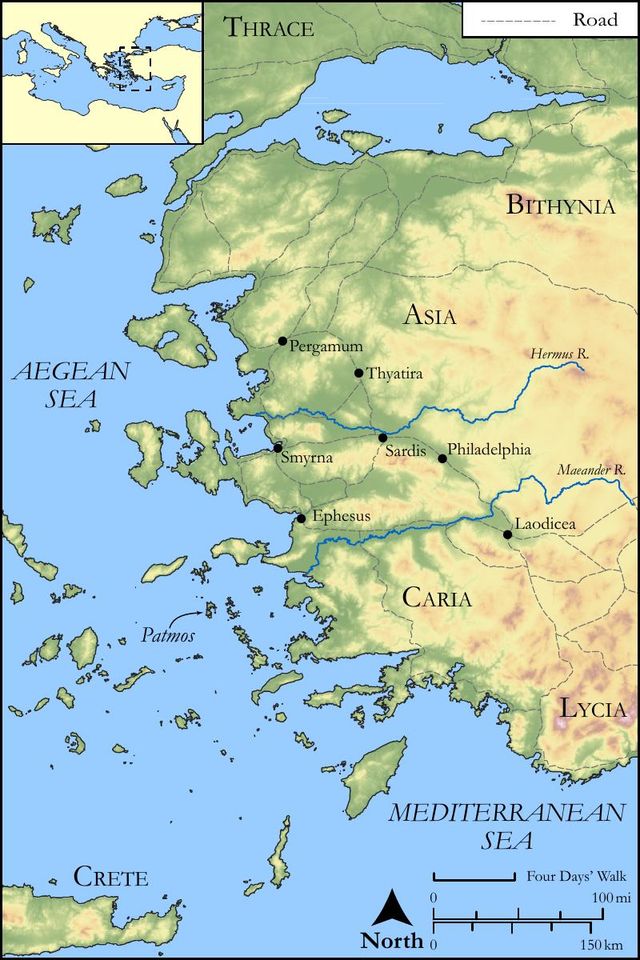
See on the biblical-era maps

Study this verse
Public-domain commentary
Matthew Henry
From his Commentary on the Whole Bible. Henry comments on passages, not single verses — this entry covers Revelation 1:3–8. His four-level outline is real structure in the source text, so it is rendered as structure.
We have here an apostolic benediction on those who should give a due regard to this divine revelation; and this benediction is given more generally and more especially.
I.More generally, to all who either read or hear the words of the prophecy.
This blessing seems to be pronounced with a design to encourage us to study this book, and not be weary of looking into it upon account of the obscurity of many things in it; it will repay the labour of the careful and attentive reader. Observe,
1.It is a blessed privilege to enjoy the oracles of God. This was one of the principal advantages the Jews had above the Gentiles.
2.It is a blessed thing to study the scriptures; those are well employed who search the scriptures.
3.It is a privilege not only to read the scriptures ourselves, but to hear them read by others, who are qualified to give us the sense of what they read and to lead us into an understanding of them.
4.It is not sufficient to our blessedness that we read and hear the scriptures, but we must keep the things that are written; we must keep them in our memories, in our minds, in our affections, and in practice, and we shall be blessed in the deed.
5.The nearer we come to the accomplishment of the scriptures, the greater regard we shall give to them. The time is at hand, and we should be so much the more attentive as we see the day approaching.
II.The apostolic benediction is pronounced more especially and particularly to the seven Asian churches, Rev 1:4.
These seven churches are named in Rev 1:11, and distinct messages sent to each of them respectively in the chapters following. The apostolic blessing is more expressly directed to these because they were nearest to him, who was now in the isle of Patmos, and perhaps he had the peculiar care of them, and superintendency over them, not excluding any of the rest of the apostles, if any of them were now living. Here observe,
1.What the blessing is which he pronounces on all the faithful in these churches: Grace and peace, holiness and comfort. Grace, that is, the good-will of God towards us and his good work in us; and peace, that is, the sweet evidence and assurance of this grace. There can be no true peace where there is not true grace; and, where grace goes before, peace will follow.
2.Whence this blessing is to come. In whose name does the apostle bless the churches? In the name of God, of the whole Trinity; for this is an act of adoration, and God only is the proper object of it; his ministers must bless the people in no name but his alone. And here,
(1.)The Father is first named: God the Father, which may be taken either essentially, for God as God, or personally, for the first person in the ever-blessed Trinity, the God and Father of our Lord Jesus Christ; and he is described as the Jehovah who is, and who was, and who is to come, eternal, unchangeable, the same to the Old Testament church which was, and to the New Testament church which is, and who will be the same to the church triumphant which is to come.
(2.)The Holy Spirit, called the seven spirits, not seven in number, nor in nature, but the infinite perfect Spirit of God, in whom there is a diversity of gifts and operations. He is before the throne; for, as God made, so he governs, all things by his Spirit.
(3.)The Lord Jesus Christ. He mentions him after the Spirit, because he intended to enlarge more upon the person of Christ, as God manifested in the flesh, whom he had seen dwelling on earth before, and now saw again in a glorious form. Observe the particular account we have here of Christ, Rev 1:5.
[1.]He is the faithful witness; he was from eternity a witness to all the counsels of God (Joh 1:18), and he was in time a faithful witness to the revealed will of God, who has now spoken to us by his Son; upon his testimony we may safely depend, for he is a faithful witness, cannot be deceived and cannot deceive us.
[2.]He is the first-begotten or first-born from the dead, or the first parent and head of the resurrection, the only one who raised himself by his own power, and who will by the same power raise up his people from their graves to everlasting honour; for he has begotten them again to a lively hope by his resurrection from the dead.
[3.]He is the prince of the kings of the earth; from him they have their authority; by him their power is limited and their wrath restrained; by him their counsels are over-ruled, and to him they are accountable. This is good news to the church, and it is good evidence of the Godhead of Christ, who is King of kings and Lord of lords.
[4.]He is the great friend of his church and people, one who has done great things for them, and this out of pure disinterested affection. He has loved them, and, in pursuance of that everlasting love, he has, First, Washed them from their sins in his own blood. Sins leave a stain upon the soul, a stain of guilt and of pollution. Nothing can fetch out this stain but the blood of Christ; and, rather than it should not be washed out, Christ was willing to shed his own blood, to purchase pardon and purity for them. Secondly, He has made them kings and priests to God and his Father. Having justified and sanctified them, he makes them kings to his Father; that is, in his Father's account, with his approbation, and for his glory. As kings, they govern their own spirits, conquer Satan, have power and prevalency with God in prayer, and shall judge the world. He hath made them priests, given them access to God, enabled them to enter into the holiest and to offer spiritual and acceptable sacrifices, and has given them an unction suitable to this character; and for these high honours and favours they are bound to ascribe to him dominion and glory for ever.
[5.]He will be the Judge of the world: Behold, he cometh, and every eye shall see him, Rev 1:7. This book, the Revelation, begins and ends with a prediction of the second coming of the Lord Jesus Christ. We should set ourselves to meditate frequently upon the second coming of Christ, and keep it in the eye of our faith and expectation. John speaks as if he saw that day: "Behold, he cometh, as sure as if you beheld him with your eyes. He cometh with clouds, which are his chariot and pavilion. He will come publicly: Every eye shall see him, the eye of his people, the eye of his enemies, every eye, yours and mine." He shall come, to the terror of those who have pierced him and have not repented and of all who have wounded and crucified him afresh by their apostasy from him, and to the astonishment of the pagan world. For he comes to take vengeance on those who know not God, as well as on those that obey not the gospel of Christ.
[6.]This account of Christ is ratified and confirmed by himself, Rev 1:8. Here our Lord Jesus justly challenges the same honour and power that is ascribed to the Father, Rev 1:4. He is the beginning and the end; all things are from him and for him; he is the Almighty; he is the same eternal and unchangeable one. And surely whoever presumes to blot out one character of this name of Christ deserves to have his name blotted out of the book of life. Those that honour him he will honour; but those who despise him shall be lightly esteemed.
Historical interpretation
Ten Centuries of Reception
15 surviving comments on this verse. Each one is dated, so this reads as a timeline rather than a list.
Select a marker to jump to its quote. Markers stagger vertically where authors wrote within a few decades of each other.
"Grace unto you, and peace, from Him which is, and which was, and which is to come." He is, because He endures continually; He was, because with the Father He made all things, and has at this time taken a beginning from the Virgin; He is to come, because assuredly He will come to judgment.
"And from the seven spirits which are before His throne." We read of a sevenfold spirit in Isaiah,1 -namely, the spirit of wisdom and of understanding, the spirit of counsel and might, of knowledge and of piety, and the spirit of the fear of the Lord.
The number seven signifies the perfection of the universal Church, for which reason the Apostle John writes to the seven churches, showing in that way that he writes to the totality of the one Church. City of God 17.4
Asia means “elevated,” by which the human race is indicated. These seven churches and the lampstands are to be seriously considered because it is the sevenfold grace which is given by God through Jesus Christ, our Lord, to us of the human race who have believed. For he himself promised to send to us the Spirit Paraclete from heaven, whom he also sent to the apostles who were seen to be in Asia, that is, in the prideful world, where he also gave the sevenfold grace to the seven churches, that is to us, through his servant John.
him that is. He wanted His eternity to be denoted by the present tense. This use of present time “today” is acknowledged to be peculiar to the divine Scriptures in this sense of perpetuity.
Here is that mystery of the number seven which is everywhere indicated. Here the seven spirits are introduced, which are one and the same Spirit, that is, the Holy Spirit, who is one in name, sevenfold in power, invisible and incorporeal, and whose form is impossible to comprehend. The great Isaiah revealed the number of its sevenfold powers when he wrote: “the Spirit of wisdom and understanding”—that through understanding and wisdom he might teach that he is the creator of all things—“the Spirit of counsel and might”—who conceived these things that he might create them—“the Spirit of knowledge and piety”—who governs the creation with piety by the exercise of his knowledge and whose purposes are always according to mercy—“the Spirit of the fear of the Lord”—by whose gift the fear of the Lord is manifested to rational creatures. This is itself the sacred character of the Spirit who is to be worshiped. It includes rather the ineffable praise, and does not indicate any form of nature.
What is the importance of the people of Asia that they alone deserve to receive the apostolic revelation? However, there is a mystery in the number and a sacrament in the name of the province. First, let us discuss the meaning of the number, because both the number six and the number seven are always used in the law with a mystical meaning: “For God made heaven and earth in six days,” and “on the seventh day he rested from his works” and “on it,” it says, “they shall enter again into my rest.” The number seven, therefore, signifies the period of the present life, so that the apostle is not merely writing to seven churches and to that world in which he was then present, but it is understood that he is giving these writings to all future ages, even to the consummation of the world. Therefore, he mentions the number in a most holy manner, and he names “Asia,” which means “elevated” or “walking,” indicating that celestial fatherland which we call the “catholic church.” For exalted by the Lord and always moving toward the things which are above, it is the church which advances by spiritual exercises and is always desirous of the things of heaven.
Although there are many churches in every place, he wrote to seven only. For through the number seven he indicates the mystery of the church which exists everywhere and that which corresponds to the present life in which there is a sevenfold period of days. And therefore he makes mention of seven angels and seven churches to which he says, “Grace to you and peace from the tri-hypostatic deity.” Through the phrase “who is” the Father is indicated, who spoke to Moses: “I am Who I am.” Through the phrase “who was” the Word is indicated, who was in the beginning with God. And through the phrase “who is to come” the Paraclete is indicated, who always visits the children of the church in holy baptism but will come more perfectly and more clearly in the age to come. It is possible to recognize in the seven spirits the seven angels who have received the governance of the churches. These are not numbered with the most divine and royal Trinity but are mentioned together with it as servants, even as the divine apostle says: “I testify to you before God and the elect angels.” These phrases may be understood also in another manner. The phrase “who is and who was and who is to come” may signify the Father, who encompasses in himself the beginning, the middle and the end of all things.
John to the seven, etc. Through these seven churches, he writes to the whole Church. For the universality is often designated by the number seven, as this whole age is revolved in seven days.
Grace to you, etc. He wishes us grace and peace from the eternal God the Father, and from the sevenfold Spirit, and from Jesus Christ, who in the assumed man bore witness to the Father. He names the Son third, of whom he was going to speak more. He names him last as well, because he is the first and the last, since he had already named him in the Father by saying, who is to come.
John to the seven churches which are in Asia. By the number seven is represented the universal Church, because of the seven gifts of him who has filled the earth. Hence Elisha made the child upon whom he lay gape seven times, [2 Kings 4:32 et seq.] because the people that died from unfaithfulness is brought back to life by the seven gifts of the Holy Spirit. So the number seven is perfect, being formed by the number three and the number four; for the number three is considered perfect in the divine Scriptures because of the mystery of the Trinity, because of the three virtues: faith, hope, and love, or because of the three classes of the faithful: preachers, celibates, and married people. As for the number four, it is perfect because of the four parts of the world, because of the four cardinal virtues (namely prudence, temperance, courage, and justice) or because of the four books of the Gospels. Therefore, because knowledge of the Trinity encompasses the four cardinal points of the sky; because hope, faith, and love complete the sum of the four cardinal virtues; or because the three classes of believers submit to the commandments of the four Gospels, it is right for the universal Church to be symbolized by this number seven. One should nonetheless know that it was especially to the seven churches of the Ephesians that he sent these mysteries he wrote in exile. So species is not excluded, but in the species a genus is shown, namely the universal Church. It is appropriate to say that the universal Church is in Asia, for Asia translates to “pride.” The word “pride” is not always used to refer to a vice, but sometimes to the summit of virtue, as in I will make thee to be the pride of worlds, [Is. 60:15] that is “I will make you despise all pleasures and low honors;” and elsewhere, He hath lifted thee up above the height of the earth. [Cf. Is. 58:14] So it is in this height of pride that the Church takes its place. Alternatively, if “pride” is being used to refer to a vice, we should not take it to mean that the Church will remain proud, but that it was raised in the arrogance of pride some time ago, but is predestined to become humble through a heavenly gift, according to this: Hast thou entered into the storehouses of the snow, or has thou beheld the treasures of the hail: Which I have prepared for the time of the enemy, against the day of battle and war? [Job 38:22-23] Grace be unto you and peace from him that is, and that was, and that is to come, and from the seven spirits which are in the sight of his throne, and from Jesus Christ. Grace means forgiveness granted freely, and it is with it shining on us when we were servants of sin that we were adopted as children of justice. It is this grace that Peter and Paul first mentioned in their salutations when they were about to write to the faithful, in order to show, before exhorting the peoples of grace, that the whole sum of the salutation was in this grace. It is proper for grace to be put before peace, because no one could have come to God's peace reconciled if the grace of mercy had not preceded them. As for the fact that he says from him that is, and that was, and that is to come, it should be taken as referring specifically to the only-begotten Son of God. He is in essence with the Father and the Holy Spirit, and has never been affected by mutability, according to this saying of Paul's: There was not in him « it is » and « it is not », but « it is » was in him [Variant of 2 Cor. 1:19], because, before he was born of the Virgin in time, he spent all times with the Father. Whence the same John says, in the beginning was the Word. [John 1:1] It is also the same who is to come to judge the living and the dead in the humanity he assumed, as it is written: He shall so come, as you have seen him going into heaven. [Acts 1:11] So, since it is certain that the Church has received this grace not only from the Son and the Holy Spirit but also from the Father through the Son and the Holy Spirit, why is the person of the Father not mentioned in this passage? Because it is habitual in the sacred Scriptures, where one or two of the persons of the Trinity are mentioned, for the whole Trinity to be understood at the same time. As for the words from the seven spirits, he says this because of the sevenfold operation of one spirit; and this spirit is said to be alone in the sight of the throne, that is of the Church, that is in the memory of the saints, because it is to this same spirit in particular that the remission of sins is ascribed, according to this: Receive ye the Holy Ghost: whose sins you shall forgive, they are forgiven them. [John 20:22-23] Or if not, then surely the whole Trinity is understood in the Spirit. In saying from Jesus Christ, he mentions the person of the Son again, because the one referred to existed before the ages, and was made man in the end of the ages. Who is the faithful witness, the first begotten of the dead, and the prince of the kings of the earth. It is obviously a way of speaking when he calls Christ specifically the faithful witness, while there are three who give testimony: the Father, the Son, and the Holy Spirit, and the three are one God. [Cf. 1 John 5:7] One may also call the Son specifically, in the role of man he assumed, a faithful witness, in that he went as far as the death of the flesh for the sake of the testimony of the truth. For while the whole Church, in the holy preachers, gives testimony concerning Christ, the ones called martyrs, that is “witnesses,” are principally those who suffered physical death for Christ. He is called first begotten because no one before him rose never to die. A different interpretation would be that all the saints are dead to the world, as it is said in for you are dead, [Col. 3:3] but he is so in a special way, because there has been no sin in him. By the kings, he means either all the saints, who know how to govern themselves well, or at any rate the preachers, who become partners with the good but raise themselves above the wicked, like Peter above Ananias, [Acts 5:1 et seq.] and Paul who brandishes his scepter, saying, What will you? shall I come to you with a rod? [1 Cor. 4:21] Because he hath loved us. How he has loved us, the pains he suffered clearly show. He did not however love us as we were, that is wicked ones, but as he made us by love itself. Whence it is added right afterwards, and washed us from our sins in his own blood; but in what way he has washed us in his own blood, the apostle indicated, saying, All we, who are baptized in Christ Jesus, are baptized in his death. [Rom. 6:3]
QUESTION: What does it mean that John salutes only seven churches whereas the Master of truth says, Go ye into the whole world, and preach to every creature? [Mark 16:15] ANSWER: Through these seven churches, he writes to the whole Church. Indeed totality is often represented by the number seven, because all this worldly time flies by in cycles of seven days. THERE FOLLOWS: Grace be unto you and peace from him that is, and that was, and that is to come, and from the seven spirits. ANSWER: He wishes the pious people grace and peace from God the eternal Father, the sevenfold Spirit, and Jesus Christ, who gave testimony to the Father in the human form he assumed. He names the Son in the third place as he is going to say more about him. He also names him last because he is the first and the last, and he has already named him together with the Father when he said that is to come. The first begotten of the dead, and the prince of the kings of the earth.
This is equivalent to saying, "Grace to you from God, the Father of all of you." For the Father names Himself, revealing Himself to the wisest Moses at the burning bush, saying, "I AM THE ONE WHO IS [ἐγώ εἰμι ὁ ὤν]." (Ex. 3:14) And indeed, concerning the Son, the divine evangelist present says, "In the beginning was the Word; and the Word was with God, and the Word was God." (Jn. 1:1) And again, in the first of the Catholic Epistles: "That which was from the beginning, which we have heard, which we have seen with our eyes, which we have looked upon, and our hands have handled, concerning the Word of life." (1 Jn. 1:1)
"who is to come." This is the Holy Spirit. For the Spirit did not only come on the day of Pentecost, as recorded in the Acts (chapter 2), but He continually comes to receive souls worthy of Him.
The seven spirits are seven angels; not as equals or coeternal, associated with the Holy Trinity, but as genuine ministers and faithful servants. For the prophet says to God, "For all things are your servants." (Ps. 118:91) And among all, the angels are included. And again, he says concerning them: Bless the Lord, all his powers, his ministers doing his will. (Ps. 102:21) In this form, the apostle also corresponded with Timothy by writing the first Epistle; "I seriously charge you," Paul says, "before God and Jesus Christ and the elect angels." (1 Tim. 5:21)
But also in what is said "before His throne," He attested to them a domestic [οἰκετικὴν] and liturgical [λειτουργικὴν] order; however, not equality in rank.
before his throne. Now the seven spirits indicate the activity of the life-giving Spirit which directed Christ, God who was made man for us.
This “7” is understood as the Church established in the world. St. Gregory says in Homily 25, “Because in 7 days all time is comprehended; the number 7 is a proper figure for the whole. Grace unto you In the present life. And peace in the future, for there the humanity will be completely tamed. From Him who is That is, from the eternal God. According to Boethius in the Consolation of Philosophy, “Eternity is endless life possessed all at once in its totality and its perfection. Nevertheless, his simplicity is not apprehended by us except by a comparison to time; for we understand in terms of succession and time. For he assists at every time, even infinitely as it were; therefore, this is expressed to us through the distinctions of present, past, and future time. And from the 7 spirits That is, from all the angels who are ministers of our salvation. Who are before His throne, Prepared to follow His will.
Continue studying Revelation 1:4 across the web’s major study libraries — every link below opens this exact verse, chapter, or book on the destination site.
Read & Compare
 BibleGatewayThis verse in more than 200 translations and 70 languages.
 Bible.comThe YouVersion reader — hundreds of translations, reading plans, and highlights.
 ESV.orgCrossway's official English Standard Version reader.
 NET BibleThe NET translation with 60,000+ translators' notes on every rendering decision.
 STEP BibleTyndale House's free study tool — original text, vocabulary, and scholarly resources.
 BibliaLogos Bible Software's free web reader.
 USCCBThe New American Bible (Revised Edition) with the U.S. bishops' study notes.
Commentaries
 BibleHub CommentariesDozens of classic commentaries on this verse, gathered on one page.
 StudyLightMore than 100 commentary sets — the largest collection on the web.
 BibleRefPlain-English commentary on what this verse means, verse by verse.
 Enduring WordDavid Guzik's free commentary on this chapter, widely used by Bible teachers.
 Bible Study ToolsVerse commentary alongside Greek and Hebrew study aids.
Original Language & Research
- BibleHub InterlinearThe verse word by word — original language, transliteration, and English.
- BibleHub LexiconEvery word's original-language definition and Strong's entry.
 Blue Letter BibleDeep-study tools — Strong's numbers, concordance, and word studies.
 CNTR CollationThe earliest Greek manuscripts of this verse, collated letter by letter.
Sermons, Hymns & Audio


TrulyRandomVerse is not affiliated with these sites and doesn’t control their content. They’re linked because they’re genuinely useful.
Summary
Revelation 1:4 serves as the formal salutation of John's apocalyptic letter, addressed to seven specific Christian congregations located in the Roman province of Asia. This opening immediately establishes the divine origin of the message, conveying a profound blessing of "grace and peace" to the churches. The source of these blessings is revealed as God the Father, described by His eternal and sovereign nature ("him which is, and which was, and which is to come"), and the Holy Spirit, symbolically represented as "the seven Spirits which are before his throne," signifying His perfect and complete presence.
Context
ShowHideLiterary Context
Revelation 1:4 initiates the epistolary framework of the Book of Revelation, following the introductory verses that declare the revelation's divine source and purpose (Revelation 1:1-3). It functions as a formal address, similar to ancient letters, but imbued with rich theological meaning. This salutation sets the stage for the specific messages to the seven churches in chapters 2 and 3, and the broader apocalyptic visions that follow. The mention of "him which is, and which was, and which is to come" is immediately echoed in Revelation 1:8, reinforcing God's eternality, while the "seven Spirits" reappear in the throne room vision of Revelation 4:5 and in connection with the Lamb in Revelation 5:6, underscoring the Holy Spirit's pervasive role.
Historical & Cultural Context
The letter is addressed to seven actual churches in the Roman province of Asia (modern-day western Turkey): Ephesus, Smyrna, Pergamum, Thyatira, Sardis, Philadelphia, and Laodicea. These cities were significant centers of Roman administration, commerce, and pagan worship, including the imperial cult. John, the author, was likely exiled to the island of Patmos (Revelation 1:9) due to his testimony for Christ, indicating a period of Roman persecution or intense pressure on Christians to conform. The greeting "grace and peace" was a common Christian salutation, combining the Greek "charis" (grace) with the Hebrew "shalom" (peace), but here it is elevated by identifying its divine, triune source, providing profound comfort and assurance to believers facing external hostility and internal spiritual challenges.
Key Themes
ShowHideThis verse introduces several foundational themes that permeate Revelation. Firstly, it highlights the Divine Authority and Sovereignty of the message, emphasizing that the blessings and subsequent revelations come directly from God. Secondly, the phrase "him which is, and which was, and which is to come" powerfully declares God's Eternality and Immutability, a bedrock truth offering stability amidst the chaotic visions to follow. This title echoes the divine self-revelation in Exodus 3:14 and establishes God's absolute control over all time. Thirdly, the mention of "the seven Spirits" underscores the Active Presence and Perfection of the Holy Spirit, who empowers and guides the churches, and whose multifaceted ministry is crucial for understanding and enduring the prophetic events. Finally, the verse implicitly points to the Triune Nature of God, with the Father and Spirit explicitly mentioned here, and Jesus Christ introduced immediately in Revelation 1:5, setting the stage for a comprehensive understanding of God's redemptive plan.
Exposition and Analysis
ShowHideKey Word Analysis
ShowHideFrom a root meaning "to rejoice," this term signifies graciousness, unmerited favor, or divine influence upon the heart, and its reflection in the life. In this context, it speaks of God's undeserved kindness and benevolence bestowed upon the churches, essential for their spiritual sustenance and endurance.
Derived from a verb meaning "to join," this word denotes a state of wholeness, well-being, and harmony, rather than merely the absence of conflict. It encompasses spiritual tranquility, reconciliation with God, and prosperity in the fullest sense, a divine gift that transcends earthly circumstances.
Meaning "breath," "wind," or "spirit," this term refers to the Holy Spirit. In the context of "the seven Spirits," it symbolizes the Holy Spirit's complete, perfect, and multifaceted nature, actively present before God's throne and ministering to the churches.
Verse Breakdown
ShowHide"John to the seven churches which are in Asia"
This clause identifies the human author, John, and the immediate recipients of the letter: seven literal Christian congregations located in the Roman province of Asia. This direct address grounds the apocalyptic visions in the real-world experiences of specific communities.
"Grace [be] unto you, and peace"
This is a standard Christian epistolary greeting, combining the Greek salutation of "grace" (God's unmerited favor) with the Hebrew greeting of "peace" (shalom, denoting wholeness and well-being). It is a divine blessing, not merely a human wish, essential for the spiritual health of the churches.
"from him which is, and which was, and which is to come"
This profound phrase describes God the Father, emphasizing His eternal, self-existent nature and His sovereignty over all time—past, present, and future. It is a powerful circumlocution for the divine name YHWH ("I AM"), asserting God's unchanging presence and ultimate authority.
"and from the seven Spirits which are before his throne"
This refers to the Holy Spirit. The number "seven" symbolizes perfection and completeness, indicating the Holy Spirit's full and perfect ministry. His position "before his throne" signifies His perfect knowledge, active presence, and readiness to execute God's will, empowering and guiding the churches.
Literary Devices
ShowHideRevelation 1:4 employs several significant Literary Devices. The most prominent is the Epistolary Opening, which frames the entire book as a letter, making the profound prophetic visions accessible and personally relevant to its original audience. The phrase "him which is, and which was, and which is to come" functions as a powerful Circumlocution for God's eternal name, echoing the divine self-revelation to Moses in Exodus. This device emphasizes God's timeless sovereignty without directly using the sacred Tetragrammaton. Furthermore, the "seven Spirits" utilizes Symbolism and Numerology, where the number seven signifies completeness and perfection, representing the Holy Spirit in the fullness of His being and ministry. This symbolic language prepares the reader for the rich tapestry of imagery that defines the rest of the book.
Theological and Thematic Connections
ShowHideRevelation 1:4 profoundly establishes the triune God as the ultimate source of all spiritual blessings, particularly grace and peace, which are foundational for believers navigating a fallen world. The description of God the Father as "him which is, and which was, and which is to come" asserts His absolute eternality, immutability, and sovereign control over all history. This declaration provides immense theological stability, assuring believers that despite earthly turmoil and persecution, God remains steadfast and actively present. The inclusion of "the seven Spirits" highlights the Holy Spirit's perfect and complete ministry, emphasizing His active role in empowering, guiding, and comforting the church, a crucial truth for the churches facing severe challenges. This verse thus lays the groundwork for understanding the divine authority behind the entire Revelation and the unwavering support available to God's people.
Reflection and Application
ShowHideRevelation 1:4 offers timeless truths that resonate deeply with believers today, providing a powerful anchor in a world often characterized by uncertainty and strife. The opening blessing of "grace and peace" reminds us that our spiritual well-being is not dependent on our circumstances or efforts, but flows directly from the unmerited favor and reconciling power of God. In a rapidly changing world, the declaration of God as "him which is, and which was, and which is to come" provides an unshakeable foundation for our faith. It assures us that our God is consistent, eternally present, and sovereign over every moment of history—past, present, and future. This truth invites us to rest in His unchanging character, knowing that His purposes will prevail. Furthermore, the mention of "the seven Spirits" underscores the active and perfect ministry of the Holy Spirit in our lives. He is not a distant force but an ever-present Helper, Counselor, and Empowerer, perfectly attuned to God's will and perfectly equipped to guide us through life's complexities and challenges. This verse encourages us to continually draw upon the divine resources of grace, peace, and the Spirit's power as we navigate our spiritual journeys and face the realities of our world.
Questions for Reflection
ShowHideFAQ
ShowHideWho are the "seven churches which are in Asia"?
ShowHideThe "seven churches which are in Asia" refer to seven literal Christian congregations located in the Roman province of Asia Minor (modern-day western Turkey). These churches were Ephesus, Smyrna, Pergamum, Thyatira, Sardis, Philadelphia, and Laodicea. Each church receives a specific message from Christ in Revelation chapters 2 and 3, addressing their unique spiritual conditions, challenges, and triumphs.
What is the meaning of "him which is, and which was, and which is to come"?
ShowHideThis profound phrase is a divine title for God the Father, emphasizing His eternal, unchanging nature and His absolute sovereignty over all time—past, present, and future. It is a powerful circumlocution that echoes the divine name YHWH ("I AM WHO I AM") revealed to Moses in Exodus 3:14. This title underscores God's self-existence, His timelessness, and His active presence throughout all of history, providing a foundational truth for the entire book of Revelation.
Who are the "seven Spirits which are before his throne"?
ShowHideThe "seven Spirits which are before his throne" are widely interpreted as a symbolic representation of the Holy Spirit in His fullness, perfection, and multifaceted ministry. The number seven in biblical numerology often signifies completeness or perfection. This imagery reappears in the throne room vision of Revelation 4:5 and in connection with the Lamb in Revelation 5:6, underscoring the Holy Spirit's perfect knowledge, active presence before God, and His comprehensive work in empowering and guiding the churches.
Christ-Centered Fulfillment
ShowHideWhile Revelation 1:4 primarily introduces God the Father and the Holy Spirit as sources of grace and peace, its Christ-centered fulfillment becomes immediately apparent in the subsequent verses and throughout the entire book. The very next verse, Revelation 1:5, explicitly names Jesus Christ as the third divine source of these blessings, completing the implicit Trinitarian salutation. The title "him which is, and which was, and which is to come," though applied to the Father here, is also ascribed to Jesus Christ in Revelation 1:8 and Revelation 22:13, affirming His co-eternality and shared sovereignty with the Father. Jesus, as the incarnate Word, is the ultimate embodiment of God's grace (John 1:14) and the bringer of true peace (John 14:27). Through His atoning sacrifice and victorious resurrection, He secured the very grace and peace that are now poured out upon His church. Furthermore, the "seven Spirits" are explicitly linked to Christ as "the seven Spirits of God sent forth into all the earth" in Revelation 5:6, indicating that the Holy Spirit's perfect ministry flows from and is directed by the exalted Christ. Thus, the divine blessings of grace and peace in Revelation 1:4 are not merely abstract concepts but are concretely mediated and fulfilled in the person and work of Jesus Christ, who is the Alpha and the Omega, the beginning and the end, the one who was, and is, and is to come.