


Revelation 1:8
Bible text: King James Version (1769 Blayney text) · Public domain
Bible text: King James Version with Strong's numbers · Public domain
Bible text: Berean Standard Bible · Public domain
Bible text: American Standard Version (1901) · Public domain
Bible text: World English Bible, Messianic edition · Public domain
Bible text: Geneva Bible (1599) · Public domain
Bible text: Young's Literal Translation · Public domain
- ἘγώEgōI myselfG1473P-1NSPersonal pronoun Nominative 1st Singular
- εἰμιeimiamG1510V-PAI-1SVerb Present Active Indicative 1st Singular
- τὸtotheG3588T-NSNDefinite article Nominative Singular Neuter
- ἄλφαalphaAlphaG1N-NSN-LINoun Nominative Singular Neuter Indeclinable Letter
- καὶkaiandG2532CONJConjunction
- τὸtotheG3588T-NSNDefinite article Nominative Singular Neuter
- ὦōOmegaG5598N-NSN-LINoun Nominative Singular Neuter Indeclinable Letter
- ἀρχὴarchēbeginningG746N-NSFNoun Nominative Singular Feminine
- καὶkaiandG2532CONJConjunction
- τέλοςtelosendG5056N-NSNNoun Nominative Singular Neuter
- λέγειlegeisaysG3004V-PAI-3SVerb Present Active Indicative 3rd Singular
- ὁhotheG3588T-NSMDefinite article Nominative Singular Masculine
- κύριοςkuriosLordG2962N-NSM-TNoun Nominative Singular Masculine Title
- ὁhowhoG3588T-NSMDefinite article Nominative Singular Masculine
- ὢνōnis beingG1510V-PAP-NSMVerb Present Active Participle Nominative Singular Masculine
- καὶkaiandG2532CONJConjunction
- ὁhowhoG3588T-NSMDefinite article Nominative Singular Masculine
- ἦνēnwasG1510V-IAI-3SVerb Imperfect Active Indicative 3rd Singular
- καὶkaiandG2532CONJConjunction
- ὁhowhoG3588T-NSMDefinite article Nominative Singular Masculine
- ἐρχόμενοςerchomenosis comingG2064V-PNP-NSMVerb Present Middle Or Passive Deponent Participle Nominative Singular Masculine
- ὁhotheG3588T-NSMDefinite article Nominative Singular Masculine
- παντοκράτωρpantokratōrAlmightyG3841N-NSM-TNoun Nominative Singular Masculine Title
English is a literal word-by-word gloss of the Greek, not the KJV's wording. Why?
This is the original text the KJV's translators worked from — each Greek word with its own literal English meaning in this verse, prepared by scholars at Tyndale House, Cambridge. The KJV translates whole sentences, not word by word, so its wording differs: one Greek word can become several English words, and the KJV may choose “charity” where the gloss reads “love”. Both are faithful — they answer different questions. For the KJV's own rendering, switch to the KJV text.
Details
See on the biblical-era maps

Study this verse
Public-domain commentary
Matthew Henry
From his Commentary on the Whole Bible. Henry comments on passages, not single verses — this entry covers Revelation 1:3–8. His four-level outline is real structure in the source text, so it is rendered as structure.
We have here an apostolic benediction on those who should give a due regard to this divine revelation; and this benediction is given more generally and more especially.
I.More generally, to all who either read or hear the words of the prophecy.
This blessing seems to be pronounced with a design to encourage us to study this book, and not be weary of looking into it upon account of the obscurity of many things in it; it will repay the labour of the careful and attentive reader. Observe,
1.It is a blessed privilege to enjoy the oracles of God. This was one of the principal advantages the Jews had above the Gentiles.
2.It is a blessed thing to study the scriptures; those are well employed who search the scriptures.
3.It is a privilege not only to read the scriptures ourselves, but to hear them read by others, who are qualified to give us the sense of what they read and to lead us into an understanding of them.
4.It is not sufficient to our blessedness that we read and hear the scriptures, but we must keep the things that are written; we must keep them in our memories, in our minds, in our affections, and in practice, and we shall be blessed in the deed.
5.The nearer we come to the accomplishment of the scriptures, the greater regard we shall give to them. The time is at hand, and we should be so much the more attentive as we see the day approaching.
II.The apostolic benediction is pronounced more especially and particularly to the seven Asian churches, Rev 1:4.
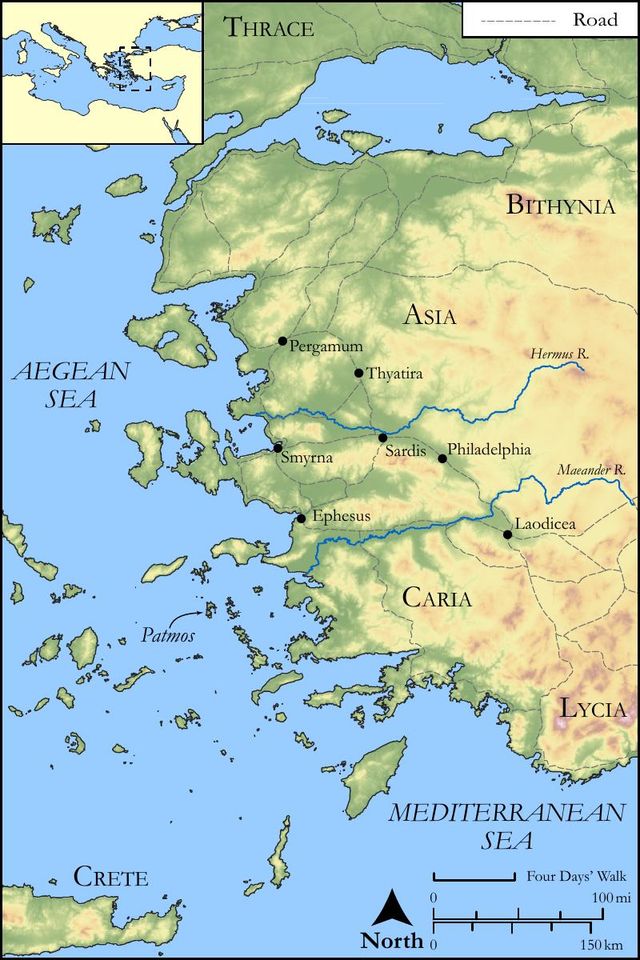
These seven churches are named in Rev 1:11, and distinct messages sent to each of them respectively in the chapters following. The apostolic blessing is more expressly directed to these because they were nearest to him, who was now in the isle of Patmos, and perhaps he had the peculiar care of them, and superintendency over them, not excluding any of the rest of the apostles, if any of them were now living. Here observe,
1.What the blessing is which he pronounces on all the faithful in these churches: Grace and peace, holiness and comfort. Grace, that is, the good-will of God towards us and his good work in us; and peace, that is, the sweet evidence and assurance of this grace. There can be no true peace where there is not true grace; and, where grace goes before, peace will follow.
2.Whence this blessing is to come. In whose name does the apostle bless the churches? In the name of God, of the whole Trinity; for this is an act of adoration, and God only is the proper object of it; his ministers must bless the people in no name but his alone. And here,
(1.)The Father is first named: God the Father, which may be taken either essentially, for God as God, or personally, for the first person in the ever-blessed Trinity, the God and Father of our Lord Jesus Christ; and he is described as the Jehovah who is, and who was, and who is to come, eternal, unchangeable, the same to the Old Testament church which was, and to the New Testament church which is, and who will be the same to the church triumphant which is to come.
(2.)The Holy Spirit, called the seven spirits, not seven in number, nor in nature, but the infinite perfect Spirit of God, in whom there is a diversity of gifts and operations. He is before the throne; for, as God made, so he governs, all things by his Spirit.
(3.)The Lord Jesus Christ. He mentions him after the Spirit, because he intended to enlarge more upon the person of Christ, as God manifested in the flesh, whom he had seen dwelling on earth before, and now saw again in a glorious form. Observe the particular account we have here of Christ, Rev 1:5.
[1.]He is the faithful witness; he was from eternity a witness to all the counsels of God (Joh 1:18), and he was in time a faithful witness to the revealed will of God, who has now spoken to us by his Son; upon his testimony we may safely depend, for he is a faithful witness, cannot be deceived and cannot deceive us.
[2.]He is the first-begotten or first-born from the dead, or the first parent and head of the resurrection, the only one who raised himself by his own power, and who will by the same power raise up his people from their graves to everlasting honour; for he has begotten them again to a lively hope by his resurrection from the dead.
[3.]He is the prince of the kings of the earth; from him they have their authority; by him their power is limited and their wrath restrained; by him their counsels are over-ruled, and to him they are accountable. This is good news to the church, and it is good evidence of the Godhead of Christ, who is King of kings and Lord of lords.
[4.]He is the great friend of his church and people, one who has done great things for them, and this out of pure disinterested affection. He has loved them, and, in pursuance of that everlasting love, he has, First, Washed them from their sins in his own blood. Sins leave a stain upon the soul, a stain of guilt and of pollution. Nothing can fetch out this stain but the blood of Christ; and, rather than it should not be washed out, Christ was willing to shed his own blood, to purchase pardon and purity for them. Secondly, He has made them kings and priests to God and his Father. Having justified and sanctified them, he makes them kings to his Father; that is, in his Father's account, with his approbation, and for his glory. As kings, they govern their own spirits, conquer Satan, have power and prevalency with God in prayer, and shall judge the world. He hath made them priests, given them access to God, enabled them to enter into the holiest and to offer spiritual and acceptable sacrifices, and has given them an unction suitable to this character; and for these high honours and favours they are bound to ascribe to him dominion and glory for ever.
[5.]He will be the Judge of the world: Behold, he cometh, and every eye shall see him, Rev 1:7. This book, the Revelation, begins and ends with a prediction of the second coming of the Lord Jesus Christ. We should set ourselves to meditate frequently upon the second coming of Christ, and keep it in the eye of our faith and expectation. John speaks as if he saw that day: "Behold, he cometh, as sure as if you beheld him with your eyes. He cometh with clouds, which are his chariot and pavilion. He will come publicly: Every eye shall see him, the eye of his people, the eye of his enemies, every eye, yours and mine." He shall come, to the terror of those who have pierced him and have not repented and of all who have wounded and crucified him afresh by their apostasy from him, and to the astonishment of the pagan world. For he comes to take vengeance on those who know not God, as well as on those that obey not the gospel of Christ.
[6.]This account of Christ is ratified and confirmed by himself, Rev 1:8. Here our Lord Jesus justly challenges the same honour and power that is ascribed to the Father, Rev 1:4. He is the beginning and the end; all things are from him and for him; he is the Almighty; he is the same eternal and unchangeable one. And surely whoever presumes to blot out one character of this name of Christ deserves to have his name blotted out of the book of life. Those that honour him he will honour; but those who despise him shall be lightly esteemed.
Historical interpretation
Eight Centuries of Reception
10 surviving comments on this verse. Each one is dated, so this reads as a timeline rather than a list.
Select a marker to jump to its quote. Markers stagger vertically where authors wrote within a few decades of each other.
Rightly, therefore, the Lord again promises milk to the righteous, that the Word may be clearly shown to be both, "the Alpha and Omega, beginning and end; "
Meanwhile, let this be my immediate answer to the argument which they adduce from the Revelation of John: "I am the Lord which is, and which was, and which is to come, the Almighty; " and from all other passages which in their opinion make the designation of Almighty God unsuitable to the Son.
In the same way the Lord applied to himself two Greek letters, the first and the last, as figures of the beginning and the end which are united in himself. For just as Alpha continues on until it reaches Omega and Omega completes the cycle back again to Alpha, so he meant to show us that in him is found the course of all things from the beginning to the end and from the end back to the beginning. Every divine dispensation should end in him through whom it first began, that is, in the Word made flesh. Accordingly, it should also end in the same way in which it first began. So truly in Christ are all things recalled to their beginning. So the faith has turned away from circumcision back to the integrity of the flesh, as it was in the beginning. So, too, there is liberty now to eat any kind of food, with abstention from blood alone, as it was in the beginning. There is a unity of marriage, as it was in the beginning. There is a prohibition of divorce, which was not in the beginning. Finally, the whole man is called once more to paradise, where he was in the beginning.
The Godhead of the Son is the Father’s. It is indivisible. Thus there is one God and none other but he. So, since they are one, and the Godhead itself one, the same things are said of the Son, which are said of the Father, except his being said to be Father. For instance, it is said that he is God: “And the Word was God.” It is said that he is Almighty, “Thus says he who was and is and is to come, the Almighty.” It is said that he is Lord, “one Lord Jesus Christ.” It is said that he is Light, “I am the Light,” that he wipes out sins, “that you may know,” he says, “that the Son of man has power upon earth to forgive sins,” and so with other attributes. For “all things,” says the Son himself, “whatsoever the Father has, are mine”; and again, “And mine are yours.”
The martyrdom of the blessed apostles has consecrated this day for us. It was by despising the world that they earned this renown throughout the whole world. Peter was the first of the apostles and Paul the last of the apostles. The first and the last were brought to one and the same day for martyrdom by the First and the Last, by Christ. In order to grasp what I’ve said, turn your minds to the Alpha and the Omega. The Lord himself said plainly in the Apocalypse, “I am the Alpha and the Omega, the first”—before whom is nobody—“the last”—after whom is nobody; he precedes all things and sets a term to all things. Do you want to gaze upon him as the first? “All things were made through him.” Do you seek him as the last? “For Christ is the end of the law, that every one who has faith may be justified.” In order for you to live at some time or other, you had him as your creator. In order for you to live always, you have him as your redeemer.
Concerning which it is rightly added: "You shall consume the head with the feet and the entrails," because our Redeemer is the Alpha and Omega, that is, God before the ages and man at the end of the ages. And as we have already said, brothers, we have learned from Paul's testimony that God is the head of Christ. Therefore, to consume the head of the lamb is to receive His divinity by faith. To consume the feet of the lamb is to seek out the footsteps of His humanity by loving and imitating.
I am Alpha and Omega, the beginning and the end, etc. The beginning, whom none precedes; the end, to whom none succeeds in the kingdom.
Who is, and who was, etc. He said the same of the Father. For God the Father also came and is to come in the Son.
I am Alpha and Omega, the beginning and the end, saith the Lord God, who is, and who was, and who is to come. By saying I am, he lets us know clearly that God was speaking through him. Whence the Apostle: Do you seek a proof of Christ that speaketh in me? [2 Cor. 13:3], and David: Attend, O my people, to my law, [Ps. 77:1] while neither the people nor the law was David's. Alpha and Omega means the same as the beginning and the end, for alpha for the Greeks is the beginning of the alphabet, and omega its end. Christ is called the beginning because all the creation has got its beginning from him, and he is called the end because he encloses everything like a boundary. Alternatively, he is called the beginning and the end because he is God before the ages and a man in the end of the ages; whence John: In the beginning was the Word, [John 1:1] as well as: The Word was made flesh. [Ibid. 14]
"The alpha" [α] signifies the beginning, "and the omega" [ω] signifies the end; therefore, basically He is saying, "I am the first and the last," indicating through the "first" the God "who is" without beginning, and through the "last," the one "who is" without end. Since there is nothing among humans that is without a beginning and without end, In our case here, He used "the beginning and the end" instead of "being without beginning and without end." This is also what God said through Isaiah: "I am the first God; and I am He who is to come." (Isa. 41:4)
He calls God "the Almighty and Lord of creation," not only of the perceptible but also of the intelligible.
Continue studying Revelation 1:8 across the web’s major study libraries — every link below opens this exact verse, chapter, or book on the destination site.
Read & Compare
 BibleGatewayThis verse in more than 200 translations and 70 languages.
 Bible.comThe YouVersion reader — hundreds of translations, reading plans, and highlights.
 ESV.orgCrossway's official English Standard Version reader.
 NET BibleThe NET translation with 60,000+ translators' notes on every rendering decision.
 STEP BibleTyndale House's free study tool — original text, vocabulary, and scholarly resources.
 BibliaLogos Bible Software's free web reader.
 USCCBThe New American Bible (Revised Edition) with the U.S. bishops' study notes.
Commentaries
 BibleHub CommentariesDozens of classic commentaries on this verse, gathered on one page.
 StudyLightMore than 100 commentary sets — the largest collection on the web.
 BibleRefPlain-English commentary on what this verse means, verse by verse.
 Enduring WordDavid Guzik's free commentary on this chapter, widely used by Bible teachers.
 Bible Study ToolsVerse commentary alongside Greek and Hebrew study aids.
Original Language & Research
- BibleHub InterlinearThe verse word by word — original language, transliteration, and English.
- BibleHub LexiconEvery word's original-language definition and Strong's entry.
 Blue Letter BibleDeep-study tools — Strong's numbers, concordance, and word studies.
 CNTR CollationThe earliest Greek manuscripts of this verse, collated letter by letter.
Sermons, Hymns & Audio


TrulyRandomVerse is not affiliated with these sites and doesn’t control their content. They’re linked because they’re genuinely useful.
Summary
Revelation 1:8 presents a profound self-declaration from God, establishing His eternal nature, absolute sovereignty, and omnipotent authority over all creation, history, and destiny. This foundational statement assures readers that the divine power behind the unfolding prophecies in the book of Revelation is the ultimate source and sustainer of all things, providing an anchor of unwavering truth amidst the dramatic visions to follow.
Context
ShowHideLiterary Context
This verse appears early in the book of Revelation, following John's initial salutation to the seven churches in Asia Minor and a glorious doxology praising Jesus Christ. In Revelation 1:7, John describes the dramatic return of Christ, setting a tone of anticipation and divine intervention. Immediately after this, the voice of God Himself breaks through in Revelation 1:8, confirming His own eternal nature and supreme power. This declaration serves as a divine imprimatur, authenticating the entire prophetic message that John is about to receive and emphasizing the unshakeable character of the Almighty God who stands behind it. It mirrors the divine title introduced in Revelation 1:4, reinforcing God's timeless existence.
Historical & Cultural Context
The Apostle John received this revelation while exiled on the island of Patmos, likely during the reign of the Roman Emperor Domitian (c. AD 81-96). This period was marked by increasing persecution of Christians who refused to participate in emperor worship, leading to immense suffering and martyrdom. The cultural backdrop was one where the Roman Empire asserted its dominion and demanded ultimate loyalty. In this environment, a declaration of God's absolute sovereignty and eternal power served as a vital message of hope, resilience, and reassurance to a beleaguered church. It reminded them that despite the seemingly overwhelming power of Rome, there was a higher, truly "Almighty" authority who held the ultimate control over all events and would bring about justice and triumph.
Key Themes
ShowHideRevelation 1:8 powerfully contributes to several overarching themes within the book of Revelation and biblical theology. Firstly, it underscores God's absolute sovereignty and timelessness, portraying Him as the beginning and end of all existence, echoing the divine self-revelation in Exodus 3:14. Secondly, it establishes divine authority and omnipotence, assuring believers that the God who speaks is fully capable of executing His will, regardless of earthly opposition. This theme is crucial for understanding the prophetic judgments and ultimate victory described throughout the book. Lastly, this verse provides a profound assurance for believers facing tribulation, reminding them that their God is unchangeable, all-powerful, and ultimately victorious, a truth that grounds their faith and perseverance in the face of persecution, as seen in the steadfastness encouraged in Revelation 2:10.
Exposition and Analysis
ShowHideKey Word Analysis
ShowHideAs the first letter of the Greek alphabet, "Alpha" (G1) symbolically represents the beginning, the origin, and the firstness of God. Its use here signifies God as the primordial source from whom all things originate, emphasizing His eternal pre-existence and His role as the uncreated Creator.
As the last letter of the Greek alphabet, "Omega" (G5598) symbolizes the conclusion, the ultimate end, and the finality. Paired with Alpha, it declares God as the one who brings all things to their appointed consummation, holding the ultimate destiny of creation in His hands. Together, "Alpha and Omega" encapsulate God's comprehensive control over all time and existence, from creation to consummation.
The Greek word pantokrátōr (G3841) literally translates to "all-ruling" or "all-powerful." This title emphatically declares God's absolute dominion and omnipotence over all creation, history, and destiny. It signifies that God is the absolute and universal sovereign, possessing unlimited power and authority to accomplish His will and overcome any opposition. This term is used frequently in Revelation to underscore God's ultimate power in the face of earthly kingdoms and spiritual forces.
Verse Breakdown
ShowHide"I am Alpha and Omega,"
This opening declaration immediately establishes the speaker's identity as the ultimate, eternal being. By using the first and last letters of the Greek alphabet, the speaker claims comprehensive control over all existence, from its inception to its conclusion. This is a statement of divine totality and timelessness.
"the beginning and the ending,"
This phrase serves as a clarifying apposition to "Alpha and Omega," reiterating and reinforcing the concept of absolute sovereignty over all time. It emphasizes that the speaker is the origin point of all things and the ultimate destination or consummation of all things, ensuring that nothing exists outside of His purview or purpose.
"saith the Lord,"
This identifies the speaker as kýrios (G2962), the supreme Master and sovereign authority. This title, often used for God in the Old Testament (YHWH), confirms the divine identity of the one making this profound self-declaration, lending ultimate weight and authority to the preceding and following statements.
"which is, and which was, and which is to come,"
This profound and unique divine title, ho ōn kai ho ēn kai ho erchómenos (G3801), emphasizes God's eternal, active presence through all epochs of time—past, present, and future. It echoes the divine name YHWH ("I AM WHO I AM") revealed to Moses in Exodus 3:14, signifying God's self-existence, timelessness, and unchanging nature. He is not merely a static being but actively present and sovereign in every moment of history.
"the Almighty."
This final descriptor, pantokrátōr (G3841), solidifies the speaker's absolute power and authority. It declares Him as the "all-ruling" one, possessing unlimited strength and dominion over all creation. This title provides ultimate assurance of God's capacity to bring His plans to fruition and to overcome any opposition, reinforcing His unchallengeable sovereignty.
Literary Devices
ShowHideRevelation 1:8 is rich with Symbolism, primarily through the use of "Alpha and Omega," the first and last letters of the Greek alphabet. These letters symbolize God's absolute totality, comprehensiveness, and eternal nature, indicating that He is the source and the conclusion of all things, encompassing everything. The verse also employs Divine Titles as a rhetorical device, accumulating epithets ("Alpha and Omega," "beginning and ending," "Lord," "which is, and which was, and which is to come," "the Almighty") to construct a robust and multifaceted portrait of God's character and authority. This accumulation creates a powerful sense of awe and unchallengeable majesty. Furthermore, there is an element of Parallelism in the pairing of "Alpha and Omega" with "the beginning and the ending," where the second phrase clarifies and reinforces the meaning of the first, adding emphasis through repetition of a similar concept. The tripartite phrase "which is, and which was, and which is to come" also demonstrates Triadic Structure, a common biblical pattern used to convey completeness and divine perfection, here emphasizing God's eternal presence across all dimensions of time.
Theological and Thematic Connections
ShowHideRevelation 1:8 serves as a theological bedrock for the entire book, affirming God's absolute sovereignty and eternal nature as the foundation for understanding His unfolding plan for humanity and creation. This declaration of divine self-existence and omnipotence provides the ultimate guarantee that the prophetic visions, no matter how daunting, are under the control of a God who is both the origin and the culmination of all things. It underscores the biblical truth that God is immutable, faithful, and ultimately victorious, offering profound comfort and assurance to those facing tribulation and uncertainty. The titles used here resonate deeply with Old Testament portrayals of Yahweh's unique and incomparable nature, asserting that the God of Israel is indeed the supreme ruler over all.
Reflection and Application
ShowHideIn a world characterized by constant change, uncertainty, and the rise and fall of human powers, Revelation 1:8 offers an unshakeable anchor for the soul. This profound self-declaration of God reminds us that our ultimate trust and hope must be placed not in fleeting human institutions or our own limited strength, but in the One who is the Alpha and Omega, the beginning and the ending, the eternal and Almighty Lord. This truth calls us to a posture of humility and worship, recognizing His supreme authority over every aspect of our lives and the grand sweep of history. It encourages perseverance in faith, knowing that the God who declares Himself to be "Almighty" is fully capable of sustaining us through trials, fulfilling His promises, and bringing all things to His intended glorious conclusion. We are invited to live with an eternal perspective, confident that our present struggles are held within the hands of the One who was, and is, and is to come, and who will ultimately triumph over all evil.
Questions for Reflection
ShowHideFAQ
ShowHideWho is speaking in Revelation 1:8, and why is this significant?
ShowHideThe speaker in Revelation 1:8 is God the Father. This is indicated by the title "the Lord" (G2962, kýrios) and especially "the Almighty" (G3841, pantokrátōr), a title almost exclusively used for God the Father in Revelation (e.g., Revelation 4:8). While the titles "Alpha and Omega" are later applied to Jesus Christ in Revelation 21:6 and Revelation 22:13, the immediate context of Revelation 1:8 and the specific phrasing "saith the Lord, which is, and which was, and which is to come, the Almighty" points to the supreme divine authority, God the Father, confirming the divine origin and authority of the entire revelation John is receiving. This significance lies in establishing the ultimate, unchallengeable source of the prophecies.
What is the theological meaning of "Alpha and Omega"?
ShowHide"Alpha and Omega" are the first and last letters of the Greek alphabet. Theologically, their use in Revelation 1:8 symbolizes God's absolute totality, comprehensiveness, and eternal nature. It means that God is the beginning of all things (the uncreated Creator, the source of all existence) and the ending of all things (the one who brings history to its appointed consummation, the ultimate goal and judge). This title signifies His eternal pre-existence, His active presence throughout all time, and His ultimate sovereignty over all creation and destiny. He encompasses all things, from eternity past to eternity future, and nothing exists outside of His divine plan or control. This concept is mirrored in Old Testament declarations of God's uniqueness, such as in Isaiah 44:6.
Christ-Centered Fulfillment
ShowHideWhile the declaration in Revelation 1:8 is spoken by God the Father, its profound implications find their ultimate fulfillment and most vivid expression in the person and work of Jesus Christ. The very titles "Alpha and Omega," "the beginning and the ending," are later explicitly applied to Jesus Himself in Revelation 21:6 and Revelation 22:13, underscoring His co-equality and co-eternality with the Father. Jesus, as the Word through whom all things were created (John 1:1-3), is indeed the "beginning." As the one who conquered death and holds the keys of Hades and Death (Revelation 1:18), and who will return to judge the living and the dead (Acts 10:42), He is also the "ending" and the one who brings all things to their culmination. The phrase "which is, and which was, and which is to come" also beautifully describes Christ's eternal nature, His historical incarnation, and His promised second coming, establishing Him as the unchanging Lord of history, "the same yesterday, today, and forever" (Hebrews 13:8). Thus, the omnipotence and eternal sovereignty declared by the Father in Revelation 1:8 are perfectly embodied and demonstrated in the saving and reigning work of Jesus Christ, the Lamb who was slain and is worthy to receive all power and glory (Revelation 5:12).