


Revelation 1:7
Bible text: King James Version (1769 Blayney text) · Public domain
Bible text: King James Version with Strong's numbers · Public domain
Bible text: Berean Standard Bible · Public domain
Bible text: American Standard Version (1901) · Public domain
Bible text: World English Bible, Messianic edition · Public domain
Bible text: Geneva Bible (1599) · Public domain
Bible text: Young's Literal Translation · Public domain
- ἸδοὺIdouBeholdG2400INJInterjection
- ἔρχεταιerchetaiHe is comingG2064V-PNI-3SVerb Present Middle Or Passive Deponent Indicative 3rd Singular
- μετὰmetawithG3326PREPPreposition
- τῶνtōntheG3588T-GPFDefinite article Genitive Plural Feminine
- νεφελῶνnephelōncloudsG3507N-GPFNoun Genitive Plural Feminine
- καὶkaiandG2532CONJConjunction
- ὄψεταιopsetaiwill beholdG3700V-FDI-3SVerb Future Middle Deponent Indicative 3rd Singular
- αὐτὸνautonHimG846P-ASMPersonal pronoun Accusative Singular Masculine
- πᾶςpaseveryG3956A-NSMAdjective Nominative Singular Masculine
- ὀφθαλμὸςophthalmoseyeG3788N-NSMNoun Nominative Singular Masculine
- καὶkaiandG2532CONJConjunction
- οἵτινεςoitinesthose whoG3748R-NPMRelative pronoun Nominative Plural Masculine
- αὐτὸνautonHimG846P-ASMPersonal pronoun Accusative Singular Masculine
- ἐξεκέντησαν·exekentēsanpiercedG1574V-AAI-3PVerb Aorist Active Indicative 3rd Plural
- καὶkaiandG2532CONJConjunction
- κόψονταιkopsontaiwill wailG2875V-FDI-3PVerb Future Middle Deponent Indicative 3rd Plural
- ἐπ᾽ep᾽because ofG1909PREPPreposition
- αὐτὸνautonHimG846P-ASMPersonal pronoun Accusative Singular Masculine
- πᾶσαιpasaiallG3956A-NPFAdjective Nominative Plural Feminine
- αἱhaitheG3588T-NPFDefinite article Nominative Plural Feminine
- φυλαὶphulaitribesG5443N-NPFNoun Nominative Plural Feminine
- τῆςtēsof theG3588T-GSFDefinite article Genitive Singular Feminine
- γῆςgēsearthG1093N-GSFNoun Genitive Singular Feminine
- ναὶnaiYesG3483PRTParticle or Disjunctive
- ἀμήνamēnAmen!G281INJ-HEBInterjection
English is a literal word-by-word gloss of the Greek, not the KJV's wording. Why?
This is the original text the KJV's translators worked from — each Greek word with its own literal English meaning in this verse, prepared by scholars at Tyndale House, Cambridge. The KJV translates whole sentences, not word by word, so its wording differs: one Greek word can become several English words, and the KJV may choose “charity” where the gloss reads “love”. Both are faithful — they answer different questions. For the KJV's own rendering, switch to the KJV text.
Details
See on the biblical-era maps

Study this verse
Public-domain commentary
Matthew Henry
From his Commentary on the Whole Bible. Henry comments on passages, not single verses — this entry covers Revelation 1:3–8. His four-level outline is real structure in the source text, so it is rendered as structure.
We have here an apostolic benediction on those who should give a due regard to this divine revelation; and this benediction is given more generally and more especially.
I.More generally, to all who either read or hear the words of the prophecy.
This blessing seems to be pronounced with a design to encourage us to study this book, and not be weary of looking into it upon account of the obscurity of many things in it; it will repay the labour of the careful and attentive reader. Observe,
1.It is a blessed privilege to enjoy the oracles of God. This was one of the principal advantages the Jews had above the Gentiles.
2.It is a blessed thing to study the scriptures; those are well employed who search the scriptures.
3.It is a privilege not only to read the scriptures ourselves, but to hear them read by others, who are qualified to give us the sense of what they read and to lead us into an understanding of them.
4.It is not sufficient to our blessedness that we read and hear the scriptures, but we must keep the things that are written; we must keep them in our memories, in our minds, in our affections, and in practice, and we shall be blessed in the deed.
5.The nearer we come to the accomplishment of the scriptures, the greater regard we shall give to them. The time is at hand, and we should be so much the more attentive as we see the day approaching.
II.The apostolic benediction is pronounced more especially and particularly to the seven Asian churches, Rev 1:4.
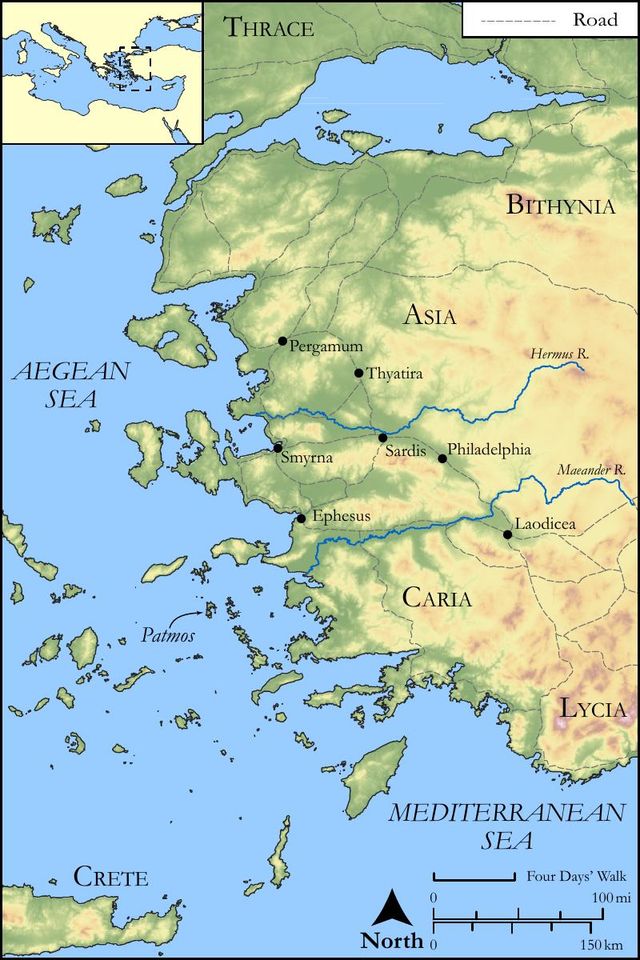
These seven churches are named in Rev 1:11, and distinct messages sent to each of them respectively in the chapters following. The apostolic blessing is more expressly directed to these because they were nearest to him, who was now in the isle of Patmos, and perhaps he had the peculiar care of them, and superintendency over them, not excluding any of the rest of the apostles, if any of them were now living. Here observe,
1.What the blessing is which he pronounces on all the faithful in these churches: Grace and peace, holiness and comfort. Grace, that is, the good-will of God towards us and his good work in us; and peace, that is, the sweet evidence and assurance of this grace. There can be no true peace where there is not true grace; and, where grace goes before, peace will follow.
2.Whence this blessing is to come. In whose name does the apostle bless the churches? In the name of God, of the whole Trinity; for this is an act of adoration, and God only is the proper object of it; his ministers must bless the people in no name but his alone. And here,
(1.)The Father is first named: God the Father, which may be taken either essentially, for God as God, or personally, for the first person in the ever-blessed Trinity, the God and Father of our Lord Jesus Christ; and he is described as the Jehovah who is, and who was, and who is to come, eternal, unchangeable, the same to the Old Testament church which was, and to the New Testament church which is, and who will be the same to the church triumphant which is to come.
(2.)The Holy Spirit, called the seven spirits, not seven in number, nor in nature, but the infinite perfect Spirit of God, in whom there is a diversity of gifts and operations. He is before the throne; for, as God made, so he governs, all things by his Spirit.
(3.)The Lord Jesus Christ. He mentions him after the Spirit, because he intended to enlarge more upon the person of Christ, as God manifested in the flesh, whom he had seen dwelling on earth before, and now saw again in a glorious form. Observe the particular account we have here of Christ, Rev 1:5.
[1.]He is the faithful witness; he was from eternity a witness to all the counsels of God (Joh 1:18), and he was in time a faithful witness to the revealed will of God, who has now spoken to us by his Son; upon his testimony we may safely depend, for he is a faithful witness, cannot be deceived and cannot deceive us.
[2.]He is the first-begotten or first-born from the dead, or the first parent and head of the resurrection, the only one who raised himself by his own power, and who will by the same power raise up his people from their graves to everlasting honour; for he has begotten them again to a lively hope by his resurrection from the dead.
[3.]He is the prince of the kings of the earth; from him they have their authority; by him their power is limited and their wrath restrained; by him their counsels are over-ruled, and to him they are accountable. This is good news to the church, and it is good evidence of the Godhead of Christ, who is King of kings and Lord of lords.
[4.]He is the great friend of his church and people, one who has done great things for them, and this out of pure disinterested affection. He has loved them, and, in pursuance of that everlasting love, he has, First, Washed them from their sins in his own blood. Sins leave a stain upon the soul, a stain of guilt and of pollution. Nothing can fetch out this stain but the blood of Christ; and, rather than it should not be washed out, Christ was willing to shed his own blood, to purchase pardon and purity for them. Secondly, He has made them kings and priests to God and his Father. Having justified and sanctified them, he makes them kings to his Father; that is, in his Father's account, with his approbation, and for his glory. As kings, they govern their own spirits, conquer Satan, have power and prevalency with God in prayer, and shall judge the world. He hath made them priests, given them access to God, enabled them to enter into the holiest and to offer spiritual and acceptable sacrifices, and has given them an unction suitable to this character; and for these high honours and favours they are bound to ascribe to him dominion and glory for ever.
[5.]He will be the Judge of the world: Behold, he cometh, and every eye shall see him, Rev 1:7. This book, the Revelation, begins and ends with a prediction of the second coming of the Lord Jesus Christ. We should set ourselves to meditate frequently upon the second coming of Christ, and keep it in the eye of our faith and expectation. John speaks as if he saw that day: "Behold, he cometh, as sure as if you beheld him with your eyes. He cometh with clouds, which are his chariot and pavilion. He will come publicly: Every eye shall see him, the eye of his people, the eye of his enemies, every eye, yours and mine." He shall come, to the terror of those who have pierced him and have not repented and of all who have wounded and crucified him afresh by their apostasy from him, and to the astonishment of the pagan world. For he comes to take vengeance on those who know not God, as well as on those that obey not the gospel of Christ.
[6.]This account of Christ is ratified and confirmed by himself, Rev 1:8. Here our Lord Jesus justly challenges the same honour and power that is ascribed to the Father, Rev 1:4. He is the beginning and the end; all things are from him and for him; he is the Almighty; he is the same eternal and unchangeable one. And surely whoever presumes to blot out one character of this name of Christ deserves to have his name blotted out of the book of life. Those that honour him he will honour; but those who despise him shall be lightly esteemed.
Historical interpretation
Twelve Centuries of Reception
18 surviving comments on this verse. Each one is dated, so this reads as a timeline rather than a list.
Select a marker to jump to its quote. Markers stagger vertically where authors wrote within a few decades of each other.
Watch for your life's sake. Let not your lamps be quenched, nor your loins unloosed; but be ye ready, for ye know not the hour in which our Lord cometh. But often shall ye come together, seeking the things which are befitting to your souls: for the whole time of your faith will not profit you, if ye be not made perfect in the last time. For in the last days false prophets and corrupters shall be multiplied, and the sheep shall be turned into wolves, and love shall be turned into hate; for when lawlessness increaseth, they shall hate and persecute and betray one another, and then shall appear the world-deceiver as Son of God, and shall do signs and wonders, and the earth shall be delivered into his hands, and he shall do iniquitous things which have never yet come to pass since the beginning. Then shall the creation of men come into the fire of trial, and many shall be made to stumble and shall perish; but they that endure in their faith shall be saved from under the curse itself. And then shall appear the signs of the truth; first, the sign of an out-spreading in heaven; then the sign of the sound of the trumpet; and the third, the resurrection of the dead; yet not of all, but as it is said: The Lord shall come and all His saints with Him. Then shall the world see the Lord coming upon the clouds of heaven.
And I know that He was possessed of a body not only in His being born and crucified, but I also know that He was so after His resurrection, and believe that He is so now. When, for instance, He came to those who were with Peter, He said to them, "Lay hold, handle Me, and see that I am not an incorporeal spirit." "For a spirit hath not flesh and bones, as ye see Me have." And He says to Thomas, "Reach hither thy finger into the print of the nails, and reach hither thy hand, and thrust it into My side; " and immediately they believed that He was Christ. Wherefore Thomas also says to Him, "My Lord, and my God." And on this account also did they despise death, for it were too little to say, indignities and stripes. Nor was this all; but also after He had shown Himself to them, that He had risen indeed, and not in appearance only, He both ate and drank with them during forty entire days. And thus was He, with the flesh, received up in their sight unto Him that sent Him, being with that same flesh to come again, accompanied by glory and power. For, say the [holy] oracles, "This same Jesus, who is taken up from you into heaven, shall so come, in like manner as ye have seen Him go unto heaven." But if they say that He will come at the end of the world without a body, how shall those "see Him that pierced Him," and when they recognise Him, "mourn for themselves? " For incorporeal beings have neither form nor figure, nor the aspect of an animal possessed of shape, because their nature is in itself simple.
That, however, which we have reserved for a concluding argument, will now stand as a plea for all, and for the apostle himself, who in very deed would have to be charged with extreme indiscretion, if he had so abruptly, as some will have it, and as they say, blindfold, and so indiscriminately, and so unconditionally, excluded from the kingdom of God, and indeed from the court of heaven itself, all flesh and blood whatsoever; since Jesus is still sitting there at the right hand of the Father, man, yet God-the last Adam, yet the primary Word-flesh and blood, yet purer than ours-who "shall descend in like manner as He ascended into heaven" the same both in substance and form, as the angels affirmed, so as even to be recognised by those who pierced Him. Designated, as He is, "the Mediator between God and man," He keeps in His own self the deposit of the flesh which has been committed to Him by both parties-the pledge and security of its entire perfection.
And then shall they "learn to know Him whom they pierced, and shall beat their breasts tribe by tribe; " of course because in days bygone they did not know Him when conditionedin the humility of human estate.
For they affirm that without those letters truth cannot be found; nay more, that in those letters the whole plenitude and perfection of truth is comprised; for this was why Christ said, "I am the Alpha and the Omega." In fact, they say that Jesus Christ descended, that is, that the dove came down on Jesus; and, since the dove is styled by the Greek name peristera/-(peristera), it has in itself this number DCCCI.
"Behold, He shall come with clouds, and every eye shall see Him." For He who at first came hidden in the manhood that He had undertaken, shall after a little while come to judgment manifest in majesty and glory. And what saith He?
and they that pierced him. a prophecy which implies that Christ will come in the very flesh in which He was crucified.
shall bewail. But when the wicked shall see the Judge, He will not seem good to them; because they will not rejoice in their heart to see Him, Trinity 1.13.31
Hold most firmly and never doubt that the Word made flesh always has the same truly human flesh with which God the Word was born of the Virgin, with which he was crucified and died, with which he rose and ascended to heaven and sits at the right hand of God, with which he will come again to judge the living and the dead. For this reason, the apostles heard from the angels, “He … will return in the same way as you have seen him going into heaven,” and the blessed John says, “Behold, he will come amid the clouds, and every eye will see him, even those who pierced him; and all the tribes of the earth will see him.”
he comes with the clouds. Either the bodiless powers are implied by the clouds, or those clouds which covered him on Mount Tabor with his holy disciples.
And those who pierced him, etc. Seeing him in the same form as a powerful judge in which they judged him as insignificant, they will lament themselves in late repentance.
Even so, Amen. He affirms it without doubt by interposing "Amen," knowing most certainly that it will happen as revealed by God.
Behold, he comes with the clouds, etc. He who first came hidden to be judged will then come manifest to judge. He mentions this to strengthen the Church to endure sufferings, now oppressed by enemies, but then to reign with Christ.
Behold, he cometh with the clouds. If we are to take this literally, when the Lord comes for the judgment, there will be a white cloud overshadowing the saints to protect them from the fire burning the world. This cloud will be frightening, and the reprobates will be terrified by its din. However, hardly anything in this Apocalypse is to be taken literally. So, in the sacred Scripture, when clouds are mentioned in the plural, they represent the holy preachers, who are light by the cleanness of their minds, and keep watering the hearts of their listeners with drops of preaching. Therefore it is with these clouds that the Lord will come for the judgment, according to this saying of the prophet: Behold, the Lord comes for the judgment with the ancients of his people. [Variant of Is. 3:14] And every eye shall see him, and they also that pierced him. Every eye shall see him, that is, every man shall (the whole is meant by a part) who shall then have been resurrected, either to life or to death — but not the eyes of animals, to which it is not given to rise again after death. Every man shall see him in the form of a servant in which he was judged by the wicked, not in the form of the divinity, which cannot be seen by the wicked. Note also that another translator says, “all the earth shall see him such,” as if he were saying, “such as the wicked did not believe he would be when he was here.” And all the tribes of the earth shall bewail themselves because of him. In this place it is to be noted that he says with an addition, the tribes of the earth, as if he were saying “those who long for earthly things and devote themselves to greed,” to whom it is said, Woe to you that are rich, [Luke 6:24] as well as, Woe to you that laugh. [Ibid. 25] As for what the cause of their pain is, it is disclosed with the words because of him: for even though there will then be mourning due to many afflictions, it will be nothing compared to the lamentation caused by the sight of Christ's glory; for the unfortunate will then feel more pained by the fact that they have lost such a Lord than by the fact that they have fallen into the most atrocious torment. Now, look: he confirms the things that have been said with the insertion of an oath, when he adds, Even so. Amen. Amen is for the Hebrews what even so is for us. Both are adverbs of affirmation: therefore he says Even so. Amen as if he were saying with duplication, “It is true. It is true.”
His coming upon "the clouds of heaven," and the Lord Himself said concerning Himself in the Gospel according to Mark as follows: "And the powers in heaven will be shaken; and then they will see the Son of Man coming in the clouds with great power and glory." (Mark 13:25-26) For as I suppose it was written concerning His ascension into heaven on the day of the Ascension in the Acts, that a cloud received Him out of their sight, so He will come again with clouds. (Acts 1:9)
I suppose, metaphorically, that the divine Scripture calls the holy angels "clouds" because of their lightness, their lofty nature, and their ability to walk on air [ἀεροβατές], as if it were saying that the Lord will come accompanied and attended by divine angels. For therefore the prophet also introduces Him, saying, "And he mounted upon the cherubim and flew; he flew upon the wings of the wind." (Ps. 17:11)
And he says, "every eye shall see Him, even those who pierced Him." For He will not come in an obscure manner in his second glorious coming, nor secretly as before, when He lived among the world in the flesh; the prophet spoke of that coming, which is foreshadowed, saying: "He will descend like rain upon the mown grass, and like showers that water the earth." (Ps. 71:6) But openly and plainly, so as to be seen by every eye, even by the very sinful and wicked. Among these, those who have been led astray or turned away from him must be dealt with accordingly.
"and all the tribes of the earth shall mourn because of Him," it says, referring clearly to those who have remained in unbelief and have not chosen to bow their own necks to the yoke of their Savior. But you will understand that "because of Him," in his appearance and presence.
Then, to indicate what will certainly happen, he added "Yes, amen," meaning exactly that these things will occur with absolute certainty; for just as among the Greeks the word "yes" [ναὶ] signifies assent to what is to come, so too among the Hebrews "amen" [ἀμὴν] serves this purpose.
every eye shall see him. Therefore all men will be present at the judgment.
they also that pierced him. That the Jews, who crucified Him by word of the soldiers by hand and Pilate by judging.
even so. Amen. this is the adverb of affirmation in Latin and similarly Amen in Hebrew, and by means of this double affirmation it is implied that truth is not retractable.
Continue studying Revelation 1:7 across the web’s major study libraries — every link below opens this exact verse, chapter, or book on the destination site.
Read & Compare
 BibleGatewayThis verse in more than 200 translations and 70 languages.
 Bible.comThe YouVersion reader — hundreds of translations, reading plans, and highlights.
 ESV.orgCrossway's official English Standard Version reader.
 NET BibleThe NET translation with 60,000+ translators' notes on every rendering decision.
 STEP BibleTyndale House's free study tool — original text, vocabulary, and scholarly resources.
 BibliaLogos Bible Software's free web reader.
 USCCBThe New American Bible (Revised Edition) with the U.S. bishops' study notes.
Commentaries
 BibleHub CommentariesDozens of classic commentaries on this verse, gathered on one page.
 StudyLightMore than 100 commentary sets — the largest collection on the web.
 BibleRefPlain-English commentary on what this verse means, verse by verse.
 Enduring WordDavid Guzik's free commentary on this chapter, widely used by Bible teachers.
 Bible Study ToolsVerse commentary alongside Greek and Hebrew study aids.
Original Language & Research
- BibleHub InterlinearThe verse word by word — original language, transliteration, and English.
- BibleHub LexiconEvery word's original-language definition and Strong's entry.
 Blue Letter BibleDeep-study tools — Strong's numbers, concordance, and word studies.
 CNTR CollationThe earliest Greek manuscripts of this verse, collated letter by letter.
Sermons, Hymns & Audio


TrulyRandomVerse is not affiliated with these sites and doesn’t control their content. They’re linked because they’re genuinely useful.
Summary
Revelation 1:7 powerfully declares the dramatic and universal return of Jesus Christ, portraying a visible and undeniable advent where every person on earth, including those historically responsible for His crucifixion and all who have rejected Him, will witness His glorious appearance. This climactic event will evoke a profound, widespread lamentation across all humanity, serving as a solemn affirmation of His ultimate sovereignty and the certainty of divine justice, underscored by John's emphatic "Even so, Amen."
Context
ShowHideLiterary Context
This verse is strategically placed within the opening salutation and introductory vision of the Book of Revelation, immediately following a doxology to Christ and a declaration of His eternal and sovereign titles (e.g., "the faithful witness, and the first begotten of the dead, and the prince of the kings of the earth" in Revelation 1:5). It serves as a foundational prophetic statement, setting the eschatological tone for the entire book by announcing the central event—the Second Coming of Jesus Christ—before delving into the detailed apocalyptic visions. This immediate declaration grounds the subsequent intricate symbolism in the concrete reality of Christ's future triumph and judgment.
Historical & Cultural Context
The Book of Revelation was written by John to seven churches in Asia Minor during a period of intense Roman persecution, likely under Emperor Domitian, who demanded emperor worship. Christians faced immense pressure to compromise their faith, enduring imprisonment and martyrdom. In this context, apocalyptic literature, prevalent in both Jewish and early Christian traditions, served to offer hope, encouragement, and a divine perspective on suffering. The imagery of Christ "coming with clouds" would resonate deeply with Old Testament prophecies of divine manifestation and judgment, providing assurance of God's ultimate victory over oppressive earthly powers and a call to steadfast endurance for the faithful.
Key Themes
ShowHideRevelation 1:7 encapsulates several pivotal themes that permeate the entire book. Firstly, it highlights the Sovereignty and Triumph of Christ, asserting His ultimate authority over all earthly powers and His undeniable return as King of Kings. Secondly, it underscores Universal Accountability, emphasizing that His coming will be witnessed by "every eye" and will elicit a response from "all kindreds of the earth," signaling a global reckoning. Thirdly, the verse introduces the theme of Divine Justice and Judgment, particularly through the "wailing" of those who rejected Him, signifying the consequences of unbelief and rebellion. Finally, the concluding "Even so, Amen" powerfully conveys the Certainty of Prophecy, assuring believers of the absolute truth and fulfillment of God's promises, providing a firm foundation for hope amidst tribulation, a theme echoed in Revelation 22:20.
Exposition and Analysis
ShowHideKey Word Analysis
ShowHideG2400 - This interjection functions as a command, "lo!" or "see!" It is used to draw immediate and emphatic attention to the profound and dramatic declaration that follows, signaling the immense importance and certainty of Christ's impending arrival. It demands a posture of readiness and anticipation from the reader.
G2064 - This verb signifies a dynamic, active coming or going. In the context of Revelation 1:7, it denotes a powerful, deliberate, and unstoppable arrival of Christ, emphasizing His initiative and sovereign control over this climactic event, rather than a passive or forced appearance.
G1574 - Meaning "to transfix," this word is a direct and poignant reference to the crucifixion of Jesus, specifically recalling the soldier piercing His side with a spear (as recorded in John 19:34). Its inclusion here highlights the continuity between Christ's suffering and His glorious return, ensuring that His identity as the crucified Messiah is central to His triumphant second advent.
G2875 - This verb means "to chop," and specifically, "to beat the breast in grief" or "to lament." It describes a deep, public, and mournful expression of sorrow, often associated with intense regret, despair, or fear. In this context, it signifies the universal anguish and dread that will seize humanity upon recognizing the true identity of the One they rejected, as He returns in glory and judgment.
Verse Breakdown
ShowHide"Behold, he cometh with clouds"
This opening phrase serves as a dramatic announcement, demanding attention to the imminent and visible return of Jesus. The imagery of "clouds" is deeply significant, recalling Old Testament depictions of divine presence, glory, and judgment (e.g., Exodus 19:9 and Daniel 7:13), as well as Jesus's own prophecies of His return (e.g., Matthew 24:30). It signifies a powerful, supernatural, and unmistakable arrival, not a secret or hidden event.
"and every eye shall see him"
This clause emphasizes the universal and undeniable nature of Christ's return. His advent will not be confined to a specific region or group; rather, it will be a globally witnessed event, transcending all geographical and cultural boundaries. This universal visibility underscores the absolute authority and inescapable reality of His coming.
"and they [also] which pierced him"
This phrase directly references those who were historically responsible for Jesus's crucifixion. However, in a broader theological sense, it extends to all who have rejected, opposed, or metaphorically "pierced" Christ through their unbelief and sin throughout history. It highlights a particular aspect of the universal witness: even His enemies will be forced to acknowledge His identity and authority.
"and all kindreds of the earth shall wail because of him"
This clause describes the universal response to Christ's return. "All kindreds" (or tribes/families) signifies every ethnic group and nation on earth. Their "wailing" indicates a profound lamentation, stemming from a mixture of recognition, regret, fear, and despair as they confront the glorious reality of the One they scorned or ignored. This echoes the prophecy in Zechariah 12:10, which speaks of mourning for the one who was pierced.
"Even so, Amen."
This concluding affirmation, spoken by John, underscores the absolute certainty and divine decree of the prophesied event. "Even so" (Greek: Nai) is a strong affirmative ("yes," "certainly"), and "Amen" (Greek: Amēn) signifies "so be it" or "truly," a powerful declaration of agreement and certainty. Together, they seal the prophetic truth, assuring the reader that this event is not merely a possibility but a divinely guaranteed reality.
Literary Devices
ShowHideRevelation 1:7 is rich in literary devices that enhance its dramatic impact and theological depth. The opening word, Interjection "Behold" (Greek: idou), immediately grabs the reader's attention, signaling the profound importance of the declaration that follows. The phrase "he cometh with clouds" employs Allusion, directly referencing Old Testament prophecies of divine appearance and the Son of Man (e.g., Daniel 7:13), which would be instantly recognizable to a Jewish audience. The "clouds" themselves serve as Symbolism for divine glory, power, and presence, often associated with judgment. The phrases "every eye shall see him" and "all kindreds of the earth" utilize Hyperbole and Universality to emphasize the global and undeniable nature of Christ's return, leaving no one untouched or unwitnessing. The specific mention of "they also which pierced him" is a poignant Allusion to Christ's crucifixion, creating Dramatic Irony as those who inflicted His suffering will be forced to witness His ultimate triumph. Finally, the concluding "Even so, Amen" acts as a powerful Affirmation and Doxology, sealing the prophecy with divine certainty and inviting the reader's assent.
Theological and Thematic Connections
ShowHideRevelation 1:7 serves as a foundational declaration for the entire apocalyptic vision, powerfully articulating the eschatological hope and warning central to Christian theology. It establishes Christ's ultimate sovereignty and His role as the returning King and Judge, emphasizing that His second advent will be a visible, universal, and undeniable event that elicits a profound response from all humanity. This universal witness and the accompanying lamentation underscore themes of divine justice, accountability, and the ultimate triumph of God's redemptive plan, reminding believers of their blessed hope while serving as a stark warning to those who reject Him. The verse encapsulates the culmination of history, where every knee will bow and every tongue confess, whether in adoration or in dread, that Jesus Christ is Lord.
Reflection and Application
ShowHideRevelation 1:7 is not merely a distant prophecy but a profound call to present-day reflection and action. For believers, it offers immense hope and assurance, reminding us that our King will return to establish His perfect reign, bringing justice and peace. This certainty should fuel our perseverance in faith, our commitment to holiness, and our passion for sharing the Gospel, knowing that the time is short and the stakes are eternal. It encourages us to live with an eternal perspective, prioritizing what truly matters in light of His imminent return. For those who have not yet acknowledged Christ, this verse serves as a solemn warning and a gracious invitation. The universal wailing signifies a moment of undeniable truth and reckoning, urging all to consider their standing before the returning Lord and to embrace His offer of salvation before that day arrives. Ultimately, Revelation 1:7 compels every individual to examine their heart, repent of sin, and prepare for the glorious and undeniable appearing of Jesus Christ.
Questions for Reflection
ShowHideFAQ
ShowHideWhat is the significance of "he cometh with clouds"?
ShowHideThe imagery of "coming with clouds" is deeply rooted in Old Testament theology, signifying a divine, powerful, and glorious manifestation of God's presence and authority. It recalls instances like God's appearance on Mount Sinai in Exodus 19:9 and the vision of the "Son of Man" coming with the clouds of heaven in Daniel 7:13. Jesus Himself used this imagery to describe His Second Coming (e.g., Matthew 24:30). Furthermore, it connects to His ascension, where He was "taken up into a cloud" (as described in Acts 1:9-11), with the promise that He would return "in like manner." Thus, it signifies a visible, supernatural, and undeniable return in divine glory and power.
Who are "they also which pierced him"?
ShowHideThis phrase primarily refers to those who were directly involved in the crucifixion of Jesus, specifically recalling the Roman soldier who pierced His side with a spear (as mentioned in John 19:37, which quotes Zechariah 12:10). However, its theological scope extends beyond the historical participants. It symbolically includes all who have rejected, scorned, or opposed Jesus throughout history, effectively "piercing" Him anew through their unbelief and sin (a concept echoed in Hebrews 6:6). This highlights the profound irony and justice that those who once rejected Him will be compelled to witness His glorious return.
Why will "all kindreds of the earth... wail"?
ShowHideThe universal "wailing" signifies a profound and widespread lamentation that will sweep across all humanity ("all kindreds" or tribes/families) upon Christ's return. This wailing is not necessarily a sign of repentance for all, but rather a multifaceted response of grief, fear, and despair. It stems from the sudden, undeniable realization of Christ's true identity and absolute authority, and the recognition of their own rebellion or neglect. For some, it may be the sorrow of missed opportunity or the terror of impending judgment, as the world confronts the King of Kings whom they rejected. This echoes the prophetic mourning described in Zechariah 12:10, where the people will look upon the one they have pierced and mourn.
Christ-Centered Fulfillment
ShowHideRevelation 1:7 stands as a powerful Christ-centered declaration, asserting that the culmination of all history is inextricably linked to the person and work of Jesus Christ. His "coming with clouds" directly fulfills Old Testament messianic prophecies, presenting Him not merely as a historical figure but as the divine Son of Man, the sovereign Lord of all. While His first coming was in humility, as the suffering servant who was indeed "pierced" for the sins of the world (as foretold in Isaiah 53:5), His second coming will be in undeniable glory and power. This verse confirms that the One who suffered and died, conquering sin and death through His resurrection, is the very One who will return as King and Judge. His return ensures that every eye will behold the Lamb of God who takes away the sin of the world (John 1:29), and every knee will ultimately bow before Him, whether in worship or in judgment (Philippians 2:9-11). Thus, Revelation 1:7 is the ultimate vindication of Christ's redemptive work, bringing to completion the cosmic drama of salvation and judgment, and establishing His eternal reign over all creation (Colossians 1:15-20).