


Revelation 1:6
- καὶkaiandG2532CONJConjunction
- ἐποίησενepoiēsenHe has madeG4160V-AAI-3SVerb Aorist Active Indicative 3rd Singular
- ἡμᾶςhēmasusG3165P-1APPersonal pronoun Accusative 1st Plural
- βασιλείανbasileiana kingdomG932N-ASFNoun Accusative Singular Feminine
- καὶkaiandG2532CONJConjunction
- ἱερεῖςhi'ereispriestsG2409N-APMNoun Accusative Plural Masculine
- τῷtōto theG3588T-DSMDefinite article Dative Singular Masculine
- θεῷtheōGodG2316N-DSM-TNoun Dative Singular Masculine Title
- καὶkaiandG2532CONJConjunction
- πατρὶpatriFatherG3962N-DSM-TNoun Dative Singular Masculine Title
- αὐτοῦautouof Him —G846P-GSMPersonal pronoun Genitive Singular Masculine
- αὐτῷautōto Him [be]G846P-DSMPersonal pronoun Dative Singular Masculine
- ἡhētheG3588T-NSFDefinite article Nominative Singular Feminine
- δόξαdoxagloryG1391N-NSFNoun Nominative Singular Feminine
- καὶkaiandG2532CONJConjunction
- τὸtotheG3588T-NSNDefinite article Nominative Singular Neuter
- κράτοςkratosdominionG2904N-NSNNoun Nominative Singular Neuter
- εἰςeistoG1519PREPPreposition
- τοὺςtoustheG3588T-APMDefinite article Accusative Plural Masculine
- αἰῶναςaiōnasagesG165N-APMNoun Accusative Plural Masculine
- τῶνtōnof theG3588T-GPMDefinite article Genitive Plural Masculine
- αἰώνωνaiōnōnagesG165N-GPMNoun Genitive Plural Masculine
- ἀμήνamēnAmenG281INJ-HEBInterjection
English is a literal word-by-word gloss of the Greek, not the KJV's wording. Why?
This is the original text the KJV's translators worked from — each Greek word with its own literal English meaning in this verse, prepared by scholars at Tyndale House, Cambridge. The KJV translates whole sentences, not word by word, so its wording differs: one Greek word can become several English words, and the KJV may choose “charity” where the gloss reads “love”. Both are faithful — they answer different questions. For the KJV's own rendering, switch to the KJV text.
Details
See on the biblical-era map

Study this verse
Public-domain commentary
Matthew Henry
From his Commentary on the Whole Bible. Henry comments on passages, not single verses — this entry covers Revelation 1:3–8. His four-level outline is real structure in the source text, so it is rendered as structure.
We have here an apostolic benediction on those who should give a due regard to this divine revelation; and this benediction is given more generally and more especially.
I.More generally, to all who either read or hear the words of the prophecy.
This blessing seems to be pronounced with a design to encourage us to study this book, and not be weary of looking into it upon account of the obscurity of many things in it; it will repay the labour of the careful and attentive reader. Observe,
1.It is a blessed privilege to enjoy the oracles of God. This was one of the principal advantages the Jews had above the Gentiles.
2.It is a blessed thing to study the scriptures; those are well employed who search the scriptures.
3.It is a privilege not only to read the scriptures ourselves, but to hear them read by others, who are qualified to give us the sense of what they read and to lead us into an understanding of them.
4.It is not sufficient to our blessedness that we read and hear the scriptures, but we must keep the things that are written; we must keep them in our memories, in our minds, in our affections, and in practice, and we shall be blessed in the deed.
5.The nearer we come to the accomplishment of the scriptures, the greater regard we shall give to them. The time is at hand, and we should be so much the more attentive as we see the day approaching.
II.The apostolic benediction is pronounced more especially and particularly to the seven Asian churches, Rev 1:4.
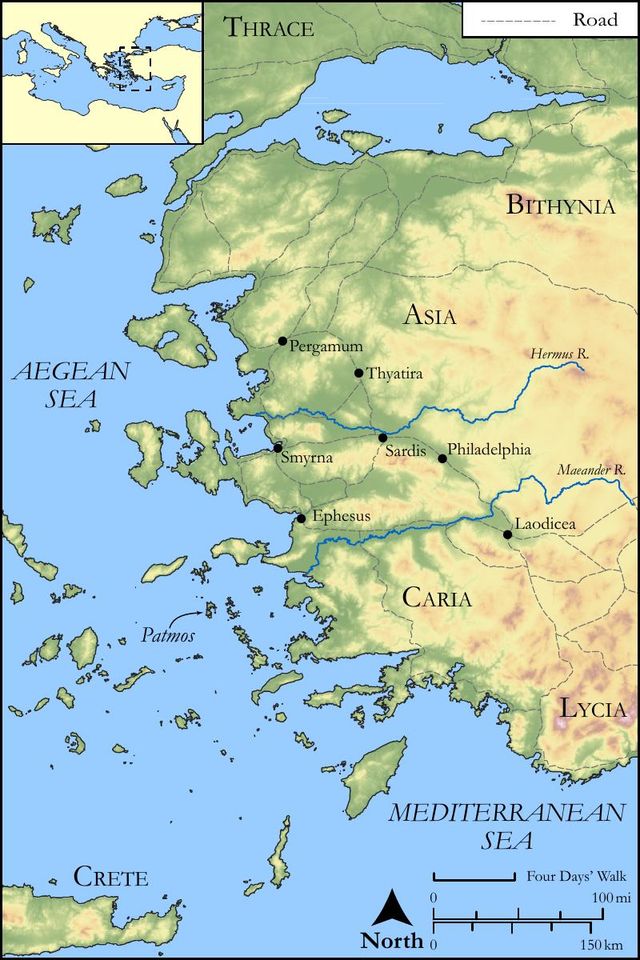
These seven churches are named in Rev 1:11, and distinct messages sent to each of them respectively in the chapters following. The apostolic blessing is more expressly directed to these because they were nearest to him, who was now in the isle of Patmos, and perhaps he had the peculiar care of them, and superintendency over them, not excluding any of the rest of the apostles, if any of them were now living. Here observe,
1.What the blessing is which he pronounces on all the faithful in these churches: Grace and peace, holiness and comfort. Grace, that is, the good-will of God towards us and his good work in us; and peace, that is, the sweet evidence and assurance of this grace. There can be no true peace where there is not true grace; and, where grace goes before, peace will follow.
2.Whence this blessing is to come. In whose name does the apostle bless the churches? In the name of God, of the whole Trinity; for this is an act of adoration, and God only is the proper object of it; his ministers must bless the people in no name but his alone. And here,
(1.)The Father is first named: God the Father, which may be taken either essentially, for God as God, or personally, for the first person in the ever-blessed Trinity, the God and Father of our Lord Jesus Christ; and he is described as the Jehovah who is, and who was, and who is to come, eternal, unchangeable, the same to the Old Testament church which was, and to the New Testament church which is, and who will be the same to the church triumphant which is to come.
(2.)The Holy Spirit, called the seven spirits, not seven in number, nor in nature, but the infinite perfect Spirit of God, in whom there is a diversity of gifts and operations. He is before the throne; for, as God made, so he governs, all things by his Spirit.
(3.)The Lord Jesus Christ. He mentions him after the Spirit, because he intended to enlarge more upon the person of Christ, as God manifested in the flesh, whom he had seen dwelling on earth before, and now saw again in a glorious form. Observe the particular account we have here of Christ, Rev 1:5.
[1.]He is the faithful witness; he was from eternity a witness to all the counsels of God (Joh 1:18), and he was in time a faithful witness to the revealed will of God, who has now spoken to us by his Son; upon his testimony we may safely depend, for he is a faithful witness, cannot be deceived and cannot deceive us.
[2.]He is the first-begotten or first-born from the dead, or the first parent and head of the resurrection, the only one who raised himself by his own power, and who will by the same power raise up his people from their graves to everlasting honour; for he has begotten them again to a lively hope by his resurrection from the dead.
[3.]He is the prince of the kings of the earth; from him they have their authority; by him their power is limited and their wrath restrained; by him their counsels are over-ruled, and to him they are accountable. This is good news to the church, and it is good evidence of the Godhead of Christ, who is King of kings and Lord of lords.
[4.]He is the great friend of his church and people, one who has done great things for them, and this out of pure disinterested affection. He has loved them, and, in pursuance of that everlasting love, he has, First, Washed them from their sins in his own blood. Sins leave a stain upon the soul, a stain of guilt and of pollution. Nothing can fetch out this stain but the blood of Christ; and, rather than it should not be washed out, Christ was willing to shed his own blood, to purchase pardon and purity for them. Secondly, He has made them kings and priests to God and his Father. Having justified and sanctified them, he makes them kings to his Father; that is, in his Father's account, with his approbation, and for his glory. As kings, they govern their own spirits, conquer Satan, have power and prevalency with God in prayer, and shall judge the world. He hath made them priests, given them access to God, enabled them to enter into the holiest and to offer spiritual and acceptable sacrifices, and has given them an unction suitable to this character; and for these high honours and favours they are bound to ascribe to him dominion and glory for ever.
[5.]He will be the Judge of the world: Behold, he cometh, and every eye shall see him, Rev 1:7. This book, the Revelation, begins and ends with a prediction of the second coming of the Lord Jesus Christ. We should set ourselves to meditate frequently upon the second coming of Christ, and keep it in the eye of our faith and expectation. John speaks as if he saw that day: "Behold, he cometh, as sure as if you beheld him with your eyes. He cometh with clouds, which are his chariot and pavilion. He will come publicly: Every eye shall see him, the eye of his people, the eye of his enemies, every eye, yours and mine." He shall come, to the terror of those who have pierced him and have not repented and of all who have wounded and crucified him afresh by their apostasy from him, and to the astonishment of the pagan world. For he comes to take vengeance on those who know not God, as well as on those that obey not the gospel of Christ.
[6.]This account of Christ is ratified and confirmed by himself, Rev 1:8. Here our Lord Jesus justly challenges the same honour and power that is ascribed to the Father, Rev 1:4. He is the beginning and the end; all things are from him and for him; he is the Almighty; he is the same eternal and unchangeable one. And surely whoever presumes to blot out one character of this name of Christ deserves to have his name blotted out of the book of life. Those that honour him he will honour; but those who despise him shall be lightly esteemed.
Historical interpretation
Eleven Centuries of Reception
13 surviving comments on this verse. Each one is dated, so this reads as a timeline rather than a list.
Select a marker to jump to its quote. Markers stagger vertically where authors wrote within a few decades of each other.
Are not even we laics priests? It is written: "A kingdom also, and priests to His God and Father, hath He made us." It is the authority of the Church, and the honour which has acquired sanctity through the joint session of the Order, which has established the difference between the Order and the laity.
" Us, moreover, Jesus, the Father's Highest and Great Priest, clothing us from His own store -inasmuch as they "who are baptized in Christ have put on Christ"-has made "priests to God His Father," according to John.
For I have heard that you have received the ministry of the purpled ones. Oh, happy are you, even sleeping on the ground, to obtain your wishes which you have always desired! You have desired to be sent into prison for His name's sake, which now has come to pass; as it is written, "The Lord grant thee according to thine own heart; " and now made a priest of God over them, and the same their minister has acknowledged it. I ask, therefore my lord, and I entreat by our Lord Jesus Christ, that you will refer the case to the rest of your colleagues, your brethren, my lords, and ask from them, that whichever of you is first crowned, should remit such a great sin to those our sisters, Numeria and Candida. For this latter I have always called Etecusa -God is my witness,-because she gave gifts for herself that she might not sacrifice; but she appears only to have ascended to the Tria Fata, and thence to have descended. I know, therefore, that she has not sacrificed. Their cause having been lately heard, the chief rulers commanded them in the meantime to remain as they are, until a bishop should be appointed. But, as far as possible, by your holy prayers and petitions, in which we trust, since you are friends as well as witnesses of Christ, (we pray) that you would be indulgent in all these matters.
"And He made us a kingdom and priests unto God and His Father." That is to say, a Church of all believers; as also the Apostle Peter says: "A holy nation, a royal priesthood."
And made us a kingdom, etc. Because the King of kings and heavenly Priest, by offering himself for us, has united us to his body, none of the saints is spiritually devoid of the office of priesthood, since he is a member of the eternal Priest.
And hath made our kingdom priests to God and his Father. Because our Head is a king and priest, all the limbs are kings and priests, as the apostle Peter says in You are a chosen generation, a kingly priesthood. [1 Pet. 2:9] They are kings by governing themselves, and priests by offering themselves to God, according to this: I beseech you therefore by the mercy of God, that you present your bodies a living sacrifice. [Rom. 12:1] So, in saying to God and his Father, he indicates one person (although, according to the rule mentioned earlier, the Holy Spirit is there understood) in the same way as the apostle also says, Blessed be the God and Father of our Lord Jesus Christ, [2 Cor. 1:3] with the intention that one person should be understood by God and Father; hence it needs to be said, to him be glory forever and ever: to him, that is to him who has made us kings and priests, namely the Father and the Son, in which we understand the love of both, which is the Holy Spirit: for the love of God is poured forth in our hearts by the Holy Ghost. [Rom. 5:5] Moreover, the Church is right to attribute glory for these things not to itself, but to the one it received them from, according to this: Not to us, O Lord, not to us; but to thy name give glory. [Ps. 113:9]
QUESTION: What is meant by And hath made us a kingdom, and priests to God and his Father? ANSWER: Seeing that the King of kings and heavenly Priest united us to his body by sacrificing himself for us, there is no one among the saints who does not spiritually have the office of a priest, since each of them is a member of the highest and eternal Priest. (1:8) THERE FOLLOWS: I am Alpha and Omega, the beginning and the end, saith the Lord God. ANSWER: The beginning means the one whom no one precedes; the end, the one whom no one succeeds. — He also repeats the same words again: who is, and who was, and who is to come. ANSWER: He had said the same about the Father, for God the Father both came and is to come in the Son.
The arrangement [σύνταξις] of the speech returns from the last to the first. He says to him, The glory and the power belong to the one who loved us; for how could he not have loved, "who gave himself as a ransom for the life of the world?" (1 Tim. 2:6)
"and has washed us from our sins in His blood." For He Himself bore our handwritten record that was against us in the decrees; and He fastened it to the wood of His cross (Col. 2:14), stretching out our sins to His own death and freeing us by His blood from our offenses, "having subjected Himself to death, even death on a cross, (Philip. 2:8) to heal our disobedience.
"and has made us a kingdom." And who says that in becoming "priests to His God and His prophets" there is benefit for us? For it was deemed fitting for men to obtain these things, securing for us the future kingdom and bestowing upon us an unfading glory even in the present time. For to "wash us from our sins in His own blood" is a greater and more marvelous gift, worthy of the divine grace. Moreover, that those who have offered nothing beforehand should become "priests of God and prophets" is a gift of such a kind.
Amen. This is a Hebrew word of affirmation.
made us a kingdom: He made us kings through hope according to the undying promise, because if we endure we shall reign with Him.
and priests. in that we continually offer to Him the rational sacrifice of thanksgiving and blessing, heeding the advice, ‘Offer to God a sacrifice of blessing’ instead of irrational sacrifices:
So at the end of this section glory is befitting to Him who brought us to this honor and created so much grace. For we have nothing else to give in exchange, except only glory.
made us a kingdom. That is, to be written as citizens of the kingdom of Heaven.
Continue studying Revelation 1:6 across the web’s major study libraries — every link below opens this exact verse, chapter, or book on the destination site.
Read & Compare
 BibleGatewayThis verse in more than 200 translations and 70 languages.
 Bible.comThe YouVersion reader — hundreds of translations, reading plans, and highlights.
 ESV.orgCrossway's official English Standard Version reader.
 NET BibleThe NET translation with 60,000+ translators' notes on every rendering decision.
 STEP BibleTyndale House's free study tool — original text, vocabulary, and scholarly resources.
 BibliaLogos Bible Software's free web reader.
 USCCBThe New American Bible (Revised Edition) with the U.S. bishops' study notes.
Commentaries
 BibleHub CommentariesDozens of classic commentaries on this verse, gathered on one page.
 StudyLightMore than 100 commentary sets — the largest collection on the web.
 BibleRefPlain-English commentary on what this verse means, verse by verse.
 Enduring WordDavid Guzik's free commentary on this chapter, widely used by Bible teachers.
 Bible Study ToolsVerse commentary alongside Greek and Hebrew study aids.
Original Language & Research
- BibleHub InterlinearThe verse word by word — original language, transliteration, and English.
- BibleHub LexiconEvery word's original-language definition and Strong's entry.
 Blue Letter BibleDeep-study tools — Strong's numbers, concordance, and word studies.
 CNTR CollationThe earliest Greek manuscripts of this verse, collated letter by letter.
Sermons, Hymns & Audio


TrulyRandomVerse is not affiliated with these sites and doesn’t control their content. They’re linked because they’re genuinely useful.
Summary
Revelation 1:6 serves as a profound doxology and declaration, articulating the elevated status of believers as "kings and priests" unto God, a direct result of Christ's redemptive work. It attributes eternal glory and dominion to Jesus Christ, establishing His supreme worthiness and authority as the foundation for the new identity and priestly access granted to His followers, culminating in a resounding affirmation of truth.
Context
ShowHideLiterary Context
This verse immediately follows a powerful Christological declaration in Revelation 1:5, which identifies Jesus as "the faithful witness, and the first begotten of the dead, and the prince of the kings of the earth," and states that He "loved us, and washed us from our sins in his own blood." Revelation 1:6, therefore, presents the glorious consequence of Christ's finished work: the transformation and exaltation of His people. It transitions from Christ's person and work to the identity and destiny of those who belong to Him, setting the stage for the subsequent visions that reveal the Church's struggles, triumphs, and ultimate reign with Christ. The doxology also serves as a fitting conclusion to John's opening salutation and blessing, shifting focus from the recipients to the worthy One.
Historical & Cultural Context
The concept of "kings and priests" carries significant weight from both Old Testament and Greco-Roman perspectives. In the Old Testament, Israel was called to be a "kingdom of priests and a holy nation" (Exodus 19:6), a unique role among nations, mediating God's presence and truth to the world. However, only specific individuals from the tribe of Levi could serve as priests, and kingship was distinct. In the Roman world, emperors were often deified and held absolute power, demanding worship. For believers in Asia Minor facing persecution, the declaration that they are "kings and priests" would have been a radical counter-cultural claim, asserting their true spiritual authority and access to the one true God, not dependent on earthly rulers or systems. This status would have provided immense encouragement and a sense of divine purpose amidst imperial pressures.
Key Themes
ShowHideRevelation 1:6 contributes to several overarching themes within the book of Revelation and the broader New Testament. Firstly, it underscores the exaltation of Christ, affirming His supreme "glory and dominion" as the one to whom all honor is due. This theme of Christ's ultimate sovereignty is central to Revelation, providing comfort and assurance to a persecuted church that their Lord is in control, even amidst chaos. Secondly, it highlights the new covenant identity of believers, transforming them into a "royal priesthood" (1 Peter 2:9), granting them direct access to God and a share in Christ's spiritual authority. This theme emphasizes the universal reach of the new covenant, where all believers, not just a select few, are consecrated for divine service and spiritual rule. Finally, it reinforces the theme of divine grace and redemption, as this exalted status is not earned but "made" (granted) by Christ's sacrificial love and atoning blood, as declared in Revelation 1:5.
Exposition and Analysis
ShowHideKey Word Analysis
ShowHideMeaning "to make or do (in a very wide application, more or less direct)." Here, it signifies a divine act of creation or transformation. God, through Christ, has actively brought about this new reality for believers, conferring upon them a status they did not inherently possess or earn. It emphasizes the sovereign initiative and power of God in establishing the identity of His people.
Meaning "a sovereign (abstractly, relatively, or figuratively)." This term denotes royalty, authority, and the capacity to rule. In the context of believers, it points to their spiritual authority over sin and evil, their participation in Christ's present reign, and their future co-regency with Him in His kingdom, as seen in passages like Revelation 5:10.
Meaning "a priest (literally or figuratively)." This refers to one who mediates between God and humanity, offering sacrifices and interceding. For believers, it signifies their direct access to God through Christ, their privilege to offer spiritual sacrifices of praise and service, and their role in interceding for the world, fulfilling the Old Testament ideal of a priestly nation.
Verse Breakdown
ShowHide"And hath made us kings and priests unto God and his Father;"
This clause declares the new, exalted status of believers. The "us" refers to those who have been "washed... from their sins in his own blood" (Revelation 1:5). Through Christ's redemptive work, they are not merely forgiven but are actively constituted as a royal priesthood. "Kings" signifies their shared authority and future reign with Christ, while "priests" denotes their direct access to God and their calling to spiritual service and worship. This status is "unto God and his Father," indicating that their new identity and service are directed towards and for the glory of the Triune God.
"to him [be] glory and dominion for ever and ever. Amen."
This is a powerful doxology, a declaration of praise and adoration directed to Jesus Christ. "Glory" (G1391, dóxa) refers to His inherent majesty, honor, and supreme worthiness, while "dominion" (G2904, krátos) speaks of His absolute power, might, and sovereign authority. The phrase "for ever and ever" (G1519 eis G165 aiṓn and G165 aiṓn) emphasizes the eternal, unending nature of Christ's reign and worthiness. The concluding "Amen" (G281, amḗn) serves as a solemn affirmation of truth, expressing assent and certainty to the preceding declaration of Christ's eternal glory and dominion.
Literary Devices
ShowHideRevelation 1:6 employs several significant literary devices. The most prominent is Symbolism, where "kings and priests" are not merely literal titles but symbolic representations of the believer's new identity and function. "Kings" symbolizes authority, sovereignty, and a share in Christ's rule, while "priests" symbolizes direct access to God, mediation, and sacred service. This combined imagery evokes the Old Testament ideal of Israel as a "kingdom of priests" (Exodus 19:6), now fulfilled and expanded in the church. The verse also features a powerful Doxology, a formal expression of praise and glory directed to Christ. This serves to elevate Christ's status and reinforce His ultimate sovereignty, providing a theological anchor for the entire book. Furthermore, there is a clear Allusion to Old Testament themes, particularly the priestly and royal roles, reinterpreted and fulfilled in the New Covenant through Christ. The concluding "Amen" functions as an Affirmation, lending solemnity and certainty to the divine declaration and doxology.
Theological and Thematic Connections
ShowHideRevelation 1:6 profoundly impacts our understanding of the New Covenant and the identity of the Church. It reveals that through Christ's sacrifice, the barrier between God and humanity has been removed, not just for a select few, but for all who believe. This "priesthood of all believers" means every Christian has direct access to God's presence, is called to offer spiritual sacrifices of praise and service, and participates in God's redemptive work in the world. Moreover, being made "kings" signifies a spiritual authority and a future co-regency with Christ, challenging believers to live in light of their royal inheritance, exercising dominion over sin and participating in the advancement of God's kingdom. This status is entirely a gift of grace, flowing from Christ's completed work, and thus all glory and dominion are rightly ascribed to Him eternally.
Reflection and Application
ShowHideUnderstanding that we have been "made kings and priests" by Christ's sacrifice is not merely a theological concept but a call to live out a transformed identity. As priests, we are given direct, unhindered access to God's presence through prayer, worship, and the study of His Word. This privilege invites us to cultivate a deep, intimate relationship with our Creator, offering our lives as "living sacrifices" (Romans 12:1) and interceding for others. As kings, we are called to exercise spiritual authority in Christ, reigning over sin in our own lives, resisting the temptations of the world, and participating in God's redemptive purposes for His creation. This means living with dignity, purpose, and confidence, knowing that our ultimate allegiance is to the King of kings, and our future is secure in His eternal dominion. This profound truth should inspire both humility for the grace received and boldness in living out our divine calling, always returning all glory and dominion to the One who made it possible.
Questions for Reflection
ShowHideFAQ
ShowHideWhat does it mean for believers to be "kings and priests"?
ShowHideFor believers to be "kings and priests" signifies a dual, exalted status granted by God through Jesus Christ. As "priests," believers have direct, unmediated access to God's presence, a privilege once reserved for a select few in the Old Testament. This means we can approach God confidently in prayer, worship, and service, offering spiritual sacrifices of praise and good works (Hebrews 13:15-16). As "kings" (or a "kingdom," as some translations render it, referring to the collective body of believers), we share in Christ's spiritual authority and reign. This implies dominion over sin, participation in God's redemptive purposes on earth, and a future co-regency with Christ in His eternal kingdom (Revelation 5:10). This status is a gift of grace, not earned, and empowers believers to live purposeful lives for God's glory.
Why is "glory and dominion" attributed to Christ in this verse?
ShowHideThe attribution of "glory and dominion for ever and ever" to Christ is a powerful doxology, an act of worship and praise that acknowledges His supreme worthiness and absolute sovereignty. It is precisely because Christ, through His sacrificial love and atoning blood (as mentioned in Revelation 1:5), has "made us kings and priests" that He is worthy of all honor, majesty, and power. This declaration reinforces the foundational truth that all blessings, salvation, and new identity flow from Him, and therefore all praise is due back to Him. It also sets the tone for the entire book of Revelation, which consistently portrays Christ as the triumphant Lord who holds ultimate authority over all creation and history.
Christ-Centered Fulfillment
ShowHideRevelation 1:6 finds its profound Christ-centered fulfillment in Jesus Himself, who embodies and bestows the very status He declares for His people. He is the ultimate High Priest, having entered the true Holy of Holies once for all, securing eternal redemption through His own blood (Hebrews 9:11-12). Through His perfect sacrifice, He has opened the way for all believers to have direct access to God, making them a "royal priesthood" (1 Peter 2:9) who can draw near with confidence (Hebrews 4:16). Furthermore, Jesus is the King of kings and Lord of lords, the "prince of the kings of the earth" (Revelation 1:5), who has conquered sin and death. By making believers "kings," He invites them to share in His present spiritual reign over sin and evil, and promises a future co-regency with Him in His eternal kingdom (2 Timothy 2:12). Thus, the status of "kings and priests" is not earned but is a gracious imputation and impartation from Christ, making His people participants in His own glorious priestly and kingly offices, all to the eternal "glory and dominion" of the One who loved us and washed us in His own blood.