


Revelation 4:8
Bible text: King James Version (1769 Blayney text) · Public domain
Bible text: King James Version with Strong's numbers · Public domain
Bible text: Berean Standard Bible · Public domain
Bible text: American Standard Version (1901) · Public domain
Bible text: World English Bible, Messianic edition · Public domain
Bible text: Geneva Bible (1599) · Public domain
Bible text: Young's Literal Translation · Public domain
- καὶkaiAndG2532CONJConjunction
- τὰtatheG3588T-NPNDefinite article Nominative Plural Neuter
- τέσσαραtessarafourG5064A-NPNAdjective Nominative Plural Neuter
- ζῷαzōaliving creaturesG2226N-NPNNoun Nominative Plural Neuter
- ἓνhenoneG1520A-NSNAdjective Nominative Singular Neuter
- καθ᾽kath᾽forG2596PREPPreposition
- αὐτῶνautōnof themG846P-GPNPersonal pronoun Genitive Plural Neuter
- ἔχωνechōnhe havingG2192V-PAP-NSMVerb Present Active Participle Nominative Singular Masculine
- ἀνὰanarespectivelyG303PREPPreposition
- πτέρυγαςpterugaswingsG4420N-APFNoun Accusative Plural Feminine
- ἕξhexsixG1803A-NUIAdjective
- κυκλόθενkuklothenaroundG2943PREPPreposition
- καὶkaiandG2532CONJConjunction
- ἔσωθενesōthenwithinG2081ADVAdverb
- γέμουσινgemousinfullG1073V-PAI-3PVerb Present Active Indicative 3rd Plural
- ὀφθαλμῶνophthalmōnof eyesG3788N-GPMNoun Genitive Plural Masculine
- καὶkaiandG2532CONJConjunction
- ἀνάπαυσινanapausinrestG372N-ASFNoun Accusative Singular Feminine
- οὐκouknotG3756PRT-NNegative Particle Negative
- ἔχουσινechousinthey haveG2192V-PAI-3PVerb Present Active Indicative 3rd Plural
- ἡμέραςhēmerasby dayG2250N-GSFNoun Genitive Singular Feminine
- καὶkaiandG2532CONJConjunction
- νυκτὸςnuktosnightG3571N-GSFNoun Genitive Singular Feminine
- λέγοντες·legontessayingG3004V-PAP-NPMVerb Present Active Participle Nominative Plural Masculine
- ἅγιοςhagiosHolyG40A-NSMAdjective Nominative Singular Masculine
- ἅγιοςhagiosHolyG40A-NSMAdjective Nominative Singular Masculine
- ἅγιοςhagiosHolyG40A-NSMAdjective Nominative Singular Masculine
- κύριοςkuriosLordG2962N-NSM-TNoun Nominative Singular Masculine Title
- ὁho<the>G3588T-NSMDefinite article Nominative Singular Masculine
- θεὸςtheosGodG2316N-NSM-TNoun Nominative Singular Masculine Title
- ὁho<the>G3588T-NSMDefinite article Nominative Singular Masculine
- παντοκράτωρpantokratōrAlmightyG3841N-NSM-TNoun Nominative Singular Masculine Title
- ὁhowhoG3588T-NSMDefinite article Nominative Singular Masculine
- ἦνēnwas beingG1510V-IAI-3SVerb Imperfect Active Indicative 3rd Singular
- καὶkaiandG2532CONJConjunction
- ὁhowhoG3588T-NSMDefinite article Nominative Singular Masculine
- ὢνōnis beingG1510V-PAP-NSMVerb Present Active Participle Nominative Singular Masculine
- καὶkaiandG2532CONJConjunction
- ὁhowhoG3588T-NSMDefinite article Nominative Singular Masculine
- ἐρχόμενοςerchomenosis comingG2064V-PNP-NSMVerb Present Middle Or Passive Deponent Participle Nominative Singular Masculine
English is a literal word-by-word gloss of the Greek, not the KJV's wording. Why?
This is the original text the KJV's translators worked from — each Greek word with its own literal English meaning in this verse, prepared by scholars at Tyndale House, Cambridge. The KJV translates whole sentences, not word by word, so its wording differs: one Greek word can become several English words, and the KJV may choose “charity” where the gloss reads “love”. Both are faithful — they answer different questions. For the KJV's own rendering, switch to the KJV text.
Details
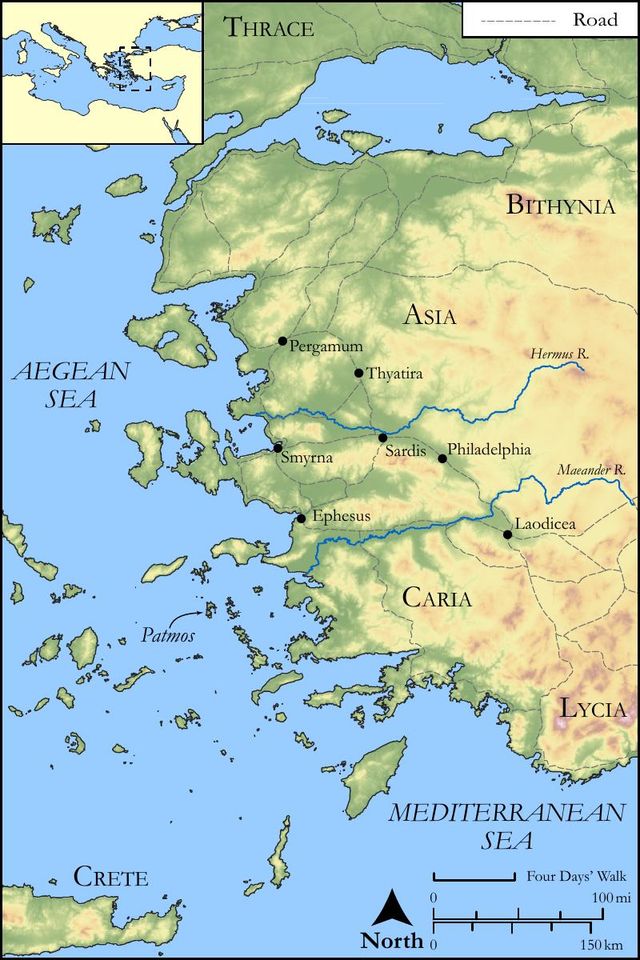
See on the biblical-era maps

Study this verse
Public-domain commentary
Matthew Henry
From his Commentary on the Whole Bible. Henry comments on passages, not single verses — this entry covers Revelation 4:8–11. His three-level outline is real structure in the source text, so it is rendered as structure.
We have considered the sights that the apostle saw in heaven: now let us observe the songs that he heard, for there is in heaven not only that to be seen which will highly please a sanctified eye, but there is that to be heard which will greatly delight a sanctified ear. This is true concerning the church of Christ here, which is a heaven upon earth, and it will be eminently so in the church made perfect in the heaven of heavens.
I.He heard the song of the four living creatures, of the ministers of the church, which refers to the prophet Isaiah's vision, Isa 6:1-13. And here,
1.They adore one God, and one only, the Lord God Almighty, unchangeable and everlasting.
2.They adore three holies in this one God, the Holy Father, the Holy Son, and the Holy Spirit; and these are one infinitely holy and eternal Being, who sits upon the throne, and lives for ever and ever. In this glory the prophet saw Christ, and spoke of him.
II.He heard the adorations of the four-and-twenty elders, that is, of the Christian people represented by them; the ministers led, and the people followed, in the praises of God, Rev 4:10, Rev 4:11. Here observe,
1.The object of their worship, the same with that which the ministers adored: Him that sat on the throne, the eternal everliving God. The true church of God has one and the same object of worship. Two different objects of worship, either co-ordinate or sub-ordinate, would confound the worship and divide the worshippers. It is unlawful to join in divine worship with those who either mistake or multiply the object. There is but one God, and he alone, as God, is worshipped by the church on earth and in heaven.
2.The acts of adoration.
(1.)They fell down before him that sat on the throne; they discovered the most profound humility, reverence, and godly fear.
(2.)They cast their crowns before the throne; they gave God the glory of the holiness wherewith he had crowned their souls on earth and the honour and happiness with which he crowns them in heaven. They owe all their graces and all their glories to him, and acknowledge that his crown is infinitely more glorious than theirs, and that it is their glory to be glorifying God.
3.The words of adoration: they said, Thou art worthy, O Lord, to receive glory, and honour, and power, Rev 4:11. Observe,
(1.)They do not say, We give thee glory, and honour, and power; for what can any creature pretend to give unto God? But they say, thou art worthy to receive glory.
(2.)In this they tacitly acknowledge that God is exalted far above all blessing and praise. He was worthy to receive glory, but they were not worthy to praise, nor able to do it according to his infinite excellences.
4.We have the ground and reason of their adoration, which is threefold: - (1.) He is the Creator of all things, the first cause; and none but the Creator of all things should be adored; no made thing can be the object of religious worship. (2.) He is the preserver of all things, and his preservation is a continual creation; they are created still by the sustaining power of God. All beings but God are dependent upon the will and power of God, and no dependent being must be set up as an object of religious worship. It is the part of the best dependent beings to be worshippers, not to be worshipped. (3.) He is the final cause of all things: For thy pleasure they are and were created. It was his will and pleasure to create all things; he was not put upon it by the will of another; there is no such thing as a subordinate creator, that acts under and by the will and power of another; and, if there were, he ought not to be worshipped. As God made all things at his pleasure, so he made them for his pleasure, to deal with them as he pleases and to glorify himself by them one way or other. Though he delights not in the death of sinners, but rather that they should turn and live, yet he hath made all things for himself, Pro 16:4. Now if these be true and sufficient grounds for religious worship, as they are proper to God alone, Christ must needs be God, one with the Father and Spirit, and be worshipped as such; for we find the same causality ascribed to him. Col 1:16, Col 1:17, All things were created by him and for him, and he is before all things, and by him all things consist.
Historical interpretation
Eight Centuries of Reception
13 surviving comments on this verse. Each one is dated, so this reads as a timeline rather than a list.
Select a marker to jump to its quote. Markers stagger vertically where authors wrote within a few decades of each other.
Certainly it is right that God should be blessed in all places and at all times because it is every person’s duty to be ever mindful of his benefits, but this wish takes the form of a benediction. Moreover, when is the name of God not holy and blessed in itself, when of itself it makes others holy? To him the attending hosts of angels cease not to say, “Holy, holy, holy!” Therefore, we, too—the future comrades of the angels, if we earn this reward—become familiar even while here on this earth with that heavenly cry of praise to God and the duty of our future glory.
Otherwise, when is the name of God not "holy," and "hallowed" through Himself, seeing that of Himself He sanctifies all others-He to whom that surrounding circle of angels cease not to say, "Holy, holy, holy? " In like wise, therefore, we too, candidates for angelhood, if we succeed in deserving it, begin even here on earth to learn by heart that strain hereafter to be raised unto God, and the function of future glory.
"Six wings." These are the testimonies of the books of the Old Testament. Thus, twenty and four make as many as there are elders sitting upon the thrones. But as an animal cannot fly unless it have wings, so, too, the announcement of the New Testament gains no faith unless it have the fore-announced testimonies of the Old Testament, by which it is lifted from the earth, and flies. For in every case, what has been told before, and is afterwards found to have happened, that begets an undoubting faith. Again, also, if wings be not attached to the living creatures, they have nothing whence they may draw their life. For unless what the prophets foretold had been consummated in Christ, their preaching was vain. For the Catholic Church holds those things which were both before predicted and afterwards accomplished. And it flies, because the living animal is reasonably lifted up from the earth. But to heretics who do not avail themselves of the prophetic testimony, to them also there are present living creatures; but they do not fly, because they are of the earth. And to the Jews who do not receive the announcement of the New Testament there are present wings; but they do not fly, that is, they bring a vain prophesying to men, not adjusting facts to their words. And the books of the Old Testament that are received are twenty-four, which you will find in the epitomes of Theodore. But, moreover (as we have said), four and twenty elders, patriarchs and apostles, are to judge His people. For to the apostles, when they asked, saying, "We have forsaken all that we had, and followed Thee: what shall we have? "our Lord replied, "When the Son of man shall sit upon the throne of His glory, ye also shall sit upon twelve thrones, judging the twelve tribes of Israel." But of the fathers also who should judge, says the patriarch Jacob, "Dan also himself shall judge his people among his brethren, even as one of the tribes in Israel."
"The first living creature was like to a lion, and the second was like to a calf, and the third had a face like to a man, and the fourth was like to a flying eagle; and they had six wings, and round about and within they were full of eyes; and they had no rest, saying, Holy, holy, holy, Lord Omnipotent. And the four and twenty elders, failing down before the throne, adored God." The four and twenty elders arethe twenty-four books of the prophets and of the law, which give testimonies of the judgment. Moreover, also, they are the twenty-four fathers-twelve apostles and twelve patriarchs.And in that the living creatures are different in appearance, this is the reason: the living creature like to a lion designates Mark, in whom is heard the voice of the lion roaring in the desert. And in the figure of a man, Matthew strives to declareto us the genealogy of Mary, from whom Christ took flesh. Therefore, in enumerating from Abraham to David, and thence to Joseph, he spoke of Him as if of a man: therefore his announcement sets forth the image of a man. Luke, in narrating the priesthood of Zacharias as he offers a sacrifice for the people, and the angel that appears to him with respect of the priesthood, and the victim in the same description bore the likeness of a calf. John the evangelist, like to an eagle hastening on uplifted wings to greater heights, argues about the Word of God. Mark, therefore, as an evangelist thus beginning, "The beginning of the Gospel of Jesus Christ, as it is written in Isaiah the prophet; " The voice of one crying in the wilderness," -has the effigy of a lion. And Matthew, "The hook of the generation of Jesus Christ, the son of David, the son of Abraham: " this is the form of a man. But Luke said, "There was a priest, by name Zachariah, of the course of Abia, and his wife was of the daughters of Aaron: " this is the likeness of a calf. But John, when he begins, "In the beginning was the Word, and the Word was with God, and the Word was God," sets forth the likeness of a flying eagle. Moreover, not only do the evangelists express their four similitudes in their respective openings of the Gospels, but also the Word itself of God the Father Omnipotent, which is His Son our Lord Jesus Christ, bears the same likeness in the time of His advent. When He preaches to us, He is, as it were, a lion and a lion's whelp. And when for man's salvation He was made man to overcome death, and to set all men free, and that He offered Himself a victim to the Father on our behalf, He was called a calf. And that He overcame death and ascended into the heavens, extending His wings and protecting His people, He was named a flying eagle. Therefore these announcements, although they are four, yet are one, because it proceeded from one mouth. Even as the river in paradise, although it is one, was divided into four heads. Moreover, that for the announcement of the New Testament those bring creatures had eyes within and without, shows the spiritual providence which both looks into the secrets of the heart, and beholds the things which are coming after that are within and without.
For what is nearer [God] than the cherubim or the seraphim? And yet they, not even seeing him or standing on their feet, or even with bare, but as it were with veiled faces, offer their praises, with untiring lips doing nothing else but glorifying the divine and ineffable nature with the Trisagion.… For the Triad, praised, reverenced and adored, is one and indivisible and without degrees. It is united without confusion, just as the Monad also is distinguished without separation. For the fact of those venerable living creatures offering their praises three times, saying “Holy, holy, holy,” proves that the three Subsistences are perfect, just as in saying “Lord,” they declare the one Essence.
In the animals the twenty-four elders are indicated, for six wings in four animals amount to twenty-four wings, and moreover he saw the animals around the throne, which is where he said that he had seen the elders. But how could an animal with six wings be like an eagle with two wings unless the four animals were one with twenty-four wings? And in this we recognize the twenty-four elders who are the church, which he likens to an eagle with two wings, that is, the two Testaments, upon which it is borne above, lest it be hindered by earthly affections.
“Almighty” is applied to him on account of the dominion he has over the universe. But the Father governs the universe through the Son, as the apostle himself states: “For through him were all things created, visible and invisible, whether thrones, or dominions, or principalities, or powers.” Again, writing to the Hebrews, he states, “Because through him he made the world and appointed him heir of all things.” By “appointed” we are to take him as meaning “generated.” But if the Father made the world through him, and if through him all things were created and he is the heir of all things, it must be through him that he wields his sway over the universe. Just as light is generated from light and truth from truth, so Almighty is generated from Almighty. So we read in John’s Apocalypse about the seraphim: “And they rested not day and night, saying, ‘Holy, holy, holy, Lord God of armies, who was, and who is, and is to come, the Almighty.’ ” He then who is to come is called Almighty. Who else is to come save Christ, the Son of God?
Everywhere diffused in its individual members and in those who profess [the faith], the church ceaselessly praises God by word and deed in times of difficulty and in times of prosperity, and she does this throughout a variety of cities, regions, provinces, languages and peoples. Nor does she cease to praise the Lord day and night, while that perpetual praise continues that is given by those rational creatures in the heavens, in the Jerusalem above, after whose likeness the pilgrim church rejoices to be formed.
Each of them had six wings. By the perfection of their doctrine, they lift the Church to the heights. For the number six is called perfect because it is completed by its own parts. For one, which is the sixth part of six, and two, which is the third, and three, which is half, make up the same six. Alternatively, the six wings of the four living creatures, which are twenty-four, signify the same number of books of the Old Testament, by which the authority of the evangelists is supported and the truth is confirmed.
And around and within they are full of eyes, etc. The holy Church vigilantly regards itself both before God and before men. The Psalmist had seen its inner eyes when he says: All the glory of the king's daughter is within (Ps. 45). And the outer eyes when he immediately adds: In embroidered garments, she is led to the king (Ibid.). Alternatively, whether you attend to the letter or seek the allegory, you will always find light from the Gospel. Another translation has: Full of eyes before and behind. Because the light of the Gospel shines into the mysteries of the law and infuses the world with the splendor of the new grace.
And they had no rest day and night, etc. The holy creatures, throughout the time of the age, affirm the single dominion of the Deity, the omnipotence and eternity of the Holy Trinity, with the perpetual praise of the intellectual creature remaining in the heavens.
And the four living creatures had each of them six wings. We take the wings of the four living creatures to mean the words of the two Testaments. Then, although these wings are two, because of the doubled number twelve found in the tribes of Israel and the apostles, they are multiplied by twelve, and give twenty-four. In the same way, because of the knowledge of the Trinity that they spread throughout the world, they are also multiplied by three, and six appear in all. Alternatively, the six wings may be taken to mean the six laws: the first which is the natural law, the second which is that of Moses, the third which is that of the prophets, the fourth which is that of grace, the fifth which is that of the apostles, and the sixth which is that of the synods; by all of which the Church flies to heaven. And round about and within they are full of eyes. The living creatures are full of eyes both round about and within because the holy Church shows the light of preaching to believers, but conceals it from the unfaithful; or because the holy preachers show the way of faith and holiness to the minds of little people as though on the outside through the history only, and to the minds of perfect people as though on the inside through allegory; or because they incessantly see to it to provide their brothers with good examples on the outside, and to persevere in right intention on the inside. And they rest not day and night, saying: Holy, holy, holy, Lord God Almighty, who is, and who was, and who is to come. They rest not, that is, they do not desist from their cry; whence it is clear that the four living creatures represent the whole Church, because not only the evangelists, but also all the faithful do not desist from praising God day and night, that is in success and in adversity. By the fact of saying holy thrice, they indicate the three Persons. On the other hand, by saying Lord God Almighty, they show the one-substanced God in these three Persons. Yet, how can the words who is to come in the aforementioned praise correspond to the Trinity, when only the Son will come in his humanity to judge? One should know then that the invisible Trinity will assume the person of the Son and examine the just and sinners through it. It will not however come by passing from one place to another, but by showing its manifest power through the human form adopted by it, which will come down from heaven to the lower regions. We may also understand in this passage the divinity's present coming by which its saints are illuminated every day.
Them being full of eyes characteristics demonstrates God's all-encompassing watchfulness over them.
And they had no rest day or night; this does not mean that they live a life of pain and misery, unable to find relief from work and pressing necessity, but rather that they never cease praising God, delighting continually in their melody to Him.
The term "holy" being repeated seven times is a frequent and unceasing form of allusion. For the number seven is often handed down by divine Scripture; for example, "the barren woman bore seven children, and the many became weak through their offspring," (1 Sam.2:5) and "the seven eyes of the Lord watch over the entire earth," (Zech. 4:10) and "the righteous man is delivered seven times from distress." (Prov. 24:16)
He says, "who was, and is, and is to come." Through these, the Holy and venerable Trinity is revealed, as was stated earlier. There is nothing wrong with saying now, "for writing the same things is not burdensome to me," (Phil. 3:1) and the divine apostle has clearly demonstrated this to those who encounter it as certain.
The Father, who is, is named by Moses. For he says to him, "I AM THE ONE WHO IS [ἐγώ εἰμι ὁ ὤν]." (Ex. 3:14) And concerning the Son, it is said to the evangelist, "In the beginning was the Word, and the Word was with God, and the Word was God." (Jn. 1:1) And he says that the Holy Spirit is the one who is to come, for He always visits the souls worthy of receiving Him.
Continue studying Revelation 4:8 across the web’s major study libraries — every link below opens this exact verse, chapter, or book on the destination site.
Read & Compare
 BibleGatewayThis verse in more than 200 translations and 70 languages.
 Bible.comThe YouVersion reader — hundreds of translations, reading plans, and highlights.
 ESV.orgCrossway's official English Standard Version reader.
 NET BibleThe NET translation with 60,000+ translators' notes on every rendering decision.
 STEP BibleTyndale House's free study tool — original text, vocabulary, and scholarly resources.
 BibliaLogos Bible Software's free web reader.
 USCCBThe New American Bible (Revised Edition) with the U.S. bishops' study notes.
Commentaries
 BibleHub CommentariesDozens of classic commentaries on this verse, gathered on one page.
 StudyLightMore than 100 commentary sets — the largest collection on the web.
 BibleRefPlain-English commentary on what this verse means, verse by verse.
 Enduring WordDavid Guzik's free commentary on this chapter, widely used by Bible teachers.
 Bible Study ToolsVerse commentary alongside Greek and Hebrew study aids.
Original Language & Research
- BibleHub InterlinearThe verse word by word — original language, transliteration, and English.
- BibleHub LexiconEvery word's original-language definition and Strong's entry.
 Blue Letter BibleDeep-study tools — Strong's numbers, concordance, and word studies.
 CNTR CollationThe earliest Greek manuscripts of this verse, collated letter by letter.
Sermons, Hymns & Audio


TrulyRandomVerse is not affiliated with these sites and doesn’t control their content. They’re linked because they’re genuinely useful.
Summary
Revelation 4:8 offers a profound glimpse into the ceaseless worship of God within the heavenly throne room, as four enigmatic living creatures, adorned with multiple wings and eyes, incessantly proclaim the tri-holy nature, omnipotence, and eternal sovereignty of the Lord God Almighty. This verse serves as a foundational declaration of divine majesty, emphasizing God's absolute holiness and His timeless reign over all creation, inspiring awe and reverence for His unchanging character.
Context
ShowHideLiterary Context
Revelation 4 marks a pivotal transition in John's apocalyptic vision. Following the messages to the seven churches in Asia Minor in Revelation 2-3 that addressed their spiritual conditions and challenges, John is immediately transported "up hither" into the heavenly realm, as commanded in Revelation 4:1. This shift moves from earthly church concerns to the cosmic reality of God's sovereign rule. Chapter 4 introduces the central figure of God enthroned, surrounded by twenty-four elders and the four living creatures, setting the stage for the unveiling of future events and judgments, all proceeding from the divine authority and holiness established here. The description of these creatures and their worship is foundational to understanding the source and nature of all subsequent revelations.
Historical & Cultural Context
The imagery in Revelation 4:8 draws heavily from Old Testament prophetic traditions, particularly the visions of Ezekiel and Isaiah. The "living creatures" (Greek: zōa) resonate with the cherubim described in Ezekiel 1 and Ezekiel 10 and the seraphim in Isaiah 6. These creatures were understood in ancient Near Eastern cosmology as guardians of the divine presence and throne, often depicted with multiple faces, wings, and eyes, symbolizing their comprehensive knowledge, swiftness, and unwavering vigilance in serving God. The repeated "Holy, holy, holy" (Trisagion) directly echoes the seraphim's cry in Isaiah 6:3, a profound declaration of God's absolute purity and transcendence that would have been immediately recognizable to Jewish readers familiar with the Hebrew Scriptures.
Key Themes
ShowHideThis verse powerfully contributes to several overarching themes within Revelation and biblical theology. Firstly, it underscores God's Absolute Holiness, presenting Him as utterly separate from sin and supremely pure, a truth that pervades the entire book and dictates the nature of divine judgment and redemption. Secondly, it highlights Ceaseless Worship, portraying a heavenly reality where adoration of God is continuous and unending, reflecting His infinite worthiness. This theme contrasts with the temporary and often flawed worship on earth, pointing to an eternal standard. Thirdly, the declaration "Lord God Almighty, which was, and is, and is to come" emphasizes God's Eternal Sovereignty and Omnipotence. This title, also found in Revelation 1:8, establishes God as the unchanging, all-powerful ruler of history and creation, providing a theological anchor for the tumultuous events that follow in the book. Finally, the "eyes within" suggest Divine Wisdom and Omniscience, indicating that God's knowledge and perception are boundless, and that His heavenly attendants share in a profound awareness of His purposes.
Exposition and Analysis
ShowHideKey Word Analysis
ShowHideMeaning "a live thing, i.e. an animal." The KJV translation "beasts" can be misleading, as the Greek zōon (ζῷον) more accurately translates to "living creatures." This distinction is crucial, as the term thērion (θηρίον), meaning "wild beast," is used later in Revelation to refer to the malevolent political and spiritual powers opposing God. Here, zōon emphasizes the vitality and spiritual nature of these beings, distinguishing them as divinely appointed attendants rather than monstrous entities. They embody life and are intimately connected to the source of all life.
G1073 (gemō) means "to swell out, i.e. be full." G3788 (ophthalmos) refers to "the eye (literally or figuratively)." G2081 (esōthen) means "from inside; also used as equivalent to ἔσω (inside)." The description of the living creatures being "full of eyes within" signifies their comprehensive knowledge, vigilance, and insight. The eyes symbolize omniscience and awareness, not only of external realities but also of the inner workings of God's purposes and creation. This imagery suggests a profound, all-encompassing perception, indicating that nothing escapes their notice, and by extension, nothing escapes God's notice.
G372 (anapausis) means "intermission; by implication, recreation," or "rest." G3756 (ou) is the absolute negative adverb "no or not." G2192 (echō) means "to hold," or "to have." The phrase "they rest not" (οὐκ ἔχουσιν ἀνάπαυσιν) emphasizes the continuous and unending nature of their worship. Their adoration is not intermittent or wearying but a perpetual, energetic outpouring of praise. This ceaseless activity underscores God's unending worthiness and the eternal, dynamic reality of heavenly worship, which never diminishes because God's glory never fades.
G2064 (erchomai) is a primary verb meaning "to come or go." G3801 (ho ōn kai ho ēn kai ho erchomenos) is a phrase meaning "the one being and the one that was and the one coming, i.e. the Eternal, as a divine epithet of Christ." This phrase, "which was, and is, and is to come," is a profound declaration of God's eternal nature, transcending all temporal limitations. It affirms His existence in the past (He "was"), His present reality (He "is"), and His future sovereignty (He "is to come"). This title encapsulates God's immutability, His active presence throughout history, and His ultimate authority over all future events, providing assurance of His unchanging character and ultimate victory.
Verse Breakdown
ShowHide"And the four beasts had each of them six wings about him;"
This introduces the appearance of the four living creatures, specifying their number and the striking detail of six wings. The wings symbolize swiftness, readiness for service, and perhaps also a covering for humility or reverence in the divine presence, echoing the seraphim of Isaiah's vision. The phrase "about him" (referring to each creature) indicates the wings encircle their bodies, contributing to their majestic and formidable appearance.
"and they were full of eyes within:"
This detail emphasizes the creatures' extraordinary perception, knowledge, and vigilance. The eyes, both "within" and presumably without (as suggested by other passages), symbolize their comprehensive awareness of God's purposes, their constant watchfulness over creation, and perhaps their deep spiritual insight into the divine mysteries. This imagery conveys a sense of beings fully attuned to God's will and glory.
"and they rest not day and night, saying,"
This clause highlights the continuous, unending nature of their worship. The absence of "rest" (ἀνάπαυσις) signifies an unceasing, tireless devotion. "Day and night" emphasizes the perpetual cycle of their adoration, indicating that God's glory is so immense and His worthiness so absolute that He is worthy of constant, uninterrupted praise. This sets a standard for heavenly worship, a model for all creation.
"Holy, holy, holy, Lord God Almighty, which was, and is, and is to come."
This is the core of their ceaseless declaration. The Trisagion, "Holy, holy, holy," is a superlative expression of God's absolute purity, moral perfection, and transcendence, emphasizing His unique and incomparable nature. The title "Lord God Almighty" (Greek: Kyrios Theos Pantokrator) proclaims His supreme authority, omnipotence, and universal sovereignty over all things. The final phrase, "which was, and is, and is to come," declares God's eternal, self-existent nature, encompassing all time—past, present, and future—and affirming His unchanging presence and control over history.
Literary Devices
ShowHideRevelation 4:8 is rich in Symbolism, employing vivid imagery to convey profound theological truths. The "four beasts" (living creatures) themselves are symbolic, representing perhaps the highest order of created beings, or even all creation, in worship before God. Their "six wings" symbolize readiness for service and reverence, while being "full of eyes within" powerfully conveys Omniscience and Vigilance, suggesting an all-encompassing awareness and insight into divine purposes. The phrase "they rest not day and night" uses Hyperbole to emphasize the continuous, unceasing nature of heavenly worship, highlighting God's infinite worthiness. The most prominent device is Repetition, specifically the Trisagion ("Holy, holy, holy"). This threefold repetition, a Hebrew idiom for superlative emphasis, underscores God's absolute and incomparable holiness, making it the central attribute proclaimed. The entire verse functions as an Apostrophe or direct address to God, even though He is not explicitly speaking, as the creatures are declaring His attributes.
Theological and Thematic Connections
ShowHideRevelation 4:8 serves as a majestic theological cornerstone, establishing God's supreme holiness, eternal nature, and absolute sovereignty as the foundation for all subsequent revelations. The ceaseless worship of the living creatures underscores that adoration is the proper and perpetual response to God's inherent glory. This divine portrait provides comfort and assurance that despite earthly turmoil, an all-powerful, ever-present, and perfectly holy God remains enthroned, actively governing all things according to His unchanging character. This vision calls believers to align their worship and understanding with this heavenly reality, recognizing God's ultimate authority and worthiness above all else.
Reflection and Application
ShowHideThe profound vision of Revelation 4:8 calls us to a deeper understanding of who God is and what our response should be. To truly grasp that the Lord God Almighty is "Holy, holy, holy" should cultivate within us an overwhelming sense of awe, reverence, and humility. This isn't a distant, passive deity, but one whose very being radiates absolute purity and power, demanding continuous adoration from the highest heavenly beings. Our earthly worship, whether corporate or private, should strive to reflect this heavenly standard – not as a duty, but as an overflow of a heart captivated by His infinite worthiness. In a world characterized by change, uncertainty, and often chaos, the declaration that God "was, and is, and is to come" provides an unshakable anchor. It assures us of His unchanging presence, His sovereign control over all history, and His ultimate victory. This truth should inspire unwavering trust and confidence, knowing that the One who holds all time in His hands is our Lord.
Questions for Reflection
ShowHideFAQ
ShowHideWhat are the "four beasts" mentioned in Revelation 4:8?
ShowHideThe "four beasts" are more accurately translated as "four living creatures" (from the Greek zōa). They are symbolic, majestic beings that serve as guardians of God's throne and lead the heavenly worship. Their description, with multiple wings and eyes, draws parallels to the cherubim and seraphim seen in Old Testament visions, such as those in Ezekiel 1 and Isaiah 6. They represent the highest order of created beings, perpetually engaged in worshipping and proclaiming God's attributes.
Why do the living creatures say "Holy, holy, holy" three times?
ShowHideThe threefold repetition, "Holy, holy, holy," known as the Trisagion, is a Hebrew idiom used to express the highest possible degree or superlative. It emphasizes God's absolute and incomparable holiness, purity, and moral perfection. The repetition underscores that God is not just holy, but supremely holy, set apart from all creation and sin. Theologically, many also interpret this triple declaration as an implicit reference to the Trinity: God the Father, God the Son, and God the Holy Spirit, all equally holy and worthy of worship. This same cry is found in Isaiah 6:3.
Christ-Centered Fulfillment
ShowHideRevelation 4:8, while focusing on the worship of God the Father on His throne, inherently points to Christ in its profound declaration of God's eternal nature and ultimate sovereignty. The title "Lord God Almighty, which was, and is, and is to come" is also applied to Jesus Christ in Revelation 1:8, affirming His co-eternality and shared divine attributes with the Father. The ceaseless worship of the living creatures, proclaiming God's holiness, foreshadows the Lamb's worthiness to receive the same adoration. Later in Revelation, the very same heavenly chorus will expand to include the worship of the Lamb who was slain (Revelation 5:12-14). Jesus, as the Lamb of God, is the one through whom humanity gains access to this holy presence and participates in this eternal worship. His atoning sacrifice on the cross makes it possible for redeemed sinners to stand before the thrice-holy God. Furthermore, Christ is the one "who is to come," signifying His return in glory to fully establish God's kingdom, bringing to completion all that is declared in this heavenly throne room scene (Revelation 22:20). Thus, the worship in Revelation 4:8 is a Christ-centered worship, made possible by Him and ultimately directed to Him as part of the triune Godhead.