


Revelation 4:7
Bible text: King James Version (1769 Blayney text) · Public domain
Bible text: King James Version with Strong's numbers · Public domain
Bible text: Berean Standard Bible · Public domain
Bible text: American Standard Version (1901) · Public domain
Bible text: World English Bible, Messianic edition · Public domain
Bible text: Geneva Bible (1599) · Public domain
Bible text: Young's Literal Translation · Public domain
- καὶkaiAndG2532CONJConjunction
- τὸtotheG3588T-NSNDefinite article Nominative Singular Neuter
- ζῷονzōonliving creatureG2226N-NSNNoun Nominative Singular Neuter
- τὸto<the>G3588T-NSNDefinite article Nominative Singular Neuter
- πρῶτονprōtonfirstG4413A-NSNAdjective Nominative Singular Neuter
- ὅμοιονhomoion[was] likeG3664A-NSNAdjective Nominative Singular Neuter
- λέοντιleontias a lionG3023N-DSMNoun Dative Singular Masculine
- καὶkaiandG2532CONJConjunction
- τὸtotheG3588T-NSNDefinite article Nominative Singular Neuter
- δεύτερονdeuteronsecondG1208A-NSNAdjective Nominative Singular Neuter
- ζῷονzōonliving creatureG2226N-NSNNoun Nominative Singular Neuter
- ὅμοιονhomoionlikeG3664A-NSNAdjective Nominative Singular Neuter
- μόσχῳmoschōas a calfG3448N-DSMNoun Dative Singular Masculine
- καὶkaiandG2532CONJConjunction
- τὸtotheG3588T-NSNDefinite article Nominative Singular Neuter
- τρίτονtritonthirdG5154A-NSNAdjective Nominative Singular Neuter
- ζῷονzōonliving creatureG2226N-NSNNoun Nominative Singular Neuter
- ἔχωνechōnhe is havingG2192V-PAP-NSMVerb Present Active Participle Nominative Singular Masculine
- τὸtotheG3588T-ASNDefinite article Accusative Singular Neuter
- πρόσωπονprosōponfaceG4383N-ASNNoun Accusative Singular Neuter
- ὡςhōsasG5613PRTParticle or Disjunctive
- ἀνθρώπουanthrōpouof a manG444N-GSMNoun Genitive Singular Masculine
- καὶkaiandG2532CONJConjunction
- τὸtotheG3588T-NSNDefinite article Nominative Singular Neuter
- τέταρτονtetartonfourthG5067A-NSNAdjective Nominative Singular Neuter
- ζῷονzōonliving creatureG2226N-NSNNoun Nominative Singular Neuter
- ὅμοιονhomoionlikeG3664A-NSNAdjective Nominative Singular Neuter
- ἀετῷaetōas an eagleG105N-DSMNoun Dative Singular Masculine
- πετομένῳpetomenōflyingG4072V-PNP-DSMVerb Present Middle Or Passive Deponent Participle Dative Singular Masculine
English is a literal word-by-word gloss of the Greek, not the KJV's wording. Why?
This is the original text the KJV's translators worked from — each Greek word with its own literal English meaning in this verse, prepared by scholars at Tyndale House, Cambridge. The KJV translates whole sentences, not word by word, so its wording differs: one Greek word can become several English words, and the KJV may choose “charity” where the gloss reads “love”. Both are faithful — they answer different questions. For the KJV's own rendering, switch to the KJV text.
Details
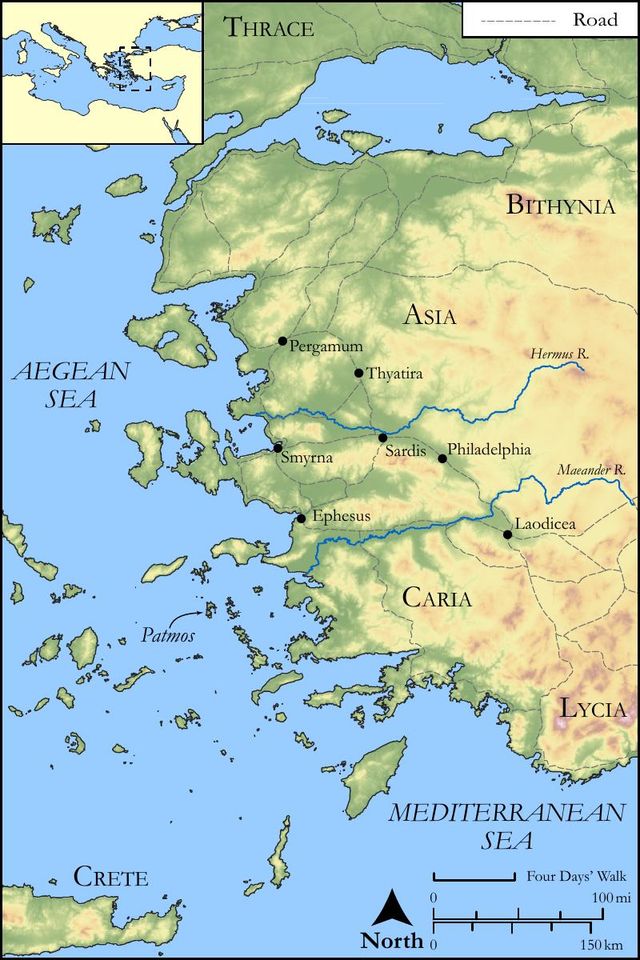
See on the biblical-era maps

Study this verse
Public-domain commentary
Matthew Henry
From his Commentary on the Whole Bible. Henry comments on passages, not single verses — this entry covers Revelation 4:1–7. His three-level outline is real structure in the source text, so it is rendered as structure.
We have here an account of a second vision with which the apostle John was favoured: After this, that is, not only "after I had seen the vision of Christ walking in the midst of the golden candlesticks," but "after I had taken his messages from his mouth, and written and sent them to the several churches, according to his command, after this I had another vision." Those who well improve the discoveries they have had of God already are prepared thereby for more, and may expect them. Observe,
I.The preparation made for the apostle's having this vision.
1.A door was opened in heaven. Hence we learn,
(1.)Whatever is transacted on earth is first designed and settled in heaven; there is the model of all the works of God; all of them are therefore before his eye, and he lets the inhabitants of heaven see as much of them as is fit for them.
(2.)We can know nothing of future events but what God is pleased to discover to us; they are within the veil, till God opens the door. But,
(3.)So far as God reveals his designs to us we may and ought to receive them, and not pretend to be wise above what is revealed.
2.To prepare John for the vision, a trumpet was sounded, and he was called up into heaven, to have a sight there of the things which were to be hereafter. He was called into the third heavens.
(1.)There is a way opened into the holiest of all, into which the sons of God may enter by faith and holy affections now, in their spirits when they die, and in their whole persons at the last day.
(2.)We must not intrude into the secret of God's presence, but stay till we are called up to it.
3.To prepare for this vision, the apostle was in the Spirit. He was in a rapture, as before (Rev 1:10), whether in the body or out of the body we cannot tell; perhaps he himself could not; however all bodily actions and sensations were for a time suspended, and his spirit was possessed with the spirit of prophecy, and wholly under a divine influence. The more we abstract ourselves from all corporeal things the more fit we are for communion with God; the body is a veil, a cloud, and clog to the mind in its transactions with God. We should as it were forget it when we go in before the Lord in duty, and be willing to drop it, that we may go up to him in heaven. This was the apparatus to the vision. Now observe,
II.The vision itself.
It begins with the strange sights that the apostle saw, and they were such as these: - 1. He saw a throne set in heaven, the seat of honour, and authority, and judgment. Heaven is the throne of God; there he resides in glory, and thence he gives laws to the church and to the whole world, and all earthly thrones are under the jurisdiction of this throne that is set in heaven. 2. He saw a glorious one upon the throne. This throne was not empty; there was one in it who filled it, and that was God, who is here described by those things that are most pleasant and precious in our world: His countenance was like a jasper and a sardine-stone; he is not described by any human features, so as to be represented by an image, but only by his transcendent brightness. This jasper is a transparent stone, which yet offers to the eye a variety of the most vivid colours, signifying the glorious perfections of God; the sardine-stone is red, signifying the justice of God, that essential attribute of which he never divests himself in favour of any, but gloriously exerts it in the government of the world, and especially of the church, through our Lord Jesus Christ. This attribute is displayed in pardoning as well as in punishing, in saving as well as in destroying sinners. 3. He saw a rainbow about the throne, like unto an emerald, Rev 4:3. The rainbow was the seal and token of the covenant of the providence that God made with Noah and his posterity with him, and is a fit emblem of that covenant of promise that God has made with Christ as the head of the church, and all his people in him, which covenant is as the waters of Noah unto God, an everlasting covenant, ordered in all things and sure. This rainbow looked like the emerald; the most prevailing colour was a pleasant green, to show the reviving and refreshing nature of the new covenant. 4. He saw four-and-twenty seats round about the throne, not empty, but filled with four-and-twenty elders, presbyters, representing, very probably, the whole church of God, both in the Old Testament and in the New Testament state; not the ministers of the church, but rather the representatives of the people. Their sitting denotes their honour, rest, and satisfaction; their sitting about the throne signifies their relation to God, their nearness to him, the sight and enjoyment they have of him. They are clothed in white raiment, the righteousness of the saints, both imputed and inherent; they had on their heads crowns of gold, signifying the honour and authority given them of God, and the glory they have with him. All these may in a lower sense be applied to the gospel church on earth, in its worshipping assemblies; and, in the higher sense, to the church triumphant in heaven. 5. He perceived lightnings and voices proceeding out of the throne; that is, the awful declarations that God makes to his church of his sovereign will and pleasure. Thus he gave forth the law on mount Sinai; and the gospel has not less glory and authority than the law, though it be of a more spiritual nature. 6. He saw seven lamps of fire burning before the throne, which are explained to be the seven Spirits of God (Rev 4:5), the various gifts, graces, and operations of the Spirit of God in the churches of Christ; these are all dispensed according to the will and pleasure of him who sits upon the throne. 7. He saw before the throne a sea of glass, like unto crystal. As in the temple there was a great vessel of brass filled with water, in which the priests were to wash when they went to minister before the Lord (and this was called a sea), so in the gospel church the sea or laver for purification is the blood of the Lord Jesus Christ, who cleanses from all sin, even from sanctuary-sins. In this all those must be washed that are admitted into the gracious presence of God on earth or his glorious presence in heaven. 8. He saw four animals, living creatures, between the throne and the circle of elders (as seems most probable), standing between God and the people; these seem to signify the ministers of the gospel, not only because of this their situation nearer to God, and between him and the elders or representatives of the Christian people, and because fewer in number than the people, but as they are here described, (1.) By their many eyes, denoting sagacity, vigilance, and circumspection. (2.) By their lion-like courage, their great labour and diligence (in which they resemble the ox), their prudence and discretion becoming men, and their sublime affections and speculations, by which they mount up with wings like eagles towards heaven (Rev 4:7), and these wings full of eyes within, to show that in all their meditations and ministrations they are to act with knowledge, and especially should be well acquainted with themselves and the state of their own souls, and see their own concern in the great doctrines and duties of religion, watching over their own souls as well as the souls of the people. (3.) By their continual employment, and that is, praising God, and not ceasing to do so night and day. The elders sit and are ministered unto; these stand and minister: they rest not night nor day. This now leads to the other part of the representation.
Historical interpretation
Eight Centuries of Reception
8 surviving comments on this verse. Each one is dated, so this reads as a timeline rather than a list.
Select a marker to jump to its quote. Markers stagger vertically where authors wrote within a few decades of each other.
It is not possible that the Gospels can be either more or fewer in number than they are. For there are four zones of the world in which we live, and four principal winds, while the church is scattered throughout the world. And the “pillar and ground” of the church is the gospel and the Spirit of life. So it is fitting that she should have four pillars, breathing out immortality on every side and making people alive once more. From which fact, it is evident that the Word, the Craftsman of all things, who sits upon the cherubim and contains all things, who was manifested to humankind, has given us the gospel under four aspects but bound together by one Spirit. As also David says, when praying to the manifestation of the Word, “You, who sit between the cherubim, shine forth.” For the cherubim, too, were four-faced, and their faces were images of the dispensation of the Son of God. For, [as the Scripture] says, “The first living creature was like a lion,” symbolizing his effectual working, his leadership and royal power. The second [living creature] was like a calf, signifying [his] sacrificial and priestly order. But “the third had, as it were, the face as of a man,” an evident description of the Word’s advent as a human being. “The fourth was like a flying eagle,” pointing out the gift of the Spirit hovering with his wings over the church. And therefore the Gospels are in accord with these things, among which Christ Jesus is seated. For the Word, according to John, relates his original, effectual and glorious generation from the Father, thus declaring, “In the beginning was the Word, and the Word was with God, and the Word was God.” Also, “all things were made by him, and without him was nothing made.” For this reason, too, is that Gospel full of all confidence, for such is his person. But that according to Luke, the taking up [his] priestly character, commenced with Zechariah the priest offering sacrifice to God. For now was made ready the fatted calf, about to be sacrificed by fire for the finding again of the younger son. Matthew, again, relates his generation of Jesus Christ, “the son of David, the son of Abraham.” And also, “the birth of Jesus Christ happened this way.” This, then, is the Gospel of his humanity. For which reason it is, too, that [the character of] a humble and meek man is sustained through the whole Gospel. Mark, on the other hand, commences with [a reference to] the prophetic spirit coming down from on high to men. He says, “The beginning of the Gospel of Jesus Christ, as it is written in Isaiah the prophet,” pointing to the winged aspect of the Gospel. On this account he made a compendious and cursory narrative, for such is the prophetic character.
"The first living creature was like to a lion, and the second was like to a calf, and the third had a face like to a man, and the fourth was like to a flying eagle; and they had six wings, and round about and within they were full of eyes; and they had no rest, saying, Holy, holy, holy, Lord Omnipotent. And the four and twenty elders, failing down before the throne, adored God." The four and twenty elders arethe twenty-four books of the prophets and of the law, which give testimonies of the judgment. Moreover, also, they are the twenty-four fathers-twelve apostles and twelve patriarchs.And in that the living creatures are different in appearance, this is the reason: the living creature like to a lion designates Mark, in whom is heard the voice of the lion roaring in the desert. And in the figure of a man, Matthew strives to declareto us the genealogy of Mary, from whom Christ took flesh. Therefore, in enumerating from Abraham to David, and thence to Joseph, he spoke of Him as if of a man: therefore his announcement sets forth the image of a man. Luke, in narrating the priesthood of Zacharias as he offers a sacrifice for the people, and the angel that appears to him with respect of the priesthood, and the victim in the same description bore the likeness of a calf. John the evangelist, like to an eagle hastening on uplifted wings to greater heights, argues about the Word of God. Mark, therefore, as an evangelist thus beginning, "The beginning of the Gospel of Jesus Christ, as it is written in Isaiah the prophet; " The voice of one crying in the wilderness," -has the effigy of a lion. And Matthew, "The hook of the generation of Jesus Christ, the son of David, the son of Abraham: " this is the form of a man. But Luke said, "There was a priest, by name Zachariah, of the course of Abia, and his wife was of the daughters of Aaron: " this is the likeness of a calf. But John, when he begins, "In the beginning was the Word, and the Word was with God, and the Word was God," sets forth the likeness of a flying eagle. Moreover, not only do the evangelists express their four similitudes in their respective openings of the Gospels, but also the Word itself of God the Father Omnipotent, which is His Son our Lord Jesus Christ, bears the same likeness in the time of His advent. When He preaches to us, He is, as it were, a lion and a lion's whelp. And when for man's salvation He was made man to overcome death, and to set all men free, and that He offered Himself a victim to the Father on our behalf, He was called a calf. And that He overcame death and ascended into the heavens, extending His wings and protecting His people, He was named a flying eagle. Therefore these announcements, although they are four, yet are one, because it proceeded from one mouth. Even as the river in paradise, although it is one, was divided into four heads. Moreover, that for the announcement of the New Testament those bring creatures had eyes within and without, shows the spiritual providence which both looks into the secrets of the heart, and beholds the things which are coming after that are within and without.
Both in the prophet Ezekiel and in the Apocalypse of the same John whose Gospel this is, there is mentioned a quadruple beast, having four characteristic faces: a man's, a calf's, a lion's, an eagle's. Very many who have commented on the mysteries of the holy Scriptures before us have understood the four Evangelists in this animal, or rather in these animals. The lion, [they say], has been put for king, because the lion seems to be, in a way, the king of beasts because of his power and terrifying bravery. This character has been attributed to Matthew because he described in proper order the royal line in the generations of the Lord, how the Lord was through royal descent from the seed of King David. But Luke, because he began from the priesthood of the priest Zechariah, making mention of the father of John the Baptist, is accounted the calf because the calf was the important victim in the sacrifice of the priests. Christ as a man has rightly been assigned to Mark, because neither did he say anything about his royal power nor did he begin from the priestly, but he simply started with Christ the man. All of these have practically not departed from the earthly things, that is, from those deeds that the Lord Jesus Christ performed on earth. They said very few things about his divinity, as if they were walking with him on earth. There remains the eagle: it is John, he who preaches the sublime and who gazes with unflinching eyes upon the internal and eternal light.
The church, therefore, lives and works on the strength and beauty of the royal majesty, because the Lion of the tribe of Judah conquers. “For Judah is a lion’s cub,” from whose tribe kings are accustomed to be set over the people. “And the second animal was like a calf.” For the same reason, the virtue of the church is indicated in the calf, namely, the first victim, for whenever anyone of the faithful is slain for Christ, he conquers at that moment. “Present your bodies as a living sacrifice, holy and pleasing to God, which is your reasonable worship,” so that what the Head has accomplished on behalf of the body, the body may be worthy to fulfill for the Head. For this reason, [the Gospel of Luke] began with Zechariah the priest. “The third animal had a face like a man.” In my opinion, the humility of the church is here commended. For although she has received “the Spirit of the adoption of sons” and possesses “this treasure in clay vessels,” she nevertheless freely prefers to glory humbly in her weaknesses than to be praised in the strengths that she has acquired. In this way she devoutly follows in the footsteps of the Master who was “made obedient even unto death” and who said, “Learn from me for I am gentle and humble of heart.” “The fourth animal was like a flying eagle.” The celestial church is being described as flying on the spiritual thoughts of her members. For she is free from the heaviness of earthly desires and is drawn into the heights at the direction of the two Testaments.
“The first animal was like a lion.” Most of our interpreters say that this signifies the person of Mark, the Evangelist. And indeed this seems most apt and true, for his Gospel begins in this way: “The beginning of the gospel of Jesus Christ, the Son of God. As it is written in Isaiah the prophet, ‘Behold, I send my messenger who shall prepare the way before your face.’ ” Nor is it strange that here Isaiah is mentioned instead of Malachi, for most certainly this testimony occurs in Malachi. However, “Isaiah” means “the salvation of the Lord,” and “Malachi” means “angel.” And so at the beginning of the Gospel he prefers to speak of the salvation of the Lord, which is “Isaiah,” rather than of the angel, which is “Malachi,” in order that through the faith of the gospel he might suggest the immovable perpetuity of the present and future life. And then, to be sure, he mentions the “messenger,” which is “angel,” and he adds the words of Isaiah: “Prepare the way of the Lord; make straight the highways of our God,” so that, salvation having been both promised and foretold, he might show the messenger of the truth and might prepare the hearts of humankind for the reception of grace. And the form of the lion is in this, that he reports that John was in the desert preaching and enjoying the desert, as he says: “John was in the desert baptizing and proclaiming the baptism of repentance for the forgiveness of sins.” The words “the second creature was like an ox” introduce Luke. For a bull is representative of the priesthood, as it is said in Isaiah: “Blessed are you who sow upon all the waters, letting the feet of the ox and the ass go free.” And so at the beginning of his Gospel, he speaks of Zechariah the priest: “In the days of Herod, king of Judea, there was a priest named Zechariah.” “The third living creature with the face of a man” indicates Matthew, for at the beginning of his Gospel, Matthew wished to report the genealogy of the Lord according to the flesh. The words “the fourth living creature was like a flying eagle” indicate John. For, at the beginning of his Gospel, John did not speak of the humanity of the Lord or of the priesthood or of John preaching in the desert. Rather, desiring like an eagle to reach toward the height of heaven itself, he left behind all things lowly and spoke properly of him as God: “In the beginning was the Word, and the Word was with God, and the Word was God; he was in the beginning with God.”
And the first living creature was like a lion, etc. These living creatures are interpreted in various ways. But blessed Augustine, according to the order of this book, says that Matthew is understood in the lion, who narrates the royal lineage of Christ, who also conquered as the Lion of the tribe of Judah. For the cub of the lion is Judah (Gen. 49). And in whom, as a king, he is feared by a king, worshipped by the magi. Where also the king reckons with his servants, the king makes a marriage for his son, and finally, the king separates the sheep from the goats. Luke is in the calf, which was a great sacrifice in the law. For not only are his beginnings around the temple and sacrifices, but it also concludes: And they were continually in the temple praising and blessing God (Luke 24). The face of a man signifies Mark, who, saying nothing of the royal or priestly power of the Lord, simply narrates the deeds of the man Christ. But John is the eagle, who sharply looks at the birth of the Word like the rising sun. The living creatures sometimes signify the evangelists, sometimes the whole Church. Whose strength is shown in the lion, sacrifice in the calf, humility in the man, sublimity in the flying eagle.
And the first living creature was like a lion: and the second living creature like a calf: and the third living creature, having the face, as it were, of a man: and the fourth living creature was like an eagle flying. We should ask the question of why John said that the first living creature was like a lion while Ezekiel says that the appearance of man was in the first animal. So, either the historical order (which the mystical words of the Scriptures do not always keep) has been changed, or he put the symbol of the lion first because it is not on account of the Nativity or of the Passion that people have believed in Christ, but on account of the Resurrection, which is symbolized by the lion. Finally, since he began with the human generation, [Sc. of Jesus. Matt. 1:1 et seq.] Matthew is appropriately represented by the man; since he began with the cry in the desert, [Mark 1:3] Mark is appropriately represented by the lion; since he started with a sacrifice, [Luke 1:8] Luke is well represented by the calf; and John, who began with the divinity, [John 1:1 et seq.] is fittingly represented by the eagle. All this can also refer to Christ and all his limbs. However, for brevity's sake, let us content ourselves with what we have said here.
Each of the animals is associated with one of these elements:
the lion with fire, due to the animal's warmth and spirited nature;
the calf with the earth, because the calf's work is connected to the soil;
the man with the air, as humans are celestial and transcendent beings due to the artfulness [λεπτότητα] of the mind;
and the eagle with water, since birds originate from water.
Around the throne of God are seen those deemed worthy of care and providence, signified through living beings, that is, those on earth.
Continue studying Revelation 4:7 across the web’s major study libraries — every link below opens this exact verse, chapter, or book on the destination site.
Read & Compare
 BibleGatewayThis verse in more than 200 translations and 70 languages.
 Bible.comThe YouVersion reader — hundreds of translations, reading plans, and highlights.
 ESV.orgCrossway's official English Standard Version reader.
 NET BibleThe NET translation with 60,000+ translators' notes on every rendering decision.
 STEP BibleTyndale House's free study tool — original text, vocabulary, and scholarly resources.
 BibliaLogos Bible Software's free web reader.
 USCCBThe New American Bible (Revised Edition) with the U.S. bishops' study notes.
Commentaries
 BibleHub CommentariesDozens of classic commentaries on this verse, gathered on one page.
 StudyLightMore than 100 commentary sets — the largest collection on the web.
 BibleRefPlain-English commentary on what this verse means, verse by verse.
 Enduring WordDavid Guzik's free commentary on this chapter, widely used by Bible teachers.
 Bible Study ToolsVerse commentary alongside Greek and Hebrew study aids.
Original Language & Research
- BibleHub InterlinearThe verse word by word — original language, transliteration, and English.
- BibleHub LexiconEvery word's original-language definition and Strong's entry.
 Blue Letter BibleDeep-study tools — Strong's numbers, concordance, and word studies.
 CNTR CollationThe earliest Greek manuscripts of this verse, collated letter by letter.
Sermons, Hymns & Audio


TrulyRandomVerse is not affiliated with these sites and doesn’t control their content. They’re linked because they’re genuinely useful.
Summary
Revelation 4:7 provides a vivid description of the four living creatures surrounding God's throne, detailing their distinct appearances as a lion, a calf, a man, and a flying eagle. These symbolic forms encapsulate the multifaceted nature of creation and divine attributes, serving as central figures in the perpetual heavenly worship of the Almighty, thereby emphasizing God's supreme majesty, power, and sovereignty over all things.
Context
ShowHideLiterary Context
Revelation chapter 4 marks a pivotal transition in John's apocalyptic vision, moving from the earthly concerns of the seven churches in Revelation 2-3 to a profound unveiling of God's heavenly throne room. This shift establishes the divine authority and universal scope of the revelations that follow. Verse 7 builds directly upon the introduction of the four living creatures in Revelation 4:6, providing specific details about their individual appearances. These creatures are not merely decorative but are active participants in the heavenly liturgy, continuously offering praise and adoration, a role further emphasized in subsequent chapters like Revelation 5. Their presence underscores the holiness and majesty of the One seated on the throne, setting the stage for the unfolding of God's redemptive plan.
Historical & Cultural Context
The imagery of living creatures with multiple faces or forms is deeply rooted in the prophetic tradition of Israel. Visions of divine chariots and throne rooms, often attended by composite beings, are found in texts like Ezekiel 1 and Isaiah 6. In Scripture, animal symbolism is a common means of conveying power, character, and divine attributes. Lions represented royalty and strength, oxen/calves symbolized service and sacrifice, human figures denoted intelligence and compassion, and eagles signified transcendence and swiftness. John, writing to a first-century audience familiar with such prophetic motifs and symbolic language, would have conveyed profound theological truths through these instantly recognizable archetypes, drawing on a rich tapestry of shared spiritual understanding to depict the awe-inspiring reality of God's presence.
Key Themes
ShowHideThe description of the four living creatures in Revelation 4:7 contributes significantly to several overarching themes in Revelation. Firstly, it powerfully reinforces the theme of Divine Majesty and Sovereignty, portraying God as the supreme ruler whose throne is surrounded by beings embodying the pinnacle of creation's attributes. Secondly, the distinct forms highlight the Multifaceted Nature of Creation and God's Attributes, suggesting that all aspects of life—strength, service, intelligence, and transcendence—are encompassed within and directed towards God's glory. Thirdly, their continuous presence and worship underscore the theme of Perpetual Worship, emphasizing that the primary purpose of these creatures, and by extension all creation, is to offer unending praise to the Creator. This passage also subtly introduces the theme of Christ's Future Reign, as the attributes embodied by these creatures, particularly the lion (representing the Lion of the tribe of Judah), find their ultimate fulfillment in Jesus Christ.
Exposition and Analysis
ShowHideKey Word Analysis
ShowHideThis word, often translated "beast" in older English versions like the KJV, specifically means "a live thing" or "an animal." It is crucial to distinguish this from the Greek word therion (θηρίον), which denotes a wild, monstrous, or dangerous beast, used later in Revelation to describe evil powers (Revelation 13). Here, zōon refers to living, holy creatures, emphasizing their vitality and their role as part of God's vibrant heavenly court, not as malevolent entities.
This term signifies similarity in appearance or character, rather than exact identity. The creatures are "like" a lion, a calf, a man, and an eagle, indicating that their forms are symbolic representations or resemblances, not literal animals. This distinction is vital for understanding the symbolic nature of apocalyptic literature, where visions often convey deeper truths through evocative imagery.
This word denotes "the front," "countenance," "aspect," or "appearance." In the context of the third creature having "a face as a man," it highlights the specific human visage, emphasizing the qualities associated with humanity—reason, intelligence, and moral capacity—as distinct from the animal forms of the other creatures.
This verb means "to fly" or "to be flying," indicating dynamic movement and an aerial nature. When applied to the eagle, it accentuates the creature's ability to soar, symbolizing transcendence, swiftness, and a high, far-reaching perspective, distinguishing it from an eagle merely at rest.
Verse Breakdown
ShowHide"And the first beast [was] like a lion"
The lion, often called the "king of beasts," symbolizes strength, royalty, courage, and dominion. This aspect of the creature points to God's supreme sovereignty and the majestic power inherent in His rule, echoing the Old Testament imagery of the Lion of Judah.
"and the second beast like a calf"
The "calf" (or young bullock/ox) represents strength, service, and sacrifice. Oxen were beasts of burden, used for labor and often for sacrifice in ancient Israel. This form symbolizes steadfastness, endurance, and the willingness to serve, reflecting aspects of God's patient work and the sacrificial nature of His redemptive plan.
"and the third beast had a face as a man"
This human face signifies intelligence, reason, compassion, and moral understanding—the highest attributes of created life. It speaks to God's wisdom, His relational nature, and His capacity for profound understanding, which is reflected in humanity made in His image.
"and the fourth beast [was] like a flying eagle"
The eagle, known for its keen eyesight, swift flight, and ability to soar to great heights, symbolizes transcendence, majesty, far-sightedness, and swiftness. This aspect speaks to God's omnipresence, His divine perspective that surveys all creation, and His swift execution of His purposes, whether in judgment or deliverance.
Literary Devices
ShowHideRevelation 4:7 is rich in Symbolism, where each animal form—lion, calf, man, and eagle—represents distinct attributes of God, creation, or even the redeemed. The use of these archetypal creatures creates powerful Imagery, allowing the reader to visualize the awe-inspiring nature of the heavenly throne room and the beings who attend it. The collective description of these four distinct forms can also be seen as a form of Merism, where a totality is expressed by listing its constituent parts. By presenting a lion, an ox, a man, and an eagle, the passage comprehensively symbolizes all aspects of creation (wild animals, domesticated animals, humanity, and birds), indicating that all creation is represented in the worship surrounding God's throne. Furthermore, the attribution of animal and human characteristics to these spiritual beings employs Zoomorphism (for the lion, calf, and eagle) and Anthropomorphism (for the man-faced creature), making abstract spiritual realities more tangible and comprehensible to human understanding.
Theological and Thematic Connections
ShowHideThe four living creatures of Revelation 4:7 are profound theological symbols, echoing similar visions in the Old Testament and enriching our understanding of God's character and the nature of heavenly worship. They represent the fullness of creation—its strength, service, intelligence, and transcendence—all united in ceaseless adoration of the Creator. Their presence around the throne signifies that all aspects of existence are under God's sovereign rule and find their ultimate purpose in glorifying Him. The distinct forms also point to the multifaceted attributes of God Himself: His kingly power (lion), His patient strength and sacrificial provision (calf), His wisdom and relational nature (man), and His transcendent, all-seeing perspective (eagle). They are not merely observers but active participants in the divine drama, leading the heavenly chorus and affirming God's holiness and worthiness to receive all glory and honor.
Reflection and Application
ShowHideThe vision of the four living creatures in Revelation 4:7 invites us to expand our understanding of God's majesty and the nature of true worship. Confronted with such powerful and symbolic imagery, we are called to move beyond a limited view of God, recognizing His comprehensive dominion over all creation and His multifaceted character. This scene reminds us that worship is not merely a human activity but a reality for all creation, with heavenly beings continually giving glory to the One who sits on the throne. Reflecting on the lion's strength, the calf's service, the man's wisdom, and the eagle's transcendence should inspire us to appreciate the depth and breadth of God's attributes, fostering a deeper sense of awe and reverence. It encourages us to align our lives with this heavenly reality, making worship a central and continuous aspect of our existence, trusting in the sovereign God who encompasses all power, wisdom, and love.
Questions for Reflection
ShowHideFAQ
ShowHideAre these "beasts" evil or monstrous, as the term might imply in modern English?
ShowHideNo, the Greek word translated "beast" in the King James Version for these creatures is zōon (ζῷον), which accurately means "living creature" or "animal." This distinguishes them entirely from the monstrous, evil "beasts" (Greek: therion, θηρίον) that appear later in Revelation 13 and other chapters, which symbolize antichrist powers and oppressive empires. The four living creatures described in Revelation 4:7 are benevolent, holy beings, part of God's heavenly entourage, and they play a crucial role in leading the worship around God's throne, as seen in Revelation 5:8. Their forms are symbolic, similar to the cherubim and seraphim described in Old Testament prophetic visions, such as Ezekiel 1:5-10.
Christ-Centered Fulfillment
ShowHideThe symbolic imagery of the four living creatures, each bearing a distinct face—lion, calf, man, and eagle—finds profound Christ-centered fulfillment, as these archetypes converge in the person and work of Jesus Christ. He is the ultimate embodiment of the attributes they represent. Christ is the Lion of the tribe of Judah (Revelation 5:5), signifying His kingly power, sovereign authority, and victorious strength over sin and death. He is the Calf (or Ox), representing His humble service and sacrificial nature as the Lamb of God who takes away the sin of the world, offering Himself as the ultimate atonement. He is the perfect Man, the Son of Man (Daniel 7:13), fully human yet without sin, embodying perfect wisdom, compassion, and the ideal of humanity as God intended. Finally, He is the Eagle, symbolizing His divine transcendence, His ability to ascend to the highest heavens, and His all-encompassing divine perspective by which He upholds all things by the word of His power (Hebrews 1:3). Thus, the worship of these creatures around the throne ultimately points to the One who perfectly embodies all creation's highest qualities and is supremely worthy of all praise: Jesus Christ, the Lamb who was slain and is now glorified.