


Ezekiel 1:10
Bible text: King James Version (1769 Blayney text) · Public domain
Bible text: King James Version with Strong's numbers · Public domain
Bible text: Berean Standard Bible · Public domain
Bible text: American Standard Version (1901) · Public domain
Bible text: World English Bible, Messianic edition · Public domain
Bible text: Geneva Bible (1599) · Public domain
Bible text: Young's Literal Translation · Public domain
- וּדְמוּתu·de·Mutand [the] likeness ofH1823Conj-w ¦ N-fscNoun Singular Feminine Constructוּandדְמוּת[the] likeness of
- פְּנֵיהֶםpe·nei·Hemtheir facesH6440N-mpc ¦ 3mpNoun Plural Masculine Constructפְּנֵיfacesהֶםtheir
- פְּנֵיpe·Nei[was the] face ofH6440N-mpcNoun Plural Masculine Construct
- אָדָם'a·Dama humanH120N-msNoun Singular Masculine Absolute
- וּפְנֵיu·fe·Neiand [the] face ofH6440Conj-w ¦ N-mpcNoun Plural Masculine Constructוּandפְנֵי[the] face of
- אַרְיֵה'ar·Yeha lionH738N-msNoun Singular Masculine Absolute
- אֶל'eltoH413PrepPreposition
- הַיָּמִיןhai·ya·Minthe right [side]H3225Art ¦ N-fsNoun Singular Feminine Absoluteהַtheיָּמִיןright [side]
- לְאַרְבַּעְתָּםle·'ar·ba'·Tam[belonged] to [the] four of themH702Prep-l ¦ Adj-fsc ¦ 3mpAdjective Numerical Singular Feminine Constructלְ[belonged] toאַרְבַּעְתָּ[the] four ofםthem
- וּפְנֵיu·fe·neiand [the] face ofH6440Conj-w ¦ N-mpcNoun Plural Masculine Constructוּandפְנֵי[the] face of
- שׁוֹרShoran oxH7794N-msNoun Singular Masculine Absolute
- מֵהַשְּׂמֹאולme·ha·se·Molfrom the left [side]H8040Prep-m ¦ Art ¦ N-msNoun Singular Masculine Absoluteמֵfromהַtheשְּׂמֹאולleft [side]
- לְאַרְבַּעְתָּןle·'ar·ba'·Tan[belonged] to [the] four of themH702Prep-l ¦ Adj-fsc ¦ 3fpAdjective Numerical Singular Feminine Constructלְ[belonged] toאַרְבַּעְתָּ[the] four ofןthem
- וּפְנֵיu·fe·neiand [the] face ofH6440Conj-w ¦ N-mpcNoun Plural Masculine Constructוּandפְנֵי[the] face of
- נֶשֶׁרNe·sheran eagleH5404N-msNoun Singular Masculine Absolute
- לְאַרְבַּעְתָּןle·'ar·ba'·Tan[belonged] to [the] four of themH702Prep-l ¦ Adj-fsc ¦ 3fpAdjective Numerical Singular Feminine Constructלְ[belonged] toאַרְבַּעְתָּ[the] four ofןthem
English is a literal word-by-word gloss of the Hebrew, not the KJV's wording. Why?
This is the original text the KJV's translators worked from — each Hebrew word with its own literal English meaning in this verse, prepared by scholars at Tyndale House, Cambridge. The KJV translates whole sentences, not word by word, so its wording differs: one Hebrew word can become several English words, and the KJV may choose “the LORD” where the gloss reads “Yahweh”. Both are faithful — they answer different questions. For the KJV's own rendering, switch to the KJV text.
Details
See on the biblical-era map
Study this verse
Public-domain commentary
Matthew Henry
From his Commentary on the Whole Bible. Henry comments on passages, not single verses — this entry covers Ezekiel 1:4–14. His four-level outline is real structure in the source text, so it is rendered as structure.
The visions of God which Ezekiel here saw were very glorious, and had more particulars than those which other prophets saw. It is the scope and intention of these vision, 1. To possess the prophet's mind with very great, and high, and honourable thoughts of that God by whom he was commissioned and for whom he was employed. It is the likeness of the glory of the Lord that he sees (Eze 1:28), and hence he may infer that it is his honour to serve him, for he is one whom angels serve. He may serve him with safety, for he has power sufficient to bear him out in his work. It is at his peril to draw back from his service, for he has power to pursue him, as he did Jonah. So great a God as this must be served with reverence and godly fear; and with assurance may Ezekiel foretel what this God will do, for he is able to make his words good. 2. To strike a terror upon the sinners who remained in Zion, and those who had already come to Babylon, who were secure, and bade defiance to the threatenings of Jerusalem's ruin, as we have found in Jeremiah's prophecy, and shall find in this, many did. "Let those who said, We shall have peace though we go on, know that our God is a consuming fire, whom they cannot stand before." That this vision had a reference to the destruction of Jerusalem seems plain from Jer 43:3, where he says that it was the vision which he saw when he came to destroy the city, that is, to prophesy the destruction of it. 3. To speak comfort to those that feared God, and trembled at his word, and humbled themselves under his mighty hand. "Let them know that, though they are captives in Babylon, yet they have God nigh unto them; though they have not the place of the sanctuary to be their glorious high throne, they have the God of the sanctuary." Dr. Lightfoot observes, "Now that the church is to be planted for a long time in another country, the Lord shows a glory in the midst of them, as he had done at their first constituting into a church in the wilderness; and out of a cloud and fire, as he had done there, he showed himself; and from between living creatures, as from between the cherubim, he gives his oracles." This put an honour upon them, by which they might value themselves when the Chaldeans insulted over them, and this might encourage their hopes of deliverance in due time.
Now, to answer these ends, we have in these verses the first part of the vision, which represents God as attended and served by an innumerable company of angels, who are all his messengers, his ministers, doing his commandments and hearkening to the voice of his word. This denotes his grandeur, as it magnifies an earthly prince to have a splendid retinue and numerous armies at his command, which engages his allies to trust him and his enemies to fear him.
I.The introduction to this vision of the angels is very magnificent and awakening, Eze 1:4.
The prophet, observing the heavens to open, looked, looked up (as it was time), to see what discoveries God would make to him. Note, When the heavens are opened it concerns us to have our eyes open. To clear the way, behold, a whirlwind came out of the north, which would drive away the interposing mists of this lower region. Fair weather comes out of the north, and thence the wind comes that drives away rain. God can by a whirlwind clear the sky and air, and produce that serenity of mind which is necessary to our communion with Heaven. Yet this whirlwind was attended with a great cloud. When we think that the clouds which arise from this earth are dispelled and we can see beyond them, yet still there is a cloud which heavenly things are wrapped in, a cloud from above, so that we cannot order our speech concerning them by reason of darkness. Christ here descended, as he ascended, in a cloud. Some by this whirlwind and cloud understand the Chaldean army coming out of the north against the land of Judah, bearing down all before them as a tempest; and so it agrees with that which was signified by one of the first of Jeremiah's visions (Jer 1:14, Out of the north an evil shall break forth); but I take it here as an introduction rather to the vision than to the sermons. This whirlwind came to Ezekiel (as that to Elijah, Kg1 19:11), to prepare the way of the Lord, and to demand attention. He that has eyes, that has ears, let him see, let him hear.
II.The vision itself.
A great cloud was the vehicle of this vision, in which it was conveyed to the prophet; for God's pavilion in which he rests, his chariot in which he rides, is darkness and thick clouds, Psa 18:11; Psa 104:3. Thus he holds back the face of his throne, lest its dazzling light and lustre should overpower us, by spreading a cloud upon it. Now,
1.The cloud is accompanied with a fire, as upon Mount Sinai, where God resided in a thick cloud; but the sight of his glory was like a devouring fire (Exo 24:16, Exo 24:17), and his first appearance to Moses was in a flame of fire in the bush; for our God is a consuming fire. This was a fire enfolding itself, a globe, or orb, or wheel of fire. God being his own cause, his own rule, and his own end, if he be as a fire, he is as a fire enfolding itself, or (as some read it) kindled by itself. The fire of God's glory shines forth, but it quickly enfolds itself; for he lets us know but part of his ways; the fire of God's wrath breaks forth, but it also quickly enfolds itself, for the divine patience suffers not all his wrath to be stirred up. If it were not a fire thus enfolding itself, O Lord! who shall stand?
2.The fire is surrounded with a glory: A brightness was about it, in which it enfolded itself, yet it made some discovery of itself. Though we cannot see into the fire, cannot by searching find out God to perfection, yet we see the brightness that is round about it, the reflection of this fire from the thick cloud. Moses might see God's back parts, but not his face. We have some light concerning the nature of God, from the brightness which encompasses it, though we have not an insight into it, by reason of the cloud spread upon it. Nothing is more easy than to determine that God is, nothing more difficult than to describe what he is. When God displays his wrath as fire, yet there is a brightness about it; for his holiness and justice appear very illustrious in the punishment of sin and sinners: even about the devouring fire there is a brightness, which glorified saints will for ever admire.
3.Out of this fire there shines the colour of amber. We are not told who or what it was that had this colour of amber, and therefore I take it to be the whole frame of the following vision, which came into Ezekiel's view out of the midst of the fire and brightness; and the first thing he took notice of before he viewed the particulars was that it was of the colour of amber, or the eye of amber; that is, it looked as amber does to the eye, of a bright flaming fiery colour, the colour of a burning coal; so some think it should be read. The living creatures which he saw coming out of the midst of the fire were seraphim - burners; for he maketh his angels spirits, his ministers a flaming fire.
4.That which comes out of the fire, of a fiery amber colour, when it comes to be distinctly viewed, is the likeness of four living creatures; not the living creatures themselves (angels are spirits, and cannot be seen), but the likeness of them, such a hieroglyphic, or representation, as God saw fit to make use of for the leading of the prophet, and us with him, into some acquaintance with the world of angels (a matter purely of divine revelation), so far as is requisite to possess us with an awful sense of the greatness of that God who has angels for his attendants, and the goodness of that God who has appointed them to be attendants on his people. The likeness of these living creatures came out of the midst of the fire; for angels derive their being and power from God; they are in themselves, and to us, what he is pleased to make them; their glory is a ray of his. The prophet himself explains this vision (Eze 10:20): I knew that the living creatures were the cherubim, which is one of the names by which the angels are known in scripture. To Daniel was made known their number, ten thousand times ten thousand, Dan 7:10. But, though they are many, yet they are one, and that is made known to Ezekiel here; they are one in nature and operation, as an army, consisting of thousands, is yet called a body of men. We have here an account of,
(1.)Their nature. They are living creatures; they are the creatures of God, the work of his hands; their being is derived; they have not life in and of themselves, but receive it from him who is the fountain of life. As much as the living creatures of this lower world excel the vegetables that are the ornaments of earth, so much do the angels, the living creatures of the upper world, excel the sun, moon, and stars, the ornaments of the heavens. The sun (say some) is a flame of fire enfolding itself, but it is not a living creature, as angels, those flames of fire, are. Angels are living creatures, living beings, emphatically so. Men on earth are dying creatures, dying daily (in the midst of life we are in death), but angels in heaven are living creatures; they live indeed, live to good purpose; and, when saints come to be equal unto the angels, they shall not die any more, Luk 20:36.
(2.)Their number. They are four; so they appear here, though they are innumerable; not as if these were four particular angels set up above the rest, as some have fondly imagined, Michael and Gabriel, Raphael and Uriel, but for the sake of the four faces they put on, and to intimate their being sent forth towards the four winds of heaven, Mat 24:31. Zechariah saw them as four chariots going forth east, west, north, and south, Zac 6:1. God has messengers to send every way; for his kingdom is universal, and reaches to all parts of the world.
(3.)Their qualifications, by which they are fitted for the service of their Maker and Master. These are set forth figuratively and by similitude, as is proper in visions, which are parables to the eye. Their description here is such, and so expressed, that I think it is not possible by it to form an exact idea of them in our fancies, or with the pencil, for that would be a temptation to worship them; but the several instances of their fitness for the work they are employed in are intended in the several parts of this description. Note, It is the greatest honour of God's creatures to be in a capacity of answering the end of their creation; and the more ready we are to every good work the nearer we approach to the dignity of angels. These living creatures are described here,
[1.]By their general appearance: They had the likeness of a man; they appeared, for the main, in a human shape, First, To signify that these living creatures are reasonable creatures, intelligent beings, who have the spirit of a man which is the candle of the Lord. Secondly, To put an honour upon the nature of man, who is made lower, yet but a little lower, than the angels, in the very next rank of beings below them. When the invisible intelligences of the upper world would make themselves visible, it is in the likeness of man. Thirdly, To intimate that their delights are with the sons of men, as their Master's are (Pro 8:31), that they do service to men, and men may have spiritual communion with them by faith, hope, and holy love. Fourthly, The angels of God appear in the likeness of man because in the fulness of time the Son of God was not only to appear in that likeness, but to assume that nature; they therefore show this love to it.
[2.]By their faces: Every one had four faces, looking four several ways. In St. John's vision, which has a near affinity with this, each of the four living creatures has one of these faces here mentioned (Rev 4:7); here each of them has all four, to intimate that they have all the same qualifications for service; though, perhaps, among the angels of heaven, as among the angels of the churches, some excel in one gift and others in another, but all for the common service. Let us contemplate their faces till we be in some measure changed into the same image, that we may do the will of God as the angels do it in heaven. They all four had the face of a man (for in that likeness they appeared, Eze 1:5), but, besides that, they had the face of a lion, an ox, and an eagle, each masterly in its kind, the lion among wild beasts, the ox among tame ones, and the eagle among fowls, Eze 1:10. Does God make use of them for the executing of judgments upon his enemies? They are fierce and strong as the lion and the eagle in tearing their prey. Does he make use of them for the good of his people? They are as oxen strong for labour and inclined to serve. And in both they have the understanding of a man. The scattered perfections of the living creatures on earth meet in the angels of heaven. They have the likeness of man; but, because there are some things in which man is excelled even by the inferior creatures, they are therefore compared to some of them. They have the understanding of a man, and such as far exceeds it; they also resemble man in tenderness and humanity. But, First, A lion excels man in strength and boldness, and is much more formidable; therefore the angels, who in this resemble them, put on the face of a lion. Secondly, An ox excels man in diligence, and patience, and painstaking, and an unwearied discharge of the work he has to do; therefore the angels, who are constantly employed in the service of God and the church, put on the face of an ox. Thirdly, An eagle excels man in quickness and piercingness of sight, and in soaring high; and therefore the angels, who seek things above, and see far into divine mysteries, put on the face of a flying eagle.
[3.]By their wings: Every one had four wings, Eze 1:6. In the vision Isaiah had of them they appeared with six, now with four; for they appeared above the throne, and had occasion for two to cover their faces with. The angels are fitted with wings to fly swiftly on God's errands; whatever business God sends them upon they lose no time. Faith and hope are the soul's wings, upon which it soars upward; pious and devout affections are its wings on which it is carried forward with vigour and alacrity. The prophet observes here, concerning their wings, First, That they were joined one to another, Eze 1:9 and again Eze 1:11. They did not make use of their wings for fighting, as some birds do; there is no contest among the angels. God makes peace, perfect peace, in his high places. But their wings were joined, in token of their perfect unity and unanimity and the universal agreement there is among them. Secondly, That they were stretched upward, extended, and ready for use, not folded up, or flagging. Let an angel receive the least intimation of the divine will, and he has nothing to seek, but is upon the wings immediately; while our poor dull souls are like the ostrich, that with much difficulty lifts up herself on high. Thirdly, That two of their wings were made use of in covering their bodies, the spiritual bodies they assumed. The clothes that cover us are our hindrance in work; angels need no other covering than their own wings, which are their furtherance. They cover their bodies from us, so forbidding us needless enquiries concerning them. Ask not after them, for they are wonderful, Jdg 13:18. They cover them before God, so directing us, when we approach to God, to see to it that we be so clothed with Christ's righteousness that the shame of our nakedness may not appear.
[4.]By their feet, including their legs and thighs: They were straight feet (Eze 1:7); they stood straight, and firm, and steady; no burden of service could make their legs to bend under them. The spouse makes this part of the description of her beloved, that his legs were as pillars of marble set upon sockets of fine gold (Sol 5:15); such are the angels' legs. The sole of their feet was like that of a calf's foot, which divides the hoof and is therefore clean: as it were the sole of a round foot (as the Chaldee words it); they were ready for motion any way. Their feet were winged (so the Septuagint); they went so swiftly that it was as if they flew. And their very feet sparkled like the colour of burnished brass; not only the faces, but the very feet, of those are beautiful whom God sends on his errands (Isa 52:7); every step the angels take is glorious. In the vision John had of Christ it is said, His feet were like unto fine brass, as if they burned in a furnace, Rev 1:15.
[5.]By their hands (Eze 1:8): They had the hands of a man under their wings on their four sides, an arm and a hand under every wing. They had not only wings for motion, but hands for action. Many are quick who are not active; they hurry about a great deal, but do nothing to purpose, bring nothing to pass; they have wings, but no hands: whereas God's servants, the angels, not only go when he sends them and come when he calls them, but do what he bids them. They are the hands of a man, which are wonderfully made and fitted for service, which are guided by reason and understanding; for what angles do they do intelligently and with judgment. They have calves' feet; this denotes the swiftness of their motion (the cedars of Lebanon are said to skip like a calf, Psa 29:6); but they have a man's hand, which denotes the niceness and exactness of their performances, as the heavens are said to be the work of God's fingers. Their hands were under their wings, which concealed them, as they did the rest of their bodies. Note, The agency of angels is a secret thing and their work is carried on in an invisible way. In working for God, though we must not, with the sluggard, hide our hand in our bosom, yet we must, with the humble, not let our left hand know what our right hand doeth. We may observe that where these wings were their hands were under their wings; wherever their wings carried them they carried hands along with them, to be still doing something suitable something that the duty of the place requires.
(4.)Their motions. The living creatures are moving. Angels are active beings; it is not their happiness to sit still and do nothing, but to be always well employed; and we must reckon ourselves then best when we are doing good, doing it as the angels do it, or whom it is here observed,
[1.]That whatever service they went about they went every one straight forward (Eze 1:9, Eze 1:12), which intimates, First, That they sincerely aimed at the glory of God, and had a single eye to that, in all they did. Their going straight forward supposes that they looked straight forward, and never had any sinister intentions in what they did. And, if thus our eye be single, our whole body will be full of light. The singleness of the eye is the sincerity of the heart. Secondly, That they were intent upon the service they were employed in, and did it with a close application of mind. They went forward with their work; for what their hand found to do they did with all their might and did not loiter in it. Thirdly, That they were unanimous in it: They went straight forward, every one about his own work; they did not thwart or jostle one another, did not stand in one another's light, in one another's way. Fourthly, That they perfectly understood their business, and were thoroughly apprised of it, so that they needed not to stand still, to pause of hesitate, but pursue their work with readiness, as those that knew what they had to do and how to do it. Fifthly, They were steady and constant in their work. They did not fluctuate, did not tire, did not vary, but were of a piece with themselves. They moved in a direct line, and so went the nearest way to work in all they did and lost no time. When we go straight we go forward; when we serve God with one heart we rid ground, we rid work.
[2.]They turned not when they went, Eze 1:9, Eze 1:12. First, They made no blunders or mistakes, which would give them occasion to turn back to rectify them; their work needed no correction, and therefore needed not to be gone over again. Secondly, They minded no diversions; as they turned not back, so they turned not aside, to trifle with any thing that was foreign to their business.
[3.]They went whither the Spirit was to go (Eze 1:12), either, First, Whither their own spirit was disposed to go; thither they went, having no bodies, as we have, to clog or hinder them. It is our infelicity and daily burden that, when the spirit if willing, yet the flesh is weak and cannot keep pace with it, so that the good which we would do we do it not; but angels and glorified saints labour under no such impotency; whatever they incline or intend to do they do it, and never come short of it. Or, rather, Secondly, Whithersoever the Spirit of God would have them go, thither they went. Though they had so much wisdom of their own, yet in all their motions and actions they subjected themselves to the guidance and government of the divine will. Whithersoever the divine Providence was to go they went, to serve its purposes and to execute its orders. The Spirit of God (says Mr. Greenhill) is the great agent that sets angels to work, and it is their honour that they are led, they are easily led, by the Spirit. See how tractable and obsequious these noble creatures are. Whithersoever the Spirit is to go they go immediately, with all possible alacrity. Note, Those that walk after the Spirit do the will of God as the angels do it.
[4.]They ran and returned like a flash of lightning, Eze 1:14. This intimates, First, That they made haste; they were quick in their motions, as quick as lightning. Whatever business they went about they despatched it immediately, in a moment, in the twinkling of an eye. Happy they that have no bodies to retard their motion in holy exercises. And happy shall we be when we come to have spiritual bodies for spiritual work. Satan falls like lightning into his own ruin, Luk 10:18. Angels fly like lightning in their Master's work. The angel Gabriel flew swiftly. Secondly, That they made haste back: They ran and returned; ran to do their work and execute their orders, and then returned to give an account of what they had done and receive new instructions, that they might be always doing. They ran into the lower world, to do what was to be done there; but, when they had done it, they returned like flash of lightning to the upper world again, to the beatific vision of their God, which they could not with any patience be longer from than their service did require. Thus we should be in the affairs of this world as out of our element. Though we run into them, we must not repose in them, but our souls must quickly return like lightning to God their rest and centre.
5.We have an account of the light by which the prophet saw these living creatures, or the looking-glass in which he saw them, Eze 1:13.
(1.)He saw them by their own light, for their appearance was like burning coals of fire; they are seraphim-burners, denoting the ardour of their love to God, their fervent zeal in his service, their splendour and brightness, and their terror against God's enemies. When God employs them to fight his battles they are as coals of fire (Psa 18:12) to devour the adversaries, as lightnings shot out to discomfit them.
(2.)He saw them by the light of some lamps, which went up and down among them, the shining whereof was very bright. Satan's works are works of darkness; he is the ruler of the darkness of this world. But the angels of light are in the light, and, though they conceal their working, they show their work, for it will bear the light. But we see them and their works only by candle-light, but the dim light of lamps that go up and down among them; when the day breaks, and the shadows flee away, we shall see them clearly. Some make the appearance of these burning coals, and of the lightning that issues out of the fire, to signify the wrath of God, and his judgments, that were now to be executed upon Judah and Jerusalem for their sins, in which angels were to be employed; and accordingly we find afterwards coals of fire scattered upon the city to consume it, which were fetched from between the cherubim, Eze 10:2. But by the appearance of the lamps then we may understand the light of comfort which shone forth to the people of God in the darkness of this present trouble. If the ministry of the angels is as a consuming fire to God's enemies, it is as a rejoicing light to his own children. To the one this fire is bright, it is very reviving and refreshing; to the other, out of the fire comes fresh lightning to destroy them. Note, Good angels are our friends, or enemies, according as God is.
Historical interpretation
Five Centuries of Reception
18 surviving comments on this verse. Each one is dated, so this reads as a timeline rather than a list.
Select a marker to jump to its quote. Markers stagger vertically where authors wrote within a few decades of each other.
The cherubim have four faces, and their faces are images of the activity of the Son of God. For the first living creature, it says, was like a lion, signifying his active and princely and royal character; the second was like an ox, showing his sacrificial and priestly order; the third had the face of a man, indicating very clearly his coming in human guise; and the fourth was like a flying eagle, making plain the giving of the Spirit who broods over the church. Now the Gospels, in which Christ is enthroned, are like these. John expounds his princely and mighty and glorious birth from the Father, saying, “In the beginning was the Word, and the Word was with God, and the Word was God,” and “All things were made by him, and without him was nothing made.” Therefore this Gospel is deserving of all confidence, for such indeed is his person. That according to Luke has a priestly character, and it began with the priest Zechariah offering incense to God. For the fatted calf was already being prepared that was to be sacrificed for the finding of the younger son. Matthew proclaims his human birth, saying, “The book of the generation of Jesus Christ, son of David, son of Abraham,” and “The birth of Jesus Christ was in this manner.” This Gospel is manlike, and so through the whole Gospel Christ appears as a man of humble mind and gentle. But Mark takes his beginning from the prophetic Spirit who comes on people from on high, saying, “The beginning of the gospel of Jesus Christ, as it is written in Isaiah the prophet,” showing a winged image of the Gospel. Therefore he made his message concise and immediate, for such is the prophetic character.
This is also how Ezekiel depicts those animals that praise God. In the four figures of the four Evangelists he demonstrates the glory of the Father and draws attention to his workings, in whom all four points of the compass are fulfilled. “The one animal,” he says, “had four figures”; because each figure is a Gospel, it appears in a fourfold fashion. The first figure, he says, which was like an ox, indicates the priestly glory of Jesus, which Luke depicts. The second, which was like a lion, indicates the leadership and regal nature of the lion “of the tribe of Judah”; this is what Matthew depicts. The third was like a human being and shows the Son’s capacity for suffering and the lowly nature of humanity; this is what Mark shows. However, the fourth, the eagle, teaches the spiritual secret of his power and might who flies up to the Father’s heaven; this is John’s message.
After this description of the prophet, we still cannot comprehend as we read. But if we cannot comprehend the throne that he has described, how will we be able to comprehend him who sits on it, the invisible and ineffable God? It is impossible to examine closely the nature of God, but for his works, which we see, we can offer him praise and glory.
After I wrote the letter, I remembered what is written in Ezekiel, which he showed as an example of perfection. He saw an animal above the river Chebar that had four faces and four feet and four wings. The face of the cherub is when the Spirit of God rests in the soul and ensures that it gives praise with a pleasant and beautiful voice. When he wants to rise and enquire of a person, he takes on himself the face of the man. But what is the ox? That is surely when the faithful soul is involved in struggle; the Spirit assists in the form of an ox, which is a strong animal, able to confound Satan. And what of the eagle? The eagle flies to the heights, higher than all the birds that fly. When the soul ascends to the heights, the Spirit comes and acts in the form of an eagle, so that it can remain on high and be near to God.
Now, in every sort of person, the astute Greeks have said, are to be found logisticon, thymeticon, epithymeticon, dioraticon; in Latin these are prudence, fortitude, temperance and justice. Prudence concerns the human reason. Fortitude bestows a certain power of fierce strength and contempt for death. Temperance, when it contemplates the heavenly mysteries and is retrained by consecrated chastity, cares nothing for bodily pleasures. And justice, from a certain high position of revelation, sees and searches out anything produced for others rather than itself; justice does not examine its own conveniences as much as what benefits society. It is appropriate that the soul that has acted with justice is symbolized by an eagle. It should fly away from earthly things and be totally intent on the divine mystery of the sublime resurrection. It struggles for and attains glory insofar as it is impartial.
Four living creatures with four forms stand announcing the coming of Christ: the form of the man for one of them, because Jesus Christ was born at Bethlehem, as the Evangelist Matthew tells us; the form of the lion for another, as Mark proclaims him as having come from the Jordan, like the royal lion, as it is written, “Behold, like a lion coming up from the jungle of the Jordan”; the form of the bull for another, because Luke proclaims—and not only him, but all the Evangelists also—that at the appointed time, until the ninth hour, he was sacrificed on the cross as the ox for the world; the form of the eagle for the last, because John proclaims the Word that has come down from heaven and became flesh and has gone to heaven like an eagle, for a complete resurrection, full of the divine nature.
The Gospels are joined to each other. They stick together, and they run hither and thither in different ways in the whole circle of their flight. And they do not have an end to their flight, nor do they ever rise above and fall down, but they always move to higher places.
Most people interpret the man, the lion and the ox as the rational, emotional and appetitive parts of the soul.… And they come with a fourth part that is above and beyond these three and that the Greeks call συνειδησιν: that spark of conscience that was not even extinguished in the breast of Cain after he was turned out of paradise and by which we discern that we sin, when we are overcome by pleasures or frenzy and meanwhile are misled by an imitation of reason. They reckon that this is strictly speaking, the eagle, which is not mixed up with the other three but corrects them when they go wrong.
The four-faced creature that we met in the Apocalypse of John and in the beginning of Ezekiel’s prophecy that had the face of a man, the face of a calf, the face of a lion, the face of an eagle, has also special significance for the text we are considering. In Matthew, this human being has the face of a man; in Luke, an ox; in John, an eagle; in Mark, the lion crying in the desert.
The face means the beginning of the Gospels, from which the man and the lion, that is, the nativity of Christ and the voice of prophecy crying in the wilderness, are on the right-hand side; but the ox, that is, about the victims and the sacrifice of the Jews, is on the left, is abolished and is transformed into a spiritual priesthood … just so that all things may hold fast to him and be thought of as in one body; and the eagle, which is over the nativity and is over the prophecy that is fulfilled in the coming of Christ and over the priesthood that it surpasses, and is beyond all these things, refers to the spiritual nativity, how the Father is the Son and the Son is the Father.
[Daniel 7:9] "I beheld until thrones were set up, and the Ancient of days took His seat. His garment was as white as snow, and the hair of His head was like pure wool. His throne was composed of fiery flames and its wheels were set on fire. From before His presence there issued forth a rushing, fiery stream." We read something similar in John's Apocalypse: "After these things I was immediately in the Spirit, and lo, a throne was set up in heaven, and one was seated upon the throne; and He who sat upon it had the likeness of jasper and sardine stone, and there was a rainbow round about the throne like the appearance of emerald. Around the throne there were twenty-four other thrones, and upon the twenty-four thrones there sat twenty-four elders, clothed in shining garments; upon their heads was a golden crown, and lightning flashes issued from the throne, and voices and thunder. And in front of the throne there were seven torches of burning fire, which were the seven spirits of God. And in front of the throne lay a glassy sea like unto crystal." (Revelation 4:2-6) And so the many thrones which Daniel saw seem to me to be what John called the twenty-four thrones. And the Ancient of days is the One who, according to John sits alone upon His throne. Likewise the Son of man, who came unto the Ancient of days, is the same as He who, according to John, is called the Lion of the tribe of Judah, the Root of David, and the titles of that sort (Revelation 5:5). I imagine that these thrones are the ones of which the Apostle Paul says, "Whether thrones or dominions..." (Colossians 1:16). And in the Gospel we read, "Ye yourselves shall sit upon twelve thrones, judging the twelve tribes of Israel" (Matthew 19:28). And God is called the One who sits and who is the Ancient of days, in order that His character as eternal Judge might be indicated. His garment is shining white like the snow, and the hair of His head is like pure wool. The Savior also, when He was transfigured on the mount and assumed the glory of His divine majesty, appeared in shining white garments (Matthew 17:2). And as for the fact that His hair is compared to perfectly pure wool, the even-handedness and uprightness of His judgment is shown forth, a judgment which shows no partiality in its exercise. Moreover He is described as an elderly man, in order that the ripeness of His judgment may be established. His throne consists of fiery flames, in order that sinners may tremble before the severity of the torments, and also that the just may be saved, but so as by fire. The wheels of the throne are set aflame, or else it is the wheels of His chariot which are aflame. In Ezekiel also God is ushered on the scene seated in a four-horse chariot (Ezekiel 1:4-28), and everything pertaining to God is of a fiery consistency. In another place also a statement is made on this subject: "God is a consuming fire" (Deuteronomy 4:24), that we might know that wood, hay and stubble are going to burn up in the day of judgment. And in the Psalms we read: "Fire goeth before Him, and He shall set aflame all His enemies round about Him" (Psalm 97:3). A rushing, fiery stream proceeded from before Him in order that it might carry sinners to hell (Gehenna).
It appears to me that those who have taken the lion to point to Matthew, the man to Mark, the ox to Luke and the eagle to John have made a more reasonable application of the figures than those who have assigned the man to Matthew, the eagle to Mark and the lion to John. For in forming their particular idea of the matter, they have chosen to keep in view simply the beginnings of the book, and not the full design of the several Evangelists in its completeness, which was the matter that should, above all, have been thoroughly examined. For surely it is with much greater propriety that the Evangelist who has brought to our attention most particularly the kingly character of Christ should be taken as being represented by the lion.… That Luke is intended under the figure of the calf, in reference to the sacrifice made by the priest, has been doubted by neither of the two sets of interpreters.… In this way it further follows that Mark, who has set himself neither to give account of the royal lineage nor to expound anything distinctive of the priesthood … appears to be indicated simply under the figure of the man among those four living creatures.
The lion represents kingship (for it is the royal animal); the ox priesthood, for an ox was offered for the chief of the priests; prophecy is shown through the eagle, for it is the creature that flies high and has very sharp sight. The prophecy is of this kind: it contemplates the heights and looks very far into the future. It therefore teaches through what has been spoken, that the whole of human nature, together with its own leaders, has been subjected to the ruler and maker of all things, and he has instructed the human race in so many gifts.
The four animals that bore the chariot were a type of the leading characteristics of the soul. For as the eagle rules over all the other birds and the lion is king of the wild beasts and the bull over the tamed animals and humanity rules over all creatures, so the soul has certain dominant powers that are superior to others. I am speaking of the faculties of the will: conscience, the mind and the power of loving. For it is through such that the chariot of the soul is directed, and it is in these that God resides. In some other fashion also such a symbolism can be applied to the heavenly church of the saints. In this text of Ezekiel’s vision it is said that the animals were exceedingly tall, full of eyes. It was impossible for anyone to comprehend the number of eyes or grasp their height since the knowledge of such was not given. And in a similar manner the stars in the sky are given for people to gaze on and be filled with awe, but to know their number is given to no one. So in regard to the saints in the heavenly church it is permitted to all who only enter into it and enjoy it as they strive to live in it. But to know and comprehend the number of the saints is given only to God.
Every elect person who is perfect in the way of God is simultaneously a man, a calf, a lion, and an eagle. For man is a rational animal. The calf, moreover, is customarily slaughtered in sacrifice. The lion is a mighty beast, as it is written: "The lion, the mightiest of beasts, will not cower before any encounter." The eagle soars to the heights and gazes upon the rays of the sun with unwavering eyes. Therefore, everyone who is perfect in reason is a man. And because he mortifies himself from the pleasures of this world, he is a calf. Because through that voluntary mortification of his own he possesses the strength of security against all adversities—whence it is written: "The righteous man, confident as a lion, shall be without fear"—he is a lion. Because he contemplates in a lofty manner those things which are heavenly and eternal, he is an eagle. Therefore, since every righteous person becomes a man through reason, a calf through the sacrifice of his mortification, a lion through the strength of security, and an eagle through contemplation, each perfect person can rightly be signified by these holy living creatures. We say this in order to demonstrate that the things which have been said about the four living creatures pertain also to each individual among the perfect.
But a great question arises for us concerning these same evangelists and holy preachers: why is man and lion said to be on the right side of the four of them, while the calf is said to be on the left side of the four? For it is not without wonder why those two are said to be on the right and this one on the left. And again we must ask why the eagle is mentioned as being not on the right or left, but above the four of them. We have thus posed two questions for ourselves, which we must resolve with the Lord's help. Therefore, man and lion are said to be on the right, while the calf is said to be on the left. For on the right we have joyful things, but on the left we have sorrowful things. Hence we also say that what we consider adverse is on our left. And, as we said before, the incarnation is signified by the man, the passion by the calf, and the resurrection of our Creator by the lion. Now concerning the incarnation of the only-begotten Son, by which we were redeemed, all the elect rejoiced; but concerning his death, those first saints among the elect, the holy apostles themselves, were saddened, who again rejoiced at his resurrection. Since, therefore, both his birth and resurrection brought joy to the disciples, whom his passion had saddened, man and lion are described as being on his right, while the calf was on his left. For those same holy evangelists rejoiced at his humanity, were strengthened by his resurrection, who had been saddened by his passion. Therefore, man and lion are on their right, because the incarnation of our Redeemer gave them life, and his resurrection strengthened them. But the calf is on the left, because his death cast them down into unbelief for a moment of time. Rightly, however, the place of the eagle is described as being not beside but above, because whether through what it signifies—his ascension—or because it proclaims that the Word of the Father is God with the Father, it surpassed the other evangelists in the power of contemplation; although he speaks of his divinity together with them, yet he contemplates this more subtly than all. But if the eagle, joined with the three others, is mentioned as the four living creatures, it is strange how it is described as being above the four of them—unless it is because John, through seeing the Word in the beginning, also passed beyond himself. For unless he had also transcended himself, he would not have seen the Word in the beginning. Since, therefore, he transcended even himself, he was no longer merely above three, but with himself added, above four.
Through the holy spirit of prophecy the winged creatures are described in detail, so that the very subtlety of the description may reveal to us that the persons of the Evangelists are signified through them, and the word of God may leave nothing doubtful to our understanding. For behold it is said: "And the likeness of their faces was the face of a man, and the face of a lion on the right side of the four of them; and the face of an ox on the left side of the four of them; and the face of an eagle above the four of them." That these four winged creatures designate the four holy Evangelists, the very beginnings of each gospel book testify. For because he began from the human generation, Matthew is rightly represented by the man; because of the cry in the wilderness, Mark is rightly designated by the lion; because he began from sacrifice, Luke is well represented by the calf; but because he began from the divinity of the Word, John is worthily signified by the eagle, who saying: "In the beginning was the Word, and the Word was with God, and the Word was God," while he gazed upon the very substance of Divinity, fixed his eyes upon the sun like an eagle. But because all the elect are members of our Redeemer, and our Redeemer himself is the head of all the elect, through the fact that his members are figured, nothing prevents him also from being signified in all these. For he, the only-begotten Son of God, truly became man; he deigned to die as a calf in the sacrifice of our redemption; he rose through the power of his strength as a lion. The lion is also said to sleep with open eyes, because in that very death in which our Redeemer could sleep according to his humanity, he kept watch according to his divinity by remaining immortal. He also, ascending to heaven after his resurrection, was raised up on high as an eagle. Therefore he is everything to us at once, who by being born became man, by dying a calf, by rising a lion, and by ascending to heaven was made an eagle. But because we have already said above that the four evangelists are signified by these creatures, and under their appearance all the perfect together, it remains for us to show how each of the elect is expressed by these visions of creatures.
In the figure of the four living creatures the two designated by the man and the calf display the tokens of his passion and death, but the two prefigured by the lion and the eagle reveal the signs of the victory in which he destroyed death. For the man represents the Lord as he was made mortal through the incarnation; the calf stands for him as he was offered for us on the altar of the cross; the lion portrays him when he bravely conquered death; the eagle when he ascended into heaven.
Continue studying Ezekiel 1:10 across the web’s major study libraries — every link below opens this exact verse, chapter, or book on the destination site.
Read & Compare
 BibleGatewayThis verse in more than 200 translations and 70 languages.
 Bible.comThe YouVersion reader — hundreds of translations, reading plans, and highlights.
 ESV.orgCrossway's official English Standard Version reader.
 NET BibleThe NET translation with 60,000+ translators' notes on every rendering decision.
 STEP BibleTyndale House's free study tool — original text, vocabulary, and scholarly resources.
 BibliaLogos Bible Software's free web reader.
 USCCBThe New American Bible (Revised Edition) with the U.S. bishops' study notes.
Commentaries
 BibleHub CommentariesDozens of classic commentaries on this verse, gathered on one page.
 StudyLightMore than 100 commentary sets — the largest collection on the web.
 BibleRefPlain-English commentary on what this verse means, verse by verse.
 Enduring WordDavid Guzik's free commentary on this chapter, widely used by Bible teachers.
 Bible Study ToolsVerse commentary alongside Greek and Hebrew study aids.
Original Language & Research
- BibleHub InterlinearThe verse word by word — original language, transliteration, and English.
- BibleHub LexiconEvery word's original-language definition and Strong's entry.
 Blue Letter BibleDeep-study tools — Strong's numbers, concordance, and word studies.
 SefariaThe Hebrew text with Rashi and centuries of Jewish commentary.
Sermons, Hymns & Audio


TrulyRandomVerse is not affiliated with these sites and doesn’t control their content. They’re linked because they’re genuinely useful.
Summary
Ezekiel 1:10 offers a precise description of the four distinct faces adorning each of the four living creatures within Ezekiel's inaugural vision, serving as a profound revelation of divine attributes and God's comprehensive sovereignty over all creation. These celestial beings, integral to the divine throne-chariot, uniquely display the faces of a man, a lion, an ox, and an eagle. Each face, strategically positioned, signifies distinct yet harmoniously integrated aspects of God's character and His absolute dominion across all realms of life. This vivid and complex imagery was designed to impress upon the exiled prophet and his audience the transcendent yet immanent nature of YHWH, demonstrating that His presence and power are not confined by earthly temples or human limitations, but are universally active.
Context
ShowHideLiterary Context
This verse is a pivotal component of Ezekiel's awe-inspiring inaugural vision, which begins in Ezekiel 1:4 with the dramatic appearance of a whirlwind, a great cloud, and flashing fire. The narrative meticulously details the four living creatures, later identified as cherubim in passages such as Ezekiel 10:15, describing their overall structure, multiple wings, and the accompanying wheels (often called "ophanim"). Ezekiel 1:10 specifically elaborates on the unique facial configurations of these beings, building upon the general description of their human-like form and four wings provided in Ezekiel 1:5-9. The subsequent verses, Ezekiel 1:22-28, further develop this holistic picture by portraying the firmament above the creatures and the glorious throne, solidifying the vision of God's mobile and majestic presence.
Historical & Cultural Context
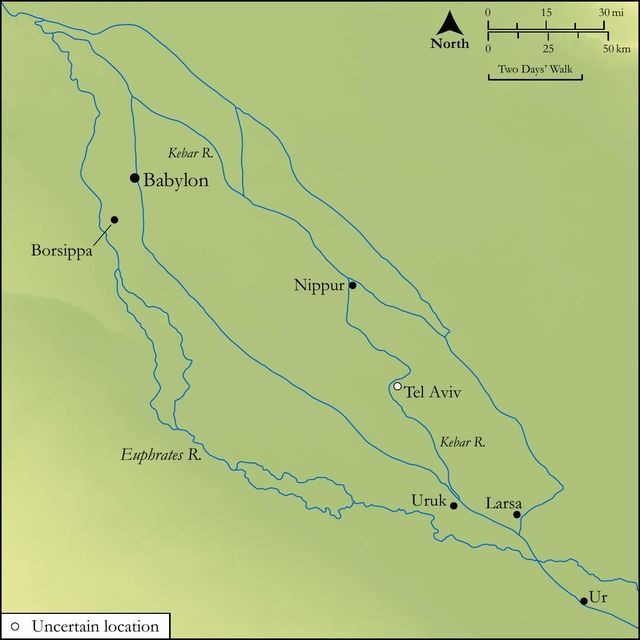
Ezekiel received this transformative vision around 593 BC, while he was among the Jewish exiles by the Chebar Canal in Babylon. As a priest, Ezekiel possessed an intimate familiarity with the sacred imagery of the Jerusalem Temple, particularly the cherubim guarding the Ark of the Covenant. However, this vision profoundly expands and recontextualizes such familiar imagery, powerfully conveying that God's presence and sovereignty were not confined to the now-destroyed Temple in Jerusalem. Instead, YHWH remained actively present and sovereign even in the foreign land of exile. As the cherubim of Eden and of the mercy seat were guardians of God's holiness, Ezekiel's vision, with its unique combination of features and profound theological purpose, distinctly reveals the unparalleled majesty and universal dominion of YHWH. This assurance was crucial for the disheartened exiles, demonstrating that God had not abandoned them.
Key Themes
ShowHideEzekiel 1:10 significantly contributes to several overarching themes found within the book of Ezekiel and broader biblical theology. Firstly, it powerfully underscores the theme of Divine Sovereignty and Omnipresence, illustrating that God's power and active presence are not limited by geographical boundaries or human circumstances, extending even to the land of exile. Secondly, the intricate and complex imagery highlights God's Transcendent Glory and Majesty, emphasizing His incomprehensibility and the awe-inspiring nature of His being, which can only be partially grasped through symbolic representation. Thirdly, the four distinct faces collectively symbolize God's Comprehensive Dominion over Creation, representing the highest forms of life—humanity, wild animals, domesticated animals, and birds—and thus signifying His absolute authority over all aspects of the created order. This vision serves as a potent reminder that despite Israel's sin and the ensuing judgment, God remains actively involved in His creation and faithful to His covenant purposes, a truth beautifully echoed in passages like Psalm 103:19.
Exposition and Analysis
ShowHideKey Word Analysis
ShowHideMeaning "resemblance; concretely, model, shape; adverbially, like." This term is crucial, as it immediately signals that Ezekiel's description is of a likeness or similitude, not a literal, physical form. It highlights the apophatic nature of divine revelation, indicating that while God reveals Himself, human language and perception can only grasp a representation or resemblance, not the full, unmediated reality of His being. This word sets the interpretive framework for the entire vision, reminding the reader that they are encountering a symbolic, revelatory depiction of divine truth.
A plural noun (though always used as singular) meaning "the face (as the part that turns)." This word is extensively used in the Hebrew Bible with a vast array of applications, both literal and figurative, often denoting "presence," "countenance," or "aspect." In Ezekiel 1:10, it refers to the literal countenances of the living creatures. However, its broader semantic range subtly reinforces the idea that these faces are not merely physical features but represent the aspects or manifestations of God's character and presence that these creatures embody and reflect. The multiplicity of faces on each creature signifies a comprehensive and multifaceted representation of divine attributes.
Meaning "a human being (an individual or the species, mankind, etc.)." The presence of the face of a man among these divine attendants represents intelligence, reason, moral discernment, and the pinnacle of creation, as humanity was uniquely created in God's image (Genesis 1:26). Its inclusion suggests that God's wisdom, rationality, and moral perfection are paramount, and that humanity, in its ideal form, reflects something essential of the divine.
Verse Breakdown
ShowHide"As for the likeness of their faces,"
This opening phrase immediately establishes the symbolic and representational nature of the vision. It prepares the reader for a description that is revelatory and metaphorical rather than strictly literal, emphasizing that what follows is a representation of divine reality, filtered through human perception.
"they four had the face of a man, and the face of a lion, on the right side:"
Each of the four living creatures possessed these two specific faces. The "face of a man" symbolizes divine intelligence, wisdom, and moral understanding. The "face of a lion" (H738, ʼărîy), renowned for its strength, courage, and kingliness, represents power, nobility, and dominion. The strategic placement "on the right side" (H3225, yâmîyn), which in Hebrew thought was consistently associated with strength, favor, and authority, suggests a prominent and powerful display of these attributes.
"and they four had the face of an ox on the left side;"
Each creature also bore the "face of an ox" (H7794, shôwr). The ox, a powerful and enduring beast of burden, symbolizes strength, steadfastness, patient endurance, and dedicated service, often associated with labor and sacrifice. Its placement "on the left side" (H8040, sᵉmôʼwl), while sometimes culturally associated with lesser prominence, here primarily functions to complete the comprehensive representation, ensuring that all cardinal directions and aspects of God's character are covered.
"they four also had the face of an eagle."
Finally, each creature possessed the "face of an eagle" (H5404, nesher). The eagle, a bird of prey celebrated for its swiftness, keen eyesight, and soaring majesty, symbolizes transcendence, far-sightedness, swift judgment, and divine majesty. Its inclusion completes the quartet of faces, representing the highest forms of life across distinct domains (humanity, wild animals, domesticated animals, and birds), thereby signifying God's absolute and comprehensive sovereignty over all creation.
Literary Devices
ShowHideEzekiel 1:10 is exceptionally rich in Symbolism and vivid Imagery. The four faces themselves are profoundly symbolic: the man represents intelligence, reason, and moral capacity; the lion denotes strength, courage, and kingship; the ox signifies steadfastness, service, and enduring power; and the eagle embodies swiftness, transcendence, and far-sightedness. Collectively, these faces form a comprehensive symbolic representation of God's multifaceted attributes and His complete dominion over all aspects of creation—humanity, wild beasts, domesticated animals, and birds. The detailed and composite Imagery of these creatures creates an awe-inspiring, almost overwhelming mental picture, designed to convey the overwhelming glory, power, and majesty of God. The specific placement of faces ("on the right side," "on the left side") also employs Merism, a literary device where two opposing or complementary parts are mentioned to represent a complete whole, suggesting a full and balanced display of these divine attributes from every conceivable perspective.
Theological and Thematic Connections
ShowHideThe composite faces of the living creatures in Ezekiel 1:10 offer profound theological insights into the nature of God and His intricate relationship with creation. They reveal a God who is simultaneously wise (man), powerful (lion), enduring (ox), and transcendent (eagle)—attributes that are not disparate but are harmoniously integrated within His divine being. This vision asserts God's absolute and universal sovereignty, indicating that all aspects of creation, from the rational to the wild, from the laborious to the majestic, are under His ultimate control and serve His divine purposes. It speaks to the comprehensive nature of God's character, assuring the exiles that the God they serve is capable of exercising profound wisdom in judgment, invincible strength in deliverance, unwavering patience in their suffering, and swiftness in the execution of His ultimate plan.
Reflection and Application
ShowHideEzekiel 1:10 profoundly challenges us to expand our understanding of God beyond simplistic or one-dimensional views. The multifaceted nature of the living creatures' faces serves as a powerful reminder that God is infinitely complex, glorious, and majestic, possessing attributes that encompass all wisdom, strength, enduring presence, and transcendent authority. In times of personal or collective "exile"—whether distress, uncertainty, or feeling far from God—this vision offers immense comfort and a compelling call to awe. It assures us that God's presence is not limited by our circumstances, geographical location, or even our perception of Him, and His power remains undiminished. Recognizing His comprehensive sovereignty over all creation—including our individual lives, our most daunting challenges, and the apparent chaos of the world—can foster a deeper trust and reliance on His divine plan. This passage invites us to worship a God who is both intimately involved in the intricate details of our lives and supremely majestic over all things.
Questions for Reflection
ShowHideFAQ
ShowHideWhat do the four faces of the living creatures specifically symbolize?
ShowHideThe four faces symbolize a comprehensive array of divine attributes and God's absolute dominion over all creation. The face of a man represents intelligence, wisdom, and moral discernment, reflecting humanity created in God's image, as illuminated in Genesis 1:26. The face of a lion signifies strength, courage, nobility, and kingliness, often associated with power and authority, much like the "Lion of the tribe of Judah" in Revelation 5:5. The face of an ox (or bull) denotes steadfastness, service, and enduring strength, often linked to patient labor and sacrifice. Lastly, the face of an eagle symbolizes swiftness, far-sightedness, majesty, and transcendence, often associated with divine judgment and swift action, as beautifully described in Deuteronomy 32:11. Collectively, these faces represent the highest forms of life across distinct domains (humanity, wild beasts, domesticated animals, and birds), emphasizing God's absolute and comprehensive sovereignty over all living things.
Christ-Centered Fulfillment
ShowHideWhile Ezekiel's vision primarily serves to reveal the awe-inspiring glory and multifaceted attributes of God the Father, its profound Christ-centered fulfillment is found in how Jesus Christ perfectly embodies and manifests these very attributes in His person and work. The "face of a man" finds its ultimate expression in Christ's perfect humanity, as the Son of Man who fully revealed God to us, for "no one has ever seen God; the only God, who is at the Father's side, he has made him known" (John 1:18). He is the embodiment of divine wisdom and reason, the one in whom "are hidden all the treasures of wisdom and knowledge" (Colossians 2:3). The "face of a lion" foreshadows Christ as the "Lion of the tribe of Judah" (Revelation 5:5), symbolizing His kingly power, conquering might, and ultimate authority over all creation, having declared, "All authority in heaven and on earth has been given to me" (Matthew 28:18). The "face of an ox" points to Christ's tireless service and ultimate sacrifice as the Suffering Servant, who came "not to be served but to serve, and to give his life as a ransom for many" (Mark 10:45). Finally, the "face of an eagle" speaks to Christ's divine transcendence, His swift and decisive action in salvation and judgment, and His majestic return, when "every eye will see him" (Revelation 1:7). Thus, the composite glory of God revealed in Ezekiel's vision is perfectly and redemptively fulfilled in the person and work of Jesus Christ, who is indeed "the radiance of the glory of God and the exact imprint of his nature" (Hebrews 1:3).