


Luke 10:18
Bible text: King James Version (1769 Blayney text) · Public domain
Bible text: Berean Standard Bible · Public domain
Bible text: American Standard Version (1901) · Public domain
Bible text: World English Bible, Messianic edition · Public domain
Bible text: Geneva Bible (1599) · Public domain
Bible text: Young's Literal Translation · Public domain
- εἶπενeipenHe saidG2036V-2AAI-3SVerb 2nd Aorist Active Indicative 3rd Singular
- δὲdethenG1161CONJConjunction
- αὐτοῖς·autoisto themG846P-DPMPersonal pronoun Dative Plural Masculine
- ἐθεώρουνetheōrounI was beholdingG2334V-IAI-1SVerb Imperfect Active Indicative 1st Singular
- τὸνton<the>G3588T-ASMDefinite article Accusative Singular Masculine
- σατανᾶνsatananSatanG4567N-ASM-TNoun Accusative Singular Masculine Title
- ὡςhōsasG5613PRTParticle or Disjunctive
- ἀστραπὴνastrapēnlightningG796N-ASFNoun Accusative Singular Feminine
- ἐκekout ofG1537PREPPreposition
- τοῦtoutheG3588T-GSMDefinite article Genitive Singular Masculine
- οὐρανοῦouranouheavenG3772N-GSMNoun Genitive Singular Masculine
- πεσόνταpesontahaving fallenG4098V-2AAP-ASMVerb 2nd Aorist Active Participle Accusative Singular Masculine
English is a literal word-by-word gloss of the Greek, not the KJV's wording. Why?
This is the original text the KJV's translators worked from — each Greek word with its own literal English meaning in this verse, prepared by scholars at Tyndale House, Cambridge. The KJV translates whole sentences, not word by word, so its wording differs: one Greek word can become several English words, and the KJV may choose “charity” where the gloss reads “love”. Both are faithful — they answer different questions. For the KJV's own rendering, switch to the KJV text.
Details
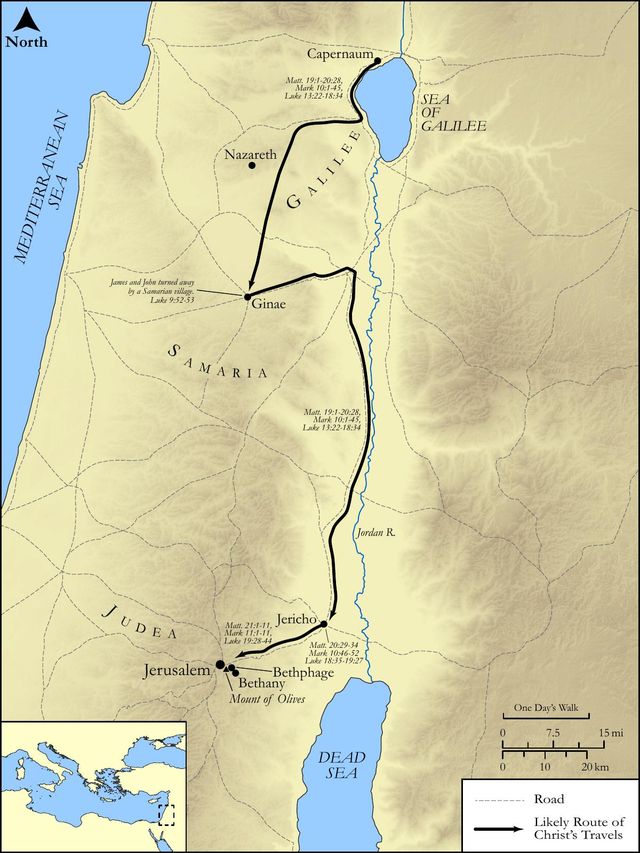
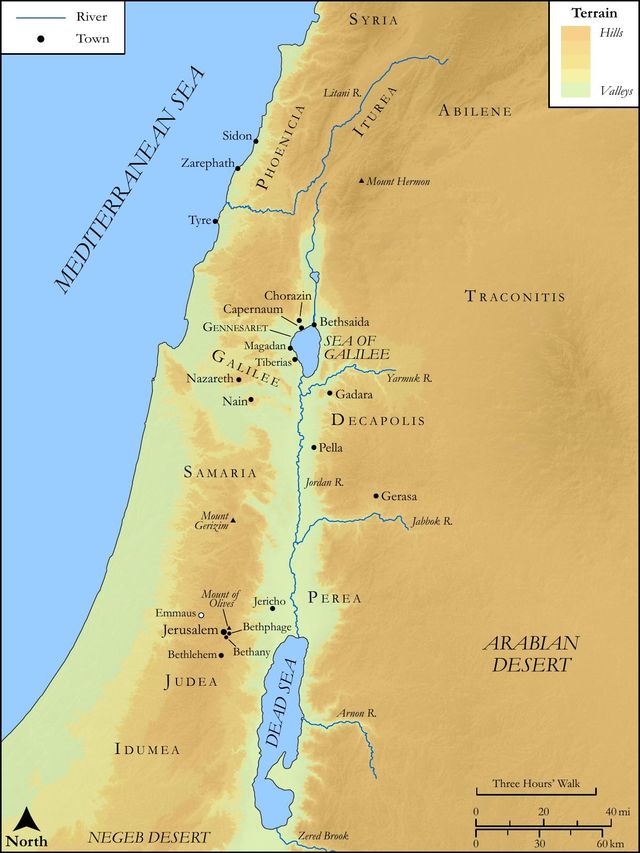
See on the biblical-era maps

Study this verse
Public-domain commentary
Matthew Henry
From his Commentary on the Whole Bible. Henry comments on passages, not single verses — this entry covers Luke 10:17–24. His four-level outline is real structure in the source text, so it is rendered as structure.
Christ sent forth the seventy disciples as he was going up to Jerusalem to the feast of tabernacles, when he went up, not openly, but as it were in secret (Joh 7:10), having sent abroad so great a part of his ordinary retinue; and Dr. Lightfoot thinks it was before his return from that feast, and while he was yet at Jerusalem, or Bethany, which was hard by (for there he was, Luk 10:38), that they, or at least some of them, returned to him. Now here we are told,
1.What account they gave him of the success of their expedition: They returned again with joy (Luk 10:17); not complaining of the fatigue of their journeys, nor of the opposition and discouragement they met with, but rejoicing in their success, especially in casting out unclean spirits: Lord, even the devils are subject unto us through thy name. Though only the healing of the sick was mentioned in their commission (Luk 10:19), yet no doubt the casting out of devils was included, and in this they had wonderful success. 1. They give Christ the glory of this: It is through thy name. Note, all our victories over Satan are obtained by power derived from Jesus Christ. We must in his name enter the lists with our spiritual enemies, and, whatever advantages we gain, he must have all the praise; if the work be done in his name, the honour is due to his name. 2. They entertain themselves with the comfort of it; they speak of it with an air of exultation: Even the devils, those potent enemies, are subject to us. Note, the saints have no greater joy or satisfaction in any of their triumphs than in those over Satan. If devils are subject to us, what can stand before us?
II.What acceptance they found with him, and how he received this account.
1.He confirmed what they said, as agreeing with his own observation (Luk 10:18): "My heart and eye went along with you; I took notice of the success you had, and I saw Satan fall as lightning from heaven." Note, Satan and his kingdom fell before the preaching of the gospel. "I see how it is," saith Christ, "as you get ground the devil loseth ground." He falls as lightning falls from heaven, so suddenly, so irrecoverably, so visibly, that all may perceive it, and say, "See how Satan's kingdom totters, see how it tumbles." They triumphed in casting devils out of the bodies of people; but Christ sees and rejoices in the fall of the devil from the interest he has in the souls of men, which is called his power in high places, Eph 6:12. He foresees this to be but an earnest of what should now be shortly done and was already begun - the destroying of Satan's kingdom in the world by the extirpating of idolatry and the turning of the nations to the faith of Christ. Satan falls from heaven when he falls from the throne in men's hearts, Act 26:18. And Christ foresaw that the preaching of the gospel, which would fly like lightning through the world, would wherever it went pull down Satan's kingdom. Now is the prince of this world cast out. Some have given another sense of this, as looking back to the fall of the angels, and designed for a caution to these disciples, lest their success should puff them up with pride: "I saw angels turned into devils by pride: that was the sin for which Satan was cast down from heaven, where he had been an angel of light I saw it, and give you an intimation of it lest you, being lifted up with pride should fall into that condemnation of the devil, who fell by pride," Ti1 3:6.
2.He repeated, ratified, and enlarged their commission: Behold I give you power to tread on serpents, Luk 10:19. Note, To him that hath, and useth well what he hath, more shall be given. They had employed their power vigorously against Satan, and now Christ entrusts them with greater power.
(1.)An offensive power, power to tread on serpents and scorpions, devils and malignant spirits, the old serpent: "You shall bruise their heads in my name," according to the first promise, Gen 3:15. Come, set your feet on the necks of these enemies; you shall tread upon these lions and adders wherever you meet with them; you shall trample them under foot, Psa 91:13. You shall tread upon all the power of the enemy, and the kingdom of the Messiah shall be every where set up upon the ruins of the devil's kingdom. As the devils have now been subject to you, so they shall still be.
(2.)A defensive power: "Nothing shall by any means hurt you; not serpents nor scorpions, if you should be chastised with them or thrown into prisons and dungeons among them; you shall be unhurt by the most venomous creatures," as St. Paul was (Act 28:5), and as is promised in Mar 16:18. "If wicked men be as serpents to you, and you dwell among those scorpions (as Eze 2:6), you may despise their rage, and tread upon it; it need not disturb you, for they have no power against you but what is given them from above; they may hiss, but they cannot hurt." You may play upon the hole of the asp, for death itself shall not hurt nor destroy, Isa 11:8, Isa 11:9; Isa 25:8.
3.He directed them to turn their joy into the right channel (Luk 10:20): "Notwithstanding in this rejoice not, that the spirits are subject unto you, that they have been so, and shall be still so. Do not rejoice in this merely as it is your honour, and a confirmation of your mission, and as it sets you a degree above other good people; do not rejoice in this only, or in this chiefly, but rather rejoice because your names are written in heaven, because you are chosen of God to eternal life, and are the children of God through faith." Christ, who knew the counsels of God, could tell them that their names were written in heaven, for it is the Lamb's book of life that they are written in. All believers are through grace, entitled to the inheritance of sons, and have received the adoption of sons, and the Spirit of adoption, which is the earnest of that inheritance and so are enrolled among his family; now this is matter of joy, greater joy than casting out devils. Note, Power to become the children of God is to be valued more than a power to work miracles; for we read of those who did in Christ's name cast out devils, as Judas did, and yet will be disowned by Christ in the great day. But they whose names are written in heaven shall never perish; they are Christ's sheep, to whom he will give eternal life. Saving graces are more to be rejoiced in than spiritual gifts; holy love is a more excellent way than speaking with tongues.
4.He offered up a solemn thanksgiving to his Father, for employing such mean people as his disciples were in such high and honourable service, Luk 10:21, Luk 10:22. This we had before (Mat 11:25-27), only here it is prefixed that in that hour Jesus rejoiced. It was fit that particular notice should be taken of that hour, because there were so few such, for he was a man of sorrows. In that hour in which he saw Satan fall, and heard of the good success of his ministers, in that hour he rejoiced. Note, Nothing rejoices the heart of the Lord Jesus so much as the progress of the gospel, and its getting ground of Satan, by the conversion of souls to Christ. Christ's joy was a solid substantial joy, an inward joy: he rejoiced in spirit; but his joy, like deep waters, made no noise; it was a joy that a stranger did not intermeddle with. Before he applied himself to thank his Father, he stirred up himself to rejoice; for, as thankful praise is the genuine language of holy joy, so holy joy is the root and spring of thankful praise. Two things he gives thanks for: -
(1.)For what was revealed by the Father through the Son: I thank thee, O Father, Lord of heaven and earth, Luk 10:21. In all our adorations of God, we must have an eye to him, both as the Maker of heaven and earth and as the Father of our Lord Jesus Christ, and in him our Father. Now that which he gives thanks for is,
[1.]That the counsels of God concerning man's reconciliation to himself were revealed to some of the children of men, who might be fit also to teach others, and it is God that by his Son has spoken these things to us and by his Spirit has revealed them in us; he has revealed that which had been kept secret from the beginning of the world.
[2.]That they were revealed to babes, to those who were of mean parts and capacities, whose extraction and education had nothing in them promising, who were but children in understanding, till God by his Spirit elevated their faculties, and furnished them with this knowledge, and an ability to communicate it. We have reason to thank God, not so much for the honour he has hereby put upon babes, as for the honour he has hereby done himself in perfecting strength out of weakness.
[3.]That, at the same time when he revealed them unto babes, he hid them from the wise and prudent, the Gentile philosophers, the Jewish rabbin. He did not reveal the things of the gospel to them, nor employ them in preaching up his kingdom. Thanks be to God that the apostles were not fetched from their schools; for, First, they would have been apt to mingle their notions with the doctrine of Christ, which would have corrupted it, as afterwards it proved. For Christianity was much corrupted by the Platonic philosophy in the first ages of it, by the Peripatetic in its latter ages, and by the Judaizing teachers at the first planting of it. Secondly, If rabbin and philosophers had been made apostles, the success of the gospel would have been ascribed to their learning and wit and the force of their reasonings and eloquence; and therefore they must not be employed, lest they should have taken too much to themselves, and others should have attributed too much to them. They were passed by for the same reason that Gideon's army was reduced: The people are yet too many, Jdg 7:4. Paul indeed was bred a scholar among the wise and prudent; but he became a babe when he became an apostle, and laid aside the enticing words of man's wisdom, forgot them all, and made neither show nor use of any other knowledge than that of Christ and him crucified, Co1 2:2, Co1 2:4.
[4.]That God herein acted by way of sovereignty: Even so, Father, for so it seemed good in thy sight. If God gives his grace and the knowledge of his son to some that are less likely, and does not give it to others whom we should think better able to deliver it with advantage, this must satisfy: so it pleases God, whose thoughts are infinitely above ours. He chooses to entrust the dispensing of his gospel in the hands of those who with a divine energy will give it the setting on, rather than in theirs who with human art will give it the setting off.
(2.)For what was secret between the Father and the Son, Luk 10:22.
[1.]The vast confidence that the Father puts in the Son: All things are delivered to me of my Father, all wisdom and knowledge, all power and authority, all the grace and comfort which are intended for the chosen remnant; it is all delivered into the hands of the Lord Jesus; in him all fulness must dwell, and from him it must be derived: he is the great trustee that manages all the concerns of God's kingdom.
[2.]The good understanding that there is between the Father and the Son, and their mutual consciousness, such as no creature can be admitted to: No man knows who the Son is, nor what his mind is, but the Father, who possessed him in the beginning of his ways, before his works of old (Pro 8:22), nor who the Father is, and what his counsels are, but the Son, who lay in his bosom from eternity, was by him as one brought up with him, and was daily his delight (Pro 8:30), and he to whom the Son by the Spirit will reveal him. The gospel is the revelation of Jesus Christ, to him we owe all the discoveries made to us of the will of God for our salvation; and here he speaks of being entrusted with it as that which was a great pleasure to himself and for which he was very thankful to his Father.
5.He told his disciples how well it was for them that they had these things revealed to them, Luk 10:23, Luk 10:24. Having addressed himself to his Father, he turned to his disciples, designing to make them sensible how much it was for their happiness, as well as for the glory and honour of God, that they knew the mysteries of the kingdom and were employed to lead others into the knowledge of them, considering,
(1.)What a step it is towards something better. Though the bare knowledge of these things is not saving, yet it puts us in the way of salvation: Blessed are the eyes which see the things which we see. God therein blesseth them, and, if it be not their own fault it will be an eternal blessedness to them.
(2.)What a step it is above those that went before them, even the greatest saints, and those that were most the favourites of Heaven: "Many prophets and righteous men" (so it is in Mat 13:17), many prophets and kings (so it is here), "have desired to see and hear those things which you are daily and intimately conversant with, and have not seen and heard them." The honour and happiness of the New Testament saints far exceed those even of the prophets and kings of the Old Testament, though they also were highly favoured. The general ideas which the Old Testament saints had, according to the intimations given them, of the graces and glories of the Messiah's kingdom, made them wish a thousand times that their lot had been reserved for those blessed days, and that they might see the substance of those things of which they had faint shadows. Note, The consideration of the great advantages which we have in the New Testament light, above what they had who lived in Old Testament times, should awaken our diligence in the improvement of it; for, if it do not, it will aggravate our condemnation for the non-improvement of it.
Historical interpretation
Ten Centuries of Reception
23 surviving comments on this verse. Each one is dated, so this reads as a timeline rather than a list.
Select a marker to jump to its quote. Markers stagger vertically where authors wrote within a few decades of each other.
[On the Audacity of Satan] Darest thou, then, who didst fall "as lightning" [Luke 10:18] from the very highest glory, to say to the Lord, "Cast thyself down from hence [to Him] to whom the things that are not are reckoned as if they were, and to provoke to a display of vainglory Him that was free from all ostentation? And didst thou pretend to read in Scripture concerning Him: "For He hath given His angels charge concerning Thee, and in their hands they shall bear Thee up, lest thou shouldest dash Thy foot against a stone?" At the same time thou didst pretend to be ignorant of the rest, furtively concealing what [the Scripture] predicted concerning thee and thy servants: "Thou shalt tread upon the adder and the basilisk; the lion and the dragon shall thou trample under foot.
This Spirit, again, He did confer upon the Church, sending throughout all the world the Comforter from heaven, from whence also the Lord tells us that the devil, like lightning, was cast down.
We may not, I say, we may not call into question the truth of the (poor vilified) senses, lest we should even in Christ Himself, bring doubt upon the truth of their sensation; lest perchance it should be said that He did not really "behold Satan as lightning fall from heaven; " that He did not really hear the Father's voice testifying of Himself; or that He was deceived in touching Peter's wife's mother; or that the fragrance of the ointment which He afterwards smelled was different from that which He accepted for His burial; and that the taste of the wine was different from that which He consecrated in memory of His blood.
This description, it is manifest, properly belongs to the transgression of the angel, and not to the prince's: for none among human beings was either born in the paradise of God, not even Adam himself, who was rather translated thither; nor placed with a cherub upon God's holy mountain, that is to say, in the heights of heaven, from which the Lord testifies that Satan fell; nor detained amongst the stones of fire, and the flashing rays of burning conStellations, whence Satan was cast down like lightning. No, it is none else than the very author of sin who was denoted in the person of a sinful man: he was once irreproachable, at the time of his creation, formed for good by God, as by the good Creator of irreproachable creatures, and adorned with every angelic glory, and associated with God, good with the Good; but afterwards of his own accord removed to evil.
(Orat. in Pass. et cruce Domini.) But now through the power of Christ boys make a mock at pleasure, which formerly led away the aged, and virgins stedfastly trample upon the desires of serpentine pleasure. Some also tread upon the very sting of the scorpion, that is, of the devil, namely death, and fearing not destruction, become witnesses of the word. But many giving up earthly things walk with a free step in heaven, dreading not the prince of the air.
“I was looking at Satan, who fell like lightning from the heavens.” It was not that he was actually in the heavens. He was not in them when he said, “I will place my throne above the stars,” but he fell from his greatness and his dominion. “I was looking at Satan, who fell like lightning from the heavens.” He did not fall from heaven, because lightning does not fall from heaven, since the clouds create it. Why then did he say “from the heavens”? This was because it was as though it was from the heavens, as if lightning which comes suddenly. In one second, Satan fell beneath the victory of the cross. Ordinary people were anointed and sent out by reason of their mission and were highly successful in a second, through miracles of healing those in pain, sickness and evil spirits. It was affirmed that Satan suddenly fell from his dominion, like lightning from the clouds. Just as lightning goes out and does not return to its place, so too did Satan fall and did not again have control over his dominion. “Behold, I am giving you dominion.”
But at the same time He herein consoles His disciples, as if He said, Say not why are we about to suffer reproach. Let your speech be with moderation. I give you grace, upon Me your reproaches fall.
Now He says that He saw it, as being Judge, for He knew the sufferings of the spirits. Or He says, as lightning, because by nature Satan shone as lightning, but became darkness through his affections, since what God made good he changed in himself to evil.
Serpents indeed at one time under a figure were made to bite the Jews, and kill them because of their unbelief. But there came One who should destroy those serpents; even the Brazen Serpent, (Numb. 21:8.) the Crucified, so that if any one should look on Him believing, he might be healed from his wounds and saved.
But because the joy with which He saw them rejoice savoured of vain-glory, for they rejoiced that they were as it were exalted, and were a terror to men and evil spirits, our Lord therefore adds, Notwithstanding in this rejoice not, that the spirits are subject unto you, &c.
(Hom. Quod Deus non est auctor mali.) He is called Satan, because he is an enemy to God, (for this the Hebrew word signifies,) but he is called the Devil, because he assists us in doing evil, and is an accuser. His nature is incorporeal, his abode in the air.
(adv. Eunom. l. 3.) For the heavenly Powers are not naturally holy, but according to the analogy of divine love they receive their measure of sanctification. And as iron placed in the fire does not cease to be iron, though by the violent application of the flame, both in effect and appearance, it passes into fire; so also the Powers on high, from their participation in that which is naturally holy, have a holiness implanted in them. For Satan had not fallen, if by nature he had been unsusceptible of evil.
Who hast cast him down as lightning from heaven to earth,
He [Jesus] was not baptized to receive the forgiveness of sins. He was without sin. Being sinless, still he was baptized so that he might give grace and dignity to those who receive the sacrament. “Since the children share in flesh and blood, so he in like manner has shared in these,” that we, sharing his incarnate life, might also share his divine grace. Jesus was baptized that we in turn also made here partakers with him, might receive not only salvation but also the dignity.
(Hom. in Cant.) For pleasure is called in Scripture a serpent, which by nature is such that if its head has reached a wall so as to press upon it, it drags its whole body after it. So nature has given man the habitation which was necessary for him. But by means of this necessity, pleasure assaults the heart, and perverts it to the indulgence of immoderate ornament; in addition to this it brings in its train covetousness, which is followed by lust, that is, the last member or tail of the beast. But as it is not possible to draw back the serpent by its tail, so to remove pleasure we must not begin with the last, unless one has closed the first entrance to evil.
And I know that He has said somewhere else, 'If Satan casts out Satan, he is divided against himself: how then is his kingdom to stand?' And He pointed out that He saw the evil one like lightning falling down from heaven. And elsewhere He said, 'He who sowed the bad seed is the devil.' And again, 'Give no pretext to the evil one.' Moreover, in giving advice, He said, 'Let your yea be yea, and your nay nay; for what is more than these is of the evil one.' Also, in the prayer which He delivered to us, we have it said, 'Deliver us from the evil one.' And in another place, He promised that He would say to those who are impious, 'Go into outer darkness, which the Father prepared for the devil and his angels.' And not to prolong this statement further, I know that my Teacher often said that there is an evil one. Wherefore I also agree in thinking that he exists. If, then, in future you have anything to say in accordance with this belief, say it, as you promised."
Then lest we should suppose this was spoken of beasts, He added, And over all the power of the enemy.
[Daniel 4:4] "I, Nebuchadnezzar, was at ease in my house and prospering in my palace." The narrative is clear indeed and requires but little interpretation. Because he displeased God, Nebuchadnezzar was turned into a madman and dwelt for seven years amongst the brute beasts and was fed upon the roots of herbs, Afterwards by the mercy of God he was restored to his throne, and praised and glorified the King of heaven, on the ground that all His works are truth and His ways are justice and He is able to abase those who walk in pride. But there are some who claim to understand by the figure of Nebuchadnezzar the hostile power which the Lord speaks of in the Gospel, saying: "I beheld Satan falling from heaven like lightning" (Luke 10:18). Likewise John in Revelation, in the passage where the dragon falls upon the earth drawing a third of the stars with him (Revelation 12:4). Likewise Isaiah: "How hath the morning star fallen, which used to rise early in the morning" (Isaiah 14:12). These authorities assert that it was absolutely impossible for a man who was reared in luxury to subsist on hay for seven years and to dwell among wild beasts for seven years without being at all mangled by them. Also they ask how the imperial authority could have been kept waiting for a mere madman, and how so mighty a kingdom could have gone without a king for so long a period. If, on the other hand, anyone had succeeded him on the throne, how foolish he would have to be thought to surrender an imperial authority which he had possessed for so long. Such a thing would be especially incredible since the historical records of the Chaldeans contain no such record, and since they recorded matters of far less import, it is impossible that they should have left things of major importance unmentioned. And so they pose all of these questions and offer as their own reply the proposition that since the episode does not stand up as genuine history, the figure of Nebuchadnezzar represents the devil. To this position we make not the slightest concession; otherwise everything we read in Scripture may appear to be imperfect representations and mere fables. For once men have lost their reason, who would not perceive them to lead their existence like brutish animals in the open fields and forest regions? And to pass over all other considerations, since Greek and Roman history offer episodes far more incredible, such as Scylla and the Chimaera, the Hydra and the Centaurs, and the birds and wild beasts and flowers and trees, the stars and the stones into which men are related to have been transformed, what is so remarkable about the execution of such a divine judgment as this for the manifestation of God's power and the humbling of the pride of kings? Nebuchadnezzar says, "'I was at ease in my house and prospering in my palace...'" or as Theodo-tion renders it "upon my throne." Now those who follow the interpretation we are opposing understand by the devil's home this world of ours. Concerning the world Satan himself in the Gospel says to the Savior: "All these things have been given over to me" (Luke 4:6). Likewise the Apostle says: "The world lieth in the Wicked One" (1 John 5:19).
Or else, I saw Satan as lightning fall from heaven, that is, from the highest power to the lowest impotence. For before the coming of our Saviour, he had subdued the world to him, and was worshipped by all men. But when the only-begotten Word of God came down from heaven, he fell as lightning, seeing that he is trodden under foot by those who worship Christ. As it follows, And, behold, I give unto you power to tread upon serpents, &c.
What is Christ's reply? "I saw Satan fall like lightning from heaven." That is, "I am aware of this, because as you set out on this journey by my will, you have conquered Satan. I saw him fall like lightning from heaven." This means that he was thrown down from on high to earth, from overweening pride to humiliation, from glory to contempt, from great power to utter weakness. The saying is true, because before the coming of the Savior, he possessed the world. All was subject to him, and there was no one able to escape the trap of his overwhelming might. Everyone worshiped him. He had temples and altars for sacrifice everywhere and had an innumerable multitude of worshipers. Since the only-begotten Word of God came down from heaven, he has fallen like lightning.
According to Christ's declaration, the harvest indeed was great, but the laborers were few. In addition to those first chosen, he appointed seventy others and sent them to every village and city of Judea before his face to be his forerunners and to preach the things that belonged to him.The authority that they carried to rebuke evil spirits and the power of crushing Satan was not given to them that they might be regarded with admiration. It was given to them so that Christ would be glorified by their means. Those whom they taught would believe that he was by nature God and the Son of God. He was invested with so great glory and supremacy and might, as to be even able to bestow upon others the power of trampling Satan under their feet.
Since we possess the Lord Jesus who has freed us by his suffering, let us always look on him and hope for medicine for our wounds from his sign. That is to say, if perhaps the poison of greed spreads in us, we should look to him, and he will heal us. If the malicious desire of the scorpion stings us, we should beg him, and he will cure us. If bites of worldly thoughts tear us, we should ask him, and we will live. These are the spiritual serpents of our souls. The Lord was crucified in order to crush them. He says concerning them, “You will tread upon serpents and scorpions, and they will do no harm to you.”
Daniel said that in Babylon there was a nobleman’s daughter, who was possessed by a devil. Her father asked a monk for help. The monk said to him, ‘No one can cure your daughter except some hermits I know: and if you go to them, they will refuse to do it from motives of humility. Let us do it this way: when they come to the city bringing their produce for sale, tell them that you want to buy what they have. When they come into the house to receive the money, we will ask them to pray, and I believe that your daughter will be cured.’ So they went into the street, and found a disciple of a hermit who was sitting there to sell his baskets. They took him back with them to the house, as if to give him the money for his wares. When the monk came into the house, the girl who was troubled with the demon went up to him and slapped him. He followed the Lord’s commandment, and turned to her the other cheek. The demon was forced out, and began to cry: ‘Violence! The commandment of Jesus Christ is driving me out;’ the girl was healed at that moment. When they came back to the hermit, they told him what had happened, and he glorified God, saying, ‘The pride of devils must fall before humble obedience to the commandments of Jesus Christ.’
(23. Mor. c. 4.) Now our Lord, in a remarkable manner, in order to put down high thoughts in the hearts of His disciples, Himself related the account of the fall which the teacher of pride suffered; that they might learn by the example of the author of pride, what they would have to dread from the sin of pride. Hence it follows, I beheld Satan as lightning fall from heaven.
And he said to them: I was watching Satan fall from heaven like lightning. Not only do I see it now, but I saw it before, when he fell. What he said, "like lightning," either signifies a precipitous fall from high to low, or because, having been cast out, he still transforms himself into an angel of light. Therefore, because he saw the disciples elevated over their performance of signs, he frightens them by example and recalls them to humility by one who first fell by pride, so that they, remembering him cast out of heaven for pride, may understand that they, made from the earth, will be much more humbled if they become proud.
He says not, 'I see now,' but referring to past time, I saw, when he fell. But by the words as lightning, He signifies either a fall headlong from the high places to the lowest, or that now cast down, he transforms himself into an angel of light. (2 Cor. 11:14.)
That is, I give you the power of casting out every kind of unclean spirit, from the bodies possessed. And as far as regards themselves, He adds, And nothing shall hurt you. Although it might also be taken literally. For Paul when attacked by a viper suffered no injury. (Acts 28:5.) John having drunk poison is not harmed by ita. But I think there is this difference between serpents who bite with the teeth, and scorpions who sting with the tail, that the serpents signify men or spirits raging openly, scorpions signify them plotting in secret. Or serpents are those which east the poison of evil persuasion upon virtues just beginning, scorpions which go about to corrupt at last virtues which have been brought to perfection.
They are forbidden to rejoice in the subjection of the spirits to God, since they were flesh; for to cast out spirits and to exercise other powers is sometimes not on account of his merit who works, but is wrought through the invocation of Christ's name to the condemnation of those who mock it, or to the advantage of those who see and hear.
As if he said, It becomes you to rejoice not in the putting down of the evil spirits, but in your own exaltation. But it would be well for us to understand, that whether a man has done heavenly or earthly works, he is thereby, as if marked down by letter, for ever fixed in the memory of God.
Or serpents are those which visibly hurt, as the evil spirit of adultery and murder. But those are called scorpions which invisibly injure, as in the sins of the spirit.
For the names of the saints are written in the book of life not in ink, but in the memory and grace of God. And the devil indeed fell from above; but men being below have their names inscribed above in heaven.
Continue studying Luke 10:18 across the web’s major study libraries — every link below opens this exact verse, chapter, or book on the destination site.
Read & Compare
 BibleGatewayThis verse in more than 200 translations and 70 languages.
 Bible.comThe YouVersion reader — hundreds of translations, reading plans, and highlights.
 ESV.orgCrossway's official English Standard Version reader.
 NET BibleThe NET translation with 60,000+ translators' notes on every rendering decision.
 STEP BibleTyndale House's free study tool — original text, vocabulary, and scholarly resources.
 BibliaLogos Bible Software's free web reader.
 USCCBThe New American Bible (Revised Edition) with the U.S. bishops' study notes.
Commentaries
 BibleHub CommentariesDozens of classic commentaries on this verse, gathered on one page.
 StudyLightMore than 100 commentary sets — the largest collection on the web.
 BibleRefPlain-English commentary on what this verse means, verse by verse.
 Enduring WordDavid Guzik's free commentary on this chapter, widely used by Bible teachers.
 Bible Study ToolsVerse commentary alongside Greek and Hebrew study aids.
Original Language & Research
- BibleHub InterlinearThe verse word by word — original language, transliteration, and English.
- BibleHub LexiconEvery word's original-language definition and Strong's entry.
 Blue Letter BibleDeep-study tools — Strong's numbers, concordance, and word studies.
 CNTR CollationThe earliest Greek manuscripts of this verse, collated letter by letter.
Sermons, Hymns & Audio


TrulyRandomVerse is not affiliated with these sites and doesn’t control their content. They’re linked because they’re genuinely useful.
Summary
Luke 10:18 captures Jesus' profound declaration to His jubilant seventy (or seventy-two) disciples, who had just returned from a successful mission, exclaiming that even demons were subject to them in His name. Jesus responds by revealing a deeper spiritual reality: "I beheld Satan as lightning fall from heaven." This statement is not merely a historical recounting but a vivid, authoritative pronouncement of Satan's decisive, swift, and catastrophic defeat, directly connected to and made manifest by the disciples' successful exercise of delegated divine authority over demonic forces. It underscores the inbreaking of God's Kingdom and the recession of Satan's dominion through Christ's power.
Context
ShowHideLiterary Context
This potent declaration by Jesus immediately follows the joyful return of the seventy (or seventy-two) disciples whom He had commissioned and sent out with specific instructions to proclaim the Kingdom of God, heal the sick, and cast out demons (as detailed in Luke 10:1-12). Their enthusiastic report, "Lord, even the devils are subject unto us through thy name" (Luke 10:17), sets the stage for Jesus' profound response in Luke 10:18. Jesus' statement serves as a divine interpretation of their success, linking their practical victories over demonic forces to a cosmic spiritual reality. It validates their ministry while also placing it within the larger framework of His ongoing triumph over evil. The subsequent verse, Luke 10:19, further clarifies the authority He bestows upon them, grounding it in His own ultimate victory.
Historical & Cultural Context
In the first-century Jewish context, the concept of demonic influence and spiritual warfare was widely accepted. People attributed various afflictions and moral failings to the work of evil spirits. Exorcism was practiced by some Jewish groups, but Jesus' authority over demons was unparalleled, demonstrating His unique divine power. His sending out of the seventy was a significant expansion of His ministry beyond the twelve apostles, signaling the widespread advance of God's Kingdom. The reference to "heaven" (οὐρανός) would have been understood as the dwelling place of God and spiritual beings, emphasizing the cosmic scale of Satan's fall. The imagery of "lightning" (ἀστραπή) would have evoked a common, powerful, and instantaneous natural phenomenon, readily understood by the audience as a symbol of sudden, visible, and overwhelming force.
Key Themes
ShowHideThe verse contributes significantly to several key themes in Luke's Gospel and broader biblical theology. Firstly, it highlights the inbreaking of the Kingdom of God through Jesus' ministry, demonstrating that His presence and the work of His disciples directly challenge and diminish Satan's dominion. Secondly, it underscores Jesus' supreme authority over evil, revealing that the power exercised by the disciples is a delegated authority rooted in Christ's own decisive victory. Thirdly, it emphasizes the reality of spiritual warfare but assures believers of their position of victory through Christ. The disciples' success is a tangible manifestation of Satan's spiritual defeat, foreshadowing his ultimate and complete overthrow, a theme echoed throughout the New Testament, particularly in passages like Colossians 2:15 where Christ triumphs over principalities and powers.
Exposition and Analysis
ShowHideKey Word Analysis
ShowHideMeaning "to be a spectator of, i.e. discern, (literally, figuratively (experience) or intensively (acknowledge))." This is not merely a casual glance but a profound, spiritual perception or a vivid recollection of a past event with ongoing relevance. It implies Jesus had a unique, continuous, and authoritative spiritual insight into the cosmic event of Satan's fall, seeing it with divine clarity and understanding its full implications.
Meaning "the accuser, i.e. the devil." This refers to the chief adversary of God and humanity, the embodiment of evil. Jesus' direct naming of Satan underscores the personal and powerful nature of the enemy whose dominion is being dismantled. The term itself highlights his role as the great adversary and slanderer.
Meaning "to fall (literally or figuratively)." This verb denotes a sudden and decisive descent from a position of power, authority, or stability. In this context, it signifies a dramatic loss of status and influence for Satan, a catastrophic spiritual defeat rather than a mere stumble. The imagery of "lightning" intensifies the suddenness and finality of this downfall.
Verse Breakdown
ShowHide"And he said unto them"
This phrase establishes Jesus as the speaker and the returning seventy disciples as His audience. It highlights that this profound spiritual insight is given directly to those who have just experienced a tangible manifestation of God's Kingdom advancing through their ministry. Jesus' words serve as an authoritative interpretation of their success, connecting their earthly victories to a cosmic spiritual reality.
"I beheld Satan"
Jesus declares His unique, divine perception of a spiritual event. The imperfect tense of "beheld" (ἐθεώρουν) suggests either an ongoing spiritual observation, a vivid recollection of a past event whose effects are continually manifest, or a timeless, divine vision. This is not a human observation but a divine insight into the spiritual realm, emphasizing Jesus' unparalleled understanding and authority over the forces of evil.
"as lightning fall from heaven"
This powerful simile describes the manner and impact of Satan's fall. "As lightning" (ὡς ἀστραπή) conveys the suddenness, swiftness, and undeniable visibility of the event. It implies a dramatic, irreversible, and publicly evident (in the spiritual realm) loss of power and position. "From heaven" (ἀπὸ τοῦ οὐρανοῦ) indicates a fall from a place of spiritual authority or access, signifying a profound demotion and expulsion from the divine presence or sphere of influence. This imagery underscores the catastrophic and decisive nature of Satan's defeat.
Literary Devices
ShowHideThe primary literary device employed in Luke 10:18 is Simile. Jesus uses the phrase "as lightning" (ὡς ἀστραπή) to vividly describe the manner of Satan's fall. This simile emphasizes the suddenness, swiftness, and undeniable clarity of the event. Just as a flash of lightning is instantaneous, visible, and powerful, so too was Satan's descent from his position of power. This imagery conveys a sense of irreversible and dramatic defeat. Additionally, the verse can be seen as an instance of Spiritual Vision or Metaphor, where Jesus is not necessarily describing a single, literal historical event occurring at that precise moment, but rather a profound spiritual reality—Satan's decisive dethroning and loss of authority—which is now being manifested and confirmed through the disciples' successful ministry. The language is highly evocative, painting a picture of cosmic conflict and divine triumph.
Theological and Thematic Connections
ShowHideLuke 10:18 stands as a pivotal declaration of Christ's triumph over the forces of darkness, providing a theological framework for understanding the disciples' authority and the advance of God's Kingdom. Jesus' vision of Satan's fall signifies a decisive shift in the cosmic battle between good and evil. It is not merely a past event but a foundational reality that underpins the power of the Gospel and the authority granted to believers. The success of the seventy in casting out demons is a tangible manifestation of this spiritual reality: Satan's power is broken, and his dominion is receding in the face of Christ's advancing Kingdom. This verse assures believers that their spiritual battles are fought from a position of victory, not striving for it, because the enemy has already been decisively defeated by Christ.
Reflection and Application
ShowHideLuke 10:18 offers profound encouragement and a call to confident action for believers today. It reminds us that our authority over spiritual opposition is not self-generated but delegated by Christ, who has already secured the decisive victory over Satan. When we face spiritual resistance, temptation, or the oppressive works of darkness, we are not fighting a losing battle, nor are we engaging in an uncertain struggle. Instead, we are participating in the ongoing manifestation of a victory already won at the highest cosmic level. This verse calls us to confidently exercise the authority given to us in Jesus' name, knowing that the "strong man" has been bound, and his kingdom is in retreat. It shifts our focus from the perceived power of evil to the supreme, triumphant power of Christ, empowering us to live fearlessly, proclaim the Gospel boldly, and engage in spiritual warfare with the assurance that Satan has fallen from his place of power and influence. Our mission, like that of the seventy, is to demonstrate the inbreaking reality of God's Kingdom.
Questions for Reflection
ShowHideFAQ
ShowHideWhat does Jesus mean by "I beheld Satan as lightning fall from heaven"? Is this a past event, a future event, or something else?
ShowHideJesus' statement in Luke 10:18 is best understood as a profound spiritual vision or a timeless declaration of a decisive, comprehensive defeat of Satan that undergirds the disciples' current success. It's not necessarily a single, literal event occurring at that very moment, nor solely a future event. The imperfect tense of "beheld" (ἐθεώρουν) can imply an ongoing observation, a vivid recollection of a past event whose effects are continually manifest, or a divine, timeless perception. This "fall" signifies Satan's dramatic loss of power, authority, and access to the divine presence, a spiritual dethroning that began with his rebellion and is decisively confirmed and manifested through Jesus' ministry and ultimately His death and resurrection. The disciples' ability to cast out demons is a tangible sign that this cosmic defeat is now being realized on earth, demonstrating that Satan's dominion is broken and God's Kingdom is advancing.
Christ-Centered Fulfillment
ShowHideLuke 10:18 finds its ultimate Christ-centered fulfillment in the person and work of Jesus, who is the victorious King over all powers and principalities. Jesus' vision of Satan's fall is not merely a prophetic utterance but a declaration of a spiritual reality that He Himself brings to fruition. His entire ministry, culminating in His death, resurrection, and ascension, constitutes the decisive blow to Satan's dominion. On the cross, Jesus disarmed the spiritual rulers and authorities, triumphing over them (as powerfully described in Colossians 2:15). His resurrection confirms His victory over death, hell, and the grave, which were the very instruments of Satan's power (as seen in Hebrews 2:14). The authority Jesus delegates to His disciples in Luke 10:19 is a direct outflow of His accomplished work, allowing believers to participate in His ongoing triumph. The ultimate casting down of Satan, as depicted in Revelation 12:9-10, is a future consummation of the victory Jesus secured, ensuring that His Kingdom will ultimately prevail and every enemy will be put under His feet (1 Corinthians 15:25). Thus, Jesus' statement in Luke 10:18 is a powerful testament to His sovereign authority and the certainty of His ultimate, complete victory over all evil.