


Ezekiel 1:4
Bible text: King James Version (1769 Blayney text) · Public domain
Bible text: King James Version with Strong's numbers · Public domain
Bible text: Berean Standard Bible · Public domain
Bible text: American Standard Version (1901) · Public domain
Bible text: World English Bible, Messianic edition · Public domain
Bible text: Geneva Bible (1599) · Public domain
Bible text: Young's Literal Translation · Public domain
- וָאֵרֶאva·'E·re'and I sawH7200Conj-w ¦ V-Qal-ConsecImperf-1csVerb Qal Consecutive Imperfect 1st Singular common genderוָandאֵרֶאI saw
- וְהִנֵּהve·hi·Nehand there!H2009Conj-w ¦ PrtParticle Interjectionוְandהִנֵּהthere!
- רוּחַRu·acha wind ofH7307N-fscNoun Singular Feminine Construct
- סְעָרָהse·'a·RahstormH5591N-fsNoun Singular Feminine Absolute
- בָּאָהba·'Ah[was] comingH935V-Qal-Prtcpl-fsVerb Qal Participle Singular Feminine Absolute
- מִןminfromH4480PrepPreposition
- הַצָּפוֹןha·tza·Fonthe northH6828Art ¦ N-fsNoun Singular Feminine Absoluteהַtheצָּפוֹןnorth
- עָנָן'a·Nana cloudH6051N-msNoun Singular Masculine Absolute
- גָּדוֹלga·dOlgreatH1419Adj-msAdjective Singular Masculine Absolute
- וְאֵשׁve·'Eshand fireH784Conj-w ¦ N-csNoun Singular common gender Absoluteוְandאֵשׁfire
- מִתְלַקַּחַתmit·la·Ka·chatflashingH3947V-Hithpael-Prtcpl-fsVerb Hithpael Participle Singular Feminine Absolute
- וְנֹגַהּve·No·gahand brightnessH5051Conj-w ¦ N-fsNoun Singular Feminine Absoluteוְandנֹגַהּbrightness
- לוֹlo[belonged] to itPrep-l ¦ 3msSuffix Personal 3rd Singular Masculineל[belonged] toוֹit
- סָבִיבsa·Vivall aroundH5439N-csNoun Singular common gender Absolute
- וּמִתּוֹכָהּu·Mi·to·Khahand [was] from [the] middle of itH8432Conj-w ¦ Prep-m ¦ N-msc ¦ 3fsNoun Singular Masculine Constructוּandמִ[was] fromתּוֹכָ[the] middle ofהּit
- כְּעֵיןke·'Einlike [the] appearance ofH5869Prep-k ¦ N-fscNoun Singular Feminine Constructכְּlikeעֵין[the] appearance of
- הַחַשְׁמַלha·chash·Mal<the> shining substanceH2830Art ¦ N-msNoun Singular Masculine Absoluteהַ<the>חַשְׁמַלshining substance
- מִתּוֹךְmi·Tokhfrom [the] middle ofH8432Prep-m ¦ N-mscNoun Singular Masculine Constructמִfromתּוֹךְ[the] middle of
- הָאֵשׁha·'Eshthe fireH784Art ¦ N-csNoun Singular common gender Absoluteהָtheאֵשׁfire
English is a literal word-by-word gloss of the Hebrew, not the KJV's wording. Why?
This is the original text the KJV's translators worked from — each Hebrew word with its own literal English meaning in this verse, prepared by scholars at Tyndale House, Cambridge. The KJV translates whole sentences, not word by word, so its wording differs: one Hebrew word can become several English words, and the KJV may choose “the LORD” where the gloss reads “Yahweh”. Both are faithful — they answer different questions. For the KJV's own rendering, switch to the KJV text.
Details
See on the biblical-era map
Study this verse
Public-domain commentary
Matthew Henry
From his Commentary on the Whole Bible. Henry comments on passages, not single verses — this entry covers Ezekiel 1:4–14. His four-level outline is real structure in the source text, so it is rendered as structure.
The visions of God which Ezekiel here saw were very glorious, and had more particulars than those which other prophets saw. It is the scope and intention of these vision, 1. To possess the prophet's mind with very great, and high, and honourable thoughts of that God by whom he was commissioned and for whom he was employed. It is the likeness of the glory of the Lord that he sees (Eze 1:28), and hence he may infer that it is his honour to serve him, for he is one whom angels serve. He may serve him with safety, for he has power sufficient to bear him out in his work. It is at his peril to draw back from his service, for he has power to pursue him, as he did Jonah. So great a God as this must be served with reverence and godly fear; and with assurance may Ezekiel foretel what this God will do, for he is able to make his words good. 2. To strike a terror upon the sinners who remained in Zion, and those who had already come to Babylon, who were secure, and bade defiance to the threatenings of Jerusalem's ruin, as we have found in Jeremiah's prophecy, and shall find in this, many did. "Let those who said, We shall have peace though we go on, know that our God is a consuming fire, whom they cannot stand before." That this vision had a reference to the destruction of Jerusalem seems plain from Jer 43:3, where he says that it was the vision which he saw when he came to destroy the city, that is, to prophesy the destruction of it. 3. To speak comfort to those that feared God, and trembled at his word, and humbled themselves under his mighty hand. "Let them know that, though they are captives in Babylon, yet they have God nigh unto them; though they have not the place of the sanctuary to be their glorious high throne, they have the God of the sanctuary." Dr. Lightfoot observes, "Now that the church is to be planted for a long time in another country, the Lord shows a glory in the midst of them, as he had done at their first constituting into a church in the wilderness; and out of a cloud and fire, as he had done there, he showed himself; and from between living creatures, as from between the cherubim, he gives his oracles." This put an honour upon them, by which they might value themselves when the Chaldeans insulted over them, and this might encourage their hopes of deliverance in due time.
Now, to answer these ends, we have in these verses the first part of the vision, which represents God as attended and served by an innumerable company of angels, who are all his messengers, his ministers, doing his commandments and hearkening to the voice of his word. This denotes his grandeur, as it magnifies an earthly prince to have a splendid retinue and numerous armies at his command, which engages his allies to trust him and his enemies to fear him.
I.The introduction to this vision of the angels is very magnificent and awakening, Eze 1:4.
The prophet, observing the heavens to open, looked, looked up (as it was time), to see what discoveries God would make to him. Note, When the heavens are opened it concerns us to have our eyes open. To clear the way, behold, a whirlwind came out of the north, which would drive away the interposing mists of this lower region. Fair weather comes out of the north, and thence the wind comes that drives away rain. God can by a whirlwind clear the sky and air, and produce that serenity of mind which is necessary to our communion with Heaven. Yet this whirlwind was attended with a great cloud. When we think that the clouds which arise from this earth are dispelled and we can see beyond them, yet still there is a cloud which heavenly things are wrapped in, a cloud from above, so that we cannot order our speech concerning them by reason of darkness. Christ here descended, as he ascended, in a cloud. Some by this whirlwind and cloud understand the Chaldean army coming out of the north against the land of Judah, bearing down all before them as a tempest; and so it agrees with that which was signified by one of the first of Jeremiah's visions (Jer 1:14, Out of the north an evil shall break forth); but I take it here as an introduction rather to the vision than to the sermons. This whirlwind came to Ezekiel (as that to Elijah, Kg1 19:11), to prepare the way of the Lord, and to demand attention. He that has eyes, that has ears, let him see, let him hear.
II.The vision itself.
A great cloud was the vehicle of this vision, in which it was conveyed to the prophet; for God's pavilion in which he rests, his chariot in which he rides, is darkness and thick clouds, Psa 18:11; Psa 104:3. Thus he holds back the face of his throne, lest its dazzling light and lustre should overpower us, by spreading a cloud upon it. Now,
1.The cloud is accompanied with a fire, as upon Mount Sinai, where God resided in a thick cloud; but the sight of his glory was like a devouring fire (Exo 24:16, Exo 24:17), and his first appearance to Moses was in a flame of fire in the bush; for our God is a consuming fire. This was a fire enfolding itself, a globe, or orb, or wheel of fire. God being his own cause, his own rule, and his own end, if he be as a fire, he is as a fire enfolding itself, or (as some read it) kindled by itself. The fire of God's glory shines forth, but it quickly enfolds itself; for he lets us know but part of his ways; the fire of God's wrath breaks forth, but it also quickly enfolds itself, for the divine patience suffers not all his wrath to be stirred up. If it were not a fire thus enfolding itself, O Lord! who shall stand?
2.The fire is surrounded with a glory: A brightness was about it, in which it enfolded itself, yet it made some discovery of itself. Though we cannot see into the fire, cannot by searching find out God to perfection, yet we see the brightness that is round about it, the reflection of this fire from the thick cloud. Moses might see God's back parts, but not his face. We have some light concerning the nature of God, from the brightness which encompasses it, though we have not an insight into it, by reason of the cloud spread upon it. Nothing is more easy than to determine that God is, nothing more difficult than to describe what he is. When God displays his wrath as fire, yet there is a brightness about it; for his holiness and justice appear very illustrious in the punishment of sin and sinners: even about the devouring fire there is a brightness, which glorified saints will for ever admire.
3.Out of this fire there shines the colour of amber. We are not told who or what it was that had this colour of amber, and therefore I take it to be the whole frame of the following vision, which came into Ezekiel's view out of the midst of the fire and brightness; and the first thing he took notice of before he viewed the particulars was that it was of the colour of amber, or the eye of amber; that is, it looked as amber does to the eye, of a bright flaming fiery colour, the colour of a burning coal; so some think it should be read. The living creatures which he saw coming out of the midst of the fire were seraphim - burners; for he maketh his angels spirits, his ministers a flaming fire.
4.That which comes out of the fire, of a fiery amber colour, when it comes to be distinctly viewed, is the likeness of four living creatures; not the living creatures themselves (angels are spirits, and cannot be seen), but the likeness of them, such a hieroglyphic, or representation, as God saw fit to make use of for the leading of the prophet, and us with him, into some acquaintance with the world of angels (a matter purely of divine revelation), so far as is requisite to possess us with an awful sense of the greatness of that God who has angels for his attendants, and the goodness of that God who has appointed them to be attendants on his people. The likeness of these living creatures came out of the midst of the fire; for angels derive their being and power from God; they are in themselves, and to us, what he is pleased to make them; their glory is a ray of his. The prophet himself explains this vision (Eze 10:20): I knew that the living creatures were the cherubim, which is one of the names by which the angels are known in scripture. To Daniel was made known their number, ten thousand times ten thousand, Dan 7:10. But, though they are many, yet they are one, and that is made known to Ezekiel here; they are one in nature and operation, as an army, consisting of thousands, is yet called a body of men. We have here an account of,
(1.)Their nature. They are living creatures; they are the creatures of God, the work of his hands; their being is derived; they have not life in and of themselves, but receive it from him who is the fountain of life. As much as the living creatures of this lower world excel the vegetables that are the ornaments of earth, so much do the angels, the living creatures of the upper world, excel the sun, moon, and stars, the ornaments of the heavens. The sun (say some) is a flame of fire enfolding itself, but it is not a living creature, as angels, those flames of fire, are. Angels are living creatures, living beings, emphatically so. Men on earth are dying creatures, dying daily (in the midst of life we are in death), but angels in heaven are living creatures; they live indeed, live to good purpose; and, when saints come to be equal unto the angels, they shall not die any more, Luk 20:36.
(2.)Their number. They are four; so they appear here, though they are innumerable; not as if these were four particular angels set up above the rest, as some have fondly imagined, Michael and Gabriel, Raphael and Uriel, but for the sake of the four faces they put on, and to intimate their being sent forth towards the four winds of heaven, Mat 24:31. Zechariah saw them as four chariots going forth east, west, north, and south, Zac 6:1. God has messengers to send every way; for his kingdom is universal, and reaches to all parts of the world.
(3.)Their qualifications, by which they are fitted for the service of their Maker and Master. These are set forth figuratively and by similitude, as is proper in visions, which are parables to the eye. Their description here is such, and so expressed, that I think it is not possible by it to form an exact idea of them in our fancies, or with the pencil, for that would be a temptation to worship them; but the several instances of their fitness for the work they are employed in are intended in the several parts of this description. Note, It is the greatest honour of God's creatures to be in a capacity of answering the end of their creation; and the more ready we are to every good work the nearer we approach to the dignity of angels. These living creatures are described here,
[1.]By their general appearance: They had the likeness of a man; they appeared, for the main, in a human shape, First, To signify that these living creatures are reasonable creatures, intelligent beings, who have the spirit of a man which is the candle of the Lord. Secondly, To put an honour upon the nature of man, who is made lower, yet but a little lower, than the angels, in the very next rank of beings below them. When the invisible intelligences of the upper world would make themselves visible, it is in the likeness of man. Thirdly, To intimate that their delights are with the sons of men, as their Master's are (Pro 8:31), that they do service to men, and men may have spiritual communion with them by faith, hope, and holy love. Fourthly, The angels of God appear in the likeness of man because in the fulness of time the Son of God was not only to appear in that likeness, but to assume that nature; they therefore show this love to it.
[2.]By their faces: Every one had four faces, looking four several ways. In St. John's vision, which has a near affinity with this, each of the four living creatures has one of these faces here mentioned (Rev 4:7); here each of them has all four, to intimate that they have all the same qualifications for service; though, perhaps, among the angels of heaven, as among the angels of the churches, some excel in one gift and others in another, but all for the common service. Let us contemplate their faces till we be in some measure changed into the same image, that we may do the will of God as the angels do it in heaven. They all four had the face of a man (for in that likeness they appeared, Eze 1:5), but, besides that, they had the face of a lion, an ox, and an eagle, each masterly in its kind, the lion among wild beasts, the ox among tame ones, and the eagle among fowls, Eze 1:10. Does God make use of them for the executing of judgments upon his enemies? They are fierce and strong as the lion and the eagle in tearing their prey. Does he make use of them for the good of his people? They are as oxen strong for labour and inclined to serve. And in both they have the understanding of a man. The scattered perfections of the living creatures on earth meet in the angels of heaven. They have the likeness of man; but, because there are some things in which man is excelled even by the inferior creatures, they are therefore compared to some of them. They have the understanding of a man, and such as far exceeds it; they also resemble man in tenderness and humanity. But, First, A lion excels man in strength and boldness, and is much more formidable; therefore the angels, who in this resemble them, put on the face of a lion. Secondly, An ox excels man in diligence, and patience, and painstaking, and an unwearied discharge of the work he has to do; therefore the angels, who are constantly employed in the service of God and the church, put on the face of an ox. Thirdly, An eagle excels man in quickness and piercingness of sight, and in soaring high; and therefore the angels, who seek things above, and see far into divine mysteries, put on the face of a flying eagle.
[3.]By their wings: Every one had four wings, Eze 1:6. In the vision Isaiah had of them they appeared with six, now with four; for they appeared above the throne, and had occasion for two to cover their faces with. The angels are fitted with wings to fly swiftly on God's errands; whatever business God sends them upon they lose no time. Faith and hope are the soul's wings, upon which it soars upward; pious and devout affections are its wings on which it is carried forward with vigour and alacrity. The prophet observes here, concerning their wings, First, That they were joined one to another, Eze 1:9 and again Eze 1:11. They did not make use of their wings for fighting, as some birds do; there is no contest among the angels. God makes peace, perfect peace, in his high places. But their wings were joined, in token of their perfect unity and unanimity and the universal agreement there is among them. Secondly, That they were stretched upward, extended, and ready for use, not folded up, or flagging. Let an angel receive the least intimation of the divine will, and he has nothing to seek, but is upon the wings immediately; while our poor dull souls are like the ostrich, that with much difficulty lifts up herself on high. Thirdly, That two of their wings were made use of in covering their bodies, the spiritual bodies they assumed. The clothes that cover us are our hindrance in work; angels need no other covering than their own wings, which are their furtherance. They cover their bodies from us, so forbidding us needless enquiries concerning them. Ask not after them, for they are wonderful, Jdg 13:18. They cover them before God, so directing us, when we approach to God, to see to it that we be so clothed with Christ's righteousness that the shame of our nakedness may not appear.
[4.]By their feet, including their legs and thighs: They were straight feet (Eze 1:7); they stood straight, and firm, and steady; no burden of service could make their legs to bend under them. The spouse makes this part of the description of her beloved, that his legs were as pillars of marble set upon sockets of fine gold (Sol 5:15); such are the angels' legs. The sole of their feet was like that of a calf's foot, which divides the hoof and is therefore clean: as it were the sole of a round foot (as the Chaldee words it); they were ready for motion any way. Their feet were winged (so the Septuagint); they went so swiftly that it was as if they flew. And their very feet sparkled like the colour of burnished brass; not only the faces, but the very feet, of those are beautiful whom God sends on his errands (Isa 52:7); every step the angels take is glorious. In the vision John had of Christ it is said, His feet were like unto fine brass, as if they burned in a furnace, Rev 1:15.
[5.]By their hands (Eze 1:8): They had the hands of a man under their wings on their four sides, an arm and a hand under every wing. They had not only wings for motion, but hands for action. Many are quick who are not active; they hurry about a great deal, but do nothing to purpose, bring nothing to pass; they have wings, but no hands: whereas God's servants, the angels, not only go when he sends them and come when he calls them, but do what he bids them. They are the hands of a man, which are wonderfully made and fitted for service, which are guided by reason and understanding; for what angles do they do intelligently and with judgment. They have calves' feet; this denotes the swiftness of their motion (the cedars of Lebanon are said to skip like a calf, Psa 29:6); but they have a man's hand, which denotes the niceness and exactness of their performances, as the heavens are said to be the work of God's fingers. Their hands were under their wings, which concealed them, as they did the rest of their bodies. Note, The agency of angels is a secret thing and their work is carried on in an invisible way. In working for God, though we must not, with the sluggard, hide our hand in our bosom, yet we must, with the humble, not let our left hand know what our right hand doeth. We may observe that where these wings were their hands were under their wings; wherever their wings carried them they carried hands along with them, to be still doing something suitable something that the duty of the place requires.
(4.)Their motions. The living creatures are moving. Angels are active beings; it is not their happiness to sit still and do nothing, but to be always well employed; and we must reckon ourselves then best when we are doing good, doing it as the angels do it, or whom it is here observed,
[1.]That whatever service they went about they went every one straight forward (Eze 1:9, Eze 1:12), which intimates, First, That they sincerely aimed at the glory of God, and had a single eye to that, in all they did. Their going straight forward supposes that they looked straight forward, and never had any sinister intentions in what they did. And, if thus our eye be single, our whole body will be full of light. The singleness of the eye is the sincerity of the heart. Secondly, That they were intent upon the service they were employed in, and did it with a close application of mind. They went forward with their work; for what their hand found to do they did with all their might and did not loiter in it. Thirdly, That they were unanimous in it: They went straight forward, every one about his own work; they did not thwart or jostle one another, did not stand in one another's light, in one another's way. Fourthly, That they perfectly understood their business, and were thoroughly apprised of it, so that they needed not to stand still, to pause of hesitate, but pursue their work with readiness, as those that knew what they had to do and how to do it. Fifthly, They were steady and constant in their work. They did not fluctuate, did not tire, did not vary, but were of a piece with themselves. They moved in a direct line, and so went the nearest way to work in all they did and lost no time. When we go straight we go forward; when we serve God with one heart we rid ground, we rid work.
[2.]They turned not when they went, Eze 1:9, Eze 1:12. First, They made no blunders or mistakes, which would give them occasion to turn back to rectify them; their work needed no correction, and therefore needed not to be gone over again. Secondly, They minded no diversions; as they turned not back, so they turned not aside, to trifle with any thing that was foreign to their business.
[3.]They went whither the Spirit was to go (Eze 1:12), either, First, Whither their own spirit was disposed to go; thither they went, having no bodies, as we have, to clog or hinder them. It is our infelicity and daily burden that, when the spirit if willing, yet the flesh is weak and cannot keep pace with it, so that the good which we would do we do it not; but angels and glorified saints labour under no such impotency; whatever they incline or intend to do they do it, and never come short of it. Or, rather, Secondly, Whithersoever the Spirit of God would have them go, thither they went. Though they had so much wisdom of their own, yet in all their motions and actions they subjected themselves to the guidance and government of the divine will. Whithersoever the divine Providence was to go they went, to serve its purposes and to execute its orders. The Spirit of God (says Mr. Greenhill) is the great agent that sets angels to work, and it is their honour that they are led, they are easily led, by the Spirit. See how tractable and obsequious these noble creatures are. Whithersoever the Spirit is to go they go immediately, with all possible alacrity. Note, Those that walk after the Spirit do the will of God as the angels do it.
[4.]They ran and returned like a flash of lightning, Eze 1:14. This intimates, First, That they made haste; they were quick in their motions, as quick as lightning. Whatever business they went about they despatched it immediately, in a moment, in the twinkling of an eye. Happy they that have no bodies to retard their motion in holy exercises. And happy shall we be when we come to have spiritual bodies for spiritual work. Satan falls like lightning into his own ruin, Luk 10:18. Angels fly like lightning in their Master's work. The angel Gabriel flew swiftly. Secondly, That they made haste back: They ran and returned; ran to do their work and execute their orders, and then returned to give an account of what they had done and receive new instructions, that they might be always doing. They ran into the lower world, to do what was to be done there; but, when they had done it, they returned like flash of lightning to the upper world again, to the beatific vision of their God, which they could not with any patience be longer from than their service did require. Thus we should be in the affairs of this world as out of our element. Though we run into them, we must not repose in them, but our souls must quickly return like lightning to God their rest and centre.
5.We have an account of the light by which the prophet saw these living creatures, or the looking-glass in which he saw them, Eze 1:13.
(1.)He saw them by their own light, for their appearance was like burning coals of fire; they are seraphim-burners, denoting the ardour of their love to God, their fervent zeal in his service, their splendour and brightness, and their terror against God's enemies. When God employs them to fight his battles they are as coals of fire (Psa 18:12) to devour the adversaries, as lightnings shot out to discomfit them.
(2.)He saw them by the light of some lamps, which went up and down among them, the shining whereof was very bright. Satan's works are works of darkness; he is the ruler of the darkness of this world. But the angels of light are in the light, and, though they conceal their working, they show their work, for it will bear the light. But we see them and their works only by candle-light, but the dim light of lamps that go up and down among them; when the day breaks, and the shadows flee away, we shall see them clearly. Some make the appearance of these burning coals, and of the lightning that issues out of the fire, to signify the wrath of God, and his judgments, that were now to be executed upon Judah and Jerusalem for their sins, in which angels were to be employed; and accordingly we find afterwards coals of fire scattered upon the city to consume it, which were fetched from between the cherubim, Eze 10:2. But by the appearance of the lamps then we may understand the light of comfort which shone forth to the people of God in the darkness of this present trouble. If the ministry of the angels is as a consuming fire to God's enemies, it is as a rejoicing light to his own children. To the one this fire is bright, it is very reviving and refreshing; to the other, out of the fire comes fresh lightning to destroy them. Note, Good angels are our friends, or enemies, according as God is.
Historical interpretation
Four Centuries of Reception
11 surviving comments on this verse. Each one is dated, so this reads as a timeline rather than a list.
Select a marker to jump to its quote. Markers stagger vertically where authors wrote within a few decades of each other.
When you have been purified by the sweeping wind, to the extent that it has swept away every evil from you and everything of evil character in your soul, then you will begin to benefit from the great cloud that envelopes the sweeping wind.
(Verse 4) And I saw, and behold, a whirlwind wind was coming from the north, and a great cloud, and a rolling fire, and brightness around it. And within it was something like the appearance of electric sparks, that is, from within the fire. LXX: And I saw, and behold, a spirit was coming from the north, carrying (or lifting) a great cloud within it, and a shining fire, and brightness around it. And within it was a vision like electric sparks within fire, and brightness within it. In the consolation of the migrating people, and in the revelation of God's sentence, the prophet sees the greatest vision. By its interpretation, all the synagogues of the Jews are rendered speechless, beyond those who say that it is beyond human, and they attempt something about this and about the building of the temple, which is written at the end of this prophecy. However, we, comparing spiritual things with spiritual things, according to the measure of our small intellect, can more suspect than explain. We will believe kind and faithful readers, seeking forgiveness, that they may favor our audacity, or rather the measure of our faith, rather than be angry. First of all, it must be known that the term spiritus, which we have interpreted as 'wind' in accordance with Aquila, and as 'blast' and 'stormy wind' in accordance with Symmachus and Theodotion, can be understood by others as coming from a favorable direction and by others as coming from an unfavorable direction. The Hebrew word Rua, depending on the quality of the places, can be understood as 'spirit,' 'soul,' or 'wind.' 'Spirit' as in: 'Send forth your spirit and they shall be created' (Ps. 103, 30). Soul: His spirit will go forth and return to its own land (Ps. 144:4). Wind: You will break the ships of Tarshish with a violent wind (Ps. 47:8). And elsewhere: Fire and brimstone, and a spirit of storms, is the portion of their cup (Ps. 11:7). Those who study the wind and the breath of the storm understand this: the anger and fury of God coming from the north, that is, from Nebuchadnezzar, and that Jerusalem will be captured after six years of this vision. This is the vision of the fifth year of the reign of King Joachin, who was the fifth king of Jerusalem during the reign of Sedeciah. We read that after six years, in the eleventh year of his reign, when the city was captured, he was taken to Babylon. It is revealed to those who dwell near the river Chobar and who willingly submitted themselves to the king that they have done well to obey God's judgment. In a short time, both the province of Judaea and the city of Jerusalem are to be captured. And when a great cloud is described, let us understand that it brings rains of destruction upon Judea, and showers of collisions. And the wrapped fire shows the future punishments and the evils of captivity. And the splendor around it signifies the open judgments of God. But those who think in the opposite way, that is, the good, understand the spirit that takes away, or lifts up, the Holy Spirit, who takes away vices and sins from people, or raises the fallen to sublime things, and makes them retreat from the very cold North wind, from which evils blaze up over the whole earth (Ecclesiasticus 43); and in Jeremiah, that terrifying pot is kindled from the face of the North wind (Jeremiah 1). They also refer to the great cloud in relation to the person of Christ, who came to Egypt of this world upon a light cloud: and properly it is called great in comparison with the lesser clouds, namely, the prophets and apostles and all the saints, of whom it is written: And thy truth unto the clouds (Ps. XXXV, 6); and: I will command the clouds that they rain no rain upon Israel (Isai. V, 6); and elsewhere: The cloud is the dust of his feet (Naum I, 3); and again: Clouds and darkness are round about him (Ps. XCVI, 2). And also the shining fire and the splendor around it, according to what is written: God is a consuming fire (Deut. IV, 24). The Savior says that he came to send fire upon the earth, and desires to burn in us and all who believe (Luke XI); although he brings terror and punishment to sinners, nevertheless he shines with splendor and is full of light and brightness. Therefore, he purifies us so that he may grant us greater joys in purity and purification.
In the middle of the fire or the torments of God is the likeness of amber, which is more precious than gold or silver, and after judgment and torments, which seem awkward and hard to those who suffer them, a flash of lightning more precious than amber appears, while all things are steered by the providence of God and what is considered punishment is in fact a medicine.
[Daniel 7:9] "I beheld until thrones were set up, and the Ancient of days took His seat. His garment was as white as snow, and the hair of His head was like pure wool. His throne was composed of fiery flames and its wheels were set on fire. From before His presence there issued forth a rushing, fiery stream." We read something similar in John's Apocalypse: "After these things I was immediately in the Spirit, and lo, a throne was set up in heaven, and one was seated upon the throne; and He who sat upon it had the likeness of jasper and sardine stone, and there was a rainbow round about the throne like the appearance of emerald. Around the throne there were twenty-four other thrones, and upon the twenty-four thrones there sat twenty-four elders, clothed in shining garments; upon their heads was a golden crown, and lightning flashes issued from the throne, and voices and thunder. And in front of the throne there were seven torches of burning fire, which were the seven spirits of God. And in front of the throne lay a glassy sea like unto crystal." (Revelation 4:2-6) And so the many thrones which Daniel saw seem to me to be what John called the twenty-four thrones. And the Ancient of days is the One who, according to John sits alone upon His throne. Likewise the Son of man, who came unto the Ancient of days, is the same as He who, according to John, is called the Lion of the tribe of Judah, the Root of David, and the titles of that sort (Revelation 5:5). I imagine that these thrones are the ones of which the Apostle Paul says, "Whether thrones or dominions..." (Colossians 1:16). And in the Gospel we read, "Ye yourselves shall sit upon twelve thrones, judging the twelve tribes of Israel" (Matthew 19:28). And God is called the One who sits and who is the Ancient of days, in order that His character as eternal Judge might be indicated. His garment is shining white like the snow, and the hair of His head is like pure wool. The Savior also, when He was transfigured on the mount and assumed the glory of His divine majesty, appeared in shining white garments (Matthew 17:2). And as for the fact that His hair is compared to perfectly pure wool, the even-handedness and uprightness of His judgment is shown forth, a judgment which shows no partiality in its exercise. Moreover He is described as an elderly man, in order that the ripeness of His judgment may be established. His throne consists of fiery flames, in order that sinners may tremble before the severity of the torments, and also that the just may be saved, but so as by fire. The wheels of the throne are set aflame, or else it is the wheels of His chariot which are aflame. In Ezekiel also God is ushered on the scene seated in a four-horse chariot (Ezekiel 1:4-28), and everything pertaining to God is of a fiery consistency. In another place also a statement is made on this subject: "God is a consuming fire" (Deuteronomy 4:24), that we might know that wood, hay and stubble are going to burn up in the day of judgment. And in the Psalms we read: "Fire goeth before Him, and He shall set aflame all His enemies round about Him" (Psalm 97:3). A rushing, fiery stream proceeded from before Him in order that it might carry sinners to hell (Gehenna).
So that the exiled people can be comforted and the purpose of God revealed, the prophet saw a very great vision. As far as its interpretation is concerned, all the synagogues of the Jews are silent beyond what a person can say.
"And behold a whirlwind came from the North, and a great cloud." Because the north wind constrains with cold, the torpor of the malignant spirit is not unfittingly designated by the name of the north wind. The prophet Isaiah also testifies to this, who declares that the devil said: "I will sit upon the mountain of the testament, in the sides of the north." For the malignant spirit held the mountain of the testament, because he subjugated the Jewish people, who had received the law, to himself in faithlessness. For when he holds the hearts of teachers, the devil presides over the mountain of the testament. He also sits in the sides of the north, because he possesses the cold minds of men. Whence also it is said in the voice of the bridegroom in the Song of Songs: "Arise, O north wind, and come, O south wind, blow through my garden, and let its spices flow forth." For when, at the Lord's command, the cold spirit withdraws, the warm spirit occupies the mind of the faithful; which blows through God's garden, that is, the holy Church, so that the fragrances of its virtues may flow forth to the knowledge of many like spices. For when the north wind withdraws, that is, the malignant spirit, the Holy Spirit fills the mind like the south wind. When He blows by warming, immediately the spices of virtues flow from the hearts of the faithful. Therefore the prophet, seeing what things were to come at the end, saw a wind of whirlwind coming from the north, because at the end of the age the malignant spirit will more grievously occupy the minds of men with the cold of his torpor. Whence it is written: "Woe to the earth and to the sea, because the devil has descended to you having great wrath, knowing that he has but a short time." For the ancient adversary has more grievously intensified the efforts of his treacheries in human minds. Against his growing pride, the humility of the incarnate God was made manifest: and so that He might heal the human race from its weakness, then the great power of the physician appeared, when the sickness of the patient increased.
Well, the sending forth of a malign spirit is called a whirlwind. For a whirlwind shatters a building it touches by shaking it. And every temptation of the ancient enemy, which is carried out in the mind, is a whirlwind; because by shaking it through desires, it tears it from the state of its uprightness. But let us pass over in silence these things that will come upon the human race from the cunning enemy at the end, and turn our words to Judaea alone, from which the Prophet came, and whose destruction he beholds in prophesying. She endured a whirlwind from the north all the more grievously when the Lord was incarnate, inasmuch as she fell shaken from her uprightness and remained in cold perfidy through the torpor of the mind. Therefore a whirlwind came from the north when the malign spirit shook the life of the Jewish people in temptation. Where it is also rightly added: "And a great cloud."
For the more anyone burned with cruelty, the more he deserved to be blinded in the darkness of his ignorance. Indeed, they denied the Redeemer of the human race whom they had awaited while understanding him in the law and the prophets, yet denied him when they saw him. Hence it came about that their mind was covered by a great cloud of their ignorance, so that they would not recognize him when seeking him afterward—him whom they had been able to proclaim before, yet refused to love. For when they beheld now his powers and miracles, but now his sufferings, a great cloud had come from the North into the hearts of the unbelievers, because from the cold of their sin, on account of the weakness of his passion, they were blind even amid the signs.
But if anyone wishes to understand these things which we have said about the Lord's first coming also concerning His second coming, he is to be followed with swift agreement, because often the spirit of prophecy in one thing it speaks beholds many things at once. For the whirlwind comes from the North, because indeed the cause of sins demands that the shaking of strict judgment disturb all the elements together. For the terror of the final disturbance is said to come from where it is generated. For since the judgment of final disturbance is carried out to strike the cold minds of sinners, rightly the whirlwind is said to come from the North. This shaking is aptly called a whirlwind, because on that day the hearts of all who shall then be found in mortal flesh will be moved with excessive fear. For when what is written begins to be fulfilled: "The sun shall be darkened, and the moon shall not give her light, and the stars shall fall from heaven, and the powers of the heavens shall be shaken," what mind of man will there be that does not dread the sentence of the eternal Judge? For there then all sins at once return before the eyes, there all things which were done with delight are recalled to memory with fear, there is the darkness of miserable thought from the punishment of approaching damnation. Whence it is also added: "And a great cloud." For then from the memory of sins the darkness of blindness weighs down the perception of the mind, when the reprobate are not permitted to behold the only-begotten Son of God in the form of divinity. For "they shall look upon Him whom they pierced." And, "Let the ungodly be taken away, lest he see the glory of God." Where it is also openly added: "And fire enfolding itself." Because indeed that fire of judgment, which will burn up the aerial heaven and the earth, will no longer permit sinners to be raised up in their pride, but will enfold them, whom without doubt it will crush in the punishment of their damnation.
And there was splendor all around it. For just as lightning goes out from the East and appears even to the West, so will be the coming of the Son of Man. Where no one is then permitted to hide in his mind from the judgment, because he is penetrated by the very brilliance of the Judge. Concerning this it is soon added: "And in its midst was something like the appearance of electrum," that is, from the midst of the fire. For He Himself, our Redeemer, presiding over angels and archangels and all the powers, who as in the likeness of electrum remained one from both and in both natures, both God with the Father, and for our redemption was made mortal with men, will then be seen in His terror, and the fire of judgment will serve Him in vengeance upon the reprobate. For thus it is written: "The day of the Lord will make clear because it will be revealed in fire." Thus the Psalmist says: "God will come manifestly, our God, and He will not be silent; fire will burn in His sight, and around Him will be a mighty storm." Thus the apostle Peter says: "The day of the Lord will come as a thief, in which the heavens will pass away with great violence, and the elements will be dissolved by the heat of fire."
And so this fire of malice which burned from the hearts of the Jews in persecution, before it would afflict the holy apostles by raging against them, exercised itself upon the very author and redeemer of the human race. Whence it is also added: "And from its midst as it were the appearance of electrum," that is, from the midst of the fire.
What is designated by the appearance of electrum, except Christ Jesus, the Mediator of God and men? For electrum is made from gold and silver. In electrum, when gold and silver are mixed, the silver increases in brightness, while the gold grows pale from its own brilliance. The one advances toward brightness, the other is tempered from brightness. Therefore, since in the only-begotten Son of God our nature was united to the nature of divinity, in which union humanity grew into the glory of majesty, while divinity tempered itself from the power of its brilliance to human eyes—through the fact that human nature was made brighter, as it were the silver increased through the gold. And because divinity was tempered from its brilliance to our sight, as it were the gold grew pale to us through the silver. For that immutable nature, which remaining in itself renews all things, if it had wished to appear to us as it is, would have burned us with its brilliance rather than renewed us. But God tempered the brightness of his greatness to our eyes, so that while his brightness is tempered for us, even our weakness might become bright in his light through likeness to him, and through grace received might change, so to speak, the color of its condition. Therefore, like electrum in fire is God made man in persecution.
But this fire burned in one place and shone in another. For it is added: "And splendor was round about it." For while persecution was being carried out in Judea, the holy preaching of the apostles was scattered throughout the whole world, as they themselves say: "The word of God had been sent to you, but since you have judged yourselves unworthy, behold, we go to the Gentiles." Therefore from the cruelty of malice, which burned up the mind of Judea, almighty God spread light to the Gentiles, because through the fact that she persecuted her Redeemer and his members, with the holy apostles scattered in various directions, we who were situated in the region around Judea in darkness saw the splendor of the true light by the gift of heavenly grace. Whence it is written: "To those sitting in darkness and the shadow of death, a light has risen for them."
But what followed from that darkness of the great cloud is added, when it immediately says: "And fire enveloping." For by the name of fire, when it is spoken through signification, sometimes the Holy Spirit is designated, and sometimes the malice of the mind. For concerning good fire it is written: "I have come to cast fire upon the earth; and what do I desire, except that it be kindled?" For fire is cast upon the earth when the earthly mind, breathed upon by the ardor of the Holy Spirit, is consumed away from its carnal desires. But concerning evil fire it is said: "And now fire shall consume the adversaries," because the most wicked heart wastes away from its own malice. Moreover, just as the fire of love raises up the mind, so the fire of malice envelops it, because the Holy Spirit elevates the heart which it fills, and the ardor of malice always bends it toward lower things. Therefore Judea, blinded by the cloud of her ignorance, because she soon burst forth into the wickedness of persecution, was enveloped by her own fire, she who entangled herself in the bond of wickedness through that very cruelty with which she burned. "And a wind of whirlwind was coming from the North, and a great cloud, and fire enveloping," because having been led from the coldness of her torpor into the darkness of ignorance, she burst forth even unto the malice of persecution. Whence it is also said to another prophet: "What do you see?" Who immediately responded: "I see a boiling pot, and its face is from the face of the North." For the mind of the Jews, raging in persecution and rolling waves of thoughts in the cruelty of malice, what else was it but a boiling pot? Its face is said to be from the face of the North, because if she had not subjected herself to the adversary spirit through torpor of mind, she would not have burned against good people in such great malice. Therefore fire enveloping follows the cloud, because in them the cruelty of persecution followed the blindness of mind. For if they had known, they would never have crucified the Lord of glory.
Continue studying Ezekiel 1:4 across the web’s major study libraries — every link below opens this exact verse, chapter, or book on the destination site.
Read & Compare
 BibleGatewayThis verse in more than 200 translations and 70 languages.
 Bible.comThe YouVersion reader — hundreds of translations, reading plans, and highlights.
 ESV.orgCrossway's official English Standard Version reader.
 NET BibleThe NET translation with 60,000+ translators' notes on every rendering decision.
 STEP BibleTyndale House's free study tool — original text, vocabulary, and scholarly resources.
 BibliaLogos Bible Software's free web reader.
 USCCBThe New American Bible (Revised Edition) with the U.S. bishops' study notes.
Commentaries
 BibleHub CommentariesDozens of classic commentaries on this verse, gathered on one page.
 StudyLightMore than 100 commentary sets — the largest collection on the web.
 BibleRefPlain-English commentary on what this verse means, verse by verse.
 Enduring WordDavid Guzik's free commentary on this chapter, widely used by Bible teachers.
 Bible Study ToolsVerse commentary alongside Greek and Hebrew study aids.
Original Language & Research
- BibleHub InterlinearThe verse word by word — original language, transliteration, and English.
- BibleHub LexiconEvery word's original-language definition and Strong's entry.
 Blue Letter BibleDeep-study tools — Strong's numbers, concordance, and word studies.
 SefariaThe Hebrew text with Rashi and centuries of Jewish commentary.
Sermons, Hymns & Audio


TrulyRandomVerse is not affiliated with these sites and doesn’t control their content. They’re linked because they’re genuinely useful.
Summary
Ezekiel 1:4 inaugurates the prophet Ezekiel's foundational vision of God's glory, setting a dramatic and awe-inspiring scene for the divine revelation that follows. This verse describes the initial appearance of a powerful theophany, characterized by a whirlwind from the north, a vast cloud, a self-consuming fire, intense brightness, and a radiant, amber-like glow emanating from the heart of the fire. It establishes the overwhelming majesty and mysterious nature of God's presence, preparing Ezekiel for his prophetic commission in exile.
Context
ShowHideLiterary Context
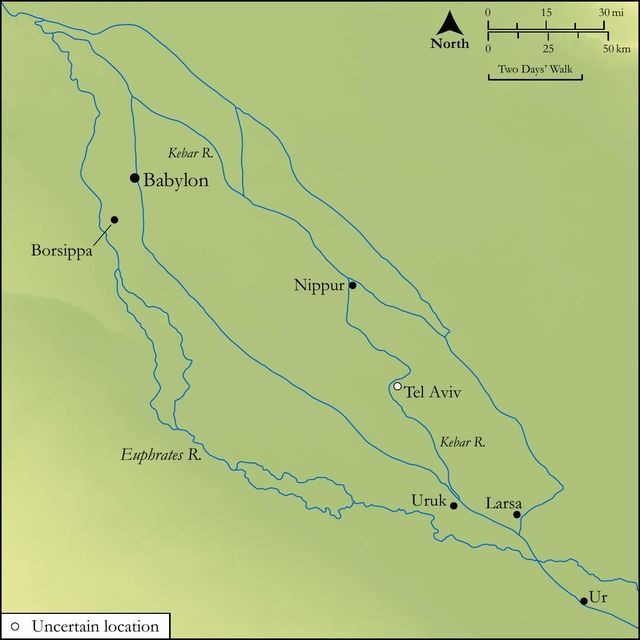
Ezekiel 1:4 immediately follows the introductory verses (Ezekiel 1:1-3), which establish the precise time, geographical place (by the Chebar Canal in Babylon), and Ezekiel's identity as a priest among the exiles. This verse marks the abrupt and dramatic transition from the setting to the direct encounter with the divine. It is the initial manifestation of the elaborate chariot-throne vision that unfolds in the subsequent verses, progressively revealing the complex imagery of the living creatures, wheels, and the divine throne, culminating in the description of the glory of the LORD in Ezekiel 1:26-28. The chaotic yet ordered imagery of the whirlwind, cloud, and fire in this verse serves as a powerful and disorienting prelude, designed to capture the prophet's attention and prepare him for the profound and often challenging revelations to follow.
Historical & Cultural Context
Ezekiel received this vision in 593 BC, five years after the first major deportation of Judahites to Babylon (597 BC), which included Ezekiel himself. Living as an exile, far from Jerusalem and its Temple—the traditional and expected locus of God's presence—Ezekiel's vision profoundly affirmed God's sovereignty and His ability to manifest His presence anywhere, even in a foreign land among a displaced people. The imagery of storms, clouds, and fire as manifestations of divine power was common in ancient Near Eastern cultures, often associated with powerful deities. However, for Israel, these elements were intimately tied to Yahweh's unique appearances, such as His descent on Mount Sinai in Exodus 19:16-18 or His guiding presence in the pillar of cloud and fire during the wilderness wanderings, as seen in Exodus 13:21-22. This vision, therefore, resonated deeply with Israel's theological heritage while challenging their geographical preconceptions of God's dwelling, offering hope amidst despair.
Key Themes
ShowHideThis opening verse immediately introduces several pivotal themes that permeate the entire book of Ezekiel. First, the theme of Divine Majesty and Transcendence is powerfully conveyed through the overwhelming natural phenomena—whirlwind, cloud, fire, and brightness—which underscore God's incomprehensible power, unapproachable holiness, and absolute control over creation. Second, the Presence of God in Exile is a central and comforting message; despite being far from the Temple, God is not confined, but actively present with His people, even in their captivity, offering reassurance and hope. Third, the Enigmatic and Awe-Inspiring Nature of Revelation is highlighted; the vision is not immediately clear but unfolds in layers of complex, often symbolic imagery, demanding careful contemplation and evoking profound reverence. Finally, the scene serves as Preparation for Prophecy, indicating the weighty, often challenging, and divinely authorized nature of the messages Ezekiel is about to receive, empowering him for his difficult task of speaking God's word to a rebellious people, as described in Ezekiel 2:3-5.
Exposition and Analysis
ShowHideKey Word Analysis
ShowHideDerived from a root meaning "to storm," this word denotes a hurricane, tempest, or violent wind. In biblical contexts, whirlwinds often signify the powerful, sometimes destructive, arrival of God or His judgments, emphasizing His untamed power and the suddenness of His appearance. It suggests an overwhelming, unstoppable force.
A primitive root meaning "to take" in a wide variety of applications, including "to gather," "to seize," or "to receive." When used with "fire" (as "fire infolding itself"), it suggests a self-contained, intensely active, and perhaps self-consuming or coiling motion within the fire. This indicates its dynamic, vibrant, and living quality, rather than a static or passive flame, hinting at the inherent energy of the divine presence.
From a root meaning "to shine," this word refers to brilliancy, light, or shining. It describes an intense radiance or glow surrounding the divine manifestation, further emphasizing the overwhelming glory, purity, and holiness associated with God's presence, indicating an effulgence that is almost too much for human eyes to behold.
Of uncertain derivation, this term is unique to Ezekiel (appearing only in Ezekiel 1:4, 1:27, and 8:2). While often translated as "amber," its precise meaning is debated. The Strong's definition suggests "probably bronze or polished spectrum metal," implying a brilliant, gleaming, perhaps metallic luster. This "color" or "appearance" emanating from the fire's midst signifies a radiant, dazzling, and perhaps indescribable quality of divine glory, distinct from mere flame, representing the most intense and refined aspect of God's essence.
Verse Breakdown
ShowHide"And I looked, and, behold, a whirlwind came out of the north"
The prophet's direct observation begins with an immediate and striking phenomenon. The "whirlwind" (H7307, H5591) signifies a powerful, often chaotic force, frequently associated with divine manifestations or judgment (e.g., Job 38:1). Its origin "out of the north" (H6828) is significant. In ancient Near Eastern cosmology, the north was sometimes associated with the dwelling place of deities (e.g., Mount Zaphon) or a direction from which judgment or divine activity might come, adding to the awe and perhaps apprehension of the vision.
"a great cloud, and a fire infolding itself"
Following the whirlwind, a "great cloud" (H1419, H6051) appears, a classic biblical motif for God's presence, often associated with mystery, majesty, and the concealment of His full glory (e.g., Exodus 19:9). Within this cloud, "a fire" (H784) is seen, described as "infolding itself" (H3947). This is not a static flame but a dynamic, self-contained, and intensely active fire, perhaps swirling or consuming itself, suggesting an inherent, vibrant energy and purity that is both terrifying and mesmerizing.
"and a brightness [was] about it"
Surrounding the cloud and fire was an intense "brightness" (H5051). This radiance indicates the overwhelming glory and purity of the divine presence, an effulgence that is almost too much to behold, serving as a boundary or aura of holiness around the core manifestation, signifying God's unapproachable light.
"and out of the midst thereof as the colour of amber, out of the midst of the fire."
From the very center of this fiery, bright manifestation, an even more concentrated and enigmatic radiance emerges, described as "the colour of amber" (H5869, H2830). This "amber" (or polished, gleaming metal/electrum) suggests a brilliant, fiery, and perhaps metallic luster that is distinct from the fire itself, representing the most intense and refined aspect of God's glory, radiating from His very essence. The repetition "out of the midst of the fire" emphasizes the origin of this unique glow from the absolute heart of the divine presence, underscoring its profound significance.
Literary Devices
ShowHideEzekiel 1:4 is rich in Imagery, painting a vivid and multisensory picture of the divine encounter. The descriptions of "whirlwind," "great cloud," "fire," "brightness," and "amber" appeal primarily to sight, but also evoke a sense of immense power and mystery. The verse employs Theophany, the visible manifestation of God to humanity, using traditional biblical motifs (storm, cloud, fire) to convey God's presence, yet with an intensified, almost alien quality. There is also significant Symbolism: the "north" can symbolize the direction of divine judgment or the cosmic mountain; the "whirlwind," "cloud," and "fire" symbolize God's power, transcendence, and purifying holiness. The phrase "fire infolding itself" uses Personification or Anthropomorphism to describe the fire as having an active, dynamic quality, almost as if it is alive and self-contained. The description of "amber" (Hebrew: chashmal) is an example of Enigma or Mystery, as its precise nature is debated, contributing to the ineffable and indescribable quality of God's glory. The cumulative effect of these devices is to create an overwhelming sense of Awe and Reverence in the face of the divine, preparing the reader for the profound revelations that follow.
Theological and Thematic Connections
ShowHideEzekiel 1:4 serves as a powerful theological statement about the nature of God. It asserts His absolute sovereignty and transcendence, demonstrating that His presence is not confined to the Temple in Jerusalem but can manifest anywhere, even among His exiled people in Babylon. The overwhelming imagery of storm, cloud, and fire speaks to God's raw power, His unapproachable holiness, and His capacity for both judgment and revelation, while the "brightness" and "amber" highlight His glorious, pure, and awe-inspiring essence. This vision underscores that God is both utterly transcendent—beyond human comprehension and control—and immanently present, actively engaging with His creation and His covenant people, even in their darkest hour. It is a revelation designed to re-establish hope, confirm God's unwavering control over history and human destiny, and prepare Ezekiel for his prophetic ministry.
Reflection and Application
ShowHideEzekiel's initial encounter with God's glory in such a dramatic and overwhelming fashion offers profound lessons for our own spiritual journeys. It reminds us that God's presence is not limited by our circumstances, geographical location, or even our perceived spiritual dryness. Just as He met Ezekiel in exile, He can meet us in our own "Babylons"—times of displacement, uncertainty, despair, or spiritual wilderness. This vision calls us to cultivate a posture of awe and reverence before a God who is infinitely greater, more glorious, and more mysterious than we can imagine. It challenges our tendency to domesticate God or confine Him to our comfortable expectations and predictable experiences. Furthermore, the intensity of the revelation suggests that encountering the living God is often a transformative, sometimes unsettling, experience that strips away our preconceived notions and prepares us for His purposes. We are called to be open to His manifestations, even when they challenge our understanding and call us to uncomfortable truths, trusting that His presence is always for our ultimate good and His glory.
Questions for Reflection
ShowHideFAQ
ShowHideWhat is the significance of the "north" as the direction from which the whirlwind came?
ShowHideThe "north" (Hebrew: tsâphôwn, H6828) held various symbolic meanings in the ancient world. In some ancient Near Eastern myths, it was associated with the dwelling place of the gods (e.g., Mount Zaphon). In biblical tradition, the north is often depicted as the direction from which invasions, judgment, or divine power emanates (e.g., Jeremiah 1:14-15). For Ezekiel, it could signify that God's judgment was coming upon Judah from Babylon (to the north), or more broadly, it emphasizes that God's power is not localized to Jerusalem but can manifest from any direction, asserting His universal sovereignty. It adds to the sense of awe and the unexpected, overwhelming nature of this divine appearance.
Christ-Centered Fulfillment
ShowHideEzekiel's vision of the divine glory, initiated by the whirlwind, cloud, fire, and brilliant amber, finds its ultimate and most accessible fulfillment in the person of Jesus Christ. While Ezekiel saw a veiled, overwhelming manifestation of God's transcendence, the New Testament reveals that "the Word became flesh and dwelt among us, and we have seen his glory, glory as of the only Son from the Father" (John 1:14). The dazzling, unapproachable brightness of Ezekiel's vision is embodied in Christ, who is "the radiance of the glory of God and the exact imprint of his nature" (Hebrews 1:3). The fiery, self-sustaining essence of God's holiness, hinted at by the "fire infolding itself" and the "colour of amber," is perfectly revealed in Christ, who, though fully human, is also fully divine, the very presence of God with us. He is the visible image of the invisible God (Colossians 1:15), making the incomprehensible glory of God comprehensible and relatable. Through Christ, the awe-inspiring power and majesty of God are not diminished but made approachable, inviting us into a relationship with the very God whom Ezekiel struggled to describe. He is the true "brightness" that came out of the "midst of the fire," illuminating the path to salvation and revealing the Father's heart.