


Ezekiel 1:3
- הָיֹהha·Yohexpressly <come>H1961V-Qal-InfAbsVerb Qal Infinitive Absolute
- הָיָהha·Yahit cameH1961V-Qal-Perf-3msVerb Qal Perfect 3rd Singular Masculine
- דְבַרde·var[the] word ofH1697N-mscNoun Singular Masculine Construct
- יְהוָהYah·wehYahwehH3068N-properNoun Proper Title
- אֶל'eltoH413PrepPreposition
- יְחֶזְקֵאלye·chez·KelEzekielH3168N-proper-mNoun Proper Masculine
- בֶּןben[the] son ofH1121N-mscNoun Singular Masculine Construct
- בּוּזִיbu·ZiBuziH941N-proper-mNoun Proper Masculine
- הַכֹּהֵןha·ko·Henthe priestH3548Art ¦ N-msNoun Singular Masculine Absoluteהַtheכֹּהֵןpriest
- בְּאֶרֶץbe·'E·retzin [the] land ofH776Prep-b ¦ N-fscNoun Singular Feminine Constructבְּinאֶרֶץ[the] land of
- כַּשְׂדִּיםkas·Dim[the] ChaldeansH3778N-properNoun Proper Location
- עַל'alatH5921PrepPreposition
- נְהַרne·har[the] river ofH5104N-mscNoun Singular Masculine Construct
- כְּבָרke·VarKebarH3529N-properNoun Proper Location
- וַתְּהִיva·te·Hiand it wasH1961Conj-w ¦ V-Qal-ConsecImperf-3fsVerb Qal Consecutive Imperfect 3rd Singular Feminineוַandתְּהִיit was
- עָלָיו'a·Lavon himH5921Prep ¦ 3msPrepositionעָלָיonוhim
- שָׁםshamthereH8033AdvAdverb
- יַדyad[the] hand ofH3027N-cscNoun Singular common gender Construct
- יְהוָהYah·wehYahwehH3068N-properNoun Proper Title
English is a literal word-by-word gloss of the Hebrew, not the KJV's wording. Why?
This is the original text the KJV's translators worked from — each Hebrew word with its own literal English meaning in this verse, prepared by scholars at Tyndale House, Cambridge. The KJV translates whole sentences, not word by word, so its wording differs: one Hebrew word can become several English words, and the KJV may choose “the LORD” where the gloss reads “Yahweh”. Both are faithful — they answer different questions. For the KJV's own rendering, switch to the KJV text.
Details
See on the biblical-era map
Study this verse
Historical interpretation
Four Centuries of Reception
8 surviving comments on this verse. Each one is dated, so this reads as a timeline rather than a list.
Select a marker to jump to its quote. Markers stagger vertically where authors wrote within a few decades of each other.
If you want to understand that this word is said about the Savior, do not hold back. The allegory has its own meaning as well, in this way: the Word of God comes to us as he who was born of the virgin, that is, man; as the Word who lives always in the Father.
Whenever God is going to reveal some sight beyond all expectation to his servants, he leads them out of the cities to a place free from tumult.
(Verse 3) The word of the Lord came to Ezekiel, son of Buzi, the priest, in the land of the Chaldeans, by the river Chebar. And to Daniel and Ezekiel, who were in Babylon by the rivers, the mysteries of things to come are revealed upon the waters, indeed in the purest waters, so that the power of baptism may be shown. Otherwise, even the apostle Paul, when he was baptized by Ananias in the Lord, having his eyes covered with scales, was freed from blindness (Acts 9). And in Genesis, the first creatures that lived came forth from the waters. It should also be understood that in the thirtieth year of his age the Lord came to baptism: in the fourth month, which is called January among us, and is at the beginning of the year, except for the month of Nisan, the month of the new moon, in which the Passover is celebrated. Among Oriental peoples, after the gathering of crops and the pressing of grapes, when tithes were brought to the temple, October was the first month, and January the fourth. But he adds the fifth day of the month, to signify baptism, in which the heavens were opened to Christ, and the day of Epiphany is venerable until now, not as some suppose, the birthday in the flesh, for he was hidden at that time and did not appear. This is suitable for this time, when it was said: This is my beloved Son, in whom I am well pleased (Matthew 3:17). Furthermore, Buzi is translated into our language, despised and rejected: Ezekiel, strengthened by God. What is thus joined to the Lord, that we may say the Creator of the world, who is the Father of the Savior, is despised and rejected by all heretics, who do not accept the old Testament. It is not surprising that the Lord is the strength of God, since He is the power and wisdom of God Himself.
And the hand of the Lord came upon him there. LXX: And the hand of the Lord came upon me. In order to see the visions of God and understand them, we need the hand and strength of God upon us (1 Corinthians 1). With that hand and arm, the people of Israel were led out of Egypt; even the Magi understood a part of that power, saying: This is the finger of God (Exodus 8). And the Savior in the Gospel said: But if I cast out demons by the finger of God (Matthew 12:28). For it is written in another Gospel: If I cast out demons by the Spirit of God (Luke 11:20).
The Holy Spirit descended on Christ and remained; he descends on people, assuredly, but does not remain. Furthermore, in the scroll of Ezekiel, who is properly a type of the Savior—no other prophet, I mean of the major prophets, is called, “Son of man”; the title is given strictly to Ezekiel.
So that we can discern and understand the visions of God, it is necessary for us to have the hand and strength of God on us.
To both Daniel and Ezekiel who were in Babylon by the river, the sacraments of the future were unfolded, I mean in the purest of waters, so that the power of baptism could be shown.
"And the word of the Lord came to Ezekiel the son of Buzi, the priest." The hand or arm of the Lord is called the Son, because through Him all things were made. Of whom the Psalmist also says: "Let Your hand be upon me to save me." For the hand of God, which through divinity was not made but begotten, was made through humanity, so that it might heal the wounds of the human race. Therefore the prophet recognized the incarnation of the Only-begotten there, where he saw the hand of the Lord made upon him.
We must consider what order of expression there is in the words of the prophet. For he who had said above concerning himself, "The heavens were opened, and I saw visions of God," afterward adds as if narrating about another: "And the hand of the Lord was upon him there." And then he returns as it were to himself and says: "And I saw, and behold a whirlwind came from the North." What is this, that now Ezekiel speaks, now about Ezekiel? If he had spoken about himself throughout, there would be no question. If he had spoken throughout as if about another, there would likewise have been no question. What then is this, that the prophetic discourse is so varied that now the Prophet speaks about himself, but now another seems to speak about him? But we must know that those who are filled with the spirit of prophecy, by the fact that they sometimes speak openly about themselves, and sometimes utter words about themselves as if about others, indicate that it is not the prophet but the Holy Spirit who speaks through the prophet. For inasmuch as the word is made through them, they themselves speak about themselves; and inasmuch as they speak by the inspiration of the Holy Spirit, the same Holy Spirit speaks through them about them, as the Truth attests who says: "For it is not you who speak, but the Spirit of your Father who speaks in you." Hence Moses also says: "Moses was the meekest man above all men who dwelt on the earth." For he who does not say "I was" but "he was" plainly indicates that he who was speaking through him about him was another. Hence John says: "He saw that disciple whom Jesus loved." Whence Paul also, to show that it was not he who was speaking, said: "Do you seek proof of Christ who speaks in me?" Therefore, since in prophetic speech one is he who presides, another he who serves, when the prophet speaks about himself it is the person of the one serving, but when the Holy Spirit speaks through the prophet about the prophet, the sublimity of the one presiding is shown.
Continue studying Ezekiel 1:3 across the web’s major study libraries — every link below opens this exact verse, chapter, or book on the destination site.
Read & Compare
 BibleGatewayThis verse in more than 200 translations and 70 languages.
 Bible.comThe YouVersion reader — hundreds of translations, reading plans, and highlights.
 ESV.orgCrossway's official English Standard Version reader.
 NET BibleThe NET translation with 60,000+ translators' notes on every rendering decision.
 STEP BibleTyndale House's free study tool — original text, vocabulary, and scholarly resources.
 BibliaLogos Bible Software's free web reader.
 USCCBThe New American Bible (Revised Edition) with the U.S. bishops' study notes.
Commentaries
 BibleHub CommentariesDozens of classic commentaries on this verse, gathered on one page.
 StudyLightMore than 100 commentary sets — the largest collection on the web.
 BibleRefPlain-English commentary on what this verse means, verse by verse.
 Enduring WordDavid Guzik's free commentary on this chapter, widely used by Bible teachers.
 Bible Study ToolsVerse commentary alongside Greek and Hebrew study aids.
Original Language & Research
- BibleHub InterlinearThe verse word by word — original language, transliteration, and English.
- BibleHub LexiconEvery word's original-language definition and Strong's entry.
 Blue Letter BibleDeep-study tools — Strong's numbers, concordance, and word studies.
 SefariaThe Hebrew text with Rashi and centuries of Jewish commentary.
Sermons, Hymns & Audio


TrulyRandomVerse is not affiliated with these sites and doesn’t control their content. They’re linked because they’re genuinely useful.
Summary
Ezekiel 1:3 serves as the foundational introduction to the prophet Ezekiel and the extraordinary divine encounter that initiated his ministry. This pivotal verse precisely identifies Ezekiel as a priest, details his lineage through Buzi, and critically situates his prophetic calling in the "land of the Chaldeans by the river Chebar." It immediately establishes the indisputable source of his authority and the compelling nature of his commission, declaring that "the word of the LORD came expressly unto Ezekiel" and "the hand of the LORD was there upon him," thereby setting the stage for the profound visions, challenging messages, and often dramatic symbolic actions that comprise the book of Ezekiel.
Context
ShowHideLiterary Context
Ezekiel 1:3 immediately follows the opening verses (Ezekiel 1:1-2), which meticulously establish the precise date of Ezekiel's vision. These initial verses ground the supernatural revelation in a specific historical moment, emphasizing the divine initiative and the prophet's identity. Verse 3 then functions as a crucial bridge, transitioning from the chronological setting to the awe-inspiring vision of God's glory that begins in Ezekiel 1:4. By formally introducing Ezekiel, detailing his priestly lineage, and specifying his geographical location, this verse legitimizes his subsequent messages by highlighting the direct, undeniable, and divinely compelled nature of his encounter with God before plunging into the complex imagery of the cherubim and the divine throne-chariot. It underscores that what follows is not a human invention but a divine impartation.
Historical & Cultural Context
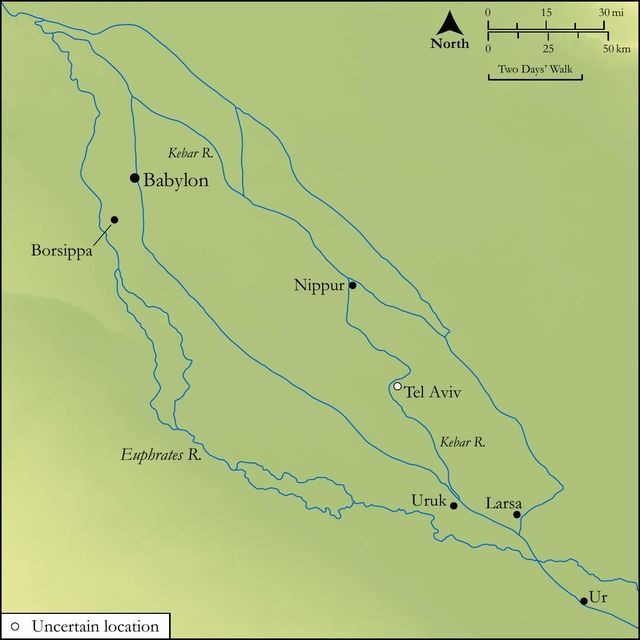
The setting of Ezekiel's call, "in the land of the Chaldeans by the river Chebar," is profoundly significant. Ezekiel was among the Jewish exiles deported to Babylon in 597 BC, during the second major wave of deportations under King Nebuchadnezzar, a historical event vividly recounted in 2 Kings 24:14-16. Unlike earlier prophets who ministered within the sacred confines of Jerusalem, Ezekiel's ministry began in a foreign, pagan land, far removed from the Temple. The Chebar river was likely a large irrigation canal near Nippur, a significant Babylonian city, indicating a settled community of exiles. For a priest like Ezekiel, whose life and ministry were traditionally centered around the Temple in Jerusalem, this exile was a profound disruption to his identity and calling. His divine commission in Babylon underscored God's sovereignty and active presence even outside the Promised Land and the Temple, challenging the exiles' understanding of God's dwelling and activity and demonstrating His faithfulness even in judgment.
Key Themes
ShowHideEzekiel 1:3 introduces several key themes that permeate the entire book. Firstly, it highlights Divine Initiative and Authority. The emphatic phrase "The word of the LORD came expressly" stresses that God is the primary actor, initiating the prophetic message with undeniable clarity and power. This contrasts sharply with human speculation or desire, establishing the absolute authority of the divine revelation that follows. Secondly, the verse underscores God's Omnipresence and Presence in Adversity. Ezekiel's call in exile, far from the spiritual heart of Israel, powerfully demonstrates that God's presence is not confined to Jerusalem or the Temple. Even in a foreign land, amidst national despair and displacement, God actively communicates with His people, revealing His commitment to them despite their disobedience, a theme beautifully echoed in Psalm 139:7-10. Lastly, the verse introduces the theme of Prophetic Empowerment. "And the hand of the LORD was there upon him" signifies the powerful, compelling, and enabling influence of God's Spirit, preparing and equipping Ezekiel to receive profound visions and deliver challenging messages. This divine touch is a recurring motif in Ezekiel, marking him as a true prophet under God's direct control and inspiration, as seen again in Ezekiel 3:22.
Exposition and Analysis
ShowHideKey Word Analysis
ShowHideFrom the root meaning "to speak," dâbâr here refers to "a word," but by implication, it encompasses a "matter" or "thing" that is spoken. In this context, it signifies the authoritative, active, and specific communication from God. It is not merely a sound but a divine declaration, carrying the weight of God's will and purpose, which is "expressly" delivered to Ezekiel. This "word" is the very source of all prophetic revelation in the book, indicating a divine act of communication, not a human utterance.
This term denotes one who officiates in sacred rites, a priest. Ezekiel's identity as a priest, the son of Buzi, is crucial. As a member of the Levitical priesthood, he was trained in the Law and the Temple rituals. His priestly background gives him a unique perspective on Israel's sin and the defilement of the Temple, which becomes a major theme in his prophecy (e.g., Ezekiel 8). It also highlights the profound disruption of his traditional priestly duties due to exile, making his prophetic call even more significant as a new, divinely ordained form of service to God's people.
While literally meaning "hand," yâd is used here idiomatically to signify power, means, direction, or influence. "The hand of the LORD" is a powerful anthropomorphism, representing God's direct, tangible, and enabling power upon the prophet. It indicates divine compulsion and empowerment, suggesting that Ezekiel was not merely receiving a message but was physically and spiritually overwhelmed and directed by God's presence, preparing him for the intense visions and difficult ministry ahead. This "hand" signifies divine control and the impartation of spiritual capacity.
Verse Breakdown
ShowHide"The word of the LORD came expressly unto Ezekiel the priest, the son of Buzi"
This opening clause establishes the divine origin and authoritative nature of the message. "The word of the LORD" (Hebrew: dâbâr YHWH) is a standard prophetic formula, but the addition of "expressly" (Hebrew: hayoh hayah, an infinitive absolute construction) intensifies the certainty and clarity of the divine revelation. It means the word "came, indeed it came" or "came certainly," leaving no doubt about the divine source and the prophet's clear, undeniable reception of it. Identifying Ezekiel as "the priest, the son of Buzi" grounds his prophetic ministry in his established identity and lineage, emphasizing his legitimate standing within the Israelite community, even in exile.
"in the land of the Chaldeans by the river Chebar;"
This geographical and cultural locator is highly significant. It places the divine encounter not in the sacred land of Israel or the Temple in Jerusalem, but in a foreign, pagan land of exile. The "river Chebar" (likely a canal) indicates a specific, tangible location within the Babylonian diaspora. This detail powerfully conveys God's omnipresence and His continued engagement with His people, even when they are displaced and far from their traditional spiritual centers, challenging the notion that God's presence was limited to Jerusalem and offering hope that God had not abandoned them.
"and the hand of the LORD was there upon him."
This concluding clause describes the powerful, enabling presence of God's Spirit upon Ezekiel. "The hand of the LORD" is a recurring motif in prophetic literature, signifying divine empowerment, inspiration, and often a compelling force that prepares the prophet for visions or pronouncements. It implies a tangible, overwhelming spiritual experience that equipped Ezekiel for his extraordinary and often challenging ministry, marking him as divinely chosen and supernaturally enabled to receive and deliver God's profound and often difficult messages.
Literary Devices
ShowHideEzekiel 1:3 employs several powerful literary devices to underscore the significance of Ezekiel's prophetic call. The phrase "The word of the LORD came expressly" utilizes Emphasis through an infinitive absolute construction in Hebrew (hayoh hayah), underscoring the undeniable certainty, clarity, and forceful nature of the divine revelation. This is not a vague impression but a direct, authoritative communication from God. The recurring phrase "the hand of the LORD" is a potent Anthropomorphism and Idiom, attributing a human characteristic (a hand) to God to convey His active, powerful, and often compelling presence and influence upon the prophet. This Symbolism of the hand represents divine empowerment, control, and the impartation of prophetic ability. The detailed geographical setting ("in the land of the Chaldeans by the river Chebar") serves as Verisimilitude, lending authenticity and realism to the supernatural events that follow, while also highlighting the profound Irony of God's word appearing in a pagan land rather than in the "holy" land or the Temple, thereby emphasizing God's universal sovereignty and His presence with His exiled people.
Theological and Thematic Connections
ShowHideEzekiel 1:3 profoundly articulates the nature of divine revelation and prophetic authority. It underscores that true prophecy originates solely from God's initiative, not human will or desire. The "express" coming of the word of the LORD signifies its clarity, certainty, and undeniable power, establishing the prophet as a mere conduit for God's authoritative message. Furthermore, the presence of God's "hand" upon Ezekiel in a foreign land highlights God's omnipresence and His unwavering commitment to His covenant people, even in judgment and exile. This demonstrates that God's power and presence are not confined by geographical boundaries or human circumstances, offering a profound theological truth about His sovereignty over all creation and His steadfast love for His people, even in their darkest hours of displacement and despair.
Reflection and Application
ShowHideEzekiel 1:3 offers profound encouragement and guidance for believers today, reminding us that God's call and His presence are not limited by our circumstances, our location, or even our past failures. Just as Ezekiel, a priest, was called in a foreign land during a time of national crisis and spiritual desolation, God can reach out to anyone, anywhere, to use them for His sovereign purposes. This verse challenges us to recognize that God's word is "express"—clear, authoritative, and compelling—and demands our attentive listening and obedient response, rather than our own preconceived notions or desires. It assures us that when God calls, He also empowers. The "hand of the LORD" upon Ezekiel speaks powerfully to the enabling presence of the Holy Spirit, equipping believers to live out their calling, face adversity with divine strength, and bear witness to God's truth, even in seemingly impossible or hostile situations. Our effectiveness in ministry and life stems not from our own strength, wisdom, or ideal circumstances, but from the divine enablement that God graciously provides to accomplish His will.
Questions for Reflection
ShowHideFAQ
ShowHideWhy is Ezekiel's location 'by the river Chebar' significant?
ShowHideThe location "by the river Chebar" (in the "land of the Chaldeans") is profoundly significant because it demonstrates God's omnipresence and sovereignty beyond the confines of the Promised Land or the Temple in Jerusalem. For a priest like Ezekiel, whose ministry was traditionally tied to the Temple and the sacred land, being called in exile underscored that God's presence and power were not limited to a specific geographical location. It conveyed a crucial message to the exiled Israelites: even though they were far from home and the Temple was destroyed, God was still with them, actively communicating and working among them. This challenged their understanding of God's dwelling and activity, showing that His covenant faithfulness extended even into their captivity, a theme central to the initial vision in Ezekiel 1.
What does 'the hand of the LORD' signify in this context?
ShowHideThe phrase "the hand of the LORD" is a powerful biblical idiom that consistently signifies the active, compelling, and enabling presence of God's Spirit upon an individual, particularly a prophet. In Ezekiel 1:3, it indicates that Ezekiel was not merely receiving a message intellectually but was physically and spiritually overwhelmed and empowered by divine force. This "hand" prepared him for the profound visions he was about to receive and equipped him for the challenging prophetic ministry ahead. It denotes divine inspiration, control, and the supernatural ability to perceive and communicate God's truth, a motif that recurs throughout the book of Ezekiel, notably when Ezekiel is transported by the Spirit in Ezekiel 8:1.
How does Ezekiel's call as a priest relate to his prophetic ministry?
ShowHideEzekiel's identity as a priest, the son of Buzi, is integral to understanding his prophetic ministry. As a priest, he was trained in the Mosaic Law, the sacrificial system, and the rituals of the Temple. This background provided him with a deep understanding of Israel's covenant obligations and the sanctity of God's presence. His priestly perspective profoundly influences his prophetic messages, which frequently address the defilement of the Temple, the idolatry of the people, and the need for spiritual cleansing and restoration. While his traditional priestly duties were suspended due to exile, his prophetic call became a new, divinely ordained form of service, allowing him to continue ministering to God's people by revealing His judgment and promises, as detailed in the unfolding narrative of the Book of Ezekiel.
Christ-Centered Fulfillment
ShowHideEzekiel 1:3, with its profound emphasis on the "word of the LORD" coming "expressly" and the "hand of the LORD" empowering the prophet, finds its ultimate and perfect fulfillment in Jesus Christ. He is not merely one who received God's word, but He is the living "Word of God" made flesh, the perfect and final revelation of God to humanity, as profoundly declared in John 1:1 and John 1:14. While Ezekiel was a conduit for God's message, Christ is God's message, the very embodiment of divine truth, purpose, and presence. Furthermore, just as the "hand of the LORD" was upon Ezekiel, the Holy Spirit empowered Jesus without measure for His earthly ministry, from His baptism (recorded in Matthew 3:16) to His miracles, teaching, and ultimate sacrifice. Christ functions as the ultimate Prophet, delivering God's definitive message, and the ultimate Priest, offering Himself as the perfect, once-for-all sacrifice and continually interceding for His people, as described in Hebrews 4:14-16. His ministry, like Ezekiel's, transcended geographical and cultural boundaries, bringing God's presence and salvation to all nations, not just Israel. Ultimately, the Spirit's empowering "hand" that fell on Ezekiel now rests upon all believers through Christ, enabling them to be witnesses of God's truth in the world, just as the Spirit descended upon the church with power at Pentecost in Acts 2:1-4.