


2 Kings 25:27
Bible text: King James Version (1769 Blayney text) · Public domain
Bible text: King James Version with Strong's numbers · Public domain
Bible text: Berean Standard Bible · Public domain
Bible text: American Standard Version (1901) · Public domain
Bible text: World English Bible, Messianic edition · Public domain
Bible text: Geneva Bible (1599) · Public domain
Bible text: Young's Literal Translation · Public domain
- וַיְהִיvay·Hiand it wasH1961Conj-w ¦ V-Qal-ConsecImperf-3msVerb Qal Consecutive Imperfect 3rd Singular Masculineוַandיְהִיit was
- בִשְׁלֹשִׁיםvish·lo·Shimin thirtyH7970Prep-b ¦ N-mpNoun Plural Masculine Absoluteבִinשְׁלֹשִׁיםthirty
- וָשֶׁבַעva·She·va'and sevenH7651Conj-w ¦ N-csNoun Singular common gender Absoluteוָandשֶׁבַעseven
- שָׁנָהsha·NahyearH8141N-fsNoun Singular Feminine Absolute
- לְגָלוּתle·ga·Lutof [the] exile ofH1546Prep-l ¦ N-fscNoun Singular Feminine Constructלְofגָלוּת[the] exile of
- יְהוֹיָכִיןye·ho·ya·KhinJehoiachinH3078N-proper-mNoun Proper Masculine
- מֶלֶךְMe·lekh[the] king ofH4428N-mscNoun Singular Masculine Construct
- יְהוּדָהye·hu·DahJudahH3063N-properNoun Proper Location
- בִּשְׁנֵיםbish·Neimin two [plus]H8147Prep-b ¦ N-cdNoun Dual common gender Absoluteבִּinשְׁנֵיםtwo [plus]
- עָשָׂר'a·SartenH6240N-csNoun Singular common gender Absolute
- חֹדֶשׁCho·deshmonthH2320N-msNoun Singular Masculine Absolute
- בְּעֶשְׂרִיםbe·'es·Rimon [day] twentyH6242Prep-b ¦ N-mpNoun Plural Masculine Absoluteבְּonעֶשְׂרִים[day] twenty
- וְשִׁבְעָהve·shiv·'Ahand sevenH7651Conj-w ¦ N-csNoun Singular common gender Absoluteוְandשִׁבְעָהseven
- לַחֹדֶשׁla·Cho·deshof the monthH2320Prep-l ¦ N-msNoun Singular Masculine Absoluteלַof theחֹדֶשׁmonth
- נָשָׂאna·Sa'he lifted upH5375V-Qal-Perf-3msVerb Qal Perfect 3rd Singular Masculine
- אֱוִיל'e·VilEvil-H192N-proper-mNoun Proper Masculine
- מְרֹדַךְme·ro·daKhMerodachH192N-proper-mNoun Proper Masculine
- מֶלֶךְMe·lekh[the] king ofH4428N-mscNoun Singular Masculine Construct
- בָּבֶלba·VelBabylonH894N-properNoun Proper Location
- בִּשְׁנַתbish·Natin [the] yearH8141Prep-b ¦ N-fscNoun Singular Feminine Constructבִּinשְׁנַת[the] year
- מָלְכוֹma·le·Khohe became kingH4427V-Qal-Inf ¦ 3msVerb Qal Infinitive Constructמָלְכbecame kingוֹhe
- אֶת'et<obj.>H853DirObjMParticle Object Indicator
- רֹאשׁrosh[the] head ofH7218N-mscNoun Singular Masculine Construct
- יְהוֹיָכִיןye·ho·ya·KhinJehoiachinH3078N-proper-mNoun Proper Masculine
- מֶלֶךְMe·lekh[the] king ofH4428N-mscNoun Singular Masculine Construct
- יְהוּדָהye·hu·DahJudahH3063N-properNoun Proper Location
- מִבֵּיתmi·Beitfrom [the] house ofH1004Prep-m ¦ N-mscNoun Singular Masculine Constructמִfromבֵּית[the] house of
- כֶּלֶאKe·le'imprisonmentH3608N-msNoun Singular Masculine Absolute
English is a literal word-by-word gloss of the Hebrew, not the KJV's wording. Why?
This is the original text the KJV's translators worked from — each Hebrew word with its own literal English meaning in this verse, prepared by scholars at Tyndale House, Cambridge. The KJV translates whole sentences, not word by word, so its wording differs: one Hebrew word can become several English words, and the KJV may choose “the LORD” where the gloss reads “Yahweh”. Both are faithful — they answer different questions. For the KJV's own rendering, switch to the KJV text.
Details
See on the biblical-era maps
Study this verse
Public-domain commentary
Matthew Henry
From his Commentary on the Whole Bible. Henry comments on passages, not single verses — this entry covers 2 Kings 25:22–30. His three-level outline is real structure in the source text, so it is rendered as structure.
In these verses we have,
I.The dispersion of the remaining people.
The city of Jerusalem was quite laid waste. Some people there were in the land of Judah (Kg2 25:22) that had weathered the storm, and (which was no small favour at this time, Jer 45:5) had their lives given them for a prey. Now see,
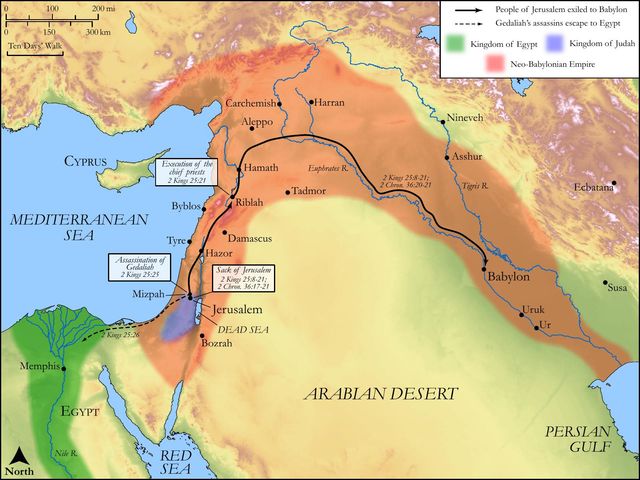
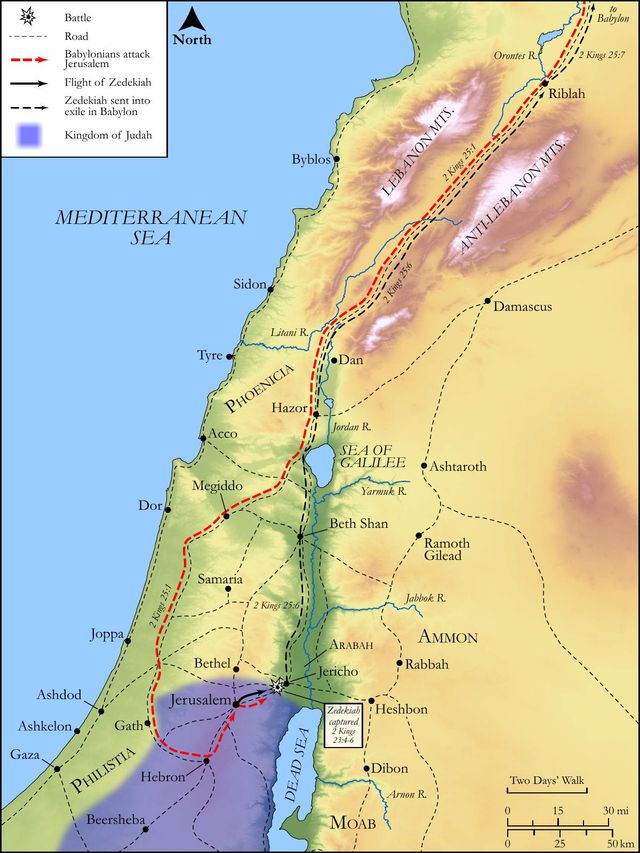
1.What a good posture they were put into. The king of Babylon appointed Gedaliah, one of themselves, to be their governor and protector under him, a very good man, and one that would make the best of the bad, Kg2 25:22. His father Ahikam was one that countenanced and protected Jeremiah when the princes had vowed his death, Jer 26:24. It is probable that this Gedaliah, by the advice of Jeremiah, had gone over the Chaldeans, and had conducted himself so well that the king of Babylon entrusted him with the government. He resided not at Jerusalem, but at Mizpah, in the land of Benjamin, a place famous in Samuel's time. Thither those came who had fled from Zedekiah (Kg2 25:4) and put themselves under his protection (Kg2 25:23), which he assured them of if they would be patient and peaceable under the government of the king of Babylon, Kg2 25:24. Gedaliah, though he had not the pomp and power of a sovereign prince, yet might have been a greater blessing to them than many of their kings had been, especially having such a privy-council as Jeremiah, who was now with them, and interested himself in their affairs, Jer 40:5, Jer 40:6.
2.What a fatal breach was made upon them, soon afterwards, by the death of Gedaliah, within two months after he entered upon his government. The utter extirpation of the Jews, for the present, was determined, and therefore it was in vain for them to think of taking root again: the whole land must be plucked up, Jer 45:4. Yet this hopeful settlement is dashed to pieces, not by the Chaldeans, but by some of themselves. The things of their peace were so hidden from their eyes that they knew not when they were well off, nor would believe when they were told.
(1.)They had a good governor of their own, and him they slew, out of spite to the Chaldeans, because he was appointed by Nebuchadnezzar, Kg2 25:25. Ishmael, who was of the royal family, envying Gedaliah's advancement and the happy settlement of the people under him, though he could not propose to set up himself, resolved to ruin him, and basely slew him and all his friends, both Jews and Chaldeans. Nebuchadnezzar would not, could not, have been a more mischievous enemy to their peace than this degenerate branch of the house of David was.
(2.)They were as yet in their own good land, but they forsook it, and went to Egypt, for fear of the Chaldeans, Kg2 25:26. The Chaldeans had reason enough to be offended at the murder of Gedaliah; but if those that remained had humbly remonstrated, alleging that it was only the act of Ishmael and his party, we may suppose that those who were innocent of it, nay, who suffered greatly by it, would not have been punished for it: but, under pretence of this apprehension, contrary to the counsel of Jeremiah, they all went to Egypt, where, it is probable, they mixed with the Egyptians by degrees, and were never heard of more as Israelites. Thus was there a full end made of them by their own folly and disobedience, and Egypt had the last of them, that the last verse of that chapter of threatenings might be fulfilled, after all the rest, Deu 28:68, The Lord shall bring thee into Egypt again. These events are more largely related by the prophet Jeremiah, ch. 40 to Jer 45:1-5. Quaeque ipse miserrima vidit, et quorum pars magna fuit - Which scenes he was doomed to behold, and in which he bore a melancholy part.
II.The reviving of the captive prince.
Of Zedekiah we hear no more after he was carried blind to Babylon; it is probable that he did not live long, but that when he died he was buried with some marks of honour, Jer 34:5. Of Jehoiachin, or Jeconiah, who surrendered himself (Kg2 24:12), we are here told that as soon as Evil-merodach came to the crown, upon the death of his father Nebuchadnezzar, he released him out of prison (where he had lain thirty-seven years, and was now fifty-five years old), spoke kindly to him, paid more respect to him than to any other of the kings his father had left in captivity (Kg2 25:28), gave him princely clothing instead of his prison-garments, maintained him in his own palace (Kg2 25:29), and allowed him a pension for himself and his family in some measure corresponding to his rank, a daily rate for every day as long as he lived. Consider this,
1.As a very happy change of Jehoiachin's condition. To have honour and liberty after he had been so long in confinement and disgrace, the plenty and pleasure of a court after he had been so long accustomed to the straits and miseries of a prison, was like the return of the morning after a very dark and tedious night. Let none say that they shall never see good again because they have long seen little but evil; the most miserable know not what blessed turn Providence may yet give to their affairs, nor what comforts they are reserved for, according to the days wherein they have been afflicted, Psa 90:15. However the death of afflicted saints is to them such a change as this was to Jehoiachin: it will release them out of their prison, shake off the body, that prison-garment, and open the way to their advancement; it will send them to the throne, to the table, of the King of kings, the glorious liberty of God's children.
2.As a very generous act of Evil-merodach's. He thought his father made the yoke of his captives too heavy, and therefore, with the tenderness of a man and the honour of a prince, made it lighter. It should seem all the kings he had in his power were favoured, but Jehoiachin above them all, some think for the sake of the antiquity of his family and the honour of his renowned ancestors, David and Solomon. None of the kings of the nations, it is likely, had descended from so long a race of kings in a direct lineal succession, and by a male line, as the king of Judah. The Jews say that this Evil-merodach had been himself imprisoned by his own father, when he returned from his madness, for some mismanagement at that time, and that in prison he contracted a friendship with Jehoiachin, in consequence of which, as soon as he had it in his power, he showed him this kindness as a sufferer, as a fellow-sufferer. Some suggest that Evil-merodach had learned from Daniel and his fellows the principles of the true religion, and was well affected to them, and upon that account favoured Jehoiachin.
3.As a kind dispensation of Providence, for the encouragement of the Jews in captivity, and the support of their faith and hope concerning their enlargement in due time. This happened just about the midnight of their captivity. Thirty-six of the seventy years were now past, and almost as many were yet behind, and now to see their king thus advanced would be a comfortable earnest to them of their own release in due time, in the set time. Unto the upright there thus ariseth light in the darkness, to encourage them to hope, even in the cloudy and dark day, that at evening time it shall be light; when therefore we are perplexed, let us not be in despair.
Historical interpretation
Six Centuries of Reception
3 surviving comments on this verse. Each one is dated, so this reads as a timeline rather than a list.
Select a marker to jump to its quote. Markers stagger vertically where authors wrote within a few decades of each other.
In the twelfth year of king Zedekiah, seventy years before the dominance of the Persians, Nebuchadnezzar campaigned against the Phoenicians and Jews, as Berossus says in his "Researches on the Chaldeans." Juba, writing "On the Assyrians," admits that he took his account from Berossus, testifying to its accuracy. Nebuchadnezzar blinded Zedekiah and removed him to Babylon, deporting the whole people except a few who escaped to Egypt. The captivity lasted for seventy years. Jeremiah and Habakkuk continued to prophesy under Zedekiah, and in the fifth year of his reign Ezekiel was prophesying in Babylon. After him came the prophet Nahum, then Daniel, and again after him, Haggai and Zechariah prophesied for two years under Darius I, and after him, one of the twelve, the Herald.
Jeremiah calls this son of Jehoiakim Jeconiah, and the Pharaoh Neco called the father of this man, though named Eliakim, Jehoiakim, whom Babylon, having carried off, cast forth before the gate, as the present prophet and Josephus in the tenth book of his Antiquities says. And the other editions have given the signet ring as a seal. And every person who through repentance makes shine again what is according to the image becomes a seal, a ring on the "right hand of God." For good works are understood as the part on the right of God, who places "the sheep at the right." The father gave this kind of seal to the profligate son who returned. If Jeconiah had become this way, he would have been a model for those who are subjects of devotion. But that did not happen. Yet he seemed to be persuaded by what the prophet said: "He who goes out to surrender to the Chaldeans who besieged you shall live." For after he brought with him his mother and the mighty men, he left, deserting to the Babylonians. But if he also displays mature repentance, so that he becomes "a seal of righteousness in circumcision." So that, according to this, he seems to be on the right hand of God, he would be delivered, since he did pay a penalty for his recent sins, though one more moderate. For in Babylon, after he chastised in prison and in chains, due to Evil-merodach, he was then set free, becoming one who ate with the king, and thus in a foreign land he finished life.
Evil-merodach was the son of Nebuchadnezzar. Since he had ruled the kingdom badly and had, in addition, troubled the land with a severe conflict, when his father came back [from his military campaign], his father imprisoned him, fearing that he might rebel against him. Now he was imprisoned in the same place where also Jehoaichin was imprisoned. There they kept each other company for a long time and became friends. Therefore, after Nebuchadnezzar was dead and Evil-merodach was appointed as the new king, he granted [Jehoiachin] favors and gifts. And this was a reward given to Jehoiachin, because he had obeyed the prophecy and had surrendered, so that God did not refuse him the wage that he had earned.
Continue studying 2 Kings 25:27 across the web’s major study libraries — every link below opens this exact verse, chapter, or book on the destination site.
Read & Compare
 BibleGatewayThis verse in more than 200 translations and 70 languages.
 Bible.comThe YouVersion reader — hundreds of translations, reading plans, and highlights.
 ESV.orgCrossway's official English Standard Version reader.
 NET BibleThe NET translation with 60,000+ translators' notes on every rendering decision.
 STEP BibleTyndale House's free study tool — original text, vocabulary, and scholarly resources.
 BibliaLogos Bible Software's free web reader.
 USCCBThe New American Bible (Revised Edition) with the U.S. bishops' study notes.
Commentaries
 BibleHub CommentariesDozens of classic commentaries on this verse, gathered on one page.
 StudyLightMore than 100 commentary sets — the largest collection on the web.
 BibleRefPlain-English commentary on what this verse means, verse by verse.
 Enduring WordDavid Guzik's free commentary on this chapter, widely used by Bible teachers.
 Bible Study ToolsVerse commentary alongside Greek and Hebrew study aids.
Original Language & Research
- BibleHub InterlinearThe verse word by word — original language, transliteration, and English.
- BibleHub LexiconEvery word's original-language definition and Strong's entry.
 Blue Letter BibleDeep-study tools — Strong's numbers, concordance, and word studies.
 SefariaThe Hebrew text with Rashi and centuries of Jewish commentary.
Sermons, Hymns & Audio


TrulyRandomVerse is not affiliated with these sites and doesn’t control their content. They’re linked because they’re genuinely useful.
Summary
The opening verse of the final passage of 2 Kings, 2 Kings 25:27, presents a poignant and unexpected moment of grace amidst the desolation of Judah's exile. It meticulously records the release of Jehoiachin, the former king of Judah, from his decades-long imprisonment in Babylon by the newly enthroned King Evil-merodach. This seemingly small act of clemency, occurring after a prolonged period of national judgment and personal suffering, offers a crucial glimmer of hope, subtly affirming God's enduring faithfulness to His covenant promises even in the darkest of times, and hinting at a future beyond the immediate despair.
Context
ShowHideLiterary Context
2 Kings 25:27 functions as the narrative's final event in the entire book of 2 Kings, and indeed, in the broader Deuteronomistic History (which includes Joshua, Judges, Samuel, and Kings). The preceding chapters meticulously chronicle the relentless decline of both the northern kingdom of Israel and the southern kingdom of Judah, culminating in the horrific siege and destruction of Jerusalem, the Temple, and the final deportation of the people to Babylon. The book's narrative arc does not conclude with a triumphant return or an explicit promise of restoration, but rather with the people in exile, their land desolate, and their monarchy seemingly extinguished. In this context of pervasive despair, Jehoiachin's release, while not a full restoration of the kingdom, provides a vital, albeit subtle, counterpoint. It prevents the narrative from ending in utter hopelessness, offering a final, unexpected note that hints at God's continued engagement with His people, even in their lowest state.
Historical & Cultural Context
King Jehoiachin ascended the throne of Judah in 598 BC but reigned for a mere three months and ten days before surrendering to Nebuchadnezzar, king of Babylon, in 597 BC. He was subsequently deported to Babylon along with the royal family, court officials, skilled craftsmen, and many prominent citizens, marking the first major wave of the Babylonian exile, as recorded in 2 Kings 24:15. His uncle, Zedekiah, was then installed as a puppet king, whose subsequent rebellion led to the final destruction of Jerusalem and the Temple in 586 BC, a devastating event described in detail in 2 Kings 25. For 37 years, Jehoiachin languished in a Babylonian prison. The mention of Evil-merodach (Akkadian: Amēl-Marduk) beginning his reign provides a precise historical anchor, dating this event to approximately 561 BC, shortly after Nebuchadnezzar's death. This act of clemency—releasing a defeated king from prison and granting him a regular allowance—was highly unusual for the period, where conquered monarchs were typically executed or kept in harsh confinement. It suggests a significant shift in Babylonian policy or a personal inclination of the new king.
Key Themes
ShowHideThis verse, despite its brevity, resonates with several profound theological themes. Firstly, it offers a Glimmer of Hope in the midst of profound national despair. After chapters detailing judgment and destruction, this unexpected act of mercy suggests that God has not entirely abandoned His people or His promises, even when they are in exile. Secondly, it subtly highlights Divine Providence. While Evil-merodach acts according to his own will, the biblical narrative often frames such events as part of God's overarching plan. This unexpected release could be seen as an early, quiet sign that the Lord was beginning to remember His covenant and prepare the way for the eventual return from Babylonian captivity, as foretold by prophets like Jeremiah (e.g., Jeremiah 29:10). Finally, it underscores the Enduring Davidic Covenant. Jehoiachin was a direct descendant of King David. His release and elevation, even while still in exile, subtly reinforces the idea that the royal line was not completely extinguished, upholding the promise of an enduring dynasty made to David in 2 Samuel 7:16). This act ensures the survival of the royal lineage, which would be crucial for the future hope of Israel and the coming Messiah.
Exposition and Analysis
ShowHideKey Word Analysis
ShowHideThis term (H1546) refers to the state of forced displacement, exile, and loss of national sovereignty. In the context of Judah, it signifies the culmination of God's judgment for their persistent idolatry and disobedience, as forewarned by the prophets. The "seven and thirtieth year of the captivity" underscores the long, arduous duration of their punishment, emphasizing the depth of their suffering and the unexpected nature of the subsequent release. It represents a period of divine discipline and the consequences of covenant unfaithfulness.
This name (H192) identifies the specific Babylonian king, Amēl-Marduk, who initiated Jehoiachin's release. His identity is historically verifiable through extra-biblical sources, adding a layer of authenticity to the biblical account. The fact that this act of clemency occurred "in the year that he began to reign" suggests it was an early policy decision, perhaps a gesture of goodwill, a re-evaluation of his predecessor's treatment of royal prisoners, or even a strategic move to stabilize his new reign.
This is a significant Hebrew idiom (combining H5375 for "lift up" and H7218 for "head") that signifies far more than a mere physical release from chains. It implies a restoration to favor, a change in status from disgrace to honor, or even a promotion. It is used elsewhere in the Old Testament to denote a positive change in one's circumstances or standing, such as Pharaoh "lifting up the head" of his chief butler (Genesis 40:13) or the "lifting up of the head" of the righteous in judgment (Psalm 3:3). Here, it means Jehoiachin was not simply let out of prison but was granted a place of honor, regular provisions, and a degree of freedom, signifying a profound and public reversal of his fortunes.
Verse Breakdown
ShowHide"And it came to pass in the seven and thirtieth year of the captivity of Jehoiachin king of Judah"
This precise chronological marker highlights the immense duration of Jehoiachin's imprisonment and, by extension, Judah's exile. Thirty-seven years represents a significant portion of a human lifetime, emphasizing the long period of suffering and the unexpectedness of the sudden change in his circumstances. It underscores the depth of the national humiliation and the perseverance of God's people through prolonged discipline.
"in the twelfth month, on the seven and twentieth [day] of the month"
This further precision in dating underscores the historical accuracy and meticulous record-keeping of the biblical author. It firmly roots the event in a specific historical moment (approximately March 561 BC), adding to its verifiability and significance as a concrete act within the broader sweep of God's providential history.
"[that] Evilmerodach king of Babylon in the year that he began to reign"
This clause identifies the new agent of change—the successor to Nebuchadnezzar—and the timing of his action. The fact that this act of clemency occurred at the very beginning of Evil-merodach's reign suggests it was a deliberate and immediate policy decision, potentially indicating a new era in Babylonian treatment of conquered royalty or a personal inclination of the new monarch.
"did lift up the head of Jehoiachin king of Judah out of prison;"
This is the climactic action of the verse and the theological pivot point. The idiom "lift up the head" signifies Jehoiachin's release from literal confinement and his restoration to a position of honor and favor, even while still residing in Babylon. It marks a dramatic shift from his previous state of disgrace and imprisonment, offering a tangible sign of hope for the Davidic line and, by extension, for the exiled people of Judah.
Literary Devices
ShowHideThis verse, which opens the final passage of 2 Kings, employs several powerful literary devices to convey its profound message. There is a strong sense of Juxtaposition as the long, bleak narrative of Judah's decline, destruction, and decades of exile is suddenly contrasted with this unexpected act of clemency. The decades of "captivity" are set against the sudden moment when Evil-merodach "did lift up the head." This creates a profound Irony, as the book, which has meticulously detailed the consequences of disobedience and the severity of divine judgment, ends not with total despair but with a subtle, yet significant, note of grace. The phrase "lift up the head" functions as potent Symbolism, representing not just physical release but a restoration of dignity, honor, and a glimmer of future hope for the Davidic line. This act also serves as a subtle Foreshadowing, hinting at the possibility of a future restoration for the exiled people of Judah, even though the full return is not explicitly stated here. The meticulous chronological details lend an air of historical verisimilitude, grounding this symbolic act in concrete time and space, enhancing its impact.
Theological and Thematic Connections
ShowHideThis opening verse of the final passage of 2 Kings, though seemingly a minor detail in the grand sweep of history, carries immense theological weight. It serves as a powerful testament to God's enduring faithfulness to His covenant promises, even when His people have been utterly unfaithful and are undergoing severe judgment. The unexpected release of Jehoiachin, a direct descendant of David, ensures the survival of the royal line, subtly affirming that God's promise of an eternal dynasty to David (as found in 2 Samuel 7:16) remains intact, despite the apparent collapse of the monarchy. It underscores that even in the deepest valleys of despair and long periods of divine discipline, God retains the sovereign power to orchestrate unexpected turns of events, often through unlikely human agents, to demonstrate His mercy and lay the groundwork for future redemption. This act of grace, occurring at the very end of a book filled with judgment, provides a crucial anchor of hope, reminding readers that God's ultimate plan for His people extends beyond their present suffering and that His mercies are indeed new every morning.
Reflection and Application
ShowHideThe story of Jehoiachin's unexpected release from prison, after 37 long years of confinement, offers a profound and enduring message for believers today. It reminds us that even when circumstances seem utterly bleak, when hope has been deferred for what feels like an eternity, and when we are experiencing the consequences of our own or others' failures, God's sovereign hand can still orchestrate surprising acts of grace. This verse encourages us to cultivate a posture of persistent hope, recognizing that God's timing is perfect and His purposes are often revealed in ways we least expect. It teaches us that even small, seemingly insignificant shifts in our circumstances can be profound indicators of God's continued faithfulness and the unfolding of His larger redemptive plan. Just as Jehoiachin's "lifting up" hinted at a future beyond exile for Judah, so too does God often provide glimpses of His redemptive work in our lives, even when the full restoration is yet to come. It calls us to trust in His steadfast character, knowing that His covenant love endures even through seasons of discipline and despair, and that He is always working for the good of those who love Him.
Questions for Reflection
ShowHideFAQ
ShowHideWho was Jehoiachin and why was he in prison?
ShowHideJehoiachin was a king of Judah who reigned for a very brief period (three months and ten days) before surrendering to Nebuchadnezzar, the king of Babylon, in 597 BC. As a result, he was taken captive and deported to Babylon along with many of Judah's leading citizens, as recorded in 2 Kings 24:15. He remained imprisoned in Babylon for 37 years, a symbol of Judah's subjugation and the apparent end of the Davidic monarchy, until his release by Evil-merodach.
What is the significance of the phrase "did lift up the head of Jehoiachin"?
ShowHideThe phrase "did lift up the head" is a significant Hebrew idiom that means more than just a physical release from confinement. It signifies a restoration to favor, a change in status from disgrace to honor, or even a promotion. In Jehoiachin's case, it meant he was not only freed from prison but also granted a position of honor among other kings, provided with a regular allowance, and allowed to eat at the king's table (as detailed in the parallel account in Jeremiah 52:33-34). This act marked a profound reversal of his fortunes and a public display of favor, indicating a shift in his circumstances from utter disgrace to a measure of dignity.
Why is this verse at the very end of 2 Kings?
ShowHideThe placement of this verse at the conclusion of 2 Kings is highly significant. After chronicling centuries of Israel's and Judah's rebellion, the division of the kingdom, and the ultimate destruction of Jerusalem and the Temple, the book ends not in utter despair but with a subtle, yet crucial, note of hope. It prevents the narrative from concluding with the complete extinction of the Davidic line or the absolute abandonment of God's people. This unexpected act of clemency for Jehoiachin, a descendant of David, serves as a quiet affirmation of God's enduring covenant faithfulness and a hint that His plans for future restoration are still in motion, even in the darkest moments of exile. It provides a theological bridge to the later books of Ezra and Nehemiah, which detail the return from captivity, and ultimately points towards the enduring promise of a Messiah from David's line.
Christ-Centered Fulfillment
ShowHideThe unexpected "lifting up" of Jehoiachin from his long imprisonment in Babylon, recorded at the very end of 2 Kings, serves as a poignant foreshadowing of the ultimate and glorious "lifting up" found in Jesus Christ. Jehoiachin, a descendant of David, represents the enduring, though seemingly broken, promise of a Davidic king. His release ensures the continuation of that royal lineage, which ultimately culminates in Jesus, the true Son of David, whose throne is eternal (as prophesied in Luke 1:32-33). While Jehoiachin's liberation was from a physical prison, Christ's work offers liberation from the far greater prison of sin and death. Jesus himself was "lifted up" on the cross (as he foretold in John 3:14), not as a prisoner, but as the atoning sacrifice for humanity. His subsequent resurrection from the grave and ascension to the right hand of the Father (as described in Acts 2:33) represent the ultimate "lifting up" – a triumph over all spiritual enemies and the establishment of His eternal kingdom. Thus, Jehoiachin's story, a small glimmer of hope in a dark age, points forward to the radiant dawn of salvation and the ultimate restoration of all things through the crucified and resurrected Christ, who truly sets the captives free (as promised in Isaiah 61:1).