


Jeremiah 52:34
Bible text: King James Version (1769 Blayney text) · Public domain
Bible text: King James Version with Strong's numbers · Public domain
Bible text: Berean Standard Bible · Public domain
Bible text: American Standard Version (1901) · Public domain
Bible text: World English Bible, Messianic edition · Public domain
Bible text: Geneva Bible (1599) · Public domain
Bible text: Young's Literal Translation · Public domain
- וַאֲרֻחָתוֹva·'a·ru·cha·Toand his allowanceH737Conj-w ¦ N-fsc ¦ 3msNoun Singular Feminine Constructוַandאֲרֻחָתallowanceוֹhis
- אֲרֻחַת'a·ru·Chatan allowance ofH737N-fscNoun Singular Feminine Construct
- תָּמִידta·MidcontinuityH8548N-msNoun Singular Masculine Absolute
- נִתְּנָהni·te·nahit was givenH5414V-Niphal-Perf-3fsVerb Niphal Perfect 3rd Singular Feminine
- לּוֹloto <the> himPrep-l ¦ 3msSuffix Personal 3rd Singular Masculineלּto <the>וֹhim
- מֵאֵתme·'Etfrom withH854Prep-m ¦ PrepPrepositionמֵfromאֵתwith
- מֶלֶךְMe·lekh[the] king ofH4428N-mscNoun Singular Masculine Construct
- בָּבֶלba·VelBabylonH894N-properNoun Proper Location
- דְּבַרde·vara matter ofH1697N-mscNoun Singular Masculine Construct
- יוֹםYoma dayH3117N-msNoun Singular Masculine Absolute
- בְּיוֹמוֹbe·yo·Moin its dayH3117Prep-b ¦ N-msc ¦ 3msNoun Singular Masculine Constructבְּinיוֹמdayוֹits
- עַד'aduntilH5704PrepPreposition
- יוֹםYom[the] day ofH3117N-mscNoun Singular Masculine Construct
- מוֹתוֹmo·Tohis deathH4194N-msc ¦ 3msNoun Singular Masculine Constructמוֹתdeathוֹhis
- כֹּלkolallH3605N-mscNoun Singular Masculine Construct
- יְמֵיye·Mei[the] days ofH3117N-mpcNoun Plural Masculine Construct
- חַיָּיוchai·Yavhis lifeH2416N-mpc ¦ 3msNoun Plural Masculine Constructחַיָּיlifeוhis
English is a literal word-by-word gloss of the Hebrew, not the KJV's wording. Why?
This is the original text the KJV's translators worked from — each Hebrew word with its own literal English meaning in this verse, prepared by scholars at Tyndale House, Cambridge. The KJV translates whole sentences, not word by word, so its wording differs: one Hebrew word can become several English words, and the KJV may choose “the LORD” where the gloss reads “Yahweh”. Both are faithful — they answer different questions. For the KJV's own rendering, switch to the KJV text.
Details
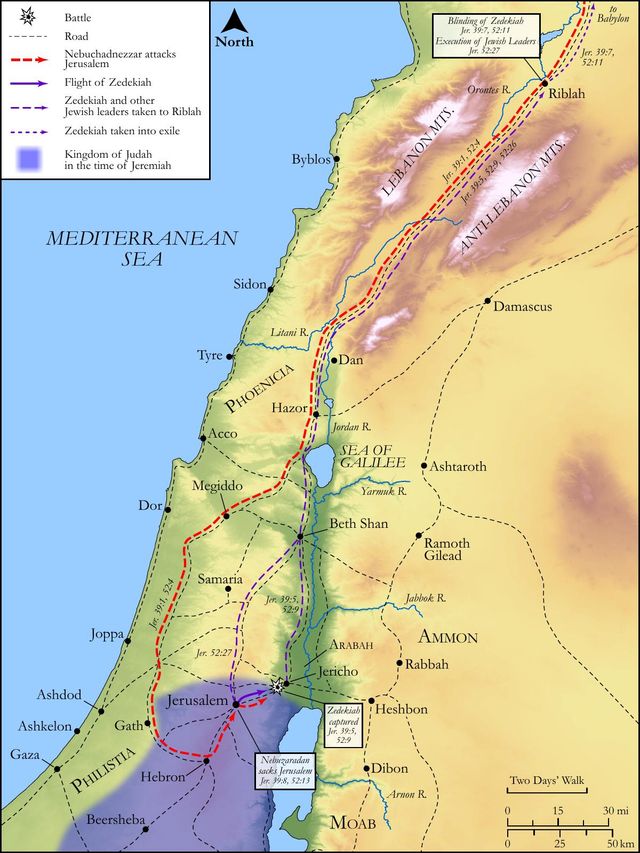
See on the biblical-era map
Study this verse
Public-domain commentary
Matthew Henry
From his Commentary on the Whole Bible. Henry comments on passages, not single verses — this entry covers Jeremiah 52:31–34.
This passage of story concerning the reviving which king Jehoiachin had in his bondage we had likewise before (Kg2 25:27-30), only there it is said to be done on the twenty-seventh day of the twelfth month, here on the twenty-fifth; but in a thing of this nature two days make a very slight difference in the account. It is probable that the orders were given for his release on the twenty-fifth day, but that he was not presented to the king till the twenty-seventh. We may observe in this story, 1. That new lords make new laws. Nebuchadnezzar had long kept this unhappy prince in prison; and his son, though well-affected to the prisoner, could not procure him any favour, not one smile, from his father, any more than Jonathan could for David from his father; but, when the old peevish man was dead, his son countenanced Jehoiachin and made him a favourite. It is common for children to undo what their fathers have done; it were well if it were always as much for the better as this was. 2. That the world we live in is a changing world. Jehoiachin, in his beginning, fell from a throne into a prison, but here he is advanced again to a throne of state (Jer 52:32), though not to a throne of power. As, before, the robes were changed into prison-garments, so now they were converted into robes again. Such chequer-work is this world; prosperity and adversity are set the one over-against the other, that we may learn to rejoice as though we rejoiced not and weep as though we wept not. 3. That, though the night of affliction be very long, yet we must not despair but that the day may dawn at last. Jehoiachin was thirty-seven years a prisoner, in confinement, in contempt, ever since he was eighteen years old, in which time we may suppose him so inured to captivity that he had forgotten the sweets of liberty; or, rather, that after so long an imprisonment it would be doubly welcome to him. Let those whose afflictions have been lengthened out encourage themselves with this instance; the vision will at the end speak comfortably, and therefore wait for it. Dum spiro spero - While there is life there is hope. Non si male nunc, et olim sic erit - Though now we suffer, we shall not always suffer. 4. That god can make his people to find favour in the eyes of those that are their oppressors, and unaccountably turn their hearts to pity them, according to that word (Psa 106:46), He made them to be pitied of all those that carried them captives. He can bring those that have spoken roughly to speak kindly, and those to feed his people that have fed upon them. Those therefore that are under oppression will find that it is not in vain to hope and quietly to wait for the salvation of the Lord. Therefore our times are in God's hand, because the hearts of all we deal with are so. 5. And now, upon the whole matter, comparing the prophecy and the history of this book together, we may learn, in general, (1.) That it is no new thing for churches and persons highly dignified to degenerate, and become very corrupt. (2.) That iniquity tends to the ruin of those that harbour it; and, if it be not repented of and forsaken, will certainly end in their ruin: (3.) That external professions and privileges will not only not amount to an excuse for sin and an exemption from ruin, but will be a very great aggravation of both. (4.) That no word of God shall fall to the ground, but the event will fully answer the prediction; and the unbelief of man shall not make God's threatenings, any more than his promises, of no effect. The justice and truth of God are here written in bloody characters, for the conviction or the confusion of all those that make a jest of his threatenings. Let them not be deceived, God is not mocked.
Continue studying Jeremiah 52:34 across the web’s major study libraries — every link below opens this exact verse, chapter, or book on the destination site.
Read & Compare
 BibleGatewayThis verse in more than 200 translations and 70 languages.
 Bible.comThe YouVersion reader — hundreds of translations, reading plans, and highlights.
 ESV.orgCrossway's official English Standard Version reader.
 NET BibleThe NET translation with 60,000+ translators' notes on every rendering decision.
 STEP BibleTyndale House's free study tool — original text, vocabulary, and scholarly resources.
 BibliaLogos Bible Software's free web reader.
 USCCBThe New American Bible (Revised Edition) with the U.S. bishops' study notes.
Commentaries
 BibleHub CommentariesDozens of classic commentaries on this verse, gathered on one page.
 StudyLightMore than 100 commentary sets — the largest collection on the web.
 BibleRefPlain-English commentary on what this verse means, verse by verse.
 Enduring WordDavid Guzik's free commentary on this chapter, widely used by Bible teachers.
 Bible Study ToolsVerse commentary alongside Greek and Hebrew study aids.
Original Language & Research
- BibleHub InterlinearThe verse word by word — original language, transliteration, and English.
- BibleHub LexiconEvery word's original-language definition and Strong's entry.
 Blue Letter BibleDeep-study tools — Strong's numbers, concordance, and word studies.
 SefariaThe Hebrew text with Rashi and centuries of Jewish commentary.
Sermons, Hymns & Audio


TrulyRandomVerse is not affiliated with these sites and doesn’t control their content. They’re linked because they’re genuinely useful.
Summary
Jeremiah 52:34 concludes the book with a pivotal historical detail, marking a significant turning point in the life of King Jehoiachin of Judah. After 37 years of arduous imprisonment in Babylon, he was unexpectedly released and elevated by Evil-merodach, the new Babylonian king. This verse specifically highlights the consistent, daily provision of food and necessities granted to Jehoiachin "until the day of his death," signifying an extraordinary act of sustained grace and care. Its placement at the book's close, following extensive prophecies of judgment and the devastating fall of Jerusalem, offers a subtle yet profound note of divine providence and enduring hope, hinting at the preservation of the Davidic lineage amidst national ruin.
Context
ShowHideLiterary Context
Jeremiah 52:34 functions as a crucial historical appendix to the prophetic book, serving both as a concluding summary and a subtle theological statement. It mirrors and slightly expands upon the account found in 2 Kings 25:27-30. This final historical note provides concrete evidence of the fate of Judah's last king, Jehoiachin, after the fall of Jerusalem and the Babylonian exile. Its strategic placement at the very end of Jeremiah, after numerous prophecies of impending judgment and a smaller section on restoration, offers a quiet, yet powerful, testament to God's sovereign hand and enduring faithfulness, even in the direst consequences of national sin. It brings the narrative of the Davidic monarchy to a close, not with utter despair, but with a surprising, albeit still captive, note of improved circumstances for the king, leaving the reader with a glimmer of hope for God's long-term plans.
Historical & Cultural Context
King Jehoiachin was deported to Babylon in 597 BC, along with a significant portion of Judah's elite, during the first major Babylonian siege of Jerusalem, as vividly recounted in 2 Kings 24:10-17. He endured 37 years of imprisonment under Nebuchadnezzar. The year of his release, 561 BC, coincides with the ascension of Evil-merodach (also known as Amel-Marduk) to the Babylonian throne. It was a common practice for new monarchs of that day to initiate their reigns with acts of clemency, court reorganization, or grand gestures to solidify their authority and demonstrate their magnanimity. Jehoiachin's release and elevation—being granted a seat of honor above other captive kings and a regular allowance—was a significant and public gesture. This act not only reflected a dramatic change in his personal fortunes but also an acknowledgment of his royal status, even while in exile. From a theological perspective, this act, though initiated by a pagan king, can be understood as a profound instance of God's providential working behind the scenes of human history.
Key Themes
ShowHideThis concluding verse, though brief, contributes significantly to several overarching themes within Jeremiah and the broader biblical narrative. Firstly, it powerfully underscores Divine Providence and Sustenance. Despite the devastating judgment that befell Judah and its monarchy, God's unseen hand is evident in providing for Jehoiachin's daily needs. This emphasizes that even in the darkest valleys of exile and punishment, God does not entirely abandon His people or His covenant promises, echoing the broader biblical theme of God's consistent care for His own, as seen in passages like Philippians 4:19. Secondly, it offers a striking glimmer of Mercy Amidst Judgment. While Jeremiah is replete with prophecies of severe consequences for disobedience, this final scene introduces a surprising note of grace. The elevation of Jehoiachin, a direct descendant of David, subtly suggests that God had not utterly forsaken His covenant people or the Davidic line. This act of clemency hints at future restoration and the eventual fulfillment of promises concerning a righteous branch, as prophesied earlier in Jeremiah 23:5. Lastly, it marks The End of an Era for the direct Davidic monarchy in Judah, transitioning fully into the period of exile. Yet, the continued sustenance of Jehoiachin serves as a symbolic bridge, preserving the royal lineage for future generations and the eventual return to Jerusalem.
Exposition and Analysis
ShowHideKey Word Analysis
ShowHideThis feminine passive participle refers to a "ration of food," "allowance," or "victuals." In this context, it specifically denotes a regular, appointed portion of food and necessities. It signifies a structured and consistent provision rather than sporadic charity, highlighting the official and regular nature of the support Jehoiachin received from the king of Babylon. It implies a significant improvement in his living conditions from imprisonment.
Derived from a root meaning "to stretch," this term signifies "continuance," "constant," or "perpetual." It emphasizes the unbroken, uninterrupted nature of the provision. This was not a temporary grant but an ongoing, daily allowance, underscoring the stability and permanence of Jehoiachin's new status and care, ensuring his needs were met without fail.
While commonly translated as "word" or "matter," this term has a broad semantic range, including "thing," "affair," "business," and indeed, "portion" or "provision" in certain contexts, as it refers to something spoken of or dealt with. Here, it reinforces the idea of a specific, allotted share of resources—a concrete "thing" or "matter" that was given to him daily. This further emphasizes the systematic, reliable, and complete nature of his sustenance, ensuring he received a full measure of what was due to him.
Verse Breakdown
ShowHide"And [for] his diet, there was a continual diet given him of the king of Babylon,"
This opening clause immediately establishes the central theme of the verse: the provision of food and necessities for Jehoiachin. The deliberate repetition of "diet" (ʼăruchâh) underscores the nature of this provision as a regular, appointed allowance. The crucial detail that it was "continual" highlights its unbroken and unwavering nature. Furthermore, the source of this provision is explicitly stated: it was "given him of the king of Babylon," specifically Evil-merodach. This signifies a direct royal decree and consistent support from the highest authority in the land, marking a profound and unexpected change from Jehoiachin's previous state of imprisonment.
"every day a portion"
This phrase meticulously reinforces the consistency and regularity of the provision. The Hebrew phrase "every day" (yôwm yôwm) emphasizes the daily, unwavering nature of the allowance, ensuring his sustenance was not left to chance or whim. The term "a portion" (dâbâr) further specifies that it was a set amount, a designated share, indicating a structured and reliable system of care that guaranteed his needs were met consistently.
"until the day of his death, all the days of his life."
This concluding phrase powerfully emphasizes the duration and permanence of Jehoiachin's improved status. The allowance was not temporary but guaranteed for the remainder of his natural life. The seemingly redundant phrasing "until the day of his death, all the days of his life" serves as a literary device to stress absolute finality and an unbroken continuum. It ensures the reader understands that Jehoiachin's needs were met without interruption from the moment of his release until his very last breath, highlighting the comprehensive and enduring nature of this royal benevolence.
Literary Devices
ShowHideJeremiah 52:34 employs several literary devices to convey its profound message effectively. Repetition is a prominent feature, particularly with the use of "diet" (twice) and "day" (four times in the Hebrew, though rendered as "every day" and "all the days" in English). This powerful repetition emphasizes the consistent, unwavering, and daily nature of Jehoiachin's provision, underscoring the reliability and permanence of the Babylonian king's decree. There is also a subtle yet significant Contrast at play; the final king of Judah, who had suffered decades of harsh imprisonment, now enjoys a privileged status, highlighting the unexpected turn of events and the unpredictability of human circumstances, often under divine orchestration. Furthermore, the meticulous detail regarding the daily, lifelong provision can be seen as Symbolism. While a historical fact, it symbolically represents a lingering thread of hope for the Davidic line and, by extension, for the covenant promises of God. Its placement as the very last words of the book of Jeremiah, focusing on sustenance and life for the last king, offers a quiet, understated note of enduring grace and God's faithfulness even amidst national desolation and exile.
Theological and Thematic Connections
ShowHideJeremiah 52:34, though a brief historical appendix, carries significant theological weight, serving as a powerful testament to God's sovereign control over all earthly kings and kingdoms, even those hostile to His people. The unexpected clemency shown to Jehoiachin by a pagan king, Evil-merodach, illustrates that God can work through any means—even through seemingly secular or unexpected channels—to accomplish His divine purposes, including the preservation of a remnant or a lineage. This act of grace, extended to a king whose kingdom was destroyed due to disobedience, profoundly underscores the enduring nature of God's mercy and His unwavering faithfulness to His covenant promises, particularly those made to David concerning an eternal dynasty. It suggests that the Davidic line, though seemingly broken and in exile, was not utterly extinguished. This concluding verse thus provides a quiet affirmation that even in the aftermath of severe judgment, God's long-term plan for redemption and restoration remains active, offering a subtle yet profound beacon of hope for a future beyond the immediate devastation of exile.
Reflection and Application
ShowHideJeremiah 52:34, strategically positioned at the very end of a book filled with lament, judgment, and the devastating consequences of sin, offers a profound and unexpected message of hope and divine faithfulness. It serves as a powerful reminder that even in the darkest valleys of life—when circumstances seem utterly hopeless, and we feel imprisoned by our trials or the consequences of our past actions—God's providence can intervene in surprising and miraculous ways. Jehoiachin's story teaches us that God's grace is not limited by human expectations, the severity of our past, or the power of our oppressors. Just as a pagan king was moved to show kindness, God can use any person, any situation, or any unexpected turn of events to provide for us, to lift us up, and to sustain us. This verse encourages us to cultivate a deep and unwavering trust in God's daily provision, recognizing that His care is "continual" and "every day," even when it comes through channels we might not anticipate. It invites us to look for the "portion" of grace He grants us daily, acknowledging that His mercies are indeed new every morning, even in the midst of our personal or collective "exiles" and periods of adversity.
Questions for Reflection
ShowHideFAQ
ShowHideWho was King Jehoiachin, and why is his story significant at the end of Jeremiah?
ShowHideKing Jehoiachin was one of the last kings of Judah, reigning for a mere three months and ten days before being taken captive to Babylon by Nebuchadnezzar in 597 BC, along with many of Judah's elite (as detailed in 2 Kings 24:8-17). His story is profoundly significant at the end of Jeremiah because it provides a final historical anchor for the book, confirming the historical reality of the exile and the fate of the Davidic monarchy. More importantly, his release and elevation by Evil-merodach after 37 years of imprisonment, as described in Jeremiah 52:31-34, serves as a subtle, yet powerful, sign of God's enduring faithfulness to His covenant with David. It indicates that the royal line, though in exile, was not utterly cut off, offering a glimmer of hope and divine providence amidst the widespread devastation and judgment that characterizes much of the book.
What does "continual diet" imply about Jehoiachin's status in Babylon?
ShowHideThe phrase "continual diet given him of the king of Babylon, every day a portion" implies a dramatic and significant elevation in Jehoiachin's status from that of a common prisoner. It indicates that he was no longer confined to the harsh conditions of a dungeon but was granted a privileged position, likely living in or near the royal court. This "diet" was not mere sustenance but a regular, official allowance of food and necessities, placing him in a position of honor, perhaps even above other captive kings. It suggests he was treated as a royal personage, albeit still under Babylonian authority, and his needs were consistently met directly from the king's provision, signifying a life of relative comfort and dignity for the remainder of his days. This was a remarkable reversal of fortune.
Why is this verse, focusing on Jehoiachin's provision, placed at the very end of the book of Jeremiah?
ShowHideThe strategic placement of Jeremiah 52:34 at the very end of the book, after extensive prophecies of judgment and the detailed account of Jerusalem's destruction, serves several crucial purposes. Firstly, it provides historical closure and verification, confirming the fulfillment of prophecies regarding the exile and the fate of the monarchy. Secondly, and perhaps more profoundly, it offers a subtle, yet significant, note of hope and divine faithfulness. After the overwhelming darkness of judgment, this small act of grace toward the last Davidic king suggests that God had not entirely abandoned His people or His covenant promises (such as those found in 2 Samuel 7). It hints at the preservation of the royal line, a necessary precursor for the future Messiah. Thus, the book ends not on a note of absolute despair, but with a quiet, providential act that points toward God's enduring plan for restoration and redemption, even in the midst of national ruin.
Christ-Centered Fulfillment
ShowHideJeremiah 52:34, while a historical footnote detailing the unexpected mercy shown to an exiled king, offers a profound foreshadowing of Christ's redemptive work and God's ultimate faithfulness to His covenant. Jehoiachin, a descendant of David, was released from prison and given a "continual diet" until his death, ensuring the preservation of the royal line. This act of unexpected grace by a pagan king points to the greater, divine act of liberation and sustenance found in Jesus Christ. Jesus, the true Son of David, came not to be released from an earthly prison, but to release humanity from the ultimate captivity of sin and death (as profoundly proclaimed in Colossians 1:13-14). Just as Jehoiachin received daily physical sustenance, Christ offers Himself as the Bread of Life, providing spiritual nourishment that sustains us eternally. The "continual diet" for Jehoiachin, lasting "all the days of his life," symbolizes the perpetual and unending provision of grace and life found in Christ, who promises to be with His followers "always, to the very end of the age" (Matthew 28:20). Ultimately, Jehoiachin's story, a small act of mercy at the end of a book of judgment, points to the grander narrative of God's unwavering covenant faithfulness, culminating in the person and work of Jesus, who brings true freedom, eternal life, and unending sustenance to all who believe and are brought into His glorious kingdom.