


Ezekiel 3:22
Bible text: King James Version (1769 Blayney text) · Public domain
Bible text: Berean Standard Bible · Public domain
Bible text: American Standard Version (1901) · Public domain
Bible text: World English Bible, Messianic edition · Public domain
Bible text: Geneva Bible (1599) · Public domain
Bible text: Young's Literal Translation · Public domain
- וַתְּהִיva·te·Hiand it wasH1961Conj-w ¦ V-Qal-ConsecImperf-3fsVerb Qal Consecutive Imperfect 3rd Singular Feminineוַandתְּהִיit was
- עָלַי'a·Laion meH5921Prep ¦ 1csPrepositionעָלַonיme
- שָׁםshamthereH8033AdvAdverb
- יַדyad[the] hand ofH3027N-cscNoun Singular common gender Construct
- יְהוָהYah·wehYahwehH3068N-properNoun Proper Title
- וַיֹּאמֶרvai·Yo·merand he saidH559Conj-w ¦ V-Qal-ConsecImperf-3msVerb Qal Consecutive Imperfect 3rd Singular Masculineוַandיֹּאמֶרhe said
- אֵלַי'e·Laito meH413Prep ¦ 1csPrepositionאֵלַtoיme
- קוּםkumariseH6965V-Qal-Imp-2msVerb Qal Imperative 2nd Singular Masculine
- צֵאtze'go outH3318V-Qal-Imp-2msVerb Qal Imperative 2nd Singular Masculine
- אֶל'eltoH413PrepPreposition
- הַבִּקְעָהha·bik·'Ahthe plainH1237Art ¦ N-fsNoun Singular Feminine Absoluteהַtheבִּקְעָהplain
- וְשָׁםve·Shamand thereH8033Conj-w ¦ AdvAdverbוְandשָׁםthere
- אֲדַבֵּר'a·da·BerI will speakH1696V-Piel-Imperf-1csVerb Piel Imperfect 1st Singular common gender
- אוֹתָךְ'o·Takhwith youH854Prep ¦ 2msPrepositionאוֹתָwithךְyou
English is a literal word-by-word gloss of the Hebrew, not the KJV's wording. Why?
This is the original text the KJV's translators worked from — each Hebrew word with its own literal English meaning in this verse, prepared by scholars at Tyndale House, Cambridge. The KJV translates whole sentences, not word by word, so its wording differs: one Hebrew word can become several English words, and the KJV may choose “the LORD” where the gloss reads “Yahweh”. Both are faithful — they answer different questions. For the KJV's own rendering, switch to the KJV text.
Details
See on the biblical-era map
Study this verse
Public-domain commentary
Matthew Henry
From his Commentary on the Whole Bible. Henry comments on passages, not single verses — this entry covers Ezekiel 3:22–27. His two-level outline is real structure in the source text, so it is rendered as structure.
After all this large and magnificent discovery which God had made of himself to the prophet, and the full instructions he had given him how to deal with those to whom he sent him with an ample commission, we should have expected presently to see him preaching the word of God to a great congregation of Israel; but here we find it quite otherwise. his work here, at first, seems not at all proportionable to the pomp of his call.
I.We have him here retired for further learning.
By his unwillingness to go it should seem as if he were not so thoroughly convinced as he might have been of the ability of him that sent him to bear him out; and therefore, to encourage him against the difficulties he foresaw, God will favour him with another vision of his glory, which (if any thing) would put life into him and animate him for his work. In order for this, God calls him out to the plain (Eze 3:22) and there he will have some talk with him. See and admire the condescension of God in conversing thus familiarly with a man, a son of man, a poor captive, nay, with a sinful man, who, when God sent him went in bitterness of spirit, and was at this time out of humour with his work. And let us own ourselves for ever indebted to the mediation of Christ for this blessed intercourse and communion between God and man, between heaven and earth. See here the benefit of solitude, and how much it befriends contemplation. It is very comfortable to be alone with God, withdrawn from the word for converse with him, to hear from him, to speak to him; and a good man will say that he is never less along than when thus alone. Ezekiel went forth into the plain more willingly than he went among those of the captivity (Eze 3:15); for those that know what it is to have communion with God cannot but prefer that before any converse with this world, especially such as is commonly met with. He went out into the plain, and there he saw the same vision that he had seen by the river of Chebar; for God is not tied to places. Note, Those who follow God shall meet with his consolations, wherever they go. God called him out to talk with him, but did more than that: he showed him his glory, Eze 3:23. We are not now to expect such visions, but we must own that we have a favour done us no way inferior if we so by faith behold the glory of the Lord as to be changed into the same image, by the Spirit of the Lord; and this honour have all his saints. Praise you the Lord, Co2 3:18.
II.We have him here restrained from further teaching for the present.
When he saw he fell on his face, being struck with an awe of God's majesty and a dread of his displeasure; but the Spirit entered into him to raise him up, and then he recovered himself and got upon his feet and heard what the Spirit whispered to him, which is very surprising. One would have expected now that God would send him directly to the chief place of concourse, would give him favour in the eyes of his brethren, and make him and his message acceptable to them, that he would have a wider door of opportunity opened to him and that God would give him a door of utterance to open his mouth boldly; but what is here said to him is the reverse of all this.
1.Instead of sending him to a public assembly, he orders him to confine himself to his own lodgings: Go, shut thyself within thy house, Eze 3:24. He was not willing to appear in public, and, when he did, the people did not regard him, nor show him the respect he deserved, and as a just rebuke both to him and them, to him for his shyness of them and to them for their coldness towards him, God forbids him to appear in public. Note, Our choice is often made our punishment; and it is a righteous thing with God to remove teachers into corners when they, or their people, or both, grow indifferent to solemn assemblies. Ezekiel must shut up himself, some think, to give a sign of the besieging of Jerusalem, in which the people should be closely shut up as he was in his house, and which he speaks of in the next chapter. He must shut himself within his house, that he might receive further discoveries of the mind of God and might abundantly furnish himself with something to say to the people when he went abroad. We find that the elders of Judah visited him and sat before him sometimes in his house (Eze 8:1), to be witnesses of his ecstasies; but it was not till Eze 11:25 that he spoke to those of the captivity all the things that the Lord had shown him. Note, Those that are called to preach must find time to study, and a great deal of time too, must often shut themselves up in their houses, that they may give attendance to reading and meditation, and so their profiting may appear to all.
2.Instead of securing him an interest in the esteem and affections of those to whom he sent him he tells him that they shall put bands upon him and bind him (Eze 3:25), either (1.) As a criminal. They shall bind him in order to the further punishing of him as a disturber of the peace; though they were themselves sent into bondage in Babylon for persecuting the prophets, yet there they continue to persecute them. Or, rather, (2.) As a distracted man. They would go about to bind him as one beside himself; for to that they imputed his violent motions in his raptures. The captains asked Jehu, Wherefore came this mad fellow unto thee? Festus said to Paul, Thou art beside thyself; and so the Jews said of our Lord Jesus, Mar 3:21. Perhaps this was the reason why he must keep within doors, because otherwise they would bind him, under pretence of his being mad, and therefore he must not go out among them. Justly are prophets forbidden to go to those that will abuse them.
3.Instead of opening his lips that his mouth might show forth God's praise, God silence him, made his tongue cleave to the roof of his mouth, so that he was dumb for a considerable time, Eze 3:26. The pious captives in Babylon used this imprecation upon themselves, that, if they should forget Jerusalem, there tongue might cleave to the roof of their mouth, Psa 137:6. Ezekiel remembers Jerusalem more than any of them, and yet his tongue cleaves to the roof of his mouth, and he that can speak best is forbidden to speak at all; and the reason given is because they are a rebellious house to whom he is sent, and they are not worthy to have him for a reprover. He shall not give them instructions and admonitions, for they are lost and thrown away upon them. he is before commanded to speak boldly to them because they are most rebellious (Eze 2:7); but, since that proves to no purpose, he is now for that reason enjoined silence and shall not speak at all to them. Note, Those whose hearts are hardened against conviction are justly deprived of the mans of conviction. Why should not the reprovers be dumb, if, after long trials, it be found that the reproved resolve to be deaf? If Ephraim be joined to idols, let him alone. Thou shalt be dumb, and not be a reprover, implying that unless he were dumb he would be reproving; if he could speak at all, he would witness against the wickedness of the wicked. But when God speaks with him, and designs to speak by him, he will open his mouth, Eze 3:27. Note, Though God's prophets may be silenced awhile, there will come a time when God will give them the opening of the mouth again. And, when God speaks to his ministers, he not only opens their ears to hear what he says, but opens their mouth to return an answer. Moses, who had a veil on his face when he went down to the people, took it off when he went up again to God, Exo 34:34.
4.Instead of giving him assurance of success when he should at any time speak to the people, he here leaves the matter very doubtful, and Ezekiel must not perplex and disquiet himself about it, but let it be as it will. He that hears, let him hear, and he is welcome to the comfort of it; let him hear, and his soul shall live; but he that forbears, let him forbear at his peril, and take what comes. If thou scornest, thou alone shalt bear it; neither God nor his prophet shall be any losers by it; but the prophet shall be rewarded for his faithfulness in reproving the sinner, and God will have the glory of his justice in condemning him for not taking the reproof.
Historical interpretation
Four Centuries of Reception
5 surviving comments on this verse. Each one is dated, so this reads as a timeline rather than a list.
Select a marker to jump to its quote. Markers stagger vertically where authors wrote within a few decades of each other.
“Go out into the plain, and you will be spoken to.” This means that [Ezekiel] is made into a sign for them; or on this day he is ordered to go out into the plain, and he will be spoken to; and on the plain that face will be revealed to him that was shown to him at the river Chebar.
(Verse 22.) And there, the hand of the Lord came upon me and He said to me: rise up, go out into the field, and there I will speak with you. This phrase, "there," which we have translated from the Hebrew and is not found in the Septuagint, is intentionally placed and undoubtedly signifies a specific location. For earlier we read: And I came to the captivity at Tel-abib, to those who dwelt near the river Chebar (Ezekiel 3:15). And rightly so, the one to whom he spoke, sat down, is commanded to rise up. And he who had entered into transmigration hears, 'Go forth, not into rugged valleys, not onto steep cliffs, but into the width of the fields that can contain the glory of the Lord.' Hence it is also said to the Corinthians: 'Be enlarged' (1 Corinthians 6:13). When he enters to capture the captives, of whom it is said that they are insane and persecute him, perhaps he needs a strong hand in order to resist and endure the fury of those who pursue him. But when he goes forth into the field, surely the hand of the Lord is upon him: for without his help he could not go forth, but strength is not added. For he goes out to see the glory of God, not to fight. And it should be noted that while sitting among the captives, the Prophet himself did not see the glory of the Lord.
And notice this, that, standing himself in the middle of those who sat as captives, the prophet did not see the glory of God.
Quiet is afforded by contemplating divine things, when the mind is free from external cares, which makes it anticipate things, and it is distracted no more fully here or there, but it can take in divine things more exactly when it is turned in on itself.
With the truth of history preserved, the divine utterances sometimes designate causes from time, sometimes from place, which they do not indicate by open speech. From time indeed, as when the Lord was preaching to the Jews it is said through the evangelist: "It was winter." For among those mysteries which the Truth was speaking, what was the reason for adding the name of winter, unless to show through the quality of the time the coldness of heart? Because even when they were receiving the words of truth, the hearts of the Jews remained cold. Sometimes indeed from place, as when to the carnal Israelite people, with Moses descending from the mountain, the law was given in the plains; and to the holy apostles the Lord sitting on the mountain spoke the highest and spiritual precepts, so that from the places it might be shown that to those as carnal ones the least commandments were given in the valley of the earth, and these as spiritual and holy ones might hear the heavenly commandments on the mountain, so that it might be openly shown that those ascending in heart to heavenly things would leave behind the lowest things of the world and would stand on the summit of the mind. Hence now the prophet Ezekiel describes what he did in places at God's command, so that through the qualities of places he might indicate what would follow in the future concerning the mysteries of the prophecy. For behold he says: "The hand of the Lord came upon me, and he said to me: Arise, go out into the plain, and there I will speak with you."
What is the meaning of this, that previously the Lord had spoken to His prophet in the midst of the Israelites, and yet afterward He says: "Go out into the plain, and there I will speak with you," unless that He deigned both to pour out the grace of His prophecy first upon Judea, and afterward to demonstrate it in the breadth of the Gentiles? For not without reason is the Gentile world designated by the plain, which extends far and wide, that is, throughout the entire world.
For what is it that the prophet is commanded to go out to the plain, except that everyone who preaches, on account of those placed outside himself whom he corrects and restrains from iniquity, goes out to the plain by speaking? And there he sees the glory of the Lord, because he receives the grace of teaching all the more abundantly as he extends himself in the labor of preaching out of love for his neighbors. Therefore by going out he is led into a lofty vision, because from that source by which he illuminates the blindness of ignorance in the hearts of others through the ministry of his speech, from that same source heavenly grace exalts him to a higher understanding.
Continue studying Ezekiel 3:22 across the web’s major study libraries — every link below opens this exact verse, chapter, or book on the destination site.
Read & Compare
 BibleGatewayThis verse in more than 200 translations and 70 languages.
 Bible.comThe YouVersion reader — hundreds of translations, reading plans, and highlights.
 ESV.orgCrossway's official English Standard Version reader.
 NET BibleThe NET translation with 60,000+ translators' notes on every rendering decision.
 STEP BibleTyndale House's free study tool — original text, vocabulary, and scholarly resources.
 BibliaLogos Bible Software's free web reader.
 USCCBThe New American Bible (Revised Edition) with the U.S. bishops' study notes.
Commentaries
 BibleHub CommentariesDozens of classic commentaries on this verse, gathered on one page.
 StudyLightMore than 100 commentary sets — the largest collection on the web.
 BibleRefPlain-English commentary on what this verse means, verse by verse.
 Enduring WordDavid Guzik's free commentary on this chapter, widely used by Bible teachers.
 Bible Study ToolsVerse commentary alongside Greek and Hebrew study aids.
Original Language & Research
- BibleHub InterlinearThe verse word by word — original language, transliteration, and English.
- BibleHub LexiconEvery word's original-language definition and Strong's entry.
 Blue Letter BibleDeep-study tools — Strong's numbers, concordance, and word studies.
 SefariaThe Hebrew text with Rashi and centuries of Jewish commentary.
Sermons, Hymns & Audio


TrulyRandomVerse is not affiliated with these sites and doesn’t control their content. They’re linked because they’re genuinely useful.
Summary
Ezekiel 3:22 marks a pivotal moment in the prophet's nascent ministry, where the palpable and empowering presence of the Lord settles upon him, initiating a divine directive. God commands Ezekiel to depart from the communal setting of the exiles and withdraw to a solitary plain, not merely for a change of scenery, but for a profound, undistracted encounter. This summons signifies a deeper level of divine revelation and intimate communion, preparing Ezekiel for the formidable and often challenging prophetic tasks that lie ahead, underscoring God's intentionality in equipping His chosen messenger.
Context
ShowHideLiterary Context
This verse is strategically positioned immediately following Ezekiel's overwhelming initial call vision, his symbolic consumption of the scroll filled with lamentations and woe, and his commission to speak to a "rebellious house" Ezekiel 2:3. Having been physically and spiritually overwhelmed by the divine presence and given his initial, difficult mandate, Ezekiel is now called to a specific, private encounter. The preceding verses detail his initial reluctance and God's empowering him to speak, while the subsequent verses describe a period of silence and further instructions, indicating that this summons to the plain is a pivotal transition point. It moves Ezekiel from the initial shock and public commission to a more intimate, preparatory phase of divine communication before the full public ministry truly commences, setting the stage for the detailed messages that follow in the book, such as the vision of the valley of dry bones in Ezekiel 37.
Historical & Cultural Context
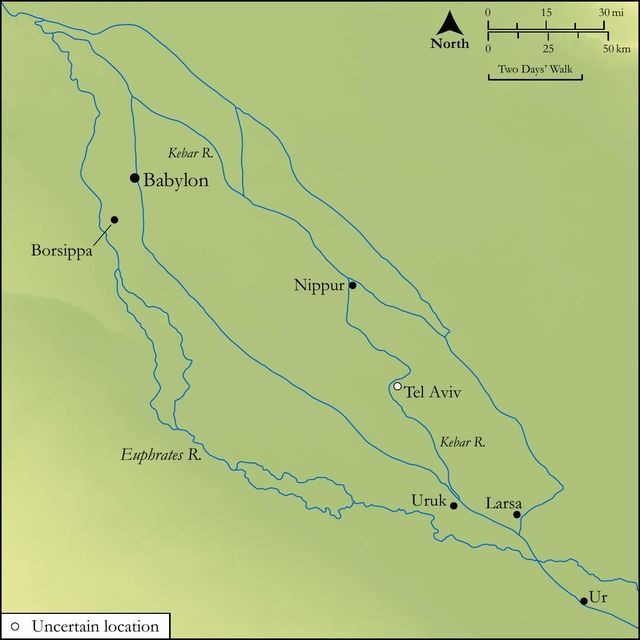
Ezekiel was a priest among the Jewish exiles, deported to Babylon after the first siege of Jerusalem in 597 BC. They lived by the Chebar river, a canal system near Nippur. Life for these exiles was characterized by communal living, but also by the profound trauma of displacement and the struggle to maintain their identity and faith in a foreign land. The "plain" (Hebrew: biqʻâh) would have referred to the broad, flat, often desolate expanses of Mesopotamia surrounding their settlement. This geographical feature provided the necessary solitude, away from the distractions, demands, and potential opposition of the exiled community. Such an isolated environment was culturally understood as conducive for prophets to receive direct, unhindered revelation from God, echoing a pattern seen throughout biblical history where significant divine encounters often occur in remote or wilderness settings, such as Moses' encounter at Mount Sinai.
Key Themes
ShowHideEzekiel 3:22 powerfully encapsulates several core themes prevalent in the book of Ezekiel and broader prophetic literature. The phrase "the hand of the LORD was there upon me" emphasizes Divine Presence and Empowerment, highlighting God's direct, tangible, and sovereign influence in equipping His chosen instruments. This motif of God's hand is a recurring symbol throughout Ezekiel's ministry, signifying divine enablement for prophetic tasks, as seen in Ezekiel 1:3. The command to "Arise, go forth into the plain" underscores the theme of Seclusion for Revelation, demonstrating God's initiative in calling His prophet away from the noise and demands of the world to a place of undistracted communion. This pattern is vital for profound encounters with God, similar to Elijah's experience at Mount Horeb. Finally, the explicit promise "I will there talk with thee" establishes Divine Communication and Purposeful Dialogue as the central aim of this encounter, signifying God's intention to convey further instructions, insights, and revelations essential for Ezekiel to fulfill his challenging and often unpopular prophetic calling to the "house of Israel" Ezekiel 3:4.
Exposition and Analysis
ShowHideKey Word Analysis
ShowHideThis primitive word signifies not merely a physical appendage but is used broadly to denote power, means, direction, authority, and active intervention. In the phrase "the hand of the LORD," it consistently represents God's sovereign power, direct influence, and empowering presence, particularly in enabling prophets for their ministry or executing His divine will. It implies an overwhelming, tangible, and often irresistible divine force that rests upon or moves a person.
This term literally means "a split," referring to a wide, level valley or expanse, typically between mountains. In the context of Ezekiel's exile by the Chebar River in Babylon, it denotes an open, desolate, or unpopulated area. This choice of location emphasizes solitude and a setting free from human distractions, ideal for receiving unhindered divine revelation away from the communal life of the exiles.
This primitive root primarily means "to speak" or "to arrange." It encompasses a wide range of verbal actions, including commanding, declaring, communing, teaching, and even subduing. Here, it signifies God's intention to engage in direct, purposeful, and authoritative communication with Ezekiel, conveying specific messages, instructions, or revelations that are vital for the prophet's understanding and future ministry. It implies a meaningful and intentional dialogue, not merely a casual utterance.
Verse Breakdown
ShowHide"And the hand of the LORD was there upon me;"
This initial clause immediately establishes the divine initiative and the overwhelming, tangible nature of God's presence and power resting upon Ezekiel. It signifies a spiritual empowerment, an anointing that physically and spiritually prepares and enables the prophet for the profound divine encounter and the arduous task ahead. This is not merely a subjective feeling but a profound, direct intervention of God's sovereign authority, indicating a divine impartation of strength and readiness.
"and he said unto me, Arise, go forth into the plain,"
This is a direct, imperative divine command, instructing Ezekiel to take specific physical action and move to a designated, solitary location. The double command "Arise, go forth" implies immediate obedience and a purposeful movement away from his current surroundings and the distractions of the community. The destination, "the plain," signifies a call to solitude and a setting apart, emphasizing the necessity of removing all external distractions for deeper, unhindered spiritual communion with God.
"and I will there talk with thee."
This final clause reveals the explicit purpose and profound intimacy of the divine summons. God promises direct, personal, and purposeful communication with Ezekiel in that solitary place. It underscores the importance of the forthcoming revelation, indicating that the encounter is not merely for empowerment but for the conveyance of specific messages, instructions, or further insights crucial for Ezekiel's understanding of his prophetic role and the unfolding divine plan for Israel. It highlights God's desire for a deep, one-on-one dialogue with His chosen servant.
Literary Devices
ShowHideThe verse employs several significant literary devices that enrich its meaning. Anthropomorphism is prominently featured in the phrase "the hand of the LORD," attributing a human physical characteristic (a hand) to God. This idiom effectively conveys God's active power, direct intervention, and empowering presence in a way that is comprehensible to human understanding, emphasizing His tangible influence on Ezekiel. The "plain" functions as powerful Symbolism, representing a place of solitude, quiet, and separation from the world's noise and distractions. It symbolizes the spiritual space necessary for undistracted divine encounter and profound revelation, a common motif in biblical narratives for significant spiritual moments. Furthermore, the entire verse is an example of Direct Address, as God speaks directly and personally to Ezekiel ("he said unto me... I will there talk with thee"), emphasizing the intimate, personal, and authoritative nature of the prophetic call and the unique relationship between the divine speaker and the human recipient.
Theological and Thematic Connections
ShowHideEzekiel 3:22 profoundly illustrates God's sovereign initiative in calling and equipping His servants, emphasizing that true prophetic ministry is not a human endeavor but a divine enablement. The "hand of the LORD" signifies the tangible, empowering presence of God, which is absolutely essential for any genuine spiritual work or prophetic utterance. This verse also highlights the theological principle that periods of solitude and withdrawal are often divinely ordained prerequisites for deeper divine revelation and communion. God frequently calls His chosen ones away from the noise and distractions of the world to speak intimately with them, preparing them for significant tasks. This underscores the value of intentional quietude and seeking isolated spaces for hearing God's voice clearly and receiving His specific instructions, a pattern seen throughout biblical history for those called to speak on God's behalf.
Reflection and Application
ShowHideEzekiel 3:22 offers timeless lessons for contemporary believers, reminding us that our spiritual effectiveness and insight stem directly from the empowering presence of the Holy Spirit in our lives, just as God's "hand" rested upon Ezekiel. This verse challenges us to actively seek and yield to that divine enablement, recognizing that true ministry and spiritual growth are not born of human effort alone. Furthermore, the command to "go forth into the plain" serves as a powerful metaphor for the indispensable importance of intentional solitude in our noisy, distraction-filled world. In an age of constant connectivity, finding our "plain"—a quiet space for prayer, meditation, and unhurried communion with God—is not a luxury but a profound necessity for discerning His voice clearly and receiving His specific guidance. Our readiness to "Arise, go forth" in obedience to God's leading, even when it calls us to unexpected, uncomfortable, or solitary places, reflects our trust and submission to His divine plan, anticipating that He desires to "talk with" us, offering wisdom, comfort, and direction for our lives and ministries.
Questions for Reflection
ShowHideFAQ
ShowHideWhat does "the hand of the LORD" signify in biblical texts?
ShowHide"The hand of the LORD" is a powerful anthropomorphic idiom used throughout the Bible to denote God's active power, sovereign authority, and direct intervention. It signifies His empowering presence, His ability to execute His will, and His direct influence, particularly in empowering prophets like Ezekiel for their ministry, as seen also in Isaiah 8:11. In the New Testament, "the hand of the Lord was with them" in spreading the gospel Acts 11:21, indicating divine enablement for mission.
Why did God instruct Ezekiel to go "into the plain" for communication?
ShowHideGod instructed Ezekiel to go "into the plain" (Hebrew: biqʻâh, a wide, level valley) to ensure a setting of solitude and quiet, free from the distractions, demands, and influences of the exiled community. This allowed for undistracted, intimate, and profound communication between God and His prophet. It highlights the biblical principle that significant divine encounters and revelations often occur in secluded places, a pattern seen with figures like Moses at the burning bush Exodus 3:1 and Jesus Himself, who frequently withdrew to solitary places for prayer and communion with the Father Luke 5:16.
Christ-Centered Fulfillment
ShowHideEzekiel 3:22, with its profound emphasis on divine empowerment, the necessity of solitude for revelation, and intimate communication with God, finds its ultimate fulfillment and deepest meaning in the person and work of Jesus Christ. Jesus is the supreme Prophet, upon whom the "hand of the LORD"—the Holy Spirit—rested not by measure, but in fullness John 3:34. He consistently modeled the principle of withdrawal, frequently seeking "solitary places" Luke 5:16 or mountains to commune intimately with His Father, demonstrating the essential pattern of seeking solitude for divine revelation, strength, and discernment before engaging in public ministry. As the living Word made flesh, Jesus perfectly embodied the "talk" God promised Ezekiel, for He alone has "declared" the Father fully, revealing Him to humanity John 1:18. Through His finished work on the cross and His resurrection, Christ makes it possible for all believers, indwelt by the Holy Spirit, to experience a new covenant "hand of the LORD" upon them, empowering them to hear God's voice, understand His truth, and be His witnesses to the ends of the earth Acts 1:8. The Spirit now guides us into all truth John 14:26, enabling a profound, personal "talk" with God that far surpasses the prophetic encounters of the Old Testament, drawing us into the very fellowship of the Father and the Son 1 John 1:3.