


Ezekiel 3:23
Bible text: King James Version (1769 Blayney text) · Public domain
Bible text: King James Version with Strong's numbers · Public domain
Bible text: Berean Standard Bible · Public domain
Bible text: American Standard Version (1901) · Public domain
Bible text: World English Bible, Messianic edition · Public domain
Bible text: Geneva Bible (1599) · Public domain
Bible text: Young's Literal Translation · Public domain
- וָאָקוּםva·'a·Kumand I aroseH6965Conj-w ¦ V-Qal-ConsecImperf-1csVerb Qal Consecutive Imperfect 1st Singular common genderוָandאָקוּםI arose
- וָאֵצֵאva·'e·Tze'and I went outH3318Conj-w ¦ V-Qal-ConsecImperf-1csVerb Qal Consecutive Imperfect 1st Singular common genderוָandאֵצֵאI went out
- אֶל'eltoH413PrepPreposition
- הַבִּקְעָהha·bik·'Ahthe plainH1237Art ¦ N-fsNoun Singular Feminine Absoluteהַtheבִּקְעָהplain
- וְהִנֵּהve·hi·nehand there!H2009Conj-w ¦ PrtParticle Interjectionוְandהִנֵּהthere!
- שָׁםshamthereH8033AdvAdverb
- כְּבוֹדke·Vod[the] glory ofH3519N-mscNoun Singular Masculine Construct
- יְהוָהYah·wehYahwehH3068N-properNoun Proper Title
- עֹמֵד'o·Med[was] standingH5975V-Qal-Prtcpl-msVerb Qal Participle Singular Masculine Absolute
- כַּכָּבוֹדka·ka·Vodlike the gloryH3519Prep-k ¦ N-msNoun Singular Masculine Absoluteכַּlike theכָּבוֹדglory
- אֲשֶׁר'a·SherwhichH834RelParticle Relative
- רָאִיתִיra·'I·tiI had seenH7200V-Qal-Perf-1csVerb Qal Perfect 1st Singular common gender
- עַל'alatH5921PrepPreposition
- נְהַרne·har[the] river ofH5104N-mscNoun Singular Masculine Construct
- כְּבָרke·VarKebarH3529N-properNoun Proper Location
- וָאֶפֹּלva·'e·Poland I fellH5307Conj-w ¦ V-Qal-ConsecImperf-1csVerb Qal Consecutive Imperfect 1st Singular common genderוָandאֶפֹּלI fell
- עַל'alonH5921PrepPreposition
- פָּנָיpa·Naimy faceH6440N-mpc ¦ 1csNoun Plural Masculine Constructפָּנָfaceיmy
English is a literal word-by-word gloss of the Hebrew, not the KJV's wording. Why?
This is the original text the KJV's translators worked from — each Hebrew word with its own literal English meaning in this verse, prepared by scholars at Tyndale House, Cambridge. The KJV translates whole sentences, not word by word, so its wording differs: one Hebrew word can become several English words, and the KJV may choose “the LORD” where the gloss reads “Yahweh”. Both are faithful — they answer different questions. For the KJV's own rendering, switch to the KJV text.
Details
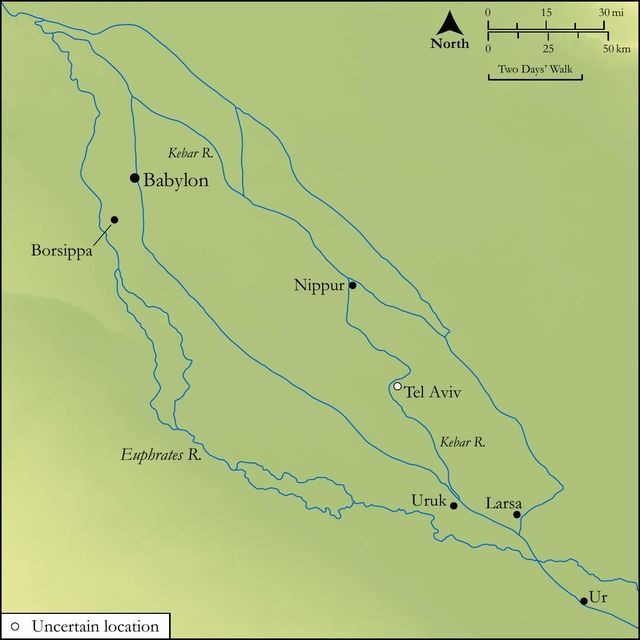
See on the biblical-era map
Study this verse
Public-domain commentary
Matthew Henry
From his Commentary on the Whole Bible. Henry comments on passages, not single verses — this entry covers Ezekiel 3:22–27. His two-level outline is real structure in the source text, so it is rendered as structure.
After all this large and magnificent discovery which God had made of himself to the prophet, and the full instructions he had given him how to deal with those to whom he sent him with an ample commission, we should have expected presently to see him preaching the word of God to a great congregation of Israel; but here we find it quite otherwise. his work here, at first, seems not at all proportionable to the pomp of his call.
I.We have him here retired for further learning.
By his unwillingness to go it should seem as if he were not so thoroughly convinced as he might have been of the ability of him that sent him to bear him out; and therefore, to encourage him against the difficulties he foresaw, God will favour him with another vision of his glory, which (if any thing) would put life into him and animate him for his work. In order for this, God calls him out to the plain (Eze 3:22) and there he will have some talk with him. See and admire the condescension of God in conversing thus familiarly with a man, a son of man, a poor captive, nay, with a sinful man, who, when God sent him went in bitterness of spirit, and was at this time out of humour with his work. And let us own ourselves for ever indebted to the mediation of Christ for this blessed intercourse and communion between God and man, between heaven and earth. See here the benefit of solitude, and how much it befriends contemplation. It is very comfortable to be alone with God, withdrawn from the word for converse with him, to hear from him, to speak to him; and a good man will say that he is never less along than when thus alone. Ezekiel went forth into the plain more willingly than he went among those of the captivity (Eze 3:15); for those that know what it is to have communion with God cannot but prefer that before any converse with this world, especially such as is commonly met with. He went out into the plain, and there he saw the same vision that he had seen by the river of Chebar; for God is not tied to places. Note, Those who follow God shall meet with his consolations, wherever they go. God called him out to talk with him, but did more than that: he showed him his glory, Eze 3:23. We are not now to expect such visions, but we must own that we have a favour done us no way inferior if we so by faith behold the glory of the Lord as to be changed into the same image, by the Spirit of the Lord; and this honour have all his saints. Praise you the Lord, Co2 3:18.
II.We have him here restrained from further teaching for the present.
When he saw he fell on his face, being struck with an awe of God's majesty and a dread of his displeasure; but the Spirit entered into him to raise him up, and then he recovered himself and got upon his feet and heard what the Spirit whispered to him, which is very surprising. One would have expected now that God would send him directly to the chief place of concourse, would give him favour in the eyes of his brethren, and make him and his message acceptable to them, that he would have a wider door of opportunity opened to him and that God would give him a door of utterance to open his mouth boldly; but what is here said to him is the reverse of all this.
1.Instead of sending him to a public assembly, he orders him to confine himself to his own lodgings: Go, shut thyself within thy house, Eze 3:24. He was not willing to appear in public, and, when he did, the people did not regard him, nor show him the respect he deserved, and as a just rebuke both to him and them, to him for his shyness of them and to them for their coldness towards him, God forbids him to appear in public. Note, Our choice is often made our punishment; and it is a righteous thing with God to remove teachers into corners when they, or their people, or both, grow indifferent to solemn assemblies. Ezekiel must shut up himself, some think, to give a sign of the besieging of Jerusalem, in which the people should be closely shut up as he was in his house, and which he speaks of in the next chapter. He must shut himself within his house, that he might receive further discoveries of the mind of God and might abundantly furnish himself with something to say to the people when he went abroad. We find that the elders of Judah visited him and sat before him sometimes in his house (Eze 8:1), to be witnesses of his ecstasies; but it was not till Eze 11:25 that he spoke to those of the captivity all the things that the Lord had shown him. Note, Those that are called to preach must find time to study, and a great deal of time too, must often shut themselves up in their houses, that they may give attendance to reading and meditation, and so their profiting may appear to all.
2.Instead of securing him an interest in the esteem and affections of those to whom he sent him he tells him that they shall put bands upon him and bind him (Eze 3:25), either (1.) As a criminal. They shall bind him in order to the further punishing of him as a disturber of the peace; though they were themselves sent into bondage in Babylon for persecuting the prophets, yet there they continue to persecute them. Or, rather, (2.) As a distracted man. They would go about to bind him as one beside himself; for to that they imputed his violent motions in his raptures. The captains asked Jehu, Wherefore came this mad fellow unto thee? Festus said to Paul, Thou art beside thyself; and so the Jews said of our Lord Jesus, Mar 3:21. Perhaps this was the reason why he must keep within doors, because otherwise they would bind him, under pretence of his being mad, and therefore he must not go out among them. Justly are prophets forbidden to go to those that will abuse them.
3.Instead of opening his lips that his mouth might show forth God's praise, God silence him, made his tongue cleave to the roof of his mouth, so that he was dumb for a considerable time, Eze 3:26. The pious captives in Babylon used this imprecation upon themselves, that, if they should forget Jerusalem, there tongue might cleave to the roof of their mouth, Psa 137:6. Ezekiel remembers Jerusalem more than any of them, and yet his tongue cleaves to the roof of his mouth, and he that can speak best is forbidden to speak at all; and the reason given is because they are a rebellious house to whom he is sent, and they are not worthy to have him for a reprover. He shall not give them instructions and admonitions, for they are lost and thrown away upon them. he is before commanded to speak boldly to them because they are most rebellious (Eze 2:7); but, since that proves to no purpose, he is now for that reason enjoined silence and shall not speak at all to them. Note, Those whose hearts are hardened against conviction are justly deprived of the mans of conviction. Why should not the reprovers be dumb, if, after long trials, it be found that the reproved resolve to be deaf? If Ephraim be joined to idols, let him alone. Thou shalt be dumb, and not be a reprover, implying that unless he were dumb he would be reproving; if he could speak at all, he would witness against the wickedness of the wicked. But when God speaks with him, and designs to speak by him, he will open his mouth, Eze 3:27. Note, Though God's prophets may be silenced awhile, there will come a time when God will give them the opening of the mouth again. And, when God speaks to his ministers, he not only opens their ears to hear what he says, but opens their mouth to return an answer. Moses, who had a veil on his face when he went down to the people, took it off when he went up again to God, Exo 34:34.
4.Instead of giving him assurance of success when he should at any time speak to the people, he here leaves the matter very doubtful, and Ezekiel must not perplex and disquiet himself about it, but let it be as it will. He that hears, let him hear, and he is welcome to the comfort of it; let him hear, and his soul shall live; but he that forbears, let him forbear at his peril, and take what comes. If thou scornest, thou alone shalt bear it; neither God nor his prophet shall be any losers by it; but the prophet shall be rewarded for his faithfulness in reproving the sinner, and God will have the glory of his justice in condemning him for not taking the reproof.
Historical interpretation
Two Centuries of Reception
3 surviving comments on this verse. Each one is dated, so this reads as a timeline rather than a list.
Select a marker to jump to its quote. Markers stagger vertically where authors wrote within a few decades of each other.
(Verse 23.) And I arose ((Vulg. arose)) and went out into the field, and behold there the glory of the Lord was standing, as the glory that I saw by the river Chobar. At the Lord's command, it enters and at the Lord's command, it goes out, and it sits among those who sit; for those who stand could not hear him. And going out into the width of the field, he saw the standing glory of the Lord, which he had seen before walking and lifting itself up, and sometimes standing. Because next to the river of this age, called Chobar, which can be interpreted as very serious, glory was seen: which signifies that all the glory of this world overflows and does not have a stable position. But the standing and enduring glory of the Lord, when seen with the standing Prophet in the field, could not stand nor be seen amidst the captives.
This is the meaning of the verse, “Because you have been strengthened by the sight of the majesty of the Lord, never fear anything and do not be frightened of anyone, and go back to your own house, whether it is for your bodily needs, as some people regard them, or as a sign of imminent danger.”
"And rising I went out into the plain, and behold, there the glory of the Lord stood, like the glory which I saw beside the river Chebar."
The prophet saw in the plain the glory of the Lord, which he had seen beside the river Chebar in the midst of the Israelites, because that same majesty appeared to the Gentiles which had first revealed itself to the elect among the Jewish people through the revealing Spirit.
"And I fell upon my face."
Having seen the glory of the Lord, the prophet falls on his face, because although a man may be elevated to understand sublime things, nevertheless from the contemplation of God's majesty he understands the weakness of his own condition; and he who sees himself to be ashes and dust before God's eyes has, as it were, no standing.
Continue studying Ezekiel 3:23 across the web’s major study libraries — every link below opens this exact verse, chapter, or book on the destination site.
Read & Compare
 BibleGatewayThis verse in more than 200 translations and 70 languages.
 Bible.comThe YouVersion reader — hundreds of translations, reading plans, and highlights.
 ESV.orgCrossway's official English Standard Version reader.
 NET BibleThe NET translation with 60,000+ translators' notes on every rendering decision.
 STEP BibleTyndale House's free study tool — original text, vocabulary, and scholarly resources.
 BibliaLogos Bible Software's free web reader.
 USCCBThe New American Bible (Revised Edition) with the U.S. bishops' study notes.
Commentaries
 BibleHub CommentariesDozens of classic commentaries on this verse, gathered on one page.
 StudyLightMore than 100 commentary sets — the largest collection on the web.
 BibleRefPlain-English commentary on what this verse means, verse by verse.
 Enduring WordDavid Guzik's free commentary on this chapter, widely used by Bible teachers.
 Bible Study ToolsVerse commentary alongside Greek and Hebrew study aids.
Original Language & Research
- BibleHub InterlinearThe verse word by word — original language, transliteration, and English.
- BibleHub LexiconEvery word's original-language definition and Strong's entry.
 Blue Letter BibleDeep-study tools — Strong's numbers, concordance, and word studies.
 SefariaThe Hebrew text with Rashi and centuries of Jewish commentary.
Sermons, Hymns & Audio


TrulyRandomVerse is not affiliated with these sites and doesn’t control their content. They’re linked because they’re genuinely useful.
Summary
Ezekiel 3:23 encapsulates a profound and pivotal moment in the prophet's early ministry, where, in immediate and humble obedience to a divine command, he experiences a renewed and overwhelming manifestation of God's majestic presence. This encounter, occurring in the desolate plain, serves to powerfully reconfirm Ezekiel's prophetic calling and reinforce the awe-inspiring reality of the Lord's glory, compelling the prophet to prostrate himself in profound reverence and submission. It underscores the tangible nature of divine revelation and the appropriate human response to such an overwhelming encounter with the Almighty.
Context
ShowHideLiterary Context
Ezekiel 3:23 immediately follows a crucial sequence in the prophet's commissioning and initial empowerment. Having consumed the scroll of lamentations, mourning, and woe (Ezekiel 2:8-3:3) and been given the daunting task of speaking to a rebellious house (Ezekiel 3:4-11), Ezekiel is then appointed as a "watchman" over the house of Israel (Ezekiel 3:16-21). The Lord's hand had come upon him, empowering him for this weighty task, and he was specifically commanded to "arise, go forth into the plain, and I will there talk with thee" Ezekiel 3:22. This verse, therefore, depicts Ezekiel's immediate and obedient response to this precise divine directive, leading directly to a renewed and confirming vision of God's glory, which sets the stage for further divine communication and the subsequent period of silence and symbolic actions that characterize much of Ezekiel's early ministry.
Historical & Cultural Context
Ezekiel served as a priest among the Jewish exiles by the Chebar Canal in Babylon, having been deported after Nebuchadnezzar's first siege of Jerusalem in 597 BC. This period was one of immense national trauma, profound confusion, and spiritual despondency for the Israelites. They grappled with reconciling their exile with God's covenant promises, often clinging to false hopes of an imminent return to Jerusalem. In this context of spiritual crisis, Ezekiel's visions served to powerfully demonstrate God's sovereignty even in exile, challenging the exiles' complacency and confronting their deep-seated idolatry. The concept of "glory" (Hebrew kavod) was deeply ingrained in Israelite culture, intrinsically associated with the visible manifestation of God's presence in the Tabernacle and Temple, signifying His holiness, power, and inherent worth. An encounter with such divine glory was universally understood to demand profound reverence, humility, and immediate prostration.
Key Themes
ShowHideEzekiel 3:23 powerfully contributes to several overarching themes within the prophetic book of Ezekiel. The most prominent is the Divine Presence and Glory, specifically the kavod Yahweh, which forms the central focus of Ezekiel's prophetic experience, from his inaugural, overwhelming vision in Ezekiel 1 to its departure from the Temple and eventual promised return. Another crucial theme is Obedience to God's Command, as Ezekiel's immediate and unquestioning compliance with the instruction to go to the plain Ezekiel 3:22 directly precipitates this renewed and confirming encounter, powerfully highlighting the prophet's submission to divine authority. Furthermore, the verse emphasizes the Continuity of Revelation, explicitly linking this vision to the earlier, foundational experience by the river Chebar Ezekiel 1:28, assuring both the prophet and the reader of the consistent and unchanging nature of the God who reveals Himself. Finally, Ezekiel's response of Humility and Reverence—falling prostrate on his face—is a recurring motif throughout the book, illustrating the appropriate posture of humanity before the overwhelming majesty and holiness of the Almighty.
Exposition and Analysis
ShowHideKey Word Analysis
ShowHideFrom the root meaning "to split," this word refers to a wide, level valley or plain, typically situated between mountains. In Ezekiel 3:23, it denotes a specific, open geographical area where God commanded Ezekiel to go. Its significance lies in its contrast to the river Chebar, indicating that God's glory is not confined to one specific, grand location or circumstance, but can manifest anywhere He chooses, even in a seemingly ordinary, desolate, or unexpected place.
Derived from a root meaning "weight" or "heaviness," kâbôwd in a theological context signifies the visible manifestation of God's splendor, majesty, honor, and inherent worth. It represents the tangible, awe-inspiring presence of God's power, holiness, and divine essence. In this verse, its explicit linkage to the previous vision confirms the identity and consistent nature of the divine being Ezekiel encounters, underscoring the enduring reality of God's manifest presence.
A primitive root meaning "to fall," with a wide range of applications. In this context, it describes Ezekiel's physical act of prostration. This is a common and profound biblical response to a divine encounter, signifying overwhelming awe, profound humility, deep reverence, and sometimes fear, acknowledging the immense power and holiness of God and the creaturely, dependent status of the human beholder.
Verse Breakdown
ShowHide"Then I arose, and went forth into the plain:"
This opening clause highlights Ezekiel's immediate and unhesitating obedience to the divine command given in the preceding verse. His physical action of rising and going to the designated, perhaps unremarkable, location demonstrates his submission and readiness to receive further revelation from the Lord, emphasizing the biblical principle that obedience often precedes deeper spiritual encounters and divine communication.
"and, behold, the glory of the LORD stood there,"
This marks the central, astonishing event of the verse: the sudden and powerful manifestation of God's glory. The interjection "behold" (Hebrew hinneh) draws immediate attention to the astonishing and immediate nature of this divine appearance. The "glory of the LORD" (Hebrew kavod Yahweh) refers to the visible, tangible, and awe-inspiring presence of God's majesty and power, which now "stood there," indicating a fixed, undeniable, and accessible presence in the plain.
"as the glory which I saw by the river of Chebar:"
This crucial comparative phrase explicitly links the current vision to Ezekiel's inaugural and profoundly impactful encounter described in Ezekiel 1. It confirms that this is the same divine being, the same overwhelming manifestation of God's presence, ensuring continuity, reinforcing the authenticity, and validating the authority of Ezekiel's prophetic commission. It grounds the present experience in a known, powerful, and foundational revelation.
"and I fell on my face."
This concluding clause describes Ezekiel's immediate, instinctive, and appropriate response to the overwhelming divine presence. Falling prostrate on his face is a universal biblical gesture of profound humility, overwhelming awe, deep reverence, and complete submission in the presence of divine majesty. It signifies a recognition of God's absolute sovereignty and holiness, and the prophet's utter unworthiness and dependence before the Almighty.
Literary Devices
ShowHideThe verse employs several potent Literary Devices to convey its profound message. The Repetition of the word "glory" ("the glory of the LORD stood there, as the glory which I saw") serves to emphasize the central theme of divine manifestation and to create a direct Allusion or Intertextual Link to Ezekiel's foundational, inaugural vision by the river Chebar (Ezekiel 1). This deliberate repetition reinforces the continuity, consistency, and unchanging nature of God's self-revelation. The act of "falling on my face" is a powerful Symbolism of human humility, awe, reverence, and submission in the presence of the transcendent God. It also functions as a recurring Motif throughout prophetic literature when individuals encounter the divine, underscoring the overwhelming and transformative nature of such experiences. The simple, direct narrative style, combined with the sudden, attention-grabbing interjection "behold," creates a sense of immediacy and dramatic impact, drawing the reader directly into the prophet's personal and profound experience of divine encounter.
Theological and Thematic Connections
ShowHideEzekiel 3:23 powerfully articulates the reality of God's active presence and His sovereign initiative in revealing Himself to His chosen servants. The repeated manifestation of the kavod Yahweh underscores that God's glory is not static or confined to a single location or past event, but is dynamic, moving with His people even into exile, and appearing where and when He wills. This encounter serves as a profound affirmation of Ezekiel's prophetic authority, demonstrating unequivocally that his messages are not his own, but directly from the sovereign Lord whose glory is undeniable and consistently revealed. It teaches that genuine encounters with God's holiness naturally evoke a response of deep reverence, profound humility, and complete submission, a posture that is essential for receiving and faithfully communicating divine truth. This verse also highlights the principle that specific obedience to God's commands, even those that seem simple or lead to an ordinary place, often opens the door to deeper spiritual experiences and clearer divine communication, preparing the heart and mind for the weighty responsibility of God's word.
Reflection and Application
ShowHideEzekiel 3:23 offers profound and enduring lessons for contemporary believers. Just as Ezekiel's immediate obedience in going to the plain led to a fresh and confirming encounter with God's glory, our willingness to heed God's specific instructions, even when they seem mundane, inconvenient, or lead us to seemingly ordinary places, often precedes deeper spiritual experiences and clearer understanding of His divine will. This verse challenges us to cultivate a profound sense of awe and reverence in our approach to God. In an age where casualness can sometimes inadvertently infiltrate our worship, prayer, and study, Ezekiel's prostrate response serves as a powerful reminder that God's holiness, majesty, and transcendence demand our utmost humility, adoration, and reverent submission. Furthermore, the continuity of the glory from Chebar to the plain assures us that the God we worship is unchanging in His character, power, and presence. He is the same yesterday, today, and forever, and His glory is just as real and accessible to those who seek Him with obedient and humble hearts. This truth should inspire unwavering confidence and a renewed, passionate pursuit of His manifest presence in every facet of our lives.
Questions for Reflection
ShowHideFAQ
ShowHideWhy was Ezekiel commanded to go to the plain, and what is its significance?
ShowHideEzekiel was commanded to go to the plain in Ezekiel 3:22 so that the Lord could speak with him there and reveal His glory. The plain, a seemingly ordinary and desolate geographical area, holds profound significance in contrast to the river Chebar where Ezekiel had his initial, elaborate vision of God's glory. It demonstrates unequivocally that God's glory and presence are not confined to specific, grand, or pre-ordained locations or circumstances (like a river with a complex divine chariot), but can manifest anywhere He chooses to reveal Himself, even in common, isolated, or seemingly unremarkable settings. This underscores God's absolute sovereignty, His omnipresence, and His personal accessibility to those He calls.
What does "the glory of the LORD" (kavod Yahweh) truly mean in this context?
ShowHide"The glory of the LORD" (Hebrew kavod Yahweh) refers to the visible, tangible, and often overwhelming manifestation of God's inherent majesty, splendor, weight, and holiness. It is not merely an abstract concept but a powerful, perceptible display of His divine presence. In Ezekiel, it is frequently associated with brilliant light, consuming fire, and a majestic cloud, reminiscent of its appearances at Mount Sinai Exodus 24:16 and in the Tabernacle and Temple. In Ezekiel 3:23, its re-appearance signifies the re-affirmation of this same awesome divine presence that Ezekiel first witnessed, confirming the reality, authenticity, and ultimate authority of his prophetic calling and the messages he was to deliver.
Why did Ezekiel fall on his face upon seeing the glory of the LORD?
ShowHideEzekiel's act of falling prostrate on his face is a common and profound biblical response to encountering the overwhelming presence and glory of God. It signifies deep humility, profound reverence, overwhelming awe, and sometimes a holy fear in the face of divine majesty. It is a physical posture that acknowledges God's supreme power, absolute holiness, and sovereign authority, and simultaneously recognizes the creaturely, dependent, and often unworthy status of humanity before the Almighty. Prophets like Isaiah Isaiah 6:5 and Daniel Daniel 8:17 similarly prostrated themselves when confronted with divine or angelic beings, illustrating the appropriate and instinctive human response to such transcendent and awe-inspiring encounters.
Christ-Centered Fulfillment
ShowHideEzekiel's repeated encounter with the "glory of the LORD" in the plain, mirroring his foundational vision by the Chebar, finds its ultimate and most profound fulfillment in the person of Jesus Christ. While Ezekiel saw the kavod Yahweh as a visible, yet often veiled and awe-inspiring, manifestation of God's splendor, the New Testament proclaims that Jesus is the very "radiance of God's glory and the exact representation of His being" Hebrews 1:3. In Christ, the invisible God became perfectly visible, and His glory was not merely a transient appearance but "dwelt among us, and we have seen his glory, glory as of the only Son from the Father, full of grace and truth" John 1:14. The plain, a simple, unadorned, and perhaps even desolate place where God chose to reveal Himself to Ezekiel, powerfully foreshadows how God's glory would ultimately be revealed not in a magnificent temple, but in the humble humanity of Jesus, born in a manger and ministering among ordinary people in ordinary settings. The Transfiguration, where Jesus' face "shone like the sun, and his clothes became as white as the light" Matthew 17:2, offers a profound glimpse of this divine glory veiled in flesh. Ultimately, the glory of the Lord that caused Ezekiel to fall on his face is fully and perfectly revealed in Christ's sacrificial death and triumphant resurrection, through which God's boundless love, omnipotent power, and unblemished holiness are supremely displayed. Our response to the revealed glory of God in Christ should likewise be one of profound awe, worship, and humble submission, as powerfully exemplified by John's response to the glorified Christ in Revelation 1:17.