


Ezekiel 1:28
Bible text: King James Version (1769 Blayney text) · Public domain
Bible text: King James Version with Strong's numbers · Public domain
Bible text: Berean Standard Bible · Public domain
Bible text: American Standard Version (1901) · Public domain
Bible text: World English Bible, Messianic edition · Public domain
Bible text: Geneva Bible (1599) · Public domain
Bible text: Young's Literal Translation · Public domain
- כְּמַרְאֵהke·mar·'Ehlike [the] appearance ofH4758Prep-k ¦ N-mscNoun Singular Masculine Constructכְּlikeמַרְאֵה[the] appearance of
- הַקֶּשֶׁתha·Ke·shet<the> rainbowH7198Art ¦ N-fsNoun Singular Feminine Absoluteהַ<the>קֶּשֶׁתrainbow
- אֲשֶׁר'a·SherwhichH834RelParticle Relative
- יִהְיֶהyih·Yehit isH1961V-Qal-Imperf-3msVerb Qal Imperfect 3rd Singular Masculine
- בֶעָנָןve·'a·Nanin the cloud[s]H6051Prep-b ¦ N-msNoun Singular Masculine Absoluteבֶin theעָנָןcloud[s]
- בְּיוֹםbe·Yomon [the] day ofH3117Prep-b ¦ N-mscNoun Singular Masculine Constructבְּonיוֹם[the] day of
- הַגֶּשֶׁםha·Ge·shem<the> rainH1653Art ¦ N-msNoun Singular Masculine Absoluteהַ<the>גֶּשֶׁםrain
- כֵּןkensoH3651AdvAdverb
- מַרְאֵהmar·'Eh[the] appearance ofH4758N-mscNoun Singular Masculine Construct
- הַנֹּגַהּha·No·gahthe brightnessH5051Art ¦ N-fsNoun Singular Feminine Absoluteהַtheנֹּגַהּbrightness
- סָבִיבsa·Vivall aroundH5439N-csNoun Singular common gender Absolute
- הוּאhu'thatH1931Pro-3msPronoun Personal 3rd Singular Masculine
- מַרְאֵהmar·'Eh[was] [the] appearance ofH4758N-mscNoun Singular Masculine Construct
- דְּמוּתde·Mut[the] likeness ofH1823N-fscNoun Singular Feminine Construct
- כְּבוֹדke·Vod[the] glory ofH3519N-mscNoun Singular Masculine Construct
- יְהוָהYah·wehYahwehH3068N-properNoun Proper Title
- וָאֶרְאֶהva·'er·'Ehand I saw [it]H7200Conj-w ¦ V-Qal-ConsecImperf-1csVerb Qal Consecutive Imperfect 1st Singular common genderוָandאֶרְאֶהI saw [it]
- וָאֶפֹּלva·'e·Poland I fellH5307Conj-w ¦ V-Qal-ConsecImperf-1csVerb Qal Consecutive Imperfect 1st Singular common genderוָandאֶפֹּלI fell
- עַל'alonH5921PrepPreposition
- פָּנַיpa·Naimy faceH6440N-mpc ¦ 1csNoun Plural Masculine Constructפָּנַfaceיmy
- וָאֶשְׁמַעva·'esh·Ma'and I heardH8085Conj-w ¦ V-Qal-ConsecImperf-1csVerb Qal Consecutive Imperfect 1st Singular common genderוָandאֶשְׁמַעI heard
- קוֹלKola voiceH6963N-msNoun Singular Masculine Absolute
- מְדַבֵּרme·da·BerspeakingH1696V-Piel-Prtcpl-msVerb Piel Participle Singular Masculine Absolute
English is a literal word-by-word gloss of the Hebrew, not the KJV's wording. Why?
This is the original text the KJV's translators worked from — each Hebrew word with its own literal English meaning in this verse, prepared by scholars at Tyndale House, Cambridge. The KJV translates whole sentences, not word by word, so its wording differs: one Hebrew word can become several English words, and the KJV may choose “the LORD” where the gloss reads “Yahweh”. Both are faithful — they answer different questions. For the KJV's own rendering, switch to the KJV text.
Details
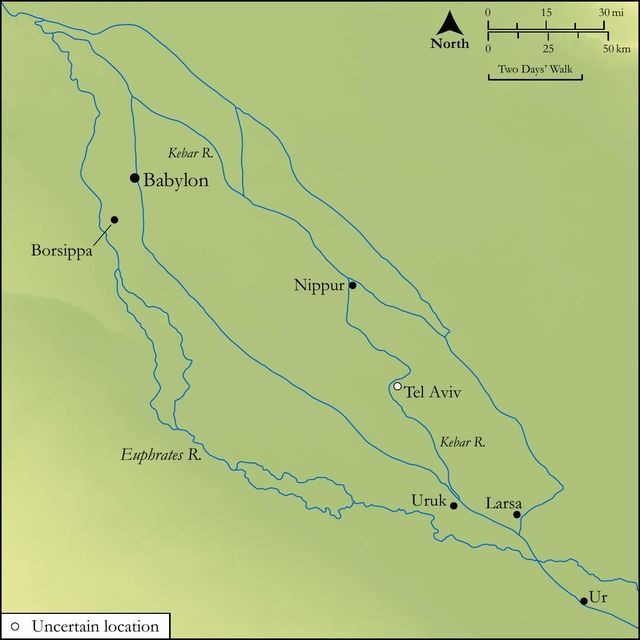
See on the biblical-era map
Study this verse
Public-domain commentary
Matthew Henry
From his Commentary on the Whole Bible. Henry comments on passages, not single verses — this entry covers Ezekiel 1:26–28.
All the other parts of this vision were but a preface and introduction to this. God in them had made himself known as Lord of angels and supreme director of all the affairs of this lower world, whence it is easy to infer that whatever God by his prophets either promises or threatens to do he is able to effect it. Angels are his servants; men are his tools. But now that a divine revelation is to be given to a prophet, and by him to the church, we must look higher than the living creatures or the wheels, and must expect that from the eternal Word, of whom we have an account in these verses. Ezekiel, hearing a voice from the firmament, looked up, as John did, to see the voice that spoke with him, and he saw one like unto the Son of man, Rev 1:12, Rev 1:13. The second person sometimes tried the fashion of a man occasionally before he clothed himself with it for good and all; and the Spirit of prophecy is called the Spirit of Christ (Pe1 1:11) and the testimony of Jesus, Rev 19:10. 1. This glory of Christ that the prophet saw was above the firmament that was over the heads of the living creatures, Eze 1:26. Note, The heads of angels themselves are under the feet of the Lord Jesus; for the firmament that is over their heads is under his feet. Angels, principalities, and powers are made subject to him, Pe1 3:22. This dignity and dominion of the Redeemer before his incarnation magnify his condescension in his incarnation, when he was made a little lower than the angels, Heb 2:9. 2. The first thing he observed was a throne; for divine revelation comes backed and supported with a royal authority. We must have an eye of faith to God and Christ as upon a throne. The first thing that John discovered in his visions was a throne set in heaven (Rev 4:2), which commands reverence and subjection. It is a throne of glory, a throne of grace, a throne of triumph, a throne of government, a throne of judgment. The Lord has prepared his throne in the heavens, has prepared it for his Son, whom he has set King on his holy hill of Zion. 3. On the throne he saw the appearance of a man. This is good new to the children of men, that the throne above the firmament is filled with one that is not ashamed to appear, even there, in the likeness of man. Daniel, in vision, saw the kingdom and dominion given to one like the Son of man, who therefore has authority given him to execute judgment because he is the Son of man (Joh 5:27), so appearing in these visions. 4. He saw him as a prince and judge upon this throne. Though he appeared in fashion as a man, yet he appeared in more than human glory, Eze 1:27. (1.) Is God a shining light? So is he: when the prophet saw him he saw as the colour of amber, that is, a brightness round about; for God dwells in light, and covers himself with light as with a garment. How low did the Redeemer stoop for us when, to bring about our salvation, he suffered his glory to be eclipsed by the veil of his humanity! (2.) Is God a consuming fire? So is he: from his loins, both upward and downward, there was the appearance of fire. The fire above the loins was round about within the amber; it was inward and involved. That below the loins was more outward and open, and yet that also had brightness round about. Some make the former to signify Christ's divine nature, the glory and virtue of which are hidden within the colour of amber; it is what no man has seen nor can see. The latter they suppose to be his human nature, the glory of which there were those who saw; the glory as of the only begotten of the Father, full of grace and truth, Joh 1:14. He had rays coming out of his hand, and yet there was the hiding of his power, Hab 3:4. The fire in which the Son of man appeared here might be intended to signify the judgments that were ready to be executed upon Judah and Jerusalem, coming form that fiery indignation of the Almighty which devours the adversaries. Nothing is more dreadful to the most daring sinners than the wrath of him that sits upon the throne, and of the Lamb, Rev 6:16. The day is coming when the Lord Jesus shall be revealed in flaming fire, Th2 1:7, Th2 1:8. It concerns us therefore to kiss the Son lest he be angry. 5. The throne is surrounded with a rainbow, Eze 1:28. It is so in St. John's vision, Rev 4:3. The brightness about it was of divers colours, as the bow that is in the cloud in the day of rain, which, as it is a display of majesty, and looks very great, so it is a pledge of mercy, and looks very kind; for it is a confirmation of that gracious promise God has made that he will not drown the world again, and he has said, I will look upon the bow and remember the covenant, Gen 9:16. This intimates that he who sits upon the throne is the Mediator of the covenant, that his dominion is for our protection, not our destruction, that he interposes between us and the judgments our sins have deserved, and that all the promises of God are in him yea and amen. Now that the fire of God's wrath was breaking out against Jerusalem bounds should be set to it, and he would not make an utter destruction of it, for he would look upon the bow and remember the covenant, as he promised in such a case, Lev 26:42.
Lastly, We have the conclusion of this vision. Observe, 1. What notion the prophet himself had of it: This was the appearance of the likeness of the glory of the Lord. Here, as all along, he is careful to guard against all gross corporeal thoughts of God, which might derogate from the transcendent purity of his nature. he does not say, This was the Lord (for he is invisible), but, This was the glory of the Lord, in which he was pleased to manifest himself a glorious being; yet it is not the glory of the Lord, but the likeness of that glory, some faint resemblance of it; nor is it any adequate likeness of that glory, but only the appearance of that likeness, a shadow of it, and not the very image of the thing, Heb 10:1. 2. What impressions it made upon him: When I saw it, I fell upon my face. (1.) He was overpowered by it; the dazzling lustre of it conquered him and threw him upon his face; for who is able to stand before this holy Lord God? Or, rather, (2.) He prostrated himself in a humble sense of his own unworthiness of the honour now done him, and of the infinite distance which he now, more than ever, perceived to be between him and God; he fell upon his face in token of that holy awe and reverence of God with which his mind was possessed and filled. Note, The more God is pleased to make known of himself to us the more low we should be before him. He fell upon his face to adore the majesty of God, to implore his mercy and to deprecate the wrath he saw ready to break out against the children of his people. 3. What instructions he had from it. All he saw was only to prepare him for that which he was to hear; for faith comes by hearing. He therefore heard a voice of one that spoke; for we are taught by words, not merely by hieroglyphics. When he fell on his face, ready to received the word, then he heard the voice of one that spoke; for God delights to teach the humble.
Historical interpretation
Four Centuries of Reception
11 surviving comments on this verse. Each one is dated, so this reads as a timeline rather than a list.
Select a marker to jump to its quote. Markers stagger vertically where authors wrote within a few decades of each other.
It is clear … that Ezekiel saw the cherubim and their course, and the firmament above them and the one seated on the throne. What could be more glorious and exalted than these things?
One might gather from a passage in Ezekiel that Ezekiel saw him, but what does Scripture actually say? He saw “the likeness of his glory”; not the Lord but only the likeness of his glory, not the glory as it really is. Yet, on beholding the likeness of his glory and not the glory itself, he fell to the earth in fear. But if the vision of the likeness of the glory inspired the prophets with fear and trembling, anyone attempting to look on God would surely lose his life.
(Verse 27, 28.) And I saw something like the appearance of electrum, like the appearance of fire within it all around. From the appearance of his loins and upward, I saw something like the appearance of glowing fire all around, like the appearance of a rainbow in the clouds on a rainy day. This was the appearance of the splendor of the Lord's glory. When I saw it, I fell facedown and heard a voice speaking. The electrum had the appearance of fire both inside and outside. But from the loins downwards, there was a shining fire all around, to show that those things which are above the loins, where the senses and reason reside, do not need fire or flames, but rather the most precious and pure metal. However, those things that are below the loins, where sexual intercourse, procreation, and the incitement of vices take place, need the purifying flames, so that when they have been purified, they may have a resemblance to a rainbow, which is commonly called Iris, when it appears in a cloud on a rainy day. For indeed the rainbow, which is called Iris in the Holy Scriptures, and in the Apocalypse of John is also called Iris (Apoc. IV), can only appear in rain and a watery cloud, of diverse and most beautiful colors, gradually transitioning into others. Hence the poet (Virgil, Aeneid IV).
Adversity brings a thousand different colors. But the same poet also follows the custom of the common people when he says: 'When he drinks, the rainbow.' From this he signifies that the rainbow never appears unless in the cloud and in the waters. This rainbow is a sign of God's mercy and covenant that he made with humans: that when it appears in the cloud, we, according to the example of antiquity, may know that we will never be destroyed by a flood (Genesis 9). From this it is shown that after punishment and punishment, and the purification of sins, there will be future mercy, only for those who deserve to see God reigning. Where it is said: Here was the appearance of splendor in a circle. In a circle of God, or of thrones, or of all things that are seen. And this is the vision of the glory of the likeness of God: not that he saw the glory of the Lord, but the likeness of his glory. And this whole vision is: a Spirit lifting up, and a great cloud, and four living creatures, and wheels following the same creatures, and the spirit, which deserve to be under the firmament of God. And after they were lifted up, and heard a voice like many waters, and like the sublime word of God, and the voice of camps and armies, they let down their wings, and showed astonishment in silence: and there appeared one sitting upon the likeness of a sapphire stone, as it were the likeness of a man that was from his loins upward, and the likeness of fire from his loins downward, and from his loins upward, as the appearance of amber. Afterwards, a sign of mercy is given to counteract this fear; just as the appearance of a rainbow when it is in the cloud on a rainy day. We have spoken at length about this vision because it is both obscure and interpreted in various ways by many. In the remaining parts, as much as possible without harming the senses, we will strive for brevity due to the large volume of the work.
[Daniel 7:9] "I beheld until thrones were set up, and the Ancient of days took His seat. His garment was as white as snow, and the hair of His head was like pure wool. His throne was composed of fiery flames and its wheels were set on fire. From before His presence there issued forth a rushing, fiery stream." We read something similar in John's Apocalypse: "After these things I was immediately in the Spirit, and lo, a throne was set up in heaven, and one was seated upon the throne; and He who sat upon it had the likeness of jasper and sardine stone, and there was a rainbow round about the throne like the appearance of emerald. Around the throne there were twenty-four other thrones, and upon the twenty-four thrones there sat twenty-four elders, clothed in shining garments; upon their heads was a golden crown, and lightning flashes issued from the throne, and voices and thunder. And in front of the throne there were seven torches of burning fire, which were the seven spirits of God. And in front of the throne lay a glassy sea like unto crystal." (Revelation 4:2-6) And so the many thrones which Daniel saw seem to me to be what John called the twenty-four thrones. And the Ancient of days is the One who, according to John sits alone upon His throne. Likewise the Son of man, who came unto the Ancient of days, is the same as He who, according to John, is called the Lion of the tribe of Judah, the Root of David, and the titles of that sort (Revelation 5:5). I imagine that these thrones are the ones of which the Apostle Paul says, "Whether thrones or dominions..." (Colossians 1:16). And in the Gospel we read, "Ye yourselves shall sit upon twelve thrones, judging the twelve tribes of Israel" (Matthew 19:28). And God is called the One who sits and who is the Ancient of days, in order that His character as eternal Judge might be indicated. His garment is shining white like the snow, and the hair of His head is like pure wool. The Savior also, when He was transfigured on the mount and assumed the glory of His divine majesty, appeared in shining white garments (Matthew 17:2). And as for the fact that His hair is compared to perfectly pure wool, the even-handedness and uprightness of His judgment is shown forth, a judgment which shows no partiality in its exercise. Moreover He is described as an elderly man, in order that the ripeness of His judgment may be established. His throne consists of fiery flames, in order that sinners may tremble before the severity of the torments, and also that the just may be saved, but so as by fire. The wheels of the throne are set aflame, or else it is the wheels of His chariot which are aflame. In Ezekiel also God is ushered on the scene seated in a four-horse chariot (Ezekiel 1:4-28), and everything pertaining to God is of a fiery consistency. In another place also a statement is made on this subject: "God is a consuming fire" (Deuteronomy 4:24), that we might know that wood, hay and stubble are going to burn up in the day of judgment. And in the Psalms we read: "Fire goeth before Him, and He shall set aflame all His enemies round about Him" (Psalm 97:3). A rushing, fiery stream proceeded from before Him in order that it might carry sinners to hell (Gehenna).
He did not say this was the nature of the Lord or the glory of the Lord but that this was the likeness of the glory of the Lord. For as he willed, so he spoke, and creating the vision, he made me worthy of contemplating it.
When you have heard of various visions of God, do not think that the divine majesty has many forms.
The godhead is empty of body and form; it is simple, and it has no part in composition and any form; nor can it be seen with eyes, nor can it be understood with the mind or limited within a boundary. He reveals visions just as it is necessary to make them appear. And in this place he shows these awesome things: he shows the favor that all people are to be granted, namely, of God and of our Savior in the dispensation of the flesh. Because of this, he says that human appearance is two natures: the one of amber, the other of fire, and the one carrying and the other being carried. In this way, the divine nature took on the human.
The prophet wonderful-in-revelations told this account.
He who ate the scroll full of the symbols of creative power
Disgorged a memra at whose meaning intellects are dazzled.
He discoursed about the chariot and about its transformations
And about its forms and the faces that were joined in it.
About the faces and the wings and eloquent wheels
And the living spirit that was in the wheels being turned,
About the movement of service of the cherubs,
And about the high throne that is established on their backs,
And about the appearance of the image of the Son of God
Which was borne on the chariot with great awe;
And about the voice of that service that is the cherubs’ own,
Which with great movement bless the most high in his place.
All these things from Ezekiel, the son of the exile,
Did the world learn about the chariot’s awesome appearance.
For neither Moses nor David published this account
Nor any prophet told [of it] like Ezekiel.
"And I saw, and I fell upon my face."
But let us recognize that the prophet, even when lifted up, could not bear this same likeness of glory. It follows: "And I saw, and I fell upon my face." What then would happen to this man if he had seen his glory as it is, when he who saw the likeness of his glory but was unable to bear it, fell? In this matter we ought to consider with great grief and contemplate with tears into what great misery and weakness we have fallen, we who cannot bear even the very good for which we were created to behold. Yet there is also another thing concerning the prophet's action that we should consider in ourselves. For the prophet, as soon as he saw the likeness of the Lord's glory, fell on his face. Since we cannot see this likeness of glory through the spirit of prophecy, we ought constantly to recognize it and carefully contemplate it in sacred scripture, in heavenly admonitions, in spiritual precepts. When we perceive something about God, we fall on our face, because we blush with shame at the evils which we remember having committed. For there a man falls where he is confounded. Hence Paul also said, as if to certain ones lying on their face: What fruit therefore did you have then in those things, of which you are now ashamed?
Behold, by the generous gift of heavenly grace, we have examined the beginning of the book wrapped in mysteries in the prophet Ezekiel, and discussing the mystical words in a mortal manner, we have drawn the soaring theory of prophecy down to earth, so that what previously flew over the minds of little ones and those like me but did not elevate them, may now be read and understood by them, and may both fly and lift them up. Let us therefore give thanks to our Redeemer, who always refreshes us with spiritual nourishment, who as the living bread descended from heaven and gives life to the world. Who lives and reigns with the Father in the unity of the Holy Spirit, God, through all ages of ages. Amen.
"Like the appearance of a bow when it is in a cloud on a day of rain."
Almighty God placed the rainbow as a sign between Himself and humanity, so that He would no longer destroy the world by flood, saying: "I will set my bow in the clouds, and it will be a sign of the covenant between me and the earth. And when I have covered the sky with clouds, my bow will appear in the clouds, and I will remember my covenant with you." Hence in that same rainbow the color of water and fire is shown together, because it is partly blue and partly red, so that it may be a witness of both judgments—namely, of one yet to be done and of another already done—but because the world will indeed be burned by the fire of judgment, yet will no longer be destroyed by the water of a flood, since that is not to happen again. But what does it mean that the prophet beheld the shining fire from the loins of the man presiding on the throne, like the appearance of a rainbow when it is in a cloud on a rainy day? For since fire, as has been said, signifies the ardor of the Holy Spirit, what is the likeness between a rainbow and the Spirit, that the fire which appeared should be said to have appeared like the appearance of a rainbow? But if we attend to the vision of the rainbow which we mentioned before, we see how the rainbow signifies the Spirit. For in the rainbow, as I said before, water and fire appear. And after the coming of the Mediator, the power of the Holy Spirit shone forth in the human race in this way: it both washed the elect of God with the water of baptism and set them on fire with the flame of divine love. For it is as if a certain rainbow is placed in a cloud for propitiation with the mingled color of water and fire together, when the Truth says: "Unless one is born again of water and the Holy Spirit, he cannot enter the kingdom of God." This rainbow is in a cloud on a rainy day, because it is shown in the Lord's incarnation and in the outpouring of preaching, so that the hearts of believers may be called back to pardon, with the Lord showing mercy. For we may fittingly understand the cloud as the flesh of the Redeemer, of which it is said through the Psalmist: "Who makes the cloud his ascent." For He made the cloud His ascent, because He who is everywhere by His divinity ascended to the heavens in the flesh.
"This was the appearance of the splendor all around, and this was the vision of the likeness of the glory of the Lord."
And when the entire mystical vision was completed, he adds: "This was the appearance of the splendor round about." For, gazing upon what the grace of the Holy Spirit does throughout the entire world, he says: "This was the appearance of the splendor round about." But wishing to consider what glory of the same Holy Spirit remains within, yet unable to see it as it truly is, he adds: "And this was the vision of the likeness of the glory of the Lord." For he does not say "the vision of the glory," but "of the likeness of the glory," so that it might be shown that however much the human mind has stretched itself with effort, even if it now restrains the phantasms of bodily images from its thought, even if it now removes all circumscribed spirits from the eyes of the heart, nevertheless while still placed in mortal flesh it is unable to see the glory of God as it is. But whatever of it shines in the mind is a likeness, and not the thing itself. Hence that preacher who had been caught up to the third heaven also said: "Now we see through a mirror in an enigma."
In this matter, a question arises for us that should not be overlooked: how did John the Evangelist, when he had described the faithlessness of the Jews toward the miracles of our Redeemer even from prophetic words, add, saying: "These things Isaiah said when he saw his glory, and spoke of him." And if Ezekiel saw not glory, but the likeness of glory, what does it mean that the one is described as having seen the likeness of glory, and the other as having seen his glory? But since John the Evangelist first narrated the miracles of our Redeemer, and afterward added the unbelief of the Jews, he makes clear that Isaiah saw this glory of our same Redeemer which appeared in the world. For everything marvelous that is done divinely on earth is the glory of almighty God, and his glory is seen in all things that are done. Therefore Isaiah saw his glory on earth; but Ezekiel could not see his glory in heaven as it is, because his glory is one thing in created things, and another in himself. Therefore this glory of his which is in things can be seen, but that which is in himself cannot be seen now except through a likeness.
Continue studying Ezekiel 1:28 across the web’s major study libraries — every link below opens this exact verse, chapter, or book on the destination site.
Read & Compare
 BibleGatewayThis verse in more than 200 translations and 70 languages.
 Bible.comThe YouVersion reader — hundreds of translations, reading plans, and highlights.
 ESV.orgCrossway's official English Standard Version reader.
 NET BibleThe NET translation with 60,000+ translators' notes on every rendering decision.
 STEP BibleTyndale House's free study tool — original text, vocabulary, and scholarly resources.
 BibliaLogos Bible Software's free web reader.
 USCCBThe New American Bible (Revised Edition) with the U.S. bishops' study notes.
Commentaries
 BibleHub CommentariesDozens of classic commentaries on this verse, gathered on one page.
 StudyLightMore than 100 commentary sets — the largest collection on the web.
 BibleRefPlain-English commentary on what this verse means, verse by verse.
 Enduring WordDavid Guzik's free commentary on this chapter, widely used by Bible teachers.
 Bible Study ToolsVerse commentary alongside Greek and Hebrew study aids.
Original Language & Research
- BibleHub InterlinearThe verse word by word — original language, transliteration, and English.
- BibleHub LexiconEvery word's original-language definition and Strong's entry.
 Blue Letter BibleDeep-study tools — Strong's numbers, concordance, and word studies.
 SefariaThe Hebrew text with Rashi and centuries of Jewish commentary.
Sermons, Hymns & Audio


TrulyRandomVerse is not affiliated with these sites and doesn’t control their content. They’re linked because they’re genuinely useful.
Summary
Ezekiel 1:28 marks the profound climax of the prophet's inaugural vision, presenting the overwhelming and indescribable appearance of God's glory. This verse culminates Ezekiel's encounter with the divine, portraying the dazzling brilliance of the manifestation, vividly likened to a rainbow, and records Ezekiel's immediate, reverent response of prostration, which then transitions to the pivotal moment of hearing the voice of the speaking God, signaling his imminent prophetic commission.
Context
ShowHideLiterary Context
This verse serves as the grand finale of the elaborate and highly symbolic vision meticulously detailed throughout Ezekiel chapter 1. Prior to this verse, Ezekiel provides a precise description of the whirlwind from the north, the four living creatures, the intricate wheels within wheels, the expansive firmament above their heads, and the sapphire throne upon which a figure with the "likeness of a man" was seated (Ezekiel 1:4-27). Each element of the vision builds in intensity and awe, preparing both the prophet and the reader for this ultimate revelation of God's transcendent glory. The description in Ezekiel 1:28 provides the final, most direct, yet still mediated, glimpse of the divine presence, leading directly into God's call and commission of Ezekiel in Ezekiel 2:1.
Historical & Cultural Context
Ezekiel, a priest, was among the exiles deported to Babylon by King Nebuchadnezzar in 597 BC (2 Kings 24:10-16). His vision occurs "by the river Chebar" (Ezekiel 1:1), a canal in Mesopotamia, far from Jerusalem and the Temple, which was the traditional dwelling place of God's glory (the Shekinah). For the exiled Israelites, this period was marked by profound despair, disillusionment, and pressing questions about God's presence and faithfulness outside their homeland. In this context, a direct manifestation of God's glory to a prophet in exile was immensely significant. It powerfully affirmed God's sovereignty, His transcendence over geographical boundaries, and His continued presence with His people, even in their captivity, offering a message of hope and reaffirming His covenant promises amidst perceived abandonment and judgment.
Key Themes
ShowHideEzekiel 1:28 encapsulates several major themes central to the book of Ezekiel and broader biblical theology. Firstly, the Divine Glory and Majesty of God is paramount, portrayed as an overwhelming, brilliant presence that elicits profound awe and reverence. The careful use of "appearance" (Hebrew marʼeh) and "likeness" (Hebrew dᵉmûwth) underscores that while God's glory is truly revealed, it is mediated, suitable for human perception without directly viewing God's unapproachable essence. Secondly, the Rainbow as a Symbol of Covenant Faithfulness connects this vision to God's promise to Noah after the flood, signifying God's enduring commitment and mercy even amidst judgment (Genesis 9:13-16). This theme reassures the exiles that God's promises remain, even in their dire circumstances. Thirdly, Ezekiel's immediate Reverence and Humility—falling on his face—is a classic biblical response to a divine encounter, emphasizing the appropriate human posture before God's overwhelming holiness and authority (Isaiah 6:5 and Revelation 1:17). Finally, the Preparation for Prophetic Calling is evident as the vision culminates in the hearing of God's voice, marking the transition from divine manifestation to direct divine communication and the initiation of Ezekiel's prophetic ministry (Ezekiel 2:1-2).
Exposition and Analysis
ShowHideKey Word Analysis
ShowHideMeaning "a view (the act of seeing); also an appearance (the thing seen)..." This word is repeated four times in Ezekiel 1:28, emphasizing that Ezekiel is describing what he saw or perceived, rather than a direct, unmediated vision of God's essence. It highlights the mediated nature of divine revelation, where God's glory is presented in a form comprehensible and survivable for human eyes.
Meaning "resemblance; concretely, model, shape; adverbially, like..." This term further qualifies "appearance," indicating that what Ezekiel saw was not God Himself in His absolute being, but a representation or similitude of His glory. It maintains God's transcendence and incomprehensibility while affirming the reality of the divine manifestation. This concept is crucial for understanding the biblical portrayal of theophany.
Meaning "properly, weight, but only figuratively in a good sense, splendor or copiousness; glorious(-ly), glory, honour(-able)." This is the central theological term, referring to the tangible manifestation of God's presence, His inherent splendor, majesty, and holiness. In the Old Testament, kâbôwd is often associated with a brilliant, overwhelming light or a cloud, signifying God's weighty presence and power.
Verse Breakdown
ShowHide"As the appearance of the bow that is in the cloud in the day of rain, so [was] the appearance of the brightness round about."
This clause introduces a powerful simile, comparing the divine brightness surrounding the throne to a rainbow. The rainbow, first seen in Genesis 9:13 as a sign of God's covenant faithfulness and promise never to destroy the earth by flood again, here symbolizes God's enduring mercy and faithfulness, even amidst the context of judgment and exile. The "brightness" (Hebrew nôgahh, H5051) conveys the dazzling, radiant light that emanates from God's presence, signifying His purity, holiness, and overwhelming power.
"This [was] the appearance of the likeness of the glory of the LORD."
This is the core theological statement of the verse. It explicitly identifies the vision as a manifestation of "the glory of the LORD" (Hebrew kâbôwd Yᵉhôvâh). The repetition of "appearance" and the inclusion of "likeness" underscore that while Ezekiel truly encountered God's manifest presence, it was not a direct, unmediated sight of God's essence, which is beyond human comprehension and endurance (Exodus 33:20). It was a divinely orchestrated representation, allowing the prophet to perceive God's majesty without being consumed.
"And when I saw [it], I fell upon my face,"
Ezekiel's immediate and instinctive reaction to this overwhelming sight is one of profound humility and reverence. Falling prostrate on his face (Hebrew nâphal H5307, pânîym H6440) is a common biblical posture of profound reverence, humility, submission, and awe in the presence of divine power or authority (e.g., Genesis 17:3, Leviticus 9:24, Daniel 8:17, Matthew 17:6). It signifies an acknowledgement of one's utter insignificance before the Almighty.
"and I heard a voice of one that spake."
The visual climax transitions to an auditory one, marking the crucial shift from revelation to commission. After the overwhelming sight, the prophet is now prepared to receive direct communication from God. The "voice of one that spake" (Hebrew qôwl H6963, dâbar H1696) signifies the beginning of God's direct address to Ezekiel, initiating his prophetic call and ministry, which immediately follows in Ezekiel chapter 2. This hearing of God's voice is the primary purpose of the preceding elaborate vision, preparing Ezekiel to be God's messenger.
Literary Devices
ShowHideEzekiel 1:28 is rich in literary devices that enhance its profound theological impact. The most prominent is Simile, where the divine "brightness" is explicitly compared to "the appearance of the bow that is in the cloud in the day of rain." This comparison not only conveys the visual splendor but also imbues the scene with symbolic meaning, linking God's awe-inspiring presence to the covenant of faithfulness. Theophany is the overarching literary and theological phenomenon, describing a visible manifestation of God to humanity, though here it is carefully qualified by the terms "appearance" and "likeness," emphasizing its mediated nature. This mediation is a form of Apophasis, where the indescribable nature of God's essence is conveyed by describing what it is like rather than what it is. The prophet's physical response, "I fell upon my face," is a powerful act of Prostration, a common Motif in biblical encounters with the divine, signifying reverence, humility, and submission. Finally, the verse functions as a moment of Foreshadowing, as the hearing of "a voice of one that spake" clearly anticipates and sets the stage for Ezekiel's direct prophetic commission that immediately follows, signaling the transition from divine revelation to divine instruction.
Theological and Thematic Connections
ShowHideEzekiel 1:28 profoundly reveals the transcendent majesty and immanent presence of God. The overwhelming "brightness" and "glory of the LORD" underscore God's absolute holiness and power, a reality so immense that it can only be perceived through a "likeness" or "appearance," protecting the human observer while still conveying divine reality. This vision establishes God's sovereignty not just over Jerusalem and the Temple, but over all creation and circumstances, even in exile, demonstrating His unconfined presence. The rainbow imagery, a symbol of covenant faithfulness, reassures His people of His enduring promises despite their sin and suffering. Ezekiel's prostration exemplifies the appropriate human response to divine encounter: profound humility, reverence, and submission, preparing the prophet to receive and faithfully deliver God's message.
Reflection and Application
ShowHideEzekiel's encounter with the glory of the LORD in Ezekiel 1:28 provides a powerful template for our own understanding of and response to God. While we may not experience such dramatic visual theophanies, the underlying principles remain timeless. This passage calls us to cultivate a deep sense of awe and reverence for God's transcendent majesty. Recognizing that God's glory is too immense for direct apprehension should humble us, reminding us of our creaturely status and His infinite holiness. Yet, the presence of the rainbow, a sign of God's covenant faithfulness, assures us that even in our "exiles"—our times of difficulty, uncertainty, or spiritual dryness—God remains faithful to His promises. Like Ezekiel, our proper response to glimpsing God's glory, however it is revealed to us (through Scripture, creation, or the Spirit's conviction), should be one of humble submission and a readiness to listen. This posture of humility prepares us to hear His voice and respond to His call, empowering us to live out our purpose in His service, trusting in His unwavering presence and sovereign control over all circumstances.
Questions for Reflection
ShowHideFAQ
ShowHideWhy is the rainbow mentioned in Ezekiel's vision of God's glory?
ShowHideThe mention of the rainbow (Hebrew qesheth) in Ezekiel 1:28 carries profound symbolic weight, primarily linking God's majestic presence to His covenant faithfulness. The rainbow was first established as a sign of God's covenant with Noah after the flood, promising never to destroy the earth by flood again (Genesis 9:13-16). In Ezekiel's context of exile and judgment, the rainbow serves as a powerful reminder that even amidst the storm of divine judgment, God's promises endure, and His mercy prevails. It signifies hope and reassurance that God remains faithful to His people, even when they face severe consequences for their sin. The rainbow also appears around God's throne in other heavenly visions, such as in Revelation 4:3, reinforcing its association with divine majesty and covenant.
Why did Ezekiel fall upon his face when he saw the glory of the LORD?
ShowHideEzekiel's act of falling upon his face (Hebrew nâphal pânîym) is a common and deeply significant response to a direct encounter with the divine throughout Scripture. It signifies profound reverence, humility, and submission in the presence of God's overwhelming holiness, power, and majesty. When humans are confronted with the unapproachable glory of God, their natural response is often one of awe-struck fear and a recognition of their own creaturely insignificance and sinfulness. This posture acknowledges God's supreme authority and sovereignty. Other biblical figures, such as Abraham (Genesis 17:3), Moses and Aaron (Numbers 16:22), Daniel (Daniel 8:17), and even the disciples at the Transfiguration (Matthew 17:6) and John in Revelation (Revelation 1:17), exhibit similar reactions, underscoring the universal human response to a direct manifestation of God's glory.
What is meant by "the glory of the LORD" in this context?
ShowHide"The glory of the LORD" (Hebrew kâbôwd Yᵉhôvâh) refers to the visible, tangible manifestation of God's presence, His inherent splendor, majesty, and holiness. In the Old Testament, God's glory is often associated with a brilliant, overwhelming light, a cloud, or fire, signifying His weighty presence and power. In Ezekiel 1:28, it is described as an "appearance of the likeness" of this glory, indicating that while Ezekiel truly encountered God's manifest presence, it was a mediated revelation, suitable for human perception without directly viewing God's infinite essence. This concept highlights God's transcendence and His ability to reveal Himself to humanity in a way that is both real and protective. The glory of the LORD represents God's active presence among His people, His sovereign power, and His unblemished purity.
Christ-Centered Fulfillment
ShowHideEzekiel's vision of the "glory of the LORD" finds its ultimate and most profound fulfillment in the person of Jesus Christ. While Ezekiel saw only the "appearance of the likeness" of God's glory, the New Testament declares that Jesus is the very embodiment and direct revelation of that glory. John 1:14 states, "And the Word became flesh and dwelt among us, and we have seen his glory, glory as of the only Son from the Father, full of grace and truth." Here, the unapproachable glory that caused Ezekiel to fall on his face became incarnate, dwelling among humanity. Jesus is the "radiance of the glory of God and the exact imprint of his nature" (Hebrews 1:3), making the invisible God visible and comprehensible. Ezekiel heard "a voice of one that spake" from the throne; in Christ, we have the living Word of God, who speaks directly to us (John 1:1). The rainbow, a sign of God's covenant faithfulness in Ezekiel's vision, is ultimately fulfilled in the New Covenant established through Christ's blood, a covenant of grace and eternal life that surpasses all previous covenants (Luke 22:20). Ezekiel's response of falling on his face foreshadows the universal reverence due to Christ, for "at the name of Jesus every knee should bow, in heaven and on earth and under the earth" (Philippians 2:10). Thus, the awe-inspiring glory glimpsed by Ezekiel is fully and perfectly revealed in Jesus, the Christ, who is the true image of the invisible God (Colossians 1:15).