


2 Thessalonians 1:7
- καὶkaiandG2532CONJConjunction
- ὑμῖνhuminto youG4771P-2DPPersonal pronoun Dative 2nd Plural
- τοῖςtoisthoseG3588T-DPMDefinite article Dative Plural Masculine
- θλιβομένοιςthlibomenoisbeing oppressedG2346V-PPP-DPMVerb Present Passive Participle Dative Plural Masculine
- ἄνεσινanesinreposeG425N-ASFNoun Accusative Singular Feminine
- μεθ᾽meth᾽withG3326PREPPreposition
- ἡμῶνhēmōnusG3165P-1GPPersonal pronoun Genitive 1st Plural
- ἐνenatG1722PREPPreposition
- τῇtēatheG3588T-DSFDefinite article Dative Singular Feminine
- ἀποκαλύψειapokalupseirevelationG602N-DSFNoun Dative Singular Feminine
- τοῦtouof theG3588T-GSMDefinite article Genitive Singular Masculine
- κυρίουkuriouLordG2962N-GSM-TNoun Genitive Singular Masculine Title
- ἸησοῦIēsouJesusG2424N-GSM-PNoun Genitive Singular Masculine Individual
- ἀπ᾽ap᾽fromG575PREPPreposition
- οὐρανοῦouranouheavenG3772N-GSMNoun Genitive Singular Masculine
- μετ᾽met᾽withG3326PREPPreposition
- ἀγγέλωνangelōn[the] angelsG32N-GPMNoun Genitive Plural Masculine
- δυνάμεωςdunameōsmightyG1411N-GSFNoun Genitive Singular Feminine
- αὐτοῦautouof HimG846P-GSMPersonal pronoun Genitive Singular Masculine
English is a literal word-by-word gloss of the Greek, not the KJV's wording. Why?
This is the original text the KJV's translators worked from — each Greek word with its own literal English meaning in this verse, prepared by scholars at Tyndale House, Cambridge. The KJV translates whole sentences, not word by word, so its wording differs: one Greek word can become several English words, and the KJV may choose “charity” where the gloss reads “love”. Both are faithful — they answer different questions. For the KJV's own rendering, switch to the KJV text.
Details
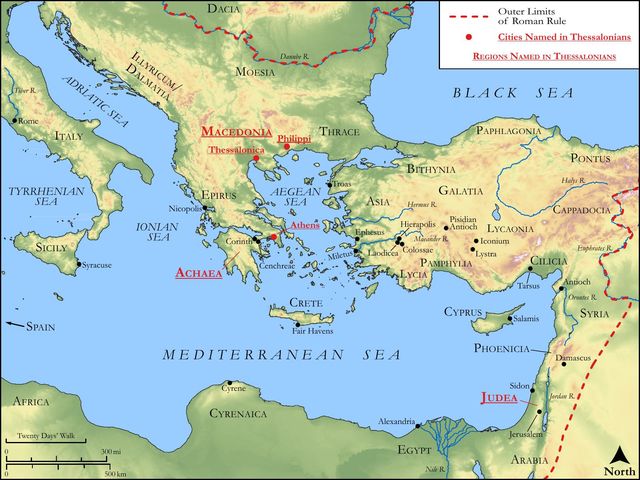
See on the biblical-era map

Study this verse
Public-domain commentary
Matthew Henry
From his Commentary on the Whole Bible. Henry comments on passages, not single verses — this entry covers 2 Thessalonians 1:5–10. His four-level outline is real structure in the source text, so it is rendered as structure.
Having mentioned their persecutions and tribulations, which they endured principally for the cause of Christ, the apostle proceeds to offer several things for their comfort under them; as,
I.He tells them of the present happiness and advantage of their sufferings, Th2 1:5.
Their faith being thus tried, and patience exercised, they were improved by their sufferings, insomuch that they were counted worthy of the kingdom of God. Their sufferings were a manifest token of this, that they were worthy or meet to be accounted Christians indeed, seeing they could suffer for Christianity. And the truth is, Religion, if it is worth any thing, is worth every thing; and those either have no religion at all, or none that is worth having, or know not how to value it, that cannot find in their hearts to suffer for it. Besides, from their patient suffering, it appeared that, according to the righteous judgment of God, they should be counted worthy of the heavenly glory: not by worthiness of condignity, but of congruity only; not that they could merit heaven, but they were made meet for heaven. We cannot by all our sufferings, any more than by our services, merit heaven as a debt; but by our patience under our sufferings we are qualified for the joy that is promised to patient sufferers in the cause of God.
II.He tells them next of the future recompence that shall be given to persecutor and persecuted.
1.In this future recompence there will be,
(1.)A punishment inflicted on persecutors: God will recompense tribulation to those that trouble you, Th2 1:6. And there is nothing that more infallibly marks a man for eternal ruin than a spirit of persecution, and enmity to the name and people of God: as the faith, patience, and constancy of the saints are to them an earnest of everlasting rest and joy, so the pride, malice, and wickedness of their persecutors are to them an earnest of everlasting misery; for every man carries about with him, and carries out of the world with him, either his heaven or his hell. God will render a recompence, and will trouble those that trouble his people. This he has done sometimes in this world, witness the dreadful end of many persecutors; but especially this he will do in the other world, where the portion of the wicked must be weeping, and wailing, and gnashing of teeth.
(2.)A reward for those that are persecuted: God will recompense their trouble with rest, Th2 1:7. There is a rest that remains for the people of God, a rest from sin and sorrow. Though many may be the troubles of the righteous now, yet God will deliver them out of them all. The future rest will abundantly recompense all their present troubles. The sufferings of this present time are not worthy to be compared with the glory that shall be revealed. There is enough in heaven to countervail all that we may lose or suffer for the name of Christ in this world. The apostle says, To you who are troubled rest with us. In heaven, ministers and people shall rest together, and rejoice together, who suffer together here; and the meanest Christian shall rest with the greatest apostle: nay, what is far more, if we suffer for Christ, we shall also reign with him, Ti2 2:12.
2.Concerning this future recompence we are further to observe,
(1.)The certainty of it, proved by the righteousness and justice of God: It is a righteous thing with God (Th2 1:6) to render to every man according to his works. The thoughts of this should be terrible to wicked men and persecutors, and the great support of the righteous and such as are persecuted; for, seeing there is a righteous God, there will be a righteous recompence. God's suffering people will lose nothing by their sufferings, and their enemies will gain nothing by their advantages against them.
(2.)The time when this righteous recompence shall be made: When the Lord Jesus shall be revealed from heaven, Th2 1:7. That will be the day of the revelation of the righteous judgment of God; for then will God judge the world in righteousness by that man whom he hath appointed, even Jesus Christ the righteous Judge. The righteousness of God does not so visibly appear to all men in the procedure of his providence as it will in the process of the great judgment-day. The scripture has made known to us the judgment to come, and we are bound to receive the revelation here given concerning Christ. As,
[1.]That the Lord Jesus will in that day appear from heaven. Now the heavens retain him, they conceal him; but then he will be revealed and made manifest. He will come in all the pomp and power of the upper world, whence we look for the Saviour.
[2.]He will be revealed with his mighty angels (Th2 1:7), or the angels of his power: these will attend upon him, to grace the solemnity of that great day of his appearance; they will be the ministers of his justice and mercy in that day; they will summon the criminals to his tribunal, and gather in the elect, and be employed in executing his sentence.
[3.]He will come in flaming fire, Th2 1:8. A fire goeth before him, which shall consume his enemies. The earth, and all the works that are therein, shall be burnt up, and the elements shall melt with fervent heat. This will be a trying fire, to try every man's work, - a refining fire, to purify the saints, who shall share in the purity, and partake of the felicity, of the new heaven and the new earth, - a consuming fire to the wicked. His light will be piercing, and his power consuming, to all those who in that day shall be found as chaff.
[4.]The effects of this appearance will be terrible to some and joyful to others.
First, They will be terrible to some; for he will then take vengeance on the wicked. 1. On those that sinned against the principles of natural religion, and rebelled against the light of nature, that knew not God (Th2 1:8), though the invisible things of him are manifested in the things that are seen. 2. On those that rebel against the light of revelation, that obey not the gospel of our Lord Jesus Christ. And this is the condemnation, that light is come into the world, and men love darkness rather than light. This is the great crime of multitudes - the gospel is revealed to them, and they will not believe it; or, if they pretend to believe it, they will not obey it. Note, Believing the truths of the gospel is in order to our obeying the precepts of the gospel: there must be the obedience of faith. To such persons as are here mentioned the revelation of our Lord Jesus Christ will be terrible, because of their doom, which is mentioned, Th2 1:9. Here observe, (1.) They will then be punished. Though sinners may be long reprieved, yet they will be punished at last. Their misery will be a proper punishment for their crimes, and only what they have deserved. They did sin's work, and must receive sin's wages. (2.) Their punishment will be no less than destruction, not of their being, but of their bliss; not that of the body alone, but both as to body and soul. (3.) This destruction will be everlasting. They shall be always dying, and yet never die. Their misery will run parallel with the line of eternity. The chains of darkness are everlasting chains, and the fire is everlasting fire. It must needs be so, since the punishment is inflicted by an eternal God, fastening upon an immortal soul, set out of the reach of divine mercy and grace. (4.) This destruction shall come from the presence of the Lord, that is, immediately from God himself. Here God punishes sinners by creatures, by instruments; but then he will take the work into his own hands. It will be destruction from the Almighty, more terrible than the consuming fire which consumed Nadab and Abihu, which came from before the Lord. (5.) It shall come from the glory of his power, or from his glorious power. Not only the justice of God, but this almighty power, will be glorified in the destruction of sinners; and who knows the power of his anger? He is able to cast into hell.
Secondly, It will be a joyful day to some, even to the saints, unto those that believe and obey the gospel. And then the apostle's testimony concerning this day will be confirmed and believed (Th2 1:10); in that bright and blessed day, 1. Christ Jesus will be glorified and admired by his saints. They will behold his glory, and admire it with pleasure; they will glorify his grace, and admire the wonders of his power and goodness towards them, and sing hallelujahs to him in that day of his triumph, for their complete victory and happiness. 2. Christ will be glorified and admired in them. His grace and power will then be manifested and magnified, when it shall appear what he has purchased for, and wrought in, and bestowed upon, all those who believe in him. As his wrath and power will be made known in and by the destruction of his enemies, so his grace and power will be magnified in the salvation of his saints. Note, Christ's dealings with those who believe will be what the world one day shall wonder at. Now, they are a wonder to many; but how will they be wondered at in this great and glorious day; or, rather, how will Christ, whose name is Wonderful, be admired, when the mystery of God shall be finished! Christ will not be so much admired in the glorious esteem of angels that he will bring from heaven with him as in the many saints, the many sons, that he will bring to glory.
Historical interpretation
Six Centuries of Reception
4 surviving comments on this verse. Each one is dated, so this reads as a timeline rather than a list.
Select a marker to jump to its quote. Markers stagger vertically where authors wrote within a few decades of each other.
But why instead of a stern reproof did our Lord speak a parable of persuasion to that Pharisee? He spoke the parable to him tenderly, that he, though stubborn and resistant, might unawares be enticed to correct his perversities. For the waters that are frozen by the force of a cold wind, the heat of the sun gently dissolves. So our Lord did not oppose him harshly, that he might not give occasion to the rebellious to rebel again.… Our Lord, then, did not employ harsh reproof, because his coming was of grace. He did not refrain from reproof, because his later coming will be of retribution. Even though he had come in humility, he nonetheless caused men to be afraid, because “it is a fearful thing to fall into his hands” when he shall come “in flaming fire.” But our Lord most often helped others by way of persuasion than by reproof. For the gentle shower softens the earth and penetrates all through it. But violent rain binds and hardens the face of the earth, so that it does not receive it.
"If so be that it is a righteous thing with God to recompense affliction to them that afflict you, and to you that are afflicted rest with us at the revelation of the Lord Jesus from heaven with the Angels of His power."
The phrase "If so be that" here is put for "because," which we also use, in speaking of things that are quite evident and not to be denied; instead of saying, "Because it is exceedingly righteous." "If so be," he says, "that it is a righteous thing" with God to punish these, he will certainly punish them. As if he had said, "If God cares for human affairs," "If God takes thought." And he does not put it of his own opinion, but among things confessedly true; as if one said, "If God hates the wicked," that he may compel them to grant that He does hate them. For such sentences are above all indisputable, inasmuch as they also themselves know that it is just. For if this is just with men, much more with God.
"To recompense," he says, "affliction to them that afflict you, and to you that are afflicted rest." What then? Is the retribution equal? By no means, but see by what follows how he shows that it is more severe, and the "rest" much greater. Behold also another consolation, in that they have their partners in the afflictions, as partners also in the retribution. He joins them in their crowns with those who had performed infinitely more and greater works. Then he adds also the period, and by the description leads their minds upward, all but opening heaven already by his word, and setting it before their eyes; and he places around Him the angelic host, both from the place and from the attendants amplifying the image, so that they may be refreshed a little. "And to you that are afflicted rest with us," he says, "at the revelation of the Lord Jesus from heaven with the Angels of his power."
is revealed that is, manifestation.
from heaven, coming to judge.
with the Angels of his virtue, just as he Himself says, "When the Son of man will come, and all the angels with him." (Mt 25:31)
with a repose with us
Beautifully do they say 'with us'; to the extent that they who were imitators of the apostles shall have fellowship with them in the Kingdom of Heaven. Therefore John says "that you may have fellowship with us," (1Jn 1:3) And because this is rest, it is conferred not here, but in the future, to the saints.
Continue studying 2 Thessalonians 1:7 across the web’s major study libraries — every link below opens this exact verse, chapter, or book on the destination site.
Read & Compare
 BibleGatewayThis verse in more than 200 translations and 70 languages.
 Bible.comThe YouVersion reader — hundreds of translations, reading plans, and highlights.
 ESV.orgCrossway's official English Standard Version reader.
 NET BibleThe NET translation with 60,000+ translators' notes on every rendering decision.
 STEP BibleTyndale House's free study tool — original text, vocabulary, and scholarly resources.
 BibliaLogos Bible Software's free web reader.
 USCCBThe New American Bible (Revised Edition) with the U.S. bishops' study notes.
Commentaries
 BibleHub CommentariesDozens of classic commentaries on this verse, gathered on one page.
 StudyLightMore than 100 commentary sets — the largest collection on the web.
 BibleRefPlain-English commentary on what this verse means, verse by verse.
 Enduring WordDavid Guzik's free commentary on this chapter, widely used by Bible teachers.
 Bible Study ToolsVerse commentary alongside Greek and Hebrew study aids.
Original Language & Research
- BibleHub InterlinearThe verse word by word — original language, transliteration, and English.
- BibleHub LexiconEvery word's original-language definition and Strong's entry.
 Blue Letter BibleDeep-study tools — Strong's numbers, concordance, and word studies.
 CNTR CollationThe earliest Greek manuscripts of this verse, collated letter by letter.
Sermons, Hymns & Audio


TrulyRandomVerse is not affiliated with these sites and doesn’t control their content. They’re linked because they’re genuinely useful.
Summary
Second Thessalonians 1:7 offers profound comfort and assurance to believers enduring persecution, promising them divine "rest" and relief when the Lord Jesus is gloriously revealed from heaven. This revelation, accompanied by His mighty angels, signifies the culmination of God's righteous judgment, bringing vindication for the afflicted and just recompense for their oppressors, thereby establishing a foundational hope for those suffering for their faith.
Context
ShowHideLiterary Context
This verse is a pivotal point in Paul's opening thanksgiving and prayer for the Thessalonian church. It directly follows Paul's declaration in 2 Thessalonians 1:6 that God will justly repay trouble to those who trouble the believers. Verse 7, therefore, presents the flip side of this divine justice: relief and rest for the persecuted. The subsequent verses (e.g., 2 Thessalonians 1:8-9) elaborate on the specific nature of the judgment that will fall upon those who do not know God or obey the gospel, further emphasizing the contrast between the fate of the righteous and the unrighteous at Christ's return. The entire chapter serves to encourage the suffering believers by fixing their gaze on the future glorious advent of Christ and the establishment of His perfect justice.
Historical & Cultural Context
The Thessalonian church, established by Paul during his second missionary journey, was a relatively young community (see Acts 17:1-9). From its inception, it faced significant opposition, as evidenced in 1 Thessalonians 1:6. This persecution likely stemmed from both Jewish opposition (who viewed Paul's message as blasphemous) and Gentile opposition (who saw Christianity as a threat to traditional Roman civic and religious practices, including emperor worship). Living in a Roman colony, Christians would have been under pressure to conform. Paul's second letter addresses their continued distress but also clarifies misunderstandings about the timing and nature of the Lord's return, which some believed had already occurred, leading to confusion and idleness. This verse specifically addresses their present "trouble" by pointing to a future, definitive act of divine intervention.
Key Themes
ShowHideThe verse powerfully contributes to several major theological and narrative themes within 2 Thessalonians and the broader Pauline corpus. Firstly, it underscores the theme of Divine Justice and Vindication. Paul assures the suffering faithful that God is righteous and will not allow their suffering to go unaddressed; rather, He will bring ultimate justice, vindicating His people and punishing their oppressors. Secondly, the verse highlights the Second Coming of Christ (the Parousia). The "revelation from heaven" of the Lord Jesus is a central eschatological hope, marking the definitive end of earthly suffering for believers and the dawn of their eternal rest. This theme is crucial throughout Paul's Thessalonian letters, as seen in 1 Thessalonians 4:16-17. Thirdly, it emphasizes Rest for the Troubled. The promise of "rest" is not merely a cessation of physical suffering but a profound, spiritual, and eternal peace that comes with the Lord's presence, signifying ultimate relief from all distress and opposition. Finally, the phrase "with his mighty angels" reinforces the Majesty and Power accompanying Christ's return, portraying it as a glorious, kingly advent, a display of irresistible divine authority and force, as also described in Matthew 25:31.
Exposition and Analysis
ShowHideKey Word Analysis
ShowHideThis word means "to crowd (literally or figuratively); afflict, narrow, throng, suffer tribulation, trouble." It vividly describes the intense pressure, affliction, and persecution the Thessalonian believers were experiencing. It suggests a crushing burden, a constricted space, or a severe pressing, conveying the deep distress and hardship they endured for their faith.
This term signifies "relaxation or (figuratively) relief." It speaks to a profound and lasting cessation of the pressure and affliction described by thlíbō. This "rest" is not merely a temporary reprieve but a complete and final alleviation from all suffering, a state of peace and ease that will be fully realized at Christ's glorious appearing.
Meaning "disclosure; appearing, coming, lighten, manifestation, be revealed, revelation." This word is the root of the English "apocalypse" and implies a powerful, undeniable "unveiling" or "making manifest" of something previously hidden or obscured. In this context, it refers to the glorious, visible, and unmistakable appearing of the Lord Jesus, an event that will bring divine truth and judgment into full light.
Verse Breakdown
ShowHide"And to you who are troubled"
This clause directly addresses the suffering believers in Thessalonica, acknowledging their current state of affliction and tribulation. It highlights Paul's pastoral heart and God's awareness of their distress, setting the stage for the promise of relief.
"rest with us,"
This is the immediate promise to the troubled. The "rest" (ánesis) signifies a complete and lasting relief from their suffering. The phrase "with us" indicates a shared experience of this future rest, implying that Paul and his companions, who also endured tribulation, anticipate the same ultimate comfort and vindication alongside the Thessalonians. It fosters a sense of solidarity and shared hope.
"when the Lord Jesus shall be revealed from heaven"
This clause specifies the timing and nature of the promised rest. It will occur at the Parousia, the glorious, visible, and unmistakable "unveiling" (apokálypsis) of Jesus Christ. His revelation "from heaven" underscores His divine origin, authority, and the transcendent nature of His return, signifying a cosmic event that will dramatically alter the present reality.
"with his mighty angels,"
This final phrase describes the magnificent entourage accompanying Christ's return. The presence of "mighty" (dýnamis, powerful) "angels" (messengers/heavenly beings) emphasizes the immense power, authority, and glory attending the Lord's advent. It signifies a display of divine majesty and irresistible force, reinforcing the certainty and grandeur of the event that will bring ultimate justice and rest.
Literary Devices
ShowHideThe verse employs several significant literary devices. Contrast is prominent, setting the present "troubled" state of believers against the future "rest" they will receive. This juxtaposition highlights the dramatic shift from suffering to solace that Christ's return will bring. The language is rich in Eschatological Language, focusing on future events and the ultimate consummation of God's plan. Phrases like "when the Lord Jesus shall be revealed from heaven" directly point to the end times and the Second Coming. Furthermore, the verse describes a Theophany or Christophany, the visible manifestation of God or Christ. The "revelation" of Jesus from heaven with "mighty angels" paints a picture of a glorious, undeniable divine appearance, emphasizing His power and authority as He returns to judge and to save.
Theological and Thematic Connections
ShowHideThis verse is profoundly significant for Christian theology, affirming God's unwavering commitment to justice and His ultimate sovereignty over all creation. It teaches that suffering for righteousness' sake is not in vain, but is seen and will be recompensed by a just God. The promise of "rest" at Christ's "revelation" provides a powerful eschatological anchor for believers, shifting their focus from temporal afflictions to eternal vindication and peace. It underscores that the consummation of salvation involves not just individual redemption but a cosmic unveiling of Christ's kingly rule, where all wrongs are righted and His faithful are brought into full communion and freedom. This future hope is designed to sustain believers through present trials, knowing that their ultimate relief and triumph are secured in the returning Lord.
Reflection and Application
ShowHideFor believers today, 2 Thessalonians 1:7 offers an enduring wellspring of hope and a vital framework for understanding present difficulties. It reminds us that our earthly struggles, no matter how intense or prolonged, are temporary and finite. The ultimate "rest" promised here is a profound and lasting peace that transcends any worldly comfort, rooted in the certain return of our Lord. This truth encourages perseverance in the face of adversity, knowing that God is not indifferent to our suffering but is actively working out His perfect justice. Our hope is not in earthly solutions or the cessation of all problems in this life, but in the glorious, future advent of Jesus Christ, who will bring complete vindication and eternal relief. This expectation should shape our perspective on our trials, empowering us to endure faithfully, to live with an eternal mindset, and to find solace in the blessed assurance that our ultimate reward and rest are secure in Him.
Questions for Reflection
ShowHideFAQ
ShowHideWhat does "rest with us" mean for believers today?
ShowHide"Rest with us" (Greek: ánesis) signifies a complete and eternal cessation of the pressure, affliction, and tribulation that believers experience in this world. It is not merely a physical repose but a profound spiritual and existential peace that comes from being fully in the presence of the Lord, free from sin, suffering, and the opposition of the ungodly. The phrase "with us" (Greek: hēmōn) indicates a shared experience among all believers, including Paul and his companions, who also endured tribulation. It means that at Christ's glorious return, all who have faithfully endured will enter into a collective, ultimate relief and vindication, sharing in the triumph and peace of His eternal kingdom. This rest is a foretaste of the new heavens and new earth where there will be no more pain or sorrow, as promised in Revelation 21:4.
What is the significance of "his mighty angels" accompanying Jesus' revelation?
ShowHideThe presence of "his mighty angels" (Greek: dýnamis ángelos) underscores the immense power, authority, and divine majesty that will accompany the Lord Jesus' second coming. Angels are often depicted in Scripture as divine messengers and agents of God's will, particularly in acts of judgment and salvation. Their presence signifies that Christ's return will be a cosmic, undeniable event of immense power and glory, not a secret or quiet one. It emphasizes His kingly authority as He comes to execute justice, gather His elect, and establish His eternal reign. This imagery aligns with other New Testament descriptions of Christ's return, such as in Matthew 25:31, where Jesus states, "When the Son of man shall come in his glory, and all the holy angels with him, then shall he sit upon the throne of his glory." It assures believers that the one who brings them rest is supremely powerful and able to overcome all opposition.
Christ-Centered Fulfillment
ShowHideThe "revelation from heaven" of the Lord Jesus is the ultimate Christ-centered fulfillment of the promise of rest for the troubled. While Jesus' first advent saw Him revealed as the suffering servant, the Lamb of God who takes away the sin of the world, His second advent will unveil Him as the glorious King and righteous Judge. The rest promised to the troubled is not merely a cessation of suffering, but a profound and eternal peace found in Him, secured by His atoning work on the cross and guaranteed by His resurrection. His suffering and death on Calvary were the means by which He conquered sin and death, making possible the very "rest" that believers anticipate. When He is "revealed," it will be the full manifestation of His redemptive victory, bringing to completion the salvation He inaugurated. This glorious appearance will not only bring vindication for His people but also the full realization of the new covenant promises, where God's dwelling is with humanity, and all things are made new through Christ, the Alpha and the Omega, the beginning and the end of all things. The "rest" is ultimately participation in His eternal reign and glory, a direct result of His finished work and triumphant return.