


1 Thessalonians 5:23
Bible text: King James Version (1769 Blayney text) · Public domain
Bible text: King James Version with Strong's numbers · Public domain
Bible text: Berean Standard Bible · Public domain
Bible text: American Standard Version (1901) · Public domain
Bible text: World English Bible, Messianic edition · Public domain
Bible text: Geneva Bible (1599) · Public domain
Bible text: Young's Literal Translation · Public domain
- αὐτὸςautosHimselfG846P-NSMPersonal pronoun Nominative Singular Masculine
- δὲdenowG1161CONJConjunction
- ὁhotheG3588T-NSMDefinite article Nominative Singular Masculine
- θεὸςtheosGodG2316N-NSM-TNoun Nominative Singular Masculine Title
- τῆςtēs<the>G3588T-GSFDefinite article Genitive Singular Feminine
- εἰρήνηςeirēnēsof peaceG1515N-GSFNoun Genitive Singular Feminine
- ἁγιάσαιhagiasaiwould sanctifyG37V-AAO-3SVerb Aorist Active Optative 3rd Singular
- ὑμᾶςhumasyouG4771P-2APPersonal pronoun Accusative 2nd Plural
- ὁλοτελεῖςholoteleiscompletelyG3651A-APMAdjective Accusative Plural Masculine
- καὶkaiandG2532CONJConjunction
- ὁλόκληρονholoklēronentirelyG3648A-NSNAdjective Nominative Singular Neuter
- ὑμῶνhumōnyourG4771P-2GPPersonal pronoun Genitive 2nd Plural
- τὸto<the>G3588T-NSNDefinite article Nominative Singular Neuter
- πνεῦμαpneumaspiritG4151N-NSNNoun Nominative Singular Neuter
- καὶkaiandG2532CONJConjunction
- ἡhē<the>G3588T-NSFDefinite article Nominative Singular Feminine
- ψυχὴpsuchēsoulG5590N-NSFNoun Nominative Singular Feminine
- καὶkaiandG2532CONJConjunction
- τὸto<the>G3588T-NSNDefinite article Nominative Singular Neuter
- σῶμαsōmabodyG4983N-NSNNoun Nominative Singular Neuter
- ἀμέμπτωςamemptōsblamelessG274ADVAdverb
- ἐνenatG1722PREPPreposition
- τῇtēatheG3588T-DSFDefinite article Dative Singular Feminine
- παρουσίᾳparousiacomingG3952N-DSFNoun Dative Singular Feminine
- τοῦtouof theG3588T-GSMDefinite article Genitive Singular Masculine
- κυρίουkuriouLordG2962N-GSM-TNoun Genitive Singular Masculine Title
- ἡμῶνhēmōnof usG3165P-1GPPersonal pronoun Genitive 1st Plural
- ἸησοῦIēsouJesusG2424N-GSM-PNoun Genitive Singular Masculine Individual
- ΧριστοῦChristouChristG5547N-GSM-TNoun Genitive Singular Masculine Title
- τηρηθείηtērētheiēwould be preservedG5083V-APO-3SVerb Aorist Passive Optative 3rd Singular
English is a literal word-by-word gloss of the Greek, not the KJV's wording. Why?
This is the original text the KJV's translators worked from — each Greek word with its own literal English meaning in this verse, prepared by scholars at Tyndale House, Cambridge. The KJV translates whole sentences, not word by word, so its wording differs: one Greek word can become several English words, and the KJV may choose “charity” where the gloss reads “love”. Both are faithful — they answer different questions. For the KJV's own rendering, switch to the KJV text.
Details
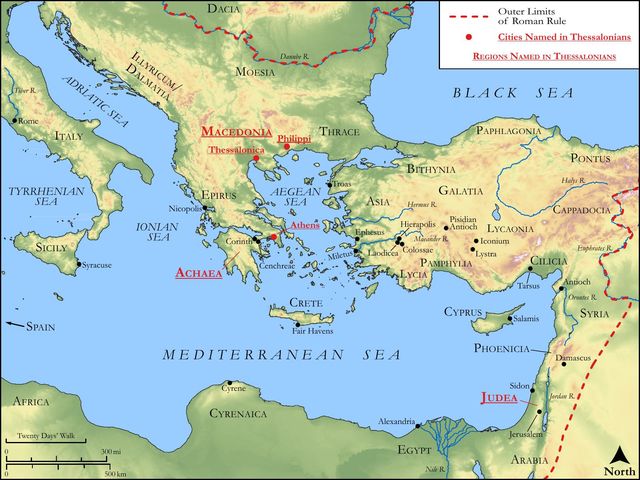
See on the biblical-era maps

Study this verse
Public-domain commentary
Matthew Henry
From his Commentary on the Whole Bible. Henry comments on passages, not single verses — this entry covers 1 Thessalonians 5:23–28. His two-level outline is real structure in the source text, so it is rendered as structure.
In these words, which conclude this epistle, observe,
I.Paul's prayer for them, Th1 5:23.
He had told them, in the beginning of this epistle, that he always made mention of them in his prayers; and, now that he is writing to them, he lifts up his heart to God in prayer for them. Take notice,
1.To whom the apostle prays, namely, The very God of peace. He is the God of grace, and the God of peace and love. He is the author of peace and lover of concord; and by their peaceableness and unity, from God as the author, those things would best be obtained which he prays for.
2.The things he prays for on behalf of the Thessalonians are their sanctification, that God would sanctify them wholly; and their preservation, that they might be preserved blameless. He prays that they may be wholly sanctified, that the whole man may be sanctified, and then that the whole man, spirit, soul, and body, may be preserved: or, he prays that they may be wholly sanctified, that is, more perfectly, for the best are sanctified but in part while in this world; and therefore we should pray for and press towards complete sanctification. Where the good work of grace is begun, it shall be carried on, be protected and preserved; and all those who are sanctified in Christ Jesus shall be preserved to the coming of our Lord Jesus Christ. And because, if God did not carry on his good work in the soul, it would miscarry, we should pray to God to perfect his work, and preserve us blameless, free from sin and impurity, till at length we are presented faultless before the throne of his glory with exceeding joy.
II.His comfortable assurance that God would hear his prayer:
Faithful is he who calleth you, who will also do it, Th1 5:24. The kindness and love of God had appeared to them in calling them to the knowledge of his truth, and the faithfulness of God was their security that they should persevere to the end; and therefore, the apostle assures them, God would do what he desired; he would effect what he had promised; he would accomplish all the good pleasure of his goodness towards them. Note, Our fidelity to God depends upon his faithfulness to us.
III.His request of their prayers:
Brethren, pray for us, Th1 5:25. We should pray for one another; and brethren should thus express brotherly love. This great apostle did not think it beneath him to call the Thessalonians brethren, nor to request their prayers. Ministers stand in need of their people's prayers; and the more people pray for their ministers the more good ministers may have from God, and the more benefit people may receive by their ministry.
IV.His salutation:
Greet all the brethren with a holy kiss, Th1 5:26. Thus the apostle sends a friendly salutation from himself, and Silvanus, and Timotheus, and would have them salute each other in their names; and thus he would have them signify their mutual love and affection to one another by the kiss of charity (Pe1 5:14), which is here called a holy kiss, to intimate how cautious they should be of all impurity in the use of this ceremony, then commonly practised; as it should not be a treacherous kiss like that of Judas, so not a lascivious kiss like that of the harlot, Pro 7:13.
V.His solemn charge for the reading of this epistle, Th1 5:27.
This is not only an exhortation, but an adjuration by the Lord. And this epistle was to be read to all the holy brethren. It is not only allowed to the common people to read the scriptures, and what none should prohibit, but it is their indispensable duty, and what they should be persuaded to do. In order to this, these holy oracles should not be kept concealed in an unknown tongue, but translated into the vulgar languages, that all men, being concerned to know the scriptures, may be able to read them, and be acquainted with them. The public reading of the law was one part of the worship of the sabbath among the Jews in their synagogues, and the scriptures should be read in the public assemblies of Christians also.
VI.The apostolical benediction that is usual in other epistles:
The grace of our Lord Jesus Christ be with you. Amen, Th1 5:28. We need no more to make us happy than to know that grace which our Lord Jesus Christ has manifested, be interested in that grace which he has purchased, and partake of that grace which dwells in him as the head of the church. This is an ever-flowing and overflowing fountain of grace to supply all our wants.
Historical interpretation
Two Centuries of Reception
10 surviving comments on this verse. Each one is dated, so this reads as a timeline rather than a list.
Select a marker to jump to its quote. Markers stagger vertically where authors wrote within a few decades of each other.
For he will not possess in that case the likeness and appearance of angels, but of those souls in whom also he receives shape; just as water when poured into a vessel takes the form of that vessel, and if on any occasion it happens to congeal in it, it will acquire the form of the vessel in which it has thus been frozen, since souls themselves possess the figure.
); and may your spirit, and soul, and body be preserved whole without complaint to the coming of the Lord Jesus Christ."
And as if this were not plain enough, it goes on to say: "And may your whole body, and soul, and spirit be preserved blameless unto the coming of the Lord." Here you have the entire substance of man destined to salvation, and that at no other time than at the coming of the Lord, which is the key of the resurrection.
I believe (He does so) for fear the heads of some should be seen! And oh that in "that day" of Christian exultation, I, most miserable (as I am), may elevate my head, even though below (the level of) your heels! I shall (then) see whether you will rise with (your) ceruse and rouge and saffron, and in all that parade of headgear: whether it will be women thus tricked out whom the angels carry up to meet Christ in the air If these (decorations) are now good, and of God, they will then also present themselves to the rising bodies, and will recognise their several places. But nothing can rise except flesh and spirit sole and pure. Whatever, therefore, does not rise in (the form of) spirit and flesh is condemned, because it is not of God.
Come now, you who deny the salvation of the flesh, and who, whenever there occurs the specific mention of body in a case of this sort, interpret it as meaning anything rather than the substance of the flesh, (tell me) how is it that the apostle has given certain distinct names to all (our faculties), and has comprised them all in one prayer for their safety, desiring that our "spirit and soul and body may be preserved blameless unto the coming of our Lord and Saviour (Jesus) Christ? " Now he has here pro-pounded the soul and the body as two several and distinct things.
In another way, it is possible to take the woman for the church, the leaven for the Holy Spirit and the three measures for body, spirit and soul. These three are sanctified by the leaven of the Holy Spirit, so that by the Holy Spirit they become one lump, in order that “our whole body and spirit and soul may be kept blameless in the day of our Lord Jesus Christ,” as Paul says.
In the wicked sin reigns over the soul, being settled as on its own throne in the mortal body, so that the soul obeys its lusts … but in the case of those who have become perfected, the spirit has gained the mastery and put to death the deeds of the body. It imparts to the body of its own life and there arises a concord of the two, body and spirit, on the earth.… But still more blessed is it if the three [i.e., body, soul and spirit] be gathered together in the name of Jesus, that this may be fulfilled, “May God sanctify you wholly, and may your spirit and soul and body be preserved entire without blame at the coming of our Lord Jesus Christ.”
Hence it is necessary that the perfect man offer up all, both the things of the soul and those of the flesh, so that he may be complete and not lacking. Therefore also God commands Abraham,
This, therefore, is perfection in the Christian life in my judgment, namely, the participation of one’s soul and speech and activities in all of the names by which Christ is signified, so that the perfect holiness, according to the eulogy of Paul, is taken upon oneself in “the whole body and soul and spirit,” continuously safeguarded against being mixed with evil.
On this subject the Lord says, “When you come into the land to which I bring you and when you eat of the food of the land, you shall present an offering to the Lord. When you separate the firstfruits of your barn floors, you shall also give the firstfruits of your dough to the Lord.” We are a composite of diverse elements mixed together, cold with hot, and moist with dry. This mixture is the source of many pleasures and manifold delights of the flesh. But these are not the firstfruits of this body of ours. Since we are composed of soul and body and spirit, the first place is held by that mixture in which the apostle desires that we find sanctification. “And may the God of peace himself sanctify you completely, and may your spirit and soul and body be preserved sound, blameless at the coming of our Lord Jesus Christ.”
"And the God of peace Himself sanctify you wholly; and may your spirit and soul and body be preserved entire, without blame at the coming of our Lord Jesus Christ."
Observe the affection of the Teacher. After the admonition he adds a prayer; not only that, but even introduces it in his letter. For we need both counsel and prayer. "Sanctify you wholly," he says, and may "your spirit and soul and body be preserved entire, without blame at the coming of our Lord Jesus Christ." What does he here call the spirit? The gift of grace. For if we depart hence having our lamps bright, we shall enter into the bridechamber. But if they are quenched, it will not be so. For this reason he says "your spirit." For if that remains pure, the other remains also. "And soul and body," he says. For neither the one nor the other then admits anything evil.
Continue studying 1 Thessalonians 5:23 across the web’s major study libraries — every link below opens this exact verse, chapter, or book on the destination site.
Read & Compare
 BibleGatewayThis verse in more than 200 translations and 70 languages.
 Bible.comThe YouVersion reader — hundreds of translations, reading plans, and highlights.
 ESV.orgCrossway's official English Standard Version reader.
 NET BibleThe NET translation with 60,000+ translators' notes on every rendering decision.
 STEP BibleTyndale House's free study tool — original text, vocabulary, and scholarly resources.
 BibliaLogos Bible Software's free web reader.
 USCCBThe New American Bible (Revised Edition) with the U.S. bishops' study notes.
Commentaries
 BibleHub CommentariesDozens of classic commentaries on this verse, gathered on one page.
 StudyLightMore than 100 commentary sets — the largest collection on the web.
 BibleRefPlain-English commentary on what this verse means, verse by verse.
 Enduring WordDavid Guzik's free commentary on this chapter, widely used by Bible teachers.
 Bible Study ToolsVerse commentary alongside Greek and Hebrew study aids.
Original Language & Research
- BibleHub InterlinearThe verse word by word — original language, transliteration, and English.
- BibleHub LexiconEvery word's original-language definition and Strong's entry.
 Blue Letter BibleDeep-study tools — Strong's numbers, concordance, and word studies.
 CNTR CollationThe earliest Greek manuscripts of this verse, collated letter by letter.
Sermons, Hymns & Audio


TrulyRandomVerse is not affiliated with these sites and doesn’t control their content. They’re linked because they’re genuinely useful.
Summary
The Apostle Paul concludes his first letter to the Thessalonians with a profound pastoral prayer, invoking the "God of peace" to completely sanctify the believers and to preserve their entire being—spirit, soul, and body—without fault until the glorious return of Jesus Christ. This benediction encapsulates Paul's deep desire for their holistic spiritual integrity and enduring faithfulness, recognizing that such a state is ultimately a work of divine grace and power.
Context
ShowHideLiterary Context
This powerful prayer serves as the climactic benediction in Paul's first epistle to the Thessalonians, immediately following a series of concise and practical exhortations. In the preceding verses (1 Thessalonians 5:16-22), Paul delivers rapid-fire commands such as "Rejoice always," "Pray without ceasing," and "Give thanks in all circumstances," along with instructions to "test everything; hold fast what is good" and "abstain from every form of evil." The prayer in 1 Thessalonians 5:23 acts as a theological anchor and a pastoral plea, acknowledging that the human capacity to live out these demanding commands is not self-generated but divinely enabled. It transitions from direct instruction to a heartfelt invocation, underscoring Paul's reliance on God's active work in the lives of the believers to bring about the very holiness and perseverance he has just called them to pursue.
Historical & Cultural Context
Written from Corinth around A.D. 50-51, 1 Thessalonians is one of Paul's earliest epistles. The Thessalonian church, a relatively young community, faced significant external pressures, including persecution from both Jewish and Gentile opposition (1 Thessalonians 2:14-16). Internally, they grappled with questions regarding the return of Christ, particularly concerning those who had died before His parousia (1 Thessalonians 4:13-18). The culture was largely pagan, steeped in idol worship and moral laxity, making Paul's emphasis on sanctification and blamelessness a radical call to counter-cultural living. His prayer for their complete preservation "unto the coming of our Lord Jesus Christ" directly addresses their eschatological anxieties and provides assurance of God's steadfast commitment to His people amidst their trials and questions about the future.
Key Themes
ShowHide1 Thessalonians 5:23 powerfully synthesizes several major themes running throughout the epistle. Firstly, it highlights God's Character as the "God of Peace," emphasizing His nature as the ultimate source of order, reconciliation, and inner tranquility, which is essential for the believers' steadfastness in a chaotic world. Secondly, the prayer underscores Holistic Sanctification, a process by which believers are set apart for God's purposes and progressively transformed. The phrase "sanctify you wholly" (Greek: holotelḗs) signifies that this divine work is comprehensive, impacting every facet of a person's being. Thirdly, the explicit mention of "spirit and soul and body" introduces the theme of Human Anthropology, suggesting a trichotomous understanding of human nature, where each component is distinct yet interconnected, and all are subject to God's sanctifying and preserving power. Finally, the prayer's ultimate goal—to be "preserved blameless unto the coming of our Lord Jesus Christ"—reinforces the epistle's strong Eschatological Hope. The parousia (coming) of Christ is not merely a future event but the driving motivation for present purity and endurance, a theme vividly explored in 1 Thessalonians 4:13-18.
Exposition and Analysis
ShowHideKey Word Analysis
ShowHideMeaning "to make holy, i.e. (ceremonially) purify or consecrate; (mentally) to venerate." In this context, it refers to God's active work of setting believers apart for His sacred purposes and progressively making them holy, both positionally (being declared holy) and practically (growing in holiness).
Meaning "complete to the end, i.e. absolutely perfect." This adverb emphasizes the comprehensive and exhaustive nature of God's sanctifying work, indicating that it is not partial but extends to every aspect of the believer's being, leaving no part untouched.
Meaning "to guard (from loss or injury, properly, by keeping the eye upon); to note (a prophecy; figuratively, to fulfil a command); by implication, to detain (in custody; figuratively, to maintain)." Here, it signifies God's ongoing, protective work of keeping believers safe from spiritual harm and moral compromise, ensuring their endurance and faithfulness until Christ's return.
Verse Breakdown
ShowHide"And the very God of peace sanctify you wholly;"
This opening clause establishes God as the primary agent of sanctification. He is identified as the "God of peace," highlighting His character as the source of all spiritual well-being and reconciliation. The prayer is for Him to "sanctify" (set apart and make holy) the believers, and the adverb "wholly" emphasizes that this work is comprehensive, touching every dimension of their existence.
"and your whole spirit and soul and body"
This phrase details the three distinct, yet interconnected, components of human nature that Paul desires to be encompassed by God's preserving power. "Spirit" (pneûma) often denotes the part of humanity that relates to God, the seat of spiritual life. "Soul" (psychḗ) typically refers to the inner life of intellect, emotion, and will. "Body" (sōma) is the physical organism through which one interacts with the world. Paul's inclusion of all three underscores the holistic nature of God's redemptive and sanctifying work.
"be preserved blameless"
This clause expresses the desired outcome of God's work. The passive voice ("be preserved") again highlights God's active role in maintaining the believers. "Blameless" (amémptōs) means without fault or irreproachable, indicating a state of moral and spiritual integrity that is maintained through divine keeping, not merely human effort.
"unto the coming of our Lord Jesus Christ."
This final phrase specifies the duration and ultimate goal of this preservation. The "coming" (parousía) refers to the future advent or return of Jesus Christ. The prayer is that the Thessalonians would be found in a state of blamelessness when Christ appears, emphasizing the eschatological hope that grounds and motivates Christian living.
Literary Devices
ShowHidePaul's prayer in 1 Thessalonians 5:23 employs several potent literary devices. It functions as a Benediction, a formal expression of divine blessing, characteristic of Paul's concluding remarks in his letters. The direct address to God ("the very God of peace") is an example of Apostrophe, lending a sense of personal appeal and solemnity to the prayer. The phrase "spirit and soul and body" is a classic instance of Tricolon, a rhetorical device where a series of three parallel words or phrases are used to emphasize completeness and totality, conveying that God's work of preservation is all-encompassing. Furthermore, the entire verse is imbued with Eschatological Language, particularly through the mention of "the coming of our Lord Jesus Christ," which grounds the present spiritual journey in the future hope of Christ's return, providing both motivation and assurance.
Theological and Thematic Connections
ShowHideThis verse profoundly articulates the comprehensive scope of God's work in the believer's life, extending from initial sanctification to final preservation. It underscores that holiness is not merely a human endeavor but primarily a divine operation, rooted in the very character of God as the "God of peace." The prayer for the preservation of "spirit and soul and body" highlights a holistic understanding of salvation that encompasses every dimension of human existence, ensuring that God's transformative power reaches into the deepest parts of our being, as well as our outward conduct. This divine commitment to preserve believers "blameless" until Christ's return offers immense assurance and reinforces the Christian hope in the final consummation of salvation.
Reflection and Application
ShowHidePaul's prayer in 1 Thessalonians 5:23 offers profound encouragement and practical guidance for believers today. It reminds us that our sanctification and perseverance are not solely dependent on our own strength or discipline, but are ultimately the work of the "God of peace." This truth fosters humility, as we recognize our reliance on divine grace, and simultaneously ignites hope, knowing that God is actively committed to completing the good work He began in us. The emphasis on "spirit and soul and body" challenges us to embrace a holistic view of our faith, understanding that every aspect of our lives—our thoughts, emotions, desires, and physical actions—is meant to be brought under God's transforming influence. This prayer encourages us to live with an eternal perspective, knowing that our present pursuit of holiness is directly linked to our ultimate encounter with Christ at His glorious return. It calls us to live blamelessly, not out of fear, but out of a confident assurance that God Himself is preserving us for that day.
Questions for Reflection
ShowHideFAQ
ShowHideWhat does it mean for God to "sanctify you wholly"?
ShowHideTo "sanctify you wholly" (Greek: holotelḗs) means for God to set you apart and make you holy in a complete and comprehensive way. It implies that God's work of transformation is not partial but extends to every single part of your being—your spirit, soul, and body. It encompasses both a positional holiness (being declared holy by God through Christ) and a progressive holiness (the ongoing process of becoming more like Christ in thought, word, and deed). It signifies that God desires and is at work to make you entirely consecrated to Him, without any part of your life being left untouched by His purifying and perfecting grace. This aligns with the call to holiness found throughout Scripture, such as in Hebrews 12:14.
What is the significance of "spirit and soul and body" in this verse?
ShowHideThe mention of "spirit and soul and body" is significant because it presents a comprehensive view of human nature, highlighting that God's work of sanctification and preservation is all-encompassing. While there are theological discussions about whether this indicates a trichotomous (three-part) or dichotomous (two-part, body and soul/spirit) understanding of humanity, the primary emphasis here is on the totality of the person.
By listing all three, Paul emphasizes that no part of the believer's being is outside the scope of God's sanctifying and preserving power. God cares for and works in every dimension of our existence, ensuring our holistic well-being and integrity until the day of Christ. This echoes the biblical emphasis on presenting our "whole selves" to God, as seen in Romans 12:1-2.
Christ-Centered Fulfillment
ShowHide1 Thessalonians 5:23 finds its ultimate fulfillment in the person and work of Jesus Christ. It is through Christ that we are initially sanctified, set apart for God's holy purposes by His atoning sacrifice on the cross (Hebrews 10:10). Furthermore, Christ Himself is the "God of peace" in human form, having reconciled us to God through His blood (Colossians 1:20). The ongoing work of sanctification and preservation of our "spirit and soul and body" is accomplished by the Holy Spirit, whom Christ sent to indwell believers, guiding them into all truth and transforming them into His likeness (John 14:26). The prayer for blameless preservation "unto the coming of our Lord Jesus Christ" points directly to Christ's return, when He will present His church to Himself "without stain or wrinkle or any other blemish, but holy and blameless" (Ephesians 5:27). Our ultimate blamelessness is not achieved by our own efforts but is a gift secured by Christ's perfect righteousness and His faithful intercession, ensuring that all who are in Him will be kept by God's power until that glorious day (Jude 1:24).