


1 Thessalonians 5:28
Bible text: King James Version (1769 Blayney text) · Public domain
Bible text: Berean Standard Bible · Public domain
Bible text: American Standard Version (1901) · Public domain
Bible text: World English Bible, Messianic edition · Public domain
Bible text: Geneva Bible (1599) · Public domain
Bible text: Young's Literal Translation · Public domain
- ἩHēTheG3588T-NSFDefinite article Nominative Singular Feminine
- χάριςcharisgraceG5485N-NSFNoun Nominative Singular Feminine
- τοῦtouof theG3588T-GSMDefinite article Genitive Singular Masculine
- κυρίουkuriouLordG2962N-GSM-TNoun Genitive Singular Masculine Title
- ἡμῶνhēmōnof usG3165P-1GPPersonal pronoun Genitive 1st Plural
- ἸησοῦIēsouJesusG2424N-GSM-PNoun Genitive Singular Masculine Individual
- ΧριστοῦChristouChristG5547N-GSM-TNoun Genitive Singular Masculine Title
- μεθ᾽meth᾽[be] withG3326PREPPreposition
- ὑμῶνhumōnyouG4771P-2GPPersonal pronoun Genitive 2nd Plural
- ἀμήνamēnAmenG281INJ-HEBInterjection
- πρόςprostoG4314PREPPreposition
- ΘεσσαλονικείςThessalonikeisThessalonicaG2331N-APM-LGNoun Accusative Plural Masculine Location Gentilic
- πρώτηprōtēfirstG4413A-NSF-SAdjective Nominative Singular Feminine Superlative
- ἐγράφηegraphēIt was writtenG1125V-2API-3SVerb 2nd Aorist Passive Indicative 3rd Singular
- ἀπόapofromG575PREPPreposition
- ἈθηνῶνAthēnōnAthensG116N-GPF-LNoun Genitive Plural Feminine Location
English is a literal word-by-word gloss of the Greek, not the KJV's wording. Why?
This is the original text the KJV's translators worked from — each Greek word with its own literal English meaning in this verse, prepared by scholars at Tyndale House, Cambridge. The KJV translates whole sentences, not word by word, so its wording differs: one Greek word can become several English words, and the KJV may choose “charity” where the gloss reads “love”. Both are faithful — they answer different questions. For the KJV's own rendering, switch to the KJV text.
Details
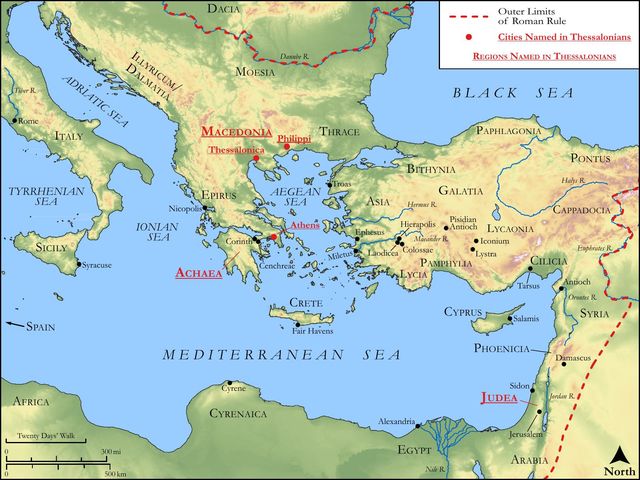
See on the biblical-era maps

Study this verse
Public-domain commentary
Matthew Henry
From his Commentary on the Whole Bible. Henry comments on passages, not single verses — this entry covers 1 Thessalonians 5:23–28. His two-level outline is real structure in the source text, so it is rendered as structure.
In these words, which conclude this epistle, observe,
I.Paul's prayer for them, Th1 5:23.
He had told them, in the beginning of this epistle, that he always made mention of them in his prayers; and, now that he is writing to them, he lifts up his heart to God in prayer for them. Take notice,
1.To whom the apostle prays, namely, The very God of peace. He is the God of grace, and the God of peace and love. He is the author of peace and lover of concord; and by their peaceableness and unity, from God as the author, those things would best be obtained which he prays for.
2.The things he prays for on behalf of the Thessalonians are their sanctification, that God would sanctify them wholly; and their preservation, that they might be preserved blameless. He prays that they may be wholly sanctified, that the whole man may be sanctified, and then that the whole man, spirit, soul, and body, may be preserved: or, he prays that they may be wholly sanctified, that is, more perfectly, for the best are sanctified but in part while in this world; and therefore we should pray for and press towards complete sanctification. Where the good work of grace is begun, it shall be carried on, be protected and preserved; and all those who are sanctified in Christ Jesus shall be preserved to the coming of our Lord Jesus Christ. And because, if God did not carry on his good work in the soul, it would miscarry, we should pray to God to perfect his work, and preserve us blameless, free from sin and impurity, till at length we are presented faultless before the throne of his glory with exceeding joy.
II.His comfortable assurance that God would hear his prayer:
Faithful is he who calleth you, who will also do it, Th1 5:24. The kindness and love of God had appeared to them in calling them to the knowledge of his truth, and the faithfulness of God was their security that they should persevere to the end; and therefore, the apostle assures them, God would do what he desired; he would effect what he had promised; he would accomplish all the good pleasure of his goodness towards them. Note, Our fidelity to God depends upon his faithfulness to us.
III.His request of their prayers:
Brethren, pray for us, Th1 5:25. We should pray for one another; and brethren should thus express brotherly love. This great apostle did not think it beneath him to call the Thessalonians brethren, nor to request their prayers. Ministers stand in need of their people's prayers; and the more people pray for their ministers the more good ministers may have from God, and the more benefit people may receive by their ministry.
IV.His salutation:
Greet all the brethren with a holy kiss, Th1 5:26. Thus the apostle sends a friendly salutation from himself, and Silvanus, and Timotheus, and would have them salute each other in their names; and thus he would have them signify their mutual love and affection to one another by the kiss of charity (Pe1 5:14), which is here called a holy kiss, to intimate how cautious they should be of all impurity in the use of this ceremony, then commonly practised; as it should not be a treacherous kiss like that of Judas, so not a lascivious kiss like that of the harlot, Pro 7:13.
V.His solemn charge for the reading of this epistle, Th1 5:27.
This is not only an exhortation, but an adjuration by the Lord. And this epistle was to be read to all the holy brethren. It is not only allowed to the common people to read the scriptures, and what none should prohibit, but it is their indispensable duty, and what they should be persuaded to do. In order to this, these holy oracles should not be kept concealed in an unknown tongue, but translated into the vulgar languages, that all men, being concerned to know the scriptures, may be able to read them, and be acquainted with them. The public reading of the law was one part of the worship of the sabbath among the Jews in their synagogues, and the scriptures should be read in the public assemblies of Christians also.
VI.The apostolical benediction that is usual in other epistles:
The grace of our Lord Jesus Christ be with you. Amen, Th1 5:28. We need no more to make us happy than to know that grace which our Lord Jesus Christ has manifested, be interested in that grace which he has purchased, and partake of that grace which dwells in him as the head of the church. This is an ever-flowing and overflowing fountain of grace to supply all our wants.
Historical interpretation
Historical reception
1 surviving comment on this verse from the historical church.
"The grace of our Lord Jesus Christ be with you. Amen."
And he closes the Epistle with a benediction, praying that the grace of our Lord Jesus Christ be with them. For grace is that which we need above all things, both in the present life and in the life to come.
Continue studying 1 Thessalonians 5:28 across the web’s major study libraries — every link below opens this exact verse, chapter, or book on the destination site.
Read & Compare
 BibleGatewayThis verse in more than 200 translations and 70 languages.
 Bible.comThe YouVersion reader — hundreds of translations, reading plans, and highlights.
 ESV.orgCrossway's official English Standard Version reader.
 NET BibleThe NET translation with 60,000+ translators' notes on every rendering decision.
 STEP BibleTyndale House's free study tool — original text, vocabulary, and scholarly resources.
 BibliaLogos Bible Software's free web reader.
 USCCBThe New American Bible (Revised Edition) with the U.S. bishops' study notes.
Commentaries
 BibleHub CommentariesDozens of classic commentaries on this verse, gathered on one page.
 StudyLightMore than 100 commentary sets — the largest collection on the web.
 BibleRefPlain-English commentary on what this verse means, verse by verse.
 Enduring WordDavid Guzik's free commentary on this chapter, widely used by Bible teachers.
 Bible Study ToolsVerse commentary alongside Greek and Hebrew study aids.
Original Language & Research
- BibleHub InterlinearThe verse word by word — original language, transliteration, and English.
- BibleHub LexiconEvery word's original-language definition and Strong's entry.
 Blue Letter BibleDeep-study tools — Strong's numbers, concordance, and word studies.
 CNTR CollationThe earliest Greek manuscripts of this verse, collated letter by letter.
Sermons, Hymns & Audio


TrulyRandomVerse is not affiliated with these sites and doesn’t control their content. They’re linked because they’re genuinely useful.
Summary
1 Thessalonians 5:28 serves as the concluding benediction of Paul's first letter to the Thessalonian believers, a concise yet profoundly significant prayer for the enduring presence and favor of Jesus Christ. This final salutation encapsulates the letter's overarching message of grace as the foundation for Christian life, perseverance, and hope, sealing Paul's pastoral care with an earnest affirmation of divine blessing.
Context
ShowHideLiterary Context
This verse marks the absolute conclusion of Paul's First Epistle to the Thessalonians. It follows a series of practical exhortations in 1 Thessalonians 5:12-27 that cover topics such as respecting spiritual leaders, living peaceably, helping the weak, and praying without ceasing. Immediately preceding this benediction, Paul offers a final set of instructions regarding reading the letter publicly, greeting one another, and his personal signature. The letter opened with a similar emphasis on grace and peace in 1 Thessalonians 1:1, creating a thematic bookend that highlights the centrality of God's unmerited favor from beginning to end. This closing benediction is a common Pauline epistolary feature, mirroring the structure and spiritual emphasis found in many of his other letters, such as Romans 16:20 or Philippians 4:23.
Historical & Cultural Context
Paul wrote this letter from Athens, likely during his second missionary journey (c. AD 50-51), shortly after leaving Thessalonica due to persecution. The Thessalonian church was relatively young, composed of both Jewish and Gentile converts, and facing significant external pressure and internal misunderstandings, particularly concerning the return of Christ and the fate of deceased believers. Paul's letter aimed to encourage their faith, correct theological errors, and provide practical guidance for living a life pleasing to God amidst adversity. The concept of "grace" (Greek: charis) was foundational in early Christian teaching, standing in stark contrast to the merit-based systems of both Jewish legalism and Gentile paganism. The closing "Amen" (from Hebrew, meaning "so be it") was a common liturgical affirmation in both Jewish synagogues and early Christian gatherings, signifying agreement, sincerity, and a fervent desire for the preceding prayer or statement to be fulfilled.
Key Themes
ShowHideThe verse powerfully encapsulates several key themes prevalent throughout the epistle. Foremost is the theme of Divine Grace, which undergirds the entire Christian experience, from the initial call to salvation (as implied in 1 Thessalonians 1:4-5) to sanctification and perseverance in the face of suffering (addressed in 1 Thessalonians 3:2-3). The phrase "our Lord Jesus Christ" highlights the Lordship and Deity of Jesus, emphasizing His supreme authority and His role as the mediator of God's blessings, a truth Paul consistently upholds (e.g., 1 Thessalonians 4:14). Finally, the verse functions as an Apostolic Benediction, a prayerful expression of Paul's pastoral heart and his earnest desire for the spiritual well-being of the Thessalonians, providing comfort and assurance as they awaited the Lord's return.
Exposition and Analysis
ShowHideKey Word Analysis
ShowHideThis term denotes God's unmerited favor, goodwill, and divine influence upon the heart, which is then reflected in the life of the believer. It encompasses both the benevolent disposition of God towards humanity and the spiritual strength and enablement He provides. In this context, it is the comprehensive divine blessing and empowering presence that Paul prays will remain with the Thessalonians.
Signifying supreme authority and control, this title, when applied to Jesus Christ, affirms His divine sovereignty and His rightful position as Master and ruler over all creation and the lives of believers. It underscores that the grace dispensed is not merely a generic blessing but flows specifically from the one who holds ultimate power and authority.
This word, transliterated directly from Hebrew into Greek and then English, acts as a solemn affirmation. It literally means "so be it," "truly," or "it is firm." In this concluding position, it expresses Paul's fervent desire and confident expectation that the grace of the Lord Jesus Christ will indeed be with the Thessalonians, sealing the benediction with a declaration of truth and certainty.
Verse Breakdown
ShowHide"The grace of our Lord Jesus Christ"
This phrase identifies the source and nature of the blessing. "Grace" (cháris) is God's unmerited favor and divine enablement, the very essence of His benevolent disposition towards humanity, particularly as manifested through salvation and sanctification. Attributing this grace to "our Lord Jesus Christ" emphasizes that all spiritual blessings flow directly from Christ, who is both "Lord" (possessing supreme authority) and "Jesus" (the Savior) and "Christ" (the Anointed One, the Messiah). This highlights His unique mediatorial role in bringing divine favor to humanity.
"[be] with you"
This is the core of the benediction, a prayerful wish or declaration that the divine favor and enabling presence of Christ would continually abide with the Thessalonian believers. It implies not just a static state, but an active, dynamic relationship where Christ's grace empowers, protects, and guides them in their daily lives, amidst their struggles and their walk of faith. The bracketed "be" indicates it is implied in the Greek, making it a direct expression of Paul's desire.
"Amen."
This final word serves as a powerful affirmation, sealing the entire letter and the preceding benediction. It conveys Paul's deep sincerity, his confident expectation that this prayer will be answered, and his earnest desire that the grace of Christ will indeed be a reality for the Thessalonians. It is a declaration of "so be it," expressing agreement and certainty in God's faithfulness to His promises.
Literary Devices
ShowHideThe verse employs several significant literary devices. Primarily, it functions as a Benediction, a formal and solemn blessing pronounced at the conclusion of a sacred text or service. This is a common feature in Paul's epistles, serving to impart spiritual encouragement and divine favor upon the recipients. The phrase "The grace of our Lord Jesus Christ" is a form of Apostolic Blessing, where the apostle, by divine authority, invokes God's favor upon the church. The use of "our Lord Jesus Christ" is a powerful Christological Affirmation, emphasizing Jesus' deity, sovereignty, and central role as the source of grace. Finally, the concluding "Amen" acts as a definitive Affirmation or Seal, lending solemnity, sincerity, and finality to the entire letter, echoing ancient Jewish and early Christian liturgical practices.
Theological and Thematic Connections
ShowHide1 Thessalonians 5:28 profoundly underscores the New Testament's foundational truth that all aspects of the Christian life, from justification to sanctification and glorification, are entirely dependent upon the unmerited favor of God, mediated through Jesus Christ. This grace is not merely a concept but a dynamic, empowering presence that sustains believers through trials, equips them for service, and enables them to live lives pleasing to God. It is a testament to God's benevolent character and the sufficiency of Christ's work, ensuring that believers can face the future, including the Lord's return, with confidence, knowing that divine favor is their constant companion and strength.
Reflection and Application
ShowHideThis concluding benediction in 1 Thessalonians 5:28 serves as a powerful reminder that the Christian journey begins, continues, and ends in the boundless grace of our Lord Jesus Christ. It calls us to live in a constant posture of dependence, recognizing that our strength, wisdom, and ability to navigate life's challenges and fulfill God's purposes do not originate from our own efforts but flow from His unmerited favor. In a world that often emphasizes self-reliance and achievement, this verse reorients our perspective towards God's abundant provision. It encourages us to lean into His grace daily, especially when we feel inadequate, overwhelmed, or undeserving, trusting that His grace is always sufficient for every need. Furthermore, it reminds us that this grace is not just for our personal benefit but is meant to empower us to extend grace to others, fostering a community marked by love, forgiveness, and mutual encouragement, reflecting the very character of Christ.
Questions for Reflection
ShowHideFAQ
ShowHideWhy does Paul consistently end his letters with a benediction focused on grace?
ShowHidePaul's consistent use of grace-centered benedictions, as seen in 1 Thessalonians 5:28 and other epistles like Romans 16:20 and 2 Corinthians 13:14, underscores the foundational theological truth that God's unmerited favor is the source and sustenance of the Christian life. It serves as a powerful reminder that salvation, sanctification, and perseverance are not achieved through human effort or merit but are entirely dependent on divine grace. By concluding with such a blessing, Paul reinforces the central message of the Gospel, provides spiritual assurance and encouragement to his readers, and invokes God's active presence and power to guide and protect them as they live out their faith. It is a pastoral act, sealing his instructions and exhortations with a final, hopeful prayer for divine enablement.
Christ-Centered Fulfillment
ShowHide1 Thessalonians 5:28 finds its ultimate fulfillment in the person and work of Jesus Christ, who is the embodiment and mediator of God's grace. The "grace of our Lord Jesus Christ" is not an abstract concept but the very essence of God's redemptive plan unveiled through Him. Christ, by His incarnation, sinless life, sacrificial death on the cross, and glorious resurrection, fully accomplished the work necessary to reconcile humanity to God, thereby becoming the conduit through whom divine favor flows freely to all who believe. As John 1:17 declares, "For the law was given by Moses, but grace and truth came by Jesus Christ." His finished work on Calvary is the wellspring of this inexhaustible grace, providing forgiveness for sins, power for holy living, and the promise of eternal life. The prayer that this grace "be with you" is a profound longing for believers to continually experience the active presence and empowering reality of their resurrected Lord, who, having ascended to the right hand of the Father, continues to intercede for His people and pour out His Spirit, ensuring that His saving and sanctifying grace is always sufficient for every need, until He returns in glory as promised in 1 Thessalonians 4:16-17.