


2 Thessalonians 3:18
- ἩHēTheG3588T-NSFDefinite article Nominative Singular Feminine
- χάριςcharisgraceG5485N-NSFNoun Nominative Singular Feminine
- τοῦtouof theG3588T-GSMDefinite article Genitive Singular Masculine
- κυρίουkuriouLordG2962N-GSM-TNoun Genitive Singular Masculine Title
- ἡμῶνhēmōnof usG3165P-1GPPersonal pronoun Genitive 1st Plural
- ἸησοῦIēsouJesusG2424N-GSM-PNoun Genitive Singular Masculine Individual
- ΧριστοῦChristouChristG5547N-GSM-TNoun Genitive Singular Masculine Title
- μετὰmeta[be] withG3326PREPPreposition
- πάντωνpantōnallG3956A-GPMAdjective Genitive Plural Masculine
- ὑμῶνhumōnof youG4771P-2GPPersonal pronoun Genitive 2nd Plural
- ἀμήνamēnAmenG281INJ-HEBInterjection
- πρόςprostoG4314PREPPreposition
- ΘεσσαλονικείςThessalonikeisThessalonicaG2331N-APM-LGNoun Accusative Plural Masculine Location Gentilic
- δευτέρᾳdeuterasecondG1208A-NSFAdjective Nominative Singular Feminine
- ἐγράφηegraphēit was writtenG1125V-2API-3SVerb 2nd Aorist Passive Indicative 3rd Singular
- ἀπόapofromG575PREPPreposition
- ἈθηνῶνAthēnōnAthensG116N-GPF-LNoun Genitive Plural Feminine Location
English is a literal word-by-word gloss of the Greek, not the KJV's wording. Why?
This is the original text the KJV's translators worked from — each Greek word with its own literal English meaning in this verse, prepared by scholars at Tyndale House, Cambridge. The KJV translates whole sentences, not word by word, so its wording differs: one Greek word can become several English words, and the KJV may choose “charity” where the gloss reads “love”. Both are faithful — they answer different questions. For the KJV's own rendering, switch to the KJV text.
Details
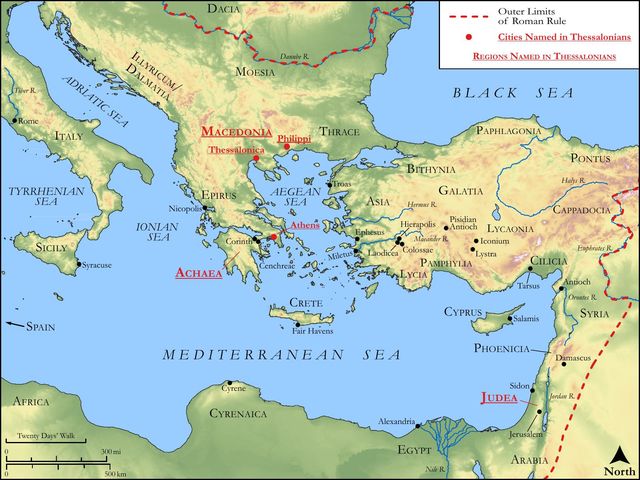
See on the biblical-era map

Study this verse
Public-domain commentary
Matthew Henry
From his Commentary on the Whole Bible. Henry comments on passages, not single verses — this entry covers 2 Thessalonians 3:16–18. His two-level outline is real structure in the source text, so it is rendered as structure.
In this conclusion of the epistle we have the apostle's benediction and prayers for these Thessalonians. Let us desire them for ourselves and our friend. There are three blessings pronounced upon them, or desired for them: -
I.That God would give them peace. Note,
1.Peace is the blessing pronounced or desired. By peace we may understand all manner of prosperity; here it may signify, in particular, peace with God, peace in their own minds and consciences, peace among themselves, and peace with all men.
2.This peace is desired for them always, or in every thing; and he desired they might have all good things at all times.
3.Peace by all means: that, as they enjoyed the means of grace, they might with success use all the means and methods of peace too; for peace is often difficult, as it is always desirable.
4.That God would give them peace, who is the Lord of peace. If we have any peace that is desirable, God must give it, who is the author of peace and lover of concord. We shall neither have peaceable dispositions ourselves nor find men disposed to be at peace with us, unless the God of peace give us both.
II.That the presence of God might be with them:
The Lord be with you all. We need nothing more to make us safe and happy, nor can we desire any thing better for ourselves and our friends, than to have God's gracious presence with us and them. This will be a guide and guard in every way that we may go, and our comfort in every condition we may be in. It is the presence of God that makes heaven to be heaven, and this will make this earth to be like heaven. No matter where we are if God be with us, nor who is absent if God be with us, nor who is absent if God be present with us.
III.That the grace of our Lord Jesus Christ might be with them.
So this apostle concluded his first epistle to these Thessalonians; and it is through the grace of our Lord Jesus Christ that we may comfortably hope to have peace with God and enjoy the presence of God, for he has made those nigh that were afar off. It is this grace that is all in all to make us happy. This is what the apostle admired and magnified on all occasions, what he delighted and trusted in; and by this salutation or benediction, written with his own hand, as the token of every epistle (when the rest was written by an amanuensis), he took care lest the churches he wrote to should be imposed on by counterfeit epistles, which he knew would be of dangerous consequence.
Let us be thankful that we have the canon of scripture complete, and by the wonderful and special care of divine Providence preserved pure and uncorrupt through so many successive ages, and not dare to add to it, nor diminish from it. Let us believe the divine original of the sacred scriptures, and conform our faith and practice to this our sufficient and only rule, which is able to make us wise unto salvation, through faith which is in Christ Jesus. Amen.
Historical interpretation
Historical reception
2 surviving comments on this verse. Each one is dated, so this reads as a timeline rather than a list.
"The salutation of me Paul with mine own hand, which is the token in every Epistle: so I write. The grace of our Lord Jesus Christ be with you all."
This he says that he writes in every Epistle, that no one may be able to counterfeit them, his subscription being subjoined as a great token. And he calls the prayer a salutation, showing that everything they then did was spiritual; even when it was proper to offer salutation, the thing was attended with advantage; and it was prayer, not merely a symbol of friendship. With this he began, and with it he ended, guarding with strong walls what he had said elsewhere, and laying safe foundations, he brought it also to a safe end. "Grace be unto you and peace," he says; and again, "The grace of our Lord Jesus Christ be with you all. Amen." This the Lord also promised, saying to His disciples, "Lo, I am with you alway, even unto the end of the world." But this takes place when we are willing. For He will not be altogether with us, if we place ourselves at a distance. "I will be with you," He says, "always." Let us not therefore drive away grace.
Whence then shall we know them, he says? For this very reason, he added, "The salutation of me Paul with mine own hand, which is the token in every Epistle: so I write. The grace of our Lord Jesus Christ be with you all." He does not here mean, that this is the token,-for it is probable that others also imitated this,-but that I write the salutation with mine own hand, as is the custom also now among us. For by the subscription the writings of those who send letters are made known.
Continue studying 2 Thessalonians 3:18 across the web’s major study libraries — every link below opens this exact verse, chapter, or book on the destination site.
Read & Compare
 BibleGatewayThis verse in more than 200 translations and 70 languages.
 Bible.comThe YouVersion reader — hundreds of translations, reading plans, and highlights.
 ESV.orgCrossway's official English Standard Version reader.
 NET BibleThe NET translation with 60,000+ translators' notes on every rendering decision.
 STEP BibleTyndale House's free study tool — original text, vocabulary, and scholarly resources.
 BibliaLogos Bible Software's free web reader.
 USCCBThe New American Bible (Revised Edition) with the U.S. bishops' study notes.
Commentaries
 BibleHub CommentariesDozens of classic commentaries on this verse, gathered on one page.
 StudyLightMore than 100 commentary sets — the largest collection on the web.
 BibleRefPlain-English commentary on what this verse means, verse by verse.
 Enduring WordDavid Guzik's free commentary on this chapter, widely used by Bible teachers.
 Bible Study ToolsVerse commentary alongside Greek and Hebrew study aids.
Original Language & Research
- BibleHub InterlinearThe verse word by word — original language, transliteration, and English.
- BibleHub LexiconEvery word's original-language definition and Strong's entry.
 Blue Letter BibleDeep-study tools — Strong's numbers, concordance, and word studies.
 CNTR CollationThe earliest Greek manuscripts of this verse, collated letter by letter.
Sermons, Hymns & Audio


TrulyRandomVerse is not affiliated with these sites and doesn’t control their content. They’re linked because they’re genuinely useful.
Summary
The concluding verse of Paul's Second Epistle to the Thessalonians offers a profound and concise benediction: "The grace of our Lord Jesus Christ [be] with you all. Amen." This verse serves as a final, comprehensive blessing, encapsulating the core of Christian faith—God's unmerited favor through Jesus Christ—and invoking its empowering presence upon the entire community of believers, sealing the letter with a solemn affirmation of truth and hope.
Context
ShowHideLiterary Context
This verse stands as the final statement of Paul's second letter to the Thessalonians, immediately following his personal authentication in 2 Thessalonians 3:17. Paul often concluded his epistles with a grace benediction, serving not merely as a farewell but as a theological summation and a final pastoral encouragement. In this specific letter, the benediction follows Paul's instructions regarding prayer, warnings against idleness, and exhortations to perseverance amidst trials. It functions as a comforting and empowering capstone, reminding the recipients that despite their challenges and the necessary disciplinary actions discussed, divine favor is their ultimate source of strength and unity. The "Amen" further solidifies the authoritative and heartfelt nature of this apostolic blessing.
Historical & Cultural Context
The church in Thessalonica faced significant challenges, including ongoing persecution (2 Thessalonians 1:4), misunderstandings about the timing of the Lord's return (2 Thessalonians 2:1-2), and issues of idleness among some members who had ceased working in expectation of Christ's imminent advent (2 Thessalonians 3:6-12). In the Greco-Roman world, letters often concluded with a formal farewell, but Paul's use of a grace benediction was distinctive, elevating it beyond a mere social custom to a theological declaration. This final blessing would have been particularly significant for a community grappling with internal and external pressures, affirming God's active presence and provision in their midst, reinforcing their identity as those sustained by divine favor.
Key Themes
ShowHideThe overarching theme of 2 Thessalonians is perseverance in faith and righteous living in light of Christ's return. This concluding verse powerfully reinforces several key themes. Firstly, it underscores the sufficiency of divine grace as the foundation for all Christian life, both for salvation and for daily endurance. Secondly, it highlights the Lordship of Jesus Christ as the sole mediator and source of this grace, emphasizing His authority and saving work. Thirdly, the phrase "with you all" reinforces the theme of community and unity, ensuring that this blessing extends to every member of the church, fostering solidarity in their shared reliance on God's favor. Finally, the "Amen" serves as an affirmation of truth and a declaration of faith, sealing the letter's message and expressing a fervent desire for the grace of Christ to be fully realized in their lives.
Exposition and Analysis
ShowHideKey Word Analysis
ShowHideThis term (G5485) signifies God's unmerited favor, kindness, and benevolent disposition towards humanity, especially as manifested in Christ's atoning work. It encompasses the divine influence upon the heart and its reflection in a transformed life, including gratitude. In this context, it is not merely a concept but an active, empowering presence that sustains believers through trials and equips them for good works, serving as the foundation of salvation and the power for daily living.
This word (G2962) denotes supreme authority and control, often used as a respectful title for Master. Applied to Jesus, it underscores His divine sovereignty, His position as the ultimate ruler, and His absolute claim over His followers. The grace extended is not generic but flows specifically from the one who holds ultimate power and authority, emphasizing the divine origin and efficacy of the blessing.
Derived from a Hebrew root meaning "firm" or "trustworthy" (G281), "Amen" serves as a solemn affirmation, meaning "so be it," "truly," or "let it be done." In this benediction, it expresses a heartfelt wish for the blessing to be truly manifest in their lives, sealing the truth and authority of Paul's words and signifying a communal assent to the divine favor invoked.
Verse Breakdown
ShowHide"The grace of our Lord Jesus Christ"
This phrase identifies the specific nature and source of the blessing. "Grace" (cháris) is God's unmerited favor, His divine enablement and kindness. It is not earned but freely given. The source is explicitly "our Lord Jesus Christ," emphasizing His unique role as the mediator of this divine favor. All spiritual blessings and the power to live the Christian life flow directly from His person and His finished work on the cross. This highlights Christ's deity, authority, and saving work as the ultimate wellspring of grace.
"[be] with you all"
The implied verb "be" (often supplied in Greek) indicates a wish or prayer for the continuous presence and active working of this grace. The phrase "with you all" signifies the universal application of this blessing to every single member of the Thessalonian church. It is a corporate blessing, promoting unity and assuring each individual, regardless of their specific struggles or roles, of God's personal care and provision through Christ's grace. It encompasses the entire community, leaving no one out.
"Amen."
This concluding word, of Hebrew origin, means "so be it" or "truly." It serves as a solemn affirmation and a fervent prayer that the preceding benediction will indeed come to pass. It seals the letter with an expression of certainty and a heartfelt desire for the grace of Christ to be fully realized in the lives of the Thessalonian believers, underscoring the truth and authority of Paul's apostolic words.
Literary Devices
ShowHideThe verse employs several significant literary devices. Primarily, it functions as a Benediction, a formal blessing or invocation of divine favor, characteristic of Pauline epistles. This serves to impart spiritual encouragement and peace as the letter concludes. It also exemplifies an Apostolic Formula, as Paul frequently ends his letters with similar grace greetings, establishing a consistent pattern of spiritual farewells that emphasize Christ's central role. The phrase "with you all" utilizes Inclusion, explicitly encompassing every member of the community, reinforcing unity and the universal availability of God's grace. Finally, the word "Amen" acts as a powerful Affirmation, a solemn declaration of truth and a heartfelt wish for the blessing to be realized, bringing a definitive and authoritative close to the entire epistle.
Theological and Thematic Connections
ShowHideThe grace invoked in 2 Thessalonians 3:18 is not merely a passive concept but the active, empowering presence of God's unmerited favor, made available through Jesus Christ. This grace is foundational to Christian theology, being the sole basis for salvation (Ephesians 2:8-9) and the sustaining power for daily living, enabling believers to persevere through trials, resist temptation, and perform good works. It underscores the truth that our spiritual strength and ability to navigate life's challenges come from God's undeserved favor, not from human effort or merit. This benediction also reinforces the Lordship of Jesus Christ, affirming Him as the ultimate source and mediator of all divine blessings, tying the entire Christian experience intrinsically to His person and work.
Reflection and Application
ShowHideFor believers today, 2 Thessalonians 3:18 serves as a timeless anchor, reminding us that our ultimate hope and strength are found not in our own abilities or circumstances, but in the boundless, unmerited grace of our Lord Jesus Christ. In a world fraught with anxiety, division, and personal struggles, this verse invites us to rest in the assurance that God's divine favor is actively "with you all," sustaining us through every challenge and equipping us for every good work. It calls us away from self-reliance and towards a profound dependence on Christ, fostering humility and gratitude. Furthermore, the corporate nature of "you all" encourages unity within the church, reminding us that we are all recipients of the same grace, empowering us to extend that grace to one another, just as Christ has extended it to us.
Questions for Reflection
ShowHideFAQ
ShowHideWhat is the significance of "grace" in this verse?
ShowHideThe "grace" (Greek: cháris) in 2 Thessalonians 3:18 is profoundly significant. It refers to God's unmerited favor, kindness, and benevolent disposition towards humanity, which is freely given and not earned. It is the divine influence upon the heart that transforms lives and enables believers to live righteously. This grace is the foundation of salvation (Ephesians 2:8) and the sustaining power for daily Christian living, empowering believers to persevere through trials and fulfill God's purposes. It emphasizes that all spiritual blessings and strength flow from God's generous nature, mediated through Jesus Christ.
Why does Paul conclude his letters with this specific type of blessing?
ShowHidePaul's consistent use of the grace benediction at the close of his epistles (e.g., Romans 16:20, 1 Corinthians 16:23, Galatians 6:18) serves multiple purposes. It is more than a mere farewell; it is a theological summation and a pastoral act. It reminds the recipients that despite the challenges addressed in the letter (theological errors, moral issues, persecution), God's grace in Christ remains their constant source of hope, strength, and peace. It underscores the centrality of Christ in all aspects of the Christian life and reaffirms Paul's apostolic desire for the spiritual well-being of the churches he served. It also acts as a final, authoritative seal on his teachings.
Christ-Centered Fulfillment
ShowHide2 Thessalonians 3:18 finds its ultimate Christ-centered fulfillment in Jesus Himself, who is the very embodiment and source of God's grace. The "grace of our Lord Jesus Christ" is not an abstract concept but a Person. It is through His incarnation, His sinless life, His atoning death on the cross (Romans 5:8), and His glorious resurrection (Romans 4:25) that God's unmerited favor is fully revealed and made accessible to humanity. Jesus is the Mediator of the New Covenant, through whom all spiritual blessings flow (Hebrews 8:6). His finished work provides not only salvation from sin but also the ongoing power to live a life pleasing to God (Titus 2:11-14). This benediction, therefore, is a profound declaration that Christ's presence and His redemptive work are the foundation, sustenance, and ultimate hope for every believer, ensuring that His grace is indeed "with you all" until His glorious return (Philippians 1:6).