


1 Thessalonians 5:25
Bible text: King James Version (1769 Blayney text) · Public domain
Bible text: Berean Standard Bible · Public domain
Bible text: American Standard Version (1901) · Public domain
Bible text: World English Bible, Messianic edition · Public domain
Bible text: Young's Literal Translation · Public domain
- ἈδελφοίAdelphoiBrothersG80N-VPMNoun Vocative Plural Masculine
- προσεύχεσθεproseuchesthedo prayG4336V-PNM-2PVerb Present Middle Or Passive Deponent Imperative 2nd Plural
- περὶperiforG4012PREPPreposition
- ἡμῶνhēmōnusG3165P-1GPPersonal pronoun Genitive 1st Plural
English is a literal word-by-word gloss of the Greek, not the KJV's wording. Why?
This is the original text the KJV's translators worked from — each Greek word with its own literal English meaning in this verse, prepared by scholars at Tyndale House, Cambridge. The KJV translates whole sentences, not word by word, so its wording differs: one Greek word can become several English words, and the KJV may choose “charity” where the gloss reads “love”. Both are faithful — they answer different questions. For the KJV's own rendering, switch to the KJV text.
Details
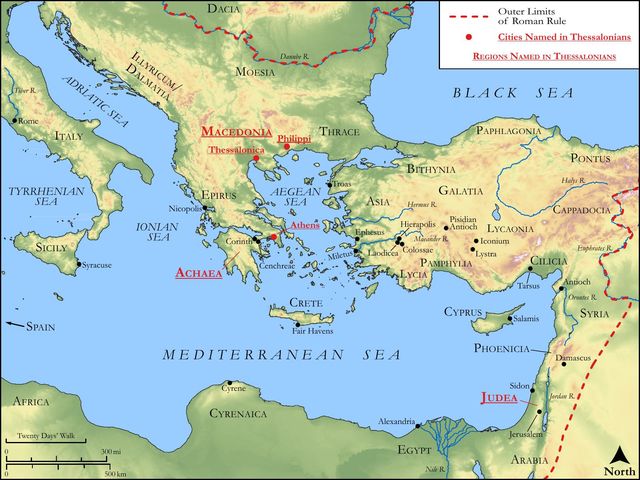
See on the biblical-era maps

Study this verse
Public-domain commentary
Matthew Henry
From his Commentary on the Whole Bible. Henry comments on passages, not single verses — this entry covers 1 Thessalonians 5:23–28. His two-level outline is real structure in the source text, so it is rendered as structure.
In these words, which conclude this epistle, observe,
I.Paul's prayer for them, Th1 5:23.
He had told them, in the beginning of this epistle, that he always made mention of them in his prayers; and, now that he is writing to them, he lifts up his heart to God in prayer for them. Take notice,
1.To whom the apostle prays, namely, The very God of peace. He is the God of grace, and the God of peace and love. He is the author of peace and lover of concord; and by their peaceableness and unity, from God as the author, those things would best be obtained which he prays for.
2.The things he prays for on behalf of the Thessalonians are their sanctification, that God would sanctify them wholly; and their preservation, that they might be preserved blameless. He prays that they may be wholly sanctified, that the whole man may be sanctified, and then that the whole man, spirit, soul, and body, may be preserved: or, he prays that they may be wholly sanctified, that is, more perfectly, for the best are sanctified but in part while in this world; and therefore we should pray for and press towards complete sanctification. Where the good work of grace is begun, it shall be carried on, be protected and preserved; and all those who are sanctified in Christ Jesus shall be preserved to the coming of our Lord Jesus Christ. And because, if God did not carry on his good work in the soul, it would miscarry, we should pray to God to perfect his work, and preserve us blameless, free from sin and impurity, till at length we are presented faultless before the throne of his glory with exceeding joy.
II.His comfortable assurance that God would hear his prayer:
Faithful is he who calleth you, who will also do it, Th1 5:24. The kindness and love of God had appeared to them in calling them to the knowledge of his truth, and the faithfulness of God was their security that they should persevere to the end; and therefore, the apostle assures them, God would do what he desired; he would effect what he had promised; he would accomplish all the good pleasure of his goodness towards them. Note, Our fidelity to God depends upon his faithfulness to us.
III.His request of their prayers:
Brethren, pray for us, Th1 5:25. We should pray for one another; and brethren should thus express brotherly love. This great apostle did not think it beneath him to call the Thessalonians brethren, nor to request their prayers. Ministers stand in need of their people's prayers; and the more people pray for their ministers the more good ministers may have from God, and the more benefit people may receive by their ministry.
IV.His salutation:
Greet all the brethren with a holy kiss, Th1 5:26. Thus the apostle sends a friendly salutation from himself, and Silvanus, and Timotheus, and would have them salute each other in their names; and thus he would have them signify their mutual love and affection to one another by the kiss of charity (Pe1 5:14), which is here called a holy kiss, to intimate how cautious they should be of all impurity in the use of this ceremony, then commonly practised; as it should not be a treacherous kiss like that of Judas, so not a lascivious kiss like that of the harlot, Pro 7:13.
V.His solemn charge for the reading of this epistle, Th1 5:27.
This is not only an exhortation, but an adjuration by the Lord. And this epistle was to be read to all the holy brethren. It is not only allowed to the common people to read the scriptures, and what none should prohibit, but it is their indispensable duty, and what they should be persuaded to do. In order to this, these holy oracles should not be kept concealed in an unknown tongue, but translated into the vulgar languages, that all men, being concerned to know the scriptures, may be able to read them, and be acquainted with them. The public reading of the law was one part of the worship of the sabbath among the Jews in their synagogues, and the scriptures should be read in the public assemblies of Christians also.
VI.The apostolical benediction that is usual in other epistles:
The grace of our Lord Jesus Christ be with you. Amen, Th1 5:28. We need no more to make us happy than to know that grace which our Lord Jesus Christ has manifested, be interested in that grace which he has purchased, and partake of that grace which dwells in him as the head of the church. This is an ever-flowing and overflowing fountain of grace to supply all our wants.
Historical interpretation
Historical reception
1 surviving comment on this verse from the historical church.
"Brethren, pray for us also."
Strange! what humility is here! But he indeed said this for the sake of humility, but we, not from humility, but for the sake of great benefit, and wishing to gain some great profit from you, say, "Pray for us also." For although you do not receive any great or wonderful benefit from us, do it nevertheless for the sake of the honor and the title itself. Some one has had children, and even if they had not been benefited by him, nevertheless, because he has been their father, he perhaps sets this before them, saying, "For one day I have not been called father by thee." On this account we too say, "Pray for us also." I am not merely saying this, but really desiring your prayers. For if I have become responsible for this presidency over you all, and shall have to render an account, much more ought I to have the benefit of your prayers. On your account my responsibilities are greater, therefore the help also from you should be greater.
Continue studying 1 Thessalonians 5:25 across the web’s major study libraries — every link below opens this exact verse, chapter, or book on the destination site.
Read & Compare
 BibleGatewayThis verse in more than 200 translations and 70 languages.
 Bible.comThe YouVersion reader — hundreds of translations, reading plans, and highlights.
 ESV.orgCrossway's official English Standard Version reader.
 NET BibleThe NET translation with 60,000+ translators' notes on every rendering decision.
 STEP BibleTyndale House's free study tool — original text, vocabulary, and scholarly resources.
 BibliaLogos Bible Software's free web reader.
 USCCBThe New American Bible (Revised Edition) with the U.S. bishops' study notes.
Commentaries
 BibleHub CommentariesDozens of classic commentaries on this verse, gathered on one page.
 StudyLightMore than 100 commentary sets — the largest collection on the web.
 BibleRefPlain-English commentary on what this verse means, verse by verse.
 Enduring WordDavid Guzik's free commentary on this chapter, widely used by Bible teachers.
 Bible Study ToolsVerse commentary alongside Greek and Hebrew study aids.
Original Language & Research
- BibleHub InterlinearThe verse word by word — original language, transliteration, and English.
- BibleHub LexiconEvery word's original-language definition and Strong's entry.
 Blue Letter BibleDeep-study tools — Strong's numbers, concordance, and word studies.
 CNTR CollationThe earliest Greek manuscripts of this verse, collated letter by letter.
Sermons, Hymns & Audio


TrulyRandomVerse is not affiliated with these sites and doesn’t control their content. They’re linked because they’re genuinely useful.
Summary
1 Thessalonians 5:25 is a concise yet profound request from the Apostle Paul, Silas, and Timothy to the believers in Thessalonica: "Brethren, pray for us." This brief exhortation powerfully underscores the essential role of intercessory prayer within the Christian community, highlighting the mutual dependence of believers and the humble reliance of spiritual leaders on the fervent prayers of those they serve for the advancement of the gospel and their personal endurance in ministry.
Context
ShowHideLiterary Context
This verse appears at the very end of Paul's first letter to the Thessalonians, nestled within the concluding practical exhortations and greetings of chapter 5. The preceding verses contain a series of general commands for Christian living, including the famous calls to "rejoice evermore," "pray without ceasing," and "in every thing give thanks" (1 Thessalonians 5:16-18). Following these broad instructions on prayer, Paul makes a specific, personal appeal for himself and his companions, demonstrating that even apostles, despite their unique spiritual authority and divine commission, deeply valued and actively sought the prayers of the church. This request immediately precedes final greetings, a charge to read the letter, and a benediction, underscoring its significance as a parting appeal that encapsulates the spirit of mutual support.
Historical & Cultural Context
The letter to the Thessalonians was likely one of Paul's earliest epistles, written around AD 50-51, shortly after his forced departure from Thessalonica due to persecution (Acts 17:1-10). The Thessalonian church was relatively young, composed of both Jewish and Gentile converts, and faced ongoing opposition. Paul, Silas, and Timothy were pioneering missionaries establishing new churches. In that day, patronage and reciprocal relationships were vital. Within the nascent Christian community, this translated into spiritual interdependence. Leaders like Paul were not seen as self-sufficient but as part of a larger body, dependent on divine power channeled through the prayers of the saints. Paul's request for prayer was not a sign of weakness but a reflection of a deeply held conviction that God works through the prayers of His people, a common theme in his epistles as seen in his requests to the Ephesians (Ephesians 6:19-20) and Colossians (Colossians 4:3).
Key Themes
ShowHide1 Thessalonians 5:25 contributes significantly to several key themes within the letter and Paul's broader theology. Firstly, it powerfully emphasizes the Power and Necessity of Intercessory Prayer. Paul's direct plea underscores the belief that prayer is not merely a spiritual exercise but an active means of support, spiritual warfare, and a vital component for the success and advancement of their ministry. Secondly, the address "Brethren" highlights the theme of Mutual Support and Christian Fellowship (Koinonia). It reinforces the familial bond within the Christian community and the mutual responsibility believers have to uphold and support one another, especially those engaged in spiritual leadership. This concept of interdependence within the body of Christ is foundational to Christian fellowship. Lastly, the verse showcases Humility in Leadership. Paul, a divinely appointed apostle, did not consider himself self-sufficient or above the need for prayer. His consistent pleas for prayer throughout his letters, such as in 2 Thessalonians 3:1-2, reveal a profound humility and a recognition that his ministry required divine empowerment, often channeled through the prayers of the saints.
Exposition and Analysis
ShowHideKey Word Analysis
ShowHideDerived from a word signifying a shared womb, this term literally means "brother" but is used here in a spiritual sense to denote fellow believers. Paul's use of "brethren" (ἀδελφοί) is a warm, familial address that emphasizes the deep spiritual kinship and solidarity within the Christian community. It highlights the shared identity and mutual responsibility that believers have towards one another, setting the tone for a request made within a trusted, loving family.
This verb (προσεύχεσθε) is the most common and significant term for prayer directed to God in the New Testament. It signifies an act of worship, supplication, or devotion, implying a direct and earnest communication with the divine. The imperative mood of the verb indicates a command or a strong exhortation, underscoring the importance and urgency of the action requested. It is not merely a suggestion but a vital spiritual act.
The preposition perí (περὶ) here means "concerning" or "on behalf of," indicating the object or beneficiary of the prayer. The pronoun hēmōn (ἡμῶν) is the genitive plural of "we," referring to Paul, Silas, and Timothy, the authors of the letter. This phrase specifies the recipients of the intercession, making the request highly personal and direct. It signifies that the Thessalonians' prayers are to be specifically directed towards the well-being, protection, and effectiveness of the apostolic team's ministry.
Verse Breakdown
ShowHide"Brethren,"
This opening word establishes the intimate and familial relationship between the apostles and the Thessalonian believers. It is a term of endearment and solidarity, reminding them of their shared identity in Christ and the mutual bond that undergirds the request that follows. It sets a tone of trust and shared purpose, appealing to their spiritual kinship.
"pray for us."
This is the direct and earnest request. The verb "pray" is in the imperative, indicating a command or strong exhortation, emphasizing the necessity and importance of the action. The phrase "for us" clearly identifies the recipients of this intercession as Paul, Silas, and Timothy, highlighting their dependence on the spiritual support of the church for their ministry and personal well-being. It is a humble admission of need and a call to active participation in the apostolic mission through prayer.
Literary Devices
ShowHideThe verse 1 Thessalonians 5:25 employs several effective literary devices. The most prominent is Direct Address, utilizing the vocative "Brethren" (ἀδελφοί), which immediately establishes a warm, familial tone and personal connection with the recipients. This fosters a sense of intimacy and shared community, making the subsequent request more impactful and less like a mere command. The use of the Imperative Mood in "pray" (προσεύχεσθε) conveys urgency and importance, transforming the request into a solemn exhortation or even a gentle command, underscoring the vital nature of intercessory prayer. Furthermore, the verse demonstrates remarkable Conciseness and Brevity. Its short, direct nature makes it memorable and impactful, delivering a profound theological and practical message without unnecessary elaboration. This brevity lends it a sense of earnestness and sincerity, reflecting the genuine need of the apostles. Finally, there is an element of Pathos, as the request evokes empathy and a sense of shared vulnerability, inviting the Thessalonians to participate actively in the spiritual struggles and triumphs of their leaders through prayer.
Theological and Thematic Connections
ShowHideThe simple request in 1 Thessalonians 5:25 resonates deeply with the biblical emphasis on the communal nature of faith and the efficacy of prayer. It underscores the theological truth that the Christian life is not lived in isolation, but within a body where members are interdependent and responsible for one another's spiritual well-being and ministry effectiveness. Paul's consistent appeals for prayer throughout his epistles reveal a profound understanding that divine power is often channeled through the intercession of the saints, and that spiritual battles are won not by human might alone, but by God's intervention in response to His people's prayers. This verse serves as a timeless reminder that even the most spiritually mature and divinely appointed leaders remain reliant on the prayerful support of the church, embodying humility and fostering unity in the shared mission of the gospel.
Reflection and Application
ShowHide1 Thessalonians 5:25 offers a timeless and powerful call to action for believers today. Just as Paul, Silas, and Timothy, despite their apostolic authority and divine commission, humbly recognized their need for the Thessalonians' prayers, so too do spiritual leaders in every generation require the fervent intercession of the church. This verse challenges us to move beyond self-centered prayer to embrace a robust culture of intercessory prayer, actively upholding pastors, missionaries, teachers, elders, and all who serve in ministry. It reminds us that our prayers are not merely passive wishes but active participation in God's work, providing spiritual strength, protection, and open doors for the gospel. Furthermore, it fosters a spirit of humility within leadership, encouraging those in authority to openly acknowledge their dependence on God and their congregants, thereby building stronger bonds of unity and shared ownership in the kingdom's advancement.
Questions for Reflection
ShowHideFAQ
ShowHideWhy would an apostle like Paul, who performed miracles and wrote Scripture, need prayer from ordinary believers?
ShowHidePaul's need for prayer, as expressed in 1 Thessalonians 5:25 and numerous other epistles (e.g., Romans 15:30-32), demonstrates several profound theological truths. Firstly, it highlights his profound humility and dependence on God; he never viewed himself as self-sufficient. Secondly, it underscores the reality of spiritual warfare; Paul faced constant opposition, both physical and spiritual, and recognized that prayer was a vital weapon. Thirdly, it emphasizes the interdependence of the body of Christ; God designed the church to function as a unified organism where members support one another, and leaders are not exempt from this mutual reliance. Finally, it teaches that God often chooses to work through the prayers of His people, making believers active participants in His divine plan, even for the most gifted servants.
Is this verse a command or a humble request?
ShowHideGrammatically, the Greek verb "pray" (προσεύχεσθε, proseúchesthe) is in the imperative mood, which typically denotes a command. However, in the context of Paul's letters and his relationship with the Thessalonians, it functions as a deeply earnest and humble exhortation or request. While carrying the weight of apostolic authority, it is framed within a familial address ("Brethren") and reflects a genuine need rather than a forceful decree. It is a plea for spiritual partnership, inviting the believers to participate actively in the ministry through their intercession, thereby underscoring the vital importance of the act of praying for those in leadership. It's a command born out of love and necessity, not out of authoritarianism.
Christ-Centered Fulfillment
ShowHideWhile 1 Thessalonians 5:25 is a direct request from Paul, it finds its ultimate fulfillment and pattern in the person and work of Jesus Christ. Paul's humble reliance on the prayers of the church mirrors Christ's own profound dependence on His Father during His earthly ministry. Jesus, though fully God, consistently withdrew to pray (Luke 5:16, Mark 1:35), demonstrating that even the Son of God operated in perfect submission and reliance upon the Father's will and power. Moreover, Christ Himself is the ultimate Intercessor for His church. Just as Paul asked the Thessalonians to pray for him, Jesus continually intercedes for His disciples before the Father (John 17:9-26, Hebrews 7:25, Romans 8:34). Paul's request, therefore, is not merely a human plea but a participation in the divine pattern of intercession established by Christ, inviting believers to join in the ongoing work of the kingdom through prayer, empowered by the Spirit, and modeled after the very heart of their Savior.