


2 Thessalonians 3:1
Bible text: King James Version (1769 Blayney text) · Public domain
Bible text: Berean Standard Bible · Public domain
Bible text: American Standard Version (1901) · Public domain
Bible text: World English Bible, Messianic edition · Public domain
Bible text: Geneva Bible (1599) · Public domain
Bible text: Young's Literal Translation · Public domain
- ΤὸTo<the>G3588T-ASNDefinite article Accusative Singular Neuter
- λοιπόνloiponFinallyG3063A-ASNAdjective Accusative Singular Neuter
- προσεύχεσθεproseuchesthedo prayG4336V-PNM-2PVerb Present Middle Or Passive Deponent Imperative 2nd Plural
- ἀδελφοίadelphoibrothersG80N-VPMNoun Vocative Plural Masculine
- περὶperiforG4012PREPPreposition
- ἡμῶνhēmōnusG3165P-1GPPersonal pronoun Genitive 1st Plural
- ἵναinathatG2443CONJConjunction
- ὁhotheG3588T-NSMDefinite article Nominative Singular Masculine
- λόγοςlogoswordG3056N-NSMNoun Nominative Singular Masculine
- τοῦtouof theG3588T-GSMDefinite article Genitive Singular Masculine
- κυρίουkuriouLordG2962N-GSM-TNoun Genitive Singular Masculine Title
- τρέχῃtrechēmay spread quicklyG5143V-PAS-3SVerb Present Active Subjunctive 3rd Singular
- καὶkaiandG2532CONJConjunction
- δοξάζηταιdoxazētaimay be glorifiedG1392V-PPS-3SVerb Present Passive Subjunctive 3rd Singular
- καθὼςkathōseven asG2531CONJConjunction
- καὶkaialsoG2532CONJConjunction
- πρὸςproswithG4314PREPPreposition
- ὑμᾶςhumasyouG4771P-2APPersonal pronoun Accusative 2nd Plural
English is a literal word-by-word gloss of the Greek, not the KJV's wording. Why?
This is the original text the KJV's translators worked from — each Greek word with its own literal English meaning in this verse, prepared by scholars at Tyndale House, Cambridge. The KJV translates whole sentences, not word by word, so its wording differs: one Greek word can become several English words, and the KJV may choose “charity” where the gloss reads “love”. Both are faithful — they answer different questions. For the KJV's own rendering, switch to the KJV text.
Details
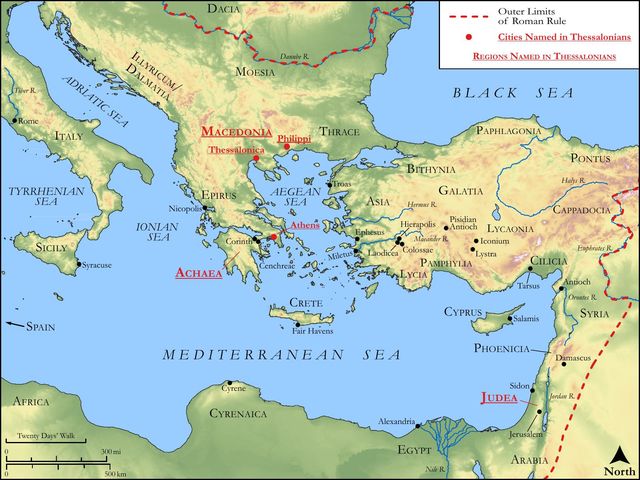
See on the biblical-era maps

Study this verse
Public-domain commentary
Matthew Henry
From his Commentary on the Whole Bible. Henry comments on passages, not single verses — this entry covers 2 Thessalonians 3:1–5. His three-level outline is real structure in the source text, so it is rendered as structure.
In these words observe,
I.The apostle desires the prayers of his friends:
Finally, brethren, pray for us, Th2 3:1. He always remembered them in his prayers, and would not have them forget him and his fellow-labourers, but bear them on their hearts at the throne of grace. Note,
1.This is one way by which the communion of saints is kept us, not only by their praying together, or with one another, but by their praying for one another when they are absent one from another. And thus those who are at great distance may meet together at the throne of grace; and thus those who are not capable of doing or receiving any other kindness may yet this way do and receive real and very great kindness.
2.It is the duty of people to pray for their ministers; and not only for their own pastors, but also for all good and faithful ministers. And,
3.Ministers need, and therefore should desire, the prayers of their people. How remarkable is the humility, and how engaging the example, of this great apostle, who was so mighty in prayer himself, and yet despised not the prayers of the meanest Christian, but desired an interest in them. Observe, further, what they are desired and directed to pray for; namely,
(1.)For the success of the gospel ministry: That the word of the Lord may have free course, and be glorified, Th2 3:1. This was the great thing that Paul was most solicitous about. He was more solicitous that God's name might be sanctified, his kingdom advanced, and his will done, than he was about his own daily bread. He desired that the word of the Lord might run (so it is in the original), that it might get ground, that the interest of religion in the world might go forward and not backward, and not only go forward, but go apace. All the forces of hell were then, and still are, more or less, raised and mustered to oppose the word of the Lord, to hinder its publication and success. We should pray, therefore, that oppositions may be removed, that so the gospel, may have free course to the ears, the hearts, and the consciences of men, that it may be glorified in the conviction and conversion of sinners, the confutation, of gainsayers, and the holy conversation of the saints. God, who magnified the law, and made it honourable, will glorify the gospel, and make that honourable, and so will glorify his own name; and good ministers and good Christians may very well be contented to be little, to be any thing, to be nothing, if Christ be magnified and his gospel be glorified. Paul was now at Athens, or, as some think, at Corinth, and would have the Thessalonians pray that he might have as good success there as he had at Thessalonica, that it might be as well with others even as it was with them. Note, If ministers have been successful in one place, they should desire to be successful in every place where they may preach the gospel.
(2.)For the safety of gospel ministers. He asks their prayers, nor for preferment, but for preservation: That we may be delivered from unreasonable and wicked men, Th2 3:2. Note, Those who are enemies to the preaching of the gospel, and persecutors of the faithful preachers of it, are unreasonable and wicked men. They act against all the rules and laws of reason and religion, and are guilty of the greatest absurdity and impiety. Not only in the principles of atheism and infidelity, but also in the practice of the vice and immorality, and especially in persecution, there is the greatest absurdity in the world, as well as impiety. There is need of the spiritual protection, as well as the assistance, of godly and faithful ministers, for these are as the standard-bearers, who are most struck at; and therefore all who wish well to the interest of Christ in the world should pray for them. For all men have not faith; that is, many do not believe the gospel; they will not embrace it themselves, and no wonder if such are restless and malicious in their endeavours to oppose the gospel, decry the ministry, and disgrace the ministers of the word; and too many have not common faith or honesty; there is no confidence that we can safely put in them, and we should pray to be delivered from those who have no conscience nor honour, who never regard what they say or do. We may sometimes be in as much or more danger from false and pretended friends as from open and avowed enemies.
II.He encourages them to trust in God.
We should not only pray to God for his grace, but also place our trust and confidence in his grace, and humbly expect what we pray for. Observe,
1.What the good is which we may expect from the grace of God - establishment, and preservation from evil; and the best Christians stand in need of these benefits.
(1.)That God would establish them. This the apostle had prayed for on their behalf (Th2 2:17), and now he encourages them to expect this favour. We stand no longer than God holds us up; unless he hold up our goings in his paths, our feet will slide, and we shall fall.
(2.)That God will keep them from evil. We have as much need of the grace of God for our perseverance to the end as for the beginning of the good work. The evil of sin is the greatest evil, but there are other evils which God will also preserve his saints from - the evil that is in the world, yea, from all evil, to his heavenly kingdom.
2.What encouragement we have to depend upon the grace of God: The Lord is faithful. He is faithful to his promises, and is the Lord who cannot lie, who will not alter the thing that has gone out of his mouth. When once the promise therefore is made, performance is sure and certain. He is faithful to his relation, a faithful God and a faithful friend; we may depend upon his filling up all the relations he stands in to his people. Let it be our care to be true and faithful in our promises, and to the relations we stand in to this faithful God. He adds,
3.A further ground of hope that God would do this for them, seeing they did and would do the things they were commanded, Th2 3:4. The apostle had this confidence in them, and this was founded upon his confidence in God; for there is otherwise no confidence in man. Their obedience is described by doing what he and his fellow-labourers had commanded them, which was no other thing than the commandments of the Lord; for the apostles themselves had no further commission than to teach men to observe and to do what the Lord had commanded, Mat 28:20. And as the experience the apostle had of their obedience for the time past was one ground of his confidence that they would do the things commanded them for the time to come, so this is one ground to hope that whatsoever we ask of God we shall receive of him, because we keep his commandments, and do those things that are pleasing in his sight, Jo1 3:22.
III.He makes a short prayer for them, Th2 3:5.
It is a prayer for spiritual blessings. Two things of the greatest importance the apostle prays for: - 1. That their hearts may be brought into the love of God, to be in love with God as the most excellent and amiable Being, the best of all beings; and this is not only most reasonable and necessary in order to our happiness, but is our happiness itself; it is a great part of the happiness of heaven itself, where this love shall be made perfect. We can never attain to this unless God by his grace direct our hearts aright, for our love is apt to go astray after other things. Note, We sustain a great deal of damage by misplacing our affections; it is our sin and our misery that we place our affections upon wrong objects. If God directs our love aright upon himself, the rest of the affections will thereby be rectified. 2. That a patient waiting for Christ may be joined with this love of God. There is no true love of God without faith in Jesus Christ. We must wait for Christ, which supposes our faith in him, that we believe he came once in flesh and will come again in glory: and we must expect this second coming of Christ, and be careful to get ready for it; there must be a patient waiting, enduring with courage and constancy all that we may meet with in the mean time: and we have need of patience, and need of divine grace to exercise Christian patience, the patience of Christ (as some read the word), patience for Christ's sake and after Christ's example.
Historical interpretation
Seven Centuries of Reception
9 surviving comments on this verse. Each one is dated, so this reads as a timeline rather than a list.
Select a marker to jump to its quote. Markers stagger vertically where authors wrote within a few decades of each other.
"Knowledge is not in all," says the apostle. "And pray that we may be delivered from unreasonable and wicked men: for all men have not faith."
"Finally, brethren, pray for us, that the word of the Lord may have free course, and be glorified, even as it is with you, and that we may be delivered from unreasonable and wicked men: for all men have not faith. But the Lord is faithful, who shall stablish you, and keep you from evil."
Indeed, there is good wisdom, but sweet mercy. Few attain the former, while the latter reaches everyone. Because of this, he says, souls renewed by the spirit love you. Hence, it is also said to the soul: Your youth will be renewed like the eagle's. For he was speaking to the soul, saying: Bless the Lord, O my soul. And therefore it hurries to the Word, and asks to be drawn, lest it be left behind; for the Word of God runs and is not hindered.
"Finally, brethren, pray for us, that the word of the Lord may run and be glorified, even as also it is with you."
He indeed had prayed for them, that they might be stablished; and now he asks of them, entreating them to pray for him, not that he may not incur danger, for to this he was appointed, but that "the word of the Lord may run and be glorified, even as also it is with you." And the request is accompanied with commendation. "Even as also it is with you."
He also says to the Thessalonians, “For the rest, brothers, pray for us that the word of the Lord may run and may be glorified even as among you; that we may be delivered from troublesome and evil men, for not all men have faith.” How else could the word of God run and be glorified except by the conversion to the faith of those to whom it is preached, when Paul says to present believers, “Even as among you”? Surely he knows that this is accomplished by him to whom he wishes prayer to be made that this may be so, and also that he may be delivered through their prayers from troublesome and evil men. It is for this reason that he adds, “For not all men have faith,” as if to say, “The word of God will not be glorified among all, even though you are praying” because those who were likely to believe were the ones “who were ordained to life everlasting,” predestined “to the adoption of children through Jesus Christ to himself” and chosen “in him before the foundation of the world.” No one is so unlearned, so carnal, so slow of wit as not to see that God does what he commands us to ask him to do.
With this in mind, dearly beloved, let us always look forward with longing toward our everlasting joy. Let us always pray for fortitude in our temporal labors and trials. Let us offer prayers for one another. Let my prayers be offered for you, and yours for me. And, brothers, do not think that you need my prayers, but that I have no need of yours. We have mutual need of one another’s prayers, for those reciprocal prayers are enkindled by charity and—like a sacrifice offered on the altar of piety—are fragrant and pleasing to the Lord. If the apostles used to ask for prayers on their own behalf, how much more does it behoove me to do so? For I am far from being their equal, although I long to follow their footsteps as closely as possible. But I have neither the wisdom to know nor the rashness to say what progress I have made.
Through the operation of these millstones—the new and the old covenants—the holy church, then, acts with unceasing care so as to draw out the fine flour of a clean heart from hidden thoughts, once the roughness of sins has been scattered, and to produce spiritual food from their kernels when they have been cleansed by the heavenly commandments. The apostle Paul says about this food, “I gave you milk to drink, not food,” and again, “Solid food is for the perfect, who have their faculties trained by habit,” and so forth. Purifying our hearts from all that is human, the faithful soul strives to offer God as it were the finest wheat, as holy David says, “A broken spirit is a sacrifice to God.” The gospel rushes forward with such speed, however, that only the wise know of its movement. About this speed the blessed Paul says with understanding, “May the word of God speed on and be made glorious in us.” But in the eyes of the foolish the gospel seems to stand still, I say, because they neglect its commands, for they do not believe that what has been written will come to pass.
Just as it is expedient for us to implore God’s mercy for the salvation of your souls, so you ought to pour forth prayers to the Lord on our behalf. We should not consider the apostle’s actions inappropriate. To so great an extent did he long to be commended to God through prayer that he himself implored the people and said, “Pray for us.” Therefore we ought to say what can both encourage ourselves and instruct you. Just as we must reflect with great fear and anxiety on how we may fulfill the office of bishop without reproach, so you should observe that you ought to strive to practice humble obedience in everything that has been commanded you. So let us pray, dearly beloved, that my episcopacy may be profitable for both you and me.
Concerning other things, brothers, pray for us
In this act of humility he leaves us an example.
so that the Word of God may advance
That is, be completed and become acceptable.
and be glorified, just as it is among you
As if he were to say, because I cannot prevail with my eloquence and merits, pray that the word of the Lord may be glorified at least by your prayers. To such a degree the word of the Lord was glorified among them, that they might show that they understood their teaching was God's.
Continue studying 2 Thessalonians 3:1 across the web’s major study libraries — every link below opens this exact verse, chapter, or book on the destination site.
Read & Compare
 BibleGatewayThis verse in more than 200 translations and 70 languages.
 Bible.comThe YouVersion reader — hundreds of translations, reading plans, and highlights.
 ESV.orgCrossway's official English Standard Version reader.
 NET BibleThe NET translation with 60,000+ translators' notes on every rendering decision.
 STEP BibleTyndale House's free study tool — original text, vocabulary, and scholarly resources.
 BibliaLogos Bible Software's free web reader.
 USCCBThe New American Bible (Revised Edition) with the U.S. bishops' study notes.
Commentaries
 BibleHub CommentariesDozens of classic commentaries on this verse, gathered on one page.
 StudyLightMore than 100 commentary sets — the largest collection on the web.
 BibleRefPlain-English commentary on what this verse means, verse by verse.
 Enduring WordDavid Guzik's free commentary on this chapter, widely used by Bible teachers.
 Bible Study ToolsVerse commentary alongside Greek and Hebrew study aids.
Original Language & Research
- BibleHub InterlinearThe verse word by word — original language, transliteration, and English.
- BibleHub LexiconEvery word's original-language definition and Strong's entry.
 Blue Letter BibleDeep-study tools — Strong's numbers, concordance, and word studies.
 CNTR CollationThe earliest Greek manuscripts of this verse, collated letter by letter.
Sermons, Hymns & Audio


TrulyRandomVerse is not affiliated with these sites and doesn’t control their content. They’re linked because they’re genuinely useful.
Summary
In this opening verse of the final section of his second letter to the Thessalonians, the Apostle Paul, along with Silvanus and Timothy, humbly requests the prayers of the believers. This appeal is not for their personal comfort or safety, but specifically that the gospel message—referred to as "the word of the Lord"—would advance rapidly and unhindered, and that it would be honored and recognized for its divine power, just as it had been among the Thessalonians themselves. This request underscores the essential role of intercessory prayer in the expansion and effectiveness of God's kingdom work.
Context
ShowHideLiterary Context
This verse marks a significant transition in Paul's second letter to the Thessalonians. Having addressed eschatological concerns (the Day of the Lord in 2 Thessalonians 2) and exhorted believers to avoid idleness and to pursue diligent work (in 2 Thessalonians 3:6-15), Paul now shifts to a more personal and practical appeal. It is characteristic of Paul's letters to conclude with personal greetings, exhortations, and prayer requests, inviting his readers into partnership in his ministry. This request for prayer for the gospel's progress is a common theme in his epistles, demonstrating his consistent reliance on the intercession of the churches for the effectiveness of his apostolic mission.
Historical & Cultural Context
Paul's ministry was characterized by constant travel, preaching, and establishing churches, often amidst significant opposition and hardship. In Thessalonica itself, Paul and his companions faced immediate and violent opposition from hostile Jewish leaders, forcing them to leave prematurely (as recounted in Acts 17:1-9). This historical reality underscores the practical need for divine intervention to clear paths for the gospel. Furthermore, the early Christian community understood prayer not merely as a private devotion but as a powerful, communal act of spiritual warfare and support for those on the front lines of evangelism. Paul's request aligns with the ancient practice of patrons and clients, where the church, as clients, would support their apostolic patron through prayer, a vital form of spiritual aid.
Key Themes
ShowHideThis verse contributes to several overarching themes within 2 Thessalonians and Paul's broader theology. Firstly, it highlights the supremacy and power of the "word of the Lord," emphasizing its dynamic, living nature, capable of overcoming obstacles and transforming lives. Secondly, it reinforces the vital role of intercessory prayer as a means by which believers participate in God's mission, acknowledging that the success of the gospel is ultimately God's work, but often facilitated through human supplication. Thirdly, the phrase "even as it is with you" speaks to the theme of mutual partnership and encouragement within the body of Christ, reminding the Thessalonians of their own positive reception of the gospel (as noted in 1 Thessalonians 1:5-6 and 1 Thessalonians 2:13), thereby motivating them to pray for similar success elsewhere.
Exposition and Analysis
ShowHideKey Word Analysis
ShowHideThis verb literally means "to run" or "to walk hastily." In this context, it conveys a vivid image of the gospel message moving swiftly, unimpeded, and dynamically, like a runner on a clear track. Paul is praying for the unhindered and rapid propagation of the "word of the Lord," desiring that it would not be slowed down by opposition, misunderstanding, or apathy, but would instead "run its course" with power and speed.
Derived from dóxa (glory), this verb means "to render (or esteem) glorious," "to honor," "to magnify." When applied to the "word of the Lord," it signifies that the gospel message would be recognized, respected, and highly esteemed for its inherent divine truth and power. It implies that the word would be received with faith, leading to transformed lives that bear witness to its divine origin, thereby bringing honor and praise to God.
This term encompasses not just spoken words but also the underlying thought, reason, and divine expression. In "the word of the Lord," it refers to the gospel message—the authoritative, life-giving message about Jesus Christ, His saving work, and the kingdom of God.
This term denotes supreme authority and mastery, here referring to God, specifically Jesus Christ, as the ultimate source and subject of this divine message. Paul is praying for the effective spread and honoring of the very message that originates from and reveals the sovereign God.
Verse Breakdown
ShowHide"Finally, brethren, pray for us,"
Paul initiates a concluding appeal, characteristic of his letters, addressing the Thessalonian believers as "brethren," emphasizing their familial bond in Christ. His request for prayer is a humble acknowledgment of his dependence on God and the spiritual support of the church, demonstrating that even apostles rely on intercession.
"that the word of the Lord may have free course,"
This is the primary object of Paul's prayer request. He desires that the gospel message, the authoritative "word of the Lord," would "run" or "have free course." This vivid imagery implies an unhindered, rapid, and effective spread of the gospel, free from obstacles, opposition, or any spiritual or practical impediment that might slow its progress.
"and be glorified,"
The second, complementary purpose of the prayer is that the word would be "glorified." This means that the gospel message would be honored, esteemed, and recognized for its divine power and truth. It implies that people would respond to it with faith, obedience, and transformed lives, thereby bringing glory to God through the word's evident impact.
"even as it is with you:"
Paul concludes by providing a powerful example and encouragement. He reminds the Thessalonians that the "word of the Lord" had already had "free course" and been "glorified" among them. Their own conversion and spiritual growth served as living proof of the gospel's power, providing a basis for their fervent prayers for its continued success elsewhere. This phrase also fosters a sense of shared mission and partnership.
Literary Devices
ShowHidePaul masterfully employs several literary devices in this concise verse. The most prominent is Imagery, specifically a Metaphor, where "the word of the Lord" is depicted as a runner on a track. The phrase "may have free course" (Greek: trechō) vividly portrays the gospel as a dynamic, active force that Paul desires to see running swiftly and unimpeded across the world. This creates a sense of urgency and power. There is also a subtle Parallelism between "have free course" and "be glorified," suggesting two intertwined aspects of the gospel's successful propagation: its unhindered spread and its honored reception. Furthermore, Paul's humble request, "pray for us," demonstrates Apostolic Humility, a recurring theme in his letters where he, despite his divine commission, consistently relies on the intercession of the churches, fostering a sense of mutual dependence and partnership within the body of Christ.
Theological and Thematic Connections
ShowHideThis verse powerfully articulates a foundational theological truth: the advancement of God's kingdom through the gospel is a divine work that God often accomplishes in response to the prayers of His people. It highlights the dynamic nature of God's Word, which is not static but active and powerful, capable of overcoming all obstacles. The request for the word to "have free course" and "be glorified" reflects a deep desire for God's sovereign will to be manifest on earth, where His truth is embraced and His name honored. This passage underscores the partnership between divine sovereignty and human responsibility, where believers are called to participate actively in God's mission through fervent intercession, trusting that God will empower His word to achieve its intended purpose.
Reflection and Application
ShowHidePaul's humble plea in 2 Thessalonians 3:1 serves as a timeless and profound call to prayer for every believer. It reminds us that the spiritual battle for souls and the expansion of God's kingdom are not fought by human strength alone, but are profoundly influenced by the intercession of God's people. We are challenged to move beyond generalized prayers and to pray specifically and fervently for the unhindered spread of the gospel message across the globe. This means praying for missionaries and evangelists, that they would have open doors and boldness to proclaim the truth. It also means praying for the removal of spiritual, cultural, and political barriers that hinder the gospel's advance, and for hearts to be receptive to its transforming power. When the word of the Lord is glorified, it means lives are changed, communities are impacted, and God receives the honor due His name. Our prayers are a vital partnership in this divine mission, demonstrating our trust in the power of God's word to accomplish His purposes.
Questions for Reflection
ShowHideFAQ
ShowHideWhat does "may have free course" mean for the gospel today?
ShowHideThe phrase "may have free course" (Greek: trechō) literally means "to run." For the gospel today, it signifies a desire for the unhindered, rapid, and effective propagation of God's word. This implies that the message of Christ would overcome all obstacles—whether spiritual apathy, cultural resistance, political suppression, or logistical challenges—and swiftly reach new hearts and territories. It's a prayer for the gospel to move with divine momentum, unimpeded by any force, so that it can accomplish its transforming work in the lives of people, just as it did in the early church as documented in Acts 6:7 and Acts 19:20.
How is "the word of the Lord... glorified"?
ShowHideWhen "the word of the Lord" is "glorified," it means that the gospel message is honored, esteemed, and recognized for its inherent divine truth and power. This glorification occurs when people respond to the word with genuine faith, when their lives are transformed by its truth, and when the divine origin and authority of the message are acknowledged and celebrated. It's not about human praise for the message itself, but about God receiving glory through the word's effective work in changing hearts and minds, leading to obedience and worship. The glorification of the word is ultimately the glorification of God Himself, as His power and wisdom are displayed through the gospel's impact, as seen in passages like John 12:28.
Christ-Centered Fulfillment
ShowHideThe "word of the Lord" that Paul prays would "have free course" and "be glorified" finds its ultimate and most profound fulfillment in Jesus Christ Himself. Christ is the living Word of God, the full and final revelation of the Father, as John 1:1 declares, "In the beginning was the Word, and the Word was with God, and the Word was God." He is the embodiment of the gospel message, the one whose life, death, and resurrection are the very content that "runs" throughout the world. The "free course" of the word is the unhindered proclamation of Christ's triumph over sin and death, a message empowered by the Holy Spirit (as promised in Acts 1:8). When the word is "glorified," it is Christ who is glorified, as people come to recognize His supreme authority and saving power, bowing their knees to Him as Lord, just as Philippians 2:9-11 proclaims. The ultimate aim of the gospel's advance is the establishment of Christ's kingdom, where His reign is acknowledged and His glory fills the earth, a vision beautifully captured in Revelation 11:15. Thus, Paul's prayer is fundamentally a Christ-centered plea for the universal recognition and triumph of the Lord Jesus.