


1 Corinthians 16:9
Bible text: King James Version (1769 Blayney text) · Public domain
Bible text: Berean Standard Bible · Public domain
Bible text: American Standard Version (1901) · Public domain
Bible text: World English Bible, Messianic edition · Public domain
Bible text: Geneva Bible (1599) · Public domain
Bible text: Young's Literal Translation · Public domain
- θύραthuraA doorG2374N-NSFNoun Nominative Singular Feminine
- γάρgarforG1063CONJConjunction
- μοιmoito meG3165P-1DSPersonal pronoun Dative 1st Singular
- ἀνέῳγενaneōgenhas openedG455V-2RAI-3SVerb 2nd Perfect Active Indicative 3rd Singular
- μεγάληmegalēgreatG3173A-NSFAdjective Nominative Singular Feminine
- καὶkaiandG2532CONJConjunction
- ἐνεργὴςenergēsproductiveG1756A-NSFAdjective Nominative Singular Feminine
- καὶkaiandG2532CONJConjunction
- ἀντικείμενοιantikeimenoiare opposingG480V-PNP-NPMVerb Present Middle Or Passive Deponent Participle Nominative Plural Masculine
- πολλοίpolloimanyG4183A-NPMAdjective Nominative Plural Masculine
English is a literal word-by-word gloss of the Greek, not the KJV's wording. Why?
This is the original text the KJV's translators worked from — each Greek word with its own literal English meaning in this verse, prepared by scholars at Tyndale House, Cambridge. The KJV translates whole sentences, not word by word, so its wording differs: one Greek word can become several English words, and the KJV may choose “charity” where the gloss reads “love”. Both are faithful — they answer different questions. For the KJV's own rendering, switch to the KJV text.
Details
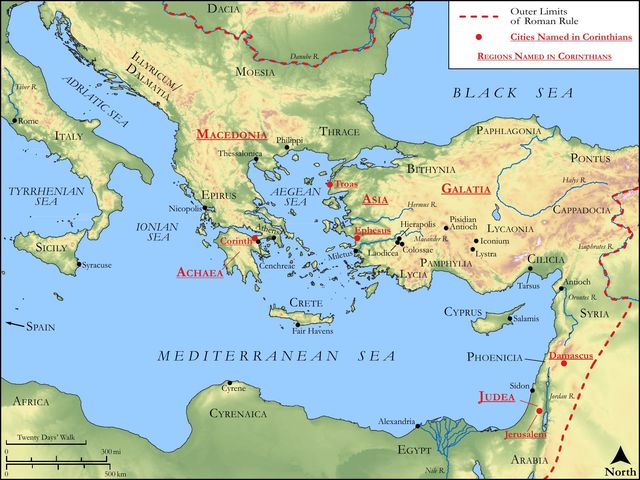
See on the biblical-era maps

Study this verse
Public-domain commentary
Matthew Henry
From his Commentary on the Whole Bible. Henry comments on passages, not single verses — this entry covers 1 Corinthians 16:5–9.
In this passage the apostle notifies and explains his purpose of visiting them, concerning which, observe, 1. His purpose: he intended to pass out of Asia, where he now was (vide Co1 16:8, Co1 16:19) and to go through Macedonia into Achaia, where Corinth was, and to stay some time with them, and perhaps the winter, Co1 16:5, Co1 16:6. He had long laboured in this church, and done much good among them, and had his heart set upon doing much more (if God saw fit), and therefore he had it in his thoughts to see them, and stay with them. Note, The heart of a truly Christian minister must be much towards that people among whom he has long laboured, and with remarkable success. No wonder that Paul was willing to see Corinth and stay with them as long as the other duties of his office would permit. Though some among this people despised him, and made a faction against him, doubtless there were many who loved him tenderly, and paid him all the respect due to an apostle and their spiritual father. And is it any wonder that he should be willing to visit them, and stay with them? And as to the rest, who now manifested great disrespect, he might hope to reduce them to a better temper, and thereby rectify what was out of order in the church, by staying among them for some time. It is plain that he hoped for some good effect, because he says he intended to stay, that they might bring him on his journey whithersoever he went (Co1 16:6); not that they might accompany him a little way on the road, but expedite and furnish him for his journey, help and encourage him to it, and provide him for it. He is to be understood of being brought forward in his journey after a godly sort (as it is expressed, Jo3 1:6), so that nothing might be wanting to him, as he himself speaks, Tit 3:13. His stay among them, he hoped, would cure their factious humour, and reconcile them to himself and their duty. Note, It was a just reason for an apostle to make his abode in a place that he had a prospect of doing good. 2. His excuse for not seeing them now, because it would be only by the way (Co1 16:7), en parodō - in transitu - en passant: it would only be a transient visit. He would not see them because he could not stay with them. Such a visit would give neither him nor them any satisfaction or advantage; it would rather raise the appetite than regale it, rather heighten their desires of being together than satisfy them. He loved them so much that he longed for an opportunity to stay with them, take up his abode among them for some length of time. This would be more pleasing to himself, and more serviceable to them, than a cursory visit in his way; and therefore he would not see them now, but another time, when he could tarry longer. 3. We have the limitation of this purpose: I trust to tarry awhile with you, if the Lord permit, Co1 16:7. Though the apostles wrote under inspiration, they did not know thereby how God would dispose of them. Paul had a purpose of coming to Corinth, and staying there, and hoped to do good thereby. This was not a purpose proceeding from any extraordinary motion or impulse of the Spirit of God; it was not the effect of inspiration; for had it been such he could not have spoken of it in this manner. A purpose formed thus in him must have been the purpose of God, signified to him by his Spirit; and could he say he would come to Corinth upon this view only, if God permit, that is, that he would execute God's own purpose concerning himself, with God's permission? It is to be understood then of a common purpose, formed in his own spirit. And concerning all our purposes it is fit we should say, "We will execute them if the Lord permit." Note, All our purposes must be made with submission to the divine providence. We should say, If the Lord will, we shall live, and do this and that, Jam 4:15. It is not in us to effect our own designs, without the divine leave. It is by God's power and permission, and under his direction, that we must do every thing. Heathens have concurred in acknowledging this concern of Providence in all our actions and concerns; surely we should readily own it, and frequently and seriously attend to it. 4. We have his purpose expressed of staying at Ephesus for the present. He says he would stay there till pentecost, Co1 16:8. It is very probable that at the time of writing this epistle he was in Ephesus, from this passage, compared with Co1 16:19, where he says, The churches of Asia salute you. A proper salutation from Ephesus, but hardly so proper had he been at Philippi, as the subscription to this epistle in our common copies has it. "The churches of Macedonia salute you" had been much more properly inserted in the close of a letter from Philippi, than the other. But, 5. We have the reason given for his staying at Ephesus for the present: Because a great door, and effectual, was opened to him, and there were many adversaries, Co1 16:9. A great door and effectual was opened to him; many were prepared to receive the gospel at Ephesus, and God gave him great success among them; he had brought over many to Christ, and he had great hope of bringing over many more. For this reason he determined to stay awhile at Ephesus. Note, Success, and a fair prospect of more, was a just reason to determine an apostle to stay and labour in a particular place. And there were many adversaries, because a great door, and an effectual, was opened. Note, Great success in the work of the gospel commonly creates many enemies. The devil opposes those most, and makes them most trouble, who most heartily and successfully set themselves to destroy his kingdom. There were many adversaries; and therefore the apostle determined to stay. Some think he alludes in this passage to the custom of the Roman Circus, and the doors of it, at which the charioteers were to enter, as their antagonists did at the opposite doors. True courage is whetted by opposition; and it is no wonder that the Christian courage of the apostle should be animated by the zeal of his adversaries. They were bent to ruin him, and prevent the effect of his ministry at Ephesus; and should he at this time desert his station, and disgrace his character and doctrine? No, the opposition of adversaries only animated his zeal. He was in nothing daunted by his adversaries; but the more they raged and opposed the more he exerted himself. Should such a man as he flee? Note, Adversaries and opposition do not break the spirits of faithful and successful ministers, but only enkindle their zeal, and inspire them with fresh courage. Indeed, to labour in vain is heartless and discouraging. This damps the spirits, and breaks the heart. But success will give life and vigour to a minister, though enemies rage, and blaspheme, and persecute. It is not the opposition of enemies, but the hardness and obstinacy of his hearers, and the backslidings and revolt of professors, that damp a faithful minister, and break his heart.
Historical interpretation
Historical reception
2 surviving comments on this verse. Each one is dated, so this reads as a timeline rather than a list.
Select a marker to jump to its quote. Markers stagger vertically where authors wrote within a few decades of each other.
Paul made it clear that he was staying at Ephesus because he had found hearts there who were thirsting for the grace of God, and in them he could quickly instill the mystery of Christ. But because the devil is always restless and hostile to those who long for God, he adds that his enemies there are many. For the more they sought after the faith, the more there were adversaries who contradicted them and fought against the teaching of the Lord.
"But I will tarry at Ephesus until Pentecost."
As we should expect, he tells them all exactly, informing them as friends, For this too is a mark of friendship to say the reason why he was not with them, why he delayed, and where he was staying.
"For a great door and effectual is opened unto me, and there are many adversaries."
Now it was "great," how could there be "adversaries?" Why on this very account the adversaries were many, because men's faith was great; because the entrance was great and wide. But what means, "A great door?" There are many prepared to receive the faith, many ready to approach and be converted. There is a spacious entrance for me, things being now come to that point that the mind of those approaching is at its prime for the obedience of the faith. On this account, vehement was the blast of the breath of the devil, because he saw many turning away from him.
You see then on both accounts it was needful for him to stay; both because the gain was abundant, and because the struggle was great.
And herewith also he cheered them up, namely, by saying, that henceforth the word works every where and springs up readily. And if there be many who plot against it, this also is a sign of the advance of the Gospel. For at no time doth that evil demon wax fierce, except on seeing his goods made spoil of abundantly.
Let us then, when we desire to effect any thing great and noble, not regard this, the greatness of the labor which it brings, but let us rather look to the gain. Mark, for instance, Paul, not therefore lingering, not therefore shrinking back, because "there were many adversaries;" but because "there was a great door," pressing on and persevering. Yea, and as I was saying, this was a sign that the devil was being stripped, for it is not, depend on it, by little and mean achievements that men provoke that evil monster to wrath. And so when thou seest a righteous man performing great and excellent deeds, yet suffering innumerable ills, marvel not; on the contrary, one might well marvel, if the devil receiving so many blows were to keep quiet and bear the wounds meekly. Even as you ought not to be surprised were a serpent, continually goaded, to grow fierce and spring on the person that goaded it. Now no serpent steals on you so fierce as the devil, leaping up against all; and, like a scorpion with its sting raised, he raises himself upright. Let not this then disturb you: since of course he that returns from war and victory and slaughter must needs be bloody, and oftentimes also have received wounds. Do thou, then, for thy part, when thou seest any one doing alms and performing numberless other good works and so curtailing the power of the devil, and then falling into temptations and perils; be not troubled thereupon. This is the very reason why he fell into temptations, because he mightily smote the devil.
Continue studying 1 Corinthians 16:9 across the web’s major study libraries — every link below opens this exact verse, chapter, or book on the destination site.
Read & Compare
 BibleGatewayThis verse in more than 200 translations and 70 languages.
 Bible.comThe YouVersion reader — hundreds of translations, reading plans, and highlights.
 ESV.orgCrossway's official English Standard Version reader.
 NET BibleThe NET translation with 60,000+ translators' notes on every rendering decision.
 STEP BibleTyndale House's free study tool — original text, vocabulary, and scholarly resources.
 BibliaLogos Bible Software's free web reader.
 USCCBThe New American Bible (Revised Edition) with the U.S. bishops' study notes.
Commentaries
 BibleHub CommentariesDozens of classic commentaries on this verse, gathered on one page.
 StudyLightMore than 100 commentary sets — the largest collection on the web.
 BibleRefPlain-English commentary on what this verse means, verse by verse.
 Enduring WordDavid Guzik's free commentary on this chapter, widely used by Bible teachers.
 Bible Study ToolsVerse commentary alongside Greek and Hebrew study aids.
Original Language & Research
- BibleHub InterlinearThe verse word by word — original language, transliteration, and English.
- BibleHub LexiconEvery word's original-language definition and Strong's entry.
 Blue Letter BibleDeep-study tools — Strong's numbers, concordance, and word studies.
 CNTR CollationThe earliest Greek manuscripts of this verse, collated letter by letter.
Sermons, Hymns & Audio


TrulyRandomVerse is not affiliated with these sites and doesn’t control their content. They’re linked because they’re genuinely useful.
Summary
In 1 Corinthians 16:9, the Apostle Paul articulates a profound paradox of Christian ministry: the simultaneous presence of immense divine opportunity and significant human opposition. This verse serves as a strategic explanation for his decision to prolong his stay in Ephesus, revealing his unwavering commitment to advancing the gospel despite the inherent challenges, recognizing that where God opens a door for impactful ministry, adversaries often arise in response.
Context
ShowHideLiterary Context
This verse appears within the closing remarks of Paul's First Letter to the Corinthians, specifically as he outlines his future travel plans and ministry intentions. Following extensive instructions on various aspects of Christian life and doctrine, including a lengthy discourse on the resurrection in 1 Corinthians 15, Paul shifts to practical matters concerning his upcoming visit and the collection for the saints in Jerusalem (1 Corinthians 16:1-4). He explains his immediate itinerary, stating his intention to remain in Ephesus until Pentecost, a decision directly justified by the "great door and effectual" and the "many adversaries" mentioned in this verse. This strategic rationale underscores Paul's pragmatic approach to ministry, balancing divine leading with an assessment of the spiritual landscape.
Historical & Cultural Context
Paul was writing from Ephesus, a prominent Roman provincial capital in Asia Minor, during his third missionary journey (circa AD 55-56). Ephesus was a bustling commercial and religious center, home to the magnificent Temple of Artemis (Diana), one of the Seven Wonders of the Ancient World. This city was a stronghold of paganism, idolatry, and occult practices, making it a challenging but strategically vital mission field. Paul's ministry there, as detailed in Acts 19, was marked by extraordinary signs and wonders, leading to widespread conversions and a significant disruption of the local economy tied to idolatry, exemplified by the riot instigated by Demetrius the silversmith (Acts 19:23-41). The "many adversaries" were likely a mix of Jewish opponents, pagan idolaters, and perhaps even false teachers or divisive elements within the nascent Christian community, all threatened by the transformative power of the gospel.
Key Themes
ShowHide1 Corinthians 16:9 contributes to several overarching themes within Paul's letters and the broader New Testament narrative. Firstly, it highlights the theme of Divine Opportunity in Ministry, where God sovereignly opens avenues for the spread of His Word, often in unexpected or challenging locations. Paul frequently speaks of such "open doors" for the gospel, as seen in Colossians 4:3 and 2 Corinthians 2:12. Secondly, it underscores the Reality of Spiritual Opposition, affirming that powerful gospel advance inevitably provokes intense resistance from forces hostile to God's kingdom. This paradox is a consistent feature of Paul's ministry, as he frequently recounts his tribulations and the constant spiritual warfare he faced (e.g., 2 Corinthians 4:8-9). Finally, the verse exemplifies the theme of Strategic Perseverance in the Face of Adversity, demonstrating Paul's resolve to remain engaged where God was working, prioritizing the gospel's impact over personal comfort or safety, a commitment echoed throughout his missionary endeavors.
Exposition and Analysis
ShowHideKey Word Analysis
ShowHideApparently a primary word; a portal or entrance (the opening or the closure, literally or figuratively). In this context, "door" is used metaphorically to signify an opportunity or access point for ministry. It implies a significant opening for the gospel to be proclaimed and take root, indicating a period of fruitful evangelism and church planting.
From ἐν and ἔργον; active, operative. This term emphasizes that the "door" was not merely open but was potent, active, and capable of producing significant results. It denotes a powerful, dynamic, and productive opportunity, suggesting that Paul's ministry in Ephesus was yielding substantial spiritual impact and conversions.
From ἀντί and κεῖμαι; to lie opposite, i.e. be adverse (figuratively, repugnant) to. This word describes those who actively set themselves against Paul's work, standing in opposition or hostility. It refers to individuals or groups who resisted the gospel message and sought to hinder its progress, confirming the presence of direct and often intense conflict.
Verse Breakdown
ShowHide"For a great door and effectual is opened unto me"
This clause reveals the primary reason for Paul's continued ministry in Ephesus. The "door" (θύρα, thýra) is a potent metaphor for a significant opportunity for gospel proclamation and spiritual impact. The adjective "great" (μέγας, mégas) underscores the vastness and importance of this opportunity, while "effectual" (ἐνεργής, energḗs) highlights its active, powerful, and productive nature. It signifies that God had provided a fertile ground where the gospel could thrive and bear much fruit, making Ephesus a strategic hub for evangelism.
"and [there are] many adversaries"
This second clause introduces a stark contrast and a common paradox in Christian ministry. Despite the immense opportunity, Paul faced "many adversaries" (ἀντικείμενοι, antíkeimenoi). These were individuals or groups actively opposing his work, whether through verbal attacks, physical persecution, or theological disputes. The presence of "many" emphasizes the widespread and intense nature of this opposition, indicating that significant spiritual activity often provokes an equally significant counter-response from forces hostile to the gospel.
Literary Devices
ShowHideThe verse prominently employs Metaphor, with "a great door and effectual" serving as a powerful image for an expansive and productive opportunity for ministry. This metaphor is common in Paul's writings, signifying access or an opening for the gospel. Furthermore, the verse presents a stark Juxtaposition or Paradox, placing the "great door" directly alongside "many adversaries." This literary technique highlights the inherent tension and reality of Christian service: where God is working powerfully, opposition often intensifies. The contrast emphasizes that divine opportunity does not imply ease, but often accompanies significant spiritual warfare, demanding perseverance and strategic engagement.
Theological and Thematic Connections
ShowHidePaul's experience in Ephesus, as encapsulated in 1 Corinthians 16:9, offers profound theological insights into the nature of God's work and the believer's role. It affirms God's sovereignty in opening doors for the gospel, demonstrating His active involvement in mission. Simultaneously, it reveals the consistent reality of spiritual opposition, reminding us that the advance of God's kingdom inevitably clashes with the forces of darkness. This tension is not a sign of God's absence or disapproval, but often an indicator of significant spiritual activity and the effectiveness of the ministry. Believers are called to discern these divine opportunities and, like Paul, to persevere faithfully despite the adversaries, understanding that the power of the gospel is made perfect in weakness and opposition.
Reflection and Application
ShowHide1 Corinthians 16:9 provides a timeless framework for understanding and engaging in God's work today. It challenges believers to cultivate a discerning eye for the "great and effectual doors" that God opens in their lives, whether in personal evangelism, vocational calling, or community service. These opportunities may not always appear in comfortable or convenient settings; often, they are found precisely where there is significant resistance or difficulty. The presence of "many adversaries"—be they spiritual forces, cultural opposition, personal struggles, or critical voices—should not deter us, but rather serve as a confirmation that we are on the front lines of God's kingdom work. Like Paul, we are called to embrace perseverance, recognizing that true impact often requires steadfastness in the face of conflict, trusting that God's power is sufficient to overcome all opposition and bring forth fruit from even the most challenging environments. Our strategic presence and unwavering commitment to the gospel, even amidst adversity, are vital for seeing God's purposes fulfilled.
Questions for Reflection
ShowHideFAQ
ShowHideDoes the presence of adversaries mean I'm not in God's will?
ShowHideAbsolutely not. 1 Corinthians 16:9 powerfully demonstrates the opposite: the presence of "many adversaries" often accompanies a "great door and effectual" opportunity opened by God. This paradox suggests that significant spiritual impact and divine favor frequently provoke strong opposition from forces hostile to God's kingdom. From the ministry of Jesus, who faced constant opposition from religious leaders and demonic forces (Matthew 12:24), to the apostles, who endured persecution for proclaiming the gospel (Acts 4:1-3), the New Testament consistently shows that faithful obedience and effective ministry often attract resistance. Therefore, encountering adversaries can actually be a sign that you are precisely where God wants you to be, engaging in work that truly threatens the kingdom of darkness. It calls for perseverance, prayer, and reliance on God's strength, rather than retreat.
Christ-Centered Fulfillment
ShowHidePaul's experience of an "effectual door" accompanied by "many adversaries" finds its ultimate fulfillment and pattern in the person and ministry of Jesus Christ. Jesus Himself was the "door" through whom humanity gains access to God (John 10:9), and His ministry, though full of divine power and grace, was met with relentless opposition from the religious establishment and ultimately led to the cross (John 1:11, Matthew 27:22-23). The "great door" of salvation was opened through His ultimate sacrifice, yet this very act was the culmination of intense spiritual warfare and human enmity. Believers, as followers of Christ, are called to walk through the same "doors" of ministry and mission, knowing that just as Christ endured the cross for the joy set before Him (Hebrews 12:2), so too will His disciples face opposition while proclaiming the good news of His kingdom (John 15:18-20). Thus, Paul's strategic decision to remain in Ephesus, embracing both opportunity and adversity, perfectly mirrors the Christ-like posture of steadfastness in fulfilling God's redemptive purposes, even unto death, for the glory of the Father and the salvation of the world.