


Colossians 4:3
- προσευχόμενοιproseuchomenoiprayingG4336V-PNP-NPMVerb Present Middle Or Passive Deponent Participle Nominative Plural Masculine
- ἅμαhamaat the same timeG260ADVAdverb
- καὶkaialsoG2532CONJConjunction
- περὶperiforG4012PREPPreposition
- ἡμῶνhēmōnusG3165P-1GPPersonal pronoun Genitive 1st Plural
- ἵναinathatG2443CONJConjunction
- ὁho<the>G3588T-NSMDefinite article Nominative Singular Masculine
- θεὸςtheosGodG2316N-NSM-TNoun Nominative Singular Masculine Title
- ἀνοίξῃanoixēmay openG455V-AAS-3SVerb Aorist Active Subjunctive 3rd Singular
- ἡμῖνhēminto usG3165P-1DPPersonal pronoun Dative 1st Plural
- θύρανthurana doorG2374N-ASFNoun Accusative Singular Feminine
- τοῦtoufor theG3588T-GSMDefinite article Genitive Singular Masculine
- λόγουlogouwordG3056N-GSMNoun Genitive Singular Masculine
- λαλῆσαιlalēsaito declareG2980V-AANVerb Aorist Active Infinitive
- τὸtotheG3588T-ASNDefinite article Accusative Singular Neuter
- μυστήριονmustērionmysteryG3466N-ASNNoun Accusative Singular Neuter
- τοῦtou<the>G3588T-GSMDefinite article Genitive Singular Masculine
- ΧριστοῦChristouof ChristG5547N-GSM-TNoun Genitive Singular Masculine Title
- δι᾽di᾽on account ofG1223PREPPreposition
- ὃhowhichG3739R-ASNRelative pronoun Accusative Singular Neuter
- καὶkaialsoG2532CONJConjunction
- δέδεμαιdedemaiI have been boundG1210V-RPI-1SVerb Perfect Passive Indicative 1st Singular
English is a literal word-by-word gloss of the Greek, not the KJV's wording. Why?
This is the original text the KJV's translators worked from — each Greek word with its own literal English meaning in this verse, prepared by scholars at Tyndale House, Cambridge. The KJV translates whole sentences, not word by word, so its wording differs: one Greek word can become several English words, and the KJV may choose “charity” where the gloss reads “love”. Both are faithful — they answer different questions. For the KJV's own rendering, switch to the KJV text.
Details
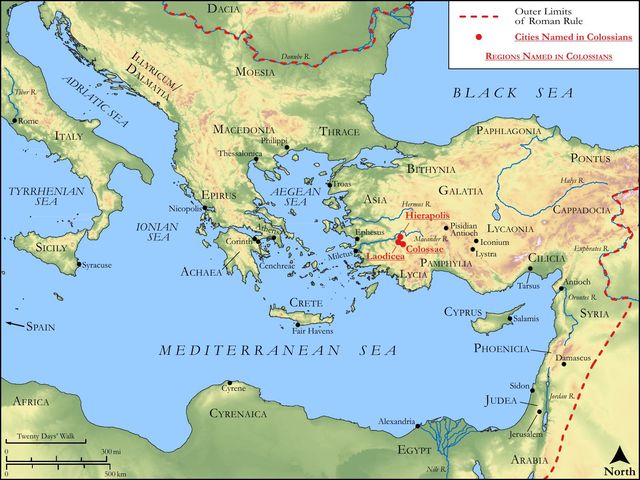
See on the biblical-era map

Study this verse
Public-domain commentary
Matthew Henry
From his Commentary on the Whole Bible. Henry comments on passages, not single verses — this entry covers Colossians 4:2–4.
If this be considered as connected with the foregoing verse, then we may observe that it is part of the duty which masters owe their servants to pray with them, and to pray daily with them, or continue in prayer. They must not only do justly and kindly by them, but act a Christian and religious part, and be concerned for their souls as well as their bodies: "As parts of your charge, and under your influence, be concerned for the blessing of God upon them, as well as the success of your affairs in their hands." And this is the duty of every one - to continue in prayer. "Keep up your constant times of prayer, without being diverted from it by other business; keep your hearts close to the duty, without wandering or deadness, and even to the end of it: Watching the same." Christians should lay hold of all opportunities for prayer, and choose the fittest seasons, which are least liable to disturbance from other things, and keep their minds lively in the duty, and in suitable frames. - With thanksgiving, or solemn acknowledgment of the mercies received. Thanksgiving must have a part in every prayer. - Withal praying also for us, Col 4:3. The people must pray particularly for their ministers, and bear them upon their hearts at all times at the throne of grace. As if he had said, "Do not forget us, whenever you pray for yourselves," Eph 6:19; Th1 5:25; Heb 13:18. That God would open to us a door of utterance, that is, either afford opportunity to preach the gospel (so he says, a great door and effectual is opened to me, Co1 16:9), or else give me ability and courage, and enable me with freedom and faithfulness; so Eph 6:19, And for me, that utterance may be given to me, that I may open my mouth boldly, to speak the mystery of Christ, for which I am also in bonds; that is, either the deepest doctrines of the gospel with plainness, of which Christ is the principal subject (he calls it the mystery of the gospel, Eph 6:19), or else he means the preaching of the gospel to the Gentile world, which he calls the mystery hidden from ages (Col 1:26) and the mystery of Christ, Eph 3:4. For this he was now in bonds. He was a prisoner at Rome, by the violent opposition of the malicious Jews. He would have them pray for him, that he might not be discouraged in his work, nor driven from it by his sufferings: "That I may make it manifest, as I ought to speak, Col 4:4. That I may make this mystery known to those who have not heard of it, and make it plain to their understanding, in such a manner as I ought to do." He had been particular in telling them what he prayed for on their behalf, ch. 1. Here he tells them particularly what he would have them pray for on his behalf. Paul knew as well as any man how to speak; and yet he begged their prayers for him, that he might be taught to speak. The best and most eminent Christians need the prayers of meaner Christians, and are not above asking them. The chief speakers need prayer, that God would give them a door of utterance, and that they may speak as they ought to speak.
Historical interpretation
Two Centuries of Reception
3 surviving comments on this verse. Each one is dated, so this reads as a timeline rather than a list.
Select a marker to jump to its quote. Markers stagger vertically where authors wrote within a few decades of each other.
And he still more clearly reveals that knowledge belongs not to all, by adding: "Praying at the same time for you, that God would open to us a door to speak the mystery of Christ, for which I am bound; that I may make it known as I ought to speak."
See his lowlymindedness; he sets himself after them.
"That God may open to us a door for the word, to speak the mystery of Christ." He means an entrance, and boldness in speaking. Wonderful! The great athlete said not "that I may be freed from my bonds," but being in bonds he exhorted others; and exhorted them for a great object, that himself might get boldness in speaking. Both the two are great, both the quality of the person, and of the thing. Wonderful! how great is the dignity! "The mystery," he saith, "of Christ." He shows that nothing was more dearly desired by him than this, to speak. "For which I am also in bonds; that I may make it manifest, as I ought to speak." He means with much boldness of speech, and withholding nothing. His bonds display, not obscure him. With much boldness he means. Tell me, art thou in bonds, and dost thou exhort others? Yea, my bonds give me the greater boldness; but I pray for God's furtherance, for I have heard the voice of Christ saying, "When they deliver you up, be not anxious how or what ye shall speak." (Matt. x. 19.) And see, how he has expressed himself in metaphor, "that God may open to us a door for the word"; (see, how unassuming he is; even in his bonds, how he expresses himself;) that is, that He would soften their hearts. Still he said not so; but, "that He would give us boldness"; out of lowlymindedness he thus spoke, and that which he had, he asks to receive.
Schisms arise when men say, we are righteous; when they say, we sanctify the unclean, we justify the wicked, we ask, we obtain. But what did John say? “If any man sin, we have an advocate with the Father, Jesus Christ the righteous.” You will say, But may not holy men ask on our behalf? May not bishops and rulers ask on behalf of the people? Look at the Scripture, and you will find rulers commending themselves to the people’s prayers. The apostle says to his people, “Praying also for us.” The apostle prays for the people and the people for the apostle. We pray for you, my brothers, but you should also pray for us. Let all the members pray for one another, and let the Head intercede for all. .
Continue studying Colossians 4:3 across the web’s major study libraries — every link below opens this exact verse, chapter, or book on the destination site.
Read & Compare
 BibleGatewayThis verse in more than 200 translations and 70 languages.
 Bible.comThe YouVersion reader — hundreds of translations, reading plans, and highlights.
 ESV.orgCrossway's official English Standard Version reader.
 NET BibleThe NET translation with 60,000+ translators' notes on every rendering decision.
 STEP BibleTyndale House's free study tool — original text, vocabulary, and scholarly resources.
 BibliaLogos Bible Software's free web reader.
 USCCBThe New American Bible (Revised Edition) with the U.S. bishops' study notes.
Commentaries
 BibleHub CommentariesDozens of classic commentaries on this verse, gathered on one page.
 StudyLightMore than 100 commentary sets — the largest collection on the web.
 BibleRefPlain-English commentary on what this verse means, verse by verse.
 Enduring WordDavid Guzik's free commentary on this chapter, widely used by Bible teachers.
 Bible Study ToolsVerse commentary alongside Greek and Hebrew study aids.
Original Language & Research
- BibleHub InterlinearThe verse word by word — original language, transliteration, and English.
- BibleHub LexiconEvery word's original-language definition and Strong's entry.
 Blue Letter BibleDeep-study tools — Strong's numbers, concordance, and word studies.
 CNTR CollationThe earliest Greek manuscripts of this verse, collated letter by letter.
Sermons, Hymns & Audio


TrulyRandomVerse is not affiliated with these sites and doesn’t control their content. They’re linked because they’re genuinely useful.
Summary
In Colossians 4:3, the Apostle Paul, writing from imprisonment, earnestly requests the Colossian believers to pray for him and his fellow ministers. His specific plea is for God to grant them an "open door of utterance," enabling them to clearly and effectively proclaim "the mystery of Christ," the very message for which he is currently suffering "in bonds." This verse powerfully highlights the essential role of intercessory prayer in advancing the Gospel, even for seasoned apostles facing significant personal hardship.
Context
ShowHideLiterary Context
Colossians 4:3 is situated within the concluding section of Paul's letter to the church at Colossae, following his profound theological exposition on the supremacy of Christ and the believer's new life in Him. Chapters 1-2 establish Christ's cosmic preeminence and His sufficiency against various false teachings, while chapter 3 transitions to practical exhortations for Christian living, emphasizing putting off the old self and putting on the new. Chapter 4 begins with further instructions on walking in wisdom towards outsiders and making the most of every opportunity, leading directly into Paul's specific request for prayer. This personal appeal for intercession for his ministry underscores that even the most profound theological truths must translate into practical, Spirit-empowered proclamation, a task not accomplished by human effort alone but through divine enablement sought in prayer. The request for prayer for his ministry is seamlessly integrated with his broader instructions for Christian conduct and witness.
Historical & Cultural Context
Paul wrote the Epistle to the Colossians while imprisoned, likely in Rome (c. A.D. 60-62). This was a period when the Roman Empire, despite its general tolerance of Judaism, viewed the rapidly expanding Christian movement with suspicion, often leading to persecution. Paul's "bonds" were a direct consequence of his zealous preaching of the Gospel, particularly his mission to the Gentiles, which often provoked opposition from both Jewish and Roman authorities. The concept of an "open door" for ministry was a common metaphor in the ancient world, signifying an opportunity or access. For Paul, this was not merely about physical freedom but about the spiritual freedom to proclaim the message in a hostile environment. The Colossian church, situated in Phrygia, was a diverse community grappling with syncretistic influences, making the clear and unhindered proclamation of the pure Gospel of Christ's supremacy all the more vital.
Key Themes
ShowHideColossians 4:3 contributes significantly to several overarching themes in the letter and Paul's broader theology. Firstly, it emphasizes the necessity of prayer in Christian ministry, demonstrating that even an apostle like Paul, endowed with unique spiritual gifts and authority, was utterly dependent on the intercession of the church for the effectiveness of his evangelistic endeavors. This aligns with Paul's consistent emphasis on prayer throughout his epistles, such as his exhortation in Ephesians 6:18. Secondly, the verse highlights the divine initiative in evangelism, where God "opens a door" for the proclamation of His Word, indicating that opportunities for effective witness are sovereignly granted. This echoes Paul's understanding of God's providential hand in his missionary journeys, as seen in Acts 14:27. Finally, the phrase "mystery of Christ" points to the central revelation of God's redemptive plan in Jesus Christ, particularly the inclusion of Gentiles into God's covenant people, a theme Paul elaborates on in Ephesians 3:4-6. Paul's imprisonment "for which I am also in bonds" underscores the theme of suffering for the Gospel, portraying it not as a hindrance but as a means by which the message of Christ is advanced, a perspective also evident in Philippians 1:12-14.
Exposition and Analysis
ShowHideKey Word Analysis
ShowHideApparently a primary word (compare "door"); a portal or entrance (the opening or the closure, literally or figuratively). Here, "door" is used metaphorically to signify an opportunity or access for the Gospel message. Paul is praying for the removal of barriers and the granting of open access to people's hearts and minds, as well as favorable circumstances for proclamation.
Something said (including the thought); by implication, a topic (subject of discourse), also reasoning (the mental faculty) or motive; by extension, a computation; specially, (with the article in John) the Divine Expression (i.e. Christ). In this context, lógos refers to the spoken word, specifically the message of the Gospel. Paul desires not just an opportunity to speak, but the ability to speak clearly, powerfully, and persuasively.
From a derivative of (to shut the mouth); a secret or "mystery" (through the idea of silence imposed by initiation into religious rites). In Pauline theology, a "mystery" is not something unknowable, but a truth previously hidden by God in past ages and now revealed through Christ and His apostles. Here, it refers to the profound truth of God's redemptive plan centered on Christ, particularly the inclusion of both Jews and Gentiles into one body through faith.
A primary verb; to bind (in various applications, literally or figuratively):--bind, be in bonds, knit, tie, wind. Here, it refers to Paul's literal physical chains and imprisonment. Despite his physical confinement, Paul's focus remains on the unhindered advancement of the Gospel, demonstrating that the Word of God is not bound.
Verse Breakdown
ShowHide"Withal praying also for us,"
Paul initiates his request for prayer, including himself and his fellow ministers (likely Timothy, Aristarchus, Mark, etc., mentioned later in Colossians 4). The "withal" (G260, háma) emphasizes that this prayer request is in conjunction with the Colossians' own prayer life, suggesting a mutual and continuous practice of prayer.
"that God would open unto us a door of utterance,"
This is the specific content of Paul's prayer request. He asks God (G2316, theós) to "open" (G455, anoígō) a "door" (G2374, thýra) for "utterance" (G3056, lógos). This is a metaphorical plea for divine enablement, seeking opportunities and effectiveness in proclaiming the Gospel message. It implies a desire for receptive hearers and favorable circumstances for evangelism.
"to speak the mystery of Christ,"
This clause clarifies the purpose of the "open door of utterance." The goal is to articulate "the mystery of Christ" (G3466, mystḗrion G5547, Christós). This refers to the profound, previously hidden truth of God's plan of salvation, now fully revealed in Jesus Christ, encompassing His person, His saving work, and the inclusion of all believers—Jew and Gentile—into His body.
"for which I am also in bonds:"
Paul concludes by stating the reason for his current imprisonment. His "bonds" (G1210, déō) are directly linked to his mission of proclaiming this very "mystery of Christ." This highlights his suffering for the Gospel and underscores the cost of discipleship and apostolic ministry, yet it also subtly implies that his imprisonment has not silenced his commitment to the message.
Literary Devices
ShowHideColossians 4:3 effectively employs several literary devices. The most prominent is Metaphor, specifically in the phrase "a door of utterance." The "door" serves as a powerful image for opportunity, access, or passage, while "utterance" refers to the spoken word or message. Together, they create a vivid picture of Paul's yearning for divinely granted avenues and effectiveness in proclaiming the Gospel. This metaphor is common in Paul's writings, reflecting his strategic approach to ministry. There is also an element of Paradox or Irony in Paul's situation: though he is physically "in bonds" and confined, he prays for an "open door" for the Word of God, which itself cannot be bound. His physical restriction contrasts sharply with his spiritual desire for boundless proclamation. Finally, the verse functions as a Personal Appeal, directly engaging the Colossian audience and inviting them into partnership through prayer, thereby fostering a sense of shared mission and mutual dependence within the Christian community.
Theological and Thematic Connections
ShowHideColossians 4:3 profoundly connects to the broader biblical narrative of God's redemptive mission and the role of His people in it. It underscores the divine sovereignty in opening doors for the Gospel, emphasizing that effective evangelism is not merely a human endeavor but a Spirit-empowered work. Paul's request for prayer for "utterance" and for "the mystery of Christ" reveals the core content of the apostolic message: Christ Himself, in whom "are hidden all the treasures of wisdom and knowledge" (Colossians 2:3). His imprisonment "for which I am also in bonds" also highlights the theme of suffering for the sake of the Gospel, a consistent motif in Paul's life and theology, demonstrating that adversity can serve as a platform for the advancement of God's kingdom. This verse serves as a powerful reminder that prayer is foundational to all missionary enterprise, aligning human effort with divine purpose.
Reflection and Application
ShowHideColossians 4:3 offers timeless and profound lessons for every believer today, calling us to a deeper commitment to prayer and evangelism. Paul's request, despite his apostolic stature and imprisonment, powerfully reminds us that no one is beyond the need for intercessory prayer, especially those engaged in proclaiming the Gospel. We are called to pray fervently for missionaries, pastors, and evangelists, asking God to open "doors of utterance" for them—opportunities to speak and the divine enablement to articulate the truth of Christ clearly and persuasively, even in challenging or hostile environments. This also extends to our personal lives: we should actively pray for God to open doors for us to share our faith in our daily interactions, workplaces, and communities. Our message, like Paul's, must always be centered on "the mystery of Christ"—His person, His saving work, and His lordship—as the ultimate hope for humanity. Furthermore, Paul's willingness to suffer "in bonds" for this message encourages us to persevere amidst our own challenges and difficulties, recognizing that even our trials can be used by God to advance His kingdom and bear witness to His truth.
Questions for Reflection
ShowHideFAQ
ShowHideWhat does "a door of utterance" mean in Colossians 4:3?
ShowHide"A door of utterance" (Greek: thýra tou lógou) is a powerful metaphor used by Paul to signify a divinely granted opportunity and effectiveness in proclaiming the Gospel message. The "door" represents access or an open avenue, while "utterance" refers to the spoken word or message itself. So, Paul is praying for God to remove obstacles and create favorable circumstances for him to speak the Word of God freely, clearly, and powerfully, and for that message to be received by receptive hearts. It's a prayer for both the chance to speak and the ability to speak effectively about Christ. This concept is also seen in 1 Corinthians 16:9 where Paul speaks of a "great door and effectual" being opened for him.
What is "the mystery of Christ" that Paul refers to?
ShowHideIn Pauline theology, a "mystery" (Greek: mystḗrion) does not mean something unknowable or incomprehensible, but rather a truth that was previously hidden or unrevealed by God in past ages, but has now been made known through Christ and His apostles. "The mystery of Christ" specifically refers to God's profound redemptive plan centered on Jesus Christ, particularly the astounding truth that Gentiles, who were once alienated from God's covenant people, are now, through faith in Christ, fellow-heirs, members of the same body, and partakers of the promise in Christ Jesus (Ephesians 3:3-6). It encompasses the full revelation of God's saving purpose, uniting all things in Christ and reconciling humanity to Himself.
Christ-Centered Fulfillment
ShowHideColossians 4:3 finds its ultimate fulfillment and deepest meaning in Jesus Christ, who is Himself the embodiment of the "mystery" Paul longs to proclaim and the very "door" through whom all access to God is granted. Christ is the "mystery" because He is the very revelation of God's eternal plan, "Christ in you, the hope of glory" (Colossians 1:27). He is the Word (Greek: Logos) made flesh, the ultimate "utterance" of God to humanity (John 1:1 and John 1:14). Furthermore, Jesus declared Himself to be "the door" for the sheep, through whom anyone enters and finds salvation (John 10:9). Paul's prayer for an "open door of utterance" is therefore a prayer for Christ Himself to be made known, for His saving work to be proclaimed, and for His sovereign power to open hearts and minds to the truth. Even Paul's "bonds" find their Christ-centered significance, as he shares in the sufferings of Christ, knowing that such suffering can advance the Gospel and ultimately lead to a deeper knowledge of Christ and the power of His resurrection (Philippians 3:10). Thus, Colossians 4:3 is not merely a request for ministry success, but a profound Christological statement, recognizing that all effective proclamation flows from and points back to the person and work of Jesus Christ.