


Romans 8:26
- ὡσαύτωςhōsautōsLikewiseG5615ADVAdverb
- δὲdenowG1161CONJConjunction
- καὶkaialsoG2532CONJConjunction
- τὸtotheG3588T-NSNDefinite article Nominative Singular Neuter
- πνεῦμαpneumaSpiritG4151N-NSNNoun Nominative Singular Neuter
- συναντιλαμβάνεταιsunantilambanetaijoins to helpG4878V-PNI-3SVerb Present Middle Or Passive Deponent Indicative 3rd Singular
- τῇtēatheG3588T-DSFDefinite article Dative Singular Feminine
- ἀσθενείᾳastheneiaweaknessG769N-DSFNoun Dative Singular Feminine
- ἡμῶν·hēmōnof usG3165P-1GPPersonal pronoun Genitive 1st Plural
- τὸtotheG3588T-ASNDefinite article Accusative Singular Neuter
- γὰρgarforG1063CONJConjunction
- τίtithings whichG5101I-ASNInterrogative pronoun Accusative Singular Neuter
- προσευξώμεθαproseuxōmethawe may pray forG4336V-ADS-1PVerb Aorist Middle Deponent Subjunctive 1st Plural
- καθὸkathoasG2526CONJConjunction
- δεῖdeiit behoovesG1163V-PAI-3SVerb Present Active Indicative 3rd Singular
- οὐκouknotG3756PRT-NNegative Particle Negative
- οἴδαμενoidamenwe knowG1492V-RAI-1PVerb Perfect Active Indicative 1st Plural
- ἀλλ᾽all᾽butG235CONJConjunction
- αὐτὸautoHimselfG846P-NSNPersonal pronoun Nominative Singular Neuter
- τὸtotheG3588T-NSNDefinite article Nominative Singular Neuter
- πνεῦμαpneumaSpiritG4151N-NSNNoun Nominative Singular Neuter
- ὑπερεντυγχάνειhuperentugchaneimakes intercessionG5241V-PAI-3SVerb Present Active Indicative 3rd Singular
- ὑπὲρhuperforG5228PREPPreposition
- ἡμῶνhēmōnof usG3165P-1GPPersonal pronoun Genitive 1st Plural
- στεναγμοῖςstenagmoiswith groaningsG4726N-DPMNoun Dative Plural Masculine
- ἀλαλήτοις·alalētoisinexpressibleG215A-DPMAdjective Dative Plural Masculine
English is a literal word-by-word gloss of the Greek, not the KJV's wording. Why?
This is the original text the KJV's translators worked from — each Greek word with its own literal English meaning in this verse, prepared by scholars at Tyndale House, Cambridge. The KJV translates whole sentences, not word by word, so its wording differs: one Greek word can become several English words, and the KJV may choose “charity” where the gloss reads “love”. Both are faithful — they answer different questions. For the KJV's own rendering, switch to the KJV text.
Details
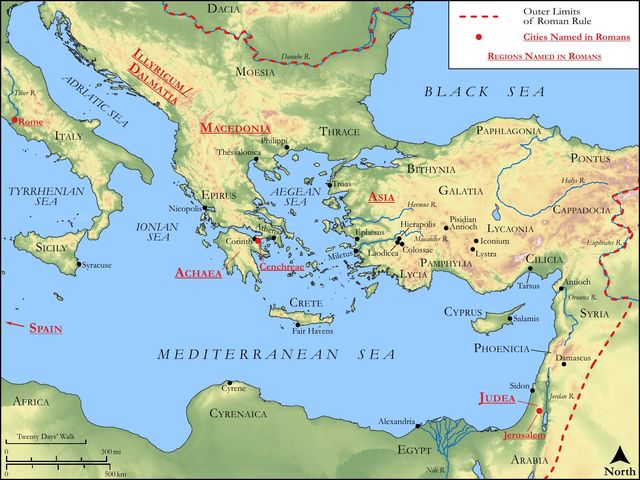
See on the biblical-era map

Study this verse
Public-domain commentary
Matthew Henry
From his Commentary on the Whole Bible. Henry comments on passages, not single verses — this entry covers Romans 8:26–28. His three-level outline is real structure in the source text, so it is rendered as structure.
The apostle here suggests two privileges more to which true Christians are entitled: -
I.The help of the Spirit in prayer.
While we are in this world, hoping and waiting for what we see not, we must be praying. Hope supposes desire, and that desire offered up to God is prayer; we groan. Now observe,
1.Our weakness in prayer: We know not what we should pray for as we ought.
(1.)As to the matter of our requests, we know not what to ask. We are not competent judges of our own condition. Who knows what is good for a man in this life? Ecc 6:12. We are short-sighted, and very much biassed in favour of the flesh, and apt to separate the end from the way. You know not what you ask, Mat 20:22. We are like foolish children, that are ready to cry for fruit before it is ripe and fit for them; see Luk 9:54, Luk 9:55.
(2.)As to the manner, we know not how to pray as we ought. It is not enough that we do that which is good, but we must do it well, seek in a due order; and here we are often at a loss - graces are weak, affections cold, thoughts wandering, and it is not always easy to find the heart to pray, Sa2 7:27. The apostle speaks of this in the first person: We know not. He puts himself among the rest. Folly, and weakness, and distraction in prayer, are what all the saints are complaining of. If so great a saint as Paul knew not what to pray for, what little reason have we to go forth about that duty in our own strength!
2.The assistances which the Spirit gives us in that duty. He helps our infirmities, meant especially of our praying infirmities, which most easily beset us in that duty, against which the Spirit helps. The Spirit in the world helps; many rules and promises there are in the word for our help. The Spirit in the heart helps, dwelling in us, working in us, as a Spirit of grace and supplication, especially with respect to the infirmities we are under when we are in a suffering state, when our faith is most apt to fail; for this end the Holy Ghost was poured out. Helpeth, sumantilambanetai - heaves with us, over against us, helps as we help one that would lift up a burden, by lifting over against him at the other end - helps with us, that is, with us doing our endeavour, putting forth the strength we have. We must not sit still, and expect that the Spirit should do all; when the Spirit goes before us we must bestir ourselves. We cannot without God, and he will not without us. What help? Why, the Spirit itself makes intercession for us, dictates our requests, indites our petitions, draws up our plea for us. Christ intercedes for us in heaven, the Spirit intercedes for us in our hearts; so graciously has God provided for the encouragement of the praying remnant. The Spirit, as an enlightening Spirit, teaches us what to pray for, as a sanctifying Spirit works and excites praying graces, as a comforting Spirit silences our fears, and helps us over all our discouragements. The Holy Spirit is the spring of all our desires and breathings towards God. Now this intercession which the Spirit makes is,
(1.)With groanings that cannot be uttered. The strength and fervency of those desires which the Holy Spirit works are hereby intimated. There may be praying in the Spirit where there is not a word spoken; as Moses prayed (Exo 14:15), and Hannah, Sa1 1:13. It is not the rhetoric and eloquence, but the faith and fervency, of our prayers, that the Spirit works, as an intercessor, in us. Cannot be uttered; they are so confused, the soul is in such a hurry with temptations and troubles, we know not what to say, nor how to express ourselves. Here is the Spirit interceding with groans that cannot be uttered. When we can but cry, Abba, Father, and refer ourselves to him with a holy humble boldness, this is the work of the Spirit.
(2.)According to the will of God, Rom 8:27. The Spirit in the heart never contradicts the Spirit in the word. Those desires that are contrary to the will of God do not come from the Spirit. The Spirit interceding in us evermore melts our wills into the will of God. Not as I will, but as thou wilt.
3.The sure success of these intercessions: He that searches the heart knoweth what is the mind of the Spirit, Rom 8:27. To a hypocrite, all whose religion lies in his tongue, nothing is more dreadful than that God searches the heart and sees through all his disguises. To a sincere Christian, who makes heart-work of his duty, nothing is more comfortable than that God searches the heart, for then he will hear and answer those desires which we want words to express. He knows what we have need of before we ask, Mat 6:8. He knows what is the mind of his own Spirit in us. And, as he always hears the Son interceding for us, so he always hears the Spirit interceding in us, because his intercession is according to the will of God. What could have been done more for the comfort of the Lord's people, in all their addresses to God? Christ had said, "Whatever you ask the Father according to his will he will give it you." But how shall we learn to ask according to his will? Why, the Spirit will teach us that. Therefore it is that the seed of Jacob never seek in vain.
II.The concurrence of all providences for the good of those that are Christ's, Rom 8:28.
It might be objected that, notwithstanding all these privileges, we see believers compassed about with manifold afflictions; though the Spirit makes intercession for them, yet their troubles are continued. It is very true; but in this the Spirit's intercession is always effectual, that, however it goes with them, all this is working together for their good. Observe here.
1.The character of the saints, who are interested in this privilege; they are here described by such properties as are common to all that are truly sanctified.
(1.)They love God. This includes all the out-goings of the soul's affections towards God as the chief good and highest end. It is our love to God that makes every providence sweet, and therefore profitable. Those that love God make the best of all he does, and take all in good part.
(2.)They are the called according to his purpose, effectually called according to the eternal purpose. The call is effectual, not according to any merit or desert of ours, but according to God's own gracious purpose.
2.The privilege of the saints, that all things work together for good to them, that is, all the providences of God that concern them. All that God performs he performs for them, Psa 57:2. Their sins are not of his performing, therefore not intended here, though his permitting sin is made to work for their good, Ch2 32:31. But all the providences of God are theirs - merciful providences, afflicting providences, personal, public. They are all for good; perhaps for temporal good, as Joseph's troubles; at least, for spiritual and eternal good. That is good for them which does their souls good. Either directly or indirectly, every providence has a tendency to the spiritual good of those that love God, breaking them off from sin, bringing them nearer to God, weaning them from the world, fitting them for heaven. Work together. They work, as physic works upon the body, various ways, according to the intention of the physician; but all for the patient's good. They work together, as several ingredients in a medicine concur to answer the intention. God hath set the one over against the other (Ecc 7:14): sunergei, a very singular, with a noun plural, denoting the harmony of Providence and its uniform designs, all the wheels as one wheel, Eze 10:13. He worketh all things together for good; so some read it. It is not from any specific quality in the providences themselves, but from the power and grace of God working in, with, and by, these providences. All this we know - know it for a certainty, from the word of God, from our own experience, and from the experience of all the saints.
Historical interpretation
Four Centuries of Reception
14 surviving comments on this verse. Each one is dated, so this reads as a timeline rather than a list.
Select a marker to jump to its quote. Markers stagger vertically where authors wrote within a few decades of each other.
If he but form the thought in the secret chamber of his soul, and call on the Father "with unspoken groanings," He is near, and is at his side, while yet speaking.
Herein also you ought to recognise the Paraclete in His character of Comforter, in that He excuses your infirmity from (the stringency of) an absolute continence.
Just as a sick man does not ask the doctor for things which will restore him to health but rather for things which his disease longs for, so likewise we, as long as we are languishing in the weakness of this life, will from time to time ask God for things which are not good for us. This is why the Spirit has to help us.The weakness which the Spirit helps us with is our flesh.… Whenever the Holy Spirit sees our spirit struggling with the flesh and being drawn to it, he stretches out his hand and helps us in our weakness.
The Holy Spirit importunes the divine ears on our behalf “with sighs too deep for words,” thereby discharging his duties as advocate and rendering his services in our defense. He has been given to dwell in our bodies and to bring about our sanctification.
Our prayers are weak because they ask for things contrary to reason, and for this reason Paul shows that this weakness in us is helped by the Holy Spirit who has been given to us. The Holy Spirit helps because he does not allow anything we ask for before the proper time or against God’s wishes to happen.Paul says that the Spirit intercedes for us not with human words but according to his own nature. For when what comes from God speaks with God, it is obvious that he will speak in the same way as the one from whom he comes speaks. For the Spirit given to us overflows with our prayers in order to make up for our inadequacy and lack of foresight by his actions and to ask God for the things which will be of benefit to us.
It is not possible, says Paul, for us human beings to have a precise knowledge of everything. So we ought to yield to the Creator of our nature and with joy and great relish accept those things which he has decided on and have an eye not to the appearance of events but to the decisions of the Lord. After all, he knows better than we do what is for our benefit, and he also knows what steps must be taken for our salvation.
"Likewise the Spirit also helpeth our infirmities." For the one point is thy own, that of patience, but the other comes of the Spirit's furnishings, Who also cherisheth thee unto this hope, and through it again lighteneth thy labors. Then that thou mightest know that it is not in thy labors only and dangers that this grace standeth by thee, but even in things the most easy seemingly, it worketh with thee, and on all occasions bears its part in the alliance, he proceeds to say, "For we know not what we should pray for as we ought."
And this he said to show the Spirit's great concern about us, and also to instruct them not to think for certainty that those things are desirable which to man's reasonings appear so. For since it was likely that they, when they were scourged, and driven out, and suffering grievances without number, should be seeking a respite, and ask this favor of God, and think it was advantageous to them, by no means (he says) suppose that what seem blessings to you really are so. For we need the Spirit's aid even to do this. So feeble is man, and such a nothing by himself. For this is why he says, "For we know not what we should pray for as we ought." In order that the learner might not feel any shame at his ignorance, he does not say, ye know not, but, "we know not."
And that he did not say this merely to seem moderate, he plainly shows from other passages. For he desired in his prayers unceasingly to see Rome. Yet the time when he obtained it was not at once when he desired it. And for "the thorn" that was given him "in the flesh," that is the dangers, he often besought God, and was entirely unsuccessful. And so was Moses, who in the Old Testament prays to see Palestine, and Jeremiah when he made supplication for the Jews, and Abraham when he interceded for the people of Sodom.
"But the Spirit Itself maketh intercession for us with groanings which cannot be uttered." This statement is not clear, owing to the cessation of many of the wonders which then used to take place. Wherefore I must needs inform you of the state of things at that time, and in this way the rest of the subject will be cleared. What therefore was the state of things then? God did in those days give to all that were baptized certain excellent gifts, and the name that these had was spirits. For "the spirits of the Prophets," it says, "are subject to the prophets." And one had the gift of prophecy and foretold things to come; and another of wisdom, and taught the many; and another of healings, and cured the sick; and another of miracles, and raised the dead; another of tongues, and spoke different languages. And with all these there was also a gift of prayer, which also was called a spirit, and he that had this prayed for all the people. For since we are ignorant of much that is profitable for us and ask things that are not profitable, the gift of prayer came into some particular person of that day, and what was profitable for all the whole Church alike, he was the appointed person to ask for in behalf of all, and the instructor of the rest. Spirit then is the name that he gives here to the grace of this character, and the soul that receiveth the grace, and intercedeth to God, and groaneth.
The Spirit helps us in accordance with the hope we have, so that we may request not earthly things but heavenly ones. For our ability is weak unless it is helped by the Holy Spirit. We still see through a glass darkly, and often what we judge to be helpful is actually harmful. Therefore our requests may not be granted by divine providence, as Paul says elsewhere.
The Holy Spirit, who intercedes with God on behalf of the saints, does not groan as if he were in need and experiencing distress. Rather he moves us to pray when we groan, and thus he is said to do what we do when he moves us.
It is clear from what follows that Paul is speaking here about the Holy Spirit.… “We do not know how to pray as we ought” for two reasons. First, it is not yet clear what future we are hoping for or where we are heading, and second, many things in this life may seem positive but are in fact negative, and vice versa. Tribulation, for example, when it comes to a servant of God in order to test or correct him may seem futile to those who have less understanding.… But God often helps us through tribulation, and prosperity, which may be negative if it traps the soul with delight and the love of this life, is sought after in vain.The Spirit sighs by making us sigh, arousing in us by his love a desire for the future life. “The Lord your God tempts you so that he might know whether you love him,” that is, to make you know, for nothing escapes God’s notice.
The Spirit that intercedes is nothing but the same charity which the Spirit has wrought in you.… Charity itself groans in prayer, and he who gave it cannot shut his ears to its voice. Cast away care, let charity make request, and the ears of God are ready to listen. The answer comes—not what you want but what is to your advantage.
We must not deduce from this that either the apostle or those to whom he spoke were unacquainted with the Lord’s Prayer. We think that the reason Paul says that we do not know how we should pray … was because temporal trials and troubles are often useful for curing the swelling of pride or for proving and testing our patience, and by this proving and testing winning for it a more glorious and precious reward; or for chastising and wiping out certain sins, while we, ignorant of these benefits, wish to be delivered from all trouble.
Do not think that you will be set free by things which are harmful. You do not know what is good for you in the way that God does. Therefore, give yourselves to him who holds the key to the universe. For even if you ask nothing but merely groan under the impulse of the grace which dwells in you, he handles your affairs wisely and will ensure that you get what you need.
He is called advocate because he intercedes with the justice of the Father for the error of sinners. He who is of one substance with the Father and the Son is said to entreat for sinners, because those whom he has filled, he makes into those who entreat. Hence Paul also says: For the Spirit himself makes intercession for us with groanings that cannot be uttered. But he who entreats is less than he who is entreated; how then is the Spirit said to entreat, who is not less? But the Spirit himself entreats because he inflames those whom he has filled to entreat.
Continue studying Romans 8:26 across the web’s major study libraries — every link below opens this exact verse, chapter, or book on the destination site.
Read & Compare
 BibleGatewayThis verse in more than 200 translations and 70 languages.
 Bible.comThe YouVersion reader — hundreds of translations, reading plans, and highlights.
 ESV.orgCrossway's official English Standard Version reader.
 NET BibleThe NET translation with 60,000+ translators' notes on every rendering decision.
 STEP BibleTyndale House's free study tool — original text, vocabulary, and scholarly resources.
 BibliaLogos Bible Software's free web reader.
 USCCBThe New American Bible (Revised Edition) with the U.S. bishops' study notes.
Commentaries
 BibleHub CommentariesDozens of classic commentaries on this verse, gathered on one page.
 StudyLightMore than 100 commentary sets — the largest collection on the web.
 BibleRefPlain-English commentary on what this verse means, verse by verse.
 Enduring WordDavid Guzik's free commentary on this chapter, widely used by Bible teachers.
 Bible Study ToolsVerse commentary alongside Greek and Hebrew study aids.
Original Language & Research
- BibleHub InterlinearThe verse word by word — original language, transliteration, and English.
- BibleHub LexiconEvery word's original-language definition and Strong's entry.
 Blue Letter BibleDeep-study tools — Strong's numbers, concordance, and word studies.
 CNTR CollationThe earliest Greek manuscripts of this verse, collated letter by letter.
Sermons, Hymns & Audio


TrulyRandomVerse is not affiliated with these sites and doesn’t control their content. They’re linked because they’re genuinely useful.
Summary
Romans 8:26 offers profound comfort and insight into the Holy Spirit's indispensable role in the believer's life, particularly in the realm of prayer. This verse assures believers that even in their deepest weaknesses, uncertainties, and inability to articulate their needs perfectly, God's Spirit actively intervenes on their behalf, making intercession with a depth and perfection that transcends human language, thereby bridging the gap between human frailty and divine will.
Context
ShowHideLiterary Context
Romans 8:26 is strategically positioned within Paul's glorious exposition on the believer's life in the Spirit, contrasting it sharply with life under the law (Romans 7). The preceding verses (Romans 8:18-25) describe the universal "groanings" of creation itself, eagerly awaiting its liberation from futility and the revealing of the sons of God. This cosmic longing is paralleled by the "groanings" of believers who, though already possessing the "firstfruits of the Spirit," still anticipate their full adoption, the redemption of their bodies, and ultimate glorification. In this context of pervasive suffering and eschatological longing, where both creation and believers groan under the weight of a fallen world, the Holy Spirit steps in as the divine Helper, addressing the specific infirmity of human prayer, ensuring that even in our deepest inadequacy, our communion with God is perfected.
Historical & Cultural Context
Paul's letter to the Romans was addressed to a diverse church in the heart of the Roman Empire, grappling with issues of Jewish-Gentile relations, theological understanding, and practical living amidst a pagan society. Believers in Rome, like Christians everywhere, faced various forms of suffering, persecution, and the daily challenges of living out their faith. In the Greco-Roman world, while prayer was common, the concept of divine intercession on behalf of humans, especially in such an intimate and empathetic manner, would have been striking. The idea of a divine spirit intimately involved in the believer's personal struggles and prayers, knowing their deepest needs even when they could not articulate them, would have been a radical departure from prevailing religious thought, offering immense solace and assurance to a community that often felt vulnerable and misunderstood.
Key Themes
ShowHideRomans 8:26 contributes significantly to several major theological themes woven throughout Romans and the broader Pauline corpus. Firstly, it underscores the Sovereignty and Providence of God, demonstrating that even our weaknesses are incorporated into His perfect plan, and He provides divine assistance precisely where we are most vulnerable. Secondly, it highlights the Active Ministry of the Holy Spirit, portraying the Spirit not as a passive influence but as a dynamic, personal agent who indwells believers, empowers them for righteous living, and actively participates in their spiritual journey, particularly in prayer. This builds on themes introduced earlier in the chapter, such as the Spirit giving life (Romans 8:11) and bearing witness to our adoption (Romans 8:16). Thirdly, the verse addresses Human Frailty and Dependence, acknowledging our inherent limitations, particularly in discerning God's will and articulating our prayers "as we ought." This weakness is not a barrier but an invitation for divine intervention, reinforcing the theme of grace. Finally, the Spirit's intercession ensures Assurance and Security for the believer, as it guarantees that our prayers, even imperfect ones, are always aligned with God's perfect will, leading to the ultimate good promised in Romans 8:28.
Exposition and Analysis
ShowHideKey Word Analysis
ShowHideThis compound verb (G4878) means "to take hold of opposite together," "to assist in bearing a burden," or "to cooperate with." It vividly portrays the Holy Spirit not merely observing our struggles but coming alongside us, actively participating in and sharing the burden of our infirmities. It implies a joint effort, where the Spirit literally "takes hold with" us, lifting the weight of our weakness in prayer.
Derived from G769, this noun refers to "feebleness," "weakness," or "frailty." It encompasses a broad range of human limitations, including physical sickness, moral weakness, and, in this context, intellectual and spiritual inadequacy in prayer. It highlights our inability to fully comprehend God's will or articulate our deepest needs and desires perfectly.
This powerful verb (G5241) means "to intercede in behalf of," "to plead for," or "to meet with for the purpose of interceding." It signifies the Spirit's active defense of the weak before God on our behalf, presenting our unspoken needs and desires in a perfect, divine language. This intercession is distinct from, yet complementary to, Christ's intercession, demonstrating the comprehensive nature of divine care for believers.
Verse Breakdown
ShowHide"Likewise the Spirit also helpeth our infirmities:"
This opening clause introduces the Holy Spirit as an active participant in the believer's life, specifically in their moments of weakness. The word "likewise" (G5615, hōsaútōs') connects the Spirit's groaning with the groaning of creation and believers mentioned earlier in the chapter, establishing a continuity of divine assistance amidst universal longing. The Spirit "helps" (G4878, synantilambánomai') us, literally taking hold with us to bear the burden of our "infirmities" (G769, asthéneia'), which here primarily refers to our weakness and inability in prayer.
"for we know not what we should pray for as we ought:"
This explanatory clause (introduced by "for," G1063, gár') articulates the specific "infirmity" being addressed: our profound ignorance and inadequacy in prayer. We often lack the wisdom, foresight, or spiritual discernment to know what truly aligns with God's perfect will or what is genuinely best for us. Our desires can be misdirected, our understanding limited, and our words insufficient to express the true depth of our needs or the mind of God. This highlights the essential human need for divine guidance in our spiritual communication.
"but the Spirit itself maketh intercession for us with groanings which cannot be uttered."
This final, comforting clause presents the divine solution to our prayerful inadequacy. The adversative "but" (G235, allá') introduces a powerful contrast to human weakness. The Spirit (G4151, pneûma'), in its divine personhood ("itself," G846, autós'), takes over, actively "making intercession" (G5241, hyperentynchánō') for us. This intercession is not a mere suggestion but a powerful advocacy, expressed through "groanings" (G4726, stenagmós') that are "unutterable" (G215, alálētos'). This signifies a profound, inexpressible communication—a spiritual language of deep longing and perfect alignment with God's will, transcending human words and fully understood by the Father.
Literary Devices
ShowHideRomans 8:26 employs several powerful literary devices to convey its profound theological truth. Personification is evident in the portrayal of the Holy Spirit as an active agent who "helpeth" and "maketh intercession" with "groanings," attributing human-like actions and emotions (albeit divine ones) to the Spirit. This makes the Spirit's role relatable and personal. The phrase "groanings which cannot be uttered" serves as a form of Hyperbole, emphasizing the inexpressible depth and perfection of the Spirit's communication with God, transcending the limitations of human language. It also functions as a Paradox, as "groanings" are typically audible expressions of distress, yet these are described as "unutterable," pointing to a spiritual reality beyond sensory perception. Furthermore, the verse utilizes Contrast by juxtaposing human weakness and ignorance ("we know not what we should pray for as we ought") with divine strength and perfect knowledge (the Spirit's flawless intercession), thereby highlighting God's gracious provision in our inadequacy.
Theological and Thematic Connections
ShowHideRomans 8:26 is a cornerstone for understanding the Holy Spirit's role as the divine Helper and intercessor, a truth that deeply impacts our theology of prayer, divine providence, and the nature of God's relationship with humanity. It reveals the Trinitarian nature of God's care, where the Holy Spirit, as the third person of the Trinity, perfectly communicates the needs of believers to the Father, complementing the ongoing intercession of Christ at the Father's right hand. This verse assures us that even when our prayers are fragmented, confused, or entirely absent due to overwhelming weakness, God's perfect will for us is still being pursued through the Spirit's flawless advocacy. It underscores God's intimate knowledge of our hearts and His unwavering commitment to our good, transforming our moments of deepest inadequacy into opportunities for divine power and perfect communion.
Reflection and Application
ShowHideRomans 8:26 offers immense comfort and liberation to every believer who has ever felt inadequate, confused, or overwhelmed in their prayer life. It dismantles the pressure to pray perfectly, eloquently, or even with full understanding, reminding us that our access to God is not dependent on our performance but on the Spirit's perfect work. This truth invites us to embrace our weaknesses, not as hindrances, but as opportunities for the Spirit's power to be manifest. When we feel utterly lost for words, burdened by unspoken anxieties, or unsure of God's will, we can rest in the profound assurance that the Holy Spirit is actively and perfectly interceding for us, translating our deepest, unarticulated longings into a language fully understood and honored by God. This understanding fosters a deeper trust in God's loving providence, knowing that even our most profound weaknesses are met with divine strength and perfect advocacy, ensuring that our ultimate good, according to God's will, is always being pursued.
Questions for Reflection
ShowHideFAQ
ShowHideDoes Romans 8:26 mean I don't need to pray if the Spirit is already interceding for me?
ShowHideAbsolutely not. Romans 8:26 does not negate the need for personal prayer but rather enhances and empowers it. The verse addresses our infirmity in prayer—our inability to know what or how to pray "as we ought." The Spirit's intercession covers these gaps, ensuring that even our imperfect prayers align with God's will. It provides assurance and confidence, encouraging us to pray even when we feel weak or uncertain, knowing that the Spirit perfects our petitions. Other scriptures consistently call believers to pray without ceasing (1 Thessalonians 5:17) and to pray in the Spirit (Ephesians 6:18), indicating that our active participation is still vital, empowered by the Spirit.
What are these "groanings which cannot be uttered"? Are they audible or a specific spiritual language?
ShowHideThe "groanings which cannot be uttered" (Greek: stenagmois alaletois) refer to deep, inexpressible sighs or yearnings. They are generally understood not as audible sounds or a specific "tongues" language, but as a profound, spiritual communication between the Holy Spirit and God the Father that transcends human articulation. It signifies the Spirit's perfect understanding of our deepest needs and God's perfect will, conveyed in a manner that is beyond human words or comprehension. It emphasizes the depth and perfection of the Spirit's intercession, which is perfectly intelligible to God, even if it remains unarticulated by human lips.
How does the Holy Spirit's intercession relate to Christ's intercession for believers?
ShowHideThe intercession of the Holy Spirit and the intercession of Christ are distinct yet complementary aspects of God's comprehensive care for believers. Christ's intercession, as our High Priest, is before the Father's throne, pleading His finished work on the cross on our behalf (Hebrews 7:25; Romans 8:34). He intercedes for our forgiveness, perseverance, and ultimate salvation. The Spirit's intercession, as described in Romans 8:26, is within us, helping us in our weakness to pray according to God's will, effectively bridging the gap between our human limitations and God's perfect knowledge. Christ intercedes for us to the Father, while the Spirit intercedes through us (and for us) to the Father, ensuring our prayers are aligned with God's divine purposes. Both are essential for the believer's spiritual well-being and assurance.
Christ-Centered Fulfillment
ShowHideRomans 8:26, while explicitly detailing the Holy Spirit's intercessory work, finds its ultimate Christ-centered fulfillment within the broader redemptive narrative. The Spirit's ministry is never isolated from the person and work of Jesus Christ; rather, it is intrinsically linked to the salvation accomplished by Him. The Spirit's indwelling and empowering presence, including His intercession, is a direct consequence of Christ's finished work on the cross and His glorification. It is Christ who secured access to the Father, and the Spirit enables us to truly approach God as "Abba, Father," a cry made possible through our adoption into God's family through Christ (Romans 8:15). The Spirit's perfect intercession ensures that our prayers, even in their weakness, align with the Father's will, which is always perfectly aligned with the redemptive purposes of Christ. Furthermore, the Spirit's "groanings" echo the deep longing for the full redemption of creation and our bodies, a redemption secured by Christ's resurrection and guaranteed by His future return (Romans 8:23). Thus, the Spirit's intercession is not just for our immediate needs but is part of the divine orchestration that brings us to the ultimate glorification in Christ, ensuring that nothing, not even our own weakness in prayer, can separate us from the love of God in Christ Jesus our Lord (Romans 8:39).