


Exodus 14:15
Bible text: King James Version (1769 Blayney text) · Public domain
Bible text: Berean Standard Bible · Public domain
Bible text: American Standard Version (1901) · Public domain
Bible text: World English Bible, Messianic edition · Public domain
Bible text: Geneva Bible (1599) · Public domain
Bible text: Young's Literal Translation · Public domain
- וַיֹּאמֶרvai·Yo·merand he saidH559Conj-w ¦ V-Qal-ConsecImperf-3msVerb Qal Consecutive Imperfect 3rd Singular Masculineוַandיֹּאמֶרhe said
- יְהוָהYah·wehYahwehH3068N-properNoun Proper Title
- אֶל'eltoH413PrepPreposition
- מֹשֶׁהmo·ShehMosesH4872N-proper-mNoun Proper Masculine
- מַהmahwhy?H4100InterrogPronoun Interrogative
- תִּצְעַקtitz·'Akare you crying outH6817V-Qal-Imperf-2msVerb Qal Imperfect 2nd Singular Masculine
- אֵלָי'e·Laito meH413Prep ¦ 1csPrepositionאֵלָtoיme
- דַּבֵּרda·BerspeakH1696V-Piel-Imp-2msVerb Piel Imperative 2nd Singular Masculine
- אֶל'eltoH413PrepPreposition
- בְּנֵיbe·nei[the] people ofH1121N-mpcNoun Plural Masculine Construct
- יִשְׂרָאֵלYis·ra·'ElIsraelH3478N-properNoun Proper Location
- וְיִסָּעוּve·yi·Sa·'uso they may set outH5265Conj-w ¦ V-Qal-ConjImperf-3mpVerb Qal Conjunction+Imperfect 3rd Plural Masculineוְsoיִסָּעוּthey may set out
English is a literal word-by-word gloss of the Hebrew, not the KJV's wording. Why?
This is the original text the KJV's translators worked from — each Hebrew word with its own literal English meaning in this verse, prepared by scholars at Tyndale House, Cambridge. The KJV translates whole sentences, not word by word, so its wording differs: one Hebrew word can become several English words, and the KJV may choose “the LORD” where the gloss reads “Yahweh”. Both are faithful — they answer different questions. For the KJV's own rendering, switch to the KJV text.
Details
See on the biblical-era maps

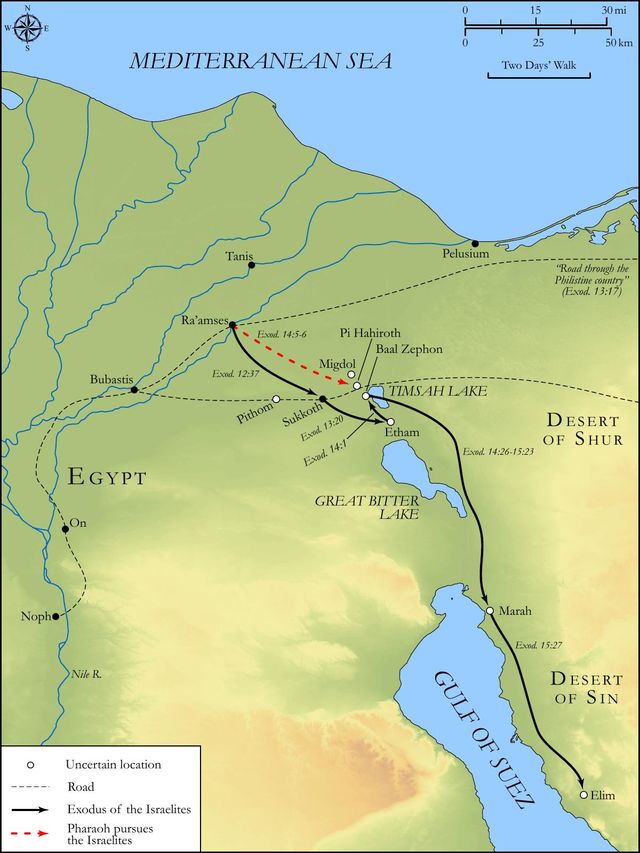
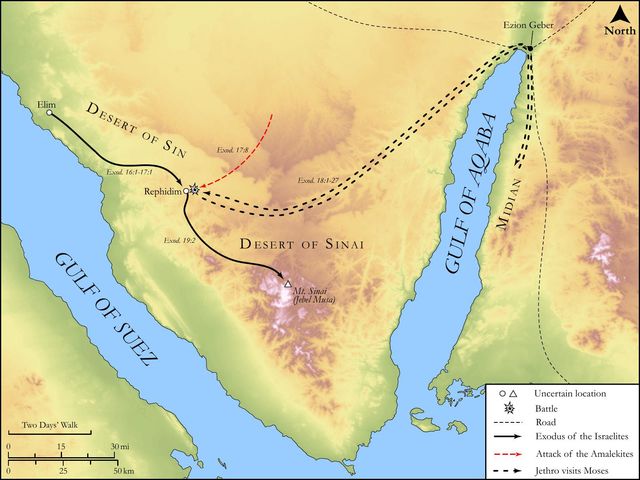
Study this verse
Public-domain commentary
Matthew Henry
From his Commentary on the Whole Bible. Henry comments on passages, not single verses — this entry covers Exodus 14:15–20. His three-level outline is real structure in the source text, so it is rendered as structure.
We have here,
I.Direction given to Israel's leader.
1.What he must do himself. He must, for the present, leave off praying, and apply himself to his business (Exo 14:15): Wherefore cryest thou unto me? Moses, though he was assured of a good issue to the present distress, yet did not neglect prayer. We read not of one word he said in prayer, but he lifted up to God his heart, the language of which God well understood and took notice of. Moses's silent prayers of faith prevailed more with God than Israel's loud outcries of fear, Exo 14:10. Note,
(1.)Praying, if of the right kind, is crying to God, which denotes it to be the language both of a natural and of an importunate desire.
(2.)To quicken his diligence. Moses had something else to do besides praying; he was to command the hosts of Israel, and it was now requisite that he should be at his post. Every thing is beautiful in its season.
2.What he must order Israel to do. Speak to them, that they go forward. Some think that Moses had prayed, not so much for their deliverance (he was assured of that) as for the pardon of heir murmurings, and that God's ordering them to go forward was an intimation of the pardon. There is no going forward with any comfort but in the sense of our reconciliation to God. Moses had bidden them stand still, and expect orders from God; and now orders are given. They thought they must have been directed either to the right hand or to the left. "No," says God, "speak to them to go forward, directly to the sea-side;" as if there had lain a fleet of transport-ships ready for them to embark in. Note, When we are in the way of our duty, though we met with difficulties, we must go forward, and not stand in mute astonishment; we must mind present work and then leave the even to God, use means and trust him with the issue.
3.What he might expect God to do. Let the children of Israel go as far as they can upon dry ground, and then God will divide the sea, and open a passage for them through it, Exo 14:16-18. God designs, not only to deliver the Israelites, but to destroy the Egyptians; and the plan of his counsels is accordingly.
(1.)He will show favour to Israel; the waters shall be divided for them to pass through, Exo 14:16. The same power could have congealed the waters for them to pass over; but Infinite Wisdom chose rather to divide the waters for them to pass through; for that way of salvation is always pitched upon which is most humbling. Thus it is said, with reference to this (Isa 63:13, Isa 63:14), He led them through the deep, as a beast goes down into the valley, and thus made himself a glorious name.
(2.)He will get him honour upon Pharaoh. If the due rent of honour be not paid to the great landlord, by and from whom we have and hold our beings and comforts, he will distrain for it, and recover it. God will be a loser by no man. In order to this, it is threatened: I, behold I, will harden Pharaoh's heart, Exo 14:17. The manner of expression is observable: I, behold I, will do it. "I, that may do it;" so it is the language of his sovereignty. We may not contribute to the hardening of any man's heart, nor withhold any thing that we can do towards the softening of it; but God's grace is his own, he hath mercy on whom he will have mercy, and whom he will be hardeneth. "I, that can do it;" so it is the language of his power; none but the Almighty can make the heart soft (Job 23:16), nor can any other being make it hard. "I, that will do it;" for it is the language of his justice; it is a righteous thing with God to put those under the impressions of his wrath who have long resisted the influences of his grace. It is spoken in a way of triumph over this obstinate and presumptuous rebel: "I even I, will take an effectual course to humble him; he shall break that would not bend." It is an expression like that (Isa 1:24), Ah, I will ease me of my adversaries.
II.A guard set upon Israel's camp where it now lay most exposed, which was in the rear, Exo 14:19, Exo 14:20.
The angel of God, whose ministry was made use of in the pillar of cloud and fire, went from before the camp of Israel, where they did not now need a guide (there was no danger of missing their way through the sea, nor needed they any other word of command than to go forward), and it came behind them, where now they needed a guard (the Egyptians being just ready to seize the hindmost of them), and so was a wall of partition between them. There it was of use to the Israelites, not only to protect them, but to light them through the sea, and, at the same time, it confounded the Egyptians, so that they lost sight of their prey just when they were ready to lay hands on it. The word and providence of God have a black and dark side towards sin and sinners, but a bright and pleasant side towards those that are Israelites indeed. That which is a savour of life unto life to some is a savour of death unto death to others. This was not the first time that he who in the beginning divided between light and darkness (Gen 1:4), and still forms both (Isa 45:7), had, at the same time, allotted darkness to the Egyptians and light to the Israelites, a specimen of the endless distinction which will be made between the inheritance of the saints in light and that utter darkness which for ever will be the portion of hypocrites. God will separate between the precious and the vile.
Historical interpretation
Three Centuries of Reception
4 surviving comments on this verse. Each one is dated, so this reads as a timeline rather than a list.
Select a marker to jump to its quote. Markers stagger vertically where authors wrote within a few decades of each other.
But if the mental voice of those who pray should not be extremely loud, though it is not weak, and should they not raise a cry and shout, God still hears those who pray thus. For it is he who says to Moses, “Why do you cry out to me?” when he had not cried out audibly (for this is not recorded in Exodus), but through prayer he had cried out loudly in that voice which is heard by God alone.
Or do you not hear how Moses, although he said nothing but met the Lord with his inexpressible groanings, was heard by the Lord, who said, “Why do you cry to me?” God knows how to hear even the blood of a just man, to which no tongue is attached and of which no voice pierces the air. The presence of good works is a loud voice before God.
The word cry in Scripture does not refer to the cry of the voice but to the cry of the heart. In fact, the Lord says to Moses, “Why are you crying out to me?” when Moses had not muttered any cry at all.
The heart reveals its silent longing, to which the Godhead listens more than to the most thundering voices of nations. He said to Moses, “Why do you cry to me?” although we do not read that Moses had said anything. So the faithful man said that his heart was speaking to the Lord, since he seemed to offer his thoughts by this means.
Continue studying Exodus 14:15 across the web’s major study libraries — every link below opens this exact verse, chapter, or book on the destination site.
Read & Compare
 BibleGatewayThis verse in more than 200 translations and 70 languages.
 Bible.comThe YouVersion reader — hundreds of translations, reading plans, and highlights.
 ESV.orgCrossway's official English Standard Version reader.
 NET BibleThe NET translation with 60,000+ translators' notes on every rendering decision.
 STEP BibleTyndale House's free study tool — original text, vocabulary, and scholarly resources.
 BibliaLogos Bible Software's free web reader.
 USCCBThe New American Bible (Revised Edition) with the U.S. bishops' study notes.
Commentaries
 BibleHub CommentariesDozens of classic commentaries on this verse, gathered on one page.
 StudyLightMore than 100 commentary sets — the largest collection on the web.
 BibleRefPlain-English commentary on what this verse means, verse by verse.
 Enduring WordDavid Guzik's free commentary on this chapter, widely used by Bible teachers.
 Bible Study ToolsVerse commentary alongside Greek and Hebrew study aids.
Original Language & Research
- BibleHub InterlinearThe verse word by word — original language, transliteration, and English.
- BibleHub LexiconEvery word's original-language definition and Strong's entry.
 Blue Letter BibleDeep-study tools — Strong's numbers, concordance, and word studies.
 SefariaThe Hebrew text with Rashi and centuries of Jewish commentary.
Sermons, Hymns & Audio


TrulyRandomVerse is not affiliated with these sites and doesn’t control their content. They’re linked because they’re genuinely useful.
Summary
Exodus 14:15 captures a pivotal moment at the Red Sea, where the Lord confronts Moses's desperate plea amidst Israel's terror, redirecting both leader and people from panicked lamentation to decisive action. Trapped between Pharaoh's pursuing army and the impassable sea, this verse marks God's command for immediate, faith-filled movement, signaling a critical shift from passive despair to active obedience as the prerequisite for divine intervention and miraculous deliverance.
Context
ShowHideLiterary Context
This verse is strategically placed at the dramatic climax of the Exodus narrative, immediately following the Israelites' panicked outcry and bitter complaints against Moses, as Pharaoh's formidable army closes in behind them Exodus 14:9-12. Having just witnessed the awe-inspiring plagues, the newly liberated people quickly succumb to terror when faced with an existential threat, longing for the perceived security of Egyptian bondage over the terrifying uncertainty of freedom. Moses, in turn, cries out to the Lord, seemingly overwhelmed by the crisis. God's sharp question and subsequent command in [Exodus 14:15 "God's Command to Moses"] serve as a direct, powerful response to Moses's distress and the people's despair, setting the stage for the miraculous parting of the Red Sea Exodus 14:16 and the subsequent destruction of the Egyptian forces, culminating in Israel's complete deliverance Exodus 14:21-31.
Historical & Cultural Context
The Israelites, having endured centuries of brutal slavery, were a people stripped of agency and initiative, accustomed to external control. Their sudden liberation, while miraculous, left them vulnerable to deeply ingrained fears and a dependency characteristic of a newly freed, unorganized multitude. Among the kings of that day, military power was paramount, and the Egyptian army was widely considered invincible. The idea of confronting such a force, or moving into a seemingly impassable natural barrier like the Red Sea, would have been utterly unthinkable to them. Furthermore, the cultural expectation of divine intervention often involved a deity acting unilaterally to save their people, not necessarily demanding a human step of faith into the unknown. This context profoundly highlights the radical nature of God's command, which challenged their ingrained fear and dependency, calling them to an active, counter-intuitive role in their own deliverance.
Key Themes
ShowHideExodus 14:15 is central to several profound themes woven throughout the book of Exodus and the broader Pentateuch. It powerfully underscores the theme of Divine Sovereignty and Deliverance, demonstrating that God is not only capable of saving His people from impossible situations but also orchestrates the means of that salvation. It introduces the critical theme of Faith and Obedience, revealing that while God is the ultimate rescuer, He often requires human participation—a step of trust and action—before revealing His mighty hand. The verse also highlights the tension between Human Despair and Divine Expectation, contrasting the Israelites' fear and lamentation with God's call to courageous movement. This event, where God makes a way through an impassable barrier, becomes a foundational narrative for the theme of God's power to overcome all obstacles, a truth echoed throughout Israel's history and prophetic literature, such as in Isaiah's promise of a highway in the wilderness.
Exposition and Analysis
ShowHideKey Word Analysis
ShowHideThis is the self-Existent or Eternal God, Jehovah, the Jewish national name of God. The use of this covenant name emphasizes that the command comes from the God who has revealed Himself to Israel, the God who is faithful to His promises, and the God who has the inherent power to bring about what He commands, even in the face of impossibility. It underscores His authority and unchanging nature.
Meaning "to shriek; (by implication) to proclaim (an assembly); (idiom) at all, call together, cry (out), gather (selves) (together)." While tsâʻaq can denote a sincere appeal for help, in this context, God's rhetorical question suggests Moses's cry was one of overwhelming distress and panic, perhaps even a plea for God to act unilaterally, rather than a confident intercession seeking specific divine direction. It implies a cry born of helplessness and fear, rather than active faith in God's known power and plan.
A primitive root meaning "perhaps properly, to arrange; but used figuratively (of words), to speak; rarely (in a destructive sense) to subdue." This imperative command to Moses signifies a shift from his personal lament to his public role as God's mouthpiece. Moses is to "speak" God's direct and authoritative instruction to the people, arranging their next action. It is a command for clear, decisive communication, not passive waiting.
A primitive root meaning "properly, to pull up, especially the tent-pins, i.e., start on a journey; cause to blow, bring, get, (make to) go (away, forth, forward, onward, out), (take) journey, march, remove, set aside (forward), (idiom) still, be on his (go their) way." This verb implies immediate, decisive, and collective movement. It is a command to break camp and proceed, not to wait, hesitate, or seek further signs. It demands physical progression into what appears to be an impassable barrier, requiring an extraordinary act of faith.
Verse Breakdown
ShowHide"And the LORD said unto Moses, Wherefore criest thou unto me?"
This opening clause highlights God's direct engagement with Moses's distress. The question is not a rebuke of prayer itself, but a redirection of Moses's focus and the nature of his prayer. It implies that the time for desperate, panicked lamentation has passed, and the situation now demands a different kind of response—one rooted in active faith and obedience. God's question shifts Moses from a posture of passive pleading to one of active participation in the divine plan, indicating that the next step requires human initiative.
"speak unto the children of Israel,"
This is an imperative command to Moses, re-establishing his leadership and his role as God's appointed messenger. The divine directive is not just for Moses personally, but for him to convey it authoritatively to the entire nation. This emphasizes the collective nature of the command and the necessity of the people's unified response. It underscores that God's plan involves the entire community, and their obedience is crucial.
"that they go forward:"
This is the core, decisive command. It is a direct, imperative instruction for immediate, collective action. The command to "go forward" into an apparent dead end—the Red Sea—is the ultimate test of faith. It signifies that God's deliverance would not come through passive waiting or miraculous intervention without human involvement, but through a courageous step of obedience, even when the path seemed utterly impossible. It powerfully illustrates that God often requires His people to move in faith before He reveals His mighty hand of salvation, transforming an obstacle into a path.
Literary Devices
ShowHideExodus 14:15 masterfully employs several literary devices to convey its powerful message. The verse opens with a rhetorical question: "Wherefore criest thou unto me?" This is not a genuine inquiry for information, but a pointed statement designed to prompt reflection and redirect action. God knows why Moses is crying out, but by asking, He challenges Moses's current posture of despair and helplessness, implying that such a cry is no longer appropriate for the moment. This question serves as a dramatic pivot, shifting the narrative from human lament to divine command. Following this, the command "go forward" functions as a profound metaphor for faith-filled action in the face of overwhelming odds. The physical act of moving into the sea represents a spiritual leap of trust beyond visible obstacles into the realm of divine possibility. The juxtaposition of Moses's "crying out" and God's "speak... go forward" also creates a stark contrast, highlighting the difference between human fear and divine expectation, and between passive pleading and active obedience.
THEOLOGICAL AND THEMATIC CONNECTIONS
ShowHideThis verse encapsulates profound theological truths about God's character and His dynamic relationship with humanity. It reveals God as utterly sovereign, not only in His power to deliver but also in His expectation of human participation through faith and obedience. It underscores that while crying out to God in distress is a valid expression of dependence, there are pivotal moments when God calls His people to transcend lamentation and step into active trust. This demonstrates that genuine faith is not merely intellectual assent but an active, responsive trust that translates into concrete action. The central theme of God making a way where there seems to be no way is powerfully established here, emphasizing His omnipotence to overcome seemingly insurmountable barriers and His faithfulness to His covenant promises. This dramatic event at the Red Sea prefigures the ultimate deliverance found in Christ, where God makes a way for humanity's salvation through His Son.
Reflection and Application
ShowHideExodus 14:15 offers timeless and profound lessons for believers navigating the "Red Sea" moments of their own lives—those overwhelming obstacles or seemingly impossible situations that induce fear and despair. While it is entirely natural and biblically sound to cry out to God in distress, this verse serves as a powerful reminder that there comes a critical juncture where God expects us to transition from passive pleading to active, courageous obedience. Sometimes, God's answer to our desperate prayers is not a miraculous sign delivered while we stand still, but a clear command to "go forward"—to take a decisive step of faith, even when the path ahead appears utterly blocked or fraught with danger. This might involve stepping out of our comfort zones, taking a calculated risk based on divine prompting, or simply trusting God's direction when we cannot see the full picture or understand the outcome. It teaches us that God's power is often most dramatically manifested when we dare to obey His call to move, transforming our paralyzing fear into dynamic, faithful action that opens the way for His miraculous intervention.
Questions for Reflection
ShowHideFAQ
ShowHideDoes God disapprove of crying out to Him in distress?
ShowHideNo, God does not disapprove of genuine cries for help. The Psalms are replete with expressions of lament and desperate appeals to God, and even Jesus Himself cried out to His Father in moments of intense suffering ([Psalm 22:1 "Psalm 22:1 - My God, My God, Why Have You Forsaken Me?"]; [Matthew 27:46 "Matthew 27:46 - Jesus' Cry on the Cross"]). However, in [Exodus 14:15 "God's Command to Moses"], God's question to Moses is not a rebuke of prayer itself, but a redirection. It implies that the time for passive lamentation has passed, and the situation now calls for active faith and obedience. It's a shift from a cry of helplessness to a command for decisive action, indicating that God had a plan that required human participation and movement.
Why did God command them to "go forward" into the sea, which seemed impossible?
ShowHideGod commanded them to "go forward" into the seemingly impossible situation of the Red Sea for several profound reasons. Primarily, it was to demonstrate His absolute power and sovereignty over all creation, and to require a crucial step of faith from His people. By commanding them to move into the very obstacle that appeared to trap them, God was setting the stage for one of the most iconic and foundational miracles in the Bible—the parting of the Red Sea. This act of obedience, even into the impossible, allowed God to display His mighty hand of deliverance in a way that glorified Him, solidified His covenant relationship with Israel, and instilled in them a lasting understanding of His power to make a way where there is no way Exodus 14:21-22.
Is this verse saying prayer isn't always the answer, or that action is more important than prayer?
ShowHideThis verse is not diminishing the importance of prayer; rather, it highlights that prayer should often lead to obedience and action. There are indeed times for fervent intercession, for waiting on God's timing, and for seeking His face. However, there are also times when God's answer to prayer is a direct command to move. It teaches that faith is active, not passive. While prayer is foundational for receiving divine direction and strength, it should not become a substitute for acting on that direction. God often waits for us to take a step of faith before revealing the next part of His plan, demonstrating that true faith involves both trust in His sovereignty and responsive action to His commands James 2:26.
Christ-Centered Fulfillment
ShowHideThe dramatic narrative of the Exodus, and specifically the miraculous crossing of the Red Sea, functions as a profound type and shadow of the greater deliverance accomplished through the person and work of Jesus Christ. Just as the LORD led Israel through an impossible barrier to freedom from physical bondage, Jesus leads His people through the ultimate, seemingly impassable barrier of sin, death, and separation from God to new life and spiritual freedom. The divine command to "go forward" into the Red Sea prefigures the New Testament call to "go forward" in faith into the new covenant established by Christ's sacrificial death and glorious resurrection. Indeed, the Apostle Paul explicitly interprets the Red Sea crossing as a type of baptism, symbolizing a new beginning and identification with God's saving work in Christ 1 Corinthians 10:1-2. Jesus Christ is the ultimate Deliverer, the one who truly makes a way where there is no way, providing the only path to reconciliation with God. His call to "follow me" Matthew 4:19 inherently involves stepping out in faith, leaving behind old ways of sin and self-reliance, and moving into the unknown, yet divinely promised, future He has prepared. Just as God's command to "go forward" required Israel's obedience for their physical salvation, so too does the gospel call for a step of faith and obedience to Christ for spiritual salvation and new life in Him John 3:16. He is the Good Shepherd who leads His people through the wilderness of this world to the promised land of eternal life, having already overcome the greatest obstacles on their behalf John 10:11.