


Exodus 14:10
- וּפַרְעֹהu·far·'Ohand PharaohH6547Conj-w ¦ N-msNoun Title Singular Masculine AbsoluteוּandפַרְעֹהPharaoh
- הִקְרִיבhik·Rivhe drew nearH7126V-Hiphil-Perf-3msVerb Hiphil Perfect 3rd Singular Masculine
- וַיִּשְׂאוּvai·yis·'Uand they lifted upH5375Conj-w ¦ V-Qal-ConsecImperf-3mpVerb Qal Consecutive Imperfect 3rd Plural Masculineוַandיִּשְׂאוּthey lifted up
- בְנֵיve·nei[the] people ofH1121N-mpcNoun Plural Masculine Construct
- יִשְׂרָאֵלYis·ra·'ElIsraelH3478N-properNoun Proper Location
- אֶת'et<obj.>H853DirObjMParticle Object Indicator
- עֵינֵיהֶם'ei·nei·Hemtheir eyesH5869N-fdc ¦ 3mpNoun Dual Feminine Constructעֵינֵיeyesהֶםtheir
- וְהִנֵּהve·hi·Nehand there!H2009Conj-w ¦ PrtParticle Interjectionוְandהִנֵּהthere!
- מִצְרַיִםmitz·Ra·yimEgyptH4713N-properNoun Proper Location
- נֹסֵעַno·Se·a'[was] marchingH5265V-Qal-Prtcpl-msVerb Qal Participle Singular Masculine Absolute
- אַחֲרֵיהֶם'a·cha·rei·Hemafter themH310Adj-mpc ¦ 3mpAdjective Numerical Plural Masculine Constructאַחֲרֵיafterהֶםthem
- וַיִּירְאוּvai·yi·re·'Uand they were afraidH3372Conj-w ¦ V-Qal-ConsecImperf-3mpVerb Qal Consecutive Imperfect 3rd Plural Masculineוַandיִּירְאוּthey were afraid
- מְאֹדme·'OdexceedinglyH3966Adj-msAdjective Numerical Singular Masculine Absolute
- וַיִּצְעֲקוּvai·yitz·'a·Kuand they cried outH6817Conj-w ¦ V-Qal-ConsecImperf-3mpVerb Qal Consecutive Imperfect 3rd Plural Masculineוַandיִּצְעֲקוּthey cried out
- בְנֵיve·nei[the] people ofH1121N-mpcNoun Plural Masculine Construct
- יִשְׂרָאֵלYis·ra·'ElIsraelH3478N-properNoun Proper Location
- אֶל'eltoH413PrepPreposition
- יְהוָהYah·wehYahwehH3068N-properNoun Proper Title
English is a literal word-by-word gloss of the Hebrew, not the KJV's wording. Why?
This is the original text the KJV's translators worked from — each Hebrew word with its own literal English meaning in this verse, prepared by scholars at Tyndale House, Cambridge. The KJV translates whole sentences, not word by word, so its wording differs: one Hebrew word can become several English words, and the KJV may choose “the LORD” where the gloss reads “Yahweh”. Both are faithful — they answer different questions. For the KJV's own rendering, switch to the KJV text.
Details
See on the biblical-era map

Study this verse
Public-domain commentary
Matthew Henry
From his Commentary on the Whole Bible. Henry comments on passages, not single verses — this entry covers Exodus 14:10–14. His three-level outline is real structure in the source text, so it is rendered as structure.
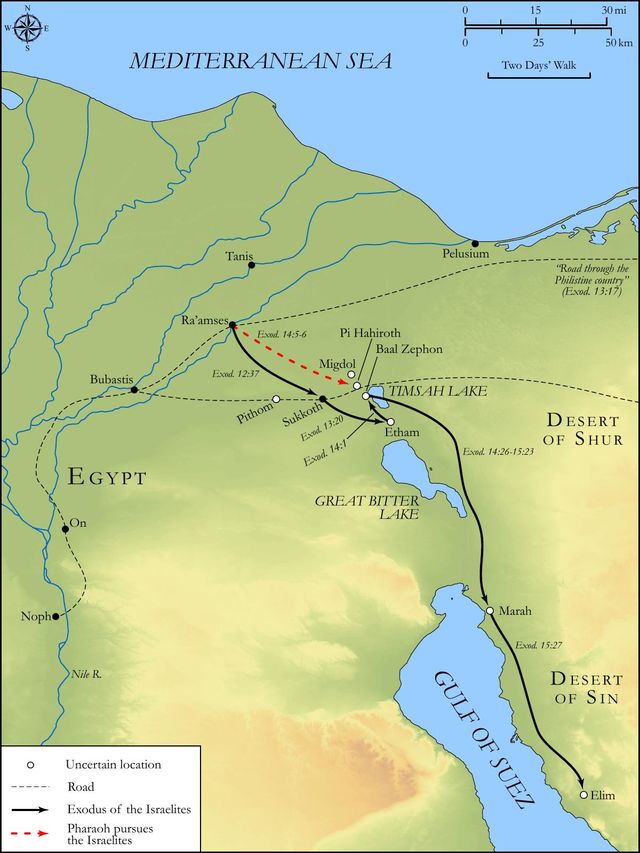
We have here, I. The fright that the children of Israel were in when they perceived that Pharaoh pursued them, Exo 14:10. They knew very well the strength and rage of the enemy, and their own weakness; numerous indeed they were, but all on foot, unarmed, undisciplined, disquieted by long servitude, and (which was worst of all) now penned up by the situation of their camp, so that they could not make their escape. On the one hand was Pi-hahiroth, a range of craggy rocks impassable; on the other hand were Migdol and Baalzephon, which, some think were forts and garrisons upon the frontiers of Egypt; before them was the sea; behind them were the Egyptians: so that there was no way open for them but upwards, and thence their deliverance came. Note, We may be in the way of our duty, following God and hastening towards heaven, and yet may be in great straits, troubled on every side, Co2 4:8. In this distress, no marvel that the children of Israel were sorely afraid; their father Jacob was so in a like case (Gen 32:7); when without are fightings, it cannot be otherwise but that within are fears: what therefore was the fruit of this fear? According as that was, the fear was good or evil. 1. Some of them cried out unto the Lord; their fear set them a praying, and that was a good effect of it. God brings us into straits that he may bring us to our knees. 2. Others of them cried out against Moses; their fear set them a murmuring, Exo 14:11, Exo 14:12. They give up themselves for lost; and as if God's arm were shortened all of a sudden, and he were not as able to work miracles today as he was yesterday, they despair of deliverance, and can count upon nothing but dying in the wilderness. How inexcusable was their distrust! Did they not see themselves under the guidance and protection of a pillar from heaven? And can almighty power fail them, or infinite goodness be false to them? Yet this was not the worst; they quarrel with Moses for bringing them out of Egypt, and, in quarrelling with him, fly in the face of God himself, and provoke him to wrath whose favour was now the only succour they had to flee to. As the Egyptians were angry with themselves for the best deed they ever did, so the Israelites were angry with God for the greatest kindness that was ever done them; so gross are the absurdities of unbelief. They here express, (1.) A sordid contempt of liberty, preferring servitude before it, only because it was attended with some difficulties. A generous spirit would have said, "If the worst come to the worst," as we say, "It is better to die in the field of honour than to live in the chains of slavery;" nay, under God's conduct, they could not miscarry, and therefore they might say, "Better live God's freemen in the open air of a wilderness than the Egyptians' bondmen in the smoke of the brick-kilns." But because, for the present, they are a little embarrassed, they are angry that they were not left buried alive in their house of bondage. (2.) Base ingratitude to Moses, who had been the faithful instrument of their deliverance. They condemn him, as if he had dealt hardly and unkindly with them, whereas it was evident, beyond dispute, that whatever he did, and however it issued, it was by direction from their God, and with design for their good. What they had said in a former ferment (when they hearkened not to Moses for anguish of spirit), they repeat and justify in this: We said in Egypt, Let us alone; and it was ill-said, yet more excusable, because then they had not had so much experience as they had now of God's wonderful appearances in their favour. But they had as soon forgotten the miracles of mercy as the Egyptians had forgotten the miracles of wrath; and they, as well as the Egyptians, hardened their hearts, at last, to their own ruin; as Egypt after ten plagues, so Israel after ten provocations, of which this was the first (Num 14:22), were sentenced to die in the wilderness.
II.The seasonable encouragement that Moses gave them in this distress, Exo 14:13, Exo 14:14.
He answered not these fools according to their folly. God bore with the provocation they gave to him, and did not (as he might justly have done) chose their delusions, and bring their fears upon them; and therefore Moses might well afford to pass by the affront they put upon him. Instead of chiding them, he comforts them, and with an admirable presence and composure of mind, not disheartened either by the threatenings of Egypt or the tremblings of Israel, stills their murmuring, with the assurance of a speedy and complete deliverance: Fear you not. Note, It is our duty and interest, when we cannot get out of our troubles, yet to get above our fears, so that they may only serve to quicken our prayers and endeavours, but may not prevail to silence our faith and hope.
1.He assures them that God would deliver them, that he would undertake their deliverance, and that he would effect it in the utter ruin of their pursuers: The Lord shall fight for you. This Moses was confident of himself, and would have them to be so, though as yet he knew not how or which way it would be brought to pass. God had assured him that Pharaoh and his host should be ruined, and he comforts them with the same comforts wherewith he had been comforted.
2.He directs them to leave it to God, in a silent expectation of the event: "Stand still, and think not to save yourselves either by fighting or flying; wait God's orders, and observe them; be not contriving what course to take, but follow your leader; wait God's appearances, and take notice of them, that you may see how foolish you are to distrust them. Compose yourselves, by an entire confidence in God, into a peaceful prospect of the great salvation God is now about to work for you. Hold your peace; you need not so much as give a shout against the enemy, as Jos 6:16. The work shall be done without any concurrence of yours." Note,
(1.)If God himself bring his people into straits, he will himself discover a way to bring them out again.
(2.)In times of great difficulty and great expectation, it is our wisdom to keep our spirits calm, quiet, and sedate; for then we are in the best frame both to do our own work and to consider the work of God. Your strength is to sit still (Isa 30:7), for the Egyptians shall help in vain, and threaten to hurt in vain.
Continue studying Exodus 14:10 across the web’s major study libraries — every link below opens this exact verse, chapter, or book on the destination site.
Read & Compare
 BibleGatewayThis verse in more than 200 translations and 70 languages.
 Bible.comThe YouVersion reader — hundreds of translations, reading plans, and highlights.
 ESV.orgCrossway's official English Standard Version reader.
 NET BibleThe NET translation with 60,000+ translators' notes on every rendering decision.
 STEP BibleTyndale House's free study tool — original text, vocabulary, and scholarly resources.
 BibliaLogos Bible Software's free web reader.
 USCCBThe New American Bible (Revised Edition) with the U.S. bishops' study notes.
Commentaries
 BibleHub CommentariesDozens of classic commentaries on this verse, gathered on one page.
 StudyLightMore than 100 commentary sets — the largest collection on the web.
 BibleRefPlain-English commentary on what this verse means, verse by verse.
 Enduring WordDavid Guzik's free commentary on this chapter, widely used by Bible teachers.
 Bible Study ToolsVerse commentary alongside Greek and Hebrew study aids.
Original Language & Research
- BibleHub InterlinearThe verse word by word — original language, transliteration, and English.
- BibleHub LexiconEvery word's original-language definition and Strong's entry.
 Blue Letter BibleDeep-study tools — Strong's numbers, concordance, and word studies.
 SefariaThe Hebrew text with Rashi and centuries of Jewish commentary.
Sermons, Hymns & Audio


TrulyRandomVerse is not affiliated with these sites and doesn’t control their content. They’re linked because they’re genuinely useful.
Summary
Exodus 14:10 captures the Israelites' immediate, visceral reaction to extreme peril: trapped between the pursuing Egyptian army and the impassable Red Sea, they were overwhelmed by fear but instinctively cried out to the LORD, setting the stage for one of the most dramatic divine interventions in biblical history.
Context
ShowHideLiterary Context
This verse immediately follows Pharaoh's change of heart and his decision to pursue the Israelites with his elite chariots and army, as detailed in Exodus 14:5-9. The narrative has meticulously built tension, with God intentionally leading Israel to a seemingly inescapable position by the Red Sea, a strategic maneuver described in Exodus 14:1-4. Following the dramatic moment of fear and crying out in Exodus 14:10, the Israelites' panic quickly escalates into bitter complaint against Moses, articulated in Exodus 14:11-12, which then prompts Moses's profound reassurance and God's powerful command to move forward and witness His salvation in Exodus 14:13-14.
Historical & Cultural Context
The scene unfolds shortly after the climactic tenth plague and the Israelites' hurried departure from Egypt, an epochal event known as the Exodus. Pharaoh, having initially released them under duress, now views their departure as a massive economic and labor loss, prompting his mobilization of a formidable military force, including 600 chosen chariots—the most advanced and devastating military technology of the ancient Near East. The Israelites, a vast multitude of former slaves, were largely unarmed, untrained for battle, and unorganized. Their position, hemmed in by the desert, the impassable sea, and the rapidly approaching chariots, represented a classic "no-win" scenario in ancient warfare, where a trapped, unorganized group would typically face annihilation or re-enslavement. Their "sore afraid" reaction was a natural, culturally understandable response to facing a superior, vengeful military power with no apparent means of escape.
Key Themes
ShowHideExodus 14:10 is pivotal in developing several key themes within the book of Exodus and the broader biblical narrative. It powerfully illustrates the theme of Divine Sovereignty, demonstrating God's intentional orchestration of events to display His power over all earthly forces, including the mightiest empire. Concurrently, it highlights Human Helplessness and Dependence, as the Israelites, despite having witnessed God's mighty plagues, are reduced to utter terror and desperation, underscoring their absolute need for divine intervention. This moment also serves as a critical test of their nascent Faith, challenging them to trust in the God who had already delivered them. Ultimately, the verse sets the stage for God's dramatic Deliverance, showcasing Him as the faithful covenant God who hears the cries of His people and acts decisively to save them, a theme that resonates throughout the entire narrative of the Exodus journey.
Exposition and Analysis
ShowHideExodus 14:10 is a concise yet powerful depiction of human vulnerability and divine dependence, capturing a pivotal moment of crisis and response.
Key Word Analysis
ShowHideThis primitive root means "to fear," but also carries the moral sense "to revere" and causatively "to frighten." In this context, it describes a profound, visceral terror, a state of being "affrighted" or "dreadful," highlighting the overwhelming panic that gripped the Israelites as they faced imminent destruction.
Derived from a root meaning "vehemence," this adverb functions as an intensifier. When paired with "afraid," it signifies "exceedingly," "greatly," or "very much afraid." It emphasizes the extreme, overwhelming nature of their fear, indicating it was not a mild apprehension but a deep, all-consuming terror.
This primitive root means "to shriek" or "to call for help." It implies a loud, desperate, and urgent plea, often a primal scream for deliverance in a moment of extreme distress. While it can also mean "to proclaim," here it denotes a desperate appeal for divine intervention.
Verse Breakdown
ShowHideThe verse unfolds as a dramatic sequence of events and reactions, revealing the Israelites' predicament and their initial response.
Literary Devices
ShowHideThe verse employs Dramatic Tension, creating a palpable sense of entrapment and impending doom. The stark Contrast between the overwhelming power of Pharaoh's elite army and the utter helplessness of the unarmed, unorganized Israelites heightens the drama and underscores the impossible odds they faced. The immediate shift from a state of being "sore afraid" to the action of "cried out unto the LORD" functions as a powerful Juxtaposition, highlighting the human tendency to turn to a higher power when all other options are exhausted. This pivotal moment serves as a Foreshadowing, setting the stage for God's miraculous display of sovereignty and demonstrating His unique ability to deliver His people from impossible situations.
Theological and Thematic Connections
ShowHideExodus 14:10 reveals profound theological truths about God's character, humanity's vulnerability, and the nature of divine salvation. It powerfully illustrates humanity's natural response of fear and despair when confronted with seemingly insurmountable odds, yet even in their panic, their cry to the LORD underscores a foundational, albeit desperate, understanding of God's ultimate authority and covenant faithfulness. This moment is not a failure of God's plan, but an intentional part of it, designed to demonstrate His unparalleled power and sovereignty over all earthly forces, including the mightiest empire. God often allows His people to reach the end of their own strength so that His deliverance can be clearly seen as a divine, not human, accomplishment, thus solidifying His identity as their faithful Deliverer and testing their nascent faith.
Cross-References:
Reflection and Application
ShowHideExodus 14:10 offers profound and enduring relevance for believers today, serving as a timeless spiritual mirror. Like the Israelites, we frequently encounter "Red Sea moments" – situations where we feel utterly trapped, overwhelmed, and facing seemingly insurmountable odds, whether in our finances, relationships, health, or spiritual battles against temptation and despair. This verse powerfully reminds us that fear, in itself, is a natural and understandable human emotion; the biblical narrative does not condemn the feeling but rather the direction we turn in its grip. The Israelites' initial, raw fear was a genuine reaction to an existential threat. Crucially, however, despite their panic, their immediate instinct was to "cry out unto the LORD." This serves as a powerful model for us: when circumstances are dire and our own resources are exhausted, our first and most vital response should be to turn to God in desperate prayer and supplication, rather than succumbing to despair, complaining, or attempting to solve everything in our own limited strength. The narrative assures us that God often permits us to reach such points of extreme human helplessness precisely so that His mighty deliverance can be undeniably evident, demonstrating that He is capable of acting most powerfully when we are most acutely aware of our need for Him, thus deepening our trust and dependence.
Questions for Reflection
ShowHideFAQ
ShowHideWhy did God lead the Israelites to such a dangerous, seemingly inescapable place?
ShowHideGod intentionally led the Israelites to the Red Sea, not to trap them, but to demonstrate His power and glory over Pharaoh and Egypt one final time, as explicitly stated in Exodus 14:4. By placing them in an impossible situation, God ensured that His deliverance would be undeniably miraculous, solidifying His reputation among both the Israelites and the Egyptians, and teaching Israel to trust Him alone as their sovereign Deliverer.
Was the Israelites' fear a sign of weak faith?
ShowHideTheir initial fear was a natural human reaction to an overwhelming and life-threatening situation. While their subsequent complaints and expressions of doubt in Exodus 14:11-12 do indicate a wavering faith and a short memory of God's past deliverances, their initial "cry out unto the LORD" in Exodus 14:10 suggests a foundational, albeit desperate, recognition of God's power and their dependence on Him. It highlights that even in moments of profound fear, turning to God is the right response, and He meets us in our weakness, often using such moments to deepen our faith.
Why did Pharaoh pursue them if he had just let them go after the plagues?
ShowHidePharaoh's heart was hardened by God, as indicated in Exodus 14:4, leading him to regret letting go of such a vast and valuable labor force. His immense pride, the significant economic loss to Egypt, and a deep-seated desire for revenge compelled him to mobilize his army and pursue them. This pursuit was part of God's sovereign plan to bring about His ultimate triumph over Pharaoh and his army, demonstrating His unrivaled power to all nations.
Christ-Centered Fulfillment
ShowHideExodus 14:10 serves as a powerful foreshadowing of the ultimate deliverance found in Jesus Christ, revealing a pattern of divine rescue that culminates in Him. The Israelites' desperate cry in the face of an insurmountable enemy—Pharaoh and his mighty army—and an impassable barrier, the Red Sea, vividly points to humanity's far greater plight: trapped by the overwhelming power of sin and death, with no way to escape on our own. Jesus Christ emerges as the ultimate Deliverer, coming to rescue us from a bondage infinitely more profound than Egyptian slavery. Where Pharaoh and his forces represent the spiritual enemies of evil, sin, and death that hold humanity captive, Jesus, through His perfect life, atoning death, and triumphant resurrection, decisively defeated these spiritual principalities and powers, triumphing over them on the cross as described in Colossians 2:15. Just as God miraculously parted the Red Sea to create a way of salvation for His people, Jesus's sacrificial death and resurrection opened the way for humanity's salvation from sin's dominion and eternal death, embodying the ultimate "Red Sea" moment where God makes a way where there was no way, leading His people through the waters of judgment to new life in Him, as powerfully illustrated in Romans 6:3-4. The Israelites cried out to the LORD, and He heard them; similarly, in the New Covenant, we are called to cry out to Jesus, the Lord, for salvation, knowing that He hears our desperate pleas and offers complete and eternal deliverance from our spiritual enemies, as promised in Romans 10:9-10. Even Jesus Himself faced overwhelming fear and distress in Gethsemane, as recounted in Luke 22:44, yet He submitted to the Father's will, demonstrating perfect trust; He now invites us, when "sore afraid" by the challenges of life or the fear of death, to cast all our anxieties on Him, for He cares for us and has definitively overcome the world, a truth echoed in 1 Peter 5:7 and John 16:33. Thus, Exodus 14:10 not only highlights God's historical faithfulness in a dramatic act of salvation but also powerfully anticipates the final, decisive, and eternal act of liberation accomplished through Jesus Christ, our ultimate Liberator and Deliverer.