


Luke 22:44
- καὶkaiAndG2532CONJConjunction
- γενόμενοςgenomenoshaving beenG1096V-2ADP-NSMVerb 2nd Aorist Middle Deponent Participle Nominative Singular Masculine
- ἐνeninG1722PREPPreposition
- ἀγωνίᾳagōniaagonyG74N-DSFNoun Dative Singular Feminine
- ἐκτενέστερονektenesteronmore earnestlyG1617A-ASN-CAdjective Accusative Singular Neuter Comparative
- προσηύχετοprosēuchetoHe was prayingG4336V-INI-3SVerb Imperfect Middle Or Passive Deponent Indicative 3rd Singular
- ἐγένετοegenetobecameG1096V-2ADI-3SVerb 2nd Aorist Middle Deponent Indicative 3rd Singular
- δὲdenowG1161CONJConjunction
- ὁhotheG3588T-NSMDefinite article Nominative Singular Masculine
- ἱδρὼςhidrōssweatG2402N-NSMNoun Nominative Singular Masculine
- αὐτοῦautouof HimG846P-GSMPersonal pronoun Genitive Singular Masculine
- ὡσεὶhōseilikeG5616PREPPreposition
- θρόμβοιthromboigreat dropsG2361N-NPMNoun Nominative Plural Masculine
- αἵματοςaimatosof bloodG129N-GSNNoun Genitive Singular Neuter
- καταβαίνοντεςkatabainontesfalling downG2597V-PAP-NPMVerb Present Active Participle Nominative Plural Masculine
- ἐπὶepiuponG1909PREPPreposition
- τὴνtēntheG3588T-ASFDefinite article Accusative Singular Feminine
- γῆνgēngroundG1093N-ASFNoun Accusative Singular Feminine
English is a literal word-by-word gloss of the Greek, not the KJV's wording. Why?
This is the original text the KJV's translators worked from — each Greek word with its own literal English meaning in this verse, prepared by scholars at Tyndale House, Cambridge. The KJV translates whole sentences, not word by word, so its wording differs: one Greek word can become several English words, and the KJV may choose “charity” where the gloss reads “love”. Both are faithful — they answer different questions. For the KJV's own rendering, switch to the KJV text.
Details
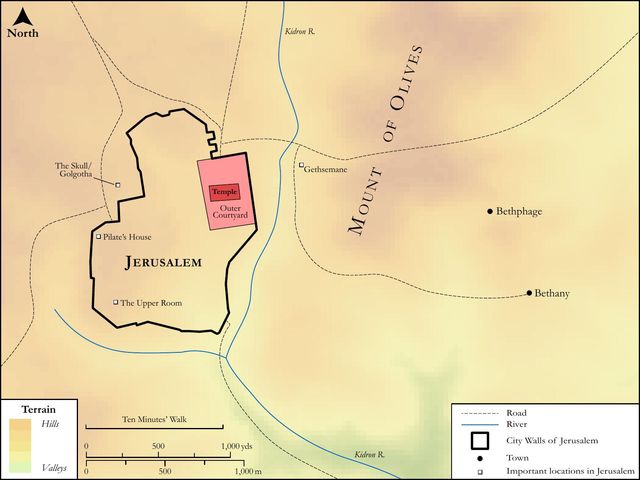
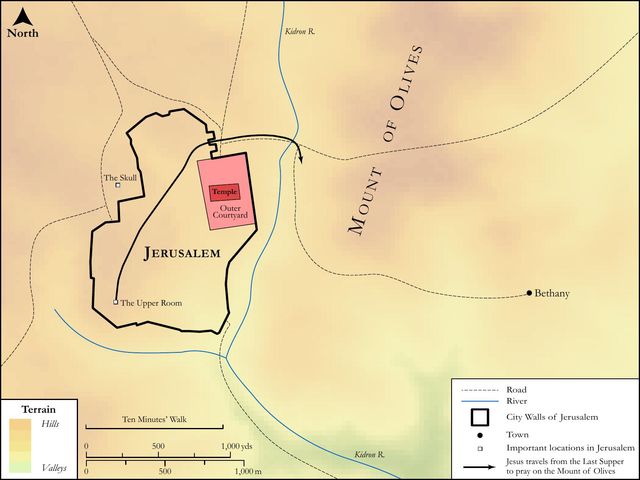
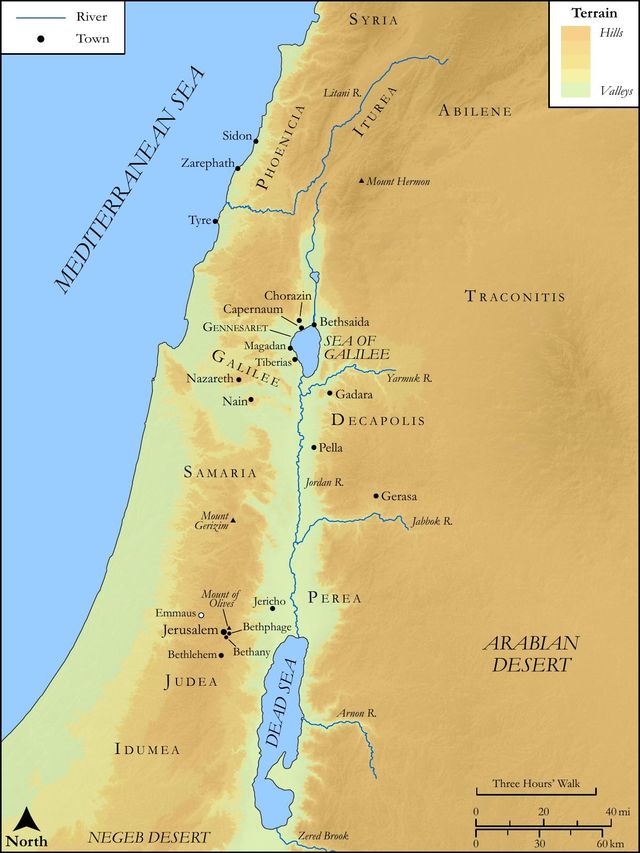
See on the biblical-era map
Study this verse
Public-domain commentary
Matthew Henry
From his Commentary on the Whole Bible. Henry comments on passages, not single verses — this entry covers Luke 22:39–46. His three-level outline is real structure in the source text, so it is rendered as structure.
We have here the awful story of Christ's agony in the garden, just before he was betrayed, which was largely related by the other evangelists. In it Christ accommodated himself to that part of his undertaking which he was now entering upon - the making of his soul an offering for sin. He afflicted his own soul with grief for the sin he was to satisfy for, and an apprehension of the wrath of God to which man had by sin made himself obnoxious, which he was pleased as a sacrifice to admit the impressions of, the consuming of a sacrifice with fire from heaven being the surest token of its acceptance. In it Christ entered the lists with the powers of darkness, gave them all the advantages they could desire, and yet conquered them.
I.What we have in this passage which we had before is,
1.That when Christ went out, though it was in the night, and a long walk, his disciples (eleven of them, for Judas had given them the slip) followed him. Having continued with him hitherto in his temptations, they would not leave him now.
2.That he went to the place where he was wont to be private, which intimates that Christ accustomed himself to retirement, was often alone, to teach us to be so, for freedom of converse with God and our own hearts. Though Christ had no conveniency for retirement but a garden, yet he retired. This should particularly be our practice after we have been at the Lord's table; we have then work to do which requires us to be private.
3.That he exhorted his disciples to pray that, though the approaching trial could not be avoided, yet they might not in it enter into temptation to sin; that, when they were in the greatest fright and danger, yet they might not have any inclination to desert Christ, nor take a step towards it: "Pray that you may be kept from sin." 4. That he withdrew from them, and prayed himself; they had their errands at the throne of grace, and he had his, and therefore it was fit that they should pray separately, as sometimes, when they had joint errands, they prayed together. He withdrew about a stone's cast further into the garden, which some reckon about fifty of sixty paces, and there he kneeled down (so it is here) upon the bare ground; but the other evangelists say that afterwards he fell on his face, and there prayed that, if it were the will of God, this cup of suffering, this bitter cup, might be removed from him. This was the language of that innocent dread of suffering which, being really and truly man, he could not but have in his nature. 5. That he, knowing it to be his Father's will that he should suffer and die, and that, as the matter was now settled, it was necessary for our redemption and salvation, presently withdrew that petition, did not insist upon it, but resigned himself to his heavenly Father's will: "Nevertheless not my will be done, not the will of my human nature, but the will of God as it is written concerning me in the volume of the book, which I delight to do, let that be done," Psa 40:7, Psa 40:8. 6. That his disciples were asleep when he was at prayer, and when they should have been themselves praying, Luk 22:45. When he rose from prayer, he found them sleeping, unconcerned in his sorrows; but see what a favourable construction is here put upon it, which we had not in the other evangelists - they were sleeping for sorrow. The great sorrow they were in upon the mournful farewells their Master had been this evening giving them had exhausted their spirits, and made them very dull and heavy, which (it being now late) disposed them to sleep. This teaches us to make the best of our brethren's infirmities, and, if there be one cause better than another, charitably impute them to that. 7. That when he awoke them, then he exhorted them to pray (Luk 22:46): "Why sleep ye? Why do you allow yourselves to sleep? Rise and pray. Shake off your drowsiness, that you may be fit to pray, and pray for grace, that you may be able to shake off your drowsiness." This was like the ship-master's call to Jonah in a storm (Jon 1:6): Arise, call upon thy God. When we find ourselves either by our outward circumstances or our inward dispositions entering into temptation, it concerns us to rise and pray, Lord, help me in this time of need. But,
II.There are three things in this passage which we had not in the other evangelists: -
1.That, when Christ was in his agony, there appeared to him an angel from heaven, strengthening him, Luk 22:43.
(1.)It was an instance of the deep humiliation of our Lord Jesus that he needed the assistance of an angel, and would admit it. The influence of the divine nature withdrew for the present, and then, as to his human nature, he was for a little while lower than the angels, and was capable of receiving help from them.
(2.)When he was not delivered from his sufferings, yet he was strengthened and supported under them, and that was equivalent. If God proportion the shoulders to the burden, we shall have no reason to complain, whatever he is pleased to lay upon us. David owns this a sufficient answer to his prayer, in the day of trouble, that God strengthened him with strength in his soul, and so does the son of David, Psa 138:3.
(3.)The angels ministered to the Lord Jesus in his sufferings. He could have had legions of them to rescue him; nay, this one could have done it, could have chased and conquered the whole band of men that came to take him; but he made use of his ministration only to strengthen him; and the very visit which this angel made him now in his grief, when his enemies were awake and his friends asleep, was such a seasonable token of the divine favour as would be a very great strengthening to him. Yet this was not all: he probably said something to him to strengthen him; put him in mind that his sufferings were in order to his Father's glory, to his own glory, and to the salvation of those that were given him, represented to him the joy set before him, the seed he should see; with these and the like suggestions he encouraged him to go on cheerfully; and what is comforting is strengthening. Perhaps he did something to strengthen him, wiped away his sweat and tears, perhaps ministered some cordial to him, as after his temptation, or, it may be, took him by the arm, and helped him off the ground, or bore him up when he was ready to faint away; and in these services of the angel the Holy Spirit was enischuōn auton - putting strength into him; for so the word signifies. It pleased the Lord to bruise him indeed; yet did he plead against him with his great power? No, but he put strength in him (Job 23:6), as he had promised, Psa 89:21; Isa 49:8; Isa 50:7.
2.That, being in an agony, he prayed more earnestly, Luk 22:44. As his sorrow and trouble grew upon him, he grew more importunate in prayer; not that there was before any coldness or indifferency in his prayers, but there was now a greater vehemency in them, which was expressed in his voice and gesture. Note, Prayer, though never out of season, is in a special manner seasonable when we are in an agony; and the stronger our agonies are the more lively and frequent our prayers should be. Now it was that Christ offered up prayers and supplications with strong crying and tears, and was heard in that he feared (Heb 5:7), and in his fear wrestled, as Jacob with the angel.
3.That, in this agony, his sweat was as it were great drops of blood falling down to the ground. Sweat came in with sin, and was a branch of the curse, Gen 3:19. And therefore, when Christ was made sin and a curse for us, he underwent a grievous sweat, that in the sweat of his face we might eat bread, and that he might sanctify and sweeten all our trials to us. There is some dispute among the critics whether this sweat is only compared to drops of blood, being much thicker than drops of sweat commonly are, the pores of the body being more than ordinarily opened, or whether real blood out of the capillary veins mingled with it, so that it was in colour like blood, and might truly be called a bloody sweat; the matter is not great. Some reckon this one of the times when Christ shed his blood for us, for without the shedding of blood there is no remission. Every pore was as it were a bleeding wound, and his blood stained all his raiment. This showed the travail of his soul. He was now abroad in the open air, in a cool season, upon the cold ground, far in the night, which, one would think, had been enough to strike in a sweat; yet now he breaks out into a sweat, which bespeaks the extremity of the agony he was in.
Historical interpretation
Nine Centuries of Reception
13 surviving comments on this verse. Each one is dated, so this reads as a timeline rather than a list.
Select a marker to jump to its quote. Markers stagger vertically where authors wrote within a few decades of each other.
Moreover, the statement, 'All my bones are poured out and dispersed like water; my heart has become like wax, melting in the midst of my belly,' was a prediction of that which happened to Him on that night when men came out against Him to the Mount of Olives to seize Him. For in the memoirs which I say were drawn up by His apostles and those who followed them, [it is recorded] that His sweat fell down like drops of blood while He was praying, and saying, 'If it be possible, let this cup pass:' His heart and also His bones trembling; His heart being like wax melting in His belly: in order that we may perceive that the Father wished His Son really to undergo such sufferings for our sakes, and may not say that He, being the Son of God, did not feel what was happening to Him and inflicted on Him. Further, the expression, 'My strength is dried up like a potsherd, and my tongue has cleaved to my throat,' was a prediction, as I previously remarked, of that silence, when He who convicted all your teachers of being unwise returned no answer at all.
For in the memoirs which I say were drawn up by His apostles and those who followed them, [it is recorded] that His sweat fell down like drops of blood while He was praying, and saying, 'If it be possible, let this cup pass:' His heart and also His bones trembling; His heart being like wax melting in His belly: in order that we may perceive that the Father wished His Son really to undergo such sufferings for our sakes, and may not say that He, being the Son of God, did not feel what was happening to Him and inflicted on Him.
The devil tempted Christ himself, and Christ pointed out the subtle director of the temptation. He later confirms this passage by his words to his apostles when he says, “Pray that you may not enter into temptation.” They were so tempted to desert their Lord because they had indulged in sleep instead of prayer. The phrase that balances and interprets “lead us not into temptation” is “but deliver us from evil.”
Although he was God clearly revealed, he did not disown what was human about himself as well. He is hungry and exhausted, weary and thirsty; he fears and flees and is troubled when he prays. He sleeps on a pillow, yet as God he has a nature that does not know sleeping. He asks to be excused the suffering of the cup, yet he was present in the world for this very reason. In his agony, he sweats and an angel strengthens him, yet he strengthens those who believe in him and has taught them by his example to treat death with contempt.
“His sweat became like drops of blood,” the Evangelist said. He sweated to heal Adam who was sick. “It is by the sweat of your brow,” said God, “that you will eat your bread.” He remained in prayer in this garden to bring Adam back into his own garden again.
Many are shocked at this place who turn the sorrows of the Saviour to an argument of inherent weakness from the beginning, rather than taken upon Him for the time. But I am so far from considering it a thing to be excused, that I never more admire His mercy and majesty; for He would have conferred less upon me had He not taken upon Him my feelings. For He took upon Him my sorrow, that upon me He might bestow His joy. With confidence therefore I name His sadness, because I preach His cross. He must needs then have undergone affliction, that He might conquer. For they have no praise of fortitude whose wounds have produced stupor rather than pain. He wished therefore to instruct us how we should conquer death, and what is far greater, the anguish of coming death. Thou smartedst then, O Lord, not from thy own but my wounds; for he was wounded for our transgressions. And perhaps He is sad, because that after Adam's fall the passage by which we must depart from this world was such that death was necessary. Nor is it far from the truth that He was sad for His persecutors, who He knew would suffer punishment for their wicked sacrilege.
And because not in appearance but in reality He took upon Himself our flesh, in order to confirm the truth of the dispensation He submits to bear human suffering; for it follows, And being in an agony he prayed more earnestly.
For it was midnight, and the disciples' eyes were heavy from grief, and their sleep was not that of drowsiness but sorrow.
(Prosp. ex Aug. Sent. 68.) Our Lord praying with a bloody sweat represented the martyrdoms which should flow from His whole body, which is the Church.
(Mor. 24. c. 17.) He has expressed also the conflict of our mind in itself, as death approaches, for we suffer a certain thrill of terror and dread, when by the dissolution of the flesh we draw near to the eternal judgment; and with good reason, for the soul finds in a moment that which can never be changed.
And being in agony, He prayed more earnestly. What would He who granted celestial things with power on earth, pray for Himself in agony? But as death approached, He expressed in Himself the struggle of our mind, we who suffer a certain force of terror and dread when we approach eternal judgment through the dissolution of the flesh. For then, no soul is unreasonably terrified when it finds, after this brief time, that which it cannot change forever.
And His sweat became like drops of blood falling to the ground. Let no one ascribe this sweat to weakness, for it is against nature to sweat blood. Nor can it in any way pertain to the heresy of weakness, which serves against the heresy lying of a phantom, towards the truth of the body by means of blood sweat. Rather, let him understand by the earth irrigated and sanctified with His blood, that it was declared openly for us, not for Himself who already knew, that He had achieved the result of His prayer, that is, to purify with His blood the faith of His disciples, which earthly frailty still accused, and whatever scandal they had borne about His death, He would erase entirely by dying Himself, and even more, with His innocent death, He would resurrect the entire vast world of the earth dead in sins to heavenly life.
In another place we read that Angels came and ministered unto Him. In testimony then of each nature, Angels are said both to have ministered to Him and comforted Him. For the Creator needed not the protection of His creature, but being made man as for our sakes He is sad, so for our sakes He is comforted.
Let no one ascribe this sweat to natural weakness, nay, it is contrary to nature to sweat blood, but rather let him derive therefrom a declaration to us, that He was now obtaining the accomplishment of His prayer, namely, that He might purge by His blood the faith of His disciples, still convicted of human frailty.
Our Lord proves by what comes after, that He prayed for His disciples whom He exhorts by watching and prayer to be partakers of His prayer; for it follows, And he saith unto them, Why sleep ye? Rise and pray, lest ye enter into temptation.
To make known unto us the power of prayer that we may exercise it in adversity, our Lord when praying is comforted by an Angel. (Matt. 4:11.)
But some say that the Angel appeared, glorifying Him, saying, O Lord, Thine is the power, for Thou art able to vanquish death, and to deliver weak mankind.
Now that the preceding prayer was of His human nature, not His divine, as the Arians say, is argued from what is said of His sweat, which follows, And his sweat was as it were great drops of blood falling down to the ground.
Or this is proverbially said of one who has sweated intensely, that He sweated blood; the Evangelist then wishing to show that He was moistened with large drops of sweat, takes drops of blood for an example. But afterwards finding His disciples asleep for sorrow, He upbraids them, at the same time reminding them to pray; for it follows, And when he rose from prayer and was come to his disciples, he found them sleeping.
That is, that they should not be overcome by temptation, for not to be led into temptation is not to be overwhelmed by it. Or He simply bids us pray that our life may be quiet, and we be not cast into trouble of any kind. For it is of the devil and presumptuous, for a man to throw himself into temptation. Therefore James said not, "Cast yourselves into temptation," but, When ye are fallen, count it all joy, (Jam. 1:2.) making a voluntary act out of an involuntary.
Continue studying Luke 22:44 across the web’s major study libraries — every link below opens this exact verse, chapter, or book on the destination site.
Read & Compare
 BibleGatewayThis verse in more than 200 translations and 70 languages.
 Bible.comThe YouVersion reader — hundreds of translations, reading plans, and highlights.
 ESV.orgCrossway's official English Standard Version reader.
 NET BibleThe NET translation with 60,000+ translators' notes on every rendering decision.
 STEP BibleTyndale House's free study tool — original text, vocabulary, and scholarly resources.
 BibliaLogos Bible Software's free web reader.
 USCCBThe New American Bible (Revised Edition) with the U.S. bishops' study notes.
Commentaries
 BibleHub CommentariesDozens of classic commentaries on this verse, gathered on one page.
 StudyLightMore than 100 commentary sets — the largest collection on the web.
 BibleRefPlain-English commentary on what this verse means, verse by verse.
 Enduring WordDavid Guzik's free commentary on this chapter, widely used by Bible teachers.
 Bible Study ToolsVerse commentary alongside Greek and Hebrew study aids.
Original Language & Research
- BibleHub InterlinearThe verse word by word — original language, transliteration, and English.
- BibleHub LexiconEvery word's original-language definition and Strong's entry.
 Blue Letter BibleDeep-study tools — Strong's numbers, concordance, and word studies.
 CNTR CollationThe earliest Greek manuscripts of this verse, collated letter by letter.
Sermons, Hymns & Audio


TrulyRandomVerse is not affiliated with these sites and doesn’t control their content. They’re linked because they’re genuinely useful.
Summary
Luke 22:44 offers a profound and harrowing glimpse into the depths of Jesus Christ's suffering in the Garden of Gethsemane, just hours before His crucifixion. It vividly portrays His intense spiritual and emotional struggle through earnest prayer, culminating in a physical manifestation of extreme anguish where His sweat became like great drops of blood falling to the ground. This verse underscores the immense cost of redemption and the unwavering resolve of Christ to fulfill His redemptive mission.
Context
ShowHideLiterary Context
This verse is situated within Luke's account of Jesus' final hours before His arrest and crucifixion. Following the Last Supper, where Jesus instituted the new covenant through His body and blood (Luke 22:19-20), He leads His disciples to the Mount of Olives, specifically to a place called Gethsemane (Luke 22:39). He instructs them to pray that they would not enter into temptation, then withdraws a short distance to pray alone. The disciples, despite being asked to "watch and pray," repeatedly fall asleep (Luke 22:45-46), highlighting their human weakness in contrast to Jesus' divine resolve. This intense prayer scene immediately precedes His betrayal by Judas and His arrest, serving as a critical transition from His teaching ministry to His atoning work on the cross.
Historical & Cultural Context
The Garden of Gethsemane, located on the slopes of the Mount of Olives overlooking Jerusalem, was a familiar place for Jesus and His disciples (John 18:1-2). Its name, likely derived from the Hebrew gat shemanim, means "oil press," a fitting metaphor for the crushing pressure Jesus experienced there. The setting is Passover night, a time of immense spiritual significance for the Jewish people, commemorating their deliverance from slavery in Egypt. Jesus' fervent prayer aligns with the Jewish tradition of intense supplication in times of crisis, but His agony transcends typical human distress, hinting at the unique spiritual burden He was carrying. The physical manifestation of His suffering, described as "great drops of blood," is often linked by scholars to a rare medical condition called hematidrosis (or hemohidrosis), where extreme psychological stress causes capillaries to rupture, mixing blood with sweat. This phenomenon, though rare, underscores the extraordinary and unparalleled level of stress Jesus was under.
Key Themes
ShowHideLuke 22:44 contributes significantly to several major themes within Luke's Gospel and the broader biblical narrative. Firstly, it profoundly emphasizes the Humanity of Christ. Jesus, though fully divine, experienced the full spectrum of human emotions, including fear, sorrow, and physical distress. His agony in Gethsemane reveals that He was not immune to suffering, making Him a compassionate High Priest who truly understands human weakness and temptation, as described in Hebrews 4:15. Secondly, the verse highlights the theme of Intense Prayer and Submission to God's Will. Despite His anguish, Jesus prayed "more earnestly," demonstrating the power and necessity of persistent, fervent prayer, especially in times of extreme trial. His prayer was not a plea to escape God's will, but a profound expression of His desire for the Father's way, even if it meant immense suffering and death (Matthew 26:39). This ultimate submission serves as a perfect model for believers. Finally, the "great drops of blood" vividly manifest the Burden of Sin Jesus was bearing. He was anticipating not only the physical pain of the cross but the immeasurable weight of taking upon Himself the sins of the world (Isaiah 53:6), a suffering unique and unparalleled in human history.
Exposition and Analysis
ShowHideKey Word Analysis
ShowHideThis word signifies a struggle, a contest, or an intense wrestling match. It denotes not just discomfort or sadness, but a profound, internal battle, a state of extreme anguish and mental conflict. In this context, it describes the overwhelming spiritual and emotional pressure Jesus was experiencing as He contemplated the cross and the weight of humanity's sin.
This adverb, derived from a word meaning "stretched out" or "intense," indicates an increased fervor and intensity in Jesus' prayer. It suggests a deepening of His supplication in direct response to the escalating agony, demonstrating His unwavering commitment to communicate with the Father even amidst His profound distress. His prayer was not a casual request but a desperate, heartfelt plea.
This term literally means "a clot" or "a lump." When used in conjunction with "blood," it emphasizes the substantial, congealed nature of the fluid, suggesting that the sweat was not merely tinged with blood but was thick and heavy, like clots of blood. This vivid imagery underscores the severity of Jesus' physical and emotional ordeal, indicating a level of stress that caused a physiological reaction.
Verse Breakdown
ShowHide"And being in an agony"
This clause immediately establishes the profound internal struggle Jesus was undergoing. The Greek word agōnía conveys a sense of intense mental and spiritual wrestling, a battle of wills or a severe contest. It highlights Jesus' full humanity, demonstrating that He truly experienced overwhelming distress and anguish in the face of the impending suffering and separation from God due to sin.
"he prayed more earnestly:"
In response to His agony, Jesus did not withdraw or despair but intensified His prayer. The phrase "more earnestly" (ektenésteron) indicates a heightened fervor and persistence in His supplication. This reveals His deep reliance on the Father and His commitment to God's will, even when that will involved unimaginable suffering. His prayer became more fervent precisely because His struggle was so intense.
"and his sweat was as it were great drops of blood"
This is a striking and graphic description of Jesus' physical manifestation of extreme stress. The phrase "as it were" (hōseí) functions as a simile, indicating that His sweat resembled "great drops of blood." While some interpret this as sweat so profuse it looked like blood, many scholars understand it to describe hematidrosis, a rare medical condition where capillaries near sweat glands rupture under extreme psychological stress, causing blood to mix with sweat. This detail powerfully conveys the unprecedented level of physical and emotional pressure Jesus endured.
"falling down to the ground."
This final phrase emphasizes the sheer volume and weight of the bloody sweat. It wasn't just a few drops but enough to fall to the ground, indicating the severity and widespread nature of this physiological reaction. It paints a vivid picture of a man utterly consumed by distress, pouring out His life force even before the cross, in preparation for the ultimate sacrifice.
Literary Devices
ShowHideLuke 22:44 is rich in Imagery and employs a powerful Simile to convey the intensity of Jesus' suffering. The phrase "his sweat was as it were great drops of blood" uses the Greek hōseí ("as if" or "like") to draw a direct comparison, allowing the reader to visualize the horrific physical manifestation of His inner turmoil. This vivid imagery creates a strong sense of Pathos, evoking deep empathy and sorrow in the reader for Christ's agony. The description also hints at Hyperbole in its evocative power, emphasizing the extreme nature of Jesus' distress, though it may also be a literal description of hematidrosis. The entire scene is imbued with Dramatic Irony, as the disciples sleep unaware of the cosmic battle being waged by their Master, who is preparing to endure the ultimate suffering for their salvation.
Theological and Thematic Connections
ShowHideLuke 22:44 serves as a profound theological touchstone, revealing the depths of God's identification with human suffering and the immeasurable cost of atonement. It underscores the reality of Christ's dual nature: fully God, yet fully human, experiencing profound anguish without compromising His divine essence. His agony in Gethsemane was not a sign of weakness but a testament to the immense spiritual battle He waged against the powers of darkness and the weight of humanity's sin, willingly submitting to the Father's will even unto death. This pre-crucifixion suffering highlights the active, conscious choice Jesus made to bear the wrath of God for sin, demonstrating the boundless love of God for a fallen world. It is in this moment of intense struggle and earnest prayer that Jesus fully embraces His role as the Suffering Servant, paving the way for the new covenant established through His blood.
Reflection and Application
ShowHideLuke 22:44 offers profound comfort and a challenging model for believers today. Firstly, it assures us that Jesus truly understands our deepest fears, anxieties, and physical pain. Knowing that He experienced such profound agony means we can bring our darkest moments and most overwhelming struggles to Him, confident that He empathizes with our weaknesses and stands ready to help us in our time of need. He is not a distant, unfeeling God, but one who has walked through the valley of the shadow of death Himself. Secondly, Jesus' "more earnest" prayer in His greatest hour of need provides a powerful model for our own prayer lives. It teaches us the importance of persistent, heartfelt, and honest communication with God, especially when facing overwhelming circumstances or wrestling with difficult decisions. It's a call to pour out our hearts to God, even when expressing our deepest fears or asking for a way out, always culminating in submission to His perfect will. Finally, this verse vividly illustrates the immense cost of our salvation. The intensity of Jesus' suffering in Gethsemane highlights the magnitude of His love and His willingness to endure everything necessary to fulfill God's redemptive plan, prompting us to live lives of gratitude and devotion in response to such an unparalleled sacrifice.
Questions for Reflection
ShowHideFAQ
ShowHideWhat is the significance of Jesus' sweat turning to blood?
ShowHideThe description of Jesus' sweat being "as it were great drops of blood" is highly significant, pointing to the extreme intensity of His suffering. While the Greek phrase "as it were" (hōseí) indicates a simile, suggesting it resembled blood, many scholars believe it refers to a rare medical condition called hematidrosis (or hemohidrosis). This condition occurs when extreme psychological stress, fear, or anxiety causes capillaries near the sweat glands to rupture, leading to blood mixing with sweat. If this was the case, it underscores the unparalleled physical and emotional pressure Jesus was under, demonstrating that His agony was not merely mental or spiritual but manifested in a profound physiological way. It vividly portrays the crushing weight of the world's sin and the Father's wrath that He was beginning to bear.
Did Jesus want to avoid the cross, and if so, what does that say about His commitment?
ShowHideJesus' prayer in Gethsemane, particularly as recorded in Matthew 26:39 ("My Father, if it be possible, let this cup pass from me; nevertheless, not as I will, but as you will"), clearly indicates His human aversion to the suffering and separation from God that the cross entailed. This was not a lack of commitment but a genuine expression of His humanity. His agony in Luke 22:44 confirms the depth of this struggle. However, His ultimate response—praying "more earnestly" and concluding with "nevertheless, not as I will, but as you will"—demonstrates His unwavering and perfect submission to the Father's redemptive plan. It highlights His commitment was not superficial but a profound, costly, and deliberate choice to obey God's will, even when it led to unimaginable pain and death.
How does this verse relate to Jesus' divinity?
ShowHideLuke 22:44 powerfully affirms Jesus' full humanity, showing He experienced fear, anguish, and physical distress just like any human being. However, it does not diminish His divinity; rather, it highlights the profound mystery of the Incarnation. As the Son of God, He willingly subjected Himself to the full experience of human suffering, including the unique agony of bearing the world's sin. His ability to endure such a struggle, to pray with such earnestness, and ultimately to submit perfectly to the Father's will, even unto death, points to His divine strength and perfect character. This verse shows that God, in Christ, truly entered into the human condition in its most profound suffering, demonstrating His perfect empathy and His unique qualification to be our Savior.
Christ-Centered Fulfillment
ShowHideLuke 22:44, depicting Christ's agony in Gethsemane, is a pivotal moment that profoundly illuminates the Christ-centered fulfillment of God's redemptive plan. This intense suffering, where His sweat became like great drops of blood, foreshadows and is intrinsically linked to the ultimate sacrifice on the cross. It reveals Jesus as the perfect, sinless Lamb of God, who willingly entered into the depths of human suffering and bore the crushing weight of sin, not merely as a physical act but as a profound spiritual and emotional ordeal. His earnest prayer and submission in Gethsemane demonstrate His perfect obedience to the Father's will, an obedience that culminated in His death on the cross, where He "bore our sins in his body on the tree" (1 Peter 2:24). This agonizing struggle underscores the immense love of God, who "demonstrates his own love for us in this: While we were still sinners, Christ died for us" (Romans 5:8). Furthermore, Gethsemane reveals Jesus as our empathetic High Priest, who, having suffered and been tempted in every way, yet without sin, is able to sympathize with our weaknesses and offer us grace in our time of need (Hebrews 4:14-16). The agony of Gethsemane was the beginning of the "cup" of God's wrath that Jesus fully drank, ensuring that when He declared "It is finished" on the cross (John 19:30), our salvation was eternally secured through His perfect and complete work.