


Luke 22:45
Bible text: King James Version (1769 Blayney text) · Public domain
Bible text: Berean Standard Bible · Public domain
Bible text: American Standard Version (1901) · Public domain
Bible text: World English Bible, Messianic edition · Public domain
Bible text: Geneva Bible (1599) · Public domain
Bible text: Young's Literal Translation · Public domain
- καὶkaiAndG2532CONJConjunction
- ἀναστὰςanastashaving risen upG450V-2AAP-NSMVerb 2nd Aorist Active Participle Nominative Singular Masculine
- ἀπὸapofromG575PREPPreposition
- τῆςtēstheG3588T-GSFDefinite article Genitive Singular Feminine
- προσευχῆςproseuchēsprayerG4335N-GSFNoun Genitive Singular Feminine
- ἐλθὼνelthōnhaving comeG2064V-2AAP-NSMVerb 2nd Aorist Active Participle Nominative Singular Masculine
- πρὸςprostoG4314PREPPreposition
- τοὺςtoustheG3588T-APMDefinite article Accusative Plural Masculine
- μαθητὰςmathētasdisciplesG3101N-APMNoun Accusative Plural Masculine
- εὗρενheurenHe foundG2147V-2AAI-3SVerb 2nd Aorist Active Indicative 3rd Singular
- κοιμωμένουςkoimōmenoussleepingG2837V-PMP-APMVerb Present Middle Participle Accusative Plural Masculine
- αὐτοὺςautousthemG846P-APMPersonal pronoun Accusative Plural Masculine
- ἀπὸapofromG575PREPPreposition
- τῆςtēstheG3588T-GSFDefinite article Genitive Singular Feminine
- λύπηςlupēsgriefG3077N-GSFNoun Genitive Singular Feminine
English is a literal word-by-word gloss of the Greek, not the KJV's wording. Why?
This is the original text the KJV's translators worked from — each Greek word with its own literal English meaning in this verse, prepared by scholars at Tyndale House, Cambridge. The KJV translates whole sentences, not word by word, so its wording differs: one Greek word can become several English words, and the KJV may choose “charity” where the gloss reads “love”. Both are faithful — they answer different questions. For the KJV's own rendering, switch to the KJV text.
Details
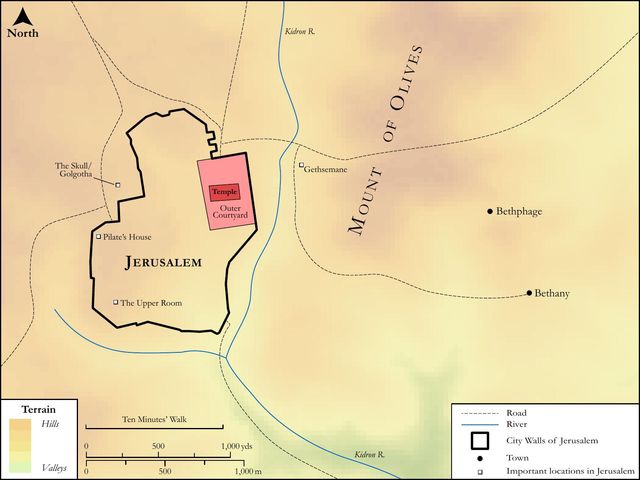
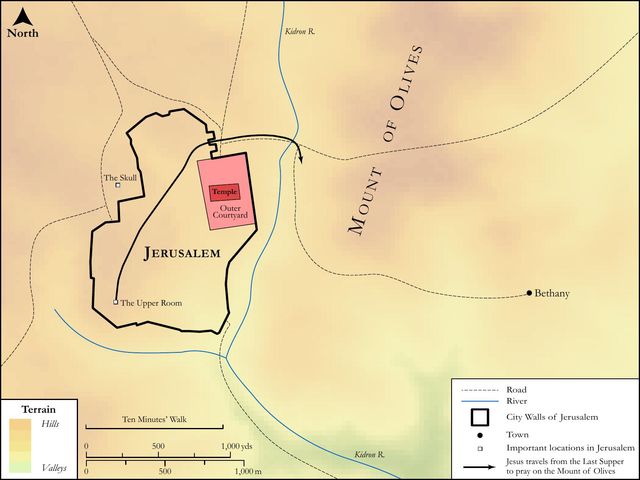
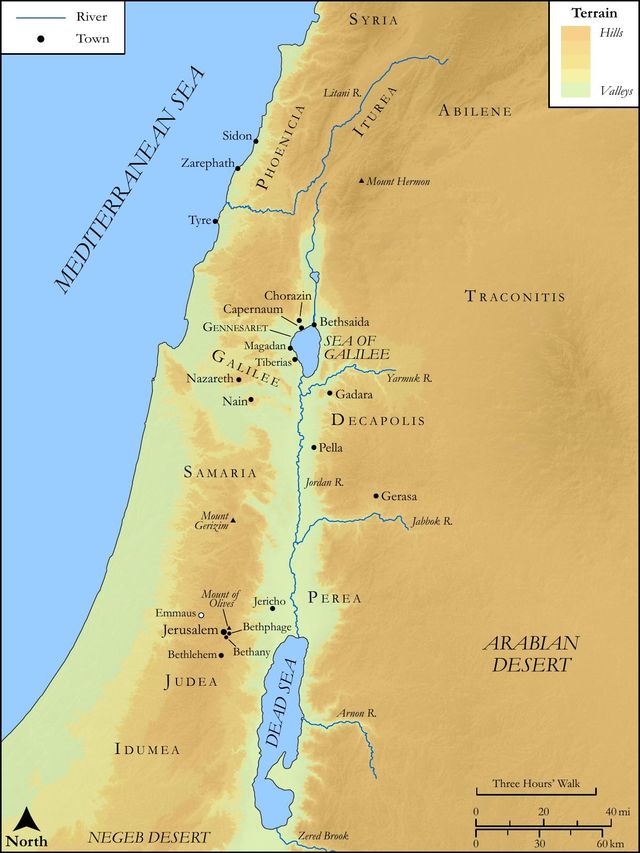
See on the biblical-era maps
Study this verse
Public-domain commentary
Matthew Henry
From his Commentary on the Whole Bible. Henry comments on passages, not single verses — this entry covers Luke 22:39–46. His three-level outline is real structure in the source text, so it is rendered as structure.
We have here the awful story of Christ's agony in the garden, just before he was betrayed, which was largely related by the other evangelists. In it Christ accommodated himself to that part of his undertaking which he was now entering upon - the making of his soul an offering for sin. He afflicted his own soul with grief for the sin he was to satisfy for, and an apprehension of the wrath of God to which man had by sin made himself obnoxious, which he was pleased as a sacrifice to admit the impressions of, the consuming of a sacrifice with fire from heaven being the surest token of its acceptance. In it Christ entered the lists with the powers of darkness, gave them all the advantages they could desire, and yet conquered them.
I.What we have in this passage which we had before is,
1.That when Christ went out, though it was in the night, and a long walk, his disciples (eleven of them, for Judas had given them the slip) followed him. Having continued with him hitherto in his temptations, they would not leave him now.
2.That he went to the place where he was wont to be private, which intimates that Christ accustomed himself to retirement, was often alone, to teach us to be so, for freedom of converse with God and our own hearts. Though Christ had no conveniency for retirement but a garden, yet he retired. This should particularly be our practice after we have been at the Lord's table; we have then work to do which requires us to be private.
3.That he exhorted his disciples to pray that, though the approaching trial could not be avoided, yet they might not in it enter into temptation to sin; that, when they were in the greatest fright and danger, yet they might not have any inclination to desert Christ, nor take a step towards it: "Pray that you may be kept from sin." 4. That he withdrew from them, and prayed himself; they had their errands at the throne of grace, and he had his, and therefore it was fit that they should pray separately, as sometimes, when they had joint errands, they prayed together. He withdrew about a stone's cast further into the garden, which some reckon about fifty of sixty paces, and there he kneeled down (so it is here) upon the bare ground; but the other evangelists say that afterwards he fell on his face, and there prayed that, if it were the will of God, this cup of suffering, this bitter cup, might be removed from him. This was the language of that innocent dread of suffering which, being really and truly man, he could not but have in his nature. 5. That he, knowing it to be his Father's will that he should suffer and die, and that, as the matter was now settled, it was necessary for our redemption and salvation, presently withdrew that petition, did not insist upon it, but resigned himself to his heavenly Father's will: "Nevertheless not my will be done, not the will of my human nature, but the will of God as it is written concerning me in the volume of the book, which I delight to do, let that be done," Psa 40:7, Psa 40:8. 6. That his disciples were asleep when he was at prayer, and when they should have been themselves praying, Luk 22:45. When he rose from prayer, he found them sleeping, unconcerned in his sorrows; but see what a favourable construction is here put upon it, which we had not in the other evangelists - they were sleeping for sorrow. The great sorrow they were in upon the mournful farewells their Master had been this evening giving them had exhausted their spirits, and made them very dull and heavy, which (it being now late) disposed them to sleep. This teaches us to make the best of our brethren's infirmities, and, if there be one cause better than another, charitably impute them to that. 7. That when he awoke them, then he exhorted them to pray (Luk 22:46): "Why sleep ye? Why do you allow yourselves to sleep? Rise and pray. Shake off your drowsiness, that you may be fit to pray, and pray for grace, that you may be able to shake off your drowsiness." This was like the ship-master's call to Jonah in a storm (Jon 1:6): Arise, call upon thy God. When we find ourselves either by our outward circumstances or our inward dispositions entering into temptation, it concerns us to rise and pray, Lord, help me in this time of need. But,
II.There are three things in this passage which we had not in the other evangelists: -
1.That, when Christ was in his agony, there appeared to him an angel from heaven, strengthening him, Luk 22:43.
(1.)It was an instance of the deep humiliation of our Lord Jesus that he needed the assistance of an angel, and would admit it. The influence of the divine nature withdrew for the present, and then, as to his human nature, he was for a little while lower than the angels, and was capable of receiving help from them.
(2.)When he was not delivered from his sufferings, yet he was strengthened and supported under them, and that was equivalent. If God proportion the shoulders to the burden, we shall have no reason to complain, whatever he is pleased to lay upon us. David owns this a sufficient answer to his prayer, in the day of trouble, that God strengthened him with strength in his soul, and so does the son of David, Psa 138:3.
(3.)The angels ministered to the Lord Jesus in his sufferings. He could have had legions of them to rescue him; nay, this one could have done it, could have chased and conquered the whole band of men that came to take him; but he made use of his ministration only to strengthen him; and the very visit which this angel made him now in his grief, when his enemies were awake and his friends asleep, was such a seasonable token of the divine favour as would be a very great strengthening to him. Yet this was not all: he probably said something to him to strengthen him; put him in mind that his sufferings were in order to his Father's glory, to his own glory, and to the salvation of those that were given him, represented to him the joy set before him, the seed he should see; with these and the like suggestions he encouraged him to go on cheerfully; and what is comforting is strengthening. Perhaps he did something to strengthen him, wiped away his sweat and tears, perhaps ministered some cordial to him, as after his temptation, or, it may be, took him by the arm, and helped him off the ground, or bore him up when he was ready to faint away; and in these services of the angel the Holy Spirit was enischuōn auton - putting strength into him; for so the word signifies. It pleased the Lord to bruise him indeed; yet did he plead against him with his great power? No, but he put strength in him (Job 23:6), as he had promised, Psa 89:21; Isa 49:8; Isa 50:7.
2.That, being in an agony, he prayed more earnestly, Luk 22:44. As his sorrow and trouble grew upon him, he grew more importunate in prayer; not that there was before any coldness or indifferency in his prayers, but there was now a greater vehemency in them, which was expressed in his voice and gesture. Note, Prayer, though never out of season, is in a special manner seasonable when we are in an agony; and the stronger our agonies are the more lively and frequent our prayers should be. Now it was that Christ offered up prayers and supplications with strong crying and tears, and was heard in that he feared (Heb 5:7), and in his fear wrestled, as Jacob with the angel.
3.That, in this agony, his sweat was as it were great drops of blood falling down to the ground. Sweat came in with sin, and was a branch of the curse, Gen 3:19. And therefore, when Christ was made sin and a curse for us, he underwent a grievous sweat, that in the sweat of his face we might eat bread, and that he might sanctify and sweeten all our trials to us. There is some dispute among the critics whether this sweat is only compared to drops of blood, being much thicker than drops of sweat commonly are, the pores of the body being more than ordinarily opened, or whether real blood out of the capillary veins mingled with it, so that it was in colour like blood, and might truly be called a bloody sweat; the matter is not great. Some reckon this one of the times when Christ shed his blood for us, for without the shedding of blood there is no remission. Every pore was as it were a bleeding wound, and his blood stained all his raiment. This showed the travail of his soul. He was now abroad in the open air, in a cool season, upon the cold ground, far in the night, which, one would think, had been enough to strike in a sweat; yet now he breaks out into a sweat, which bespeaks the extremity of the agony he was in.
Historical interpretation
Nine Centuries of Reception
11 surviving comments on this verse. Each one is dated, so this reads as a timeline rather than a list.
Select a marker to jump to its quote. Markers stagger vertically where authors wrote within a few decades of each other.
Moreover, the statement, 'All my bones are poured out and dispersed like water; my heart has become like wax, melting in the midst of my belly,' was a prediction of that which happened to Him on that night when men came out against Him to the Mount of Olives to seize Him. For in the memoirs which I say were drawn up by His apostles and those who followed them, [it is recorded] that His sweat fell down like drops of blood while He was praying, and saying, 'If it be possible, let this cup pass:' His heart and also His bones trembling; His heart being like wax melting in His belly: in order that we may perceive that the Father wished His Son really to undergo such sufferings for our sakes, and may not say that He, being the Son of God, did not feel what was happening to Him and inflicted on Him. Further, the expression, 'My strength is dried up like a potsherd, and my tongue has cleaved to my throat,' was a prediction, as I previously remarked, of that silence, when He who convicted all your teachers of being unwise returned no answer at all.
The devil tempted Christ himself, and Christ pointed out the subtle director of the temptation. He later confirms this passage by his words to his apostles when he says, “Pray that you may not enter into temptation.” They were so tempted to desert their Lord because they had indulged in sleep instead of prayer. The phrase that balances and interprets “lead us not into temptation” is “but deliver us from evil.”
Although he was God clearly revealed, he did not disown what was human about himself as well. He is hungry and exhausted, weary and thirsty; he fears and flees and is troubled when he prays. He sleeps on a pillow, yet as God he has a nature that does not know sleeping. He asks to be excused the suffering of the cup, yet he was present in the world for this very reason. In his agony, he sweats and an angel strengthens him, yet he strengthens those who believe in him and has taught them by his example to treat death with contempt.
“His sweat became like drops of blood,” the Evangelist said. He sweated to heal Adam who was sick. “It is by the sweat of your brow,” said God, “that you will eat your bread.” He remained in prayer in this garden to bring Adam back into his own garden again.
Many are shocked at this place who turn the sorrows of the Saviour to an argument of inherent weakness from the beginning, rather than taken upon Him for the time. But I am so far from considering it a thing to be excused, that I never more admire His mercy and majesty; for He would have conferred less upon me had He not taken upon Him my feelings. For He took upon Him my sorrow, that upon me He might bestow His joy. With confidence therefore I name His sadness, because I preach His cross. He must needs then have undergone affliction, that He might conquer. For they have no praise of fortitude whose wounds have produced stupor rather than pain. He wished therefore to instruct us how we should conquer death, and what is far greater, the anguish of coming death. Thou smartedst then, O Lord, not from thy own but my wounds; for he was wounded for our transgressions. And perhaps He is sad, because that after Adam's fall the passage by which we must depart from this world was such that death was necessary. Nor is it far from the truth that He was sad for His persecutors, who He knew would suffer punishment for their wicked sacrilege.
And because not in appearance but in reality He took upon Himself our flesh, in order to confirm the truth of the dispensation He submits to bear human suffering; for it follows, And being in an agony he prayed more earnestly.
For it was midnight, and the disciples' eyes were heavy from grief, and their sleep was not that of drowsiness but sorrow.
(de Con. Ev. lib. iii. c. 4.) Now Luke has not stated after which prayer He came to His disciples, still in nothing does he disagree with Matthew and Mark.
(Mor. 24. c. 17.) He has expressed also the conflict of our mind in itself, as death approaches, for we suffer a certain thrill of terror and dread, when by the dissolution of the flesh we draw near to the eternal judgment; and with good reason, for the soul finds in a moment that which can never be changed.
In another place we read that Angels came and ministered unto Him. In testimony then of each nature, Angels are said both to have ministered to Him and comforted Him. For the Creator needed not the protection of His creature, but being made man as for our sakes He is sad, so for our sakes He is comforted.
Let no one ascribe this sweat to natural weakness, nay, it is contrary to nature to sweat blood, but rather let him derive therefrom a declaration to us, that He was now obtaining the accomplishment of His prayer, namely, that He might purge by His blood the faith of His disciples, still convicted of human frailty.
Our Lord proves by what comes after, that He prayed for His disciples whom He exhorts by watching and prayer to be partakers of His prayer; for it follows, And he saith unto them, Why sleep ye? Rise and pray, lest ye enter into temptation.
And when He rose from prayer and came to His disciples, He found them sleeping from sorrow. And He said to them: Why do you sleep? Rise and pray, lest you enter into temptation. That is, lest the cup of my passion fall on you. Where He clearly shows that He prayed for them too, whom He diligently warns, by vigilantly and praying, to be participants in His prayers.
To make known unto us the power of prayer that we may exercise it in adversity, our Lord when praying is comforted by an Angel. (Matt. 4:11.)
But some say that the Angel appeared, glorifying Him, saying, O Lord, Thine is the power, for Thou art able to vanquish death, and to deliver weak mankind.
Now that the preceding prayer was of His human nature, not His divine, as the Arians say, is argued from what is said of His sweat, which follows, And his sweat was as it were great drops of blood falling down to the ground.
Or this is proverbially said of one who has sweated intensely, that He sweated blood; the Evangelist then wishing to show that He was moistened with large drops of sweat, takes drops of blood for an example. But afterwards finding His disciples asleep for sorrow, He upbraids them, at the same time reminding them to pray; for it follows, And when he rose from prayer and was come to his disciples, he found them sleeping.
That is, that they should not be overcome by temptation, for not to be led into temptation is not to be overwhelmed by it. Or He simply bids us pray that our life may be quiet, and we be not cast into trouble of any kind. For it is of the devil and presumptuous, for a man to throw himself into temptation. Therefore James said not, "Cast yourselves into temptation," but, When ye are fallen, count it all joy, (Jam. 1:2.) making a voluntary act out of an involuntary.
Continue studying Luke 22:45 across the web’s major study libraries — every link below opens this exact verse, chapter, or book on the destination site.
Read & Compare
 BibleGatewayThis verse in more than 200 translations and 70 languages.
 Bible.comThe YouVersion reader — hundreds of translations, reading plans, and highlights.
 ESV.orgCrossway's official English Standard Version reader.
 NET BibleThe NET translation with 60,000+ translators' notes on every rendering decision.
 STEP BibleTyndale House's free study tool — original text, vocabulary, and scholarly resources.
 BibliaLogos Bible Software's free web reader.
 USCCBThe New American Bible (Revised Edition) with the U.S. bishops' study notes.
Commentaries
 BibleHub CommentariesDozens of classic commentaries on this verse, gathered on one page.
 StudyLightMore than 100 commentary sets — the largest collection on the web.
 BibleRefPlain-English commentary on what this verse means, verse by verse.
 Enduring WordDavid Guzik's free commentary on this chapter, widely used by Bible teachers.
 Bible Study ToolsVerse commentary alongside Greek and Hebrew study aids.
Original Language & Research
- BibleHub InterlinearThe verse word by word — original language, transliteration, and English.
- BibleHub LexiconEvery word's original-language definition and Strong's entry.
 Blue Letter BibleDeep-study tools — Strong's numbers, concordance, and word studies.
 CNTR CollationThe earliest Greek manuscripts of this verse, collated letter by letter.
Sermons, Hymns & Audio


TrulyRandomVerse is not affiliated with these sites and doesn’t control their content. They’re linked because they’re genuinely useful.
Summary
Luke 22:45 captures a profoundly poignant moment in the Garden of Gethsemane, immediately following Jesus' intense and solitary prayer. Having wrestled with the Father's will and endured immense spiritual agony, Jesus returns to His closest disciples—Peter, James, and John—only to discover them overcome by sleep, a state explicitly attributed to their profound sorrow. This scene starkly contrasts Jesus' vigilant suffering with the human frailty and emotional exhaustion of His followers, underscoring the unique burden He was preparing to bear.
Context
ShowHideLiterary Context
This verse is situated within Luke's account of Jesus' final hours before His crucifixion. It follows the Last Supper, where Jesus instituted the new covenant and predicted Peter's denial (Luke 22:14-38). Jesus then leads His disciples to the Mount of Olives, specifically the Garden of Gethsemane (Luke 22:39). He instructs them to "pray that you may not enter into temptation" (Luke 22:40). While Jesus withdraws to pray in agonizing earnestness, even sweating blood (Luke 22:41-44), the disciples succumb to physical exhaustion. Verse 45 serves as a crucial transition, revealing the disciples' inability to remain vigilant, setting the stage for Jesus' direct confrontation with their weakness in the subsequent verse (Luke 22:46).
Historical & Cultural Context
The setting is the Garden of Gethsemane on the Mount of Olives, a familiar place for Jesus and His disciples, likely a private olive grove. This event occurs late at night, after the Passover meal, which traditionally concluded with hymns and a journey to the Mount of Olives. The disciples would have been physically tired from the day's events and the late hour. Culturally, the concept of "watching" (γρηγορέω, grēgoreō) carried significant spiritual weight, often implying vigilance against spiritual dangers and readiness for the Master's return, as seen in various parables (Matthew 24:42 or Mark 13:37). Their inability to watch, despite Jesus' explicit command, highlights not just physical fatigue but also a spiritual unpreparedness for the imminent crisis.
Key Themes
ShowHideLuke 22:45 contributes significantly to several overarching themes in Luke's Gospel and the broader biblical narrative. It powerfully illustrates human weakness and frailty in the face of overwhelming spiritual and emotional pressure, contrasting sharply with Jesus' divine strength and resolute obedience. The explicit mention of "sorrow" (λύπη, lypē) underscores the theme of suffering and grief, both Jesus' intense agony and the disciples' empathetic distress. Furthermore, the scene emphasizes Jesus' solitary burden and unique suffering, as even His closest companions cannot fully participate in or comprehend the depth of His Gethsemane ordeal. This isolation highlights the unparalleled nature of His atoning work, which He alone could accomplish.
Exposition and Analysis
ShowHideKey Word Analysis
ShowHideFrom ἀνά (ana, "up") and ἵστημι (histēmi, "to stand"), this word means "to stand up" or "to arise." Here, it signifies Jesus' physical action of rising from His posture of prayer, indicating the completion of His intense intercession and His readiness to face the next stage of His passion. It conveys a sense of purposeful movement after a period of deep spiritual engagement.
Derived from κεῖμαι (keimai, "to lie down"), this verb means "to put to sleep" or, in the passive/reflexive, "to slumber." Figuratively, it can also mean "to decease" or "to be dead." In this context, it describes the disciples' state of deep physical and mental unconsciousness. It implies more than mere drowsiness; it suggests a profound inability to remain awake, almost as if they were "laid low" by their condition.
Apparently a primary word, lýpē denotes "sadness," "grief," "pain," or "heaviness." It is a strong term for emotional distress. The phrase "sleeping for sorrow" (ἀπὸ τῆς λύπης, apo tēs lypēs) indicates that their sleep was not merely due to physical exhaustion but was a direct consequence or manifestation of the overwhelming grief and distress they felt concerning Jesus' impending fate. This deep emotional burden incapacitated them.
Verse Breakdown
ShowHide"And when he rose up from prayer"
This clause marks the conclusion of Jesus' agonizing Gethsemane prayer, described in the preceding verses. Having poured out His soul to the Father, submitting to His will even to the point of sweating blood, Jesus now physically rises. This action signifies His readiness to move from intense spiritual communion to active engagement with the events of His betrayal and arrest, demonstrating His resolved obedience.
"and was come to his disciples"
Jesus, having completed His solitary struggle, returns to the proximity of His chosen companions, Peter, James, and John, who had been asked to "watch and pray." This movement signifies His desire for their companionship and support, even if they could not fully comprehend or share the depth of His spiritual battle. It highlights His human need for fellowship in a moment of extreme vulnerability.
"he found them sleeping for sorrow"
This is the poignant climax of the verse. Instead of finding them vigilant and praying as He had commanded, Jesus discovers His disciples profoundly asleep. The crucial addition "for sorrow" provides the underlying reason for their slumber. It was not merely physical fatigue, but an overwhelming emotional burden—the dread, grief, and fear associated with the imminent arrest and suffering of their beloved Master—that led to their physical collapse and inability to stay awake. This detail evokes deep pathos, contrasting Jesus' active suffering with their passive, grief-induced unconsciousness.
Literary Devices
ShowHideLuke 22:45 employs several powerful literary devices. The most prominent is Contrast, specifically between Jesus' intense spiritual vigilance and the disciples' physical and spiritual lethargy. While Jesus is actively engaged in agonizing prayer, even to the point of sweating blood, His closest followers are found "sleeping." This contrast highlights the unique burden Jesus carried and the vast chasm between His divine resolve and human frailty. There is also profound Pathos conveyed through the disciples' condition; their sleep is not presented as mere laziness but as a direct result of "sorrow," evoking sympathy for their overwhelming grief and emotional exhaustion. This detail adds a layer of tragic irony to the scene, as their deep love for Jesus manifests in a way that prevents them from fulfilling His request. Finally, the scene contains subtle Foreshadowing; the disciples' inability to stay awake and support Jesus in His hour of greatest need subtly anticipates their later abandonment of Him during His arrest and trial. Their physical sleep can also be seen as Symbolism for a certain spiritual unawareness or inability to grasp the full gravity of the spiritual battle unfolding around them.
Theological and Thematic Connections
ShowHideLuke 22:45 is a profound theological statement on human weakness and the unique nature of Christ's suffering. It underscores that even the most devoted followers, when faced with overwhelming grief and spiritual pressure, can succumb to their human limitations. The disciples' sleep, born of sorrow, highlights the immense weight of the impending events and their inability to bear witness to Jesus' agony in the way He desired. This scene emphasizes that Jesus' Gethsemane struggle was, in essence, a solitary one, a burden He had to carry alone as He prepared to become the atoning sacrifice for humanity. It foreshadows the ultimate isolation of the cross, where He would bear the full weight of sin without human aid.
Reflection and Application
ShowHideLuke 22:45 offers a deeply human and relatable glimpse into the struggles of faith and the reality of human limitation. It reminds us that even sincere devotion does not exempt us from moments of weakness, exhaustion, or being overwhelmed by sorrow. The disciples, despite their love for Jesus, were physically and emotionally incapacitated by the profound grief and dread of what was to come. This should foster in us a spirit of humility and self-awareness, recognizing our own need for God's strength when faced with trials. It also calls us to cultivate empathy for others who are suffering, understanding that deep sorrow can manifest in physical and mental exhaustion. While the disciples failed to stay awake, Jesus' example of persistent prayer in the face of agony remains our ultimate model, urging us to lean into spiritual disciplines, especially prayer and vigilance, when life's pressures threaten to overwhelm us. We are called to "watch and pray" not out of our own strength, but in humble reliance on the Spirit, trusting that God's grace is sufficient even in our weakness.
Questions for Reflection
ShowHideFAQ
ShowHideWhy were the disciples sleeping instead of praying as Jesus asked?
ShowHideThe text explicitly states they were "sleeping for sorrow" (ἀπὸ τῆς λύπης, apo tēs lypēs). This indicates their sleep was not simply due to laziness or indifference, but was a direct consequence of the overwhelming emotional distress, grief, and fear they felt regarding Jesus' imminent arrest and suffering. The profound sorrow they experienced led to a physical and mental exhaustion that incapacitated them, making it impossible to remain awake and vigilant as Jesus had commanded them to "watch and pray" (Luke 22:40). Their human frailty succumbed to the immense emotional weight of the moment.
Was their sleep a sign of spiritual failure or lack of faith?
ShowHideWhile their inability to stay awake was a failure to heed Jesus' specific command to "watch and pray" (Matthew 26:41), the text attributes it to "sorrow," not a deliberate act of disobedience or a complete lack of faith. It highlights their human weakness and the limitations of the flesh, even when "the spirit indeed is willing" (Mark 14:38). Jesus' gentle rebuke in Luke 22:46 suggests understanding rather than harsh condemnation, acknowledging their profound emotional state. It serves as a reminder that even devoted followers can fall short due to physical and emotional exhaustion.
Christ-Centered Fulfillment
ShowHideLuke 22:45, with its stark depiction of the disciples' sleep for sorrow, profoundly underscores the unique and solitary nature of Christ's suffering and His ultimate fulfillment of redemptive prophecy. While His closest companions succumbed to their human limitations, Jesus remained awake, wrestling with the Father's will and bearing the crushing weight of humanity's sin and impending judgment alone. This scene in Gethsemane foreshadows the ultimate isolation of the cross, where Jesus would cry out, "My God, my God, why have you forsaken me?" (Matthew 27:46), experiencing the full depth of divine abandonment for our sake. His perfect obedience and willingness to endure this solitary agony, even when His disciples could not support Him, reveal Him as the true Suffering Servant of Isaiah 53, who "bore our griefs and carried our sorrows" (Isaiah 53:4). Unlike the disciples who were overcome by sorrow, Jesus perfectly endured it, not for Himself, but to bring us joy. His Gethsemane agony and subsequent crucifixion are the ultimate acts of love, allowing Him to empathize fully with our weaknesses and sorrows (Hebrews 4:15), and ultimately to conquer death and sorrow, promising a future where God "will wipe away every tear from their eyes, and death shall be no more, neither shall there be mourning, nor crying, nor pain anymore" (Revelation 21:4).