


Matthew 26:41
- γρηγορεῖτεgrēgoreitedo watchG1127V-PAM-2PVerb Present Active Imperative 2nd Plural
- καὶkaiandG2532CONJConjunction
- προσεύχεσθεproseuchesthedo prayG4336V-PNM-2PVerb Present Middle Or Passive Deponent Imperative 2nd Plural
- ἵναinathatG2443CONJConjunction
- μὴmēnotG3361PRT-NNegative Particle Negative
- εἰσέλθητεeiselthēteyou may enterG1525V-2AAS-2PVerb 2nd Aorist Active Subjunctive 2nd Plural
- εἰςeisintoG1519PREPPreposition
- πειρασμόνpeirasmontemptationG3986N-ASMNoun Accusative Singular Masculine
- τὸtoTheG3588T-NSNDefinite article Nominative Singular Neuter
- μὲνmenindeedG3303PRTParticle or Disjunctive
- πνεῦμαpneumaspiritG4151N-NSNNoun Nominative Singular Neuter
- πρόθυμονprothumon[is] willingG4289A-NSNAdjective Nominative Singular Neuter
- ἡhē<the>G3588T-NSFDefinite article Nominative Singular Feminine
- δὲdehoweverG1161CONJConjunction
- σὰρξsarxthe fleshG4561N-NSFNoun Nominative Singular Feminine
- ἀσθενήςasthenēsweakG772A-NSFAdjective Nominative Singular Feminine
English is a literal word-by-word gloss of the Greek, not the KJV's wording. Why?
This is the original text the KJV's translators worked from — each Greek word with its own literal English meaning in this verse, prepared by scholars at Tyndale House, Cambridge. The KJV translates whole sentences, not word by word, so its wording differs: one Greek word can become several English words, and the KJV may choose “charity” where the gloss reads “love”. Both are faithful — they answer different questions. For the KJV's own rendering, switch to the KJV text.
Details
See on the biblical-era map
Study this verse
Historical interpretation
Nine Centuries of Reception
26 surviving comments on this verse. Each one is dated, so this reads as a timeline rather than a list.
Select a marker to jump to its quote. Markers stagger vertically where authors wrote within a few decades of each other.
And how long will this most shameless "infirmity" persevere in waging a war of extermination against the "better things? "The time for its indulgence was (the interval) until the Paraclete began His operations, to whose coming were deferred by the Lord (the things) which in H's day "could not be endured; "which it is now no longer competent for any one to be unable to endure, seeing that He through whom the power of enduring is granted is not wanting. How long shall we allege "the flesh," because the Lord said, "the flesh is weak? " But He has withal premised that "the Spirit is prompt," in order that the Spirit may vanquish the flesh-that the weak may yield to the stronger.
This passage He confirms by subsequent ones, saying, "Pray that ye be not tempted; " yet they were tempted, (as they showed) by de-setting their Lord, because they had given way rather to sleep than prayer.
Would any man have dared to touch even with his little finger, the body of Christ, if it had been of an unusual nature; or to smear His face with spitting, if it had not invited it (by its abjectness)? Why talk of a heavenly flesh, when you have no grounds to offer us for your celestial theory? Why deny it to be earthy, when you have the best of reasons for knowing it to be earthy? He hungered under the devil's temptation; He thirsted with the woman of Samaria; He wept over Lazarus; He trembles at death (for "the flesh," as He says, "is weak " ); at last, He pours out His blood.
If the "spirit is willing, but the flesh," without patience, "weak," where, save in patience, is the safety of the spirit, and of the flesh itself? But when the Lord says this about the flesh, pronouncing it "weak," He shows what need there is of strengthening, it-that is by patience-to meet every preparation for subverting or punishing faith; that it may bear with all constancy stripes, fire, cross, beasts, sword; all which prophets and apostles, by enduring, conquered!
But we read "that the flesh is weak; " and hence we soothe ourselves in some cases.
From the saying of our Lord we know that the flesh is weak, the spirit willing. Let us not, withal, take delusive comfort from the Lord's acknowledgment of the weakness of the flesh.
But we read "that the flesh is weak; " and hence we soothe ourselves in some cases. Yet we read, too, that "the spirit is strong; " for each clause occurs in one and the same sentence.
He likewise acknowledged, it is true, that His "soul was troubled, even unto death," and the flesh weak; with the design, (however,) first of all, that by having, as His own, trouble of soul and weakness of the flesh, He might show you that both the substances in Him were truly human; lest, as certain persons have now brought it in, you might be led to think either the flesh or the soul of Christ different from ours; and then, that, by an exhibition of their states, you might be convinced that they have no power at all of themselves without the spirit. And for this reason He puts first "the willing spirit," that, looking to the natures respectively of both the substances, you may see that you have in you the spirit's strength as well as the flesh's weakness; and even from this may learn what to do, and by what means to do it, and what to bring under what,-the weak, namely, under the strong, that you may not, as is now your fashion, make excuses on the ground of the weakness of the flesh, forsooth, but put out of sight the strength of the spirit.
To us it is matter for thankfulness if we do now publicly confess our iniquities or our turpitudes: for we do at the same time both make satisfaction for our former sins, by mortification of our flesh and spirit, and lay beforehand the foundation of defences against the temptations which will closely follow. "Watch and pray," saith (the Lord), "lest ye fall into temptation." And the reason, I believe, why they were tempted was, that they fell asleep; so that they deserted the Lord when apprehended, and he who continued to stand by Him, and used the sword, even denied Him thrice: for withal the word had gone before, that "no one untempted should attain the celestial kingdoms.
As long as Jesus was present, his disciples did not sleep. After he had walked away a short distance, they were unable to watch for even one hour in his absence. For this reason we should pray that Jesus will not leave us for even a short while but will fulfill what he promised when he said to us, "And I am with you all days, even to the end of the world." In this way will we keep watch as he banishes sleep from our souls, to make it possible for us to fulfill his command: "Do not give sleep to your eyes or slumber to your eyelids, that you may escape as a doe from the nets and a bird from the snare of the fowlers." But coming to the disciples and finding them asleep, he arouses them with a word and tells them to listen, so he may as it were say to those who are listening: "How is it that you were not able to watch with me for even one hour?"He orders us then to be wakeful so we may keep watch and pray. Now that person watches who does good works, that person watches who diligently attends to the truth of the faith lest he be ensnared by any shady teaching. He who watches and prays in this way will have his prayer heard. This is what the Lord means when he says, "Watch and pray." We should first watch and, while watching, we should pray.
Finding them thus sleeping, He rouses them with a word to hearken, and commands them to watch; Watch and pray, that ye enter not into temptation; that first we should watch, and so watching pray. He watches who does good works, and is careful that He does not run into any dark doctrine, for so the prayer of the watchful is heard.
Here it should be enquired, whether as all men's flesh is weak, so all men's spirit is willing, or whether only that of the saints; and whether in unbelievers the spirit is not also dull, as the flesh is weak. In another sense the flesh of those only is weak whose spirit is willing, and who with their willing spirit do mortify the deeds of the flesh. These then He would have watch and pray that they should not enter into temptation, for the more spiritual any one may be, the more careful should he be that his goodness should not suffer a great fall.
After that, he returns to the disciples and finds them sleeping. He asks Peter why he could not watch with him one hour—Peter, indeed, was one of the three, for he had boasted in front of the others that he would not fall away. And he indicates the cause of his greater fear, saying, “Pray that you may not enter into temptation.” He wanted then to prevent temptation (so he included in his prayer the words “lead us not into temptation”), lest anything in us cater to the weakness of the flesh. He also makes it clear why he urged them to pray in order to avoid temptation, saying, “The spirit indeed is willing, but the flesh is weak.” These words did not apply to himself but were aimed at them. For that matter, how is it that now his spirit is willing, whereas before his soul was sad even to death? At any rate, he orders them to watch and pray lest they give in to temptation and succumb to the weakness of the body. He therefore prays that, if possible, the cup may pass from himself, for when it comes to drinking from it, all flesh is weak.
Otherwise; He says not, Let this cup pass away from Me, for that would be the speech of one who feared it; but He prays that it may pass not so as that He should be passed over, but that when it has passed from Him, it may go to another. His whole fear then is for those who were to suffer, and therefore He prays for those who were to suffer after Him, saying, Let this cup pass from me, i. e. as it is drunk by Me, so let it be drunk by these, without mistrust, without sense of pain, without fear of death. He says, If it be possible, because flesh and blood shrink from these things, and it is hard for human bodies not to sink beneath their infliction. That He says, Not as I will, but as thou wilt, He would fain indeed that they should not suffer, lest their faith should fail in their sufferings, if indeed we might attain to the glory of our joint inheritance with Him without the hardship of sharing in His Passion. He says, Not as I will, but as thou wilt, because it is the Father's will that strength to drink of the cup should pass from Him to them, that the Devil might be vanquished not so much by Christ as by His disciples also.
When then He returned to His disciples and found them sleeping, He rebukes Peter, Could ye not watch one hour with me? He addresses Peter rather than the rest, because he had most loudly boasted that he would not be offended.
And why He thus encouraged them to pray that they might not enter into temptation, He adds, For the spirit indeed is willing, but the flesh is weak; this He says not of Himself, but addresses them.
Otherwise, He bare in His own body all the infirmities of us His disciples who should suffer, and nailed to His cross all wherein we are distressed; and therefore that cup cannot pass from Him, unless He drink it, because we cannot suffer, except by His passion.
The fact that, after returning and finding them asleep, he first reproves them, secondly is silent and thirdly orders them to rest, can be explained in this way: First, after the resurrection, he scolded them for scattering and for being apprehensive and restless; second, once the Holy Spirit had been sent, he came and found them sleeping, since their eyes were too heavy for them to discern the freedom of the gospel—having been held back by the love of the law for some time, their faith was still sleeping; and third, with the return of his radiance, he restored them to restfulness and peace of mind.
He finds them sleeping, both because it was a late hour of the night, and their eyes were heavy with sorrow.
But as they had all said the same, He charges them all with weakness; they had chosen to die with Christ, and yet could not even watch with Him.
That He prays for this a second and a third time, comes of the feelings belonging to human frailty, through which also He feared death, thus giving assurance that He was truly made man. For in Scripture when any thing is repeated a second and third time, that is the greatest proof of its truth and reality; as, for example, when Joseph says to Pharaoh, And for that thou sawedst it twice, it is proof of the thing being established by God. (Gen. 41:32.)
However, even these He dismisses: "And He went on a little farther, and prayeth, saying, Father, if it be possible, let this cup pass from me; nevertheless not as I will, but as Thou wilt. And He cometh unto them, and findeth them sleeping, and saith unto Peter, What, could ye not watch with me one hour? Watch and pray, that ye enter not into temptation; the spirit indeed is willing, but the flesh is weak."
Not without reason doth He inveigh against Peter most, although the others also had slept; but to make him feel by this also, for the cause which I mentioned before. Then because the others also said the same thing (for when Peter had said (these are the words), "Though I must die with Thee, I will not deny Thee; likewise also," it is added, "said all the disciples"); He addresses Himself to all, convicting their weakness. For they who are desiring to die with Him, were not then able so much as to sorrow with Him wakefully, but sleep overcame them.
And He prays with earnestness, in order that the thing might not seem to be acting. And sweats flow over him for the same cause again, even that the heretics might not say this, that He acts the agony. Therefore there is a sweat like drops of blood, and an angel appeared strengthening Him, and a thousand sure signs of fear, lest any one should affirm the words to be feigned. For this cause also was this prayer. By saying then, "If it be possible, let it pass from me," He showed His humanity; but by saying, "Nevertheless not as I will, but as Thou wilt," He showed His virtue and self-command, teaching us even when nature pulls us back, to follow God. For since it was not enough for the foolish to show His face only, He uses words also. Again, words sufficed not alone, but deeds likewise were needed; these also He joins with the words, that even they who are in a high degree contentious may believe, that He both became man and died. For if, even when these things are so, this be still disbelieved by some, much more, if these had not been. See by how many things He shows the reality of the incarnation: by what He speaks, by what He suffers. After that He cometh and saith to Peter, as it is said, "What, couldest thou not watch one hour with me?" All were sleeping, and He rebukes Peter, hinting at him, in what He spake. And the words, "with me," are not employed without reason; it is as though He had said, Thou couldest not watch with me one hour, and wilt thou lay down thy life for me? and what follows also, intimates this self-same thing. For "Watch," saith He, "and pray not to enter into temptation." See how He is again instructing them not to be self-confident, but contrite in mind, and to be humble, and to refer all to God.
And at one time He addresses Himself to Peter, at another to all in common. And to him He saith, "Simon, Simon, Satan hath desired to have you, that he may sift you as wheat; but I have prayed for thee;" and to all in common, "Pray that ye enter not into temptation;" every way plucking up their self-will, and making them earnest-minded. Then, that He might not seem to make His language altogether condemnatory, He saith, "The spirit indeed is ready, but the flesh is weak." For even although thou dost desire to despise death, yet thou wilt not be able, until God stretch forth His hand, for the carnal mind draws down.
And again He prayed in the same way, saying, "Father, if this cannot pass from me except I drink it, Thy will be done," showing here, that He fully harmonizes with God's will, and that we must always follow this, and seek after it.
(Verse 41.) Watch and pray, so that you do not enter into temptation. It is impossible for the human soul not to be tempted. Hence, in the Lord's Prayer, we say: Lead us not into temptation, which we cannot bear (or be able to bear) (Matthew 6:13; Luke 11:4). Not completely rejecting temptation, but praying for the strength to endure it. Therefore, at present, it does not say: Watch and pray, lest you be tempted; but, lest you enter into temptation, that is, lest the temptation overcomes and conquers you, and keeps you within its grasp. For example, the martyr, who sheds his blood for the confessing the Lord, is indeed tempted; but he is not caught in the snares of temptations. However, whoever denies, falls into the traps of temptation.
The spirit is indeed willing, but the flesh is weak. This is against the reckless ones, who think they can achieve whatever they believe. Therefore, as much as we trust in the ardor of the mind, so much do we fear the fragility of the flesh. But nevertheless, according to the Apostle, in the spirit the works of the flesh are put to death (1 Peter 3).
“Watch and pray that you may not enter into temptation.” It is impossible for the human soul to avoid temptation. Hence we say in the Lord’s Prayer, “Lead us not into temptation,” which we are unable to withstand. We do not refuse to face temptation entirely but pray for the strength to bear up under it. Therefore he does not say, “Watch and pray that you may not be tempted” but “that you may not enter into temptation,” that is, that temptation may not overwhelm you and hold you in its grip. For example, a martyr who has shed blood by professing faith in the Lord was certainly tempted but was not ensnared in the net of temptation. One who denies the faith, however, has fallen into the snares of temptation.“The spirit indeed is willing, but the flesh is weak.” This is aimed at those rash people who think that whatever they believe, they can obtain. Therefore, as much as we trust in the ardor of our spirit, so too should we fear the weakness of the flesh. And yet, according to the apostle, the works of the flesh are mortified by the Spirit.
Or the sleep which He would have them forego is not bodily rest, for which at this critical time there was no room, but mental torpor, the sleep of unbelief.
Whence He says emphatically, This cup, that is, of this people of the Jews, who, if they shall put Me to death, can have no excuse for their ignorance, seeing they have the Law and the Prophets, who speak of Me.
It is impossible that the human mind should not be tempted, therefore He says not Watch and pray that ye be not tempted, but that ye enter not into temptation, that is, that temptation vanquish you not.
This is against those rash persons who think that whatever they believe they can perform. The more confident we are of our zeal, the more mistrustful should we be of the frailty of the flesh.
Or otherwise; He prays a second time that if Nineveh, or the Gentile world, cannot be saved unless the gourd, i. e. the Jews, be withered, His Father's will may be done, which is not contrary to the Son's will, who Himself speaks by the Prophet, I am content to do thy will, O God. (Ps. 40:8.)
Christ singly prays for all, as He singly suffers for all. Their eyes were heavy, i. e. an oppression and stupefaction came on as their denial drew near.
He prayed the third time, that in the mouth of two or three witnesses every word might be established.
"Pray that you do not enter into temptation"—that you enter not again into "contentions, envying, animosities, dissension, detractions, seditions, whispering." For we have not planted and watered the Lord's garden in you only to reap these thorns from you. But if your weakness still stirs up a storm, pray that you may be delivered from temptation. Those among you who trouble you, whoever they may be, will incur judgment unless they amend their lives.
(Serm. 58, 5.) This speech of the Head is the health of the whole body, this saying is instruction to the faithful, animates the confessor, crowns the martyr. For who could vanquish the hatred of the world, or the whirlwind of temptations, or the terrors of the persecutors, if Christ did not in all and for all say to the Father, Thy will be done. Let all the sons of the Church then utter this prayer, that when the pressure of some mighty temptation lies upon them, they may embrace endurance of the suffering, disregarding its terrors.
Evagrius said, ‘If your attention falters, pray. As it is written, pray in fear and trembling (cf. Phil. 2:12), earnestly and watchfully. We ought to pray like that, especially because our unseen and wicked enemies are trying to hinder us forcefully.’
Cassian told a story of a hermit who was living in the desert. He asked God to grant that he should never fall asleep when the conversation was edifying but that if anyone spoke with back-biting or hate, he should nod off at once so that he would not hear poisonous words. He said that the devil strives hard to make men speak idle words, and fights against letting anyone hear any spiritual teaching. He gave the following example of this: Once when I was talking to some brothers for the good of their souls they became so drowsy that they could not even keep their eyelids open. I wanted to show them that this was the devil’s work, so I started gossiping: and at once they sat up and began to enjoy what I was saying. But I said sadly, ‘We were talking of heaven just now, and your eyes were closing in slumber: but the moment the talk became frivolous, you all began to listen eagerly. I beg you then, dear brothers, since you know that this is the work of the devil, be watchful and beware of falling asleep when you are hearing about spiritual things.’
Otherwise; In these words He shows that He took real flesh of the Virgin, and had a real soul, saying that His spirit is willing to suffer, but His flesh weak in fearing the pain of Passion.
Or, He prays thrice for the Apostles, and for Peter in particular, who was to deny Him thrice.
Or, The Lord prayed thrice, to teach us to pray for pardon of sins past, defence against present evil, and provision against future perils, and that we should address every prayer to Father, Son, and Holy Spirit, and that our spirit, soul, and body should be kept in safety.
. Because Peter and the other disciples had been brash and made reckless promises, Jesus now rebukes them for their weakness, and in particular addresses Peter. Could you not keep vigil one hour with Me? How then will you lay down your life for Me? But again, after wounding them with His rebuke, He heals them by saying that the spirit is willing, but the weakness of the flesh resists. That is to say, I consider you deserving of forgiveness, because you fell asleep not out of disdain, but out of weakness. But since you are weak, do not be overly bold; rather pray that you not enter into temptation at all. Others understand "that ye enter not into temptation" to mean "that you not be defeated by temptation." For, they say, He did not bid us to be without temptations, for temptations are our crowns. Rather He bids us to pray that we not be swallowed up by temptation and enter into its belly, as into the belly of a wild beast. For he who is overcome by temptation enters into it, that is, is swallowed up by it.
Continue studying Matthew 26:41 across the web’s major study libraries — every link below opens this exact verse, chapter, or book on the destination site.
Read & Compare
 BibleGatewayThis verse in more than 200 translations and 70 languages.
 Bible.comThe YouVersion reader — hundreds of translations, reading plans, and highlights.
 ESV.orgCrossway's official English Standard Version reader.
 NET BibleThe NET translation with 60,000+ translators' notes on every rendering decision.
 STEP BibleTyndale House's free study tool — original text, vocabulary, and scholarly resources.
 BibliaLogos Bible Software's free web reader.
 USCCBThe New American Bible (Revised Edition) with the U.S. bishops' study notes.
Commentaries
 BibleHub CommentariesDozens of classic commentaries on this verse, gathered on one page.
 StudyLightMore than 100 commentary sets — the largest collection on the web.
 BibleRefPlain-English commentary on what this verse means, verse by verse.
 Enduring WordDavid Guzik's free commentary on this chapter, widely used by Bible teachers.
 Bible Study ToolsVerse commentary alongside Greek and Hebrew study aids.
Original Language & Research
- BibleHub InterlinearThe verse word by word — original language, transliteration, and English.
- BibleHub LexiconEvery word's original-language definition and Strong's entry.
 Blue Letter BibleDeep-study tools — Strong's numbers, concordance, and word studies.
 CNTR CollationThe earliest Greek manuscripts of this verse, collated letter by letter.
Sermons, Hymns & Audio


TrulyRandomVerse is not affiliated with these sites and doesn’t control their content. They’re linked because they’re genuinely useful.
Summary
In the solemn setting of Gethsemane, just hours before His crucifixion, Jesus delivers a profound instruction and tender admonition to His sleeping disciples. This pivotal verse encapsulates the essence of spiritual vigilance and the inherent conflict within humanity: the willing spirit often contends with the weak flesh. It serves as a timeless call to prayer and watchfulness as the primary defense against succumbing to the trials and temptations of life, acknowledging the deep struggle between one's spiritual aspirations and human frailty.
Context
ShowHideLiterary Context
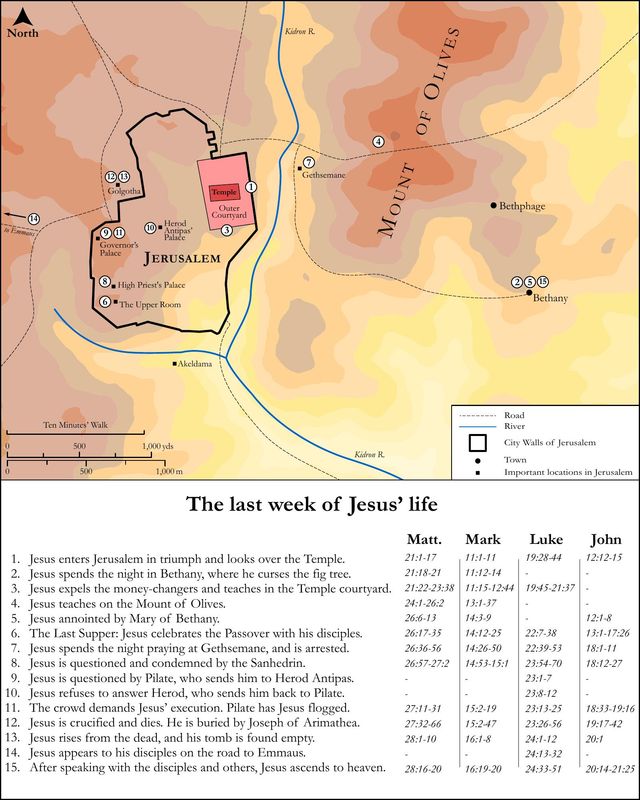
Matthew 26:41 is situated within the intensely dramatic narrative of Jesus' agony in the Garden of Gethsemane, immediately following the Last Supper and preceding His betrayal and arrest. Jesus has taken Peter, James, and John, His closest disciples, deeper into the garden, instructing them to "remain here and keep watch with me" while He goes a little farther to pray (Matthew 26:36-39). Overwhelmed with sorrow "to the point of death," Jesus pours out His soul to God, submitting to the Father's will even as He grapples with the immense suffering ahead. Three times He returns to find His disciples sleeping, underscoring their inability to comprehend the gravity of the moment or to endure even a short period of spiritual vigilance with Him. This verse is Jesus' third and final admonition to them to "Watch and pray," highlighting the critical spiritual battle they, and all believers, must face.
Historical & Cultural Context
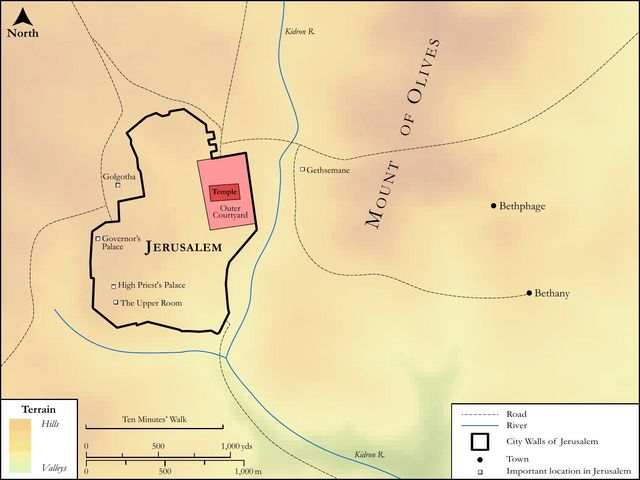
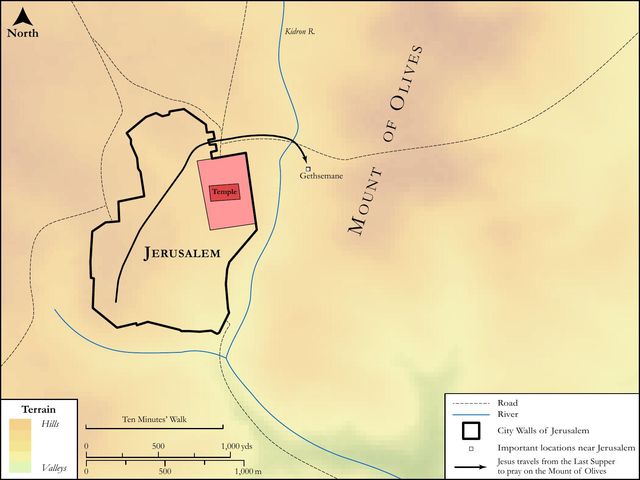
The Garden of Gethsemane, located on the Mount of Olives, was a familiar place for Jesus and His disciples, likely an olive grove with a press. The setting is night, a time often associated with spiritual darkness, vulnerability, and the activity of evil. Jewish custom placed great emphasis on prayer, particularly in times of distress, and the disciples' inability to stay awake reflects a common human failing, especially after a long day and the emotional weight of the Passover meal. The concept of "temptation" (Greek: peirasmós) in this context extends beyond mere enticement to sin; it encompasses the severe trials and tests of faith that were imminent for the disciples, including Jesus' arrest, Peter's denial (Matthew 26:69-75), and the scattering of the sheep (Matthew 26:31). Their spiritual unpreparedness, due to their physical and spiritual weariness, left them vulnerable to these impending challenges.
Key Themes
ShowHideThis verse powerfully encapsulates several overarching themes found throughout the Gospels and the broader New Testament. Firstly, it underscores the theme of spiritual vigilance and discipline, emphasizing that active watchfulness and consistent prayer are indispensable for navigating the spiritual landscape and resisting the forces that seek to lead one astray. Secondly, it highlights the reality and pervasiveness of temptation and trial in the life of a believer, echoing the petition in the Lord's Prayer, "lead us not into temptation. Thirdly, and most profoundly, it articulates the internal conflict between the spirit and the flesh. This dichotomy describes the tension between one's renewed spiritual inclinations, which desire to obey God, and the inherent weakness of human nature, prone to fatigue, fear, and sin. This struggle is a foundational aspect of the human condition, further elaborated by Paul in his letters, such as in Romans 7:18-25 and Galatians 5:17, where he describes the flesh and spirit as being in opposition to each other.
Exposition and Analysis
ShowHideKey Word Analysis
ShowHideFrom egeírō, meaning to keep awake, to be vigilant, to wake. This term signifies not merely physical wakefulness but a state of spiritual alertness, readiness, and attentiveness to spiritual realities and dangers. It implies a conscious effort to remain spiritually aware and prepared for the challenges that may arise.
From peirázō, meaning a putting to proof, by experiment (of good), experience (of evil), solicitation, discipline, or provocation; by implication, adversity. In this context, it refers to a test or trial that, if failed, could lead to sin or spiritual downfall. It encompasses both external pressures and internal enticements that challenge one's faith and resolve.
Probably from the base of saróō (to sweep); meaning flesh (as stripped of the skin), the body (as opposed to the soul or spirit), or (by implication) human nature with its frailties (physically or morally) and passions. Here, "flesh" represents the entirety of human nature in its fallen, unredeemed state, characterized by weakness, susceptibility to sin, and limitations, especially in contrast to the spirit's willing desire.
Verse Breakdown
ShowHide"Watch and pray,"
This is a direct imperative from Jesus, a command for active spiritual discipline. "Watch" (G1127, grēgoreúō) implies vigilance and alertness, not just physically but spiritually, being aware of the spiritual dangers and the urgency of the moment. "Pray" (G4336, proseúchomai) signifies earnest communication with God, seeking His strength, guidance, and protection. These two actions are presented as inseparable and foundational for spiritual endurance.
"that ye enter not into temptation:"
This clause states the purpose and desired outcome of watching and praying. "Enter not into" (G1525, eisérchomai; G3363, hína mḗ) suggests avoiding a state or condition where one is overcome or trapped by temptation (G3986, peirasmós). It's not about avoiding trials altogether, but about being equipped to withstand them without falling into sin or abandoning faith. The temptation here refers to the imminent test of their faith and loyalty during Jesus' arrest and trial.
"the spirit indeed is willing,"
This phrase acknowledges the disciples' good intentions and their inner desire to be faithful and supportive of Jesus. "Spirit" (G4151, pneûma) refers to the inner man, the part of them that is inclined towards God and His will, and is "willing" (G4289, próthymos), meaning eager or predisposed to do what is right and to remain steadfast.
"but the flesh is weak."
This contrasting clause highlights the inherent limitation and frailty of human nature. "But" (G1161, dé) introduces the opposition. "Flesh" (G4561, sárx) here denotes human nature in its fallen state, susceptible to physical exhaustion, fear, and spiritual complacency. It is "weak" (G772, asthenḗs), meaning strengthless or feeble, unable to consistently execute the spirit's good intentions without divine aid. This statement offers both an empathetic understanding of human frailty and a stark warning about its consequences.
Literary Devices
ShowHideMatthew 26:41 employs several potent literary devices that enhance its meaning and impact. The most prominent is Antithesis or Contrast, vividly displayed in the latter half of the verse: "the spirit indeed is willing, but the flesh is weak." This stark juxtaposition highlights the internal conflict within humanity, where noble intentions (the willing spirit) are often undermined by inherent human frailty and susceptibility to sin (the weak flesh). This creates a sense of Pathos, evoking sympathy for the disciples' human limitations while simultaneously serving as a universal truth about the human condition. The entire verse functions as an Aphorism or Proverbial Statement, a concise, memorable expression of a general truth or principle, offering timeless wisdom on spiritual discipline. Furthermore, the imperative "Watch and pray" followed by the explanatory "that ye enter not into temptation" demonstrates Causality, linking spiritual vigilance and prayer directly to the prevention of spiritual downfall.
Theological and Thematic Connections
ShowHideMatthew 26:41 offers profound theological insights into the nature of humanity, the reality of spiritual warfare, and the necessity of divine grace. It affirms the inherent fallenness of human nature, where even the most sincere desires of the "spirit" can be thwarted by the "weakness" of the "flesh." This is not merely physical fatigue but a comprehensive frailty encompassing moral susceptibility, fear, and a tendency towards spiritual complacency. The verse underscores that the Christian life is a constant battle against internal and external temptations, necessitating active spiritual disciplines. It reveals Jesus' deep understanding of human weakness and His compassionate yet firm call to rely on God for strength. The command to "watch and pray" is a direct antidote to spiritual lethargy and a recognition that victory over temptation is achieved not through sheer willpower, but through vigilant communion with God, who alone provides the power to stand firm.
Reflection and Application
ShowHideMatthew 26:41 stands as an enduring call to spiritual realism and active dependence on God. It compels us to acknowledge our own inherent human weakness, recognizing that even with the best intentions, our "flesh" can betray our "spirit." This is not an excuse for sin, but a profound invitation to humility and reliance on divine strength. In a world brimming with distractions, pressures, and subtle temptations, Jesus' words are more relevant than ever. To "watch" means to be spiritually alert, discerning the times, recognizing the schemes of the enemy, and being mindful of our own vulnerabilities. To "pray" means to consistently draw near to God, seeking His power, wisdom, and protection, acknowledging that true strength comes from Him. This verse teaches us that spiritual disciplines are not optional but essential for endurance, growth, and victory over the temptations that inevitably arise. It reminds us that our good intentions are insufficient without the empowering grace of God, accessed through vigilant prayer and watchfulness.
Questions for Reflection
ShowHideFAQ
ShowHideWhat kind of "temptation" is Jesus referring to here?
ShowHideThe "temptation" (Greek: peirasmós) Jesus refers to in Matthew 26:41 is multifaceted. Primarily, it refers to the severe trials and tests of faith that the disciples were about to face immediately following Jesus' arrest, including fear, denial, and abandonment of their Lord. For Peter, it would specifically manifest as the temptation to deny Jesus three times (Matthew 26:69-75). More broadly, it encompasses any trial, enticement, or adversity that could lead a believer to fall away from faith, compromise their convictions, or succumb to sin. It's a call to be prepared for spiritual warfare, understanding that the enemy seeks to exploit human weakness in moments of pressure.
What is the difference between "spirit" and "flesh" in this verse?
ShowHideIn Matthew 26:41, "spirit" (Greek: pneûma) refers to the inner, higher part of a person, the renewed mind or the deepest inclination that desires to align with God's will and do what is right. It represents the sincere intention and spiritual desire to be faithful. "Flesh" (Greek: sárx), on the other hand, refers to human nature in its fallen state, characterized by its inherent weakness, limitations, and susceptibility to sin, fatigue, and fear. It's not necessarily about the physical body itself, but rather the unredeemed aspects of human nature that often hinder spiritual aspirations. The verse highlights the internal struggle within believers where their good intentions (spirit) are often undermined by their human frailty (flesh). This tension is a recurring theme in the New Testament, particularly in Paul's writings, such as Romans 7 and Galatians 5.
Christ-Centered Fulfillment
ShowHideMatthew 26:41, while a profound instruction to the disciples, finds its ultimate fulfillment and deepest meaning in the person and work of Jesus Christ Himself. In this very moment in Gethsemane, Jesus perfectly embodies the "willing spirit" that does not succumb to the "weak flesh." Unlike His disciples who slept, Jesus remained awake, praying fervently and submitting His human will to the Father's divine will, even to the point of sweating blood (Luke 22:44). He faced the ultimate "temptation" – the temptation to avoid the cross – yet He did not "enter into" it, but overcame it through perfect obedience and reliance on God. Jesus, as the Son of Man, perfectly navigated the tension between His human nature and divine mission, demonstrating that true spiritual victory comes through absolute surrender and dependence on the Father. He is the one who, though tempted in every way, was without sin (Hebrews 4:15). Furthermore, through His death and resurrection, Jesus provides the Holy Spirit, empowering believers to overcome the weakness of the flesh. The Spirit enables the "willing spirit" to be strong, granting us the power to "walk by the Spirit, and you will not gratify the desires of the flesh" (Galatians 5:16). Thus, Jesus not only models the vigilance and prayer He commands but also provides the means by which His followers can live out this truth, finding strength in Him where their own flesh is weak.