


1 Corinthians 10:13
Bible text: King James Version (1769 Blayney text) · Public domain
Bible text: King James Version with Strong's numbers · Public domain
Bible text: Berean Standard Bible · Public domain
Bible text: American Standard Version (1901) · Public domain
Bible text: World English Bible, Messianic edition · Public domain
Bible text: Geneva Bible (1599) · Public domain
Bible text: Young's Literal Translation · Public domain
- πειρασμὸςpeirasmosTemptationG3986N-NSMNoun Nominative Singular Masculine
- ὑμᾶςhumasyouG4771P-2APPersonal pronoun Accusative 2nd Plural
- οὐκouknotG3756PRT-NNegative Particle Negative
- εἴληφενeilēphenhas seizedG2983V-2RAI-3SVerb 2nd Perfect Active Indicative 3rd Singular
- εἰeionlyG1487CONDConjunction
- μὴmēexceptG3361PRT-NNegative Particle Negative
- ἀνθρώπινος·anthrōpinoswhat is common to manG442A-NSMAdjective Nominative Singular Masculine
- πιστὸςpistosfaithfulG4103A-NSMAdjective Nominative Singular Masculine
- δὲdenowG1161CONJConjunction
- ὁho<the>G3588T-NSMDefinite article Nominative Singular Masculine
- θεόςtheos[is] GodG2316N-NSM-TNoun Nominative Singular Masculine Title
- ὃςhoswhoG3739R-NSMRelative pronoun Nominative Singular Masculine
- οὐκouknotG3756PRT-NNegative Particle Negative
- ἐάσειeaseiwill allowG1439V-FAI-3SVerb Future Active Indicative 3rd Singular
- ὑμᾶςhumasyouG4771P-2APPersonal pronoun Accusative 2nd Plural
- πειρασθῆναιpeirasthēnaito be temptedG3985V-APNVerb Aorist Passive Infinitive
- ὑπὲρhuperbeyondG5228PREPPreposition
- ὃhowhatG3739R-ASNRelative pronoun Accusative Singular Neuter
- δύνασθεdunastheyou are ableG1410V-PNI-2PVerb Present Middle Or Passive Deponent Indicative 2nd Plural
- ἀλλὰallabutG235CONJConjunction
- ποιήσειpoiēseiwill provideG4160V-FAI-3SVerb Future Active Indicative 3rd Singular
- σὺνsunwithG4862PREPPreposition
- τῷtōtheG3588T-DSMDefinite article Dative Singular Masculine
- πειρασμῷpeirasmōtemptationG3986N-DSMNoun Dative Singular Masculine
- καὶkaialsoG2532CONJConjunction
- τὴνtēntheG3588T-ASFDefinite article Accusative Singular Feminine
- ἔκβασινekbasinescapeG1545N-ASFNoun Accusative Singular Feminine
- τοῦtou<the>G3588T-GSNDefinite article Genitive Singular Neuter
- δύνασθαιdunasthaito be ableG1410V-PNNVerb Present Middle Or Passive Deponent Infinitive
- ὑμᾶςhumasyouG4771P-2APPersonal pronoun Accusative 2nd Plural
- ὑπενεγκεῖνhupenegkeinto endure [it]G5297V-2AANVerb 2nd Aorist Active Infinitive
English is a literal word-by-word gloss of the Greek, not the KJV's wording. Why?
This is the original text the KJV's translators worked from — each Greek word with its own literal English meaning in this verse, prepared by scholars at Tyndale House, Cambridge. The KJV translates whole sentences, not word by word, so its wording differs: one Greek word can become several English words, and the KJV may choose “charity” where the gloss reads “love”. Both are faithful — they answer different questions. For the KJV's own rendering, switch to the KJV text.
Details
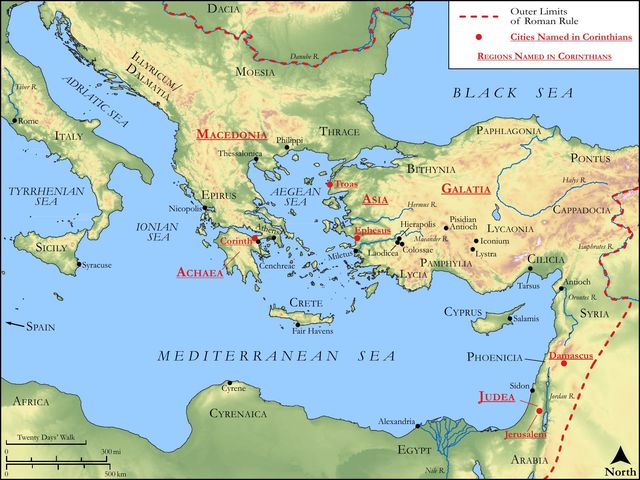
See on the biblical-era maps

Study this verse
Public-domain commentary
Matthew Henry
From his Commentary on the Whole Bible. Henry comments on passages, not single verses — this entry covers 1 Corinthians 10:6–14. His two-level outline is real structure in the source text, so it is rendered as structure.
The apostle, having recited their privileges, proceeds here to an account of their faults and punishments, their sins and plagues, which are left upon record for an example to us, a warning against the like sins, if we would escape the like punishments. We must not do as they did, lest we suffer as they suffered.
I.Several of their sins are specified as cautions to us; as,
1.We should shun inordinate desires after carnal objects: Not lust after evil things, as they lusted, Co1 10:6. God fed them with manna, but they must have flesh, Num 11:4. They had food for their supply, but, not content with this, they asked meat for their lusts, Psa 106:14. Carnal desires get head by indulgence, and therefore should be observed and checked in their first rise: if once they prevail, and bear sway in us, we know not whither they will carry us. This caution stands first, because carnal appetites indulged are the root and source of much sin.
2.He warns against idolatry (Co1 10:7): Neither be you idolaters, as were some of them; as it is written, The people sat down to eat and drink, and rose up to play. The sin of the golden calf is referred to, Exo 32:6. They first sacrificed to their idol, then feasted on the sacrifices, and then danced before it. Though only eating and drinking are mentioned here, yet the sacrifice is supposed. The apostle is speaking to the case of the Corinthians, who were tempted to feast on the heathen sacrifices, things offered to idols, though they do not seem to have been under any temptation to offer sacrifice themselves. Even eating and drinking of the sacrifices before the idol, and as things sacrificed, was idolatry, which, by the example of the Israelites, they should be warned to avoid.
3.He cautions against fornication, a sin to which the inhabitants of Corinth were in a peculiar manner addicted. They had a temple among them dedicated to Venus (that is, to lust), with above a thousand priestesses belonging to it, all common prostitutes. How needful was a caution against fornication to those who lived in so corrupt a city, and had been used to such dissolute manners, especially when they were under temptations to idolatry too! and spiritual whoredom did in many cases lead to bodily prostitution. Most of the gods whom the heathens served were represented as patterns of lewdness; and much lewdness was committed in the very worship of many of them. Many of the Jewish writers, and many Christians after them, think that such worship was paid to Baal-Peor; and that fornication was committed with the daughters of Moab in the worship of that idol. They were enticed by these women both to spiritual and corporal whoredom; first to feast on the sacrifice, if not to do more beastly acts, in honour of the idol, and then to defile themselves with strange flesh (Num. 25), which brought on a plague, that in one day slew twenty-three thousand, besides those who fell by the hand of public justice. Note, Whoremongers and adulterers God will judge, in whatever external relation they may stand to him, and whatever outward privileges he may bestow upon them. Let us fear the sins of Israel, if we would shun their plagues.
4.He warns us against tempting Christ (as some of them tempted, and were destroyed of serpents, Co1 10:9), or provoking him to jealousy, Co1 10:22. He was with the church in the wilderness; he was the angel of the covenant, who went before them. But he was greatly grieved and provoked by them in many ways: They spoke against him and Moses, Wherefore have you brought us out of Egypt to die in the wilderness? for which reason God sent fiery serpents among them (Num 21:5, Num 21:6), by which many of them were stung mortally. And it is but just to fear that such as tempt Christ under the present dispensation will be left by him in the power of the old serpent.
5.He warns against murmuring: Neither murmur you as some of them also murmured, and were destroyed of the destroyer (Co1 10:10), by a destroying angel, an executioner of divine vengeance. They quarrelled with God, and murmured against Moses his minister, when any difficulties pressed them. When they met with discouragements in the way to Canaan, they were very apt to fly in the face of their leaders, were for displacing them, and going back to Egypt under the conduct of others of their own choosing. Something like this seems to have been the case of the Corinthians; they murmured against Paul, and in him against Christ, and seem to have set up other teachers, who would indulge and soothe them in their inclinations, and particularly in a revolt to idolatry. Rather let them feast on idol sacrifices than bear the reproach, or expose themselves to the ill-will, of heathen neighbours. Such conduct was very provoking to God, and was likely to bring upon them swift destruction, as it did on the Israelites, Num 14:37. Note, Murmuring against divine disposals and commands is a sin that greatly provokes, especially when it grows to such a head as to issue in apostasy, and a revolt from him and his good ways.
II.The apostle subjoins to these particular cautions a more general one (Co1 10:11):
All these things happened to them for ensamples, and were written for our admonition. Not only the laws and ordinances of the Jews, but the providences of God towards them, were typical. Their sins against God, and backslidings from him, were typical of the infidelity of many under the gospel. God's judgments on them were types of spiritual judgments now. Their exclusion from the earthly Canaan typified the exclusion of many under the gospel out of the heavenly Canaan, for their unbelief. Their history was written, to be a standing monitor to the church, even under the last and most perfect dispensation: To us, on whom the end of the world is come, the concluding period of God's gracious government over men. Note, Nothing in scripture is written in vain. God had wise and gracious purposes towards us in leaving the Jewish history upon record; and it is our wisdom and duty to receive instruction from it. Upon this hint the apostle grounds a caution (Co1 10:12): Let him that thinketh he standeth take heed lest he fall. Note, The harms sustained by others should be cautious to us. He that thinks he stands should not be confident and secure, but upon his guard. Others have fallen, and so may we. And then we are most likely to fall when we are most confident of our own strength, and thereupon most apt to be secure, and off our guard. Distrust of himself, putting him at once upon vigilance and dependence on God, is the Christian's best security against all sin. Note, He who thinks he stands is not likely to keep his footing, if he fears no fall, nor guards against it. God has not promised to keep us from falling, if we do not look to ourselves: his protection supposes our own care and caution.
III.But to this word of caution he adds a word of comfort, Co1 10:13.
Though it is displeasing to God for us to presume, it is not pleasing to him for us to despair. If the former be a great sin, the latter is far from being innocent. Though we must fear and take heed lest we fall, yet should we not be terrified and amazed; for either our trials will be proportioned to our strength, or strength will be supplied in proportion to our temptations. We live indeed in a tempting world, where we are compassed about with snares. Every place, condition, relation, employment, and enjoyment, abounds with them; yet what comfort may we fetch from such a passage! For, 1. "No temptation," says the apostle, "hath yet taken you, but such as is common to man, what is human; that is, such as you may expect from men of such principles as heathens, and such power; or else such as is common to mankind in the present state; or else such as the spirit and resolution of mere men may bear you through." Note, The trials of common Christians are but common trials: others have the like burdens and the like temptations; what they bear up under, and break through, we may also. 2. God is faithful. Though Satan be a deceiver, God is true. Men may be false, and the world may be false; but God is faithful, and our strength and security are in him. He keepeth his covenant, and will never disappoint the filial hope and trust of his children. 3. He is wise as well as faithful, and will proportion our burden to our strength. He will not suffer us to be tempted above what we are able. He knows what we can bear, and what we can bear up against; and he will, in his wise providence, either proportion our temptations to our strength or make us able to grapple with them. He will take care that we be not overcome, if we rely upon him, and resolve to approve ourselves faithful to him. We need not perplex ourselves with the difficulties in our way when God will take care that they shall not be too great for us to encounter, especially. 4. When he will make them to issue well. He will make a way to escape, either the trial itself, or at least the mischief of it. There is no valley so dark but he can find a way through it, no affliction so grievous but he can prevent, or remove, or enable us to support it, and in the end overrule it to our advantage.
IV.And upon this argument he grounds another caution against idolatry: Wherefore, my dearly beloved, flee from idolatry. Observe,
1.How he addresses them: My dearly beloved. It is out of tender affection to them that he presses this advice upon them.
2.The matter of his advice: "Flee idolatry; shun it, and all approaches towards it." Idolatry is the most heinous injury and affront to the true God; it is transferring his worship and honour to a rival.
3.The ground of this advice: "Seeing you have such encouragement to trust God, and to be faithful, do you approve yourselves men, be not shaken by any discouragements your heathen enemies may lay before you. God will succour and assist, help you in your trials, and help you out of them; and therefore be not guilty of any idolatrous compliances." Note, We have all the encouragement in the world to flee sin and prove faithful to God. We cannot fall by a temptation if we cleave fast to him.
Historical interpretation
Four Centuries of Reception
9 surviving comments on this verse. Each one is dated, so this reads as a timeline rather than a list.
Select a marker to jump to its quote. Markers stagger vertically where authors wrote within a few decades of each other.
In whom enduring, ye shall escape all the assaults of this world: for "He is faithful, who will not suffer you to be tempted above that which ye are able."
And for this give thanks to the Lord, because He has deemed you worthy of showing you beforehand this affliction, that, knowing it before it comes, you may be able to bear it with courage.
Many do not bear it but are conquered by temptation. What God gives us is not the certainty that we shall bear it but the possibility that we may be made able to bear it.
That every one is tempted so much as he is able to bear. In the first Epistle of Paul to the Corinthians: "No temptation shall take you, except such is human. But God is faithful, who will not suffer you to be tempted above that ye are able; but will with the temptation also make a way to escape, that ye may be able to bear it."
Thus, because he terrified them greatly, relating the ancient examples, and threw them into an agony, saying, "Let him that thinketh he standeth take heed lest he fall;" though they had borne many temptations, and had exercised themselves many times therein; for "I was with you," saith he, "in weakness, and in fear, and in much trembling:" lest they should say, "Why terrify and alarm us? we are not unexercised in these troubles, for we have been both driven and persecuted, and many and continual dangers have we endured:" repressing again their pride, he says, "there hath no temptation taken you but such as man can bear," i.e., small, brief, moderate. For he uses the expression "man can bear," in respect of what is small; as when he says, "I speak after the manner of men because of the infirmity of your flesh." "Think not then great things," saith he, "as though ye had overcome the storm. For never have ye seen a danger threatening death nor a temptation intending slaughter:" which also he said to the Hebrews, "ye have not yet resisted unto blood, striving against sin."
Then, because he terrified them, see how again he raises them up, at the same time recommending moderation; in the words, "God is faithful, Who will not suffer you to be tempted above that ye are able." There are therefore temptations which we are not able to bear. And what are these? All, so to speak. For the ability lies in God's gracious influence; a power which we draw down by our own will. Wherefore that thou mayest know and see that not only those which exceed our power, but not even these which are "common to man" is it possible without assistance from God easily to bear, he added, "But will with the temptation also make the way of escape, that ye may be able to endure it."
For, saith he, not even those moderate temptations, as I was remarking, may we bear by our own power: but even in them we require aid from Him in our warfare that we may pass through them, and until we have passed, bear them. For He gives patience and brings on a speedy release; so that in this way also the temptation becomes bearable. This he covertly intimates, saying, "will also make the way of escape, that ye may be able to bear it:" and all things he refers to Him.
Paul did not pray that we should not be tempted, for a man who has not been tempted is untried, but that we should be able to bear our temptations as we ought.
Why is this written if we are now so endowed that by the strength of our free will we are able to overcome all temptations merely by bearing them?
A hermit used to say, ‘A lustful thought is brittle like papyrus. When it is thrust at us, if we do not accept it but throw it away it breaks easily. If it allures us and we keep playing with it, it becomes as difficult to break as iron. We need discernment to know that those who consent lose hope of salvation and for those who do not consent, a crown is made ready.’
Orsisius said, ‘If you put a piece of unbaked tiling in a building with a river nearby, it does not last a day. If it is baked, it is as good as stone. So it is with those of worldly wisdom, who are not proved by the word of God, as Joseph was proved at his beginning. To live among men is to be tempted often. It is good that a man should know his weakness, and not pick up too heavy a burden at first. But those of strong faith cannot be moved. Take the life of the patriarch Joseph and see what grievous temptations he suffered in a country where there was no trace of the true worship of God. But the God of his fathers was with him, and kept him safe in every trial, and he is now with his fathers in the kingdom of heaven. So let us own our weakness, and struggle onward. It is hard for us to escape the judgement of God.’
Continue studying 1 Corinthians 10:13 across the web’s major study libraries — every link below opens this exact verse, chapter, or book on the destination site.
Read & Compare
 BibleGatewayThis verse in more than 200 translations and 70 languages.
 Bible.comThe YouVersion reader — hundreds of translations, reading plans, and highlights.
 ESV.orgCrossway's official English Standard Version reader.
 NET BibleThe NET translation with 60,000+ translators' notes on every rendering decision.
 STEP BibleTyndale House's free study tool — original text, vocabulary, and scholarly resources.
 BibliaLogos Bible Software's free web reader.
 USCCBThe New American Bible (Revised Edition) with the U.S. bishops' study notes.
Commentaries
 BibleHub CommentariesDozens of classic commentaries on this verse, gathered on one page.
 StudyLightMore than 100 commentary sets — the largest collection on the web.
 BibleRefPlain-English commentary on what this verse means, verse by verse.
 Enduring WordDavid Guzik's free commentary on this chapter, widely used by Bible teachers.
 Bible Study ToolsVerse commentary alongside Greek and Hebrew study aids.
Original Language & Research
- BibleHub InterlinearThe verse word by word — original language, transliteration, and English.
- BibleHub LexiconEvery word's original-language definition and Strong's entry.
 Blue Letter BibleDeep-study tools — Strong's numbers, concordance, and word studies.
 CNTR CollationThe earliest Greek manuscripts of this verse, collated letter by letter.
Sermons, Hymns & Audio


TrulyRandomVerse is not affiliated with these sites and doesn’t control their content. They’re linked because they’re genuinely useful.
Summary
1 Corinthians 10:13 stands as a cornerstone promise, assuring believers that no temptation they face is unique or insurmountable. It profoundly declares God's unwavering faithfulness, guaranteeing that He will never permit His children to be tested beyond their divinely enabled capacity. Furthermore, it reveals His active provision of a means of escape within every trial, ensuring that His people are always equipped to endure and ultimately overcome.
Context
ShowHideLiterary Context
This verse is strategically placed within Paul's broader argument in 1 Corinthians 8-10, where he addresses the complex issue of eating meat sacrificed to idols. Having cautioned the Corinthians against spiritual arrogance and self-confidence by drawing vivid lessons from Israel's wilderness wanderings—highlighting their failures despite miraculous provision (1 Corinthians 10:1-12)—Paul pivots. While the preceding verses serve as a somber warning against idolatry and immorality, 1 Corinthians 10:13 immediately follows, offering a powerful word of encouragement and assurance. It shifts from a cautionary tale to a comforting promise, demonstrating God's steadfast character and His commitment to His people, even as they navigate the very real temptations Paul has just warned them about. This verse acts as a bridge, balancing the warning against sin with the assurance of divine grace and enabling power.
Historical & Cultural Context
Corinth was a bustling, strategically important port city in ancient Greece, renowned for its wealth, trade, and unfortunately, its notorious immorality. The city was a melting pot of diverse cultures and religions, dominated by pagan worship, including the prominent temple of Aphrodite, associated with ritual prostitution. Believers in Corinth faced immense pressure to conform to the prevailing pagan customs, which often involved participation in idol feasts, sexual promiscuity, and various forms of idolatry. This environment presented daily temptations that challenged their newfound Christian faith and ethics. Paul's letter addresses these direct challenges, providing practical guidance for living a holy life amidst a corrupt culture. The Corinthians needed assurance that God understood their struggles and would provide the strength to resist the pervasive influences of their society, which often blurred the lines between acceptable cultural practices and sinful compromise.
Key Themes
ShowHide1 Corinthians 10:13 contributes to several major themes woven throughout Paul's letter and the broader biblical narrative. Foremost is the Faithfulness of God, a foundational attribute that undergirds all His promises and actions. This verse asserts that God's character is the ultimate guarantee of His protective and enabling power in the face of human weakness. Another key theme is the Commonality and Universality of Temptation, emphasizing that no believer is exempt from trials, nor are their struggles unique. This fosters solidarity and humility, reminding us that even Christ Himself was tempted (Hebrews 4:15). Finally, the verse highlights Divine Sovereignty and Provision, demonstrating that God actively limits the intensity of temptation and simultaneously provides the necessary means for endurance and escape, aligning with His desire for His people's sanctification and perseverance, as seen in passages like Philippians 4:13.
Exposition and Analysis
ShowHideKey Word Analysis
ShowHideThis word carries a dual meaning, encompassing both a 'trial' or 'testing' (which God may permit to strengthen faith, reveal character, or refine a believer) and a 'solicitation to sin' (which originates from our fallen nature or external evil forces). In this context, it refers to any external pressure or internal desire that could lead a believer away from God's will and into sin. Paul assures that even such enticements are under God's sovereign control.
This adjective describes God's unwavering reliability, trustworthiness, and adherence to His promises. It is the bedrock of the entire verse. God's faithfulness means He is true to His character and His covenant, ensuring that He will always act in accordance with His divine nature and His commitment to His people's well-being and salvation. His faithfulness is the guarantee that the subsequent promises in the verse will hold true.
Literally meaning 'an exit,' 'a way out,' or 'a successful issue.' This is not necessarily the removal of the temptation itself, but a divinely provided path, means, or strength within the temptation that allows the believer to endure it victoriously without succumbing to sin. It implies a strategic opening or a supernatural enablement to navigate the trial successfully.
Verse Breakdown
ShowHide"There hath no temptation taken you but such as is common to man:"
This opening clause immediately normalizes the experience of temptation. Paul asserts that the trials and enticements faced by the Corinthians are not unique, overwhelming, or beyond human experience. This removes the sense of isolation and despair, reminding believers that their struggles are shared by humanity, fostering a sense of solidarity and demonstrating that what others have faced and overcome, they too can overcome.
"but God is faithful,"
This is the pivotal declaration, introducing the unwavering character of God as the ultimate safeguard and source of hope. It contrasts human weakness and the universality of temptation with divine reliability. God's faithfulness is the guarantee that His promises will be upheld, providing a firm foundation for the assurances that follow.
"who will not suffer you to be tempted above that ye are able;"
This crucial promise reveals God's active, sovereign control over every temptation. The word "suffer" (G1439, eáō) implies God's permission and limitation. He carefully measures the intensity and duration of every trial, ensuring it never exceeds the believer's divinely empowered capacity to bear it. This capacity is not inherent human strength but rather the strength God provides.
"but will with the temptation also make a way to escape,"
God's provision goes beyond merely limiting the temptation; He actively creates a means of deliverance. The "way to escape" (G1545, ékbasis) is not necessarily an avoidance of the trial, but a path through it, a divinely orchestrated opportunity, insight, or empowerment that allows the believer to stand firm and resist sin. This "way" is provided with the temptation, meaning it is present concurrently with the struggle.
"that ye may be able to bear it."
The ultimate purpose of God's provision is the believer's endurance and victory. The phrase "able to bear it" (G1410, dýnamai, G5297, hypophérō) signifies the capacity to "undergo hardship" or "endure from underneath." God's "way to escape" enables believers to stand firm, persevere, and emerge from the temptation without succumbing to its sinful pull, glorifying Him in their steadfastness.
Literary Devices
ShowHidePaul masterfully employs several literary devices in this concise verse to convey its profound truth. The verse begins with Understatement or Litotes ("no temptation... but such as is common to man"), subtly emphasizing the universality of human struggle while immediately pivoting to the extraordinary nature of divine intervention. A strong Contrast is drawn between human weakness and the unyielding Faithfulness of God, highlighting God's character as the anchor in the storm of temptation. The entire verse functions as a Divine Promise, offering absolute assurance based on God's nature. The "way to escape" can be seen as a Metaphor for a divinely provided path or resource, an exit strategy within the confines of the trial itself, rather than a magical disappearance of the trial. This skillful use of language reinforces the verse's comforting and empowering message.
Theological and Thematic Connections
ShowHide1 Corinthians 10:13 is a powerful theological statement on God's character, particularly His faithfulness and sovereignty in the lives of His people. It refutes the notion that believers are left to face overwhelming temptations alone, asserting that God is intimately involved in every trial. This verse underscores the biblical truth that God is not only aware of our weaknesses but actively limits the scope of our tests, ensuring they never exceed the strength He provides. It connects to the broader theme of divine enablement for righteous living, emphasizing that sanctification is a cooperative work where God supplies the grace for human perseverance. The "way to escape" speaks to God's active intervention, whether through a change in circumstances, a sudden infusion of strength, or the wisdom to choose the path of righteousness. This promise is a testament to God's covenant loyalty, demonstrating His commitment to preserve His elect and bring them to ultimate glory, even through the crucible of temptation.
Reflection and Application
ShowHide1 Corinthians 10:13 offers profound comfort and practical guidance for every believer navigating the complexities of life in a fallen world. It calls us to abandon the lie that our temptations are unique or insurmountable, fostering a sense of solidarity with all humanity who face similar struggles. More importantly, it shifts our focus from our own perceived weakness to the unshakeable strength and faithfulness of God. When we feel overwhelmed, this verse reminds us that God is actively engaged, setting boundaries on every trial and simultaneously providing a viable path to overcome. This truth empowers us to actively seek and utilize the "way of escape" He provides—whether it's through fervent prayer, immersing ourselves in God's Word, seeking wise counsel, or physically removing ourselves from a tempting situation. It instills a resilient hope, knowing that God's grace is always sufficient, enabling us to stand firm and emerge victorious, proving His power through our perseverance.
Questions for Reflection
ShowHideFAQ
ShowHideDoes God tempt us to sin?
ShowHideNo, God does not tempt anyone to sin. James 1:13 explicitly states, "Let no man say when he is tempted, I am tempted of God: for God cannot be tempted with evil, neither tempteth he any man." The Greek word for "temptation" (peirasmós) in 1 Corinthians 10:13 can mean both a 'trial' or 'test' (which God may permit for our growth and refinement, as seen in James 1:2-4) and a 'solicitation to sin' (which originates from our own sinful desires or from Satan, as described in Matthew 4:1-11). In 1 Corinthians 10:13, God's faithfulness ensures He will not allow us to be tempted beyond our capacity, nor will He cause us to sin. He permits trials for our good, but He never entices us to do evil.
What exactly does "make a way to escape" mean? Is it always a removal of the temptation?
ShowHideThe "way to escape" (Greek: ékbasis) does not necessarily mean the temptation or trial will be immediately removed. Instead, it signifies a divinely provided path, a means, or an enabling strength within the temptation that allows the believer to endure it without succumbing to sin. It could be a sudden insight, a surge of spiritual strength, the wisdom to physically remove oneself from a tempting environment, the timely intervention of a wise friend, or even a change in circumstances. The emphasis is on God's active provision of a viable option for faithful perseverance, ensuring that we are never truly trapped or without recourse when facing a trial. It's about enduring through the temptation victoriously, not always being delivered from it.
How do I know what I'm "able" to bear, and does this mean I'll never fail?
ShowHideThe "able" in this verse refers not to our inherent human strength, but to the divinely enabled capacity that God provides. It's about God's power working through us, not our own self-sufficiency (Philippians 4:13). This promise is a guarantee of God's faithfulness, not a guarantee of our sinless perfection. Believers can and do still fall into sin, but when they do, it is not because God failed to provide a way of escape or allowed them to be tempted beyond what they could bear. Rather, it is because they did not utilize the "way of escape" God provided. The verse assures us that the opportunity for victory is always present through God's grace, empowering us to choose righteousness even in the face of intense pressure.
Christ-Centered Fulfillment
ShowHide1 Corinthians 10:13 finds its ultimate and profound fulfillment in the person and work of Jesus Christ. He is the preeminent example of one who faced every conceivable temptation yet remained without sin, as Hebrews 4:15 declares, "For we have not an high priest which cannot be touched with the feeling of our infirmities; but was in all points tempted like as we are, yet without sin." Christ's own wilderness temptation (Matthew 4:1-11) demonstrates that He fully understands the human struggle. More than just an example, Christ is the very means by which we are "able to bear it" and the "way to escape." Through His atoning sacrifice, He broke the power of sin and death, offering us forgiveness when we fail and empowering us by His Spirit to overcome (Romans 8:26). He is our faithful High Priest who intercedes for us (Hebrews 7:25), ensuring that God's promise in 1 Corinthians 10:13 is perpetually true for all who are in Him. Our ability to bear temptation is not found in our own strength, but in His indwelling presence and the power of His resurrection life working within us, making Him the ultimate "way to escape" from the dominion of sin.