


1 Corinthians 10:11
- ταῦταtautaThese thingsG3778D-NPNDemonstrative pronoun Nominative Plural Neuter
- δὲdenowG1161CONJConjunction
- πάνταpantaallG3956A-NPNAdjective Nominative Plural Neuter
- τυπικῶςtupikōstypologicallyADVAdverb
- συνέβαινενsunebainenit was happeningG4819V-IAI-3SVerb Imperfect Active Indicative 3rd Singular
- ἐκείνοιςekeinoisto themG1565D-DPMDemonstrative pronoun Dative Plural Masculine
- ἐγράφηegraphēwere writtenG1125V-2API-3SVerb 2nd Aorist Passive Indicative 3rd Singular
- δὲdethenG1161CONJConjunction
- πρὸςprosforG4314PREPPreposition
- νουθεσίανnouthesianadmonitionG3559N-ASFNoun Accusative Singular Feminine
- ἡμῶνhēmōnof usG3165P-1GPPersonal pronoun Genitive 1st Plural
- εἰςeistoG1519PREPPreposition
- οὓςhouswhomG3739R-APMRelative pronoun Accusative Plural Masculine
- τὰtatheG3588T-NPNDefinite article Nominative Plural Neuter
- τέληtelēendsG5056N-NPNNoun Nominative Plural Neuter
- τῶνtōnof theG3588T-GPMDefinite article Genitive Plural Masculine
- αἰώνωνaiōnōnagesG165N-GPMNoun Genitive Plural Masculine
- κατήντηκενkatēntēkenhas comeG2658V-RAI-3SVerb Perfect Active Indicative 3rd Singular
English is a literal word-by-word gloss of the Greek, not the KJV's wording. Why?
This is the original text the KJV's translators worked from — each Greek word with its own literal English meaning in this verse, prepared by scholars at Tyndale House, Cambridge. The KJV translates whole sentences, not word by word, so its wording differs: one Greek word can become several English words, and the KJV may choose “charity” where the gloss reads “love”. Both are faithful — they answer different questions. For the KJV's own rendering, switch to the KJV text.
Details
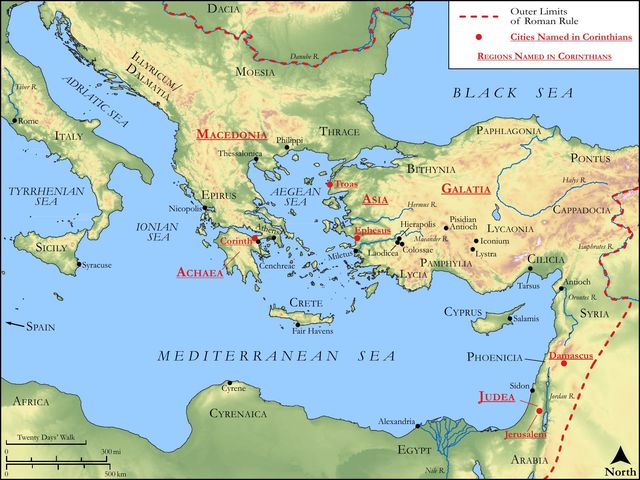
See on the biblical-era map

Study this verse
Public-domain commentary
Matthew Henry
From his Commentary on the Whole Bible. Henry comments on passages, not single verses — this entry covers 1 Corinthians 10:6–14. His two-level outline is real structure in the source text, so it is rendered as structure.
The apostle, having recited their privileges, proceeds here to an account of their faults and punishments, their sins and plagues, which are left upon record for an example to us, a warning against the like sins, if we would escape the like punishments. We must not do as they did, lest we suffer as they suffered.
I.Several of their sins are specified as cautions to us; as,
1.We should shun inordinate desires after carnal objects: Not lust after evil things, as they lusted, Co1 10:6. God fed them with manna, but they must have flesh, Num 11:4. They had food for their supply, but, not content with this, they asked meat for their lusts, Psa 106:14. Carnal desires get head by indulgence, and therefore should be observed and checked in their first rise: if once they prevail, and bear sway in us, we know not whither they will carry us. This caution stands first, because carnal appetites indulged are the root and source of much sin.
2.He warns against idolatry (Co1 10:7): Neither be you idolaters, as were some of them; as it is written, The people sat down to eat and drink, and rose up to play. The sin of the golden calf is referred to, Exo 32:6. They first sacrificed to their idol, then feasted on the sacrifices, and then danced before it. Though only eating and drinking are mentioned here, yet the sacrifice is supposed. The apostle is speaking to the case of the Corinthians, who were tempted to feast on the heathen sacrifices, things offered to idols, though they do not seem to have been under any temptation to offer sacrifice themselves. Even eating and drinking of the sacrifices before the idol, and as things sacrificed, was idolatry, which, by the example of the Israelites, they should be warned to avoid.
3.He cautions against fornication, a sin to which the inhabitants of Corinth were in a peculiar manner addicted. They had a temple among them dedicated to Venus (that is, to lust), with above a thousand priestesses belonging to it, all common prostitutes. How needful was a caution against fornication to those who lived in so corrupt a city, and had been used to such dissolute manners, especially when they were under temptations to idolatry too! and spiritual whoredom did in many cases lead to bodily prostitution. Most of the gods whom the heathens served were represented as patterns of lewdness; and much lewdness was committed in the very worship of many of them. Many of the Jewish writers, and many Christians after them, think that such worship was paid to Baal-Peor; and that fornication was committed with the daughters of Moab in the worship of that idol. They were enticed by these women both to spiritual and corporal whoredom; first to feast on the sacrifice, if not to do more beastly acts, in honour of the idol, and then to defile themselves with strange flesh (Num. 25), which brought on a plague, that in one day slew twenty-three thousand, besides those who fell by the hand of public justice. Note, Whoremongers and adulterers God will judge, in whatever external relation they may stand to him, and whatever outward privileges he may bestow upon them. Let us fear the sins of Israel, if we would shun their plagues.
4.He warns us against tempting Christ (as some of them tempted, and were destroyed of serpents, Co1 10:9), or provoking him to jealousy, Co1 10:22. He was with the church in the wilderness; he was the angel of the covenant, who went before them. But he was greatly grieved and provoked by them in many ways: They spoke against him and Moses, Wherefore have you brought us out of Egypt to die in the wilderness? for which reason God sent fiery serpents among them (Num 21:5, Num 21:6), by which many of them were stung mortally. And it is but just to fear that such as tempt Christ under the present dispensation will be left by him in the power of the old serpent.
5.He warns against murmuring: Neither murmur you as some of them also murmured, and were destroyed of the destroyer (Co1 10:10), by a destroying angel, an executioner of divine vengeance. They quarrelled with God, and murmured against Moses his minister, when any difficulties pressed them. When they met with discouragements in the way to Canaan, they were very apt to fly in the face of their leaders, were for displacing them, and going back to Egypt under the conduct of others of their own choosing. Something like this seems to have been the case of the Corinthians; they murmured against Paul, and in him against Christ, and seem to have set up other teachers, who would indulge and soothe them in their inclinations, and particularly in a revolt to idolatry. Rather let them feast on idol sacrifices than bear the reproach, or expose themselves to the ill-will, of heathen neighbours. Such conduct was very provoking to God, and was likely to bring upon them swift destruction, as it did on the Israelites, Num 14:37. Note, Murmuring against divine disposals and commands is a sin that greatly provokes, especially when it grows to such a head as to issue in apostasy, and a revolt from him and his good ways.
II.The apostle subjoins to these particular cautions a more general one (Co1 10:11):
All these things happened to them for ensamples, and were written for our admonition. Not only the laws and ordinances of the Jews, but the providences of God towards them, were typical. Their sins against God, and backslidings from him, were typical of the infidelity of many under the gospel. God's judgments on them were types of spiritual judgments now. Their exclusion from the earthly Canaan typified the exclusion of many under the gospel out of the heavenly Canaan, for their unbelief. Their history was written, to be a standing monitor to the church, even under the last and most perfect dispensation: To us, on whom the end of the world is come, the concluding period of God's gracious government over men. Note, Nothing in scripture is written in vain. God had wise and gracious purposes towards us in leaving the Jewish history upon record; and it is our wisdom and duty to receive instruction from it. Upon this hint the apostle grounds a caution (Co1 10:12): Let him that thinketh he standeth take heed lest he fall. Note, The harms sustained by others should be cautious to us. He that thinks he stands should not be confident and secure, but upon his guard. Others have fallen, and so may we. And then we are most likely to fall when we are most confident of our own strength, and thereupon most apt to be secure, and off our guard. Distrust of himself, putting him at once upon vigilance and dependence on God, is the Christian's best security against all sin. Note, He who thinks he stands is not likely to keep his footing, if he fears no fall, nor guards against it. God has not promised to keep us from falling, if we do not look to ourselves: his protection supposes our own care and caution.
III.But to this word of caution he adds a word of comfort, Co1 10:13.
Though it is displeasing to God for us to presume, it is not pleasing to him for us to despair. If the former be a great sin, the latter is far from being innocent. Though we must fear and take heed lest we fall, yet should we not be terrified and amazed; for either our trials will be proportioned to our strength, or strength will be supplied in proportion to our temptations. We live indeed in a tempting world, where we are compassed about with snares. Every place, condition, relation, employment, and enjoyment, abounds with them; yet what comfort may we fetch from such a passage! For, 1. "No temptation," says the apostle, "hath yet taken you, but such as is common to man, what is human; that is, such as you may expect from men of such principles as heathens, and such power; or else such as is common to mankind in the present state; or else such as the spirit and resolution of mere men may bear you through." Note, The trials of common Christians are but common trials: others have the like burdens and the like temptations; what they bear up under, and break through, we may also. 2. God is faithful. Though Satan be a deceiver, God is true. Men may be false, and the world may be false; but God is faithful, and our strength and security are in him. He keepeth his covenant, and will never disappoint the filial hope and trust of his children. 3. He is wise as well as faithful, and will proportion our burden to our strength. He will not suffer us to be tempted above what we are able. He knows what we can bear, and what we can bear up against; and he will, in his wise providence, either proportion our temptations to our strength or make us able to grapple with them. He will take care that we be not overcome, if we rely upon him, and resolve to approve ourselves faithful to him. We need not perplex ourselves with the difficulties in our way when God will take care that they shall not be too great for us to encounter, especially. 4. When he will make them to issue well. He will make a way to escape, either the trial itself, or at least the mischief of it. There is no valley so dark but he can find a way through it, no affliction so grievous but he can prevent, or remove, or enable us to support it, and in the end overrule it to our advantage.
IV.And upon this argument he grounds another caution against idolatry: Wherefore, my dearly beloved, flee from idolatry. Observe,
1.How he addresses them: My dearly beloved. It is out of tender affection to them that he presses this advice upon them.
2.The matter of his advice: "Flee idolatry; shun it, and all approaches towards it." Idolatry is the most heinous injury and affront to the true God; it is transferring his worship and honour to a rival.
3.The ground of this advice: "Seeing you have such encouragement to trust God, and to be faithful, do you approve yourselves men, be not shaken by any discouragements your heathen enemies may lay before you. God will succour and assist, help you in your trials, and help you out of them; and therefore be not guilty of any idolatrous compliances." Note, We have all the encouragement in the world to flee sin and prove faithful to God. We cannot fall by a temptation if we cleave fast to him.
Historical interpretation
Four Centuries of Reception
9 surviving comments on this verse. Each one is dated, so this reads as a timeline rather than a list.
Select a marker to jump to its quote. Markers stagger vertically where authors wrote within a few decades of each other.
Thus, too, He imposed upon the [Jewish] people the construction of the tabernacle, the building of the temple, the election of the Levites, sacrifices also, and oblations, legal monitions, and all the other service of the law. He does Himself truly want none of these things, for He is always full of all good, and had in Himself all the odour of kindness, and every perfume of sweet-smelling savours, even before Moses existed. Moreover, He instructed the people, who were prone to turn to idols, instructing them by repeated appeals to persevere and to serve God, calling them to the things of primary importance by means of those which were secondary; that is, to things that are real, by means of those that are typical; and by things temporal, to eternal; and by the carnal to the spiritual; and by the earthly to the heavenly; as was also said to Moses, "Thou shalt make all things after the pattern of those things which thou sawest in the mount." For during forty days He was learning to keep [in his memory] the words of God, and the celestial patterns, and the spiritual images, and the types of things to come; as also Paul says: "For they drank of the rock which followed them: and the rock was Christ." And again, having first mentioned what are contained in the law, he goes on to say: "Now all these things happened to them in a figure; but they were written for our admonition, upon whom the end of the ages is come." For by means of types they learned to fear God, and to continue devoted to His service.
And yet that "blindness" then was felt long before "the ends of the world." What, then, will the case be if God now keep us from the vices which of old were detestable before Him? "The time," says (the apostle), "is compressed.
If, then he shows plainly that even wives themselves are so to be had as if they be not had, on account of the straits of the times, what would be his sentiments about these vain appliances of theirs? Why, are there not many, withal, who so do, and seal themselves up to eunuchhood for the sake of the kingdom of God, spontaneously relinquishing a pleasure so honourable, and (as we know) permitted? Are there not some who prohibit to themselves (the use of) the very "creature of God," abstaining from wine and animal food, the enjoyments of which border upon no peril or solicitude; but they sacrifice to God the humility of their soul even in the chastened use of food? Sufficiently, therefore, have you, too, used your riches and your delicacies; sufficiently have you cut down the fruits of your dowries, before (receiving) the knowledge of saving disciplines. We are they "upon whom the ends of the ages have met, having ended their course." We have been predestined by God, before the world was, (to arise) in the extreme end of the times.
Therefore, by means of the wide licence of those days, materials for subsequent emendations were furnished beforehand, of which materials the Lord by His Gospel, and then the apostle in the last days of the (Jewish) age, either cut off the redundancies or regulated the disorders.
For as it was on our account and for our learning that these events are described in the Scriptures, so for our sakes also were they done-(even ours, I say), "upon whom the ends of the world are come." In this way it was that even then He knew full well what human feelings and affections were, intending as He always did to take upon Him man's actual component substances, body and soul, making inquiry of Adam (as if He were ignorant), "Where art thou, Adam? " -repenting that He had made man, as if He had lacked foresight; tempting Abraham, as if ignorant of what was in man; offended with persons, and then reconciled to them; and whatever other (weaknesses and imperfections) the heretics lay hold of (in their assumptions) as unworthy of God, in order to discredit the Creator, not considering that these circumstances are suitable enough for the Son, who was one day to experience even human sufferings-hunger and thirst, and tears, and actual birth and real death, and in respect of such a dispensation "made by the Father a little less than the angels.
But the fact is, the apostle's conclusion corresponds to the beginning: "Now all these things happened unto them for ensamples; and they are written for our admonition, upon whom the ends of the world are come." What a Creator! how prescient already, and considerate in warning Christians who belong to another god! Whenever cavils occur the like to those which have been already dealt with, I pass them by; certain others I despatch briefly.
"And she said to her maids, Bring me oil." For faith and love prepare oil and unguents to those who are washed. But what were these unguents, but the commandments of the holy Word? And what was the oil, but the power of the Holy Spirit, with which believers are anointed as with ointment after the layer of washing? All these things were figuratively represented in the blessed Susannah, for our sakes, that we who now believe on God might not regard the things that are done now in the Church as strange, but believe them all to have been set forth in figure by the patriarchs of old, as the apostle also says: "Now these things happened unto them for ensamples: and they were written for our instruction, on whom the ends of the world are come."
"Now all these things happened unto them by way of example; and they were written for our admonition, upon whom the ends of the ages are come."
Again he terrifies them speaking of the "ends," and prepares them to expect things greater than had already taken place. "For that we shall suffer punishment is manifest," saith he, "from what hath been said, even to those who disbelieve the statements concerning hell-fire; but that the punishment also will be most severe, is evident, from the more numerous blessings which we have enjoyed, and from the things of which those were but figures. Since, if in the gifts one go beyond the other, it is most evident that so it will be in the punishment likewise." For this cause he both called them types, and said that they were "written for us" and made mention of an "end" that he might remind them of the consummation of all things. For not such will be the penalties then as to admit of a termination and be done away, but the punishment will be eternal; for even as the punishments in this world are ended with the present life, so those in the next continually remain. But when he said, "the ends of the ages," he means nothing else than that the fearful judgment is henceforth nigh at hand.
What is the hour of supper, except the end of the world? In which we certainly are, as Paul long ago testifies, saying: "We are those upon whom the ends of the ages have come." If therefore it is already the hour of supper when we are called, the less should we excuse ourselves from the banquet of God, the more we perceive that the end of the age has drawn near. For the more we consider that nothing remains, the more we ought to fear lest the time of grace that is at hand be lost.
Continue studying 1 Corinthians 10:11 across the web’s major study libraries — every link below opens this exact verse, chapter, or book on the destination site.
Read & Compare
 BibleGatewayThis verse in more than 200 translations and 70 languages.
 Bible.comThe YouVersion reader — hundreds of translations, reading plans, and highlights.
 ESV.orgCrossway's official English Standard Version reader.
 NET BibleThe NET translation with 60,000+ translators' notes on every rendering decision.
 STEP BibleTyndale House's free study tool — original text, vocabulary, and scholarly resources.
 BibliaLogos Bible Software's free web reader.
 USCCBThe New American Bible (Revised Edition) with the U.S. bishops' study notes.
Commentaries
 BibleHub CommentariesDozens of classic commentaries on this verse, gathered on one page.
 StudyLightMore than 100 commentary sets — the largest collection on the web.
 BibleRefPlain-English commentary on what this verse means, verse by verse.
 Enduring WordDavid Guzik's free commentary on this chapter, widely used by Bible teachers.
 Bible Study ToolsVerse commentary alongside Greek and Hebrew study aids.
Original Language & Research
- BibleHub InterlinearThe verse word by word — original language, transliteration, and English.
- BibleHub LexiconEvery word's original-language definition and Strong's entry.
 Blue Letter BibleDeep-study tools — Strong's numbers, concordance, and word studies.
 CNTR CollationThe earliest Greek manuscripts of this verse, collated letter by letter.
Sermons, Hymns & Audio


TrulyRandomVerse is not affiliated with these sites and doesn’t control their content. They’re linked because they’re genuinely useful.
Summary
First Corinthians 10:11 profoundly asserts that the historical experiences and failures of ancient Israel, particularly their wilderness wanderings, were divinely orchestrated and recorded not merely as historical accounts but as enduring spiritual lessons and cautionary examples. Paul emphasizes that these narratives are preserved in Scripture specifically for the instruction and warning of believers living in the climactic period of redemptive history, often referred to as "the ends of the world," which commenced with the advent of Christ. This verse underscores the timeless relevance of the Old Testament and the heightened responsibility of those living in the eschatological age.
Context
ShowHideLiterary Context
This verse serves as the concluding summary statement for a crucial section in 1 Corinthians 10:1-10. Paul has just recounted a series of Israel's failures in the wilderness—idolatry, sexual immorality, testing Christ, and grumbling—despite their initial spiritual privileges (being under the cloud, passing through the sea, eating spiritual food and drink). He explicitly presents each of these incidents as "examples" (v. 6) and "ensamples" (v. 11) for the Corinthian believers. The immediate context of these warnings is the Corinthians' struggle with participation in pagan idol feasts, which could lead to spiritual compromise and moral laxity. Paul uses Israel's history as a powerful object lesson to caution them against spiritual overconfidence and to highlight the real danger of falling from grace, even after experiencing divine favor.
Historical & Cultural Context
The Corinthian church was situated in a bustling, cosmopolitan port city known for its diverse religious practices, including prominent pagan cults and temples. The issue of eating meat sacrificed to idols was a significant point of contention, as such practices often involved participation in temple feasts that could blur the lines between Christian worship and pagan rituals. Paul's audience would have been familiar with the Old Testament narratives, particularly the Exodus and wilderness accounts, which were foundational to Jewish and early Christian understanding of God's relationship with His people. By drawing on these well-known historical events, Paul grounds his ethical instructions in a shared theological heritage, demonstrating that God's principles of faithfulness and judgment are consistent across generations. The cultural pressure to conform to pagan practices made Paul's warnings about idolatry and immorality particularly pertinent.
Key Themes
ShowHideFirst Corinthians 10:11 contributes significantly to several major themes within the chapter and the broader epistle. It reinforces the theme of Divine Sovereignty and Purpose in History, illustrating that God orchestrates and records events for the instruction of future generations. The verse also powerfully develops the theme of Cautionary Examples, emphasizing that the failures of past generations are not mere historical facts but vivid warnings against similar sins, highlighting the ongoing danger of spiritual complacency and disobedience, as seen in 1 Corinthians 10:12. Furthermore, the phrase "the ends of the world are come" introduces a strong Eschatological Urgency, signifying that believers live in the climactic age inaugurated by Christ's first coming, which should heighten their sense of responsibility and accountability. This also underscores the Continuing Relevance of Scripture, especially the Old Testament, for New Testament believers, providing guidance and warnings for their conduct and faith, a principle echoed in 2 Timothy 3:16-17.
Exposition and Analysis
ShowHideKey Word Analysis
ShowHideThis term refers to a "type," "pattern," "model," or "instance for warning." It suggests that the Old Testament events are not just isolated historical incidents but serve as prototypes or prefigurings of spiritual realities and dangers that New Testament believers face. They are not merely illustrations but divinely appointed patterns that reveal God's consistent ways of dealing with humanity, both in blessing and in judgment.
This word denotes "calling attention to," implying a "mild rebuke or warning" or "instruction." It signifies a gentle but firm correction of the mind or disposition, aimed at preventing error or promoting right conduct. It's a form of moral instruction that seeks to shape one's inner thoughts and attitudes, rather than merely punishing outward actions.
In the phrase "ends of the world," aiṓn refers to an "age" or "period of time," often with a sense of "perpetuity" or "the world" in a temporal sense. Here, combined with "ends" (télos), it refers to the culmination or consummation of the ages, signifying that the Christian era is the final, decisive period of redemptive history, the eschatological age before Christ's final return.
Verse Breakdown
ShowHide"Now all these things happened unto them for ensamples:"
This clause asserts the divine purpose behind the historical accounts of Israel's wilderness experience. The events, including their failures and God's judgments, were not random occurrences but were designed by God to serve as "types" or "patterns" for future generations. They are not just historical records but divinely intended precedents.
"and they are written for our admonition,"
This part emphasizes the inspired and didactic nature of Scripture. The fact that these events are "written" signifies their permanent record and their specific purpose: to provide "admonition"—instruction, warning, and correction—for believers. This highlights the practical and formative role of the Old Testament for the Christian life.
"upon whom the ends of the world are come."
This concluding phrase identifies the specific audience and their unique historical position. "The ends of the world" (or "the ends of the ages") refers to the eschatological period inaugurated by Christ's first coming. Believers in the New Covenant era live in the climactic phase of God's redemptive plan, where the promises and prophecies of old are being fulfilled. This awareness should instill a heightened sense of urgency, responsibility, and privilege.
Literary Devices
ShowHideThe verse prominently employs Typology, where the Old Testament events (Israel's wilderness journey, their sins, and God's judgments) serve as types or foreshadowings of spiritual realities and dangers faced by New Testament believers. This is explicit in the use of "ensamples" (týpos). There is also clear Didacticism, as Paul's primary intent is to instruct and warn the Corinthian church, making the historical narrative directly applicable to their contemporary struggles. The phrase "the ends of the world are come" is a powerful Metaphor for the dawning of the Messianic age, signifying a shift in redemptive history from anticipation to fulfillment. This also creates a sense of Urgency, implying that the stakes are higher for those living in this final, decisive period.
Theological and Thematic Connections
ShowHideFirst Corinthians 10:11 profoundly establishes the enduring revelatory and practical value of the Old Testament for New Covenant believers. It asserts that God's historical dealings with Israel are not merely ancient history but divinely preserved object lessons, designed to instruct and warn those living in the eschatological era. This theological principle underscores the unity of God's redemptive plan across both testaments and highlights the consistent nature of human sin and divine judgment. The "ends of the world" signify that the church lives in the fulfillment of the ages, making the warnings from the past even more potent and immediate, as the final consummation draws near.
Reflection and Application
ShowHideFor contemporary believers, 1 Corinthians 10:11 serves as a profound call to diligent engagement with the entirety of Scripture. It challenges us to move beyond a superficial reading of Old Testament narratives and to recognize their profound spiritual and practical relevance for our lives today. The temptations faced by ancient Israel—idolatry, discontentment, rebellion, and testing God—are not confined to history but manifest in various forms in our modern world, from the worship of material possessions to the subtle erosion of faith through spiritual apathy. This verse compels us to humbly learn from the mistakes of those who came before us, understanding that human nature and spiritual battles remain remarkably consistent. Living in "the ends of the world" should cultivate in us a heightened sense of urgency, accountability, and a sober recognition that our time is short and the return of Christ is imminent. It calls us to vigilance, humility, and a steadfast reliance on God's grace to stand firm against temptation, ensuring that we do not repeat the errors of the past.
Questions for Reflection
ShowHideFAQ
ShowHideWhat does Paul mean by "the ends of the world are come"?
ShowHideWhen Paul states that "the ends of the world are come" (Greek: ta telē tōn aiōnōn), he is referring to the dawning of the eschatological age, the climactic period of redemptive history inaugurated by the first coming of Jesus Christ. In Jewish thought, there was a distinction between "this age" (the present evil age) and "the age to come" (the Messianic age). Paul asserts that with Christ's incarnation, death, resurrection, and ascension, the "age to come" has decisively broken into "this age." Believers are living in the time of fulfillment, where God's ultimate plan of salvation is actively unfolding. This means that the long-awaited Messianic era has begun, and the final stages of God's redemptive purposes are now in motion, leading towards Christ's second coming and the full establishment of His kingdom. It signifies a heightened sense of urgency and responsibility for those who live in this final, decisive period of history. This concept is also seen in passages like Hebrews 9:26 and Galatians 4:4.
Christ-Centered Fulfillment
ShowHideFirst Corinthians 10:11 finds its ultimate Christ-centered fulfillment in the person and work of Jesus, who stands as the pinnacle of God's redemptive plan and the very reason "the ends of the world are come." The "ensamples" of the Old Testament, particularly the wilderness experiences, are not merely historical anecdotes but serve as types that find their anti-type in Christ. He is the true spiritual Rock from whom living water flows (1 Corinthians 10:4), the perfect Passover Lamb whose sacrifice atones for sin (1 Corinthians 5:7), and the ultimate obedient Son who perfectly fulfills the Law where Israel failed (Romans 5:19). The "admonition" for us, living in the "ends of the world," is profoundly shaped by Christ's finished work; while Israel's failures led to judgment, our salvation is secured by His grace (Ephesians 2:8-9). His first advent inaugurated this final age, making the warnings against sin all the more urgent, as believers are called to live in light of His imminent return and the consummation of His kingdom (Titus 2:11-13). Thus, the Old Testament examples, written for our warning, point us to the necessity of steadfast faith in Christ, the one who perfectly navigated the wilderness of temptation and secured our eternal hope.