


2 Samuel 24:16
- וַיִּשְׁלַחvai·yish·Lachand he stretched outH7971Conj-w ¦ V-Qal-ConsecImperf-3msVerb Qal Consecutive Imperfect 3rd Singular Masculineוַandיִּשְׁלַחhe stretched out
- יָדוֹya·Dohis handH3027N-csc ¦ 3msNoun Singular common gender Constructיָדhandוֹhis
- הַמַּלְאָךְha·mal·'Akhthe angelH4397Art ¦ N-msNoun Singular Masculine Absoluteהַtheמַּלְאָךְangel
- יְרוּשָׁלִַםye·ru·sha·LimJerusalemH3389N-properNoun Proper Location
- לְשַׁחֲתָהּle·sha·cha·Tahto destroy itH7843Prep-l ¦ V-Piel-Inf ¦ 3fsVerb Piel Infinitive Constructלְtoשַׁחֲתָdestroyהּit
- וַיִּנָּחֶםvai·yi·Na·chemand he relentedH5162Conj-w ¦ V-Niphal-ConsecImperf-3msVerb Niphal Consecutive Imperfect 3rd Singular Masculineוַandיִּנָּחֶםhe relented
- יְהוָהYah·wehYahwehH3068N-properNoun Proper Title
- אֶל'elconcerningH413PrepPreposition
- הָרָעָהha·ra·'Ahthe harmH7451Art ¦ N-fsNoun Singular Feminine Absoluteהָtheרָעָהharm
- וַיֹּאמֶרVai·yo·merand he saidH559Conj-w ¦ V-Qal-ConsecImperf-3msVerb Qal Consecutive Imperfect 3rd Singular Masculineוַandיֹּאמֶרhe said
- לַמַּלְאָךְla·mal·'Akhto the angelH4397Prep-l ¦ N-msNoun Singular Masculine Absoluteלַto theמַּלְאָךְangel
- הַמַּשְׁחִיתha·mash·Chitthe destroyerH7843Art ¦ V-Hiphil-Prtcpl-msVerb Hiphil Participle Singular Masculine Absoluteהַtheמַּשְׁחִיתdestroyer
- בָּעָםba·'Amamong the peopleH5971Prep-b ¦ N-msNoun Singular Masculine Absoluteבָּamong theעָםpeople
- רַבRavenoughH7227Adj-msAdjective Singular Masculine Absolute
- עַתָּה'a·TahnowH6258AdvAdverb
- הֶרֶףHe·reflet dropH7503V-Hiphil-Imp-2msVerb Hiphil Imperative 2nd Singular Masculine
- יָדֶךָya·De·khayour handH3027N-csc ¦ 2msNoun Singular common gender Constructיָדֶhandךָyour
- וּמַלְאַךְu·mal·'Akhand [the] angel ofH4397Conj-w ¦ N-mscNoun Singular Masculine Constructוּandמַלְאַךְ[the] angel of
- יְהוָהYah·wehYahwehH3068N-properNoun Proper Title
- הָיָהha·Yahhe wasH1961V-Qal-Perf-3msVerb Qal Perfect 3rd Singular Masculine
- עִם'imnearH5973PrepPreposition
- גֹּרֶןGo·ren[the] threshing floor ofH1637N-fscNoun Singular Feminine Construct
- הָאֲרַוְנָהha·'Or·nah<the> AraunahH728Art ¦ N-proper-mNoun Proper Masculineהָ<the>אֲרַוְנָהAraunah
- הַיְבֻסִיhay·vu·Sithe JebusiteH2983Art ¦ N-msNoun Gentilic Singular Masculine AbsoluteהַtheיְבֻסִיJebusite
English is a literal word-by-word gloss of the Hebrew, not the KJV's wording. Why?
This is the original text the KJV's translators worked from — each Hebrew word with its own literal English meaning in this verse, prepared by scholars at Tyndale House, Cambridge. The KJV translates whole sentences, not word by word, so its wording differs: one Hebrew word can become several English words, and the KJV may choose “the LORD” where the gloss reads “Yahweh”. Both are faithful — they answer different questions. For the KJV's own rendering, switch to the KJV text.
Details
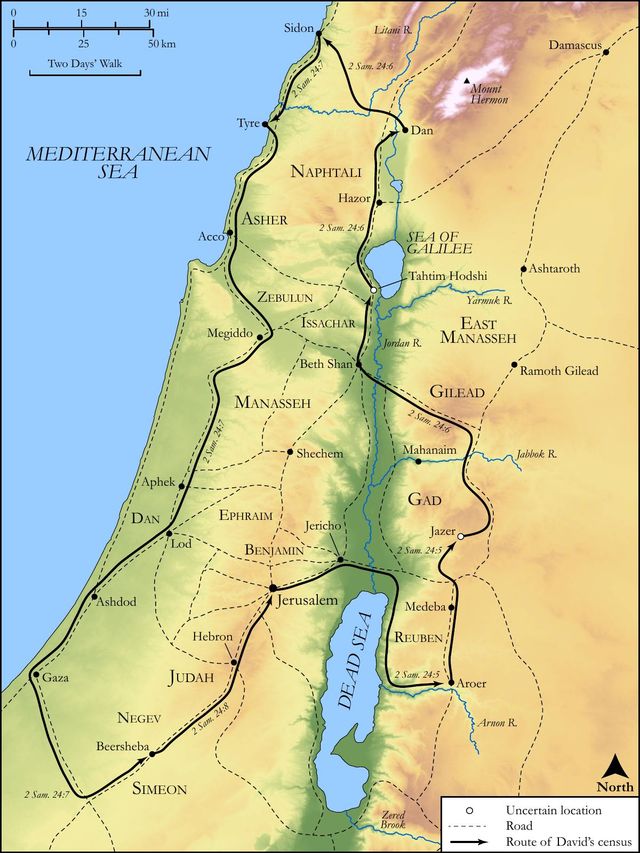
See on the biblical-era maps

Study this verse
Continue studying 2 Samuel 24:16 across the web’s major study libraries — every link below opens this exact verse, chapter, or book on the destination site.
Read & Compare
 BibleGatewayThis verse in more than 200 translations and 70 languages.
 Bible.comThe YouVersion reader — hundreds of translations, reading plans, and highlights.
 ESV.orgCrossway's official English Standard Version reader.
 NET BibleThe NET translation with 60,000+ translators' notes on every rendering decision.
 STEP BibleTyndale House's free study tool — original text, vocabulary, and scholarly resources.
 BibliaLogos Bible Software's free web reader.
 USCCBThe New American Bible (Revised Edition) with the U.S. bishops' study notes.
Commentaries
 BibleHub CommentariesDozens of classic commentaries on this verse, gathered on one page.
 StudyLightMore than 100 commentary sets — the largest collection on the web.
 BibleRefPlain-English commentary on what this verse means, verse by verse.
 Enduring WordDavid Guzik's free commentary on this chapter, widely used by Bible teachers.
 Bible Study ToolsVerse commentary alongside Greek and Hebrew study aids.
Original Language & Research
- BibleHub InterlinearThe verse word by word — original language, transliteration, and English.
- BibleHub LexiconEvery word's original-language definition and Strong's entry.
 Blue Letter BibleDeep-study tools — Strong's numbers, concordance, and word studies.
 SefariaThe Hebrew text with Rashi and centuries of Jewish commentary.
Sermons, Hymns & Audio


TrulyRandomVerse is not affiliated with these sites and doesn’t control their content. They’re linked because they’re genuinely useful.
Summary
2 Samuel 24:16 marks the dramatic cessation of the divine plague unleashed upon Israel due to King David's unauthorized census. As the destroying angel extends its hand over Jerusalem, poised for ultimate devastation, the LORD's profound compassion intervenes. He declares, "It is enough: stay now thine hand," demonstrating His sovereign control over judgment and His readiness to extend mercy. This pivotal moment occurs at the threshingplace of Araunah the Jebusite, a location destined to become a site of profound spiritual significance and national reconciliation.
Context
ShowHideLiterary Context
This verse serves as the critical turning point in the narrative of 2 Samuel 24, which details King David's sinful decision to conduct a census of Israel and Judah. This act, driven by pride or a lack of trust in God's provision, incurred the LORD's wrath, as highlighted in 2 Samuel 24:10. Consequently, David was presented with a choice of three divine punishments by the prophet Gad, described in 2 Samuel 24:13. David, acknowledging God's great mercy, chose to "fall into the hand of the LORD" rather than into the hand of man, as recorded in 2 Samuel 24:14. A devastating plague then swept through the land, claiming 70,000 lives. Verse 16 dramatically halts this judgment, setting the stage for David's act of atonement and the consecration of a significant sacred site, which ultimately becomes the location for Solomon's Temple.
Historical & Cultural Context
In ancient Israel, a census was typically conducted for military conscription or taxation purposes, implying a reliance on human strength and resources rather than divine protection. David's census, while not inherently wrong, was deemed sinful because it likely stemmed from a heart of pride, a desire to boast in numbers, or a failure to trust solely in God for national security and victory. Plagues were a common form of divine judgment in the ancient Near East, understood as direct manifestations of a deity's displeasure against sin or covenant unfaithfulness. Threshing floors, like Araunah's, were open, elevated areas, often located on hillsides or outside city walls, where grain was separated from chaff using wind for winnowing. Their elevated position made them practical for agricultural purposes and also symbolically significant as places exposed to the heavens. The halting of the plague at such a seemingly mundane yet elevated location just outside Jerusalem underscores God's sovereign intervention in the midst of everyday life and foreshadows the profound sacred significance this site would soon acquire.
Key Themes
ShowHideThis passage powerfully illustrates several interconnected themes. First, it highlights Divine Sovereignty over Judgment and Mercy. God's righteous anger against sin is evident in the devastating plague, demonstrating His justice and the severe consequences of disobedience. Yet, His profound mercy is equally on display as He limits the destruction, declaring "It is enough." This tension between justice and mercy is a recurring motif throughout the Old Testament. Second, the Angel of the LORD as an Agent of Divine Will is prominent. This figure, often understood as a special manifestation of God Himself or a direct divine messenger, is depicted as God's instrument for executing judgment, whose actions cease only by direct command from the LORD, emphasizing God's ultimate authority over all His agents and over the forces of judgment and destruction. Third, the Significance of Location and Consecration is crucial. The "threshingplace of Araunah the Jebusite" is not arbitrary. It becomes the divinely appointed site where David builds an altar and offers sacrifices to atone for the sin, as detailed in 2 Samuel 24:18-25. This very location later becomes the site for Solomon's Temple, Jerusalem's holiest place, as confirmed in 2 Chronicles 3:1. This transformation underscores that God's mercy often manifests at the very place where sin is acknowledged, repentance is offered, and sacrifice is made.
Exposition and Analysis
ShowHideKey Word Analysis
ShowHideFrom an unused root meaning to despatch as a deputy, this term refers to a messenger, specifically, of God. In this context, the mălʼâk is God's direct agent of judgment, executing the plague upon Israel. Its immediate cessation of action upon God's command underscores its role as a divine instrument, entirely subservient to the LORD's will, demonstrating God's absolute control over the forces of destruction.
This primitive root means to sigh, or breathe strongly, implying sorrow, pity, or consolation. When applied to God, as here, it does not suggest regret, error, or a change of mind in the human sense of having made a mistake. Instead, it signifies a change in God's disposition or action concerning a previously declared or executed judgment. Here, it denotes God's compassionate turning from His wrath, a cessation of the destructive action, in response to David's repentance and the suffering of His people. It reflects His covenant faithfulness and His sovereign willingness to relent from calamity.
This word, derived from a root meaning to be bad, refers to badness or (as a noun) evil, whether natural or moral. In this specific context, "evil" refers not to moral wickedness on God's part, but to the disaster, calamity, or destructive judgment that God brought upon the people. It is the "evil" of the plague, the devastating consequence of sin. God "repents" of this calamity by halting its progression, demonstrating His power to both inflict and cease judgment.
Verse Breakdown
ShowHide"And when the angel stretched out his hand upon Jerusalem to destroy it"
This clause vividly portrays the immediate and dire peril facing Jerusalem. The angel, previously executing the plague across the land, now specifically targets the capital, signifying the culmination of the judgment. The phrase "stretched out his hand" implies an active, imminent threat of total destruction, emphasizing the gravity of the situation and the direct, personal nature of the divine judgment.
"the LORD repented him of the evil"
This is the pivotal moment of divine intervention and a profound theological statement. God, observing the suffering and perhaps David's repentance, changes His course of action regarding the calamity. This "repenting" highlights God's compassion and His sovereign right to limit His own judgment, even when justly deserved. It signals a dramatic shift from the outpouring of wrath to the extension of mercy.
"and said to the angel that destroyed the people, It is enough: stay now thine hand"
This is a direct, authoritative divine command, demonstrating God's absolute sovereignty. "It is enough" (Hebrew: rav) signifies a declaration of sufficiency, a definitive and immediate halt to the ongoing destruction. God's spoken word alone is powerful enough to instantly cease the devastating plague, underscoring His complete control over the angel and the forces of judgment. This phrase encapsulates God's mercy setting a boundary to His wrath.
"And the angel of the LORD was by the threshingplace of Araunah the Jebusite"
This final clause provides the precise geographical location where the divine intervention occurred. The angel's presence "by" or "at" this specific site marks it as the divinely appointed place for the cessation of the plague and, as subsequent verses reveal, the place of atonement and future worship. Its identity as a "threshingplace" (a place of separation and processing) and belonging to "Araunah the Jebusite" (a non-Israelite, yet one who would cooperate with David) adds layers of symbolic and historical significance, pointing to God's redemptive plan unfolding in unexpected places and through unexpected people.
Literary Devices
ShowHideThe passage employs several potent literary devices that enrich its theological message. Anthropomorphism is evident in the phrase "the LORD repented him of the evil," attributing a human-like emotion or change of mind to God. This conveys God's dynamic interaction with humanity and His responsiveness to His people's plight, without implying any imperfection or error in His divine nature. Symbolism is rich in the "threshingplace of Araunah the Jebusite." A threshing floor, typically a place of separation (grain from chaff), here becomes a place where judgment is halted and mercy is extended, powerfully foreshadowing its transformation into a holy site for reconciliation and atonement. The angel's "stretched out his hand" is a vivid Metonymy or Synecdoche, where the hand represents the angel's full destructive power and intent. The divine declaration, "It is enough," functions as a powerful Divine Command, demonstrating God's absolute sovereignty and the immediate efficacy of His spoken word to halt even the most severe judgments. This abrupt cessation of the plague also serves as dramatic Foreshadowing, pointing to the future significance of this very spot as the site of the Temple, the ultimate place of atonement and communion with God.
Theological and Thematic Connections
ShowHide2 Samuel 24:16 profoundly illustrates the tension and ultimate harmony between God's justice and His boundless mercy. While David's sin justly provoked divine wrath, God's compassion ultimately prevailed, demonstrating His desire to limit destruction and provide a path to reconciliation. The immediate cessation of the plague at a specific location underscores the principle that God often designates a particular place or means for atonement and the manifestation of His grace. This narrative prefigures the broader biblical theme of intercession and the necessity of sacrifice to turn away divine judgment, setting the stage for the establishment of a permanent place of worship and atonement in Jerusalem.
Reflection and Application
ShowHideThis powerful verse offers profound reassurance of God's character: He is a God of both righteous judgment and infinite mercy. Even when our sins provoke His righteous anger, He sets limits to His wrath, always ready to extend compassion when there is genuine repentance and a turning toward Him. The phrase "It is enough" echoes through the ages, reminding us that God's grace is sufficient to halt the consequences of our sin and that His desire is for reconciliation, not ultimate destruction. It calls us to acknowledge our own sin, to trust in His readiness to forgive, and to seek His mercy, knowing that He is faithful to respond. The halting of the plague at a specific, seemingly ordinary place that becomes holy also reminds us that God's redemptive work can transform any location or circumstance into a site of divine encounter and grace, inviting us to see His hand at work even in the mundane.
Questions for Reflection
ShowHideFAQ
ShowHideWhy did God "repent" if He is unchanging?
ShowHideThe concept of God "repenting" (Hebrew: nâcham) is an anthropomorphism, attributing human-like language to divine actions to help us understand them. It does not mean God made a mistake or changed His mind in the sense of regret or error, as humans do. Instead, when applied to God, nâcham signifies a change in His disposition or a cessation of a previously declared or executed action, often in response to human repentance, intercession, or a shift in circumstances. In 2 Samuel 24:16, God "repents of the evil" (the calamity/plague) by halting its progression, demonstrating His compassionate nature and His sovereign right to limit His own judgment. This aligns with other passages where God relents from disaster, such as in Exodus 32:14 after Moses' intercession, or Joel 2:13 where His character is described as gracious and merciful, slow to anger, and abounding in steadfast love, "relenting from disaster." It highlights His dynamic relationship with humanity and His responsiveness within the framework of His unchanging character and purposes.
What is the significance of the "Angel of the LORD" in this narrative?
ShowHideThe "Angel of the LORD" is a distinct and significant figure in the Old Testament, often understood as a special manifestation of God Himself (a theophany or Christophany) or a highly authoritative divine messenger. In 2 Samuel 24:16, this Angel is depicted as the direct agent of God's judgment, executing the plague upon Israel. Its actions are precise and devastating, demonstrating its immense power and its direct obedience to the divine will. The fact that the Angel immediately ceases its destruction upon hearing God's command, "It is enough: stay now thine hand," underscores God's absolute sovereignty over all forces, including those of judgment. This figure highlights the reality of divine intervention in human affairs, both for judgment and for mercy, and points to God's active involvement in the world.
How does Araunah's threshing floor become so important?
ShowHideAraunah's threshing floor, initially a common agricultural site, gains immense spiritual significance due to the divine intervention that occurs there. It is the precise location where the Angel of the LORD is halted, marking the end of the plague. Immediately following this, God commands David to build an altar there (2 Samuel 24:18), and David purchases the site from Araunah to offer sacrifices that atone for the nation's sin (2 Samuel 24:19-25). This act of sacrifice at this specific place leads to God's favor and the lifting of the plague. Critically, 2 Chronicles 3:1 explicitly states that Solomon later built the First Temple on this very spot, Mount Moriah, which was Araunah's threshing floor. Thus, an ordinary place of labor is consecrated by divine intervention and becomes the holiest site in Israel, the center of worship and the place where God's presence would dwell among His people. It symbolizes God's transformation of a place of judgment into a place of atonement and communion.
Christ-Centered Fulfillment
ShowHideThe dramatic scene at Araunah's threshing floor in 2 Samuel 24:16 powerfully foreshadows the ultimate divine intervention and the cessation of God's wrath found in Jesus Christ. David's sin, which brought a plague of death upon Israel, mirrors humanity's universal sin, which brings the plague of spiritual death and separation from God (Romans 3:23). Just as the LORD "repented him of the evil" and declared "It is enough" at a specific location, so too did God's ultimate mercy manifest in the person and work of Jesus Christ. Christ, the true Lamb of God, became the perfect and final sacrifice, bearing the full weight of divine judgment for sin on the cross (Isaiah 53:5-6). At Golgotha, the spiritual "threshing floor" where judgment was met, God's wrath against sin was fully satisfied, and His declaration of "It is finished!" (John 19:30) echoed the "It is enough" that halted the plague. Through Christ's atoning work, the destroying hand of judgment is stayed for all who believe (Romans 5:8-9), and His ongoing intercession ensures that God's mercy continues to prevail (Hebrews 7:25). The threshing floor, destined to become the Temple Mount, points to Christ as the true Temple, the ultimate meeting place between God and humanity, where reconciliation and eternal life are found (John 2:19-21).