


2 Samuel 24:15
Bible text: King James Version (1769 Blayney text) · Public domain
Bible text: King James Version with Strong's numbers · Public domain
Bible text: Berean Standard Bible · Public domain
Bible text: American Standard Version (1901) · Public domain
Bible text: World English Bible, Messianic edition · Public domain
Bible text: Geneva Bible (1599) · Public domain
Bible text: Young's Literal Translation · Public domain
- וַיִּתֵּןvai·yi·Tenand he gaveH5414Conj-w ¦ V-Qal-ConsecImperf-3msVerb Qal Consecutive Imperfect 3rd Singular Masculineוַandיִּתֵּןhe gave
- יְהוָהYah·wehYahwehH3068N-properNoun Proper Title
- דֶּבֶרde·verpestilenceH1698N-msNoun Singular Masculine Absolute
- בְּיִשְׂרָאֵלbe·Yis·ra·'Elin IsraelH3478Prep-b ¦ N-properNoun Proper LocationבְּinיִשְׂרָאֵלIsrael
- מֵהַבֹּקֶרme·ha·Bo·kerfrom the morningH1242Prep-m ¦ Art ¦ N-msNoun Singular Masculine Absoluteמֵfromהַtheבֹּקֶרmorning
- וְעַדve·'adand untilH5704Conj-w ¦ PrepPrepositionוְandעַדuntil
- עֵת'eta time ofH6256N-cscNoun Singular common gender Construct
- מוֹעֵדmo·'Edan appointed timeH4150N-msNoun Singular Masculine Absolute
- וַיָּמָתvai·Ya·motand he diedH4191Conj-w ¦ V-Qal-ConsecImperf-3msVerb Qal Consecutive Imperfect 3rd Singular Masculineוַandיָּמָתhe died
- מִןminofH4480PrepPreposition
- הָעָםha·'Amthe peopleH5971Art ¦ N-msNoun Singular Masculine Absoluteהָtheעָםpeople
- מִדָּןmi·Danfrom DanH1835Prep-m ¦ N-properNoun Proper LocationמִfromדָּןDan
- וְעַדve·'adand toH5704Conj-w ¦ PrepPrepositionוְandעַדto
- בְּאֵרbe·'ErBeerH884N-properNoun Proper Location
- שֶׁבַעShe·va'ShebaH884N-properNoun Proper Location
- שִׁבְעִיםshiv·'ImseventyH7657N-mpNoun Plural Masculine Absolute
- אֶלֶף'E·lefthousandH505N-csNoun Singular common gender Absolute
- אִישׁ'IshmanH376N-msNoun Singular Masculine Absolute
English is a literal word-by-word gloss of the Hebrew, not the KJV's wording. Why?
This is the original text the KJV's translators worked from — each Hebrew word with its own literal English meaning in this verse, prepared by scholars at Tyndale House, Cambridge. The KJV translates whole sentences, not word by word, so its wording differs: one Hebrew word can become several English words, and the KJV may choose “the LORD” where the gloss reads “Yahweh”. Both are faithful — they answer different questions. For the KJV's own rendering, switch to the KJV text.
Details
See on the biblical-era maps

Study this verse
Historical interpretation
Historical reception
1 surviving comment on this verse from the historical church.
Bring a yet graver charge against God and ask him why, when Esau and Jacob were still in the womb, he said, “Jacob I have loved, but Esau I have hated.” Accuse him of injustice because, when Achan the son of Carmi stole part of the spoil of Jericho, he butchered so many thousands for the fault of one. Ask him why for the sin of the sons of Eli the people were well-nigh annihilated and the ark captured. And why, when David sinned by numbering the people, so many thousands lost their lives.… Why should Christ’s coming have been delayed to the last times? Why should he not have come before so vast a number had perished? Of this last question the blessed apostle in writing to the Romans most wisely disposes by admitting that he does not know and that only God does. Do you too, then, condescend to remain ignorant of that into which you inquire. Leave to God his power over what is his own; he does not need you to justify his actions.
Continue studying 2 Samuel 24:15 across the web’s major study libraries — every link below opens this exact verse, chapter, or book on the destination site.
Read & Compare
 BibleGatewayThis verse in more than 200 translations and 70 languages.
 Bible.comThe YouVersion reader — hundreds of translations, reading plans, and highlights.
 ESV.orgCrossway's official English Standard Version reader.
 NET BibleThe NET translation with 60,000+ translators' notes on every rendering decision.
 STEP BibleTyndale House's free study tool — original text, vocabulary, and scholarly resources.
 BibliaLogos Bible Software's free web reader.
 USCCBThe New American Bible (Revised Edition) with the U.S. bishops' study notes.
Commentaries
 BibleHub CommentariesDozens of classic commentaries on this verse, gathered on one page.
 StudyLightMore than 100 commentary sets — the largest collection on the web.
 BibleRefPlain-English commentary on what this verse means, verse by verse.
 Enduring WordDavid Guzik's free commentary on this chapter, widely used by Bible teachers.
 Bible Study ToolsVerse commentary alongside Greek and Hebrew study aids.
Original Language & Research
- BibleHub InterlinearThe verse word by word — original language, transliteration, and English.
- BibleHub LexiconEvery word's original-language definition and Strong's entry.
 Blue Letter BibleDeep-study tools — Strong's numbers, concordance, and word studies.
 SefariaThe Hebrew text with Rashi and centuries of Jewish commentary.
Sermons, Hymns & Audio


TrulyRandomVerse is not affiliated with these sites and doesn’t control their content. They’re linked because they’re genuinely useful.
Summary
Second Samuel 24:15 records the immediate and devastating fulfillment of divine judgment upon Israel, a direct consequence of King David's unauthorized census. This verse vividly portrays the swift onset and widespread impact of the pestilence, highlighting the severe cost of disobedience and the profound ripple effect of a leader's sin across an entire nation, resulting in the death of seventy thousand men from one end of Israel to the other.
Context
ShowHideLiterary Context
This verse serves as the climactic and tragic culmination of the divine judgment chosen by King David in response to his sin of numbering Israel. The narrative arc begins in 2 Samuel 24:1 with the Lord's anger kindled against Israel, which prompts David's decision to conduct a census. This action proceeds despite the strong objections and warnings from Joab, David's commander, who rightly perceives the potential for divine displeasure (2 Samuel 24:3). Once the census is completed and its results reported to the king (2 Samuel 24:9), David's conscience is smitten, and he immediately confesses his grave sin to the Lord, acknowledging his foolishness (2 Samuel 24:10). The prophet Gad then presents David with three options for divine punishment: seven years of famine, three months of fleeing from his enemies, or three days of pestilence. David, trusting in God's great mercy, chooses to "fall into the hand of the LORD" (2 Samuel 24:14), believing God's compassion is greater than human compassion. Verse 15 immediately follows, detailing the swift and tragic execution of this chosen judgment, setting the stage for God's relenting and David's subsequent act of worship and altar building at the threshing floor of Araunah, which becomes the future site of the Temple (2 Samuel 24:16-25).
Historical & Cultural Context
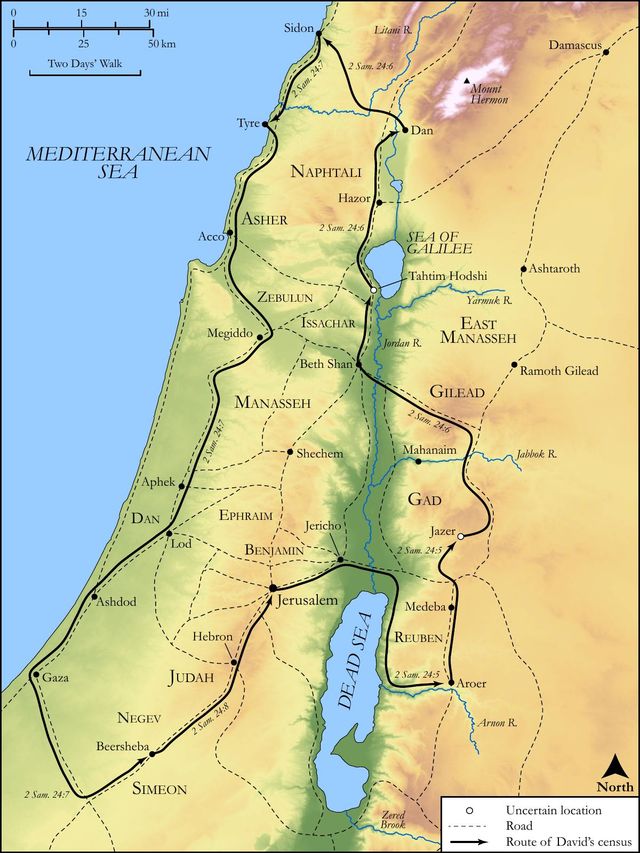
In ancient Israel, the institution of kingship was deeply intertwined with the nation's covenant relationship with Yahweh. The king was understood as God's representative, and his spiritual integrity and obedience directly impacted the well-being of the entire nation. A census, while sometimes conducted for legitimate administrative or military purposes (e.g., Numbers 1), could become problematic if undertaken out of pride, a lack of trust in God's provision, or a desire to rely on human strength (such as military numbers) rather than divine power and protection. David's census in 2 Samuel 24 is widely interpreted as an act stemming from pride or a desire to assess his military might, rather than relying on the Lord for victory and security, hence incurring divine displeasure. The concept of corporate solidarity was also a foundational aspect of Israelite society, meaning that the sin of a leader or even a few individuals could bring consequences upon the entire community. This understanding helps explain why the nation suffered for David's transgression. The idiomatic phrase "from Dan even to Beersheba" was a common expression in ancient Israel, signifying the entire geographical breadth of the promised land, from its northernmost city (Dan) to its southernmost (Beersheba). Its use here emphasizes the comprehensive and pervasive reach of the plague across the entire nation.
Key Themes
ShowHideThis verse powerfully illustrates several key themes central to the book of Samuel and broader biblical theology. Foremost is the theme of Divine Judgment for Sin, demonstrating God's absolute sovereignty and His willingness to bring severe consequences, even through devastating means, when sin is committed, particularly by those in leadership. The plague's swiftness and widespread impact underscore the Severity and Scope of Consequences that can arise from disobedience, highlighting the immense cost of sin and the seriousness of divine displeasure. The phrase "to the time appointed" subtly introduces the theme of God's Control and Mercy even in Judgment, implying that the plague was not random or unending but operated within divinely ordained limits, showcasing God's ultimate authority even over the instruments of His wrath. This event also reinforces the profound theme of Corporate Responsibility, where the actions of a king directly impact the well-being and fate of his people, as seen in the parallel account in 1 Chronicles 21:14. Ultimately, the narrative highlights the necessity of Atonement and Repentance to avert or mitigate divine wrath, as evidenced by David's subsequent actions in 2 Samuel 24:18-25.
Exposition and Analysis
ShowHideKey Word Analysis
ShowHideThis word (H1698, דֶּבֶר) denotes a plague, epidemic, or murrain, often understood as a divinely sent affliction. It describes a severe, widespread, and rapidly fatal disease, frequently associated with God's judgment against sin, as seen in the plagues against Egypt (Exodus 9:3) and during the wilderness wanderings (Numbers 14:12). Its use here emphasizes the direct, supernatural origin and the deadly nature of the judgment, signifying a divine visitation of wrath.
This term (H1242, בֹּקֶר) refers to the dawn or the break of day. In this context, "from the morning" signifies the immediate and swift onset of the plague. It underscores the suddenness and rapidity with which God's judgment began, leaving no time for preparation or escape, highlighting the instantaneous nature of divine action.
This word (H4150, מוֹעֵد) signifies a fixed time, season, or appointment. It implies a divinely set boundary or duration for the plague. While the judgment was severe, it was not arbitrary or unending. The "time appointed" indicates that God, even in His wrath, acts with precision and purpose, exercising ultimate control and demonstrating a measure of restraint and a pre-determined end to the affliction.
Verse Breakdown
ShowHide"So the LORD sent a pestilence upon Israel"
This opening clause immediately establishes divine agency and the nature of the judgment. It is not a natural disaster but a direct, intentional act of Yahweh (H3068, Yᵉhôvâh), the self-existent God. The "pestilence" (H1698, deber') is the chosen instrument of judgment, highlighting God's absolute sovereignty over life and death, and His righteous response to David's sin and, implicitly, Israel's own state of rebellion. The phrase "upon Israel" (H3478, Yisrâʼêl) underscores the corporate nature of the judgment, affecting the entire nation due to their king's transgression and the principle of corporate solidarity.
"from the morning even to the time appointed"
This phrase emphasizes both the swiftness and the controlled nature of the divine judgment. The plague began immediately ("from the morning," H1242, bôqer') and continued for a specific, divinely determined duration ("to the time appointed," H6256, ʻêth H4150, môwʻêd). This "appointed time" implies a set boundary, demonstrating that even in wrath, God acts with precision, purpose, and ultimately, restraint. This limitation hints at His underlying mercy that would soon lead Him to relent, preventing total annihilation.
"and there died of the people from Dan even to Beersheba seventy thousand men"
This final clause details the horrific outcome and the vast scope of the devastation. The verb "died" (H4191, mûwth) starkly conveys the finality of the judgment. The death toll of "seventy thousand men" (H7657, shibʻîym H505, ʼeleph H376, ʼîysh) is staggering, conveying the immense human cost of the plague. The phrase "from Dan (H1835, Dân) even to Beersheba (H884, Bᵉʼêr_ _Shebaʻ)" signifies that the judgment swept across the entire land, affecting virtually every region and "people" (H5971, ʻam) of Israel, underscoring the comprehensive and inescapable nature of God's judgment for sin.
Literary Devices
ShowHideThe verse employs several powerful literary devices to convey its message with dramatic impact. Divine Anthropomorphism is evident in the phrase "the LORD sent," portraying God as an active, personal agent directly intervening in human affairs to enact judgment. The phrase "from Dan even to Beersheba" serves as a potent Merism, a figure of speech in which two contrasting parts (the northernmost and southernmost points) are used to represent the whole, effectively communicating the widespread and comprehensive nature of the plague across the entire land of Israel. The number "seventy thousand men" functions as Hyperbole or a round number, used to emphasize the immense scale of the devastation rather than a precise literal count, thereby intensifying the emotional impact and underscoring the severity of the divine wrath. Furthermore, the swiftness indicated by "from the morning" creates a sense of Immediacy, heightening the dramatic tension and emphasizing the direct and unavoidable consequences of God's judgment.
Theological and Thematic Connections
ShowHideThis verse profoundly illustrates the biblical truth that sin, particularly the sin of those in leadership, has far-reaching and devastating consequences, affecting not only the individual but also the entire community. It underscores God's unwavering commitment to justice and His absolute sovereignty over all creation, including the power to bring judgment. Yet, even within this severe judgment, there is a subtle but crucial hint of God's mercy, as the plague is limited to an "appointed time," foreshadowing His eventual relenting and the provision for atonement. This event serves as a stark reminder of the gravity of sin and the need for genuine repentance and atonement to avert or mitigate divine wrath, reinforcing the principle that God's justice is always righteous, even when it brings immense suffering.
Reflection and Application
ShowHideThe tragic account of 2 Samuel 24:15 serves as a sobering reminder of the profound and often communal consequences of sin, particularly when committed by those in positions of authority. It challenges us to consider the ripple effect of our choices, recognizing that our actions, especially those rooted in pride, self-reliance, or a lack of trust in God, can impact not only ourselves but also those around us, sometimes with devastating results. This passage calls us to a deeper understanding of God's justice, which, while severe, is always righteous and ultimately aimed at bringing about repentance and restoration. It compels us to cultivate humility, seek divine wisdom in leadership, and prioritize absolute reliance on God over human strength, worldly measures of success, or self-aggrandizement. Furthermore, it underscores the critical importance of swift and genuine repentance when we recognize our transgressions, trusting in God's great mercy even as we face the consequences of our actions, knowing that His judgment is always purposeful and just.
Questions for Reflection
ShowHideFAQ
ShowHideWhy was David's census considered a sin, leading to such severe consequences?
ShowHideThe biblical text does not explicitly state the precise nature of David's sin in conducting the census, but scholarly consensus points to several possibilities rooted in the context of ancient Israelite kingship and covenant. It was likely not the act of numbering itself, as censuses were conducted elsewhere (e.g., Numbers 1), but rather the underlying motive or the manner in which it was carried out. David's census may have stemmed from pride, a desire to boast in his military strength and numbers rather than relying solely on God for the nation's security and provision. This would represent a lack of faith and a shift from divine dependence to human self-sufficiency. Furthermore, there was a specific Mosaic law in Exodus 30:12 that required a ransom payment for each person numbered to avert a plague, suggesting that a census, if not conducted under specific divine instruction and with proper atonement, could incur divine displeasure. David's immediate conviction and confession in 2 Samuel 24:10 confirm that he recognized his action as a grave offense against the Lord, indicating a spiritual failing rather than a mere administrative oversight.
Why did innocent people die for David's sin?
ShowHideThe death of seventy thousand people for David's sin highlights the ancient Israelite concept of corporate solidarity, where the actions of a leader could have profound consequences for the entire community. In this theological framework, the king was seen as the representative head of the nation, and his spiritual standing often directly affected the well-being and fate of his people. Additionally, 2 Samuel 24:1 states that "the anger of the LORD was kindled against Israel," suggesting that the people themselves may have been in
Christ-Centered Fulfillment
ShowHideThe devastating pestilence of 2 Samuel 24:15, born from a king's sin yet falling upon his people, powerfully foreshadows the ultimate reality of substitutionary judgment and mercy fulfilled in Jesus Christ. David, as the representative head of Israel, brought divine wrath upon the nation through his transgression, just as Adam's sin brought death upon all humanity (Romans 5:12). Yet where David could only cry out in anguish for his people and offer a purchased sacrifice on Araunah's threshing floor to stay the angel's hand (2 Samuel 24:24-25), Christ, the greater Son of David, offered Himself as the final and perfect sacrifice to turn away God's wrath once and for all (Romans 3:25). The angel's sword was stayed at Jerusalem, the very city where centuries later Christ would bear the full weight of divine judgment on the cross, not merely halting a plague but conquering death itself (Hebrews 2:14-15). David chose to fall into the hand of the Lord rather than the hand of man, trusting in divine mercy; Christ fell willingly into the hands of both God and man, absorbing the judgment His people deserved so that there is now no condemnation for those who are in Christ Jesus. The seventy thousand who perished stand as a sobering reminder of sin's cost, while the mercy that spared Jerusalem points forward to the ultimate mercy of the gospel, where God's justice and love meet perfectly at Calvary.