


2 Samuel 24:1
- וַיֹּסֶףvai·Yo·sefand it repeatedH3254Conj-w ¦ V-Hiphil-ConsecImperf-3msVerb Hiphil Consecutive Imperfect 3rd Singular Masculineוַandיֹּסֶףit repeated
- אַף'af[the] anger ofH639N-mscNoun Singular Masculine Construct
- יְהוָהYah·wehYahwehH3068N-properNoun Proper Title
- לַחֲרוֹתla·cha·Rotto burnH2734Prep-l ¦ V-Qal-InfVerb Qal Infinitive Constructלַtoחֲרוֹתburn
- בְּיִשְׂרָאֵלbe·Yis·ra·'Elon IsraelH3478Prep-b ¦ N-properNoun Proper LocationבְּonיִשְׂרָאֵלIsrael
- וַיָּסֶתvai·Ya·setand he incitedH5496Conj-w ¦ V-Hiphil-ConsecImperf-3msVerb Hiphil Consecutive Imperfect 3rd Singular Masculineוַandיָּסֶתhe incited
- אֶת'et<obj.>H853DirObjMParticle Object Indicator
- דָּוִדda·VidDavidH1732N-proper-mNoun Proper Masculine
- בָּהֶםba·Hemagainst <the> themPrep-b ¦ 3mpSuffix Personal 3rd Plural Masculineבָּagainst <the>הֶםthem
- לֵאמֹרle·Mor<to> sayingH559Prep-l ¦ V-Qal-InfVerb Qal Infinitive Constructלֵ<to>אמֹרsaying
- לֵךְlekhgoH1980V-Qal-Imp-2msVerb Qal Imperative 2nd Singular Masculine
- מְנֵהme·NehcountH4487V-Qal-Imp-2msVerb Qal Imperative 2nd Singular Masculine
- אֶת'et<obj.>H853DirObjMParticle Object Indicator
- יִשְׂרָאֵלYis·ra·'ElIsraelH3478N-properNoun Proper Location
- וְאֶתve·'Etand <obj.>H853Conj-w ¦ DirObjMParticle Object Indicatorוְandאֶת<obj.>
- יְהוּדָהye·hu·DahJudahH3063N-properNoun Proper Location
English is a literal word-by-word gloss of the Hebrew, not the KJV's wording. Why?
This is the original text the KJV's translators worked from — each Hebrew word with its own literal English meaning in this verse, prepared by scholars at Tyndale House, Cambridge. The KJV translates whole sentences, not word by word, so its wording differs: one Hebrew word can become several English words, and the KJV may choose “the LORD” where the gloss reads “Yahweh”. Both are faithful — they answer different questions. For the KJV's own rendering, switch to the KJV text.
Details
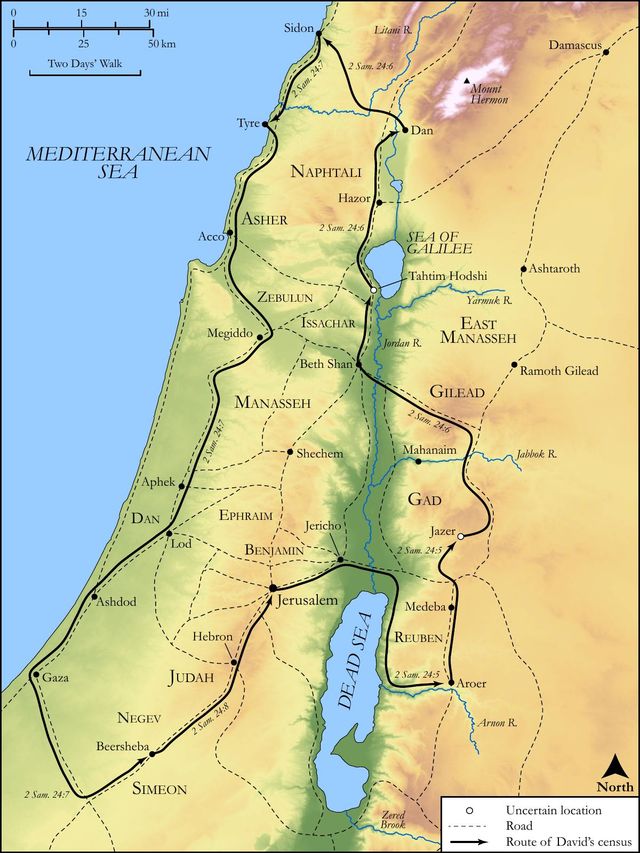
See on the biblical-era maps

Study this verse
Historical interpretation
Historical reception
1 surviving comment on this verse from the historical church.
Stirred up: This stirring up was not the doing of God, but of Satan; as it is expressly declared, 1 Chron. or Paralip. 21. 1.
Continue studying 2 Samuel 24:1 across the web’s major study libraries — every link below opens this exact verse, chapter, or book on the destination site.
Read & Compare
 BibleGatewayThis verse in more than 200 translations and 70 languages.
 Bible.comThe YouVersion reader — hundreds of translations, reading plans, and highlights.
 ESV.orgCrossway's official English Standard Version reader.
 NET BibleThe NET translation with 60,000+ translators' notes on every rendering decision.
 STEP BibleTyndale House's free study tool — original text, vocabulary, and scholarly resources.
 BibliaLogos Bible Software's free web reader.
 USCCBThe New American Bible (Revised Edition) with the U.S. bishops' study notes.
Commentaries
 BibleHub CommentariesDozens of classic commentaries on this verse, gathered on one page.
 StudyLightMore than 100 commentary sets — the largest collection on the web.
 BibleRefPlain-English commentary on what this verse means, verse by verse.
 Enduring WordDavid Guzik's free commentary on this chapter, widely used by Bible teachers.
 Bible Study ToolsVerse commentary alongside Greek and Hebrew study aids.
Original Language & Research
- BibleHub InterlinearThe verse word by word — original language, transliteration, and English.
- BibleHub LexiconEvery word's original-language definition and Strong's entry.
 Blue Letter BibleDeep-study tools — Strong's numbers, concordance, and word studies.
 SefariaThe Hebrew text with Rashi and centuries of Jewish commentary.
Sermons, Hymns & Audio


TrulyRandomVerse is not affiliated with these sites and doesn’t control their content. They’re linked because they’re genuinely useful.
Summary
Second Samuel 24:1 introduces the climactic and controversial narrative of David's census, a pivotal event that brings divine judgment upon Israel and culminates in the establishment of the temple site. The verse states that "the anger of the LORD was kindled against Israel," leading God to "move David" to command a national census of both Israel and Judah. This seemingly administrative act unfolds into a profound theological dilemma concerning divine sovereignty, human responsibility, and the severe consequences of national and leadership sin, ultimately setting the stage for a devastating plague and David's subsequent repentance.
Context
ShowHideLiterary Context
This verse serves as the powerful narrative conclusion to the main body of 2 Samuel, immediately following a series of appendices (chapters 21-23) that provide a retrospective on David's reign, including accounts of his mighty men, a famine, and his final poetic and prophetic words. These preceding chapters, particularly the accounts of Absalom's rebellion (2 Samuel 15-20) and Sheba's revolt (2 Samuel 20), depict a period of significant national turmoil, division, and moral compromise. The phrase "And again the anger of the LORD was kindled against Israel" (2 Samuel 24:1) strongly suggests that the nation's spiritual state had not fully recovered from these periods of rebellion and unfaithfulness, or perhaps had continued in ways that provoked God's righteous displeasure. The census narrative thus brings David's reign to a somber, yet ultimately redemptive, close, highlighting God's justice in judgment and His mercy in providing a means for atonement and a future site for worship.
Historical & Cultural Context
Censuses were common administrative practices in the ancient Near East, typically undertaken for purposes of military conscription, taxation, or labor. However, in Israel, the Torah provided specific divine guidelines for such counts. Notably, Exodus 30:11-16 mandated that each individual counted in a census pay a half-shekel atonement offering, serving as a ransom for their lives and acknowledging that all life belonged to God. This offering was crucial to prevent a plague from afflicting the people. The absence of this required atonement offering in David's census, coupled with the implied motive (likely a desire to assess military strength or national might rather than to fulfill a divine command or for legitimate administrative purposes), is often cited as the reason for its sinfulness. The concept of corporate solidarity was also deeply ingrained in Israelite thought, meaning that the actions of a leader, especially a divinely appointed king, could have profound and far-reaching consequences for the entire nation, explaining why Israel suffered for David's sin.
Key Themes
ShowHideThis verse introduces several profound theological themes that resonate throughout the biblical narrative. Firstly, it powerfully illustrates the complex tension between Divine Sovereignty and Human Responsibility. The statement "he moved David" (2 Samuel 24:1) initially appears to place the impetus for the census squarely on God, yet David is undeniably held accountable for his actions and expresses profound repentance for his sin (2 Samuel 24:10). This tension is further illuminated by comparing this passage with 1 Chronicles 21:1, which states that "Satan stood up against Israel, and provoked David to number Israel." This juxtaposition suggests that God, in His sovereign plan, can permit or even use the actions of evil agents or the inclinations of human hearts to bring about His purposes, including judgment or the exposure of sin. Secondly, the passage underscores the Consequences of National Sin. God's anger is kindled "against Israel," indicating that the nation as a whole bore responsibility for their collective unfaithfulness, even if the specific act of the census originated with David. This emphasizes that the actions of leaders can have far-reaching national consequences and that a nation's accumulated sin can provoke divine judgment. Finally, the census itself often symbolizes the danger of Trust in Human Strength vs. Reliance on God. David's desire to count his fighting men can be interpreted as a move towards self-reliance and a lack of full trust in God's power and protection, a theme echoed in passages like Psalm 33:16-17, which warns against relying on human military might or large armies for salvation.
Exposition and Analysis
ShowHideKey Word Analysis
ShowHideThis word (H639), literally meaning "nose" or "nostril," is a common biblical idiom for divine wrath or indignation, often depicted as a snorting or flaring of the nostrils. In this context, it signifies God's righteous and just displeasure with the accumulated sin of Israel. It is not a capricious emotion but a holy response to unfaithfulness and rebellion, indicating a breach of covenant. The phrase "again" (H3254, yâçaph, "to add or augment, to continue to do a thing") emphasizes that this is not an isolated incident but a recurring theme of God's just response to His people's ongoing sin.
The verb (H5496, çûwth) means "to prick," "stimulate," "entice," or "persuade." This is a crucial and often debated term in this verse due to the parallel account in 1 Chronicles 21:1, which attributes the incitement to Satan. In 2 Samuel, the active voice suggests God's direct involvement. However, theological interpretation often understands this as God's permissive will, allowing or orchestrating circumstances that led David to undertake the census, perhaps as a catalyst for judgment already due to Israel's sin. It does not imply God directly tempted David to sin (as James 1:13 clarifies God does not tempt anyone to evil), but rather that He permitted an action that exposed David's heart and brought about consequences for the nation's ongoing unfaithfulness. God's ultimate sovereignty means He can use various agents, even evil ones, to accomplish His ultimate purposes.
The verb (H4487, mânâh) means "to weigh out," "to allot or constitute officially," or "to enumerate or enroll." While counting people for administrative purposes was not inherently sinful (as seen in the censuses in Numbers 1 and Numbers 26), the sinfulness here lies in the underlying motive and the omission of the required atonement money (as per Exodus 30:12). David's census was likely driven by pride, a desire to boast in his military strength, or a reliance on human resources rather than absolute trust in God for Israel's security.
Verse Breakdown
ShowHide"And again the anger of the LORD was kindled against Israel,"
This opening clause immediately sets a somber tone, indicating that God's righteous indignation was not new but a renewed response to the ongoing spiritual state of the nation. The "again" implies a pattern of sin and divine displeasure, suggesting that the census was not the cause of God's anger but the occasion for a judgment already warranted by Israel's accumulated unfaithfulness and rebellion. God's anger (H639, 'aph) is a holy attribute, a just reaction to sin that seeks to bring about repentance and restoration, particularly from the covenant Lord (H3068, Yᵉhôvâh).
"and he moved David against them"
This is the most challenging and debated phrase. It explicitly states that God (H3068, Yᵉhôvâh) Himself "moved" or "incited" (H5496, çûwth) David (H1732, Dâvid). As discussed in the key word analysis, this is best understood not as God tempting David to sin, but as God's sovereign permission or orchestration of circumstances that led David to an action that exposed his pride and reliance on human strength. This act served as a catalyst for divine judgment upon a nation (H3478, Yisrâʼêl) that was already under God's displeasure. The "against them" clarifies that David's action, though initiated by God's permissive will, would ultimately bring negative consequences upon Israel.
"to say, Go, number Israel and Judah."
This is the specific command given by David (H1732, Dâvid), resulting from the divine "moving." The act of numbering (H4487, mânâh) Israel (H3478, Yisrâʼêl) and Judah (H3063, Yᵉhûwdâh) (distinguishing the northern and southern kingdoms, though still united under David) was problematic not in its administrative nature, but in its underlying motivation. It likely stemmed from David's pride, a desire to assess his military might, or a reliance on human numbers rather than divine protection. Furthermore, the omission of the required atonement money (as stipulated in Exodus 30:12) rendered the census an act of disobedience and a violation of covenant protocol, making it a sinful endeavor in God's eyes.
Literary Devices
ShowHideThe passage powerfully employs Anthropomorphism in the phrase "the anger of the LORD was kindled," attributing human emotion and action (anger, kindling) to God to convey His righteous indignation. More significantly, the narrative presents a profound Narrative Tension and Paradox concerning the source of David's incitement. While 2 Samuel 24:1 states "he moved David," the parallel account in 1 Chronicles 21:1 explicitly states that "Satan stood up against Israel, and provoked David to number Israel." This Juxtaposition forces the reader to grapple with the complexities of divine sovereignty, human free will, and the role of evil in God's overarching plan. It suggests that God, in His ultimate control, can permit evil agents to act within His boundaries, using their actions to achieve His own purposes, such as bringing about a necessary judgment or exposing the true state of human hearts. The narrative also uses Foreshadowing, as David's command to number the people immediately signals that a severe consequence or judgment is imminent, building suspense for the unfolding plague.
Theological and Thematic Connections
ShowHideThis pivotal verse underscores the profound biblical truth that God is absolutely sovereign over all creation and human affairs, even in seemingly negative or paradoxical circumstances. While God does not tempt humanity to sin, He can, in His righteous judgment, allow or orchestrate situations that expose the sinfulness of human hearts and bring about deserved consequences for individual or national unfaithfulness. The tension between God "moving" David and Satan "inciting" David (as seen in 1 Chronicles 21:1) highlights the mystery of divine sovereignty working through secondary causes, whether human inclination or demonic influence, to achieve His ultimate purposes. This narrative serves as a stark reminder that pride and self-reliance, particularly in leadership, can have devastating ripple effects, bringing divine judgment upon an entire community. Ultimately, it points to the necessity of humility, repentance, and absolute trust in God's provision and protection rather than human strength or numbers.
Reflection and Application
ShowHideSecond Samuel 24:1 offers profound insights for contemporary believers, challenging us to examine the motives behind our actions and the true source of our security. It reminds us that God's anger is not arbitrary but a righteous response to sin, and that corporate sin, whether in a nation, church, or family, can invite divine discipline. We are called to cultivate a posture of humility, recognizing that true strength and security come not from our own resources, achievements, or numbers, but from complete reliance on God's power and provision. This passage encourages us to be vigilant against the subtle temptations of pride and self-sufficiency, which can lead us to trust in human wisdom or might rather than in the Lord. It also highlights the weighty responsibility of leadership, as the choices of those in authority can have far-reaching consequences for those under their care. Ultimately, it calls us to a deeper understanding of God's sovereign hand, even in difficult circumstances, trusting that His ultimate purpose is always just and redemptive, aiming to bring His people to repentance and closer dependence on Him.
Questions for Reflection
ShowHideFAQ
ShowHideWhy was the census wrong if God commanded censuses elsewhere in the Bible?
ShowHideThe sinfulness of David's census was not in the act of counting itself, as censuses were commanded by God for specific purposes (e.g., for military readiness or taxation, as seen in Numbers 1 and Numbers 26). The problem lay in David's underlying motive and the omission of a crucial divine requirement. David's census was likely driven by pride, a desire to boast in his military might, or a reliance on human strength and numbers rather than absolute trust in God for Israel's security and victory. Furthermore, the Law explicitly required an atonement offering of a half-shekel for each person counted during a census (as detailed in Exodus 30:11-16). This offering served as a ransom for their lives, acknowledging that all life belonged to God. David's failure to adhere to this divine protocol, combined with his presumptuous motives, rendered the census an act of disobedience and sin.
Did God directly tempt David to sin by "moving" him to number Israel?
ShowHideNo, the Bible clearly states that God does not tempt anyone to sin. James 1:13 declares, "Let no one say when he is tempted, 'I am tempted by God,' for God cannot be tempted by evil, nor does He Himself tempt anyone." The phrase "he moved David" in 2 Samuel 24:1 is best understood in light of God's sovereign, permissive will. God, in His ultimate control, can allow or orchestrate circumstances that expose the hidden sin or pride in a person's heart. The parallel account in 1 Chronicles 21:1 states that "Satan stood up against Israel, and provoked David to number Israel." This suggests that God permitted Satan to incite David, using this demonic influence within His sovereign plan to bring about a necessary judgment upon Israel, whose accumulated sin had already kindled God's anger. Thus, God did not tempt David, but allowed David's own sinful inclination (or Satan's incitement) to manifest, leading to consequences that served God's righteous purposes.
Why was Israel punished for David's sin in the census?
ShowHideIsrael was punished for David's sin due to the principle of corporate solidarity, which was a deeply ingrained concept in ancient Israelite society. In this framework, the actions of a leader, especially a king chosen by God, could have profound consequences for the entire nation. David, as the head of the covenant people, represented them. His sin, particularly one rooted in pride and a lack of trust in God, reflected a deeper spiritual malaise within the nation itself, which had already provoked God's anger (as indicated by "again the anger of the LORD was kindled against Israel"). The plague, therefore, was not merely a punishment for David's individual transgression but a divine judgment upon the accumulated unfaithfulness and spiritual compromise of the nation as a whole, for which David's sin served as the catalyst or final straw. It underscores that the spiritual health of a people is intrinsically linked to the integrity and obedience of its leadership.
Christ-Centered Fulfillment
ShowHideThe narrative of David's sinful census, God's righteous anger, and the subsequent plague finds its ultimate fulfillment and resolution in Jesus Christ. David's failure to trust God fully, his reliance on human numbers, and his presumptuous act that brought judgment upon Israel, all highlight the desperate need for a perfect King. Unlike David, who succumbed to pride and brought calamity, Jesus is the perfect King who always perfectly trusts His Father, never relying on human might or earthly armies but on divine power and spiritual authority (as seen in Matthew 4:1-11 and John 6:15). The census, and specifically the requirement for atonement money in Exodus 30:12, foreshadows the ultimate ransom required for humanity's sin. No amount of silver could truly atone for the deep-seated pride and rebellion of the human heart, but Christ, through His perfect life and sacrificial death, became the ultimate atonement for our sins. He is the Lamb of God who takes away the sin of the world, bearing the righteous anger and judgment of God that was due to us, just as the plague fell on Israel. Through His perfect obedience and substitutionary sacrifice, Jesus provides the true and lasting security that David sought in vain through numbers, offering eternal life and reconciliation with God to all who trust in Him, thereby fulfilling the deepest longings and addressing the most profound failures of Old Testament Israel.