


1 Chronicles 21:1
- וַיַּעֲמֹדvai·ya·'a·Modand he rose upH5975Conj-w ¦ V-Qal-ConsecImperf-3msVerb Qal Consecutive Imperfect 3rd Singular Masculineוַandיַּעֲמֹדhe rose up
- שָׂטָןsa·Tanan adversaryH7854N-msNoun Title Singular Masculine Absolute
- עַל'alonH5921PrepPreposition
- יִשְׂרָאֵלYis·ra·'ElIsraelH3478N-properNoun Proper Location
- וַיָּסֶתvai·Ya·setand he incitedH5496Conj-w ¦ V-Hiphil-ConsecImperf-3msVerb Hiphil Consecutive Imperfect 3rd Singular Masculineוַandיָּסֶתhe incited
- אֶת'et<obj.>H853DirObjMParticle Object Indicator
- דָּוִידda·VidDavidH1732N-proper-mNoun Proper Masculine
- לִמְנוֹתlim·Notto countH4487Prep-l ¦ V-Qal-InfVerb Qal Infinitive Constructלִtoמְנוֹתcount
- אֶת'et<obj.>H853DirObjMParticle Object Indicator
- יִשְׂרָאֵלYis·ra·'ElIsraelH3478N-properNoun Proper Location
English is a literal word-by-word gloss of the Hebrew, not the KJV's wording. Why?
This is the original text the KJV's translators worked from — each Hebrew word with its own literal English meaning in this verse, prepared by scholars at Tyndale House, Cambridge. The KJV translates whole sentences, not word by word, so its wording differs: one Hebrew word can become several English words, and the KJV may choose “the LORD” where the gloss reads “Yahweh”. Both are faithful — they answer different questions. For the KJV's own rendering, switch to the KJV text.
Details
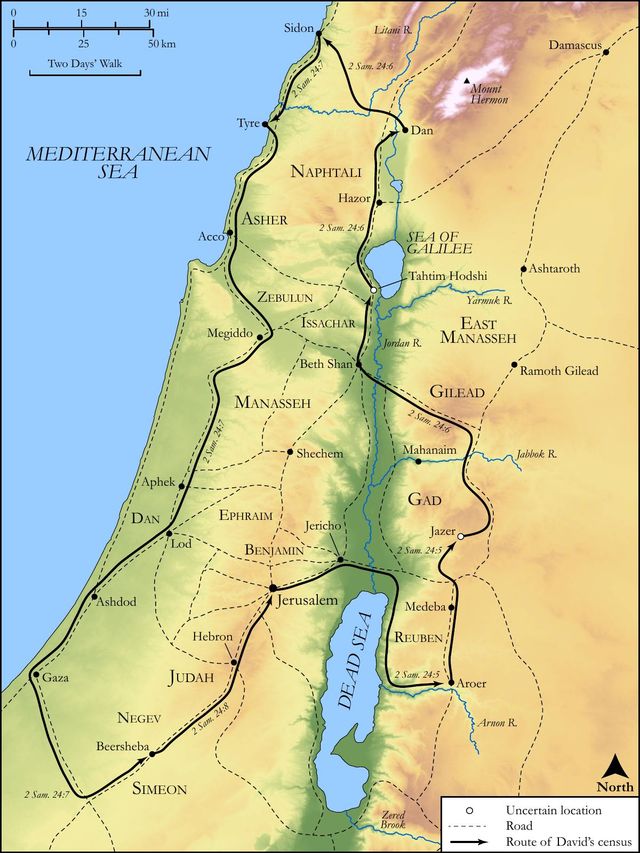
See on the biblical-era map
Study this verse
Public-domain commentary
Matthew Henry
From his Commentary on the Whole Bible. Henry comments on passages, not single verses — this entry covers 1 Chronicles 21:1–6. His three-level outline is real structure in the source text, so it is rendered as structure.
Numbering the people, one would think, was no bad thing. Why should not the shepherd know the number of his flock? But God sees not as man sees. It is plain it was wrong in David to do it, and a great provocation to God, because he did it in the pride of his heart; and there is no sin that has in it more of contradiction and therefore more of offence to God than pride. The sin was David's; he alone must bear the blame of it. But here we are told,
I.How active the tempter was in it (Ch1 21:1):
Satan stood up against Israel, and provoked David to do it. Is is said (Sa2 24:1) that the anger of the Lord was kindled against Israel, and he moved David to do it. The righteous judgments of God are to be observed and acknowledged even in the sins and unrighteousness of men. We are sure that God is not the author of sin - he tempts no man; and therefore, when it is said that he moved David to do it, it must be explained by what is intimated here, that, for wise and holy ends, he permitted the devil to do it. Here we trace this foul stream to its foundation. That Satan, the enemy of God and all good, should stand up against Israel, is not strange; it is what he aims at, to weaken the strength, diminish the numbers, and eclipse the glory of God's Israel, to whom he is Satan, a sworn adversary. But that he should influence David, the man of God's own heart to do a wrong thing, may well be wondered at. One would think him one of those whom the wicked one touches not. No, even the best saints, till they come to heaven, must never think themselves out of the reach of Satan's temptations. Now, when Satan meant to do Israel a mischief, what course did he take? He did not move God against them to destroy them (as Job, Job 2:3), but he provoked David, the best friend they had, to number them, and so to offend God, and set him against them. Note,
1.The devil does us more mischief by tempting us to sin against our God than he does by accusing us before our God. He destroys none but by their own hands,
2.The greatest spite he can do to the church of God is to tempt the rulers of the church to pride; for none can conceive the fatal consequences of that sin in all, especially in church-rulers. You shall not be so, Luk 22:26.
II.How passive the instrument was.
Joab, the person whom David employed, was an active man in public business; but to this he was perfectly forced, and did it with the greatest reluctance imaginable.
1.He put in a remonstrance against it before he began it. No man more forward that he in any thing that really tended to the honour of the king or the welfare of the kingdom; but in this matter he would gladly be excused. For,
(1.)It was a needless thing. there was not occasion at all for it. God had promised to multiply them, and he needed not question the accomplishment of that promise. They were all his servants, and he needed not doubt of their loyalty and affection to him. Their number was as much his strength as he could desire.
(2.)It was a dangerous thing. In doing it he might be a cause of trespass to Israel, and might provoke God against them. This Joab apprehended, and yet David himself did not. The most learned in the laws of God are not always the most quick-sighted in the application of those laws.
2.He was quite weary of it before he had done it; for the king's word was abominable to Joab, Ch1 21:6. Time was when whatever king David did pleased all the people, Sa2 3:36. But now there was a general disgust at these orders, which confirmed Joab in his dislike of them. so that, though the produce of this muster was really very great, yet he had no heart to perfect it, but left two tribes unnumbered (Ch1 21:5, Ch1 21:6), two considerable ones, Levi and Benjamin, and perhaps was not very exact in numbering the rest, because he did not do it with any pleasure, which might be one occasion of the difference between the sums here and Sa2 24:9.
Continue studying 1 Chronicles 21:1 across the web’s major study libraries — every link below opens this exact verse, chapter, or book on the destination site.
Read & Compare
 BibleGatewayThis verse in more than 200 translations and 70 languages.
 Bible.comThe YouVersion reader — hundreds of translations, reading plans, and highlights.
 ESV.orgCrossway's official English Standard Version reader.
 NET BibleThe NET translation with 60,000+ translators' notes on every rendering decision.
 STEP BibleTyndale House's free study tool — original text, vocabulary, and scholarly resources.
 BibliaLogos Bible Software's free web reader.
 USCCBThe New American Bible (Revised Edition) with the U.S. bishops' study notes.
Commentaries
 BibleHub CommentariesDozens of classic commentaries on this verse, gathered on one page.
 StudyLightMore than 100 commentary sets — the largest collection on the web.
 BibleRefPlain-English commentary on what this verse means, verse by verse.
 Enduring WordDavid Guzik's free commentary on this chapter, widely used by Bible teachers.
 Bible Study ToolsVerse commentary alongside Greek and Hebrew study aids.
Original Language & Research
- BibleHub InterlinearThe verse word by word — original language, transliteration, and English.
- BibleHub LexiconEvery word's original-language definition and Strong's entry.
 Blue Letter BibleDeep-study tools — Strong's numbers, concordance, and word studies.
 SefariaThe Hebrew text with Rashi and centuries of Jewish commentary.
Sermons, Hymns & Audio


TrulyRandomVerse is not affiliated with these sites and doesn’t control their content. They’re linked because they’re genuinely useful.
Summary
First Chronicles 21:1 introduces a pivotal and troubling moment in King David's reign, explicitly stating that "Satan stood up against Israel, and provoked David to number Israel." This act, seemingly a census, was a profound sin rooted in pride and a lack of trust in God's provision, leading to severe divine judgment upon the nation. The Chronicler's unique attribution of this instigation to Satan provides a crucial theological perspective on the reality of spiritual warfare and the direct, malevolent influence of the adversary in human affairs, ultimately setting the stage for the future Temple site.
Context
ShowHideLiterary Context
This verse initiates a crucial narrative sequence within the Chronicler's account, immediately following David's military successes and his extensive preparations for the Temple (as detailed in 1 Chronicles 18-20). The preceding chapters highlight David's power and God's blessing upon his reign, making the census account in 1 Chronicles 21 a stark and surprising contrast. This narrative demonstrates that even a divinely favored king is susceptible to sin, leading to national calamity. Crucially, the events of this chapter, particularly the plague and David's subsequent purchase of Ornan's threshing floor, directly lead to the establishment of the site for Solomon's Temple, a central theological concern for the Chronicler. This account parallels 2 Samuel 24, yet significantly diverges in its attribution of the instigation, a point of profound theological import that shapes the Chronicler's message.
Historical & Cultural Context
The book of 1 Chronicles was written for a post-exilic Jewish community, likely in the late 5th or early 4th century BCE. Its primary purpose was to remind the returning exiles of their heritage, the enduring nature of the Davidic covenant, the centrality of the Temple in their worship, and the necessity of obedience to God. Censuses were not inherently forbidden in ancient Israel; indeed, they were conducted in the wilderness (e.g., Numbers 1) for military and administrative purposes. However, David's census here is presented as a transgression. This could be due to its underlying motivation—a reliance on human military strength rather than divine provision, an act of pride, or perhaps the omission of the required atonement money for each counted individual as prescribed in Exodus 30:12-16. The cultural understanding of a king's power was often tied to the size of his army, making David's desire to number his fighting men a potential temptation to boast in human might rather than divine faithfulness.
Key Themes
ShowHideThe primary theme emerging from this verse is the reality of spiritual warfare and the active malice of Satan. Unlike the parallel account in 2 Samuel 24:1, which attributes the instigation to "the anger of the LORD," 1 Chronicles explicitly names Satan, highlighting the Chronicler's theological emphasis on the direct, malevolent influence of spiritual forces. This also underscores the theme of divine sovereignty versus human responsibility; while God may permit certain events, human beings remain accountable for their choices, even when tempted by external forces. Furthermore, the narrative explores the consequences of pride and disobedience, as David's sin brings plague upon the nation. Ultimately, however, this dark episode paradoxically leads to the establishment of the Temple site, demonstrating God's ability to providentially work even through human failure to achieve His ultimate redemptive purposes for His people and the place of His dwelling.
Exposition and Analysis
ShowHideKey Word Analysis
ShowHideThis term, meaning "adversary" or "accuser," is used here as a proper noun, referring to the specific arch-enemy of good, the angelic being who opposes God and His people. Its explicit mention in 1 Chronicles 21:1, as opposed to the more ambiguous "anger of the LORD" in 2 Samuel 24:1, marks a significant theological development, clearly identifying the source of malicious instigation. This emphasizes the Chronicler's post-exilic understanding of the cosmic conflict and the direct involvement of evil spiritual forces in human history.
The verb "stood up" (from ʻâmad) implies an active, deliberate posture of opposition or confrontation. It is not a passive presence but an aggressive stance, indicating that Satan actively positioned himself against Israel with a hostile intent, ready to execute his malevolent plan. This conveys a sense of direct engagement and challenge, establishing a confrontational posture.
This verb means to "prick," "stimulate," "seduce," "entice," "move," or "persuade." It suggests a strong, persuasive, and often deceptive influence to move someone to action, typically for a negative or sinful purpose. Here, it highlights Satan's active role in tempting David, not merely suggesting but actively pushing him towards the sinful census by stimulating his pride or lack of trust.
Verse Breakdown
ShowHide"And Satan stood up against Israel"
This clause immediately establishes the active role of a malevolent spiritual entity. Satan's opposition is not merely against David as an individual but "against Israel"—the entire covenant community. This signifies that the adversary's ultimate target is God's people, seeking to undermine their relationship with God and disrupt His plans for them. The phrase "stood up" denotes a deliberate and aggressive posture of hostility, indicating a direct challenge.
"and provoked David"
This clarifies the specific method of Satan's attack: direct instigation and temptation of the king. While Satan is the instigator, David remains the responsible agent for his subsequent actions. The provocation was likely an appeal to David's pride, his desire for self-reliance, or a lack of full trust in God's power and provision for his kingdom, aiming to lead him into sin.
"to number Israel"
This specifies the sinful act David was provoked to undertake. While censuses were not inherently wrong, this particular census was sinful because of its underlying motivation (pride, reliance on human military strength rather than God) or its execution (perhaps neglecting the required atonement money, as per Exodus 30:12). It represented a shift from dependence on God to confidence in human resources, a transgression against the covenant relationship.
Literary Devices
ShowHideThe Chronicler's account in 1 Chronicles 21:1 employs several significant literary devices. The most prominent is Personification, as Satan is presented not as an abstract force but as a distinct, active, and malicious agent who "stood up" and "provoked" David. This gives a vivid, almost dramatic, portrayal of spiritual warfare, emphasizing the personal nature of evil. There is also an implicit Juxtaposition with the parallel account in 2 Samuel 24:1, where the instigation is attributed to "the anger of the LORD." This highlights the Chronicler's unique theological perspective, emphasizing Satan's role while not necessarily contradicting God's ultimate sovereignty, but rather offering a complementary view of the source of temptation. Finally, the events of this chapter serve as Foreshadowing, as David's sin, the subsequent plague, and his repentance ultimately lead to the purchase of Ornan's threshing floor, which becomes the divinely appointed site for the Temple. This demonstrates God's ability to bring about His purposes even through human sin and its consequences.
Theological and Thematic Connections
ShowHideThe theological tension between God's sovereignty and human responsibility, especially in the context of evil, is profoundly addressed in 1 Chronicles 21:1. While 2 Samuel 24:1 states that "the anger of the LORD was again kindled against Israel, and he moved David against them," 1 Chronicles explicitly names Satan. This difference is not a contradiction but a complementary theological perspective that enriches our understanding. It teaches that God, in His ultimate sovereignty, can permit or even use the actions of evil agents (like Satan) to accomplish His purposes, whether in judgment or in bringing about a greater good. Satan acts as an instigator, appealing to David's sinful inclinations (pride, self-reliance), but David remains morally accountable for his choice to yield to that temptation. Thus, the verse affirms both the reality of demonic influence and the unwavering principle of human culpability for sin, reminding us that external temptation does not negate internal responsibility.
Reflection and Application
ShowHideThe account of David's census in 1 Chronicles 21:1 serves as a potent reminder of the unseen spiritual battle that rages around and within us. It underscores that temptation is not merely an internal struggle but often involves the direct, malevolent influence of an adversary who seeks to provoke us to sin. Just as Satan targeted David, he continues to seek opportunities to derail God's people, appealing to our pride, our desire for self-sufficiency, or our lack of trust in God. This narrative calls us to a profound vigilance, recognizing that our true strength lies not in our own resources or achievements, but in humble reliance upon God. It challenges us to examine our motivations, ensuring that our actions are rooted in faith and obedience rather than pride or a desire for human glory. Ultimately, while temptation is real and powerful, this passage affirms our responsibility for our choices, urging us to resist the devil and draw near to God for strength, wisdom, and the grace to stand firm against his schemes.
Questions for Reflection
ShowHideFAQ
ShowHideWhy is this account different from 2 Samuel 24:1, which says "the anger of the LORD... moved David"?
ShowHideThe difference between 1 Chronicles 21:1 and 2 Samuel 24:1 is a classic example of complementary theological perspectives rather than contradiction. The Chronicler, writing to a post-exilic audience, emphasizes the direct role of Satan to highlight the reality of spiritual warfare and the adversary's active malice. This perspective aligns with a developed understanding of evil forces in the later biblical period, showing that evil operates in the world. 2 Samuel 24:1, on the other hand, attributes the instigation to "the anger of the LORD," emphasizing God's ultimate sovereignty over all events, even those involving sin and evil. From this viewpoint, God, in His righteous anger against Israel's unfaithfulness, permitted Satan to act as an instrument of His judgment or allowed David's sinful inclination to be exposed. Both accounts are true: God's sovereign plan allowed for the event, Satan actively instigated the sin, and David willingly chose to obey the temptation, thereby remaining fully responsible for his actions.
Was numbering Israel inherently wrong, or was it David's motivation?
ShowHideNumbering Israel was not inherently wrong. The book of Numbers records two censuses commanded by God Himself for military and administrative purposes. The sin in David's case was likely rooted in his motivation and possibly the omission of a crucial Mosaic requirement. David's desire to number his fighting men seems to have stemmed from pride, a reliance on his own military strength and human resources rather than an unwavering trust in God's power and ability to deliver. It represented a shift from dependence on God to self-sufficiency. Additionally, Exodus 30:12 prescribed that when a census was taken, each person counted must pay a half-shekel as "atonement money" to the Lord, lest a plague come upon them. It is highly probable David neglected this command, further contributing to the sin and the subsequent divine judgment.
Christ-Centered Fulfillment
ShowHideThe narrative of David's sin in 1 Chronicles 21:1 finds its ultimate fulfillment and resolution in the person and work of Jesus Christ. Unlike David, who succumbed to Satan's provocation and relied on human strength, Jesus, the greater Son of David, perfectly resisted every temptation from the adversary, as seen in His wilderness temptation (Matthew 4:1-11). Where David's pride led to a plague and judgment upon the nation, Christ's perfect humility and obedience, even to death on a cross, brought about ultimate healing and salvation for all humanity. The census, an act of human self-reliance, foreshadows the need for a true King whose kingdom is not built on earthly armies or human might but on divine power and perfect righteousness. Jesus, the Lamb of God (John 1:29), became the ultimate atonement for sin, fulfilling the temporary ransom required in the Mosaic Law and providing a perfect, once-for-all sacrifice that forever defeats the power of sin and Satan (Hebrews 2:14-15). Furthermore, the very site where the plague was stopped and David offered sacrifice—Ornan's threshing floor—became the divinely appointed location for the Temple, pointing to Christ as the true dwelling place of God among humanity (John 2:19-21). In Christ, we find victory over the tempter, forgiveness for our pride, and the foundation for an unshakable kingdom built on God's unwavering faithfulness, not human strength (Hebrews 12:28).