


1 Chronicles 21:5
Bible text: King James Version (1769 Blayney text) · Public domain
Bible text: King James Version with Strong's numbers · Public domain
Bible text: Berean Standard Bible · Public domain
Bible text: American Standard Version (1901) · Public domain
Bible text: World English Bible, Messianic edition · Public domain
Bible text: Geneva Bible (1599) · Public domain
Bible text: Young's Literal Translation · Public domain
- וַיִּתֵּןvai·yi·Tenand he gaveH5414Conj-w ¦ V-Qal-ConsecImperf-3msVerb Qal Consecutive Imperfect 3rd Singular Masculineוַandיִּתֵּןhe gave
- יוֹאָבyo·'AvJoabH3097N-proper-mNoun Proper Masculine
- אֶת'et<obj.>H853DirObjMParticle Object Indicator
- מִסְפַּרmis·Par[the] number ofH4557N-mscNoun Singular Masculine Construct
- מִפְקַדmif·kad[the] muster ofH4662N-mscNoun Singular Masculine Construct
- הָעָםha·'Amthe peopleH5971Art ¦ N-msNoun Singular Masculine Absoluteהָtheעָםpeople
- אֶל'eltoH413PrepPreposition
- דָּוִידda·VidDavidH1732N-proper-mNoun Proper Masculine
- וַיְהִיvay·Hiand it wasH1961Conj-w ¦ V-Qal-ConsecImperf-3msVerb Qal Consecutive Imperfect 3rd Singular Masculineוַandיְהִיit was
- כָלkholallH3605N-mscNoun Singular Masculine Construct
- יִשְׂרָאֵלYis·ra·'ElIsraelH3478N-properNoun Proper Location
- אֶלֶף'E·lefone thousandH505N-csNoun Singular common gender Absolute
- אֲלָפִים'a·la·FimthousandsH505N-cpNoun Plural common gender Absolute
- וּמֵאָהu·me·'Ahand one hundredH3967Conj-w ¦ N-fsNoun Singular Feminine Absoluteוּandמֵאָהone hundred
- אֶלֶף'E·lefthousandH505N-csNoun Singular common gender Absolute
- אִישׁ'ishmanH376N-msNoun Singular Masculine Absolute
- שֹׁלֵףSho·lef[who] drew outH8025V-Qal-Prtcpl-msVerb Qal Participle Singular Masculine Absolute
- חֶרֶבChe·reva swordH2719N-fsNoun Singular Feminine Absolute
- וִיהוּדָהvi·hu·Dahand JudahH3063Conj-w ¦ N-properNoun Proper LocationוִandיהוּדָהJudah
- אַרְבַּע'ar·Ba'fourH702N-csNoun Singular common gender Absolute
- מֵאוֹתme·'othundred<s>H3967N-fpNoun Plural Feminine Absolute
- וְשִׁבְעִיםve·shiv·'Imand seventyH7657Conj-w ¦ N-mpNoun Plural Masculine Absoluteוְandשִׁבְעִיםseventy
- אֶלֶף'E·lefthousandH505N-csNoun Singular common gender Absolute
- אִישׁ'ishmanH376N-msNoun Singular Masculine Absolute
- שֹׁלֵףSho·lef[who] drew outH8025V-Qal-Prtcpl-msVerb Qal Participle Singular Masculine Absolute
- חָרֶבCha·reva swordH2719N-fsNoun Singular Feminine Absolute
English is a literal word-by-word gloss of the Hebrew, not the KJV's wording. Why?
This is the original text the KJV's translators worked from — each Hebrew word with its own literal English meaning in this verse, prepared by scholars at Tyndale House, Cambridge. The KJV translates whole sentences, not word by word, so its wording differs: one Hebrew word can become several English words, and the KJV may choose “the LORD” where the gloss reads “Yahweh”. Both are faithful — they answer different questions. For the KJV's own rendering, switch to the KJV text.
Details
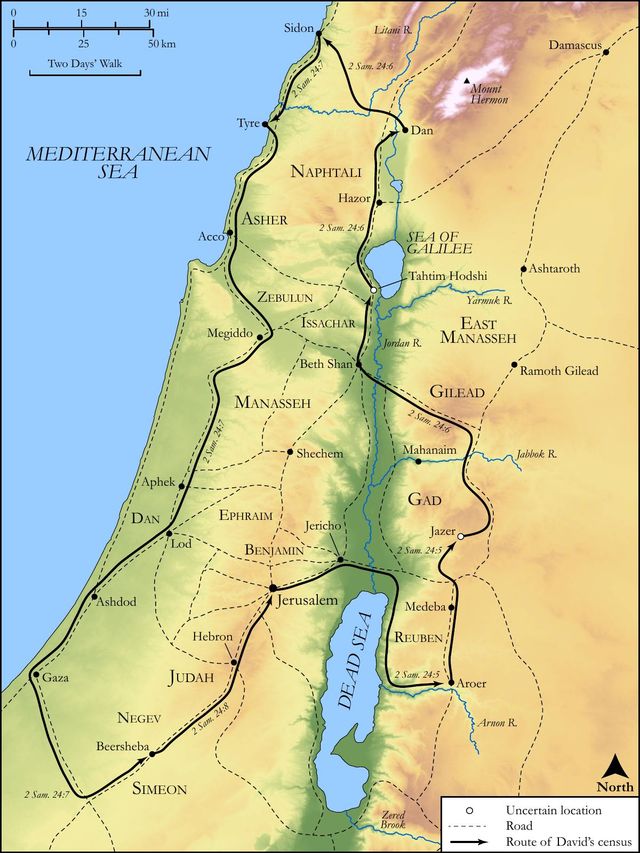
See on the biblical-era map
Study this verse
Public-domain commentary
Matthew Henry
From his Commentary on the Whole Bible. Henry comments on passages, not single verses — this entry covers 1 Chronicles 21:1–6. His three-level outline is real structure in the source text, so it is rendered as structure.
Numbering the people, one would think, was no bad thing. Why should not the shepherd know the number of his flock? But God sees not as man sees. It is plain it was wrong in David to do it, and a great provocation to God, because he did it in the pride of his heart; and there is no sin that has in it more of contradiction and therefore more of offence to God than pride. The sin was David's; he alone must bear the blame of it. But here we are told,
I.How active the tempter was in it (Ch1 21:1):
Satan stood up against Israel, and provoked David to do it. Is is said (Sa2 24:1) that the anger of the Lord was kindled against Israel, and he moved David to do it. The righteous judgments of God are to be observed and acknowledged even in the sins and unrighteousness of men. We are sure that God is not the author of sin - he tempts no man; and therefore, when it is said that he moved David to do it, it must be explained by what is intimated here, that, for wise and holy ends, he permitted the devil to do it. Here we trace this foul stream to its foundation. That Satan, the enemy of God and all good, should stand up against Israel, is not strange; it is what he aims at, to weaken the strength, diminish the numbers, and eclipse the glory of God's Israel, to whom he is Satan, a sworn adversary. But that he should influence David, the man of God's own heart to do a wrong thing, may well be wondered at. One would think him one of those whom the wicked one touches not. No, even the best saints, till they come to heaven, must never think themselves out of the reach of Satan's temptations. Now, when Satan meant to do Israel a mischief, what course did he take? He did not move God against them to destroy them (as Job, Job 2:3), but he provoked David, the best friend they had, to number them, and so to offend God, and set him against them. Note,
1.The devil does us more mischief by tempting us to sin against our God than he does by accusing us before our God. He destroys none but by their own hands,
2.The greatest spite he can do to the church of God is to tempt the rulers of the church to pride; for none can conceive the fatal consequences of that sin in all, especially in church-rulers. You shall not be so, Luk 22:26.
II.How passive the instrument was.
Joab, the person whom David employed, was an active man in public business; but to this he was perfectly forced, and did it with the greatest reluctance imaginable.
1.He put in a remonstrance against it before he began it. No man more forward that he in any thing that really tended to the honour of the king or the welfare of the kingdom; but in this matter he would gladly be excused. For,
(1.)It was a needless thing. there was not occasion at all for it. God had promised to multiply them, and he needed not question the accomplishment of that promise. They were all his servants, and he needed not doubt of their loyalty and affection to him. Their number was as much his strength as he could desire.
(2.)It was a dangerous thing. In doing it he might be a cause of trespass to Israel, and might provoke God against them. This Joab apprehended, and yet David himself did not. The most learned in the laws of God are not always the most quick-sighted in the application of those laws.
2.He was quite weary of it before he had done it; for the king's word was abominable to Joab, Ch1 21:6. Time was when whatever king David did pleased all the people, Sa2 3:36. But now there was a general disgust at these orders, which confirmed Joab in his dislike of them. so that, though the produce of this muster was really very great, yet he had no heart to perfect it, but left two tribes unnumbered (Ch1 21:5, Ch1 21:6), two considerable ones, Levi and Benjamin, and perhaps was not very exact in numbering the rest, because he did not do it with any pleasure, which might be one occasion of the difference between the sums here and Sa2 24:9.
Historical interpretation
Historical reception
1 surviving comment on this verse from the historical church.
The difference of the numbers here and 2 Kings 24. is to be accounted for, by supposing the greater number to be that which was really found, and the lesser to be that which Joab gave in.
Continue studying 1 Chronicles 21:5 across the web’s major study libraries — every link below opens this exact verse, chapter, or book on the destination site.
Read & Compare
 BibleGatewayThis verse in more than 200 translations and 70 languages.
 Bible.comThe YouVersion reader — hundreds of translations, reading plans, and highlights.
 ESV.orgCrossway's official English Standard Version reader.
 NET BibleThe NET translation with 60,000+ translators' notes on every rendering decision.
 STEP BibleTyndale House's free study tool — original text, vocabulary, and scholarly resources.
 BibliaLogos Bible Software's free web reader.
 USCCBThe New American Bible (Revised Edition) with the U.S. bishops' study notes.
Commentaries
 BibleHub CommentariesDozens of classic commentaries on this verse, gathered on one page.
 StudyLightMore than 100 commentary sets — the largest collection on the web.
 BibleRefPlain-English commentary on what this verse means, verse by verse.
 Enduring WordDavid Guzik's free commentary on this chapter, widely used by Bible teachers.
 Bible Study ToolsVerse commentary alongside Greek and Hebrew study aids.
Original Language & Research
- BibleHub InterlinearThe verse word by word — original language, transliteration, and English.
- BibleHub LexiconEvery word's original-language definition and Strong's entry.
 Blue Letter BibleDeep-study tools — Strong's numbers, concordance, and word studies.
 SefariaThe Hebrew text with Rashi and centuries of Jewish commentary.
Sermons, Hymns & Audio


TrulyRandomVerse is not affiliated with these sites and doesn’t control their content. They’re linked because they’re genuinely useful.
Summary
1 Chronicles 21:5 precisely records the outcome of King David's ill-advised census, detailing the formidable military strength of the united kingdom of Israel and Judah. It specifies that Joab, David's commander, reported 1,100,000 men from Israel and 470,000 men from Judah who were capable of drawing a sword, thereby quantifying the vast human resources available to the monarchy, an act that would soon incur severe divine judgment.
Context
ShowHideLiterary Context
This verse is a pivotal moment within the narrative of David's census, serving as the culmination of the disobedient act initiated by Satan and consented to by David. The preceding verses establish the context: Satan incites David to number Israel, and despite the strong and prophetic objections from Joab, his military commander, David insists on proceeding (1 Chronicles 21:3). Verse 5, therefore, presents the final, tangible result of this census, the very data that immediately precedes the divine judgment that follows in the subsequent verses, where God sends a plague upon Israel. It transitions the narrative from the act of disobedience to its dire consequences, setting the stage for God's righteous response.
Historical & Cultural Context
The census takes place during the height of David's reign as king over a united Israel. While censuses were not inherently forbidden (e.g., the censuses in Numbers 1 and Numbers 26 were divinely commanded), David's census here is presented as an act of sin. The sin likely stemmed from David's pride, a desire to boast in the nation's military might and human resources rather than trusting solely in God's covenant faithfulness and power. Among the nations of that day, a king's strength was often measured by the size of his army, making this census a potential display of self-reliance over divine dependence. The phrase "men that drew sword" refers to able-bodied men fit for military service, ready for combat, highlighting the military focus of the count. It is worth noting the numerical discrepancy with the parallel account in 2 Samuel 24:9, which lists 800,000 for Israel and 500,000 for Judah. Scholars often attribute this to different counting methodologies (e.g., excluding certain standing armies or administrative divisions), or variations in textual transmission over time, rather than a contradiction in the core narrative.
Key Themes
ShowHideThis verse powerfully contributes to several key themes within 1 Chronicles and the broader biblical narrative. Firstly, it underscores the theme of Divine Sovereignty versus Human Pride. David's decision to number the people, despite Joab's warnings, reveals a shift from trusting God's power to relying on human strength and numbers. The large figures presented in the verse emphasize the extent of this human reliance. Secondly, it highlights the Consequences of Disobedience. The very existence of these numbers is tied to an act of sin, directly leading to the divine judgment that follows. The census, and its outcome, becomes a catalyst for God's righteous anger and subsequent plague. Finally, it subtly reinforces the theme of God's Unwavering Faithfulness, even in judgment. While David's sin brings severe consequences, God's ultimate purpose for Israel and His covenant with David remain intact, demonstrating that even human failure cannot thwart His overarching plan.
Exposition and Analysis
ShowHideKey Word Analysis
ShowHideThis word refers to the "number" or "count" of something. In this context, it signifies the precise numerical result of the census, emphasizing the quantifiable nature of David's focus on human resources. It represents the data collected from the act of numbering, which was a source of pride and a deviation from trusting God's provision.
Literally "thousands of thousands," this repetition emphasizes the immense scale of the numbers reported. It is a hyperbolic way of expressing a very large number (1,000 x 1,000 = 1,000,000), underscoring the vastness of Israel's military potential and, by extension, the extent of David's human-centric focus.
This idiomatic phrase describes men who are capable of wielding a sword in battle, signifying their readiness for military service. It specifies that the census counted only those fit for combat, highlighting the military implications of David's census and the formidable fighting force he commanded.
Verse Breakdown
ShowHide"And Joab gave the sum of the number of the people unto David."
This clause establishes Joab's reluctant fulfillment of David's command. Despite his earlier objections and warnings, Joab, as military commander, delivers the final, compiled statistics of the census to the king, marking the completion of the disobedient act.
"And all [they of] Israel were a thousand thousand and an hundred thousand men that drew sword:"
This part specifies the numerical strength of the northern tribes of Israel. "A thousand thousand and an hundred thousand" translates to 1,100,000. This figure represents the vast pool of able-bodied men available for military conscription or combat from the tribes excluding Judah.
"and Judah [was] four hundred threescore and ten thousand men that drew sword."
This final clause provides the count for the southern tribe of Judah. "Four hundred threescore and ten thousand" translates to 470,000. This figure, combined with that of Israel, highlights the total military potential of David's united kingdom, a strength that David was tempted to rely upon rather than God.
Literary Devices
ShowHideThe text in 1 Chronicles 21:5 primarily employs Numerical Precision to convey the sheer scale of David's military strength. The explicit listing of "a thousand thousand and an hundred thousand" for Israel and "four hundred threescore and ten thousand" for Judah provides concrete, large figures that emphasize the formidable human resources available to the king. This detailed enumeration serves to underscore the temptation David faced to trust in these impressive numbers rather than in God's power. Furthermore, there is an implicit Contrast between the vastness of these human numbers and the singular, all-powerful God whom David should have relied upon. The very act of counting, and the resulting large figures, are presented as a source of human pride, standing in stark contrast to the humility and dependence required for divine favor. Finally, the verse functions as Foreshadowing, as these numbers, a consequence of David's sin, immediately precede the narrative of divine judgment, signaling that the act of counting and the resulting strength would lead to severe repercussions rather than security.
Theological and Thematic Connections
ShowHide1 Chronicles 21:5 serves as a powerful theological statement about the dangers of human pride and the critical importance of divine trust. The meticulous enumeration of Israel's fighting men, while seemingly a neutral statistic, is presented within the biblical narrative as the tangible outcome of an act of disobedience. David's sin was not merely in the act of counting, but in the heart behind it – a desire to rely on numerical strength and human might rather than the covenant faithfulness and omnipotence of God. This verse, therefore, highlights the fundamental theological truth that true security and strength come from God alone, not from impressive human resources or achievements. It warns against the temptation to find confidence in earthly metrics, reminding believers that reliance on anything other than God is a form of idolatry that invites divine displeasure.
Reflection and Application
ShowHideThe detailed census figures in 1 Chronicles 21:5, born of David's pride, offer a timeless lesson for believers today. In a world that constantly measures success by visible metrics—bank accounts, social media followers, career achievements, or even church attendance numbers—this passage calls us to a profound re-evaluation of where our trust lies. Just as David was tempted to rely on the formidable size of his army, we too can be subtly drawn into placing our confidence in our own abilities, resources, or the perceived strength of our institutions rather than in the living God. This verse challenges us to examine the "censuses" we take in our own lives: are we counting our blessings with gratitude, or are we counting our achievements with a subtle sense of self-reliance? True spiritual strength and security are found not in what we can quantify or control, but in humble, unwavering dependence on the Lord, recognizing that His power is made perfect in our weakness.
Questions for Reflection
ShowHideFAQ
ShowHideWhy did God get angry at David's census, if censuses were sometimes commanded in the Bible?
ShowHideGod's anger was not directed at the act of counting people in itself, as censuses were indeed commanded at other times (e.g., in Numbers 1 and Numbers 26 for military and organizational purposes). The sin in David's census, as implied by the narrative in 1 Chronicles 21:1, stemmed from the heart and motivation behind it. It was likely an act of pride, a desire to boast in the nation's military might and human resources rather than trusting solely in God's covenant faithfulness and power. David sought security in numbers rather than in the Lord, possibly for military expansion or taxation without divine sanction, indicating a lack of reliance on God's provision and protection. Joab's strong objections (1 Chronicles 21:3) also suggest that the census was undertaken outside of God's will and for an unrighteous purpose.
Why do the numbers in 1 Chronicles 21:5 differ from the parallel account in 2 Samuel 24:9?
ShowHideThe numbers reported in 1 Chronicles 21:5 (1,100,000 for Israel and 470,000 for Judah) do differ from those in the parallel account in 2 Samuel 24:9 (800,000 for Israel and 500,000 for Judah). Scholars propose several plausible explanations for this discrepancy. One common theory is that different counting methodologies were used; for instance, one account might include standing armies or specific tribal levies that the other excludes, or perhaps certain administrative divisions were counted differently. Another possibility is that the numbers represent different stages of the census, or that one account refers to the total population eligible for service while the other refers to those actually mustered. Furthermore, textual transmission variations over centuries could also account for slight differences. Regardless of the precise reason, both accounts convey the immense scale of Israel's military potential and the underlying theological message about David's sin of pride.
Christ-Centered Fulfillment
ShowHideThe narrative of David's census in 1 Chronicles 21:5, with its focus on human numbers and the ensuing divine judgment, finds its profound Christ-centered fulfillment in the person and work of Jesus. David's sin was a failure to trust God's provision, seeking security in the strength of his earthly kingdom. In stark contrast, Jesus, the greater Son of David, perfectly embodied absolute reliance on the Father. His kingdom is not of this world, nor is it built upon military might, human statistics, or impressive earthly armies, as He Himself declared in John 18:36. Instead, Christ's power is demonstrated through humility, self-sacrifice, and spiritual authority. The "census" of Christ's kingdom is not a count of those who "draw sword" but a spiritual gathering of all nations, drawn by grace through the gospel, as commissioned in Matthew 28:18-20. Where David sought glory in human strength, Christ emptied Himself, taking the form of a servant, and was exalted by God (Philippians 2:5-8). The New Testament consistently highlights that God chooses the weak and foolish things of the world to shame the strong, so that no one may boast in His presence (1 Corinthians 1:27-29). Thus, 1 Chronicles 21:5, by illustrating the perils of human pride and reliance on earthly power, ultimately points to the perfect trust and divine strength found only in Christ, who establishes a kingdom not by might or power, but by the Spirit of the Lord.