


1 Chronicles 21:3
Bible text: King James Version (1769 Blayney text) · Public domain
Bible text: King James Version with Strong's numbers · Public domain
Bible text: Berean Standard Bible · Public domain
Bible text: American Standard Version (1901) · Public domain
Bible text: World English Bible, Messianic edition · Public domain
Bible text: Geneva Bible (1599) · Public domain
Bible text: Young's Literal Translation · Public domain
- וַיֹּאמֶרvai·Yo·merand he saidH559Conj-w ¦ V-Qal-ConsecImperf-3msVerb Qal Consecutive Imperfect 3rd Singular Masculineוַandיֹּאמֶרhe said
- יוֹאָבyo·'AvJoabH3097N-proper-mNoun Proper Masculine
- יוֹסֵףyo·Sefmay he addH3254V-Hiphil-Imperf-3msVerb Hiphil Imperfect 3rd Singular Masculine
- יְהוָהYah·wehYahwehH3068N-properNoun Proper Title
- עַל'altoH5921PrepPreposition
- עַמּוֹa·Mohis peopleH5971N-msc ¦ 3msNoun Singular Masculine Constructעַמּpeopleוֹhis
- כָּהֵםka·Hemlike themPrep-k ¦ 3mpSuffix Personal 3rd Plural Masculineכָּlikeהֵםthem
- מֵאָהme·'Aha hundredH3967N-fsNoun Singular Feminine Absolute
- פְעָמִיםfe·'a·MimtimesH6471N-mpNoun Plural Masculine Absolute
- הֲלֹאha·Lo'¿ notH3808Interrog ¦ NegParticle Negativeהֲ¿לֹאnot
- אֲדֹנִי'a·do·Nimy O lordH113N-msc ¦ 1csNoun Singular Masculine ConstructאֲדֹנִO lordיmy
- הַמֶּלֶךְha·Me·lekhthe kingH4428Art ¦ N-msNoun Singular Masculine Absoluteהַtheמֶּלֶךְking
- כֻּלָּםku·Lam[do] all of themH3605N-msc ¦ 3mpNoun Singular Masculine Constructכֻּלָּ[do] all ofםthem
- לַאדֹנִיla·do·Ni[belong] to my lordH113Prep-l ¦ N-msc ¦ 1csNoun Singular Masculine Constructלַ[belong] toאדֹנִlordיmy
- לַעֲבָדִיםla·'a·va·Dimto subjectsH5650Prep-l ¦ N-mpNoun Plural Masculine Absoluteלַtoעֲבָדִיםsubjects
- לָמָּהLa·mah<to> why?H4100Prep-l ¦ InterrogPronoun Interrogativeלָ<to>מָּהwhy?
- יְבַקֵּשׁye·va·Keshdoes he seekH1245V-Piel-Imperf-3msVerb Piel Imperfect 3rd Singular Masculine
- זֹאתzoTthisH2063PrtParticle Demonstrative
- אֲדֹנִי'a·do·Nimy lordH113N-msc ¦ 1csNoun Singular Masculine Constructאֲדֹנִlordיmy
- לָמָּהLa·mah<to> why?H4100Prep-l ¦ InterrogPronoun Interrogativeלָ<to>מָּהwhy?
- יִהְיֶהyih·Yehwill it becomeH1961V-Qal-Imperf-3msVerb Qal Imperfect 3rd Singular Masculine
- לְאַשְׁמָהle·'ash·Mah<into> guiltH819Prep-l ¦ N-fsNoun Singular Feminine Absoluteלְ<into>אַשְׁמָהguilt
- לְיִשְׂרָאֵלle·Yis·ra·'Elfor IsraelH3478Prep-l ¦ N-properNoun Proper LocationלְforיִשְׂרָאֵלIsrael
English is a literal word-by-word gloss of the Hebrew, not the KJV's wording. Why?
This is the original text the KJV's translators worked from — each Hebrew word with its own literal English meaning in this verse, prepared by scholars at Tyndale House, Cambridge. The KJV translates whole sentences, not word by word, so its wording differs: one Hebrew word can become several English words, and the KJV may choose “the LORD” where the gloss reads “Yahweh”. Both are faithful — they answer different questions. For the KJV's own rendering, switch to the KJV text.
Details
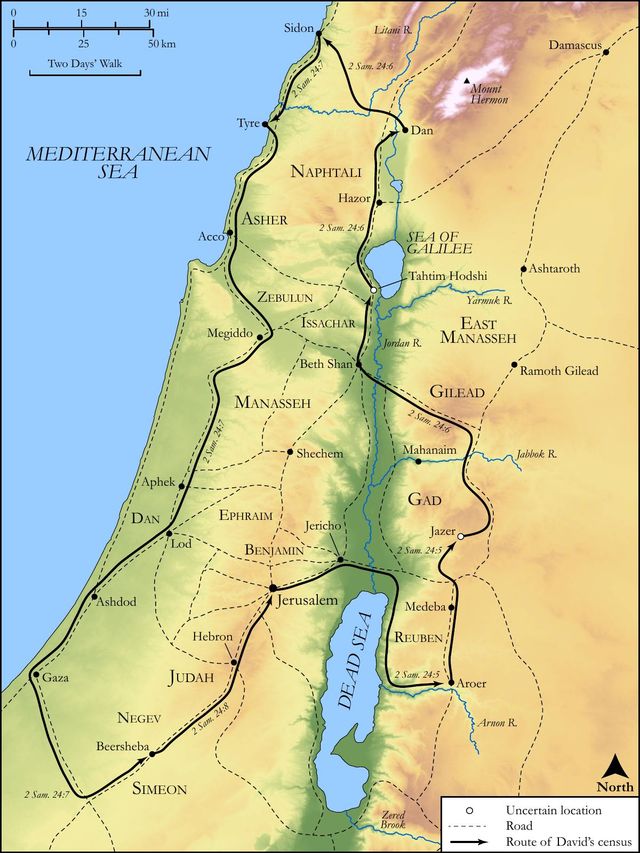
See on the biblical-era map
Study this verse
Public-domain commentary
Matthew Henry
From his Commentary on the Whole Bible. Henry comments on passages, not single verses — this entry covers 1 Chronicles 21:1–6. His three-level outline is real structure in the source text, so it is rendered as structure.
Numbering the people, one would think, was no bad thing. Why should not the shepherd know the number of his flock? But God sees not as man sees. It is plain it was wrong in David to do it, and a great provocation to God, because he did it in the pride of his heart; and there is no sin that has in it more of contradiction and therefore more of offence to God than pride. The sin was David's; he alone must bear the blame of it. But here we are told,
I.How active the tempter was in it (Ch1 21:1):
Satan stood up against Israel, and provoked David to do it. Is is said (Sa2 24:1) that the anger of the Lord was kindled against Israel, and he moved David to do it. The righteous judgments of God are to be observed and acknowledged even in the sins and unrighteousness of men. We are sure that God is not the author of sin - he tempts no man; and therefore, when it is said that he moved David to do it, it must be explained by what is intimated here, that, for wise and holy ends, he permitted the devil to do it. Here we trace this foul stream to its foundation. That Satan, the enemy of God and all good, should stand up against Israel, is not strange; it is what he aims at, to weaken the strength, diminish the numbers, and eclipse the glory of God's Israel, to whom he is Satan, a sworn adversary. But that he should influence David, the man of God's own heart to do a wrong thing, may well be wondered at. One would think him one of those whom the wicked one touches not. No, even the best saints, till they come to heaven, must never think themselves out of the reach of Satan's temptations. Now, when Satan meant to do Israel a mischief, what course did he take? He did not move God against them to destroy them (as Job, Job 2:3), but he provoked David, the best friend they had, to number them, and so to offend God, and set him against them. Note,
1.The devil does us more mischief by tempting us to sin against our God than he does by accusing us before our God. He destroys none but by their own hands,
2.The greatest spite he can do to the church of God is to tempt the rulers of the church to pride; for none can conceive the fatal consequences of that sin in all, especially in church-rulers. You shall not be so, Luk 22:26.
II.How passive the instrument was.
Joab, the person whom David employed, was an active man in public business; but to this he was perfectly forced, and did it with the greatest reluctance imaginable.
1.He put in a remonstrance against it before he began it. No man more forward that he in any thing that really tended to the honour of the king or the welfare of the kingdom; but in this matter he would gladly be excused. For,
(1.)It was a needless thing. there was not occasion at all for it. God had promised to multiply them, and he needed not question the accomplishment of that promise. They were all his servants, and he needed not doubt of their loyalty and affection to him. Their number was as much his strength as he could desire.
(2.)It was a dangerous thing. In doing it he might be a cause of trespass to Israel, and might provoke God against them. This Joab apprehended, and yet David himself did not. The most learned in the laws of God are not always the most quick-sighted in the application of those laws.
2.He was quite weary of it before he had done it; for the king's word was abominable to Joab, Ch1 21:6. Time was when whatever king David did pleased all the people, Sa2 3:36. But now there was a general disgust at these orders, which confirmed Joab in his dislike of them. so that, though the produce of this muster was really very great, yet he had no heart to perfect it, but left two tribes unnumbered (Ch1 21:5, Ch1 21:6), two considerable ones, Levi and Benjamin, and perhaps was not very exact in numbering the rest, because he did not do it with any pleasure, which might be one occasion of the difference between the sums here and Sa2 24:9.
Continue studying 1 Chronicles 21:3 across the web’s major study libraries — every link below opens this exact verse, chapter, or book on the destination site.
Read & Compare
 BibleGatewayThis verse in more than 200 translations and 70 languages.
 Bible.comThe YouVersion reader — hundreds of translations, reading plans, and highlights.
 ESV.orgCrossway's official English Standard Version reader.
 NET BibleThe NET translation with 60,000+ translators' notes on every rendering decision.
 STEP BibleTyndale House's free study tool — original text, vocabulary, and scholarly resources.
 BibliaLogos Bible Software's free web reader.
 USCCBThe New American Bible (Revised Edition) with the U.S. bishops' study notes.
Commentaries
 BibleHub CommentariesDozens of classic commentaries on this verse, gathered on one page.
 StudyLightMore than 100 commentary sets — the largest collection on the web.
 BibleRefPlain-English commentary on what this verse means, verse by verse.
 Enduring WordDavid Guzik's free commentary on this chapter, widely used by Bible teachers.
 Bible Study ToolsVerse commentary alongside Greek and Hebrew study aids.
Original Language & Research
- BibleHub InterlinearThe verse word by word — original language, transliteration, and English.
- BibleHub LexiconEvery word's original-language definition and Strong's entry.
 Blue Letter BibleDeep-study tools — Strong's numbers, concordance, and word studies.
 SefariaThe Hebrew text with Rashi and centuries of Jewish commentary.
Sermons, Hymns & Audio


TrulyRandomVerse is not affiliated with these sites and doesn’t control their content. They’re linked because they’re genuinely useful.
Summary
1 Chronicles 21:3 captures Joab's courageous and spiritually discerning counsel to King David, as he vehemently opposes David's command to conduct a census of Israel. Joab's words reveal a profound understanding that David's motivation for the census stems from pride and a reliance on human strength rather than trust in God's divine provision. He warns that such an act would constitute a serious "trespass" against the Lord, bringing guilt and potential judgment upon the entire nation. His protest highlights the critical responsibility of leadership and the far-reaching corporate consequences of a leader's sin when not aligned with God's will.
Context
ShowHideLiterary Context
This verse is situated within a pivotal and somber narrative in 1 Chronicles 21, which provides a parallel account to 2 Samuel 24. The chapter opens with the ominous statement that "Satan stood up against Israel, and provoked David to number Israel" (1 Chronicles 21:1). Despite this malevolent influence or spiritual prompting, David issues the command for a census. Joab, typically portrayed as a pragmatic and often ruthless military commander, surprisingly exhibits profound spiritual discernment here, recognizing the inherent sinfulness of David's directive. His objection in 1 Chronicles 21:3 is met with David's unyielding insistence (1 Chronicles 21:4), leading to Joab's reluctant compliance. The narrative swiftly moves to God's severe displeasure and subsequent judgment upon Israel through a devastating plague (1 Chronicles 21:7-14). Joab's counsel thus serves as a critical, albeit unheeded, warning, underscoring the gravity of David's impending transgression and its dire consequences.
Historical & Cultural Context
Censuses in ancient Israel were not inherently forbidden; indeed, they were sometimes commanded by God for legitimate purposes, such as military conscription, taxation, or tribal organization, as exemplified in Numbers 1. However, David's census in 1 Chronicles 21 was distinct in its motivation. Its sinfulness lay in David's underlying pride, a desire to boast in his own military strength and the sheer number of his fighting men, rather than placing his trust in God's power and blessing. In a culture where national prosperity and military success were understood as direct indicators of divine favor, a king's attempt to quantify his strength apart from God's provision was a profound act of distrust and self-exaltation. Joab, as David's chief general, would have understood the practical logistics of a census, but his objection transcends mere practicality, touching upon the spiritual implications of such an act as a "trespass" against God, which would inevitably incur divine wrath and judgment upon the entire community.
Key Themes
ShowHideThis verse contributes significantly to several major themes within 1 Chronicles and the broader biblical narrative. Firstly, it powerfully highlights the sinfulness of human pride and self-reliance in stark contrast to absolute dependence on God. David's desire to number his fighting men, despite God's consistent provision of victory and protection, reveals a heart that momentarily shifted its trust from the divine to the human. Secondly, it profoundly illustrates the corporate consequences of leadership sin. Joab's warning that David would "be a cause of trespass to Israel" underscores the biblical principle that the actions of a leader, especially a king, have profound ripple effects, often bringing either blessing or judgment upon the entire nation. This theme is tragically reinforced as the subsequent plague devastates Israel (1 Chronicles 21:14). Finally, the verse subtly introduces the theme of wise counsel and spiritual discernment, as Joab, despite his often-flawed character, demonstrates a surprising spiritual insight that David, the "man after God's own heart," initially lacks, emphasizing the importance of heeding godly advice.
Exposition and Analysis
ShowHideKey Word Analysis
ShowHideThe verb "require" (H1245, בָּקַשׁ) is a primitive root meaning "to search out (by any method, specifically in worship or prayer); by implication, to strive after; ask, beg, beseech, desire, enquire, get, make inquisition, procure, (make) request, require, seek (for)." When Joab asks, "why then doth my lord require this thing?", he is not merely questioning a logistical command but challenging the underlying motive and necessity of David's demand. It implies a seeking or demanding that is misplaced, unnecessary, or spiritually misguided. Joab is probing the king's heart, sensing that David's insistent will is overriding spiritual wisdom and potentially leading to a dangerous pursuit of self-glory rather than God's honor.
This significant term (H819, אַשְׁמָה) denotes "guiltiness, a fault, the presentation of a sin-offering." It often implies a breach of trust or an act that incurs a penalty and requires restitution or atonement. In a cultic context, it specifically refers to a "guilt offering" or "trespass offering" (e.g., Leviticus 5:15). Joab's use of this word indicates that he understood David's action would not merely be a mistake or a logistical error, but a serious theological transgression against God. It signifies an act that would demand a divine response and potential judgment, bringing corporate guilt and culpability upon the entire nation of Israel before God.
Verse Breakdown
ShowHide"And Joab answered, The LORD make his people an hundred times so many more as they [be]:"
Joab begins his response with a respectful, even deferential, blessing. This opening is a shrewd rhetorical move, establishing his loyalty and goodwill before delivering a challenging rebuke. By invoking God's blessing for exponential growth, Joab subtly reminds David of the true source of Israel's strength and prosperity – divine favor and multiplication, not human enumeration or military might. It serves as a gentle, yet pointed, rebuke to David's potential pride, suggesting that true greatness and security come from God's hand, not from man's counting.
"but, my lord the king, [are] they not all my lord's servants?"
Joab then shifts to a logical and practical argument, questioning the necessity of the census by stating the obvious: the people are already loyal servants of the king. This implies that David already possesses their allegiance and military service, rendering a head count redundant if its purpose is merely to assess control or readiness. Joab suggests that David's existing authority and the people's devotion are sufficient, and the census adds nothing truly valuable or necessary to his reign.
"why then doth my lord require this thing?"
This is Joab's direct and probing challenge to David's motivation. It is a rhetorical question, implying that there is no good, legitimate, or divinely sanctioned reason for such a demand. Joab is attempting to expose the king's heart, sensing that the underlying motive is not for the good of the kingdom or the glory of God, but for something less noble, perhaps personal pride, a misguided sense of security in numbers, or a desire for self-aggrandizement.
"why will he be a cause of trespass to Israel?"
This final question is the crux of Joab's objection and reveals his profound spiritual insight and prophetic warning. He understands that David's action will not be a mere administrative error but a grave spiritual offense (an 'ashmâh') against God. More critically, he warns that David's personal sin will have devastating corporate consequences, making the entire nation of Israel culpable and subject to divine judgment. Joab foresees the devastating ripple effect of the king's pride, anticipating the collective suffering that will result from David's individual transgression.
Literary Devices
ShowHideThe verse employs several potent Literary Devices. Rhetorical Questions are central to Joab's argument, as he poses two direct challenges to David: "why then doth my lord require this thing? why will he be a cause of trespass to Israel?" These questions are not seeking information but are designed to provoke deep thought, highlight the absurdity or spiritual danger of David's command, and underscore Joab's strong disapproval. There is also a significant element of Irony present; Joab, often depicted as a ruthless and pragmatic military commander, is the one who exhibits keen spiritual discernment, warning the king against a spiritual transgression, while David, the "man after God's own heart," is momentarily blinded by pride. Furthermore, Joab's final question serves as powerful Foreshadowing, accurately predicting the divine judgment and "trespass" that will indeed fall upon Israel as a direct consequence of David's census.
Theological and Thematic Connections
ShowHideThis verse profoundly illustrates the tension between human pride and divine sovereignty, a recurring and critical theme throughout the Old Testament. David's desire to number his fighting men, despite God's consistent provision of victory and blessing, reflects a dangerous shift from trusting in the Lord to relying on human strength and statistics. Joab's prophetic warning about "trespass" highlights the corporate responsibility inherent in the covenant relationship between God and Israel, where the sins of leaders could bring judgment upon the entire nation. It underscores the critical importance of discerning leadership that prioritizes God's honor over personal ambition and the necessity of heeding wise, even uncomfortable, counsel. This episode serves as a stark reminder that true security, prosperity, and national well-being come from God's blessing and His alone, not from human efforts or perceived might.
Reflection and Application
ShowHide1 Chronicles 21:3 offers timeless lessons for individuals and leaders alike, resonating with profound spiritual truths. Joab's courageous counsel serves as a powerful reminder of the importance of rebuking the powerful, even when it is unpopular or goes against the desires of those in authority. For leaders, it underscores the profound and far-reaching impact of personal decisions on the collective well-being of those they lead; a leader's sin is rarely confined to themselves but often creates a "trespass" that affects the entire community. This passage challenges us to examine our own motivations: do our actions stem from a humble reliance on God's power and provision, or from a desire to boast in our own strength, accomplishments, or resources? True spiritual strength and security are found not in what we can count or control, but in our unwavering trust in the Lord, who alone gives growth and victory. We are called to cultivate spiritual discernment, to recognize when our desires might lead us away from God's perfect will, and to be open to the wise counsel of others, even if it challenges our preconceived notions or personal ambitions.
Questions for Reflection
ShowHideFAQ
ShowHideWhy was David's census considered a sin, when other censuses in the Bible were commanded by God?
ShowHideThe sinfulness of David's census lay not in the act of counting itself, but profoundly in its underlying motivation. While censuses for military purposes or taxation were indeed divinely commanded at other times (e.g., in Numbers 1), David's census in 1 Chronicles 21 (and its parallel in 2 Samuel 24) was rooted in pride and a desire to boast in his own military strength rather than relying on God's power and blessing. 1 Chronicles 21:1 explicitly states that "Satan stood up against Israel, and provoked David to number Israel," indicating a malevolent, faithless impulse behind the king's command. It was an act of self-reliance, seeking security in numbers rather than in the Lord who had consistently granted Israel victory and prosperity.
Christ-Centered Fulfillment
ShowHideJoab's poignant warning in 1 Chronicles 21:3 that David's prideful act would "be a cause of trespass to Israel" poignantly foreshadows the ultimate need for a perfect King who would not cause trespass but would bear it. David, despite being a man after God's own heart and a type of the coming Messiah, failed as a king, bringing judgment upon his people through his sin. This narrative underscores the profound human need for a truly righteous and perfectly obedient leader, one whose perfect life and self-sacrifice would not bring a curse but bring ultimate blessing and redemption. Jesus Christ, the Son of David, is that perfect King. He never sought to glorify Himself or rely on human strength or numbers; rather, He perfectly submitted to the Father's will, even to the point of death on a cross (Philippians 2:8). Unlike David, whose sin brought a plague upon Israel, Jesus became the Lamb of God who takes away the sin of the world, bearing the trespass of His people upon Himself (Isaiah 53:5). Through His atoning work, He removes the "trespass" that humanity incurs, offering forgiveness, reconciliation, and righteousness, thereby fulfilling the ultimate need for a King who leads His people not into judgment, but into eternal life and peace (Romans 5:17-19).