


1 Chronicles 21:2
Bible text: King James Version (1769 Blayney text) · Public domain
Bible text: King James Version with Strong's numbers · Public domain
Bible text: Berean Standard Bible · Public domain
Bible text: American Standard Version (1901) · Public domain
Bible text: World English Bible, Messianic edition · Public domain
Bible text: Geneva Bible (1599) · Public domain
Bible text: Young's Literal Translation · Public domain
- וַיֹּאמֶרvai·Yo·merand he saidH559Conj-w ¦ V-Qal-ConsecImperf-3msVerb Qal Consecutive Imperfect 3rd Singular Masculineוַandיֹּאמֶרhe said
- דָּוִידda·VidDavidH1732N-proper-mNoun Proper Masculine
- אֶל'eltoH413PrepPreposition
- יוֹאָבyo·'AvJoabH3097N-proper-mNoun Proper Masculine
- וְאֶלve·'eland toH413Conj-w ¦ PrepPrepositionוְandאֶלto
- שָׂרֵיsa·Rei[the] leaders ofH8269N-mpcNoun Plural Masculine Construct
- הָעָםha·'Amthe peopleH5971Art ¦ N-msNoun Singular Masculine Absoluteהָtheעָםpeople
- לְכוּle·KhugoH1980V-Qal-Imp-2mpVerb Qal Imperative 2nd Plural Masculine
- סִפְרוּsif·RucountH5608V-Qal-Imp-2mpVerb Qal Imperative 2nd Plural Masculine
- אֶת'et<obj.>H853DirObjMParticle Object Indicator
- יִשְׂרָאֵלYis·ra·'ElIsraelH3478N-properNoun Proper Location
- מִבְּאֵרmi·be·'Erfrom BeerH884Prep-m ¦ N-properNoun Proper LocationמִfromבְּאֵרBeer
- שֶׁבַעShe·va'ShebaH884N-properNoun Proper Location
- וְעַדve·'adand toH5704Conj-w ¦ PrepPrepositionוְandעַדto
- דָּןDanDanH1835N-properNoun Proper Location
- וְהָבִיאוּve·ha·Vi·'uand bring [it]H935Conj-w ¦ V-Hiphil-Imp-2mpVerb Hiphil Imperative 2nd Plural Masculineוְandהָבִיאוּbring [it]
- אֵלַי'e·Laito meH413Prep ¦ 1csPrepositionאֵלַtoיme
- וְאֵדְעָהve·'e·de·'Ahso let me knowH3045Conj-w ¦ V-Qal-Imperf-1csVerb Qal Imperfect 1st Singular common genderוְsoאֵדְעָהlet me know
- אֶת'et<obj.>H853DirObjMParticle Object Indicator
- מִסְפָּרָםmis·pa·Ramtheir numberH4557N-msc ¦ 3mpNoun Singular Masculine Constructמִסְפָּרָnumberםtheir
English is a literal word-by-word gloss of the Hebrew, not the KJV's wording. Why?
This is the original text the KJV's translators worked from — each Hebrew word with its own literal English meaning in this verse, prepared by scholars at Tyndale House, Cambridge. The KJV translates whole sentences, not word by word, so its wording differs: one Hebrew word can become several English words, and the KJV may choose “the LORD” where the gloss reads “Yahweh”. Both are faithful — they answer different questions. For the KJV's own rendering, switch to the KJV text.
Details
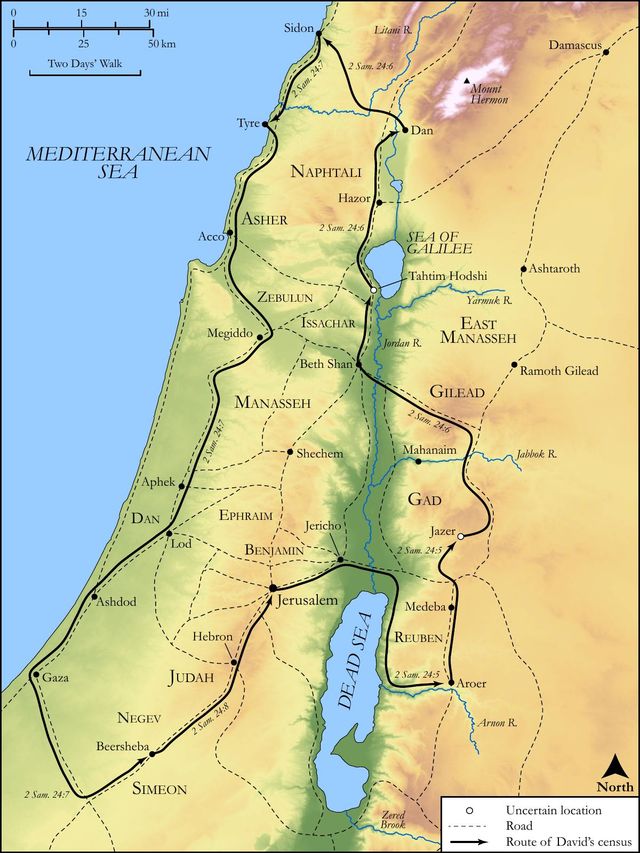
See on the biblical-era map
Study this verse
Public-domain commentary
Matthew Henry
From his Commentary on the Whole Bible. Henry comments on passages, not single verses — this entry covers 1 Chronicles 21:1–6. His three-level outline is real structure in the source text, so it is rendered as structure.
Numbering the people, one would think, was no bad thing. Why should not the shepherd know the number of his flock? But God sees not as man sees. It is plain it was wrong in David to do it, and a great provocation to God, because he did it in the pride of his heart; and there is no sin that has in it more of contradiction and therefore more of offence to God than pride. The sin was David's; he alone must bear the blame of it. But here we are told,
I.How active the tempter was in it (Ch1 21:1):
Satan stood up against Israel, and provoked David to do it. Is is said (Sa2 24:1) that the anger of the Lord was kindled against Israel, and he moved David to do it. The righteous judgments of God are to be observed and acknowledged even in the sins and unrighteousness of men. We are sure that God is not the author of sin - he tempts no man; and therefore, when it is said that he moved David to do it, it must be explained by what is intimated here, that, for wise and holy ends, he permitted the devil to do it. Here we trace this foul stream to its foundation. That Satan, the enemy of God and all good, should stand up against Israel, is not strange; it is what he aims at, to weaken the strength, diminish the numbers, and eclipse the glory of God's Israel, to whom he is Satan, a sworn adversary. But that he should influence David, the man of God's own heart to do a wrong thing, may well be wondered at. One would think him one of those whom the wicked one touches not. No, even the best saints, till they come to heaven, must never think themselves out of the reach of Satan's temptations. Now, when Satan meant to do Israel a mischief, what course did he take? He did not move God against them to destroy them (as Job, Job 2:3), but he provoked David, the best friend they had, to number them, and so to offend God, and set him against them. Note,
1.The devil does us more mischief by tempting us to sin against our God than he does by accusing us before our God. He destroys none but by their own hands,
2.The greatest spite he can do to the church of God is to tempt the rulers of the church to pride; for none can conceive the fatal consequences of that sin in all, especially in church-rulers. You shall not be so, Luk 22:26.
II.How passive the instrument was.
Joab, the person whom David employed, was an active man in public business; but to this he was perfectly forced, and did it with the greatest reluctance imaginable.
1.He put in a remonstrance against it before he began it. No man more forward that he in any thing that really tended to the honour of the king or the welfare of the kingdom; but in this matter he would gladly be excused. For,
(1.)It was a needless thing. there was not occasion at all for it. God had promised to multiply them, and he needed not question the accomplishment of that promise. They were all his servants, and he needed not doubt of their loyalty and affection to him. Their number was as much his strength as he could desire.
(2.)It was a dangerous thing. In doing it he might be a cause of trespass to Israel, and might provoke God against them. This Joab apprehended, and yet David himself did not. The most learned in the laws of God are not always the most quick-sighted in the application of those laws.
2.He was quite weary of it before he had done it; for the king's word was abominable to Joab, Ch1 21:6. Time was when whatever king David did pleased all the people, Sa2 3:36. But now there was a general disgust at these orders, which confirmed Joab in his dislike of them. so that, though the produce of this muster was really very great, yet he had no heart to perfect it, but left two tribes unnumbered (Ch1 21:5, Ch1 21:6), two considerable ones, Levi and Benjamin, and perhaps was not very exact in numbering the rest, because he did not do it with any pleasure, which might be one occasion of the difference between the sums here and Sa2 24:9.
Continue studying 1 Chronicles 21:2 across the web’s major study libraries — every link below opens this exact verse, chapter, or book on the destination site.
Read & Compare
 BibleGatewayThis verse in more than 200 translations and 70 languages.
 Bible.comThe YouVersion reader — hundreds of translations, reading plans, and highlights.
 ESV.orgCrossway's official English Standard Version reader.
 NET BibleThe NET translation with 60,000+ translators' notes on every rendering decision.
 STEP BibleTyndale House's free study tool — original text, vocabulary, and scholarly resources.
 BibliaLogos Bible Software's free web reader.
 USCCBThe New American Bible (Revised Edition) with the U.S. bishops' study notes.
Commentaries
 BibleHub CommentariesDozens of classic commentaries on this verse, gathered on one page.
 StudyLightMore than 100 commentary sets — the largest collection on the web.
 BibleRefPlain-English commentary on what this verse means, verse by verse.
 Enduring WordDavid Guzik's free commentary on this chapter, widely used by Bible teachers.
 Bible Study ToolsVerse commentary alongside Greek and Hebrew study aids.
Original Language & Research
- BibleHub InterlinearThe verse word by word — original language, transliteration, and English.
- BibleHub LexiconEvery word's original-language definition and Strong's entry.
 Blue Letter BibleDeep-study tools — Strong's numbers, concordance, and word studies.
 SefariaThe Hebrew text with Rashi and centuries of Jewish commentary.
Sermons, Hymns & Audio


TrulyRandomVerse is not affiliated with these sites and doesn’t control their content. They’re linked because they’re genuinely useful.
Summary
1 Chronicles 21:2 records King David's pivotal command to Joab and the leaders of Israel to conduct a national census, spanning the entire geographical breadth of the kingdom from Beersheba to Dan. This seemingly administrative directive, however, was rooted in a profound spiritual miscalculation: a reliance on human strength and military might rather than unwavering trust in God's sovereign protection and provision. This verse carries forward a critical narrative sequence that unveils the devastating consequences of pride and disobedience, ultimately leading to divine judgment upon Israel and a poignant, enduring lesson in leadership accountability and the necessity of humble dependence on God.
Context
ShowHideLiterary Context
This verse marks an abrupt and significant turning point in the Chronicler's narrative of David's reign. The preceding chapters (1 Chronicles 11-20) meticulously detail David's establishment of Jerusalem as the spiritual and political capital, his military successes, and his extensive preparations for the building of the temple. The command to conduct a census in 1 Chronicles 21:2 introduces a major moral failure on David's part, a stark contrast to his earlier devotion. It sets the stage for divine judgment, David's subsequent repentance, and the pivotal purchase of the threshing floor of Ornan (Araunah in 2 Samuel 24), which becomes the sacred site for Solomon's temple. This incident, therefore, serves as a crucial theological pivot, underscoring that even God's chosen king is subject to divine discipline and that true worship and national security are founded upon humility and obedience, not human strength.
Historical & Cultural Context
While censuses were not inherently forbidden in ancient Israel—the books of Numbers and Numbers 26 record divinely commanded enumerations for military organization and tribal land distribution—there was a specific stipulation in Exodus 30:12. This law mandated that each counted person pay a half-shekel as "atonement money" to avoid a plague. David's census, as presented in Chronicles and its parallel in 2 Samuel 24, appears to deviate from this practice and was driven by an illicit, prideful motive. The phrase "from Beersheba even to Dan" was a common merism (a figure of speech in which two contrasting parts represent the whole) signifying the entire geographical extent of the Israelite kingdom, from its southernmost point to its northernmost. This emphasizes the comprehensive nature of David's command. The parallel account in 2 Samuel 24:1 states that "the anger of the LORD was again kindled against Israel, and he incited David against them, saying, 'Go, number Israel and Judah.'" Chronicles, however, attributes the incitement to "Satan" (1 Chronicles 21:1). This difference highlights the Chronicler's theological emphasis on the direct agency of evil in tempting David, while the underlying divine permission or purpose remains consistent, revealing God's sovereign hand even in allowing temptation for His ultimate purposes.
Key Themes
ShowHideThe central theme emerging from this verse is the profound tension between Human Pride vs. Divine Trust. David's desire to "know" the number of his fighting men suggests a reliance on quantifiable strength rather than on the qualitative power of God, echoing warnings found in Psalm 20:7. This act reveals the Nature of Sin and Motivation, demonstrating that the sin was not merely the act of counting but the corrupt heart motivation behind it—a self-reliant spirit that usurped God's sovereignty. Even Joab, David's seasoned general, immediately recognized the spiritual danger, as seen in his objection in 1 Chronicles 21:3. Furthermore, the narrative powerfully underscores Leadership Accountability, illustrating that even a divinely appointed king like David is not exempt from the consequences of his actions and must answer to God for his choices, profoundly impacting the nation he leads. This incident serves as a stark reminder that true strength lies in humble dependence on God.
Exposition and Analysis
ShowHideKey Word Analysis
ShowHideThe verb סָפַר (çâphar) fundamentally means "to score with a mark as a tally or record," and by implication, "to inscribe," "to enumerate," or "to recount." While the act of counting itself is neutral, its significance in 1 Chronicles 21:2 is entirely dependent on David's underlying motivation. Unlike the divinely commanded censuses in Numbers, which were for legitimate military organization or tribal distribution and often accompanied by ritual atonement, David's command here is presented as an act of self-reliance. It signifies a desire to quantify his strength and resources, thereby placing his trust in human might rather than acknowledging God as the true source of his power and security. The act of "numbering" thus becomes an outward expression of a proud and self-sufficient heart.
The verb יָדַע (yâdaʻ) is a primitive root meaning "to know," "to ascertain by seeing," "to perceive," "to understand," or "to experience." In this context, David's explicit desire "that I may know [it]" highlights his personal agenda. It suggests a desire for comprehensive, empirical knowledge of his military resources, implying a shift from trusting in God's unseen, infinite power to relying on his own visible, finite might. This "knowing" becomes a symbol of human self-sufficiency and control, contrasting sharply with the biblical emphasis on God's omniscience and the believer's humble dependence. It points to a desire for a knowledge that serves human pride rather than divine purposes.
Verse Breakdown
ShowHide"And David said to Joab and to the rulers of the people"
This opening clause immediately establishes David's supreme authority as king, issuing a direct and formal command. By addressing both Joab, his chief military commander, and "the rulers of the people," David ensures that this decree carries the full weight of royal authority and necessitates immediate implementation by the highest echelons of leadership responsible for governing and leading the nation. This was not a casual suggestion but a decisive, kingly order.
"Go, number Israel from Beersheba even to Dan"
This is the core of David's instruction. The imperative "Go, number" conveys the urgency and directness of the royal mandate. The geographical phrase "from Beersheba even to Dan" is a well-known merism, a literary device that uses two contrasting extremes to represent the entire whole. It signifies the comprehensive geographical and demographic extent of the united kingdom of Israel, from its southernmost boundary to its northernmost. This emphasizes that David intended a thorough and exhaustive census of all eligible men across the entire land, leaving no part of his domain uncounted.
"and bring the number of them to me, that I may know [it]"
This final clause explicitly reveals David's personal motivation and the ultimate purpose behind the census. The directive "bring the number of them to me" underscores his desire for the compiled data to be personally delivered and processed by him, indicating a direct interest in the outcome. The concluding phrase "that I may know [it]" is crucial, as it points to David's internal desire for self-knowledge regarding his military strength and resources, rather than a divinely mandated count for a specific, holy purpose. This personal desire for quantified power and control, rather than humble reliance on God, is where the fundamental sin of the census lies.
Literary Devices
ShowHideThe verse employs several significant Literary Devices that underscore its theological weight. The most prominent is the Imperative Mood in David's command, "Go, number," which highlights his absolute authority and the directness of his will. This contrasts sharply with divine commands often found in Scripture, where God's imperatives are righteous and for the good of His people. Another key device is Merism, seen in the phrase "from Beersheba even to Dan." This geographical pairing effectively represents the entire kingdom of Israel, conveying the comprehensive scope of David's intended census and his desire to quantify all his available resources. Furthermore, the verse functions as a subtle form of Foreshadowing, as David's seemingly innocuous command immediately sets in motion a chain of events that leads to divine judgment and national suffering. The very act of commanding the census, particularly with the stated motivation, subtly foreshadows the impending divine displeasure and the severe consequences that will unfold in the subsequent narrative.
Theological and Thematic Connections
ShowHideDavid's census, as initiated in 1 Chronicles 21:2, serves as a profound biblical case study on the dangers of pride and self-reliance, even for those divinely chosen and abundantly blessed. It powerfully illustrates that sin is not merely an outward action but often stems from the heart's disposition—a desire to trust in human strength and visible resources rather than in the invisible, omnipotent God. This episode underscores the constant temptation, even for spiritual leaders, to replace divine dependence with human calculation, leading to spiritual vulnerability and opening the door for adversarial influence. The narrative reminds us that true security and enduring strength are found not in numbers or military might, but in humble submission to God's will and unwavering faith in His sovereign provision.
Reflection and Application
ShowHideThe account of David's census in 1 Chronicles 21:2 calls us to a deep and honest examination of our own hearts and motivations. In a world that often values measurable success, quantifiable achievements, and self-sufficiency, it is profoundly easy to fall into the same trap as David: relying on our own resources, intelligence, or strength rather than wholeheartedly trusting in God. We might "number" our bank accounts, our social media followers, our professional accolades, our personal accomplishments, or even our spiritual disciplines, believing these metrics are the source of our security or significance. This narrative challenges us to ask whether our actions, even those that appear benign or beneficial on the surface, are rooted in a humble dependence on God or in a subtle pride that seeks to establish our own kingdom and glory. True spiritual strength, peace, and lasting fruit come from acknowledging God's absolute sovereignty over every aspect of our lives and resting in His unfailing provision, rather than striving to control or quantify our own perceived power.
Questions for Reflection
ShowHideFAQ
ShowHideWas numbering Israel always a sin?
ShowHideNo, numbering Israel was not inherently sinful. The Old Testament records several censuses commanded by God Himself, such as those detailed in the book of Numbers for military organization, tribal registration, and land distribution. The sin in David's census, as initiated in 1 Chronicles 21:2, lay not in the act of counting itself but in David's underlying motivation and perhaps his neglect of specific divine stipulations. The parallel account in 2 Samuel 24:1 indicates that "the anger of the LORD was again kindled against Israel," and 1 Chronicles 21:1 states that "Satan stood up against Israel and incited David to number Israel." This suggests that David's heart was moved by pride, a desire to rely on his own military might rather than on God's protection and provision. Furthermore, it's possible David neglected the atonement money required for a census in Exodus 30:12, which was meant to avert a plague. Thus, the sin was a combination of prideful self-reliance and possibly a disregard for divine stipulations, rather than the act of counting itself.
Why did God allow Satan to incite David to sin?
ShowHideThe biblical narrative, particularly when comparing 1 Chronicles 21:1 with 2 Samuel 24:1, presents a complex theological truth about divine sovereignty and human responsibility. While Chronicles states "Satan stood up against Israel and incited David," Samuel says "the anger of the LORD was again kindled against Israel, and he incited David." This is not a contradiction but rather a demonstration of God's ultimate sovereignty, even over the actions of evil. God can permit or use an adversary (like Satan) to achieve His purposes, which may include exposing latent sin in His people, bringing about judgment for prior transgressions (as suggested by God's anger against Israel), or leading to a situation where His people are forced to acknowledge their dependence on Him. In David's case, the census exposed his pride and led to a severe but ultimately redemptive discipline, culminating in the purchase of the threshing floor, which became the sacred site for the temple (1 Chronicles 21:28-30 and 1 Chronicles 22:1). God's permission of Satan's incitement served His larger redemptive and disciplinary plan, bringing about a profound lesson for David and the nation.
Christ-Centered Fulfillment
ShowHideThe narrative of David's census, taking shape in his prideful command in 1 Chronicles 21:2, powerfully foreshadows the perfect kingship of Jesus Christ. David, despite being "a man after God's own heart," faltered, succumbing to pride and relying on human strength, leading to devastating consequences for his people in the form of a plague (1 Chronicles 21:14). This stands in stark contrast to Jesus, the true and eternal King, who never relied on human might or earthly numbers. His strength came from perfect obedience and utter dependence on His Father (John 5:19). While David's census brought judgment, Christ's "numbering" of His people, the true Israel, is for their salvation and eternal security. He is the Good Shepherd who knows His sheep by name (John 10:14), not to count them for military might, but to lay down His life for them (John 10:11). The consequences of David's sin required a costly sacrifice to avert further judgment (1 Chronicles 21:26-27), but Christ Himself became the ultimate, once-for-all sacrifice, taking away the sin of the world (John 1:29), thereby fulfilling the need for atonement that David's census implicitly lacked. In Christ, we find a King whose reign is marked by humility, perfect obedience, and a salvation that truly secures His people, not by their numbers or worthiness, but by His infinite grace and redemptive power.