


Genesis 20:9
- וַיִּקְרָאvai·yik·Ra'and he summonedH7121Conj-w ¦ V-Qal-ConsecImperf-3msVerb Qal Consecutive Imperfect 3rd Singular Masculineוַandיִּקְרָאhe summoned
- אֲבִימֶלֶךְ'a·vi·Me·lekhAbimelechH40N-proper-mNoun Proper Masculine
- לְאַבְרָהָםle·'av·ra·Ham<to> AbrahamH85Prep-l ¦ N-proper-mNoun Proper Masculineלְ<to>אַבְרָהָםAbraham
- וַיֹּאמֶרvai·Yo·merand he saidH559Conj-w ¦ V-Qal-ConsecImperf-3msVerb Qal Consecutive Imperfect 3rd Singular Masculineוַandיֹּאמֶרhe said
- לוֹloto <the> himPrep-l ¦ 3msSuffix Personal 3rd Singular Masculineלto <the>וֹhim
- מֶהmehwhat?H4100InterrogPronoun Interrogative
- עָשִׂיתָ'a·Si·tahave you doneH6213V-Qal-Perf-2msVerb Qal Perfect 2nd Singular Masculine
- לָּנוּla·nuto <the> usPrep-l ¦ 1cpSuffix Personal 1st Plural common genderלָּto <the>נוּus
- וּמֶהu·mehand what?H4100Conj-w ¦ InterrogPronoun Interrogativeוּandמֶהwhat?
- חָטָאתִיcha·Ta·tihave I sinnedH2398V-Qal-Perf-1csVerb Qal Perfect 1st Singular common gender
- לָךְLakhto <the> youPrep-l ¦ 2msSuffix Personal 2nd Singular Masculineלָto <the>ךְyou
- כִּיkiforH3588PrtParticle Conditional
- הֵבֵאתָhe·Ve·tayou have broughtH935V-Hiphil-Perf-2msVerb Hiphil Perfect 2nd Singular Masculine
- עָלַי'a·Laion meH5921Prep ¦ 1csPrepositionעָלַonיme
- וְעַלve·'aland onH5921Conj-w ¦ PrepPrepositionוְandעַלon
- מַמְלַכְתִּיmam·lakh·Timy kingdomH4467N-fsc ¦ 1csNoun Singular Feminine Constructמַמְלַכְתִּkingdomיmy
- חֲטָאָהcha·ta·'Aha sinH2401N-fsNoun Singular Feminine Absolute
- גְדֹלָהge·do·LahgreatH1419Adj-fsAdjective Singular Feminine Absolute
- מַעֲשִׂיםma·'a·SimdeedsH4639N-mpNoun Plural Masculine Absolute
- אֲשֶׁר'a·SherwhichH834RelParticle Relative
- לֹאlo'notH3808NegParticle Negative
- יֵעָשׂוּye·'a·Suthey will be doneH6213V-Niphal-Imperf-3mpVerb Niphal Imperfect 3rd Plural Masculine
- עָשִׂיתָ'a·Si·tayou have doneH6213V-Qal-Perf-2msVerb Qal Perfect 2nd Singular Masculine
- עִמָּדִי'i·ma·Diwith meH5978Prep ¦ 1csPrepositionעִמָּדִwithיme
English is a literal word-by-word gloss of the Hebrew, not the KJV's wording. Why?
This is the original text the KJV's translators worked from — each Hebrew word with its own literal English meaning in this verse, prepared by scholars at Tyndale House, Cambridge. The KJV translates whole sentences, not word by word, so its wording differs: one Hebrew word can become several English words, and the KJV may choose “the LORD” where the gloss reads “Yahweh”. Both are faithful — they answer different questions. For the KJV's own rendering, switch to the KJV text.
Details
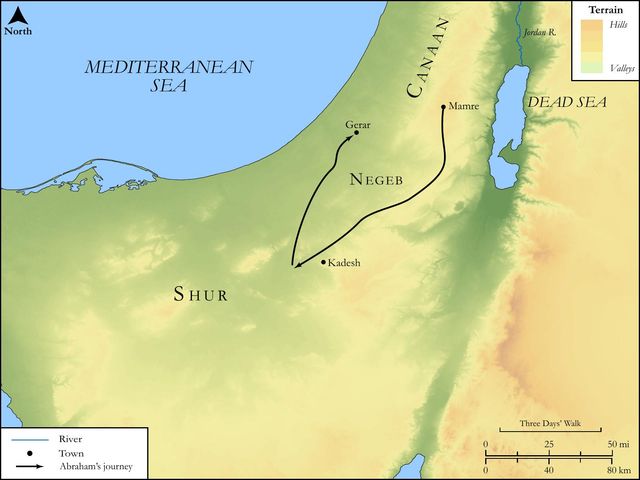
See on the biblical-era map


Study this verse
Public-domain commentary
Matthew Henry
From his Commentary on the Whole Bible. Henry comments on passages, not single verses — this entry covers Genesis 20:8–13. His four-level outline is real structure in the source text, so it is rendered as structure.
Abimelech, being thus warned of God in a dream, takes the warning, and, as one truly afraid of sin and its consequences, he rises early to obey the directions given him.
I.He has a caution for his servants, Gen 20:8.
Abraham himself could not be more careful than he was to command his household in this matter. Note, Those whom God has convinced of sin and danger ought to tell others what God has done for their souls, that they also may be awakened and brought to a like holy fear.
II.He has a chiding for Abraham. Observe,
1.The serious reproof which Abimelech gave to Abraham, Gen 20:9, Gen 20:10. His reasoning with Abraham upon this occasion was very strong, and yet very mild. Nothing could be said better; he does not reproach him, nor insult over him, does not say, "Is this your profession? I see, though you will not swear, you will lie. If these be prophets, I will beg to be freed from the sight of them:" but he fairly represents the injury Abraham had done him, and calmly signifies his resentment of it.
(1.)He calls that sin which he now found he had been in danger of a great sin. Note, Even the light of nature teaches men that the sin of adultery is a very great sin: be it observed, to the shame of many who call themselves Christians, and yet make a light matter of it.
(2.)He looks upon it that both himself and his kingdom would have been exposed to the wrath of God if he had been guilty of this sin, though ignorantly. Note, The sins of kings often prove the plagues of kingdoms; rulers should therefore, for their people's sake, dread sin.
(3.)He charges Abraham with doing that which was not justifiable, in disowning his marriage. This he speaks of justly, and yet tenderly; he does not call him a liar and cheat, but tells him he had done deeds that ought not to be done. Note, Equivocation and dissimulation, however they may be palliated, are very bad things, and by no means to be admitted in any case.
(4.)He takes it as a very great injury to himself and his family that Abraham had thus exposed them to sin: "What have I offended thee? If I had been thy worst enemy, thou couldst not have done me a worse turn, nor taken a more effectual course to be revenged on me." Note, We ought to reckon that those do us the greatest unkindness in the world that any way tempt us or expose us to sin, though they may pretend friendship, and offer that which is grateful enough to corrupt nature.
(5.)He challenges him to assign a cause for his suspecting them as a dangerous people for an honest man to live among: "What sawest thou, that thou hast done this thing? Gen 20:10. What reason hadst thou to think that if we had known her to be thy wife thou wouldst have been exposed to any danger by it?" Note, A suspicion of our goodness is justly reckoned a greater affront than a slight upon our greatness.
2.The poor excuse that Abraham made for himself.
(1.)He pleaded the bad opinion he had of the place, Gen 20:11. He thought within himself (though he could not give any good reason for his thinking so), "Surely the fear of God is not in this place, and then they will slay me." [1.] Little good is to be expected where no fear of God is. See Psa 36:1. [2.] There are many places and persons that have more of the fear of God in them than we think they have: perhaps they are not called by our dividing name, they do not wear our badges, they do not tie themselves to that which we have an opinion of; and therefore we conclude they have not the fear of God in their hearts, which is very injurious both of Christ and Christians, and makes us obnoxious to God's judgment, Mat 7:1. [3.] Uncharitableness and censoriousness are sins that are the cause of many other sins. When men have once persuaded themselves concerning such and such that they have not the fear of God, they think this will justify them in the most unjust and unchristian practices towards them. Men would not do ill if they did not first think ill.
(2.)He excused it from the guilt of a downright lie by making it out that, in a sense, she was his sister, Gen 20:12. Some think she was own sister to Lot, who is called his brother Lot (Gen 14:16), though he was his nephew; so Sarah is called his sister. But those to whom he said, She is my sister, understood that she was so his sister as not to be capable of being his wife; so that it was an equivocation, with an intent to deceive.
(3.)He clears himself from the imputation of an affront designed to Abimelech in it by alleging that it had been his practice before, according to an agreement between him and his wife, when they first became sojourners (Gen 20:13): "When God caused me to wander from my father's house, then we settled this matter." Note,
[1.]God is to be acknowledged in all our wanderings.
[2.]Those that travel abroad, and converse much with strangers, as they have need of the wisdom of the serpent, so it is requisite that that wisdom be ever tempered with the innocence of the dove. It may, for aught I know, be suggested that God denied to Abraham to punish them for this sinful compact if they will not own their marriage, why should God own it? But we may suppose that, after this reproof which Abimelech gave them, they agreed never to do so again, and then presently we read (Gen 21:1, Gen 21:2) that Sarah conceived.
Historical interpretation
Historical reception
1 surviving comment on this verse from the historical church.
What was the reason, he asked, that you wanted to embroil me in such a terrible sin? What on earth did you have in mind in doing it? See how Abimelech shows by his own words the threat delivered against him by God. You see, since God had said to him, “If you do not restore her, death will come upon you and all that is yours,” Abimelech interprets this very thing in saying, “What offense did I give you to cause you to bring such a great sin on me and my kingdom?” I mean, surely the extent of the punishment did not stop at me? My whole kingdom was set to be utterly destroyed through the deception you contrived. “So what did you have in mind in doing it?” Homilies on Genesis
Continue studying Genesis 20:9 across the web’s major study libraries — every link below opens this exact verse, chapter, or book on the destination site.
Read & Compare
 BibleGatewayThis verse in more than 200 translations and 70 languages.
 Bible.comThe YouVersion reader — hundreds of translations, reading plans, and highlights.
 ESV.orgCrossway's official English Standard Version reader.
 NET BibleThe NET translation with 60,000+ translators' notes on every rendering decision.
 STEP BibleTyndale House's free study tool — original text, vocabulary, and scholarly resources.
 BibliaLogos Bible Software's free web reader.
 USCCBThe New American Bible (Revised Edition) with the U.S. bishops' study notes.
Commentaries
 BibleHub CommentariesDozens of classic commentaries on this verse, gathered on one page.
 StudyLightMore than 100 commentary sets — the largest collection on the web.
 BibleRefPlain-English commentary on what this verse means, verse by verse.
 Enduring WordDavid Guzik's free commentary on this chapter, widely used by Bible teachers.
 Bible Study ToolsVerse commentary alongside Greek and Hebrew study aids.
Original Language & Research
- BibleHub InterlinearThe verse word by word — original language, transliteration, and English.
- BibleHub LexiconEvery word's original-language definition and Strong's entry.
 Blue Letter BibleDeep-study tools — Strong's numbers, concordance, and word studies.
 SefariaThe Hebrew text with Rashi and centuries of Jewish commentary.
Sermons, Hymns & Audio


TrulyRandomVerse is not affiliated with these sites and doesn’t control their content. They’re linked because they’re genuinely useful.
Summary
Genesis 20:9 captures the righteous indignation and bewildered concern of King Abimelech as he confronts Abraham for his deceptive claim regarding Sarah. Abimelech expresses profound distress over the "great sin" Abraham's lie nearly brought upon him and his kingdom, highlighting the severe moral and spiritual implications of Abraham's actions and, ironically, the king's own unexpected integrity in the face of potential transgression.
Context
ShowHideLiterary Context
This incident immediately follows Abraham's relocation to Gerar after the destruction of Sodom and Gomorrah, serving as a stark reminder that even after significant divine interventions and covenant renewals, Abraham's faith could waver. The narrative in Genesis 20 mirrors an earlier episode in Genesis 12 where Abraham employed the same deception in Egypt concerning Sarah (then Sarai), fearing for his life. This repetition underscores a persistent character flaw in Abraham, despite his designation as the "father of faith." Abimelech's confrontation in Genesis 20:9 is the climax of his discovery, following God's direct intervention in a dream warning the king and revealing Sarah's true marital status (Genesis 20:3-7).
Historical & Cultural Context
In the ancient Near East, the abduction or unwitting marriage of another man's wife, especially a chieftain's, could lead to severe diplomatic crises, inter-tribal warfare, or divine judgment. Kings often had the prerogative to take women into their harems, but doing so without proper knowledge of their marital status, particularly if they were already married, was considered a grave offense, both socially and religiously. The concept of corporate guilt, where the sin of an individual, especially a leader, could bring divine wrath upon an entire community or kingdom, was prevalent. Abimelech's concern for "his kingdom" reflects this understanding, demonstrating a moral awareness that transcends his non-Israelite status.
Key Themes
ShowHideThe passage contributes to several major themes within Genesis and the broader biblical narrative. It highlights Divine Protection and Providence, demonstrating God's unwavering faithfulness to His covenant promises, even when His chosen instruments falter. Despite Abraham's deception, God actively intervenes to protect Sarah and the lineage through which the Messiah would come. It also explores the Human Fallibility of Even Great Faith Figures, showing that even Abraham, a man called by God and promised a great nation, struggled with fear and resorted to deceit. Furthermore, the narrative underscores the Gravity and Corporate Impact of Sin, as Abimelech rightly perceives Abraham's actions as a "great sin" that could have brought calamitous consequences upon his entire realm, emphasizing that sin is not merely a personal failing but has far-reaching ripple effects, as seen in other instances like Achan's sin.
Exposition and Analysis
ShowHideAbimelech's confrontation in Genesis 20:9 is marked by a profound sense of betrayal, bewilderment, and moral outrage. His direct questions convey the depth of his shock and the perceived injustice of Abraham's actions.
Key Word Analysis
ShowHideThis term refers to an "offence" or "missing of the mark." It signifies a transgression against a moral or divine standard, implying a deviation from what is right. Abimelech's use of this word indicates his understanding that Abraham's deception was not merely a social faux pas but a serious moral and spiritual wrong with potential consequences from a higher power.
This word denotes magnitude in any sense, emphasizing the immense scale or severity of the "sin." When combined with "sin," it highlights the profound gravity of the potential transgression and the far-reaching implications it would have had for Abimelech and his entire kingdom.
This primitive root means "to miss" or "to sin." In this context, Abimelech's question "what have I offended thee?" is rhetorical, expressing his bewilderment and implying that he has done nothing to provoke such a deceptive and dangerous act from Abraham. It underscores his innocence and Abraham's culpability.
Verse Breakdown
ShowHide"Then Abimelech called Abraham, and said unto him,"
This opening clause sets the scene for a direct, personal confrontation. Abimelech, as king, summons Abraham, indicating his authority and the seriousness with which he views the matter. The immediate address highlights the king's urgency and desire for an explanation.
"What hast thou done unto us? and what have I offended thee,"
These are rhetorical questions expressing Abimelech's shock and profound sense of injustice. "What hast thou done unto us?" conveys the collective peril Abraham's deception brought upon Abimelech's household and kingdom. "What have I offended thee?" underscores Abimelech's perceived innocence and bewilderment, implying that Abraham's actions were unprovoked and malicious.
"that thou hast brought on me and on my kingdom a great sin?"
This clause reveals the core of Abimelech's concern: the potential for corporate guilt and divine judgment. The "great sin" (Hebrew: chatta'ah gedolah) refers to the unwitting act of adultery, which, if consummated, would have been a severe moral transgression, potentially inviting divine wrath upon Abimelech and his entire realm.
"thou hast done deeds unto me that ought not to be done."
This concluding statement is a powerful condemnation. It emphasizes the absolute impropriety and moral reprehensibility of Abraham's actions. Abimelech asserts a universal moral standard that Abraham has clearly violated, underscoring the gravity of the deception and the king's own moral clarity.
Literary Devices
ShowHideThe passage makes effective use of several literary devices. Rhetorical Questions ("What hast thou done unto us? and what have I offended thee?") are employed by Abimelech to express his bewilderment, indignation, and the profound injustice he feels, rather than seeking literal answers. This device powerfully conveys his moral outrage. There is also significant Irony in the narrative: Abraham, the patriarch of faith, repeatedly demonstrates a lack of trust in God's protection, while Abimelech, a non-covenant king, displays a remarkable degree of moral integrity and fear of God. Furthermore, Repetition of the verb "done" (Hebrew: ʻâsâh) in "What hast thou done unto us?" and "thou hast done deeds unto me that ought not to be done" emphasizes the deliberate nature and severity of Abraham's actions, highlighting the king's condemnation of his conduct.
Theological and Thematic Connections
ShowHideThis narrative powerfully illustrates God's sovereign faithfulness, even in the face of human frailty and sin. Despite Abraham's repeated failure to trust God's protection, God intervenes directly to preserve Sarah and His covenant promises, demonstrating that His purposes are not contingent on human perfection but on His own unwavering character. The passage also highlights the profound biblical truth that sin is not merely a personal failing but can have far-reaching, corporate consequences, potentially bringing guilt and judgment upon an entire community or nation. Abimelech's righteous indignation underscores a universal moral law, suggesting that even those outside the direct covenant relationship with God can possess an innate understanding of right and wrong, and that God holds all people accountable to a foundational moral standard.
Reflection and Application
ShowHideGenesis 20:9 offers timeless lessons for believers today, reminding us that our choices, particularly those driven by fear or self-preservation, can have profound and damaging consequences for others, even those who are innocent. Abraham's deception nearly led an entire kingdom into profound sin, serving as a stark warning to prayerfully consider the broader impact of our decisions and to prioritize truthfulness in all our dealings. While this narrative reveals the persistent human struggle with fear and the capacity for even great figures of faith to stumble, it simultaneously magnifies God's enduring grace and protective hand. He remains faithful to His promises, safeguarding His purposes even when we are less than perfect. This account compels us to cultivate a deeper trust in God's provision and to live with unwavering integrity, echoing the New Testament call to "put away lying, and speak every man truth with his neighbour" (Ephesians 4:25).
Questions for Reflection
ShowHideFAQ
ShowHideWhy did Abraham lie again, despite God's promises to protect him?
ShowHideAbraham's repeated deception in Genesis 20:9 (and previously in Genesis 12:13) reveals a persistent struggle with fear and a lack of full trust in God's protective power, despite having received clear and repeated promises from the Lord. It highlights that even great figures of faith are not immune to human weakness, the lingering effects of sin, and the temptation to rely on their own cunning rather than divine provision. This pattern underscores the ongoing need for believers to grow in their reliance on God's faithfulness, even when facing perceived threats or uncertainties, recognizing that true security comes from Him alone.
Christ-Centered Fulfillment
ShowHideThe narrative in Genesis 20:9 serves as a powerful testament to humanity's pervasive sinfulness and the profound need for a perfect mediator and a truly righteous King. Abraham, the father of faith, repeatedly falters in integrity, demonstrating the inherent inability of even the most devout to perfectly uphold God's standards. This human failure points forward to Jesus Christ, the faithful Son, who never succumbed to fear or deception, perfectly fulfilling God's will and embodying absolute truth and righteousness. Where Abraham brought the potential for "a great sin" upon others, Christ bore the "great sin" of humanity upon Himself, offering a perfect, once-for-all sacrifice that cleanses individuals and nations from guilt (Hebrews 9:26). His intervention is not merely to prevent sin, as God did for Abimelech, but to utterly remove it (John 1:29), establishing a kingdom founded on perfect justice and grace, a stark contrast to the flawed kingdoms of this world (Colossians 1:13-14).