


Genesis 38:24
- וַיְהִיvay·Hiand it wasH1961Conj-w ¦ V-Qal-ConsecImperf-3msVerb Qal Consecutive Imperfect 3rd Singular Masculineוַandיְהִיit was
- כְּמִשְׁלֹשׁke·mish·Loshwhen from threeH7969Prep-k ¦ Prep-m ¦ Adj-cscAdjective Numerical Singular common gender Constructכְּwhenמִfromשְׁלֹשׁthree
- חֳדָשִׁיםcho·da·ShimmonthsH2320N-mpNoun Plural Masculine Absolute
- וַיֻּגַּדvai·yu·Gadand it was toldH5046Conj-w ¦ V-Hophal-ConsecImperf-3msVerb Hophal Consecutive Imperfect 3rd Singular Masculineוַandיֻּגַּדit was told
- לִיהוּדָהli·hu·Dahto JudahH3063Prep-l ¦ N-proper-mNoun Proper MasculineלִtoיהוּדָהJudah
- לֵאמֹרle·Mor<to> sayingH559Prep-l ¦ V-Qal-InfVerb Qal Infinitive Constructלֵ<to>אמֹרsaying
- זָנְתָהza·ne·Tahshe has acted as a prostituteH2181V-Qal-Perf-3fsVerb Qal Perfect 3rd Singular Feminine
- תָּמָרta·MarTamarH8559N-proper-fNoun Proper Feminine
- כַּלָּתֶךָka·la·Te·khayour daughter-in-lawH3618N-fsc ¦ 2msNoun Singular Feminine Constructכַּלָּתֶdaughter-in-lawךָyour
- וְגַםve·Gamand alsoH1571Conj-w ¦ AdvAdverbוְandגַםalso
- הִנֵּהhi·Nehhere!H2009PrtParticle Interjection
- הָרָהha·Rah[she is] pregnantH2030Adj-fsAdjective Singular Feminine Absolute
- לִזְנוּנִיםliz·nu·Nimto prostitution<s>H2183Prep-l ¦ N-mpNoun Plural Masculine Absoluteלִtoזְנוּנִיםprostitution<s>
- וַיֹּאמֶרvai·Yo·merand he saidH559Conj-w ¦ V-Qal-ConsecImperf-3msVerb Qal Consecutive Imperfect 3rd Singular Masculineוַandיֹּאמֶרhe said
- יְהוּדָהye·hu·DahJudahH3063N-proper-mNoun Proper Masculine
- הוֹצִיאוּהָho·tzi·'U·habring out herH3318V-Hiphil-Imp-2mp ¦ 3fsVerb Hiphil Imperative 2nd Plural Masculineהוֹצִיאוּbring outהָher
- וְתִשָּׂרֵףve·ti·sa·Refso she may be burnedH8313Conj-w ¦ V-Niphal-ConjImperf-3fsVerb Niphal Conjunction+Imperfect 3rd Singular Feminineוְsoתִשָּׂרֵףshe may be burned
English is a literal word-by-word gloss of the Hebrew, not the KJV's wording. Why?
This is the original text the KJV's translators worked from — each Hebrew word with its own literal English meaning in this verse, prepared by scholars at Tyndale House, Cambridge. The KJV translates whole sentences, not word by word, so its wording differs: one Hebrew word can become several English words, and the KJV may choose “the LORD” where the gloss reads “Yahweh”. Both are faithful — they answer different questions. For the KJV's own rendering, switch to the KJV text.
Details
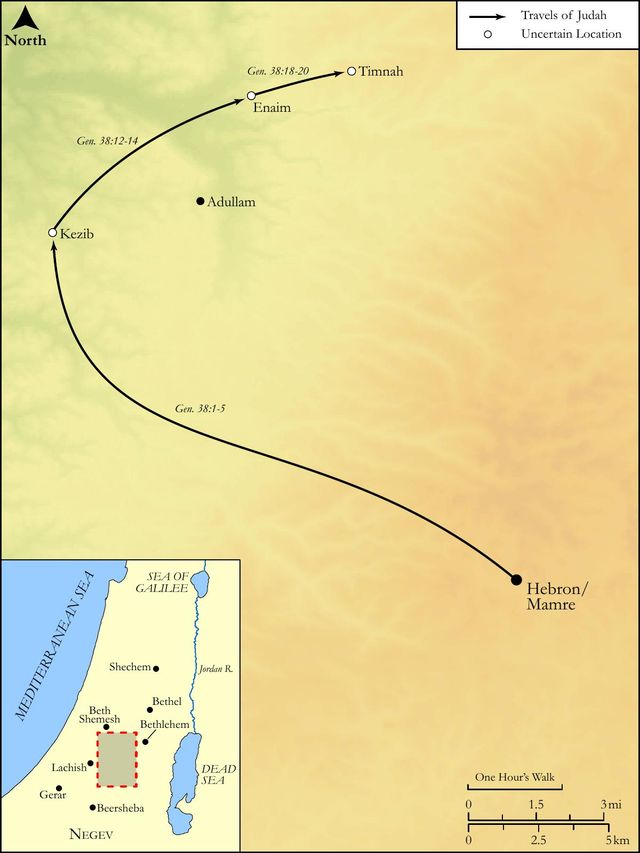
See on the biblical-era map


Study this verse
Public-domain commentary
Matthew Henry
From his Commentary on the Whole Bible. Henry comments on passages, not single verses — this entry covers Genesis 38:24–30. His two-level outline is real structure in the source text, so it is rendered as structure.
Here is, I. Judah's rigour against Tamar, when he heard she was an adulteress. She was, in the eye of the law, Shelah's wife, and therefore her being with child by another was looked upon as an injury and reproach to Judah's family: Bring her forth therefore, says Judah, the master of the family, and let her be burnt; not burnt to death, but burnt in the cheek or forehead, stigmatized for a harlot. This seems probable, Gen 38:24. Note, it is a common thing for men to be severe against those very sins in others in which yet they allow themselves; and so, in judging others, they condemn themselves, Rom 2:1; Rom 14:22. If he designed that she should be burnt to death, perhaps, under pretence of zeal against the sin, he was contriving how to get rid of his daughter-in-law, being loath to marry Shelah to her. Note, It is a common thing, but a very bad thing, to cover malice against men's persons with a show of zeal against their vices.
II.Judah's shame, when it was made to appear that he was the adulterer.
She produced the ring and the bracelets in court, which justified the fathering of the child upon Judah, Gen 38:25, Gen 38:26. Note, The wickedness that has been most secretly committed, and most industriously concealed, yet sometimes is strangely brought to light, to the shame and confusion of those who have said, No eye sees. A bird of the air may carry the voice; however, there is a destroying day coming, when all will be laid open. Some of the Jewish writers observe that as Judah had said to his father, See, is this thy son's coat? (Gen 37:32) so it was now said to him, "See, are these thy signet and bracelets?" Judah, being convicted by his own conscience,
1.Confesses his sin: She has been more righteous than I. He owns that a perpetual mark of infamy should be fastened rather upon him, who had been so much accessory to it. Note, Those offenders ought to be treated with the greatest tenderness to whom we have any way given occasion of offending. If servants purloin, and their masters, by withholding from them what is due, tempt them to it, they ought to forgive them.
2.He never returned to it again: He knew her again no more. Note, Those do not truly repent of their sins that do not forsake them.
III.The building up of Judah's family hereby, notwithstanding, in the birth of Pharez and Zarah, from whom descended the most considerable families of the illustrious tribe of Judah. It should seem, the birth was hard to the mother, by which she was corrected for her sin. The children also, like Jacob and Esau, struggled for the birthright, and Pharez obtained it, who is ever named first, and from him Christ descended. He had his name from his breaking forth before his brother: This breach be upon thee, which is applicable to those that sow discord, and create distance, between brethren. The Jews, as Zarah, bade fair for the birthright, and were marked with a scarlet thread, as those that came out first; but the Gentiles, like Pharez, as a son of violence, got the start of them, by that violence which the kingdom of heaven suffers, and attained to the righteousness of which the Jews came short. Yet, when the fulness of time is come, all Israel shall be saved. Both these sons are named in the genealogy of our Saviour (Mat 1:3), to perpetuate the story, as an instance of the humiliation of our Lord Jesus. Some observe that the four eldest sons of Jacob fell under very foul guilt, Reuben and Judah under the guilt of incest, Simeon and Levi under that of murder; yet they were patriarchs, and from Levi descended the priests, from Judah the kings and Messiah. Thus they became examples of repentance, and monuments of pardoning mercy.
Continue studying Genesis 38:24 across the web’s major study libraries — every link below opens this exact verse, chapter, or book on the destination site.
Read & Compare
 BibleGatewayThis verse in more than 200 translations and 70 languages.
 Bible.comThe YouVersion reader — hundreds of translations, reading plans, and highlights.
 ESV.orgCrossway's official English Standard Version reader.
 NET BibleThe NET translation with 60,000+ translators' notes on every rendering decision.
 STEP BibleTyndale House's free study tool — original text, vocabulary, and scholarly resources.
 BibliaLogos Bible Software's free web reader.
 USCCBThe New American Bible (Revised Edition) with the U.S. bishops' study notes.
Commentaries
 BibleHub CommentariesDozens of classic commentaries on this verse, gathered on one page.
 StudyLightMore than 100 commentary sets — the largest collection on the web.
 BibleRefPlain-English commentary on what this verse means, verse by verse.
 Enduring WordDavid Guzik's free commentary on this chapter, widely used by Bible teachers.
 Bible Study ToolsVerse commentary alongside Greek and Hebrew study aids.
Original Language & Research
- BibleHub InterlinearThe verse word by word — original language, transliteration, and English.
- BibleHub LexiconEvery word's original-language definition and Strong's entry.
 Blue Letter BibleDeep-study tools — Strong's numbers, concordance, and word studies.
 SefariaThe Hebrew text with Rashi and centuries of Jewish commentary.
Sermons, Hymns & Audio


TrulyRandomVerse is not affiliated with these sites and doesn’t control their content. They’re linked because they’re genuinely useful.
Summary
This verse marks a dramatic turn in the narrative of Judah and Tamar, revealing Judah's severe judgment upon learning that his daughter-in-law, Tamar, is pregnant by "whoredom." Unaware of his own unwitting involvement in the conception, Judah, acting as the patriarchal head, immediately decrees a capital punishment by burning, exposing his profound hypocrisy and the harsh societal standards of the time regarding sexual purity and family honor.
Context
ShowHideLiterary Context
Genesis 38 is a significant narrative interlude, strategically placed between the accounts of Joseph's descent into Egypt in Genesis 37 and his subsequent rise in Genesis 39. This chapter shifts focus entirely to Judah, one of Jacob's sons, highlighting his personal moral failures and the complex dynamics within the patriarchal family. The immediate preceding verses detail Tamar's desperate and deceptive plan to secure an heir from Judah, after he failed to uphold the levirate marriage custom by withholding his youngest son, Shelah, following the deaths of Er and Onan (Genesis 38:6-10). This verse, Genesis 38:24, serves as the climax of Tamar's scheme, as her pregnancy becomes undeniable, forcing a confrontation and revealing Judah's unwitting complicity.
Historical & Cultural Context
The events of Genesis 38 unfold in a patriarchal society where lineage, family honor, and the continuation of the family name were paramount. The custom of levirate marriage (yibbum), though not yet formally codified in Mosaic Law, was a recognized social obligation, ensuring a deceased brother's line continued through his widow. Sexual purity, especially for women, was stringently enforced, and illicit sexual activity, particularly by a daughter-in-law, could bring immense shame upon the family. Capital punishment, including burning, was a known practice in the ancient Near East for severe sexual offenses, particularly those that defiled family or priestly lines, as seen in later Mosaic legislation for a priest's daughter (Leviticus 21:9) or certain forms of incest (Leviticus 20:14). Judah's immediate decree reflects the severe societal consequences for perceived harlotry and the patriarchal authority he wielded.
Key Themes
ShowHideThis chapter, and specifically Genesis 38:24, powerfully illustrates several key themes. Hypocrisy is starkly evident in Judah's swift condemnation of Tamar for an act in which he was the unwitting participant, highlighting a profound lack of self-awareness. The theme of Divine Providence is also central, as God sovereignly works through human sin and morally ambiguous circumstances to preserve the lineage of promise, ultimately leading to the Messiah. The narrative also explores the Vulnerability of Women in a patriarchal society and the lengths to which they might go to secure their rights and ensure their survival, as Tamar's actions, though deceptive, were born out of Judah's failure to uphold his familial obligations.
Exposition and Analysis
ShowHideKey Word Analysis
ShowHideA primitive root meaning "to commit adultery (usually of the female, and less often of simple fornication, rarely of involuntary ravishment); figuratively, to commit idolatry." In this context, it refers to Tamar's perceived act of illicit sexual activity, specifically her posing as a cult prostitute to conceive. The term carries significant moral and social condemnation, implying a deliberate and shameful act of promiscuity.
Meaning "pregnant." This word signifies the undeniable physical evidence of Tamar's condition, which became apparent "about three months after" the encounter. Her visible pregnancy is the catalyst for the accusation and Judah's subsequent judgment, confirming the success of her plan to conceive.
A primitive root meaning "to be (causatively, set) on fire; (cause to, make a) burn." This term denotes the extreme capital punishment decreed by Judah. Burning was a particularly severe form of execution in the ancient Near East, often associated with offenses that were seen as defiling or polluting, such as certain sexual transgressions or acts of sacrilege. Judah's command reflects the gravity with which he viewed Tamar's perceived offense and his patriarchal authority to enforce such a sentence.
Verse Breakdown
ShowHide"And it came to pass about three months after, that it was told Judah, saying"
This opening clause establishes the timeline, indicating that enough time had passed for Tamar's pregnancy to become evident. The information is "told" (Hebrew, nâgad' H5046) to Judah, implying a formal accusation or report, likely from someone within his household or community who observed Tamar's condition.
"Tamar thy daughter in law hath played the harlot; and also, behold, she [is] with child by whoredom"
This is the core accusation. Tamar is identified as Judah's "daughter in law" (Hebrew, kallâh' H3618), emphasizing her familial relationship and the perceived breach of family honor. The accusation is two-fold: she "played the harlot" (Hebrew, zânâh' H2181) and is pregnant "by whoredom" (Hebrew, zânûwn' H2183), reinforcing the illicit nature of her conception in the eyes of the accusers and Judah. The phrase "behold, she is with child" underscores the undeniable physical evidence.
"And Judah said, Bring her forth, and let her be burnt"
Judah's immediate and unequivocal response. His command, "Bring her forth" (Hebrew, yâtsâʼ' H3318), is an order for her public exposure and judgment. The decree "let her be burnt" (Hebrew, sâraph' H8313) signifies the ultimate and most severe form of capital punishment, reflecting the patriarchal authority Judah wielded and the extreme societal condemnation of such an offense, particularly given her status as a member of his household. This command is delivered without investigation or hesitation, revealing Judah's swift and harsh judgment.
Literary Devices
ShowHideThe passage employs several potent literary devices. Irony is profoundly present, as Judah, the very man who impregnated Tamar, unknowingly condemns her to death for the very act he participated in. This dramatic irony highlights his profound Hypocrisy and moral blindness. The phrase "it came to pass about three months after" serves as a crucial element of Foreshadowing, building suspense as the inevitable discovery of Tamar's pregnancy approaches. The Juxtaposition of Judah's stern decree with his earlier failure to provide Tamar with an heir underscores the double standard Judah himself confesses: "She hath been more righteous than I" (Genesis 38:26). The use of the direct command, "Bring her forth, and let her be burnt," emphasizes Judah's absolute authority and the immediate, unyielding nature of his judgment.
Theological and Thematic Connections
ShowHideGenesis 38:24 powerfully exposes the human capacity for hypocrisy and moral blindness, particularly when judging others. Judah's swift and severe condemnation of Tamar for an act in which he was complicit serves as a stark biblical example of the very human tendency to see the "speck" in another's eye while ignoring the "plank" in one's own. Yet, amidst this profound human failing, the narrative also underscores God's sovereign ability to work through flawed individuals and morally compromised situations to fulfill His divine purposes. The lineage of the Messiah, Jesus Christ, would ultimately flow through this unconventional union, demonstrating that God's redemptive plan is not thwarted by human sin but rather often unfolds through it, revealing His extraordinary grace and faithfulness.
Reflection and Application
ShowHideThe dramatic scene in Genesis 38:24 compels us to engage in profound self-reflection regarding our own propensities for judgment and hypocrisy. Judah's immediate condemnation of Tamar, without any self-awareness of his own complicity, serves as a powerful cautionary tale. It challenges us to examine our own hearts and motives before we are quick to cast judgment on others, reminding us that true justice begins with a humble recognition of our own fallenness. This narrative also offers a profound spiritual truth: God's redemptive plan is not contingent upon human perfection. He sovereignly weaves even the most morally complex and scandalous human events into His grand design, demonstrating His ability to bring about good from situations marred by sin. This should inspire us to trust in His unfailing providence, even when circumstances seem chaotic or morally ambiguous, and to extend grace and understanding to others, just as God extends it to us.
Questions for Reflection
ShowHideFAQ
ShowHideWhy did Judah decree such a harsh punishment as burning for Tamar?
ShowHideBurning was indeed a severe form of capital punishment in the ancient Near East, often reserved for offenses considered particularly heinous or defiling, especially those related to sexual immorality that threatened the purity of a lineage or household. While the specific law for a daughter-in-law's harlotry isn't explicitly codified in the later Mosaic Law, the severity of Judah's decree reflects the extreme societal condemnation of such acts within a patriarchal system where family honor and purity were paramount. For example, later Mosaic Law prescribes burning for a priest's daughter committing harlotry (Leviticus 21:9) and for certain forms of incest (Leviticus 20:14). Judah's command highlights the gravity of Tamar's perceived offense in his eyes and the cultural norms of the time.
How could Judah not realize he was the father of Tamar's child?
ShowHideJudah's ignorance of his paternity stems from Tamar's elaborate and effective deception. When she encountered Judah, she was disguised as a cult prostitute, covering her face with a veil (Genesis 38:14). This disguise, coupled with the brief and anonymous nature of their encounter, prevented Judah from recognizing her. Furthermore, Judah's subsequent actions suggest he was not actively seeking out the prostitute again to pay his debt, and the passage implies that he simply forgot the incident or dismissed it as an anonymous encounter. The "three months" that passed would have made her pregnancy evident, but Judah would not have connected it to his own actions, especially given the shame and secrecy surrounding such illicit encounters.
Christ-Centered Fulfillment
ShowHideThe narrative of Judah and Tamar, despite its morally ambiguous and scandalous elements, is profoundly significant in the unfolding of God's redemptive history, pointing directly to Christ. Tamar, through this unconventional and deceptive union with Judah, is remarkably included in the genealogy of Jesus Christ (Matthew 1:3). This inclusion powerfully demonstrates God's sovereign ability to work through human sin, brokenness, and morally complex situations to achieve His ultimate redemptive purposes. It underscores that God's grace transcends human failings, weaving even the most unexpected and seemingly impure threads into the tapestry of salvation. The story highlights that the Messiah's lineage is not one of perfect moral purity but one that embraces and redeems human fallenness, foreshadowing Jesus' mission to come not for the righteous, but for sinners, to call them to repentance and offer the ultimate cleansing and redemption.