


Genesis 38:26
- וַיַּכֵּרvai·ya·Kerand he recognized [them]H5234Conj-w ¦ V-Hiphil-ConsecImperf-3msVerb Hiphil Consecutive Imperfect 3rd Singular Masculineוַandיַּכֵּרhe recognized [them]
- יְהוּדָהye·hu·DahJudahH3063N-proper-mNoun Proper Masculine
- וַיֹּאמֶרvai·Yo·merand he saidH559Conj-w ¦ V-Qal-ConsecImperf-3msVerb Qal Consecutive Imperfect 3rd Singular Masculineוַandיֹּאמֶרhe said
- צָדְקָהtza·de·Kahshe is righteousH6663V-Qal-Perf-3fsVerb Qal Perfect 3rd Singular Feminine
- מִמֶּנִּיmi·Me·nimore than meH4480Prep ¦ 1csPreposition Definiteמִמֶּmore thanנִּיme
- כִּיkiforH3588PrtParticle Conditional
- עַל'alsinceH5921PrepPreposition
- כֵּןken<thus>H3651AdvAdverb
- לֹאlo'notH3808NegParticle Negative
- נְתַתִּיהָne·ta·Ti·haI gave herH5414V-Qal-Perf-1cs ¦ 3fsVerb Qal Perfect 1st Singular common genderנְתַתִּיI gaveהָher
- לְשֵׁלָהle·she·Lahto ShelahH7956Prep-l ¦ N-proper-mNoun Proper MasculineלְtoשֵׁלָהShelah
- בְנִיve·Nimy sonH1121N-msc ¦ 1csNoun Singular Masculine Constructבְנִsonיmy
- וְלֹאve·lo'and notH3808Conj-w ¦ NegParticle Negativeוְandלֹאnot
- יָסַףya·Safhe repeatedH3254V-Qal-Perf-3msVerb Qal Perfect 3rd Singular Masculine
- עוֹדodagainH5750Adj-msAdjective Numerical Singular Masculine Absolute
- לְדַעְתָּהle·da'·Tahto know herH3045Prep-l ¦ V-Qal-Inf ¦ 3fsVerb Qal Infinitive Constructלְtoדַעְתָּknowהher
English is a literal word-by-word gloss of the Hebrew, not the KJV's wording. Why?
This is the original text the KJV's translators worked from — each Hebrew word with its own literal English meaning in this verse, prepared by scholars at Tyndale House, Cambridge. The KJV translates whole sentences, not word by word, so its wording differs: one Hebrew word can become several English words, and the KJV may choose “the LORD” where the gloss reads “Yahweh”. Both are faithful — they answer different questions. For the KJV's own rendering, switch to the KJV text.
Details
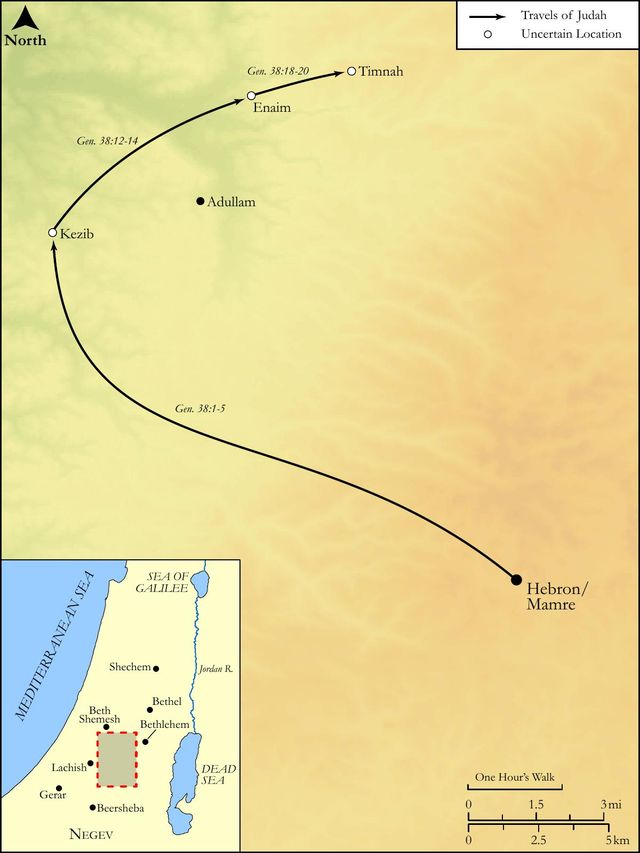
See on the biblical-era map


Study this verse
Public-domain commentary
Matthew Henry
From his Commentary on the Whole Bible. Henry comments on passages, not single verses — this entry covers Genesis 38:24–30. His two-level outline is real structure in the source text, so it is rendered as structure.
Here is, I. Judah's rigour against Tamar, when he heard she was an adulteress. She was, in the eye of the law, Shelah's wife, and therefore her being with child by another was looked upon as an injury and reproach to Judah's family: Bring her forth therefore, says Judah, the master of the family, and let her be burnt; not burnt to death, but burnt in the cheek or forehead, stigmatized for a harlot. This seems probable, Gen 38:24. Note, it is a common thing for men to be severe against those very sins in others in which yet they allow themselves; and so, in judging others, they condemn themselves, Rom 2:1; Rom 14:22. If he designed that she should be burnt to death, perhaps, under pretence of zeal against the sin, he was contriving how to get rid of his daughter-in-law, being loath to marry Shelah to her. Note, It is a common thing, but a very bad thing, to cover malice against men's persons with a show of zeal against their vices.
II.Judah's shame, when it was made to appear that he was the adulterer.
She produced the ring and the bracelets in court, which justified the fathering of the child upon Judah, Gen 38:25, Gen 38:26. Note, The wickedness that has been most secretly committed, and most industriously concealed, yet sometimes is strangely brought to light, to the shame and confusion of those who have said, No eye sees. A bird of the air may carry the voice; however, there is a destroying day coming, when all will be laid open. Some of the Jewish writers observe that as Judah had said to his father, See, is this thy son's coat? (Gen 37:32) so it was now said to him, "See, are these thy signet and bracelets?" Judah, being convicted by his own conscience,
1.Confesses his sin: She has been more righteous than I. He owns that a perpetual mark of infamy should be fastened rather upon him, who had been so much accessory to it. Note, Those offenders ought to be treated with the greatest tenderness to whom we have any way given occasion of offending. If servants purloin, and their masters, by withholding from them what is due, tempt them to it, they ought to forgive them.
2.He never returned to it again: He knew her again no more. Note, Those do not truly repent of their sins that do not forsake them.
III.The building up of Judah's family hereby, notwithstanding, in the birth of Pharez and Zarah, from whom descended the most considerable families of the illustrious tribe of Judah. It should seem, the birth was hard to the mother, by which she was corrected for her sin. The children also, like Jacob and Esau, struggled for the birthright, and Pharez obtained it, who is ever named first, and from him Christ descended. He had his name from his breaking forth before his brother: This breach be upon thee, which is applicable to those that sow discord, and create distance, between brethren. The Jews, as Zarah, bade fair for the birthright, and were marked with a scarlet thread, as those that came out first; but the Gentiles, like Pharez, as a son of violence, got the start of them, by that violence which the kingdom of heaven suffers, and attained to the righteousness of which the Jews came short. Yet, when the fulness of time is come, all Israel shall be saved. Both these sons are named in the genealogy of our Saviour (Mat 1:3), to perpetuate the story, as an instance of the humiliation of our Lord Jesus. Some observe that the four eldest sons of Jacob fell under very foul guilt, Reuben and Judah under the guilt of incest, Simeon and Levi under that of murder; yet they were patriarchs, and from Levi descended the priests, from Judah the kings and Messiah. Thus they became examples of repentance, and monuments of pardoning mercy.
Historical interpretation
Historical reception
4 surviving comments on this verse. Each one is dated, so this reads as a timeline rather than a list.
Select a marker to jump to its quote. Markers stagger vertically where authors wrote within a few decades of each other.
He then said, “She is more innocent than I,” that is, “She is more righteous than I. What great sinners my sons were. ‘Because of this, I did not give her to my son Shelah.’ She is innocent of that evil suspicion that I held against her and [for which] I withheld my son Shelah from her.” She who had been cheated out of marriage was justified in her fornication, and he who sent her out on account of his first two sons brought her back for the sake of his last two sons. “He did not lie with her again” because she had been the wife of his first two sons; nor did he take another wife, for she was the mother of his last two sons.
What is the meaning of “She has more right on her side than I”? In other words, she is guiltless, whereas I condemn myself and without anyone to accuse me I confess—or rather, I have sufficient accuser in the pledge given by me. Then Judah goes on to supply a defense for Tamar by saying, “because I did not give her to my son Shelah.” Perhaps, however, this happened for the reason that I am about to give. I mean, Judah thought that it was through her fault that death fell on Er and Onan. For fear of this he did not give Shelah to her despite promising to do so. Accordingly, so as to prove in fact that she was not responsible for their death but rather that they were punished for their own wickedness (“God took his life” the text says, remember, and again, “he put him to death,” in reference to the second one), Judah himself had intercourse with his own daughter-in-law all unawares. He learned by later developments that, far from it being her fault, those men’s wickedness made them liable to suffer punishment. So Judah admitted his own sin, delivered her from punishment and, the text says, “had no further relations with her,” showing that he would not previously have had intercourse with her if he had not done so in ignorance.
(Verse 26.) But Judas acknowledged and said: she is more righteous than I, because I did not give her to my son Selom. In Hebrew, it says, she has been justified by me: not that she was just, but that in comparison to her, I have done less evil, not seeking base immorality, but seeking children.
In the first place it must be said that, even though there are some famous characters who are discovered to be guilty of acting in a not entirely honest way, however, since God in the holy Scriptures produces through them something useful for our salvation, let us drive away from us what may offend. If we take good care of our wisdom and intelligence, we are not unaware of what regards our profit. Let us consider how the blessed prophet Hosea took a prostitute as his wife, nor [did he refuse] a notorious marriage and was called the father of hateful sons, whose names were “Not my people” and “Unpitied.” I will not hesitate to declare what this means. In fact, after those who were the nobles and the princes in Israel opposed the preaching of the prophets and the divine word was unpleasing to them, in the meantime God acted through his saints so that they might see the future from what was happening as if it was magnificently and expressly depicted in a picture. God did this so they might rededicate their minds to understanding their hope and might look with the strongest application for what would have been salutary to them and might also persuade others to do the same. And they learned that they would not have been the elected people anymore but would have been received among those who show no mercy, if they behaved with hardness and immoderation. Were not they afflicted by evils and overwhelmed by them everywhere?… Since we now understand the criterion and direction of the divine plan in those times, we will not condemn anymore the adultery of Tamar and Judah, but rather we will say that their union occurred in the divine plan. In fact, the former was in need of the seed of procreation as her legitimate husband was lacking it. The latter was guilty of a slight fault since he was free after his first wife had already died. So this union and generation teach us about our spiritual union and the rebirth of our mind. The human mind cannot be drawn to truth in a more appropriate way.
Continue studying Genesis 38:26 across the web’s major study libraries — every link below opens this exact verse, chapter, or book on the destination site.
Read & Compare
 BibleGatewayThis verse in more than 200 translations and 70 languages.
 Bible.comThe YouVersion reader — hundreds of translations, reading plans, and highlights.
 ESV.orgCrossway's official English Standard Version reader.
 NET BibleThe NET translation with 60,000+ translators' notes on every rendering decision.
 STEP BibleTyndale House's free study tool — original text, vocabulary, and scholarly resources.
 BibliaLogos Bible Software's free web reader.
 USCCBThe New American Bible (Revised Edition) with the U.S. bishops' study notes.
Commentaries
 BibleHub CommentariesDozens of classic commentaries on this verse, gathered on one page.
 StudyLightMore than 100 commentary sets — the largest collection on the web.
 BibleRefPlain-English commentary on what this verse means, verse by verse.
 Enduring WordDavid Guzik's free commentary on this chapter, widely used by Bible teachers.
 Bible Study ToolsVerse commentary alongside Greek and Hebrew study aids.
Original Language & Research
- BibleHub InterlinearThe verse word by word — original language, transliteration, and English.
- BibleHub LexiconEvery word's original-language definition and Strong's entry.
 Blue Letter BibleDeep-study tools — Strong's numbers, concordance, and word studies.
 SefariaThe Hebrew text with Rashi and centuries of Jewish commentary.
Sermons, Hymns & Audio


TrulyRandomVerse is not affiliated with these sites and doesn’t control their content. They’re linked because they’re genuinely useful.
Summary
Genesis 38:26 captures Judah's pivotal confession regarding Tamar, acknowledging her actions as more righteous than his own. This profound moment stems from Judah's failure to fulfill his levirate obligations, leading Tamar to unconventional means to secure her lineage. The verse marks a significant turning point in Judah's character, validating Tamar's pursuit of justice and ensuring the preservation of the family line, which is ultimately crucial for the messianic genealogy.
Context
ShowHideLiterary Context
Genesis 38 stands as a dramatic interlude, strategically placed between the narrative of Joseph's sale into slavery and his rise in Potiphar's house. This chapter shifts focus entirely to Judah, one of Joseph's brothers, detailing his personal life and moral failures. The placement is not arbitrary; it highlights Judah's character flaws, which contrast sharply with Joseph's integrity, yet also sets the stage for Judah's later transformation and his eventual leadership role among his brothers. The narrative builds to this climactic confession, where Judah, confronted with undeniable evidence, is forced to admit his culpability and Tamar's relative righteousness, thereby resolving the immediate conflict and ensuring the continuation of the patriarchal line through an unexpected means.
Historical & Cultural Context
The story is deeply embedded in ancient Near Eastern customs, particularly the practice of levirate marriage (yibbum), which was later codified in Deuteronomy 25:5-10. This custom obligated a deceased man's brother (or nearest male relative) to marry his widow to produce an heir for the deceased, thereby preserving the family name, inheritance, and lineage. Judah's failure to give Tamar his youngest son, Shelah, after the deaths of Er and Onan, was a serious breach of this societal and familial duty. Tamar's desperate and deceptive actions, though morally ambiguous, were driven by the profound cultural imperative to secure offspring and maintain her position within the family, especially given the vulnerability of childless widows in that society. Judah's public acknowledgment of her righteousness, despite her methods, underscores the weight of his unfulfilled obligation.
Key Themes
ShowHideThis narrative powerfully explores several key themes. Divine Providence and Sovereignty are evident as God works through complex, even scandalous, human actions to preserve the chosen lineage, ultimately leading to the Messiah. The theme of Justice and Righteousness is central, as Judah's confession redefines what is "right" in this context, highlighting that true righteousness can sometimes be found in unexpected places, even when human methods are flawed. Furthermore, the chapter showcases Character Transformation, particularly in Judah, whose humility and acknowledgment of guilt here foreshadow his later selfless intercession for Benjamin in Genesis 44:18-34, demonstrating a profound moral growth from his earlier actions in the sale of Joseph (Genesis 37:26-27). The Importance of Lineage is also paramount, as Tamar's actions are driven by the need to secure offspring and continue the family line, a foundational element of God's covenant promises to Abraham.
Exposition and Analysis
ShowHideKey Word Analysis
ShowHideThis word (H5234) means "to scrutinize, i.e., look intently at; hence (with recognition implied), to acknowledge, be acquainted with, care for, respect, revere, or (with suspicion implied), to disregard, ignore, be strange toward, reject, resign, dissimulate." In this context, Judah's acknowledgment is a profound act of recognition and acceptance of the truth, despite its damning implications for himself. He scrutinizes the evidence (his signet, cord, and staff) and recognizes the undeniable reality, leading to a public confession.
This term (H6663) means "to be (causatively, make) right (in a moral or forensic sense); cleanse, clear self, (be, do) just(-ice, -ify, -ify self), (be turn to) righteous(-ness)." Judah's declaration that Tamar is "more righteous" than he is a powerful admission. It's not necessarily an endorsement of her deceptive means but an affirmation that her underlying motive—to secure her rightful lineage in the face of his unfulfilled obligation—was morally superior to his own evasiveness and neglect. She acted to preserve justice and the family line, while he acted out of fear and self-interest.
The phrase "knew her" (H3045, yâdaʻ') is a common biblical euphemism for sexual intimacy, meaning "to know (properly, to ascertain by seeing); used in a great variety of senses, figuratively, literally, euphemistically and inferentially (including observation, care, recognition)." The addition of "again no more" (H3254, yâçaph' meaning "to add or augment (often adverbial, to continue to do a thing); add, [idiom] again, [idiom] any more") signifies a definitive cessation of the illicit relationship. This indicates Judah's acceptance of the situation and a commitment to not repeat the transgression, marking a turning point in his moral conduct.
Verse Breakdown
ShowHide"And Judah acknowledged [them]"
Upon seeing his signet, cord, and staff, Judah immediately recognizes the items he had given to the woman he thought was a harlot. This acknowledgment is not merely intellectual recognition but a profound, public admission of his own culpability. The "them" refers to these personal pledges, which served as irrefutable proof of his involvement.
"and said, She hath been more righteous than I"
This is the core of Judah's confession. Despite Tamar's deceptive methods, Judah declares her actions to be more just and upright than his own. He recognizes that while her means were unconventional, her end—the preservation of the family line and the securing of her rightful place—was more aligned with the spirit of the levirate custom and divine intention than his own failure to provide Shelah.
"because that I gave her not to Shelah my son"
Judah explicitly states the reason for Tamar's actions and, by extension, his own greater fault. He admits that his failure to fulfill his promise to give Shelah (H7956, Shêlâh') to Tamar, thereby ensuring the continuation of his deceased sons' lineage, directly led to her desperate measures. This demonstrates remarkable self-awareness and accountability.
"And he knew her again no more"
This final clause signifies the end of the sexual relationship between Judah and Tamar. It indicates a resolution to the immediate crisis and implies Judah's acceptance of the outcome (Tamar's pregnancy by him) without continuing the illicit liaison. This act also serves as a marker of Judah's moral development, indicating a move towards greater integrity and responsibility.
Literary Devices
ShowHideThe narrative of Judah and Tamar, culminating in this verse, is rich in Irony. Judah, the patriarch, is outwitted and exposed by Tamar, an overlooked widow, forcing him to confront his own moral failings. The very man who suggested selling Joseph into slavery is now exposed in a deeply humiliating way, yet this humiliation becomes a catalyst for his Character Development. His public confession is an act of profound humility, contrasting sharply with his earlier self-serving actions. There is also an element of Dramatic Irony for the reader, who knows Tamar's true identity and motives throughout her deception, making Judah's eventual realization and confession all the more impactful. The story also uses Symbolism, with Judah's signet, cord, and staff serving as undeniable proof of his identity and culpability, representing his authority and the binding nature of his pledges.
THEOLOGICAL AND THEMATIC CONNECTIONS
ShowHideGenesis 38:26 is a powerful testament to God's sovereign hand working through human imperfection and even sin to accomplish His redemptive purposes. Despite the morally complex and scandalous circumstances surrounding Judah and Tamar, their union, born out of Judah's failure and Tamar's desperate pursuit of justice, becomes a crucial link in the messianic lineage. This narrative reminds us that God's plan is not contingent on human perfection but often unfolds within the messy realities of human brokenness, demonstrating His immense grace and ability to redeem even the most challenging situations for His glory. It underscores that God's faithfulness to His covenant promises transcends human failings and cultural norms.
Reflection and Application
ShowHideGenesis 38:26 offers profound lessons on humility, accountability, and the redemptive power of truth. Judah's willingness to acknowledge his own fault, even when it was deeply humiliating and exposed his hypocrisy, serves as a powerful example for us today. It reminds us that true integrity begins with honest self-assessment and the courage to admit our wrongs, rather than deflecting blame or clinging to pride. This narrative also provides immense comfort, demonstrating that God's purposes are not thwarted by human failures or the complexities of life. He can and does work through imperfect people and messy situations to bring about His perfect will, offering hope that our own imperfections do not disqualify us from His plan, but rather highlight His grace and sovereignty. We are called to pursue righteousness and justice, even when the path is unconventional, and to trust that God can redeem any circumstance for His glory.
Questions for Reflection
ShowHideFAQ
ShowHideWhy did Judah declare Tamar "more righteous than I"?
ShowHideJudah's declaration acknowledges that while Tamar's methods were unconventional and deceptive, her underlying motive—to secure her rightful place and continue the family lineage as per the custom of levirate marriage—was more aligned with justice and the spirit of the law than Judah's own failure to uphold his promise to her. He recognized that his evasion had forced her desperate actions, making her pursuit of a legitimate heir more righteous than his neglect of his familial duty.
What is levirate marriage, and how does it relate to this story?
ShowHideLevirate marriage (Hebrew: yibbum) was an ancient custom, later codified in Deuteronomy 25:5, where a man was obligated to marry his deceased brother's widow if the brother died childless. The first son born of this union would be considered the heir of the deceased brother, ensuring the continuation of his name and lineage. Judah's failure to give Tamar his youngest son, Shelah, after the deaths of Er and Onan, was a breach of this custom and his promise, leading to Tamar's desperate actions to secure an heir.
What is the significance of Judah's statement, "And he knew her again no more"?
ShowHideThis statement signifies the definitive cessation of the illicit sexual relationship between Judah and Tamar. It indicates a resolution to the immediate crisis and implies Judah's acceptance of the situation and perhaps a commitment to avoid further moral transgression in this specific context. It also marks a significant turning point in Judah's character, as he appears to mature and take responsibility for his actions, leading to a more selfless and honorable character later in Genesis.
Christ-Centered Fulfillment
ShowHideThe narrative of Judah and Tamar, culminating in Judah's confession in Genesis 38:26, is profoundly significant for its Christ-centered fulfillment. Despite the scandalous and unconventional circumstances, the lineage stemming from Judah and Tamar—through their sons Perez and Zerah—is explicitly traced in the genealogy of Jesus Christ in Matthew 1:3. This inclusion highlights God's sovereign plan to bring forth the Messiah not through a perfect, untainted lineage, but through flawed human beings and complex, even sinful, situations. It underscores the theme of God's grace and redemptive power, demonstrating that His purposes cannot be thwarted by human failure or sin, and that He works through the messiness of human history to bring about the ultimate fulfillment of His promises in Christ, who came to redeem all humanity from their own sin and brokenness (Romans 5:8). The story of Judah and Tamar, therefore, serves as a powerful reminder that God's grace is sufficient even for the most imperfect of human stories, ultimately pointing to the perfect and sinless Lamb of God (John 1:29) who would descend from this very line.