


Genesis 38:25
- הִואhi'sheH1931Pro-3fsPronoun Personal 3rd Singular Feminine
- מוּצֵאתmu·Tzet[was being] brought outH3318V-Hophal-PassPrtcpl-fsVerb Hophal Participle Passive Singular Feminine Absolute
- וְהִיאve·Hi'and sheH1931Conj-w ¦ Pro-3fsPronoun Personal 3rd Singular Feminineוְandהִיאshe
- שָׁלְחָהshal·Chahshe sentH7971V-Qal-Perf-3fsVerb Qal Perfect 3rd Singular Feminine
- אֶל'eltoH413PrepPreposition
- חָמִיהָcha·Mi·haher father-in-lawH2524N-msc ¦ 3fsNoun Singular Masculine Constructחָמִיfather-in-lawהָher
- לֵאמֹרle·Mor<to> sayingH559Prep-l ¦ V-Qal-InfVerb Qal Infinitive Constructלֵ<to>אמֹרsaying
- לְאִישׁle·'Ishto a manH376Prep-l ¦ N-msNoun Singular Masculine Absoluteלְtoאִישׁa man
- אֲשֶׁר'a·SherwhomH834RelParticle Relative
- אֵלֶּה'E·lehtheseH428PrtParticle Demonstrative
- לּוֹlo[belong] to <the> himPrep-l ¦ 3msSuffix Personal 3rd Singular Masculineלּ[belong] to <the>וֹhim
- אָנֹכִי'a·no·KhiIH595Pro-1csPronoun Personal 1st Singular common gender
- הָרָהha·Rah[am] pregnantH2030Adj-fsAdjective Singular Feminine Absolute
- וַתֹּאמֶרva·To·merand she saidH559Conj-w ¦ V-Qal-ConsecImperf-3fsVerb Qal Consecutive Imperfect 3rd Singular Feminineוַandתֹּאמֶרshe said
- הַכֶּרha·kerinvestigateH5234V-Hiphil-Imp-2msVerb Hiphil Imperative 2nd Singular Masculine
- נָאNa'pleaseH4994PrtParticle Interjection
- לְמִיle·Mi[belong] to whom?H4310Prep-l ¦ InterrogPronoun Interrogativeלְ[belong] toמִיwhom?
- הַחֹתֶמֶתha·cho·Te·metthe sealH2858Art ¦ N-fsNoun Singular Feminine Absoluteהַtheחֹתֶמֶתseal
- וְהַפְּתִילִיםve·ha·pe·ti·Limand the cordH6616Conj-w ¦ Art ¦ N-mpNoun Plural Masculine Absoluteוְandהַtheפְּתִילִיםcord
- וְהַמַּטֶּהve·ham·ma·Tehand the staffH4294Conj-w ¦ Art ¦ N-msNoun Singular Masculine Absoluteוְandהַtheמַּטֶּהstaff
- הָאֵלֶּהha·'E·leh<the> theseH428Art ¦ PrtParticle Demonstrativeהָ<the>אֵלֶּהthese
English is a literal word-by-word gloss of the Hebrew, not the KJV's wording. Why?
This is the original text the KJV's translators worked from — each Hebrew word with its own literal English meaning in this verse, prepared by scholars at Tyndale House, Cambridge. The KJV translates whole sentences, not word by word, so its wording differs: one Hebrew word can become several English words, and the KJV may choose “the LORD” where the gloss reads “Yahweh”. Both are faithful — they answer different questions. For the KJV's own rendering, switch to the KJV text.
Details
See on the biblical-era map


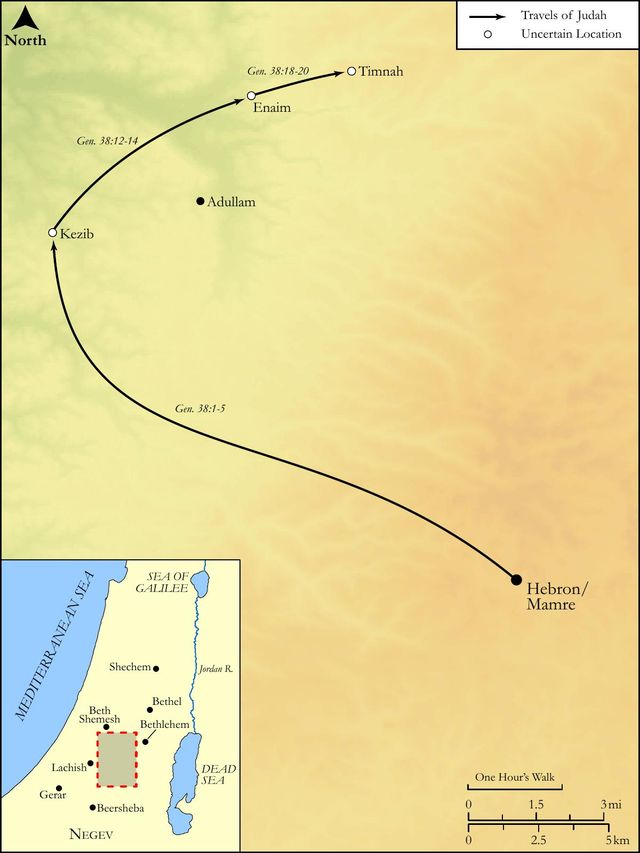
Study this verse
Public-domain commentary
Matthew Henry
From his Commentary on the Whole Bible. Henry comments on passages, not single verses — this entry covers Genesis 38:24–30. His two-level outline is real structure in the source text, so it is rendered as structure.
Here is, I. Judah's rigour against Tamar, when he heard she was an adulteress. She was, in the eye of the law, Shelah's wife, and therefore her being with child by another was looked upon as an injury and reproach to Judah's family: Bring her forth therefore, says Judah, the master of the family, and let her be burnt; not burnt to death, but burnt in the cheek or forehead, stigmatized for a harlot. This seems probable, Gen 38:24. Note, it is a common thing for men to be severe against those very sins in others in which yet they allow themselves; and so, in judging others, they condemn themselves, Rom 2:1; Rom 14:22. If he designed that she should be burnt to death, perhaps, under pretence of zeal against the sin, he was contriving how to get rid of his daughter-in-law, being loath to marry Shelah to her. Note, It is a common thing, but a very bad thing, to cover malice against men's persons with a show of zeal against their vices.
II.Judah's shame, when it was made to appear that he was the adulterer.
She produced the ring and the bracelets in court, which justified the fathering of the child upon Judah, Gen 38:25, Gen 38:26. Note, The wickedness that has been most secretly committed, and most industriously concealed, yet sometimes is strangely brought to light, to the shame and confusion of those who have said, No eye sees. A bird of the air may carry the voice; however, there is a destroying day coming, when all will be laid open. Some of the Jewish writers observe that as Judah had said to his father, See, is this thy son's coat? (Gen 37:32) so it was now said to him, "See, are these thy signet and bracelets?" Judah, being convicted by his own conscience,
1.Confesses his sin: She has been more righteous than I. He owns that a perpetual mark of infamy should be fastened rather upon him, who had been so much accessory to it. Note, Those offenders ought to be treated with the greatest tenderness to whom we have any way given occasion of offending. If servants purloin, and their masters, by withholding from them what is due, tempt them to it, they ought to forgive them.
2.He never returned to it again: He knew her again no more. Note, Those do not truly repent of their sins that do not forsake them.
III.The building up of Judah's family hereby, notwithstanding, in the birth of Pharez and Zarah, from whom descended the most considerable families of the illustrious tribe of Judah. It should seem, the birth was hard to the mother, by which she was corrected for her sin. The children also, like Jacob and Esau, struggled for the birthright, and Pharez obtained it, who is ever named first, and from him Christ descended. He had his name from his breaking forth before his brother: This breach be upon thee, which is applicable to those that sow discord, and create distance, between brethren. The Jews, as Zarah, bade fair for the birthright, and were marked with a scarlet thread, as those that came out first; but the Gentiles, like Pharez, as a son of violence, got the start of them, by that violence which the kingdom of heaven suffers, and attained to the righteousness of which the Jews came short. Yet, when the fulness of time is come, all Israel shall be saved. Both these sons are named in the genealogy of our Saviour (Mat 1:3), to perpetuate the story, as an instance of the humiliation of our Lord Jesus. Some observe that the four eldest sons of Jacob fell under very foul guilt, Reuben and Judah under the guilt of incest, Simeon and Levi under that of murder; yet they were patriarchs, and from Levi descended the priests, from Judah the kings and Messiah. Thus they became examples of repentance, and monuments of pardoning mercy.
Continue studying Genesis 38:25 across the web’s major study libraries — every link below opens this exact verse, chapter, or book on the destination site.
Read & Compare
 BibleGatewayThis verse in more than 200 translations and 70 languages.
 Bible.comThe YouVersion reader — hundreds of translations, reading plans, and highlights.
 ESV.orgCrossway's official English Standard Version reader.
 NET BibleThe NET translation with 60,000+ translators' notes on every rendering decision.
 STEP BibleTyndale House's free study tool — original text, vocabulary, and scholarly resources.
 BibliaLogos Bible Software's free web reader.
 USCCBThe New American Bible (Revised Edition) with the U.S. bishops' study notes.
Commentaries
 BibleHub CommentariesDozens of classic commentaries on this verse, gathered on one page.
 StudyLightMore than 100 commentary sets — the largest collection on the web.
 BibleRefPlain-English commentary on what this verse means, verse by verse.
 Enduring WordDavid Guzik's free commentary on this chapter, widely used by Bible teachers.
 Bible Study ToolsVerse commentary alongside Greek and Hebrew study aids.
Original Language & Research
- BibleHub InterlinearThe verse word by word — original language, transliteration, and English.
- BibleHub LexiconEvery word's original-language definition and Strong's entry.
 Blue Letter BibleDeep-study tools — Strong's numbers, concordance, and word studies.
 SefariaThe Hebrew text with Rashi and centuries of Jewish commentary.
Sermons, Hymns & Audio


TrulyRandomVerse is not affiliated with these sites and doesn’t control their content. They’re linked because they’re genuinely useful.
Summary
Genesis 38:25 marks the pivotal moment in the dramatic narrative of Tamar and Judah, where Tamar, on the brink of being condemned for harlotry, masterfully reveals the personal items of her father-in-law, Judah—his signet, cord, and staff. This bold and strategic act forces Judah to confront his own hypocrisy and acknowledge his paternity, thereby vindicating Tamar's desperate pursuit of justice and ensuring the continuation of the Messianic lineage through her.
Context
ShowHideLiterary Context
This verse is the climax of the Judah and Tamar narrative, which serves as a significant interlude within the larger Joseph cycle in Genesis. Immediately preceding this, Judah, having failed to fulfill his levirate obligations to Tamar after the deaths of his first two sons, Er and Onan, had sent Tamar back to her father's house, instructing her to wait for his third son, Shelah, to grow up (Genesis 38:11). However, Judah never intended to give Shelah to her. Feeling unjustly denied her rightful place and the continuation of the family line, Tamar devises a plan. She disguises herself as a cult prostitute and waits for Judah at Timnah. Judah, unknowingly, engages her services and offers his signet, cord, and staff as collateral for payment (Genesis 38:16-18). When Tamar's pregnancy is later discovered, Judah, unaware of his own involvement, orders her execution for harlotry (Genesis 38:24). Genesis 38:25 is the dramatic moment when Tamar, as she is "brought forth" for judgment, presents the irrefutable evidence that exposes Judah's sin and vindicates her actions.
Historical & Cultural Context
The narrative is deeply embedded in the cultural practices of the ancient Near East, particularly the custom of levirate marriage. This law obligated a brother-in-law to marry his deceased brother's widow to produce an heir for the deceased, thus preserving the family line and inheritance. Judah's failure to uphold this duty, first by allowing Onan to shirk his responsibility and then by withholding Shelah from Tamar, placed Tamar in a precarious and unjust position. Her actions, though unconventional and seemingly deceptive, were a desperate attempt to secure her rights within the patriarchal society and ensure the continuation of the family line, which was paramount for tribal identity and inheritance. The items presented—the signet, cord, and staff—were not merely personal effects but symbols of a man's identity, authority, and often, his legal standing, making them irrefutable proof in a society that relied on such personal markers for authentication.
Key Themes
ShowHideThe story of Judah and Tamar, culminating in this verse, highlights several profound themes. It powerfully demonstrates God's sovereignty working through human imperfection and sin to accomplish His redemptive purposes, particularly in preserving the Messianic lineage. It exposes the theme of hypocrisy and divine justice, showing how hidden sins are brought to light and how God vindicates the oppressed. Judah's initial judgment of Tamar without self-reflection starkly contrasts with Tamar's desperate, yet ultimately righteous, pursuit of justice. The narrative also underscores the importance of covenant fidelity and responsibility, as Judah's failure to uphold his familial duty is contrasted with Tamar's determination to ensure the continuation of the family line, which had broader implications for the covenant promises made to Abraham. Ultimately, Tamar's actions are deemed "more righteous" than Judah's inaction, a theme explicitly stated in Genesis 38:26.
Exposition and Analysis
ShowHideKey Word Analysis
ShowHideThis primitive root means "to go (causatively, bring) out." In this context, it signifies Tamar being led out, likely from her confinement, to face public judgment and execution, emphasizing the dramatic and perilous nature of her situation. It highlights the moment of her public exposure and the critical juncture where she reveals her evidence.
Meaning "pregnant." This word describes Tamar's physical state, which is the direct cause of her condemnation for harlotry. It is the undeniable evidence of her "sin" in Judah's eyes, yet it is also the very condition that forces the truth to be revealed, as she is pregnant by Judah himself.
Meaning "to scrutinize, i.e. look intently at; hence (with recognition implied), to acknowledge, be acquainted with." Tamar's command to Judah, "Discern, I pray thee," is a direct challenge for him to carefully examine the items and, more profoundly, to acknowledge the truth of his own actions and paternity. It calls for a recognition that goes beyond mere sight to a moral and personal admission.
Verse Breakdown
ShowHide"When she [was] brought forth"
This phrase sets the scene for the dramatic confrontation. Tamar is not confronting Judah in private but is being led out, presumably for public shaming and execution (likely by burning, as per Judah's decree in Genesis 38:24). This public setting amplifies the tension and the stakes of her revelation.
"she sent to her father in law, saying, By the man, whose these [are, am] I with child"
Instead of directly confronting Judah, Tamar sends messengers, which adds a layer of formality and perhaps allows Judah a moment of private reflection before public acknowledgment. Her message is direct and accusatory, cutting to the heart of the matter: she is pregnant, and the father is the owner of the items she is about to present. This statement subtly shifts the accusation from her to the unknown man, forcing Judah to consider his own complicity.
"and she said, Discern, I pray thee, whose [are] these, the signet, and bracelets, and staff."
This is Tamar's direct challenge and the core of her defense. The repetition of "whose are these" emphasizes the undeniable link between the items and their owner. The three specific items—the signet, bracelets (or cord), and staff—were highly personal and identifiable. The signet (Hebrew, chôthemeth' from H2858) was a personal seal, often worn on a cord, used for authentication and representing one's identity and authority. The bracelets (Hebrew, pâthîyl' from H6616), more accurately a cord or thread, likely referred to the cord from which the signet hung, or perhaps a distinctive sash. The staff (Hebrew, maṭṭeh' from H4294) was a walking stick, often unique to its owner through carvings or distinct features, symbolizing authority or personal identity. Together, these items constituted irrefutable proof of Judah's paternity, forcing him to "discern" and acknowledge his own hidden sin.
Literary Devices
ShowHideThe narrative of Genesis 38:25 is rich with Dramatic Irony, where the audience is aware of Judah's unwitting involvement, while Judah himself remains ignorant until Tamar's revelation. This creates intense suspense and highlights Judah's hypocrisy as he condemns Tamar for a "crime" he himself committed. The specific items—the signet, cord, and staff—function as powerful Symbols. They are not merely objects but represent Judah's identity, authority, and the binding nature of his pledge. Their presentation serves as a symbolic unveiling of truth and a reversal of fortune. The entire scene is a moment of profound Anagnorisis (recognition or discovery), particularly for Judah, as he realizes the true identity of the woman and his own culpability. This recognition leads directly to his confession and a significant shift in his character. The narrative also employs Foreshadowing, as this dramatic exposure of sin and the subsequent vindication of the seemingly less righteous figure subtly foreshadows the complex and often unconventional ways God works to bring about His redemptive plan, even through flawed human agents.
Theological and Thematic Connections
ShowHideThis pivotal moment in the Judah and Tamar narrative powerfully illustrates God's sovereign hand working through human sin and moral ambiguity to achieve His divine purposes, particularly in the preservation of the Messianic lineage. It serves as a profound reminder that God's plan is not contingent upon human perfection but often unfolds amidst complex and even scandalous human actions. The episode underscores the principle that truth, especially divine truth and justice, cannot be permanently suppressed; hidden deeds, whether righteous or unrighteous, are ultimately brought to light.
Reflection and Application
ShowHideThe dramatic confrontation in Genesis 38:25 compels us to examine our own lives for areas of hidden hypocrisy, unfulfilled commitments, or unacknowledged sin. Like Judah, we are called to embrace humility and repentance when confronted with the truth, rather than clinging to self-righteousness. This narrative offers profound comfort, reminding us that even in the midst of our human imperfections and complex moral dilemmas, God remains sovereign, orchestrating events to fulfill His ultimate redemptive purposes. It encourages us to trust in His overarching plan, even when circumstances appear messy or unjust, knowing that His truth will ultimately prevail and that He can use even our failures for His glory. Furthermore, Tamar's bold pursuit of justice, despite the personal risk, challenges us to consider what we are willing to risk for righteousness and the fulfillment of divine obligations.
Questions for Reflection
ShowHideFAQ
ShowHideWhy did Tamar resort to such a deceptive method?
ShowHideTamar's actions, while unconventional and seemingly deceptive, are presented in the text as a desperate and ingenious measure to secure her rightful place within Judah's family and ensure the continuation of the lineage, which Judah had unjustly denied her. Her primary motivation was not personal gain but the fulfillment of the levirate marriage custom and the preservation of the family line, which was crucial for the Messianic promise. Judah's repeated failure to provide her with a husband, particularly his third son Shelah, left her without an heir and without status. Her actions are ultimately vindicated by Judah's own confession in Genesis 38:26, where he declares her "more righteous" than himself, acknowledging his own culpability in denying her justice.
Christ-Centered Fulfillment
ShowHideGenesis 38:25, and the broader narrative of Tamar and Judah, is profoundly Christ-centered through its direct contribution to the Messianic lineage. From this unconventional union, born out of human failure and a desperate pursuit of justice, Perez and Zerah were born. Perez is explicitly named in the genealogies of King David (Ruth 4:18-22) and, most significantly, in the genealogy of Jesus Christ (Matthew 1:3). This episode powerfully illustrates God's sovereign ability to work through human sin, deception, and moral ambiguity to achieve His perfect redemptive plan. It underscores that God's chosen line, leading to the Messiah, is not one of human perfection but of divine grace, demonstrating that Christ's ancestry includes those who were deeply flawed—like Judah and Tamar—highlighting His identification with fallen humanity and His redemptive power. The story foreshadows the unexpected ways God brings about salvation, often through means that defy conventional human expectations, ultimately pointing to the Lamb of God who takes away the sin of the world (John 1:29).