


Genesis 38:27
Bible text: King James Version (1769 Blayney text) · Public domain
Bible text: Berean Standard Bible · Public domain
Bible text: American Standard Version (1901) · Public domain
Bible text: World English Bible, Messianic edition · Public domain
Bible text: Geneva Bible (1599) · Public domain
Bible text: Young's Literal Translation · Public domain
- וַיְהִיvay·Hiand it wasH1961Conj-w ¦ V-Qal-ConsecImperf-3msVerb Qal Consecutive Imperfect 3rd Singular Masculineוַandיְהִיit was
- בְּעֵתbe·'Etat [the] timeH6256Prep-b ¦ N-cscNoun Singular common gender Constructבְּatעֵת[the] time
- לִדְתָּהּlid·Tahshe gave birthH3205V-Qal-Inf ¦ 3fsVerb Qal Infinitive Constructלִדְתָּgave birthהּshe
- וְהִנֵּהve·hi·Nehand there!H2009Conj-w ¦ PrtParticle Interjectionוְandהִנֵּהthere!
- תְאוֹמִיםte·'o·MimtwinsH8380N-mpNoun Plural Masculine Absolute
- בְּבִטְנָהּbe·vit·Nah[were] in her wombH990Prep-b ¦ N-fsc ¦ 3fsNoun Singular Feminine Constructבְּ[were] inבִטְנָwombהּher
English is a literal word-by-word gloss of the Hebrew, not the KJV's wording. Why?
This is the original text the KJV's translators worked from — each Hebrew word with its own literal English meaning in this verse, prepared by scholars at Tyndale House, Cambridge. The KJV translates whole sentences, not word by word, so its wording differs: one Hebrew word can become several English words, and the KJV may choose “the LORD” where the gloss reads “Yahweh”. Both are faithful — they answer different questions. For the KJV's own rendering, switch to the KJV text.
Details
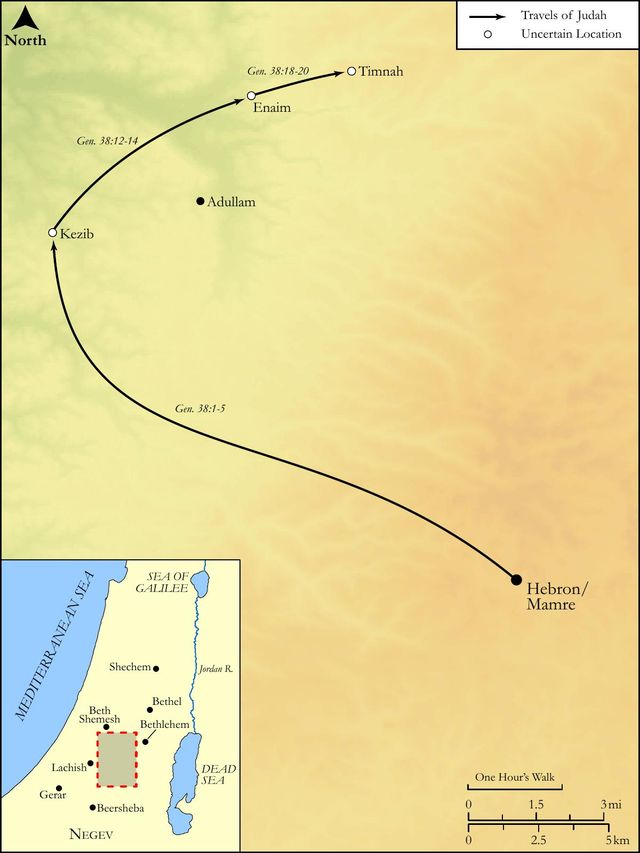
See on the biblical-era maps


Study this verse
Public-domain commentary
Matthew Henry
From his Commentary on the Whole Bible. Henry comments on passages, not single verses — this entry covers Genesis 38:24–30. His two-level outline is real structure in the source text, so it is rendered as structure.
Here is, I. Judah's rigour against Tamar, when he heard she was an adulteress. She was, in the eye of the law, Shelah's wife, and therefore her being with child by another was looked upon as an injury and reproach to Judah's family: Bring her forth therefore, says Judah, the master of the family, and let her be burnt; not burnt to death, but burnt in the cheek or forehead, stigmatized for a harlot. This seems probable, Gen 38:24. Note, it is a common thing for men to be severe against those very sins in others in which yet they allow themselves; and so, in judging others, they condemn themselves, Rom 2:1; Rom 14:22. If he designed that she should be burnt to death, perhaps, under pretence of zeal against the sin, he was contriving how to get rid of his daughter-in-law, being loath to marry Shelah to her. Note, It is a common thing, but a very bad thing, to cover malice against men's persons with a show of zeal against their vices.
II.Judah's shame, when it was made to appear that he was the adulterer.
She produced the ring and the bracelets in court, which justified the fathering of the child upon Judah, Gen 38:25, Gen 38:26. Note, The wickedness that has been most secretly committed, and most industriously concealed, yet sometimes is strangely brought to light, to the shame and confusion of those who have said, No eye sees. A bird of the air may carry the voice; however, there is a destroying day coming, when all will be laid open. Some of the Jewish writers observe that as Judah had said to his father, See, is this thy son's coat? (Gen 37:32) so it was now said to him, "See, are these thy signet and bracelets?" Judah, being convicted by his own conscience,
1.Confesses his sin: She has been more righteous than I. He owns that a perpetual mark of infamy should be fastened rather upon him, who had been so much accessory to it. Note, Those offenders ought to be treated with the greatest tenderness to whom we have any way given occasion of offending. If servants purloin, and their masters, by withholding from them what is due, tempt them to it, they ought to forgive them.
2.He never returned to it again: He knew her again no more. Note, Those do not truly repent of their sins that do not forsake them.
III.The building up of Judah's family hereby, notwithstanding, in the birth of Pharez and Zarah, from whom descended the most considerable families of the illustrious tribe of Judah. It should seem, the birth was hard to the mother, by which she was corrected for her sin. The children also, like Jacob and Esau, struggled for the birthright, and Pharez obtained it, who is ever named first, and from him Christ descended. He had his name from his breaking forth before his brother: This breach be upon thee, which is applicable to those that sow discord, and create distance, between brethren. The Jews, as Zarah, bade fair for the birthright, and were marked with a scarlet thread, as those that came out first; but the Gentiles, like Pharez, as a son of violence, got the start of them, by that violence which the kingdom of heaven suffers, and attained to the righteousness of which the Jews came short. Yet, when the fulness of time is come, all Israel shall be saved. Both these sons are named in the genealogy of our Saviour (Mat 1:3), to perpetuate the story, as an instance of the humiliation of our Lord Jesus. Some observe that the four eldest sons of Jacob fell under very foul guilt, Reuben and Judah under the guilt of incest, Simeon and Levi under that of murder; yet they were patriarchs, and from Levi descended the priests, from Judah the kings and Messiah. Thus they became examples of repentance, and monuments of pardoning mercy.
Historical interpretation
Historical reception
2 surviving comments on this verse. Each one is dated, so this reads as a timeline rather than a list.
Select a marker to jump to its quote. Markers stagger vertically where authors wrote within a few decades of each other.
Observe in this, I ask you, a mystery and a prediction of what is to come. You see, after the midwife bound the scarlet thread around his hand to make Zerah recognizable, then “he drew his hand back, and his brother came out.” He yielded precedence to his brother, it is saying, and the one thought last came out first, and the one thought first emerged after him. “The midwife said, ‘What a breach you have made for yourself!’ He was called Perez.” The name, in fact, means “breach” or “division,” as you might say. “After him came his brother with the mark on his right hand; he was given the name Zerah,” which means “sunrise.”It was not idly or to no purpose that these things happened; rather, it was a type of things to come, revealing the events themselves. You see, what happened was not according to natural processes. I mean, how would it have been possible, after his hand was bound with crimson, for him to draw back again and give way to the one after him, unless there were some divine power arranging this in advance? It was also prefiguring, as if in a kind of shadow, the fact that right from the outset Zerah, which means sunrise (he is, after all, a type of the church), began to peer ahead; as he moved gradually forward and then retired, the legal observance denoted by Perez made its entrance. After that had held precedence for a long time, the former one—I mean Zerah, who had retired—came forward, and the whole Judaic way of life in turn yielded place to the church.
What is one to say of Tamar, who brought to birth the twins Zerah and Perez? Their separation at the moment of birth was like a wall that divides the two peoples, and the hand tied with the scarlet ribbon already then speckled the conscience of the Jews with the passion of Christ.
Continue studying Genesis 38:27 across the web’s major study libraries — every link below opens this exact verse, chapter, or book on the destination site.
Read & Compare
 BibleGatewayThis verse in more than 200 translations and 70 languages.
 Bible.comThe YouVersion reader — hundreds of translations, reading plans, and highlights.
 ESV.orgCrossway's official English Standard Version reader.
 NET BibleThe NET translation with 60,000+ translators' notes on every rendering decision.
 STEP BibleTyndale House's free study tool — original text, vocabulary, and scholarly resources.
 BibliaLogos Bible Software's free web reader.
 USCCBThe New American Bible (Revised Edition) with the U.S. bishops' study notes.
Commentaries
 BibleHub CommentariesDozens of classic commentaries on this verse, gathered on one page.
 StudyLightMore than 100 commentary sets — the largest collection on the web.
 BibleRefPlain-English commentary on what this verse means, verse by verse.
 Enduring WordDavid Guzik's free commentary on this chapter, widely used by Bible teachers.
 Bible Study ToolsVerse commentary alongside Greek and Hebrew study aids.
Original Language & Research
- BibleHub InterlinearThe verse word by word — original language, transliteration, and English.
- BibleHub LexiconEvery word's original-language definition and Strong's entry.
 Blue Letter BibleDeep-study tools — Strong's numbers, concordance, and word studies.
 SefariaThe Hebrew text with Rashi and centuries of Jewish commentary.
Sermons, Hymns & Audio


TrulyRandomVerse is not affiliated with these sites and doesn’t control their content. They’re linked because they’re genuinely useful.
Summary
Genesis 38:27 marks a pivotal moment in the dramatic narrative of Judah and Tamar, revealing the surprising culmination of Tamar's pregnancy with the discovery of twins during her labor. This verse underscores God's sovereign hand in preserving the promised Messianic lineage through unexpected, morally complex, and unconventional circumstances, setting the stage for the significant births of Perez and Zerah.
Context
ShowHideLiterary Context
Genesis chapter 38 serves as a deliberate and somewhat jarring interlude in the unfolding narrative of Joseph, shifting focus abruptly to Judah, one of Jacob's sons. This chapter provides a stark contrast to Joseph's narrative of integrity and suffering, highlighting the moral failings and complexities within the patriarchal family itself. Verse 27 brings the dramatic tension of Judah and Tamar's story to its climax, following Tamar's ingenious and desperate plan to secure her rightful lineage after Judah's failure to fulfill his levirate duty (as outlined in Genesis 38:8). Having conceived by Judah himself through deception (Genesis 38:13-19), the revelation of twins in this verse is the direct outcome of their encounter and sets the stage for Judah's eventual confession of Tamar's righteousness (as seen in Genesis 38:26) and the subsequent, highly significant birth sequence in the verses that follow (Genesis 38:28-30).
Historical & Cultural Context
The narrative of Genesis 38 is deeply embedded in the patriarchal practice of levirate marriage (yibbum), which obligated a man to marry his deceased brother's widow to produce an heir for the deceased, thereby preserving the family line and inheritance. For a widow like Tamar, having no children meant social and economic vulnerability, and the continuation of her deceased husband's name was paramount. Judah's failure to provide his youngest son, Shelah, violated this sacred custom and put Tamar in a precarious position. Her actions, though deceptive, were driven by a desperate desire to secure her place and ensure the continuation of the family line, which was a matter of survival and honor in that patriarchal society. The emphasis on lineage was not merely social but also theological, as the covenant promises to Abraham, Isaac, and Jacob were tied to their descendants.
Key Themes
ShowHideGenesis 38:27 contributes significantly to several overarching themes within the book of Genesis and the broader biblical narrative. Firstly, it powerfully illustrates Divine Providence and Sovereignty, showcasing how God works through imperfect human actions and unexpected circumstances to fulfill His overarching plan, particularly in preserving the promised Messianic lineage. Secondly, the verse highlights the critical importance of Lineage and Inheritance in ancient Israel, emphasizing the continuation of family lines as central to the patriarchal promises. The surprising birth of twins doubles the potential for an heir, underscoring the divine commitment to this theme. Thirdly, the narrative is rich with the theme of Justice and Righteousness, as Tamar's actions, though unconventional, are ultimately vindicated by Judah's confession, revealing a deeper moral order at play. Finally, the element of The Unexpected is prominent, with the "behold" (וְהִנֵּה, vehinnēh) emphasizing the surprising discovery of twins, a recurring motif in biblical narratives where God often works in ways that defy human expectations, such as the unexpected births of Isaac (Genesis 21:1-3) or Jacob and Esau (Genesis 25:24-26).
Exposition and Analysis
ShowHideThe King James Version of Genesis 38:27 states, "And it came to pass in the time of her travail, that, behold, twins [were] in her womb." This concise verse is packed with narrative and theological significance.
Key Word Analysis
ShowHideʻêth refers to a specific period or season. In this context, it precisely pinpoints the moment of Tamar's delivery, emphasizing the culmination of the nine-month gestation and the unfolding of God's perfect timing in bringing forth the next generation of the promised lineage.
Derived from the primitive root H3205, yâlad encompasses the act of bearing young, giving birth, or acting as a midwife. Here, it specifically denotes the intense labor pains associated with childbirth, marking the painful yet ultimately fruitful culmination of Tamar's pregnancy and her desperate quest for an heir.
tâʼôwm (or tāʼōm) literally means "a twin," used here in the plural. This word highlights the surprising and significant discovery of two infants within Tamar's womb, doubling the blessing and profoundly impacting the narrative's trajectory by providing two potential heirs for the continuation of Judah's line.
beṭen refers to the belly, specifically the womb. Its mention here emphasizes the internal, hidden nature of the developing life and the miraculous revelation of its dual presence at the point of birth, making the discovery of twins even more striking.
Verse Breakdown
ShowHide"And it came to pass in the time of her travail"
This opening phrase, a common Hebrew narrative device (וַיְהִי, vayhi), signals a significant progression in the storyline, moving the narrative forward to the crucial moment of Tamar's delivery. The phrase "in the time of her travail" (בְּעֵת לִדְתָּהּ, bəʿēṯ liḏəttāh) specifically indicates the onset of labor pains, highlighting the natural, yet intense, process of childbirth. It sets the stage for the dramatic revelation that follows, emphasizing the culmination of her pregnancy and the imminent fulfillment of her desire for offspring.
"that, behold, twins [were] in her womb"
The interjection "behold" (וְהִנֵּה, vehinnēh, from H2009) is crucial, serving to draw the reader's attention to an unexpected and highly significant discovery. It emphasizes the element of surprise and divine intervention. The Hebrew word for "twins" (תְּאוֹמִים, təʾōmîm, from H8380) reveals the astonishing fact that Tamar was carrying not one, but two children. This revelation is not merely a medical detail but a momentous plot development, doubling the blessing and ensuring the continuation of the lineage through more than one son, setting the stage for the dramatic birth order in the subsequent verses. The phrase "in her womb" (בְּבִטְנָהּ, bəviṭnāh) clarifies the location of the twins, making the discovery at the point of birth even more striking.
Literary Devices
ShowHideGenesis 38:27 effectively employs several literary devices to enhance its narrative impact. The most prominent is Foreshadowing, as the mere presence of twins hints at the subsequent dramatic struggle for birth order between Perez and Zerah, which itself foreshadows the later biblical theme of the younger son superseding the elder. There is also an element of Irony in the narrative's broader context: Judah, who had failed to provide an heir for Tamar, unwittingly becomes the father of her children, ensuring the continuation of his own line through the very woman he had wronged. The use of the interjection "behold" (וְהִנֵּה, vehinnēh) functions as a powerful Exclamation or Emphasis, drawing the reader's attention to the surprising and divinely orchestrated revelation of the twins, highlighting the unexpected nature of God's work in human affairs. This also subtly points to Divine Providence, as the unexpected doubling of offspring underscores God's active hand in preserving the lineage despite human sin and moral ambiguity.
Theological and Thematic Connections
ShowHideGenesis 38:27 profoundly illustrates God's unwavering sovereignty and providential care over His redemptive plan, even amidst human sin and moral complexity. The discovery of twins, particularly after Tamar's unconventional actions, serves as a powerful testament to God's ability to work through flawed individuals and unexpected circumstances to achieve His perfect will. This verse emphasizes that God's purposes for His covenant people and the promised lineage are not thwarted by human failings but are ultimately secured by His faithfulness. It highlights that the continuation of the Messianic line is not dependent on human perfection but on divine commitment, ensuring that the seed promised to Abraham would indeed come forth.
Reflection and Application
ShowHideThe story of Tamar and Judah, culminating in the surprising birth of twins in this verse, offers profound insights into God's character and His redemptive plan that resonate deeply with believers today. It serves as a powerful reminder that God's purposes are not thwarted by human sin, moral complexity, or unconventional paths. He is utterly sovereign over all circumstances, weaving together even the most challenging and ethically ambiguous situations to advance His redemptive plan. For believers, this truth can be a profound source of comfort and assurance, knowing that God can work through and redeem even our most difficult, flawed, or seemingly hopeless situations. It encourages us to trust in His overarching plan, even when the immediate circumstances seem confusing, unjust, or ethically challenging, recognizing His infinite capacity to bring good out of unexpected and even sinful events. This narrative challenges us to look beyond human failings and conventional expectations to discern God's faithful hand at work, reminding us that His grace is greater than our sin and His wisdom surpasses our understanding.
Questions for Reflection
ShowHideFAQ
ShowHideWhy is the discovery of twins significant in this narrative?
ShowHideThe discovery of twins is significant for several profound reasons. Narratively, it adds an element of surprise and further emphasizes God's abundant provision, doubling the offspring for a lineage that seemed at risk. Theologically, it ensures the continuation of the crucial covenant lineage promised to Abraham, Isaac, and Jacob. Specifically, one of these twins, Perez, becomes a direct and explicit ancestor of King David and, ultimately, of Jesus Christ, making this discovery vital for the Messianic line, as noted in Matthew 1:3. It highlights God's sovereign hand in preserving His redemptive plan despite human failings.
Does this story condone Tamar's deceptive actions?
ShowHideThe biblical narrative presents Tamar's actions without explicitly condoning or condemning them. Instead, it focuses on the outcome: Judah's acknowledgment of her righteousness compared to his own failure to fulfill his duty (Genesis 38:26). The story primarily highlights God's sovereignty in preserving the promised lineage despite human sin and moral complexity, demonstrating His ability to work through imperfect means to achieve His perfect will. It's a testament to God's grace and His capacity to bring about His purposes even when human agents act in morally ambiguous ways.
What does the word "behold" (KJV) signify in this verse?
ShowHideThe Hebrew word translated "behold" (וְהִנֵּה, vehinnēh) is a common interjection used to draw attention to something new, surprising, or particularly noteworthy. In Genesis 38:27, it emphatically signals the unexpected nature of finding twins during Tamar's labor. It serves to heighten the drama and underscore the significance of this discovery, indicating to the reader that this is not just a routine birth but a divinely orchestrated event with profound implications for the unfolding narrative and the divine plan of redemption.
Christ-Centered Fulfillment
ShowHideGenesis 38:27, with its surprising revelation of twins, is profoundly Christ-centered in its fulfillment, specifically through the birth of Perez. Despite the morally ambiguous and unconventional circumstances surrounding his conception, Perez is explicitly named in the genealogy of Jesus Christ in the New Testament (Matthew 1:3). This verse powerfully underscores God's unwavering commitment to His redemptive plan, demonstrating His sovereignty over human actions, even sin and deception. God orchestrates events, using unexpected individuals like Tamar and surprising discoveries like the twins, to ensure the continuation of the promised lineage through which the Messiah would ultimately come. It highlights that Christ's ancestry is not one of perfect human righteousness, but one woven through the complexities and imperfections of human history, showcasing God's extraordinary grace and His ability to redeem all circumstances for His ultimate purpose of salvation. The twin birth, particularly the unexpected prominence of Perez (the "breacher"), foreshadows Christ's own breaking through the barriers of sin and death to establish a new covenant.