


Ruth 4:12
Bible text: King James Version (1769 Blayney text) · Public domain
Bible text: Berean Standard Bible · Public domain
Bible text: American Standard Version (1901) · Public domain
Bible text: World English Bible, Messianic edition · Public domain
Bible text: Geneva Bible (1599) · Public domain
Bible text: Young's Literal Translation · Public domain
- וִיהִיvi·Hiso may it beH1961Conj-w ¦ V-Qal-Imperf-3msVerb Qal Imperfect 3rd Singular Masculineוִsoיהִיmay it be
- בֵיתְךָvei·te·Khayour householdH1004N-msc ¦ 2msNoun Singular Masculine Constructבֵיתְhouseholdךָyour
- כְּבֵיתke·Veitlike [the] household ofH1004Prep-k ¦ N-mscNoun Singular Masculine Constructכְּlikeבֵית[the] household of
- פֶּרֶץPe·retzPerezH6557N-proper-mNoun Proper Masculine
- אֲשֶׁר'a·SherwhomH834RelParticle Relative
- יָלְדָהYal·dahshe boreH3205V-Qal-Perf-3fsVerb Qal Perfect 3rd Singular Feminine
- תָמָרta·MarTamarH8559N-proper-fNoun Proper Feminine
- לִיהוּדָהli·hu·Dahto JudahH3063Prep-l ¦ N-properNoun Proper LocationלִtoיהוּדָהJudah
- מִןminfromH4480PrepPreposition
- הַזֶּרַעha·Ze·ra'the offspringH2233Art ¦ N-msNoun Singular Masculine Absoluteהַtheזֶּרַעoffspring
- אֲשֶׁר'a·SherwhichH834RelParticle Relative
- יִתֵּןyi·Tenhe will giveH5414V-Qal-Imperf-3msVerb Qal Imperfect 3rd Singular Masculine
- יְהוָהYah·wehYahwehH3068N-properNoun Proper Title
- לְךָle·Khato <the> youPrep-l ¦ 2msSuffix Personal 2nd Singular Masculineלְto <the>ךָyou
- מִןminfromH4480PrepPreposition
- הַנַּעֲרָהha·na·'a·Rahthe young womanH5291Art ¦ N-fsNoun Singular Feminine Absoluteהַtheנַּעֲרָהyoung woman
- הַזֹּאתha·Zot<the> thisH2063Art ¦ PrtParticle Demonstrativeהַ<the>זֹּאתthis
English is a literal word-by-word gloss of the Hebrew, not the KJV's wording. Why?
This is the original text the KJV's translators worked from — each Hebrew word with its own literal English meaning in this verse, prepared by scholars at Tyndale House, Cambridge. The KJV translates whole sentences, not word by word, so its wording differs: one Hebrew word can become several English words, and the KJV may choose “the LORD” where the gloss reads “Yahweh”. Both are faithful — they answer different questions. For the KJV's own rendering, switch to the KJV text.
Details
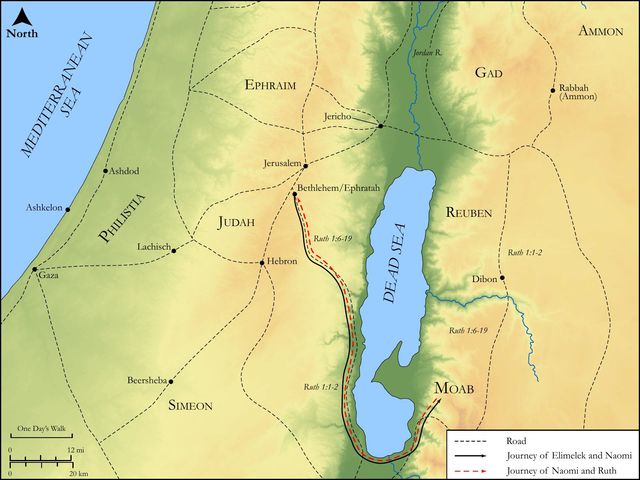
See on the biblical-era map
Study this verse
Public-domain commentary
Matthew Henry
From his Commentary on the Whole Bible. Henry comments on passages, not single verses — this entry covers Ruth 4:9–12. His three-level outline is real structure in the source text, so it is rendered as structure.
Boaz now sees his way clear, and therefore delays not to perform his promise made to Ruth that he would do the kinsman's part, but in the gate of the city, before the elders and all the people, publishes a marriage-contract between himself and Ruth the Moabitess, and therewith the purchase of all the estate that belonged to the family of Elimelech. If he had not been (Rut 2:1) a mighty man of wealth, he could not have compassed this redemption, nor done this service to his kinsman's family. What is a great estate good for, but that it enables a man to do so much the more good in his generation, and especially to those of his own household, if he have but a heart to use it so! Now concerning this marriage it appears,
I.That it was solemnized, or at least published, before many witnesses, Rut 4:9, Rut 4:10.
"You are witnesses," 1. "That I have bought the estate. Whoever has it, or any part of it, mortgaged to him, let him come to me and he shall have his money, according to the value of the land," which was computed by the number of years to the year of jubilee (Lev 25:15), when it would have returned of course to Elimelech's family. The more public the sales of estates are the better they are guarded against frauds. 2. "That I have purchased the widow to be my wife." He had no portion with her; what jointure she had was encumbered, and he could not have it without giving as much for it as it was worth, and therefore he might well say he purchased her; and yet, being a virtuous woman, he reckoned he had a good bargain. House and riches are the inheritance of fathers, but a prudent wife is more valuable, is from the Lord as a special gift. He designed, in marrying her, to preserve the memory of the dead, that the name of Mahlon, though he left no son to bear it up, might not be cut off from the gate of his place, but by this means might be preserved, that it should be inserted in the public register that Boaz married Ruth the widow of Mahlon, the son of Elimelech, which posterity, whenever they had occasion to consult the register, would take particular notice of. And this history, being preserved for the sake of that marriage and the issue of it, proved an effectual means to perpetuate the name of Mahlon, even beyond the thought or intention of Boaz, to the world's end. And observe that because Boaz did this honour to the dead, as well as this kindness to the living, God did him the honour to bring him into the genealogy of the Messiah, by which his family was dignified above all the families of Israel; while the other kinsman, that was so much afraid of diminishing himself, and marring his inheritance, by marrying the widow, has his name, family, and inheritance, buried in oblivion and disgrace. A tender and generous concern for the honour of the dead and the comfort of poor widows and strangers, neither of which can return the kindness (Luk 14:14), is sure what God will be well pleased with and will surely recompense. Our Lord Jesus is our Goel, our Redeemer, our everlasting Redeemer. He looked, like Boaz, with compassion on the deplorable state of fallen mankind. At a vast expense he redeemed the heavenly inheritance for us, which by sin was mortgaged, and forfeited into the hands of divine justice, and which we should never have been able to redeem. He likewise purchased a peculiar people, whom he would espouse to himself, though strangers and foreigners, like Ruth, poor and despised, that the name of that dead and buried race might not be cut off for ever. He ventured the marring of his own inheritance, to do this, for, though he was rich, yet for our sakes he became poor; but he was abundantly recompensed for it by his Father, who, because he thus humbled himself, hath highly exalted him, and given him a name above every name. Let us own our obligations to him, make sure our contract with him, and study all our days how to do him honour. Boaz, by making a public declaration of this marriage and purchase, not only secured his title against all pretenders, as it were by a fine with proclamations, but put honour upon Ruth, showed that he was not ashamed of her, and her parentage and poverty, and left a testimony against clandestine marriages. It is only that which is evil that hates the light and comes not to it. Boaz called witnesses to what he did, for it was what he could justify, and would never disown; and such regard was then had, even to the contemned crowd, that not only the elders, but all the people that were in the gate, passing and re-passing, were appealed to (Rut 4:9), and hearkened to (Rut 4:11) when they said, We are witnesses.
II.That it was attended with many prayers.
The elders and all the people, when they witnessed to it, wished well to it, and blessed it, Rut 4:11, Rut 4:12. Ruth, it should seem, was now sent for; for they speak of her (Rut 4:12) as present: This young woman; and, he having taken her to wife, they look upon her as already come into his house. And very heartily they pray for the new-married couple.
1.The senior elder, it is likely, made this prayer, and the rest of the elders, with the people, joined in it, and therefore it is spoken of as made by them all; for in public prayers, though but one speaks, we must all pray. Observe,
(1.)Marriages ought to be blessed, and accompanied with prayer, because every creature and every condition are that to us, and no more, that God makes them to be. It is civil and friendly to wish all happiness to those who enter into that condition; and what good we desire we should pray for from the fountain of all good. The minister who gives himself to the word and prayer, as he is the fittest person to exhort, so he is the fittest to bless and pray for those that enter into this relation.
(2.)We ought to desire and pray for the welfare and prosperity one of another, so far from envying or grieving at it.
2.Now here, (1.) They prayed for Ruth: The Lord make the woman that has come into thy house like Rachel and Leah, that is, "God make her a good wife and a fruitful mother." Ruth was a virtuous woman, and yet needed the prayers of her friends, that by the grace of God she might be made a blessing to the family she had come into. They prayed that she might be like Rachel and Leah, rather than like Sarah and Rebekah, for Sarah had but one son, and Rebekah but one that was in covenant, the other was Esau, who was rejected; but Rachel and Leah did build up the house of Israel: all their children were in the church, and their offspring was numerous. "May she be a flourishing, fruitful, faithful vine by thy house side." (2.) They prayed for Boaz, that he might continue to do worthily in the city to which he was an ornament, and might there be more and more famous. They desired that the wife might be a blessing in the private affairs of the house, and the husband a blessing in the public business of the town, that she in her place, and he in his, might be wise, virtuous, and successful. Observe, The way to be famous is to do worthily. Great reputation must be obtained by great merits. It is not enough not to do unworthily, to be harmless and inoffensive, but we must do worthily, be useful and serviceable to our generation. Those that would be truly illustrious must in their places shine as lights. (3.) They prayed for the family: "Let thy house be like the house of Pharez," that is, "let it be very numerous, let it greatly increase and multiply, as the house of Pharez did." The Bethlehemites were of the house of Pharez, and knew very well how numerous it was; in the distribution of the tribes, that grandson of Jacob had the honour which none of the rest had but Manasseh and Ephraim, that his posterity was subdivided into two distinct families, Hezron and Hamul, Num 26:21. Now they prayed that the family of Boaz, which was one branch of that stock, might in process of time become as numerous and great as the whole stock now was.
Historical interpretation
Two Centuries of Reception
4 surviving comments on this verse. Each one is dated, so this reads as a timeline rather than a list.
Select a marker to jump to its quote. Markers stagger vertically where authors wrote within a few decades of each other.
For, by the law, when a man died, the marriage bond with his wife was passed on to his brother or other male next of kin, in order that the seed of the brother or next of kin might renew the life of the house. And so it was that Ruth, though she was foreign-born, had possessed a husband of the Jewish people who had left a kinsman of near relation. Although she was seen and loved by Boaz while gleaning and maintaining herself and her mother-in-law with what she gleaned, she could not become the wife of Boaz until she had first loosed the shoe from him whose wife she ought, by the law, to have become.The story is a simple one, but deep are its hidden meanings, for that which was done was the outward signs of something more. If indeed we should stretch the sense so as to fit the letter exactly, we should almost find the words an occasion of a certain shame and horror, that we should regard them as intending and conveying the thought of common bodily intercourse. Rather it was the foreshadowing of one who was to arise from the Jewish people—whence Christ was, after the flesh—who should, with the seed of heavenly teaching, revive the seed of his dead kinsman, that is to say, the people, and to whom the precepts of the law, in their spiritual significance, assigned the sandal of marriage, for the espousals of the church.
Those things which happened to Ruth should be seen as figures. For she was an outsider and had fallen into extreme penury; but Boaz, seeing her, did not despise her on account of her poverty, nor was he horrified on account of her impiety; even as Christ received the church, who was both a stranger and laboring, in need of great good things. Ruth is not joined with her consort before forsaking her parents and her nation and her native land: never was anyone so much ennobled by marriage. Thus the church was not made loveable to her spouse before she had forsaken her prior customs. The prophet says, “Forget your people.”
The elders confirmed the marriage with a blessing, saying, “The Lord made this woman,” etc. Moreover, “So that she may be an example of virtue in Ephrathah,” they predicted the salvific birth through which Bethlehem was made famous among all people.
It was an old custom that if a groom wished to divorce his bride he took off his sandal and this was the sign of the divorce. Consequently, he was ordered to take off his sandals, lest he approach the church wearing sandals like a bridegroom; for this office was reserved for Christ, who is the true bridegroom. However, the blessing of the ten elders showed that all Gentile peoples were saved and blessed in the name of Christ. For iota signifies ten in Greek, and this first letter will signify the name of the Lord Jesus in full; which shows, as we said, that all peoples are saved through him and are blessed. Therefore, let no one doubt these things that were said, since it may be seen that they were everywhere and from the beginning prefigured by antecedent figures; and they were clearly fulfilled in this way through the advent of the Lord; and which were superfluous, being completed in this way by the accord of all voiced in truth; and by all “figures” of the holy Scriptures, which he who promised [them] fulfilled through his son, Jesus Christ our Lord, king, and redeemer and savior, with whom is honor and glory from age to age. Amen.
Continue studying Ruth 4:12 across the web’s major study libraries — every link below opens this exact verse, chapter, or book on the destination site.
Read & Compare
 BibleGatewayThis verse in more than 200 translations and 70 languages.
 Bible.comThe YouVersion reader — hundreds of translations, reading plans, and highlights.
 ESV.orgCrossway's official English Standard Version reader.
 NET BibleThe NET translation with 60,000+ translators' notes on every rendering decision.
 STEP BibleTyndale House's free study tool — original text, vocabulary, and scholarly resources.
 BibliaLogos Bible Software's free web reader.
 USCCBThe New American Bible (Revised Edition) with the U.S. bishops' study notes.
Commentaries
 BibleHub CommentariesDozens of classic commentaries on this verse, gathered on one page.
 StudyLightMore than 100 commentary sets — the largest collection on the web.
 BibleRefPlain-English commentary on what this verse means, verse by verse.
 Enduring WordDavid Guzik's free commentary on this chapter, widely used by Bible teachers.
 Bible Study ToolsVerse commentary alongside Greek and Hebrew study aids.
Original Language & Research
- BibleHub InterlinearThe verse word by word — original language, transliteration, and English.
- BibleHub LexiconEvery word's original-language definition and Strong's entry.
 Blue Letter BibleDeep-study tools — Strong's numbers, concordance, and word studies.
 SefariaThe Hebrew text with Rashi and centuries of Jewish commentary.
Sermons, Hymns & Audio


TrulyRandomVerse is not affiliated with these sites and doesn’t control their content. They’re linked because they’re genuinely useful.
Summary
Ruth 4:12 is a profound communal blessing pronounced by the elders and people of Bethlehem upon Boaz and Ruth's marriage at the city gate. It invokes the significant and divinely ordained lineage of Pharez, born to Tamar and Judah, expressing a fervent hope for a fruitful, enduring "house" for Boaz. This blessing emphasizes God's sovereign hand in providing offspring and subtly foreshadows the future Messianic lineage that would ultimately emerge from this pivotal union.
Context
ShowHideLiterary Context
This verse serves as the culminating public affirmation and blessing within the meticulously detailed legal and social proceedings at the city gate of Bethlehem. It immediately follows Boaz's formal declaration to the elders and the people that he is redeeming Elimelech's land and taking Ruth as his wife, fulfilling the levirate responsibility. The elders' pronouncement seals this covenant, transitioning the narrative from the initial destitution of Naomi and Ruth to a powerful promise of restoration, prosperity, and the continuation of a vital family line. This blessing is strategically placed to set the stage for the subsequent verses, which detail the birth of Obed and the crucial genealogy leading directly to King David, thereby solidifying the book's trajectory towards the Messianic lineage.
Historical & Cultural Context
The setting at the city gate was the established public forum for all significant legal, commercial, and social transactions in ancient Israel. Elders, revered for their wisdom and authority, served as community leaders and judges, and their public pronouncements, like this blessing, carried immense authoritative and binding weight. The profound emphasis on "house" (referring to the family line or dynasty) and "seed" (offspring) reflects the patriarchal society's deep-seated value placed on progeny, particularly male heirs, for the continuation of the family name, inheritance, and social standing. The remarkable circumstances of Ruth, a Moabite widow, being integrated into an Israelite family and lineage, are implicitly validated and celebrated by the elders' blessing, demonstrating a remarkable openness to God's redemptive work even through those considered outside the conventional bounds.
Key Themes
ShowHideRuth 4:12 powerfully encapsulates several overarching themes of the Book of Ruth. It highlights redemption, as Boaz acts as the kinsman-redeemer, restoring Naomi's family line and securing Ruth's future within the covenant community. It underscores divine providence, with the elders explicitly acknowledging that the "seed" is a gift from the LORD, reinforcing God's sovereign hand in human affairs, even in seemingly ordinary circumstances like marriage and procreation. Furthermore, the explicit mention of Pharez and Tamar introduces the theme of lineage and legacy, particularly a lineage marked by unconventional beginnings but divinely ordained purposes, ultimately pointing towards the future house of David. This blessing also subtly introduces the theme of inclusion, as a foreign woman is welcomed into the very heart of Israel's redemptive history.
Exposition and Analysis
ShowHideKey Word Analysis
ShowHideIn this context, "house" signifies far more than a physical dwelling; it refers to the entire household, family, lineage, or even a dynasty. The elders' wish is for Boaz's family line to be firmly established, enduring, and celebrated, much like the prominent and divinely blessed line of Pharez. This term carries significant weight regarding legacy and continuity, extending beyond immediate family to future generations, implying a lasting and significant family name.
This word literally means "seed" but is commonly used metaphorically to denote offspring, descendants, or progeny. Its usage here emphasizes the vital importance of children for the continuation of the family name and inheritance. The phrase "the seed which the LORD shall give thee" explicitly attributes the gift of children to divine activity, underscoring God's sovereignty over procreation and the establishment of families, particularly in the context of covenant promises and the continuation of a divinely chosen lineage.
Verse Breakdown
ShowHide"And let thy house be like the house of Pharez"
This is the core of the elders' blessing, a powerful invocation for Boaz's future family. They wish for his lineage to be as prolific, established, and significant as that of Pharez, a foundational ancestor in the tribe of Judah. The comparison is not merely to a large family but to one that is divinely blessed and instrumental in God's redemptive plan, despite its own unconventional origins, setting a high standard for Boaz's future legacy.
"whom Tamar bare unto Judah"
This specific reference to Tamar and Judah is crucial. It immediately brings to mind the dramatic and ethically complex story in Genesis 38, where Tamar, through extraordinary and unconventional means, ensures the continuation of Judah's line, bearing Pharez and Zerah. This connection serves to validate Ruth, a Moabite woman entering the Israelite lineage through a kinsman-redeemer, suggesting that God works through unexpected paths and individuals, even those considered outsiders or operating outside conventional norms, to fulfill His sovereign purposes.
"of the seed which the LORD shall give thee of this young woman"
This concluding phrase explicitly grounds the blessing in divine providence, highlighting the belief that fruitfulness is not merely a biological process but a direct gift from God. The elders acknowledge that any offspring will be a direct gift from the LORD, confirming God's active involvement in the establishment and continuation of families, particularly in this case, the family that will lead to the Messianic line. It underscores the divine initiative in the unfolding of redemptive history.
Literary Devices
ShowHideThe verse employs several significant literary devices, enriching its meaning and impact. Allusion is central, as the reference to "the house of Pharez, whom Tamar bare unto Judah" immediately calls to mind the entire narrative of Genesis 38, imbuing the blessing with layers of meaning concerning unconventional lineage, divine purpose, and the surprising ways God works through human circumstances. This specific allusion serves as a powerful foreshadowing, subtly hinting at the future significance of Boaz and Ruth's union in the broader redemptive history, especially in light of the subsequent genealogy leading to David. The phrase "let thy house be like the house of Pharez" functions as a simile, drawing a direct comparison between Boaz's hoped-for lineage and the established, divinely blessed, and historically significant line of Pharez. Furthermore, the entire blessing acts as a form of prophetic utterance, though perhaps unknowingly on the part of the elders, as it speaks to a future reality (the birth of David and ultimately Christ) that far transcends their immediate understanding, demonstrating God's sovereign orchestration of events.
Theological and Thematic Connections
ShowHideThis blessing in Ruth 4:12 beautifully encapsulates the theological truth that God's redemptive plan often unfolds through unexpected people and unconventional circumstances. Just as Tamar, an outsider (by marriage to Judah's son), played a pivotal role in preserving Judah's lineage, so too does Ruth, a Moabite widow, become instrumental in the continuation of a line that will lead to Israel's greatest king and, ultimately, the Messiah. It affirms God's sovereignty over human history, demonstrating His faithfulness to His covenant promises even when human circumstances seem dire or irregular. The emphasis on "the seed which the LORD shall give thee" underscores the divine initiative in establishing families and fulfilling promises, reminding us that fruitfulness, both physical and spiritual, is ultimately a gift from God, orchestrated for His grand purposes.
Reflection and Application
ShowHideRuth 4:12 offers profound insights into God's working in our lives and the significance of community. It reminds us that God's purposes are not limited by our perceived limitations, social standing, or past circumstances. Just as Ruth, a Moabite widow, was integrated into the lineage of promise through divine grace and human faithfulness, so too can God use anyone, regardless of their background, to fulfill His grand design. This verse encourages us to embrace God's sovereignty in our lives, trusting that He is at work even in the most unconventional or challenging seasons. It also highlights the power of community affirmation and prayer, as the elders' blessing served as a powerful declaration of hope and divine favor over Boaz and Ruth's union, reminding us of the importance of godly community in supporting and speaking life into significant life transitions. It challenges us to look beyond immediate appearances and recognize God's hand in shaping our futures and the futures of those around us.
Questions for Reflection
ShowHideFAQ
ShowHideWhy is the reference to Pharez and Tamar so important in this blessing?
ShowHideThe reference to Pharez and Tamar is profoundly important because it legitimizes and elevates Ruth's position within the Israelite community and the lineage of Judah. The story of Tamar in Genesis 38 details an unconventional, even scandalous, situation where Tamar, by her own initiative and through a levirate-like act, ensures the continuation of Judah's line, bearing Pharez and Zerah. Pharez becomes a critical ancestor in the Davidic and ultimately Messianic line. By comparing Boaz and Ruth's future "house" to that of Pharez, the elders are not only wishing for fruitfulness but also implicitly validating Ruth, a Moabite widow, by associating her with a foundational, albeit irregular, ancestral figure in Israel's history. It underscores God's ability to work through unexpected means and people to achieve His sovereign purposes, even when human circumstances appear to deviate from the norm or challenge social conventions.
Does this verse imply that God directly intervenes in every conception?
ShowHideThe phrase "the seed which the LORD shall give thee" certainly emphasizes God's ultimate sovereignty over life and procreation. While it doesn't negate human biological processes, it attributes the gift of children to divine providence. In ancient Israelite thought, children were consistently viewed as a blessing from God, and barrenness was often seen as a sign of divine disfavor or a challenge to faith (e.g., Genesis 30:2). This verse reflects a theological worldview where God is actively involved in all aspects of life, including the establishment of families and the continuation of lineages. It serves as a reminder that every life is a gift from God, and that He orchestrates events, even the seemingly mundane, to fulfill His greater redemptive plan, often in ways that highlight His power and grace.
How does this blessing relate to the broader narrative of the Book of Ruth?
ShowHideThis blessing serves as a powerful culmination and turning point in the Book of Ruth. It brings together the themes of redemption, as Boaz completes his role as kinsman-redeemer; restoration, as Naomi's desolate family line is promised new life and an heir; and divine faithfulness, as God's hand is acknowledged in providing offspring and orchestrating events. The blessing publicly affirms the union of Boaz and Ruth, a union that transcends social and ethnic barriers, and sets the stage for the birth of Obed, who will be the grandfather of King David. It underscores that the individual stories of Naomi and Ruth are intricately woven into God's larger plan of salvation history, demonstrating how seemingly small acts of faithfulness, kindness, and divine providence contribute to grand divine purposes, ultimately pointing toward the coming of the Messiah.
Christ-Centered Fulfillment
ShowHideRuth 4:12, with its invocation of the "house of Pharez" and the promise of "seed which the LORD shall give," finds its ultimate and glorious fulfillment in Jesus Christ. The lineage blessed by the elders at Bethlehem is precisely the one through which the Messiah would come. Pharez, born through unconventional means to Tamar and Judah, is a direct ancestor of King David. This very lineage, including the unexpected inclusion of Ruth, a Moabite, is meticulously traced in the genealogies of Jesus found in Matthew 1:3-5 and Luke 3:33. The "seed which the LORD shall give" points beyond mere physical progeny to the singular, promised Seed—Christ Himself—through whom all the nations of the earth would be blessed, just as God promised Abraham in Genesis 22:18. The inclusion of Tamar and Ruth, both Gentile women entering the line of promise through extraordinary circumstances, powerfully foreshadows the universal scope of Christ's redemption, breaking down barriers between Jew and Gentile (Ephesians 2:14), and demonstrating that God's grace extends to all who believe, fulfilling the very essence of the blessing pronounced at the city gate.