


Ruth 4:22
- וְעֹבֵדve·'o·Vedand ObedH5744Conj-w ¦ N-proper-mNoun Proper MasculineוְandעֹבֵדObed
- הוֹלִידho·Lidhe fatheredH3205V-Hiphil-Perf-3msVerb Hiphil Perfect 3rd Singular Masculine
- אֶת'et<obj.>H853DirObjMParticle Object Indicator
- יִשָׁיyi·ShaiJesseH3448N-proper-mNoun Proper Masculine
- וְיִשַׁיve·yi·Shaiand JesseH3448Conj-w ¦ N-proper-mNoun Proper MasculineוְandיִשַׁיJesse
- הוֹלִידho·Lidhe fatheredH3205V-Hiphil-Perf-3msVerb Hiphil Perfect 3rd Singular Masculine
- אֶת'et<obj.>H853DirObjMParticle Object Indicator
- דָּוִדda·VidDavidH1732N-proper-mNoun Proper Masculine
English is a literal word-by-word gloss of the Hebrew, not the KJV's wording. Why?
This is the original text the KJV's translators worked from — each Hebrew word with its own literal English meaning in this verse, prepared by scholars at Tyndale House, Cambridge. The KJV translates whole sentences, not word by word, so its wording differs: one Hebrew word can become several English words, and the KJV may choose “the LORD” where the gloss reads “Yahweh”. Both are faithful — they answer different questions. For the KJV's own rendering, switch to the KJV text.
Details
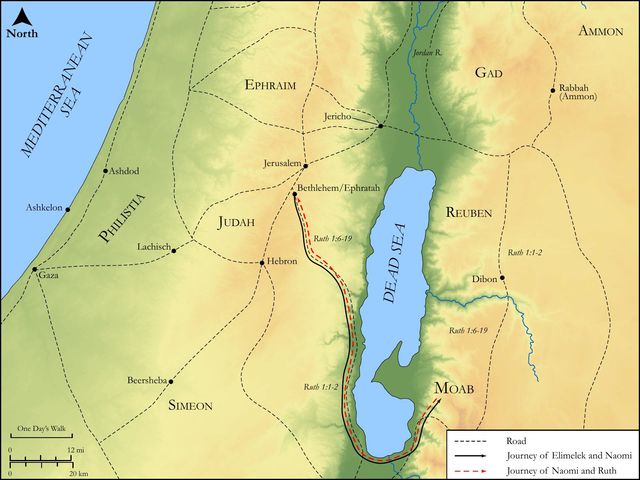
See on the biblical-era map
Study this verse
Public-domain commentary
Matthew Henry
From his Commentary on the Whole Bible. Henry comments on passages, not single verses — this entry covers Ruth 4:13–22. His three-level outline is real structure in the source text, so it is rendered as structure.
Here is, I. Ruth a wife. Boaz took her, with the usual solemnities, to his house, and she became his wife (Rut 4:13), all the city, no doubt, congratulating the preferment of a virtuous woman, purely for her virtues. We have reason to think that Orpah, who returned from Naomi to her people and her gods, was never half so well preferred as Ruth was. He that forsakes all for Christ shall find more than all with him; it shall be recompensed a hundred-fold in this present time. Now Orpah wished she had gone with Naomi too; but she, like the other kinsman, stood in her own light. Boaz had prayed that this pious proselyte might receive a full reward of her courage and constancy from the God of Israel, under whose wings she had come to trust; and now he became an instrument of that kindness, which was an answer to his prayer, and helped to make his own words good. Now she had the command of those servants with whom she had associated and of those fields in which she had gleaned. Thus sometimes God raiseth up the poor out of the dust, to set them with princes, Psa 113:7, Psa 113:8.
II.Ruth a mother:
The Lord gave her conception; for the fruit of the womb is his reward, Psa 127:3. It is one of the keys he hath in his hand; and he sometimes makes the barren woman that had been long so to be a joyful mother of children, Psa 113:9; Isa 54:1.
III.Ruth still a daughter-in-law, and the same that she always was, to Naomi, who was so far from being forgotten that she was a principal sharer in these new joys. The good women that were at the labour when this child was born congratulated Naomi upon it more than either Boaz or Ruth, because she was the match-maker, and it was the family of her husband that was hereby built up. See here, as before, what an air of devotion there was then even in the common expressions of civility among the Israelites. Prayer to God attended the birth of the child. What a pity it is that such pious language should either be disused among Christians or degenerate into a formality. "Blessed be the Lord that has sent thee this grandson," Rut 4:14, Rut 4:15.
1.Who was the preserver of the name of her family, and who, they hoped, would be famous, because his father was so.
2.Who would be hereafter dutiful and kind to her, so they hoped, because his mother was so. If he would but take after her, he would be a comfort to his aged grandmother, a restorer of her life, and, if there should be occasion, would have wherewithal to be the nourisher of her old age. It is a great comfort to those that are going into years to see any of those that descend from them growing up, that are likely, by the blessing of God, to be a stay and support to them, when the years come wherein they will need such, and of which they will say they have no pleasure in them. Observe, They say of Ruth that she loved Naomi, and therefore was better to her than seven sons. See how God in his providence sometimes makes up the want and loss of those relations from whom we expected most comfort in those from whom we expected least. The bonds of love prove stronger than those of nature, and there is a friend that sticks closer than a brother; so here there was a daughter-in-law better than an own child. See what wisdom and grace will do. Now here,
(1.)The child is named by the neighbours, Rut 4:17. The good women would have it called Obed, a servant, either in remembrance of the meanness and poverty of the mother or in prospect of his being hereafter a servant, and very serviceable, to his grandmother. It is no dishonour to those that are ever so well born to be servants to God, their friends, and their generation. The motto of the princes of Wales is Ich dien - I serve.
(2.)The child is nursed by the grandmother, that is, dry-nursed, when the mother had weaned him from the breast, Rut 4:16. She laid it in her bosom, in token of her tender affection to it and care of it. Grandmothers are often the most fond.
IV.Ruth is hereby brought in among the ancestors of David and Christ, which was the greatest honour.
The genealogy is here drawn from Pharez, through Boaz and Obed, to David, and so leads towards the Messiah, and therefore it is not an endless genealogy.
Continue studying Ruth 4:22 across the web’s major study libraries — every link below opens this exact verse, chapter, or book on the destination site.
Read & Compare
 BibleGatewayThis verse in more than 200 translations and 70 languages.
 Bible.comThe YouVersion reader — hundreds of translations, reading plans, and highlights.
 ESV.orgCrossway's official English Standard Version reader.
 NET BibleThe NET translation with 60,000+ translators' notes on every rendering decision.
 STEP BibleTyndale House's free study tool — original text, vocabulary, and scholarly resources.
 BibliaLogos Bible Software's free web reader.
 USCCBThe New American Bible (Revised Edition) with the U.S. bishops' study notes.
Commentaries
 BibleHub CommentariesDozens of classic commentaries on this verse, gathered on one page.
 StudyLightMore than 100 commentary sets — the largest collection on the web.
 BibleRefPlain-English commentary on what this verse means, verse by verse.
 Enduring WordDavid Guzik's free commentary on this chapter, widely used by Bible teachers.
 Bible Study ToolsVerse commentary alongside Greek and Hebrew study aids.
Original Language & Research
- BibleHub InterlinearThe verse word by word — original language, transliteration, and English.
- BibleHub LexiconEvery word's original-language definition and Strong's entry.
 Blue Letter BibleDeep-study tools — Strong's numbers, concordance, and word studies.
 SefariaThe Hebrew text with Rashi and centuries of Jewish commentary.
Sermons, Hymns & Audio


TrulyRandomVerse is not affiliated with these sites and doesn’t control their content. They’re linked because they’re genuinely useful.
Summary
Ruth 4:22 serves as the climactic and foundational conclusion to the Book of Ruth, succinctly stating, "And Obed begat Jesse, and Jesse begat David." This verse completes the genealogy initiated in Ruth 4:18, establishing the direct lineage from Obed, the son of Boaz and Ruth, to Jesse, and ultimately to David, Israel's greatest king. It unveils the profound historical and theological significance of Ruth's story, revealing how God's providential hand guided the lives of seemingly ordinary individuals to prepare the way for the royal house of David and, by extension, the future Messiah.
Context
ShowHideLiterary Context
Ruth 4:22 stands as the final verse of the Book of Ruth, serving as the capstone to the narrative's carefully constructed plot. The preceding verses (Ruth 4:18-21) provide a broader genealogy tracing the line from Perez, son of Judah, down to Obed. This final verse narrows the focus, specifically highlighting the immediate succession from Obed to Jesse, and then to David. This genealogical appendix transforms a personal story of loss, loyalty, and redemption into a crucial historical document, linking the humble Bethlehem family of Elimelech, Naomi, and Ruth directly to the future royal dynasty. It emphasizes that the entire story, from famine and migration to Boaz's act of redemption and the birth of Obed, was not merely a charming pastoral tale but a divinely orchestrated prelude to the establishment of Israel's monarchy, giving the entire book a profound teleological purpose.
Historical & Cultural Context
Genealogies held immense importance in ancient Israelite society, serving not only to establish lineage and inheritance rights but also to affirm social status, tribal affiliation, and, critically, legitimacy for leadership roles, especially kingship. The mention of David at the very end of the book would have immediately resonated with an Israelite audience, who would have known him as their most revered king. The setting in Bethlehem, "the city of David" (as noted in Luke 2:4), underscores the significance of this lineage. Furthermore, the inclusion of Ruth, a Moabitess, in this sacred lineage (a people historically antagonistic to Israel, as seen in Deuteronomy 23:3-6) highlights God's expansive grace and sovereign plan, transcending ethnic boundaries. This inclusion foreshadows a broader, inclusive redemptive purpose that extends beyond nationalistic confines.
Key Themes
ShowHideThis concluding verse powerfully crystallizes several major theological and narrative themes woven throughout the Book of Ruth. Firstly, it underscores Divine Providence and Sovereignty, demonstrating how God's unseen hand orchestrates seemingly ordinary human events—from a famine that drives Naomi to Moab to the faithful loyalty of Ruth and the righteous actions of Boaz—to achieve His grand, redemptive purposes. The story, which began with tragedy (as seen in Ruth 1:3-5), culminates in the birth of a child who becomes a direct ancestor of Israel's greatest king. Secondly, the verse explicitly establishes The Lineage of King David. This genealogical link is foundational to understanding Israel's history and the subsequent prophetic promises concerning an everlasting kingdom through David's descendants (e.g., 2 Samuel 7:12-16). Thirdly, for later readers, particularly in the New Testament era, this verse takes on profound Messianic Foreshadowing. The lineage traced here through Obed, Jesse, and David is precisely the line through which Jesus Christ, the promised Messiah, would eventually come, fulfilling the prophecies of a "Son of David" (as noted in Matthew 1:1 and Luke 3:31-32). Finally, the verse highlights Redemption's Fruit. The birth of Obed, and his subsequent place in this lineage, is the direct outcome of Boaz's faithful act as a kinsman-redeemer (Hebrew: go'el). This demonstrates how an act of faithfulness and redemption not only restored a family's inheritance and continuity but also laid the groundwork for divine kingship and, ultimately, the coming of the Redeemer of all humanity.
Exposition and Analysis
ShowHideKey Word Analysis
ShowHideThe Hebrew verb יָלַד (yalad) is a primitive root meaning "to bear young" or, causatively, "to beget." Its simple repetition in Ruth 4:22 ("Obed begat Jesse, and Jesse begat David") serves to emphasize the direct, biological, and legitimate succession from father to son. In genealogical lists, yalad signifies continuity and the unbroken chain of descent, which is crucial for establishing claims to inheritance, tribal identity, and, in this case, royal legitimacy. While grammatically straightforward, its theological weight here is immense, as it affirms the authentic link between the humble family in Bethlehem and the future king of Israel, underscoring the divine orchestration of this lineage.
This name, derived from a participle meaning "serving," carries a subtle but significant layer of meaning. Obed, the son of Ruth and Boaz, embodies the fruit of faithful service and redemption. His name can be seen as a reflection of Ruth's loyal service to Naomi and Boaz's righteous service as a kinsman-redeemer. Thus, the one whose name means "serving" becomes a pivotal link in the lineage of the ultimate Servant King, David, and ultimately, the Messiah.
Derived from a root meaning "loving," the name David encapsulates the character of Israel's most beloved king. His inclusion here is the culmination of the entire narrative, revealing the ultimate purpose of the Bethlehem lineage. The name itself, "loving," foreshadows the covenant love of God that would be expressed through David's reign and, more perfectly, through the ultimate "Son of David" who would demonstrate the greatest love by laying down His life.
Verse Breakdown
ShowHide"And Obed begat Jesse"
This clause establishes the first crucial link in the final segment of the genealogy. Obed, the son of Boaz and Ruth, is presented as the direct father of Jesse. This connection is vital because it brings the story's immediate protagonists (Ruth and Boaz) into the direct ancestral line of Israel's monarchy. The birth of Obed was already celebrated by the women of Bethlehem as a "redeemer" and a restorer of Naomi's life (Ruth 4:14-17), but this clause reveals his even greater significance in the broader sweep of redemptive history, moving from personal blessing to national destiny.
"and Jesse begat David"
This second clause provides the climactic revelation, linking Jesse, Obed's son, directly to David, the future king of Israel. This is the ultimate purpose of the genealogy presented in Ruth 4:18-22, demonstrating that the entire narrative of Ruth, with its themes of loyalty, redemption, and divine providence, serves as the prologue to the rise of the Davidic dynasty. The simple, declarative statement bridges the gap between the private lives of ordinary people and the grand, public history of God's chosen nation, culminating in the most significant royal figure in Israelite history.
Literary Devices
ShowHideRuth 4:22, though brief, employs several significant literary devices that amplify its meaning and impact. The primary device is Genealogy, which is not merely a list of names but a narrative tool. In this context, it functions to establish legitimacy, continuity, and divine purpose. By concluding the book with this specific lineage, the author elevates the story of Ruth from a simple family drama to a foundational account for Israel's monarchy. The Repetition of the verb "begat" (Hebrew yalad) creates a rhythmic, authoritative tone, emphasizing the unbroken chain of descent and the certainty of the lineage. This repetition underscores the divine hand in preserving and directing this specific line. Furthermore, the verse serves as a Climax or Culmination for the entire Book of Ruth. It provides the ultimate answer to the narrative's unfolding questions about Naomi's future, Ruth's place, and the fruit of Boaz's redemption, revealing that their faithfulness contributed directly to the most significant royal line in Israel's history. The concise, declarative nature of the verse also lends it an air of Finality, signaling the completion of the story and its profound historical implications.
Theological and Thematic Connections
ShowHideRuth 4:22 is not merely a historical record but a profound theological statement. It powerfully illustrates God's sovereign control over human history, demonstrating how He uses ordinary individuals and seemingly insignificant events to accomplish His grand, redemptive purposes. The inclusion of Ruth, a Moabitess, in this pivotal lineage underscores God's expansive grace and His willingness to work through unexpected channels to fulfill His promises. This verse affirms that God's covenant faithfulness extends across generations, meticulously preserving the line through which His ultimate King and Redeemer would come. It transforms a personal narrative of family redemption into a foundational chapter in the unfolding story of salvation, revealing the meticulous care with which God prepares the way for His kingdom and demonstrates His unwavering commitment to His redemptive plan for humanity.
Reflection and Application
ShowHideRuth 4:22, the quiet conclusion to a beautiful story, offers profound insights for contemporary life. It reminds us that God's grand narrative of redemption often unfolds through the seemingly small, faithful acts of ordinary people. The loyalty of Ruth, the kindness of Boaz, and the perseverance of Naomi, though perhaps unnoticed by the wider world at the time, were meticulously woven into God's tapestry, culminating in the very lineage of King David and, ultimately, Jesus Christ. This teaches us that our faithfulness in our daily lives—our integrity, our loyalty to family and community, our acts of kindness and justice—are never insignificant in God's eyes. They contribute to a larger, divine purpose that extends far beyond our immediate understanding, impacting generations and playing a part in God's eternal design. It encourages us to trust in God's sovereign plan, even when our circumstances seem humble or our contributions small, knowing that every life lived in His will can contribute to His extraordinary work in the world and bring glory to His name.
Questions for Reflection
ShowHideFAQ
ShowHideWhy is this specific genealogy so important to the Book of Ruth and beyond?
ShowHideThis genealogy is crucial because it transforms the Book of Ruth from a charming family story into a foundational historical and theological document. By explicitly linking Obed, the son of Ruth and Boaz, to Jesse and then to David, it establishes the direct ancestral line of Israel's greatest king. This legitimizes David's kingship by showing his roots in Bethlehem and through a righteous, divinely blessed family. More profoundly, for later readers, it sets the stage for the coming of the Messiah, who was prophesied to be of the "house of David" (as seen in Isaiah 11:1 and Jeremiah 23:5). It underscores God's meticulous providence in preserving this specific lineage for His ultimate redemptive plan.
What is the significance of Ruth, a Moabitess, being included in this royal lineage?
ShowHideThe inclusion of Ruth, a Moabitess, in the direct lineage of King David is highly significant. Moabites were traditionally viewed as enemies of Israel and were even excluded from the assembly of the Lord (as stated in Deuteronomy 23:3). Ruth's inclusion demonstrates God's expansive grace and sovereign choice, transcending ethnic and national boundaries. It foreshadows the New Testament truth that salvation is not limited to one nation but is open to all who come to God in faith. It also highlights the theme of redemption, as Ruth, an outsider, is brought into the covenant community and becomes a vital link in the line of the Messiah, emphasizing God's inclusive plan for humanity and His ability to work through anyone who faithfully turns to Him.
Christ-Centered Fulfillment
ShowHideRuth 4:22 finds its ultimate and most profound fulfillment in Jesus Christ. The concise genealogical statement, "And Obed begat Jesse, and Jesse begat David," serves as a direct bridge from the Old Testament narrative to the New Testament's revelation of the Messiah. The promises of an everlasting kingdom and an eternal throne made to David (as recorded in 2 Samuel 7:12-16) find their ultimate realization not in an earthly king, but in Jesus, the "Son of David" (a title frequently used in the Gospels, e.g., Matthew 9:27). Both Matthew's and Luke's genealogies of Jesus explicitly trace His lineage through David, affirming His rightful claim to the Davidic throne (see Matthew 1:1-17 and Luke 3:23-38). The story of Ruth, culminating in this verse, therefore becomes a testament to God's meticulous and long-term plan to bring forth the Redeemer of the world. The humble faithfulness of Ruth and Boaz, and the birth of Obed, were all divinely orchestrated steps in the unfolding drama of salvation, leading directly to the birth of the Lamb of God who takes away the sin of the world, Jesus Christ, the true King of kings and Lord of lords, whose reign is eternal and whose redemption is for all peoples.