


Ruth 4:14
- וַתֹּאמַרְנָהva·to·Mar·nahand they saidH559Conj-w ¦ V-Qal-ConsecImperf-3fpVerb Qal Consecutive Imperfect 3rd Plural Feminineוַandתֹּאמַרְנָהthey said
- הַנָּשִׁיםha·na·Shimthe womenH802Art ¦ N-mpNoun Plural Masculine Absoluteהַtheנָּשִׁיםwomen
- אֶל'eltoH413PrepPreposition
- נָעֳמִיno·'o·MiNaomiH5281N-proper-fNoun Proper Feminine
- בָּרוּךְba·Rukh[be] blessedH1288V-Qal-PassPrtcpl-msVerb Qal Participle Passive Singular Masculine Absolute
- יְהוָהYah·wehYahwehH3068N-properNoun Proper Title
- אֲשֶׁר'a·SherwhoH834RelParticle Relative
- לֹאlo'notH3808NegParticle Negative
- הִשְׁבִּיתhish·Bithe has caused to ceaseH7673V-Hiphil-Perf-3msVerb Hiphil Perfect 3rd Singular Masculine
- לָךְlakhto <the> youPrep-l ¦ 2fsSuffix Personal 2nd Singular Feminineלָto <the>ךְyou
- גֹּאֵלgo·'Ela kinsman-redeemerH1350V-Qal-Prtcpl-msVerb Qal Participle Singular Masculine Absolute
- הַיּוֹםhai·Yomthis dayH3117Art ¦ N-msNoun Singular Masculine Absoluteהַthisיּוֹםday
- וְיִקָּרֵאve·yi·ka·Re'and may it be proclaimedH7121Conj-w ¦ V-Niphal-ConjImperf-3msVerb Niphal Conjunction+Imperfect 3rd Singular Masculineוְandיִקָּרֵאmay it be proclaimed
- שְׁמוֹshe·Mohis nameH8034N-msc ¦ 3msNoun Singular Masculine Constructשְׁמnameוֹhis
- בְּיִשְׂרָאֵלbe·Yis·ra·'Elin IsraelH3478Prep-b ¦ N-properNoun Proper LocationבְּinיִשְׂרָאֵלIsrael
English is a literal word-by-word gloss of the Hebrew, not the KJV's wording. Why?
This is the original text the KJV's translators worked from — each Hebrew word with its own literal English meaning in this verse, prepared by scholars at Tyndale House, Cambridge. The KJV translates whole sentences, not word by word, so its wording differs: one Hebrew word can become several English words, and the KJV may choose “the LORD” where the gloss reads “Yahweh”. Both are faithful — they answer different questions. For the KJV's own rendering, switch to the KJV text.
Details
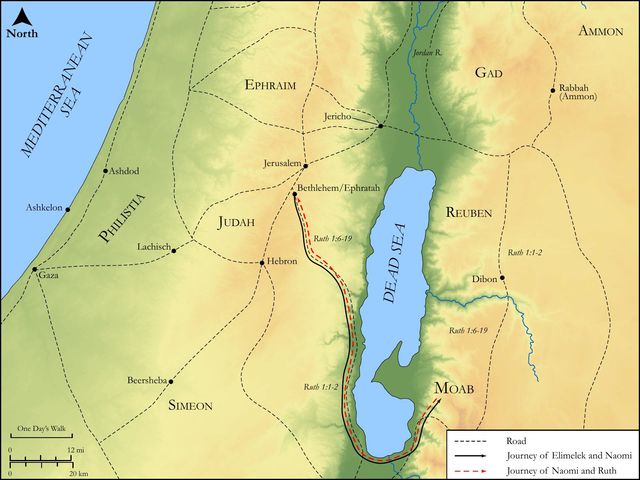
See on the biblical-era map
Study this verse
Public-domain commentary
Matthew Henry
From his Commentary on the Whole Bible. Henry comments on passages, not single verses — this entry covers Ruth 4:13–22. His three-level outline is real structure in the source text, so it is rendered as structure.
Here is, I. Ruth a wife. Boaz took her, with the usual solemnities, to his house, and she became his wife (Rut 4:13), all the city, no doubt, congratulating the preferment of a virtuous woman, purely for her virtues. We have reason to think that Orpah, who returned from Naomi to her people and her gods, was never half so well preferred as Ruth was. He that forsakes all for Christ shall find more than all with him; it shall be recompensed a hundred-fold in this present time. Now Orpah wished she had gone with Naomi too; but she, like the other kinsman, stood in her own light. Boaz had prayed that this pious proselyte might receive a full reward of her courage and constancy from the God of Israel, under whose wings she had come to trust; and now he became an instrument of that kindness, which was an answer to his prayer, and helped to make his own words good. Now she had the command of those servants with whom she had associated and of those fields in which she had gleaned. Thus sometimes God raiseth up the poor out of the dust, to set them with princes, Psa 113:7, Psa 113:8.
II.Ruth a mother:
The Lord gave her conception; for the fruit of the womb is his reward, Psa 127:3. It is one of the keys he hath in his hand; and he sometimes makes the barren woman that had been long so to be a joyful mother of children, Psa 113:9; Isa 54:1.
III.Ruth still a daughter-in-law, and the same that she always was, to Naomi, who was so far from being forgotten that she was a principal sharer in these new joys. The good women that were at the labour when this child was born congratulated Naomi upon it more than either Boaz or Ruth, because she was the match-maker, and it was the family of her husband that was hereby built up. See here, as before, what an air of devotion there was then even in the common expressions of civility among the Israelites. Prayer to God attended the birth of the child. What a pity it is that such pious language should either be disused among Christians or degenerate into a formality. "Blessed be the Lord that has sent thee this grandson," Rut 4:14, Rut 4:15.
1.Who was the preserver of the name of her family, and who, they hoped, would be famous, because his father was so.
2.Who would be hereafter dutiful and kind to her, so they hoped, because his mother was so. If he would but take after her, he would be a comfort to his aged grandmother, a restorer of her life, and, if there should be occasion, would have wherewithal to be the nourisher of her old age. It is a great comfort to those that are going into years to see any of those that descend from them growing up, that are likely, by the blessing of God, to be a stay and support to them, when the years come wherein they will need such, and of which they will say they have no pleasure in them. Observe, They say of Ruth that she loved Naomi, and therefore was better to her than seven sons. See how God in his providence sometimes makes up the want and loss of those relations from whom we expected most comfort in those from whom we expected least. The bonds of love prove stronger than those of nature, and there is a friend that sticks closer than a brother; so here there was a daughter-in-law better than an own child. See what wisdom and grace will do. Now here,
(1.)The child is named by the neighbours, Rut 4:17. The good women would have it called Obed, a servant, either in remembrance of the meanness and poverty of the mother or in prospect of his being hereafter a servant, and very serviceable, to his grandmother. It is no dishonour to those that are ever so well born to be servants to God, their friends, and their generation. The motto of the princes of Wales is Ich dien - I serve.
(2.)The child is nursed by the grandmother, that is, dry-nursed, when the mother had weaned him from the breast, Rut 4:16. She laid it in her bosom, in token of her tender affection to it and care of it. Grandmothers are often the most fond.
IV.Ruth is hereby brought in among the ancestors of David and Christ, which was the greatest honour.
The genealogy is here drawn from Pharez, through Boaz and Obed, to David, and so leads towards the Messiah, and therefore it is not an endless genealogy.
Historical interpretation
Seven Centuries of Reception
2 surviving comments on this verse. Each one is dated, so this reads as a timeline rather than a list.
Select a marker to jump to its quote. Markers stagger vertically where authors wrote within a few decades of each other.
Let Tamar rejoice that her Lord has come, for her name announced the son of her Lord, and her appellation called you to come to her.By you honorable women made themselves contemptible, [you] the One who makes all chaste. She stole you at the crossroads, [you] who prepared the road to the house of the kingdom. Since she stole life, the sword was insufficient to kill her.
Ruth lay down with a man on the threshing floor for your sake. Her love was bold for your sake. She teaches boldness to all penitents. Her ears held in contempt all [other] voices for the sake of your voice.
The fiery coal that crept into the bed of Boaz went up and lay down. She saw the Chief Priest hidden in his loins, the fire for his censer. She ran and became the heifer of Boaz. For you she brought forth the fatted ox.
She went gleaning for love of you; she gathered straw. You repaid her quickly the wage of her humiliation: instead of ears [of wheat], the Root of kings, and instead of straw, the Sheaf of Life that descends from her.
And Boaz begat Obed of Ruth. Ruth was a foreigner, but nevertheless she was married to Boaz. So, too, the church is from among the Gentiles. For like Ruth, these Gentiles had been foreigners and outside the covenants, yet they forsook their people, their idols and their father, the devil. And as Ruth was wed to Boaz of the seed of Abraham, so too was the church taken as bride by the Son of God.
Continue studying Ruth 4:14 across the web’s major study libraries — every link below opens this exact verse, chapter, or book on the destination site.
Read & Compare
 BibleGatewayThis verse in more than 200 translations and 70 languages.
 Bible.comThe YouVersion reader — hundreds of translations, reading plans, and highlights.
 ESV.orgCrossway's official English Standard Version reader.
 NET BibleThe NET translation with 60,000+ translators' notes on every rendering decision.
 STEP BibleTyndale House's free study tool — original text, vocabulary, and scholarly resources.
 BibliaLogos Bible Software's free web reader.
 USCCBThe New American Bible (Revised Edition) with the U.S. bishops' study notes.
Commentaries
 BibleHub CommentariesDozens of classic commentaries on this verse, gathered on one page.
 StudyLightMore than 100 commentary sets — the largest collection on the web.
 BibleRefPlain-English commentary on what this verse means, verse by verse.
 Enduring WordDavid Guzik's free commentary on this chapter, widely used by Bible teachers.
 Bible Study ToolsVerse commentary alongside Greek and Hebrew study aids.
Original Language & Research
- BibleHub InterlinearThe verse word by word — original language, transliteration, and English.
- BibleHub LexiconEvery word's original-language definition and Strong's entry.
 Blue Letter BibleDeep-study tools — Strong's numbers, concordance, and word studies.
 SefariaThe Hebrew text with Rashi and centuries of Jewish commentary.
Sermons, Hymns & Audio


TrulyRandomVerse is not affiliated with these sites and doesn’t control their content. They’re linked because they’re genuinely useful.
Summary
Ruth 4:14 marks the triumphant climax of the book, articulating a profound reversal of fortune for Naomi. After enduring deep sorrow and loss, the women of Bethlehem pronounce a heartfelt blessing, acknowledging the Lord's unwavering faithfulness in providing a kinsman-redeemer. This divine provision ensures the continuation of Naomi's family line and the establishment of a renowned legacy in Israel, celebrating the meticulous divine orchestration that transformed Naomi's bitterness into abundant joy and a secure future.
Context
ShowHideLiterary Context
This verse serves as the emotional and narrative culmination of the book of Ruth, immediately following the formal gate transaction where Boaz legally secured his right to redeem Naomi's land and marry Ruth. This act was crucial for ensuring the continuation of Elimelech's family line and legacy. The women's communal blessing in this verse is a joyous response to the birth of Obed, the son of Ruth and Boaz, signifying the complete and miraculous reversal of Naomi's fortunes. From her initial return to Bethlehem, where she famously lamented her bitter fate and instructed the women to call her "Mara" (meaning "bitter") as recorded in Ruth 1:20, Naomi now experiences profound restoration. She witnesses the Lord's abundant provision and the re-establishment of her legacy through her grandson. The women's blessing acts as the final communal affirmation of God's redemptive work in the lives of these faithful individuals, bringing the narrative full circle from despair to delight.
Historical & Cultural Context
The social fabric of ancient Israel placed immense importance on family lineage, land inheritance, and the continuation of a family name, especially for those who had no male heir. The concept of the go'el, or kinsman-redeemer, was a vital legal and social institution. This role obligated the nearest male relative to protect the family's interests, which could include buying back sold land (as detailed in Leviticus 25:25), avenging bloodshed, or, as is paramount in this narrative, marrying a deceased relative's widow to raise an heir for the deceased brother or relative (known as levirate marriage, described in Deuteronomy 25:5-10). This verse highlights the community's understanding and celebration of Boaz's faithful fulfillment of this sacred duty, which ensured Naomi's security and the preservation of her husband's name in Israel. The collective voice of the women also underscores the significant role of communal affirmation and blessing in Israelite society, where such significant life events were publicly acknowledged and celebrated.
Key Themes
ShowHideThis verse powerfully encapsulates several overarching themes of the book of Ruth. First, Divine Providence and Faithfulness are central, as the women explicitly attribute Naomi's restoration to the Lord, who "hath not left thee this day without a kinsman." This underscores God's active, behind-the-scenes orchestration of events, transforming Naomi's bitterness into blessing, a stark contrast between her lament in Ruth 1:20 and the joyous pronouncements in Ruth 4:15. Second, the theme of the Kinsman-Redeemer (Go'el) is paramount, with Boaz embodying this role by securing Ruth's future and Naomi's lineage, demonstrating selfless love and adherence to covenant law, as Ruth herself recognized in Ruth 3:9. Finally, Restoration and Legacy are celebrated through the birth of Obed. His arrival not only restores Naomi's hope and secures her future but also ensures the continuation of Elimelech's name and, significantly, places Ruth and Boaz in the direct messianic lineage that culminates in King David, as noted in Ruth 4:17 and later affirmed in the New Testament in Matthew 1:5. This fulfills the desire that Boaz's "name may be famous in Israel," ensuring a lasting and significant heritage.
Exposition and Analysis
ShowHideKey Word Analysis
ShowHideThis term (H1288) is a primitive root meaning "to kneel"; by implication, "to bless God (as an act of adoration), and (vice-versa) man (as a benefit)." In this context, it signifies the women's act of adoration and praise directed toward the LORD, acknowledging His divine favor and beneficial action in Naomi's life. It expresses profound gratitude and recognition of God's goodness and provision.
This word (H1350) refers to a primitive root meaning "to redeem (according to the Oriental law of kinship), i.e., to be the next of kin (and as such to buy back a relative's property, marry his widow, etc.)." The go'el (kinsman-redeemer) was a crucial figure in Israelite society, responsible for protecting the family's integrity, property, and lineage. Here, it specifically refers to Boaz, who faithfully fulfilled this role for Naomi and Ruth, ensuring the continuation of Elimelech's family line.
While the KJV translates this as "famous," the underlying Hebrew root (H7121) literally means "to call out to," or "to call by name," implying a public proclamation or recognition. The phrase "that his name may be famous in Israel" (וְיִקָּרֵא שְׁמוֹ בְּיִשְׂרָאֵל, wəyiqqārē' šmô bəyiśrā'ēl) implies that Boaz's name and deeds will be publicly acknowledged and honored throughout Israel, signifying a reputation of integrity, righteousness, and lasting legacy, particularly through the lineage he establishes.
Verse Breakdown
ShowHide"And the women said unto Naomi"
This opening clause emphasizes the communal voice of Bethlehem's women. These are the same women who witnessed Naomi's despairing return to Bethlehem, where she famously instructed them to call her "Mara" (Ruth 1:19). Their collective pronouncement here signifies the community's profound recognition and celebration of God's redemptive work in Naomi's life, validating the complete transformation of her circumstances from emptiness to fullness. It underscores the social and spiritual significance of the events for the entire community.
"Blessed [be] the LORD, which hath not left thee this day without a kinsman"
The women's immediate and heartfelt response is to bless the Lord, acknowledging Him as the ultimate source of Naomi's restoration and the orchestrator of all good things. This declaration directly counters Naomi's earlier lament that the Lord's hand was against her and had dealt bitterly with her (Ruth 1:21). The phrase "without a kinsman" (מִגֹּאֵל, mi-go'el) highlights the divine provision of Boaz, the go'el, as the instrument of God's faithfulness. This provision ensures Naomi's security, the preservation of her family line, and the reversal of her desolate state.
"that his name may be famous in Israel"
This concluding clause expresses the community's fervent desire for Boaz's righteous actions to be publicly honored and remembered throughout Israel. It speaks to the immense importance of a good reputation and a lasting legacy within the covenant community, especially for one who so faithfully upheld the law and demonstrated such generosity and integrity. The "name" (שֵׁם, shem) here encompasses not only Boaz's personal identity but also his character, his exemplary deeds, and the significant lineage he establishes through his role as redeemer and the father of Obed, who would become the grandfather of the revered King David.
Literary Devices
ShowHideRuth 4:14 employs several powerful literary devices that enhance its meaning and emotional impact. The most prominent is Irony and Contrast, as it directly reverses Naomi's initial despair and self-identification as "Mara" (bitter) upon her return to Bethlehem (Ruth 1:20). The women's blessing, "Blessed be the LORD," marks a complete turnaround, highlighting God's redemptive work in transforming sorrow into profound joy and emptiness into fullness. There is also significant Foreshadowing, particularly in the desire for Boaz's "name" to be famous. This desire for a lasting legacy is fulfilled far beyond their immediate understanding, as Obed becomes the grandfather of King David, thereby placing Boaz and Ruth directly in the messianic lineage. Finally, the Communal Voice of the women serves as a crucial narrative device, validating the divine work and the righteousness of Boaz's actions, emphasizing the social and theological significance of the events for the entire community and underscoring the public nature of God's redemptive plan.
Theological and Thematic Connections
ShowHideRuth 4:14 serves as a profound theological statement on God's active and faithful providence in the lives of His people. It underscores that even in periods of deep personal loss, perceived abandonment, and seemingly insurmountable challenges, the Lord is meticulously working behind the scenes to bring about restoration and fulfill His purposes. The women's blessing attributes the provision of the kinsman-redeemer directly to God, highlighting His compassionate care for the vulnerable and His unwavering commitment to upholding His covenant promises. This divine faithfulness is not merely a passive observation but an active, sovereign intervention, transforming barrenness into fruitfulness and despair into hope, ultimately pointing to a greater redemptive plan for humanity.
Reflection and Application
ShowHideThe narrative climax in Ruth 4:14 offers enduring lessons for contemporary believers, calling us to cultivate a deep and unwavering trust in God's sovereign faithfulness, even when our circumstances seem bleak and our hopes diminished. Naomi's journey from "Mara" (bitter) to being profoundly blessed illustrates that God is capable of reversing our deepest sorrows and bringing forth unexpected joy and abundant provision. This verse also emphasizes the vital role of community in our spiritual journeys – the women's blessing reminds us of the power of communal affirmation, support, and shared celebration of God's goodness and redemptive work in individual lives. Furthermore, it challenges us to consider how we, like Boaz, can embody selfless love, integrity, and redemptive action in our spheres of influence, becoming instruments of God's blessing and restoration for others, thereby leaving a legacy of righteousness that honors His name and extends His kingdom.
Questions for Reflection
ShowHideFAQ
ShowHideWhy is the communal blessing of the women so significant in this verse?
ShowHideThe communal blessing of the women in Ruth 4:14 is profoundly significant for several interconnected reasons. Firstly, it provides a public and emphatic affirmation of God's active hand in Naomi's life, transforming her lament of bitterness (Ruth 1:20) into a declaration of blessing and fullness. Their collective voice represents the community's recognition of divine providence and Boaz's righteous fulfillment of the kinsman-redeemer role. Secondly, it underscores the importance of communal witness and celebration within ancient Israelite society, where events of such magnitude, particularly concerning lineage, land, and the continuation of a family name, were publicly acknowledged and validated. Their blessing also echoes the earlier blessing from the elders at the gate (Ruth 4:11-12), reinforcing the widespread approval and joy surrounding the union of Ruth and Boaz and the subsequent birth of Obed. It highlights that God's redemptive work often unfolds within and through the affirmation and participation of His people, making His faithfulness evident to all.
Christ-Centered Fulfillment
ShowHideRuth 4:14, with its celebration of the kinsman-redeemer and the restoration of lineage, powerfully foreshadows the ultimate redemption found in Jesus Christ. Just as Boaz, the go'el, stepped in to redeem Naomi's lost inheritance and secure her lineage, so Christ, our divine Kinsman, entered humanity's brokenness to redeem us from the curse of sin and death (Galatians 3:13). He, being fully God and fully man, became our "next-of-kin" by taking on flesh (Hebrews 2:14-17), thereby qualifying to pay the ultimate price for our redemption through His sacrificial death on the cross (1 Peter 1:18-19). The women's desire for Boaz's "name to be famous" finds its supreme and eternal fulfillment in the name of Jesus, which is above every name (Philippians 2:9-11), through whom all things are reconciled to God. Through Christ, we, who were once alienated and without hope, are brought into God's family and receive an inheritance that is imperishable and undefiled (Ephesians 1:7 and 1 Peter 1:3-4), far surpassing the temporal restoration experienced by Naomi, providing eternal hope and a glorious spiritual legacy.