


Genesis 38:8
- וַיֹּאמֶרvai·Yo·merand he saidH559Conj-w ¦ V-Qal-ConsecImperf-3msVerb Qal Consecutive Imperfect 3rd Singular Masculineוַandיֹּאמֶרhe said
- יְהוּדָהye·hu·DahJudahH3063N-proper-mNoun Proper Masculine
- לְאוֹנָןle·'o·Nanto OnanH209Prep-l ¦ N-proper-mNoun Proper MasculineלְtoאוֹנָןOnan
- בֹּאbo'goH935V-Qal-Imp-2msVerb Qal Imperative 2nd Singular Masculine
- אֶל'elintoH413PrepPreposition
- אֵשֶׁת'E·shet[the] wife ofH802N-fscNoun Singular Feminine Construct
- אָחִיךָ'a·Chi·khayour brotherH251N-msc ¦ 2msNoun Singular Masculine Constructאָחִיbrotherךָyour
- וְיַבֵּםve·ya·Bemand act as a husband's brother forH2992Conj-w ¦ V-Piel-Imp-2msVerb Piel Imperative 2nd Singular Masculineוְandיַבֵּםact as a husband's brother for
- אֹתָהּ'o·Tah<obj.> herH853DirObjM ¦ 3fsParticle Object Indicatorאֹתָ<obj.>הּher
- וְהָקֵםve·ha·Kemand raise upH6965Conj-w ¦ V-Hiphil-Imp-2msVerb Hiphil Imperative 2nd Singular Masculineוְandהָקֵםraise up
- זֶרַעZe·ra'offspringH2233N-msNoun Singular Masculine Absolute
- לְאָחִיךָle·'a·Chi·khafor your brotherH251Prep-l ¦ N-msc ¦ 2msNoun Singular Masculine Constructלְforאָחִיbrotherךָyour
English is a literal word-by-word gloss of the Hebrew, not the KJV's wording. Why?
This is the original text the KJV's translators worked from — each Hebrew word with its own literal English meaning in this verse, prepared by scholars at Tyndale House, Cambridge. The KJV translates whole sentences, not word by word, so its wording differs: one Hebrew word can become several English words, and the KJV may choose “the LORD” where the gloss reads “Yahweh”. Both are faithful — they answer different questions. For the KJV's own rendering, switch to the KJV text.
Details
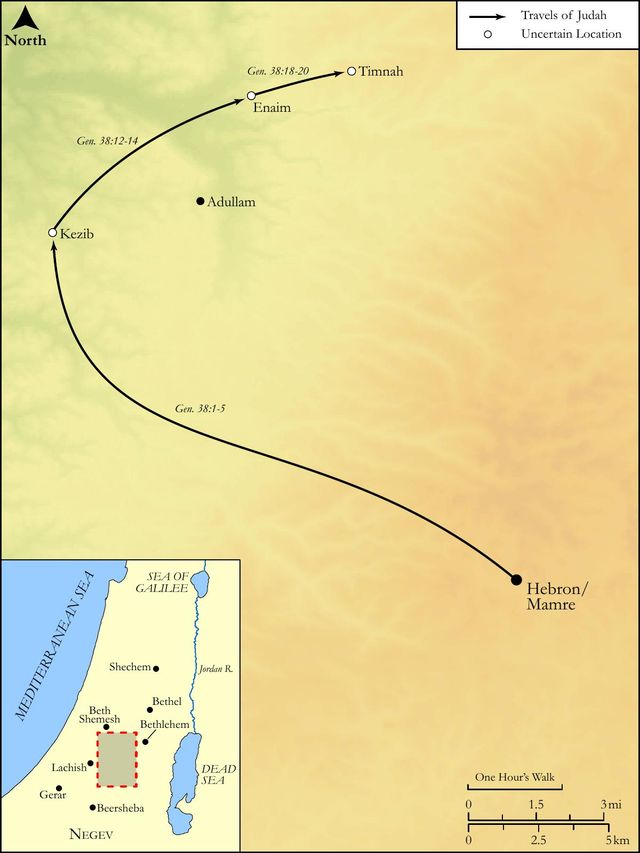
See on the biblical-era map


Study this verse
Public-domain commentary
Matthew Henry
From his Commentary on the Whole Bible. Henry comments on passages, not single verses — this entry covers Genesis 38:1–11.
Here is, 1. Judah's foolish friendship with a Canaanite-man. He went down from his brethren, and withdrew for a time from their society and his father's family, and got to be intimately acquainted with one Hirah, an Adullamite, Gen 38:1. It is computed that he was now not much above fifteen or sixteen years of age, an easy prey to the tempter. Note, When young people that have been well educated begin to change their company, they will soon change their manners, and lose their good education. Those that go down from their brethren, that despise and forsake the society of the seed of Israel, and pick up Canaanites for their companions, are going down the hill apace. It is of great consequence to young people to choose proper associates; for these they will imitate, study to recommend themselves to, and, by their opinion of them, value themselves: an error in this choice is often fatal. 2. His foolish marriage with a Canaanite-woman, a match made, not by his father, who, it should seem, was not consulted, but by his new friend Hirah, Gen 38:2. Many have been drawn into marriages scandalous and pernicious to themselves and their families by keeping bad company, and growing familiar with bad people: one wicked league entangles men in another. Let young people be admonished by this to take their good parents for their best friends, and to be advised by them, and not by flatterers, who wheedle them, to make a prey of them. 3. His children by this Canaanite, and his disposal of them. Three sons he had by her, Er, Onan, and Shelah. It is probable that she embraced the worship of the God of Israel, at least in profession, but, for aught that appears, there was little of the fear of God in the family. Judah married too young, and very rashly; he also married his sons too young, when they had neither wit nor grace to govern themselves, and the consequences were very bad. (1.) His first-born, Er, was notoriously wicked; he was so in the sight of the Lord, that is, in defiance of God and his law; or, if perhaps he was not wicked in the sight of God, to whom all men's wickedness is open; and what came of it? Why, God cut him off presently (Gen 38:7): The Lord slew him. Note, Sometimes God makes quick work with sinners, and takes them away in his wrath, when they are but just setting out in a wicked course of life. (2.) The next son, Onan, was, according to the ancient usage, married to the widow, to preserve the name of his deceased brother that died childless. Though God had taken away his life for his wickedness, yet they were solicitous to preserve his memory; and their disappointment therein, through Onan's sin, was a further punishment of his wickedness. The custom of marrying the brother's widow was afterwards made one of the laws of Moses, Deu 25:5. Onan, though he consented to marry the widow, yet, to the great abuse of his own body, of the wife that he had married, and of the memory of his brother that was gone, he refused to raise up seed unto his brother, as he was in duty bound. This was so much the worse because the Messiah was to descend from Judah, and, had he not been guilty of this wickedness, he might have had the honour of being one of his ancestors. Note, Those sins that dishonour the body and defile it are very displeasing to God and evidences of vile affections. (3.) Shelah, the third son, was reserved for the widow (Gen 38:11), yet with a design that he should not marry so young as his brothers had done, lest he die also. Some think that Judah never intended to marry Shelah to Tamar, but unjustly suspected her to have been the death of her two former husbands (whereas it was their own wickedness that slew them), and then sent her to her father's house, with a charge to remain a widow. If so, it was an inexcusable piece of prevarication that he was guilty of. However, Tamar acquiesced for the present, and waited the issue.
Continue studying Genesis 38:8 across the web’s major study libraries — every link below opens this exact verse, chapter, or book on the destination site.
Read & Compare
 BibleGatewayThis verse in more than 200 translations and 70 languages.
 Bible.comThe YouVersion reader — hundreds of translations, reading plans, and highlights.
 ESV.orgCrossway's official English Standard Version reader.
 NET BibleThe NET translation with 60,000+ translators' notes on every rendering decision.
 STEP BibleTyndale House's free study tool — original text, vocabulary, and scholarly resources.
 BibliaLogos Bible Software's free web reader.
 USCCBThe New American Bible (Revised Edition) with the U.S. bishops' study notes.
Commentaries
 BibleHub CommentariesDozens of classic commentaries on this verse, gathered on one page.
 StudyLightMore than 100 commentary sets — the largest collection on the web.
 BibleRefPlain-English commentary on what this verse means, verse by verse.
 Enduring WordDavid Guzik's free commentary on this chapter, widely used by Bible teachers.
 Bible Study ToolsVerse commentary alongside Greek and Hebrew study aids.
Original Language & Research
- BibleHub InterlinearThe verse word by word — original language, transliteration, and English.
- BibleHub LexiconEvery word's original-language definition and Strong's entry.
 Blue Letter BibleDeep-study tools — Strong's numbers, concordance, and word studies.
 SefariaThe Hebrew text with Rashi and centuries of Jewish commentary.
Sermons, Hymns & Audio


TrulyRandomVerse is not affiliated with these sites and doesn’t control their content. They’re linked because they’re genuinely useful.
Summary
Genesis 38:8 records Judah's explicit command to his second son, Onan, to fulfill the ancient custom of levirate marriage by taking his deceased elder brother Er's wife, Tamar, and "raising up seed" for Er. This instruction is a pivotal moment in the narrative, illustrating the deep-seated societal and familial obligation to preserve a deceased brother's lineage and inheritance, even before the formal codification of such laws in Israelite jurisprudence.
Context
ShowHideLiterary Context
This verse is situated within a significant narrative interlude (Genesis 38) that temporarily shifts focus from the main storyline of Joseph and his brothers. This chapter serves several crucial literary functions: it highlights Judah's character development, foreshadows the prominence of his lineage in the patriarchal narrative, and demonstrates the challenges and complexities of family life, succession, and moral responsibility within the early Israelite context. The events of this chapter, including Judah's command to Onan, immediately follow Joseph's sale into slavery, providing a stark contrast to the unfolding divine plan for Joseph while subtly advancing the broader covenantal narrative through Judah's line.
Historical & Cultural Context
Genesis 38:8 reflects the widespread ancient Near Eastern custom of levirate marriage, known in Hebrew as yibbum (from the root יבם, meaning "to perform the duty of a husband's brother"). While later formalized in the Mosaic Law (e.g., Deuteronomy 25:5-10), its appearance here demonstrates its pre-Mosaic origins as an established social norm. The primary purpose of this custom was to prevent the extinction of a family line, particularly when a man died childless. Without an heir, his name would perish, and his inheritance, especially land, would be lost to his immediate family. The surviving brother's duty was to ensure the deceased's name and property continued through an heir who would legally be considered the deceased's offspring.
Key Themes
ShowHideThe command to Onan in Genesis 38 contributes to several overarching themes in Genesis and the broader biblical narrative. Firstly, it underscores the importance of lineage and inheritance, particularly within the patriarchal covenant, where the promise of a "seed" (offspring) is central to God's plan for Israel and, ultimately, for humanity. Secondly, it highlights family duty and social obligation, emphasizing the responsibilities individuals held within their kinship groups to uphold tradition and ensure continuity. Lastly, the chapter, including this verse, subtly introduces the theme of divine providence working through human complexity and moral failure, as God's plan for the promised "seed" (the Messiah) continues to unfold despite the flawed actions of individuals like Judah and Onan. This theme is further explored in later narratives, such as the story of Ruth and Boaz, which explicitly references the levirate custom.
Exposition and Analysis
ShowHideKey Word Analysis
ShowHideThis primitive root, used only as a denominative from יָבָם (yabam, "brother-in-law"), specifically means "to marry a (deceased) brother's widow" or "to perform the duty of a husband's brother." It denotes the unique and legally binding obligation of levirate marriage, distinct from a general marriage, emphasizing the specific familial duty involved.
This primitive root signifies "to rise" or "to cause to stand." In this context, combined with "seed," it means "to establish," "to set up," or "to cause to endure." It conveys the active and intentional effort required to perpetuate the deceased brother's line, ensuring his name and legacy would not be extinguished.
From the root זָרַע (zaraʻ, "to sow"), this noun literally means "seed." Figuratively, it refers to offspring, progeny, or posterity. In Genesis 38:8, "seed" is not merely any child but a specific heir who would legally carry on the deceased brother Er's name and inherit his portion, thus preserving his identity within the tribal structure.
Verse Breakdown
ShowHide"And Judah said unto Onan,"
This opening clause establishes Judah's authority as the patriarch and the one issuing the command. It highlights the direct, personal nature of the instruction, underscoring the weight of familial expectation and responsibility placed upon Onan by his father.
"Go in unto thy brother's wife,"
This phrase is a common biblical idiom for engaging in sexual intercourse, specifically within the context of marriage or a recognized union. It signifies the expectation that Onan would consummate the marriage with Tamar, his deceased brother Er's widow, as the necessary step for procreation.
"and marry her,"
This command directly instructs Onan to formalize the union with Tamar under the custom of levirate marriage. It implies not just cohabitation but a legally recognized marital bond, which carried with it specific rights and obligations for both parties, particularly concerning the raising of an heir.
"and raise up seed to thy brother."
This is the core purpose of Judah's command and the essence of levirate marriage. The phrase "raise up seed" (Hebrew: הָקֵם זֶרַע, haqem zera) means to establish or cause to stand up offspring. The crucial detail is "to thy brother," meaning the child born from this union would legally be considered the son of the deceased Er, not Onan. This ensured the continuation of Er's name, lineage, and inheritance rights within the family.
Literary Devices
ShowHideThe verse employs Direct Command to convey Judah's authoritative instruction to Onan, emphasizing the non-negotiable nature of the familial duty. The phrase "Go in unto thy brother's wife" functions as a Euphemism for sexual intercourse, common in biblical texts, which maintains decorum while clearly indicating the expected action. Furthermore, the entire command serves as a form of Foreshadowing, as Onan's subsequent refusal to fulfill this duty (Genesis 38:9) and its consequences become central to the narrative's unfolding and Judah's own moral development. The repetition of "thy brother" also highlights the central Theme of fraternal obligation and the preservation of lineage.
Theological and Thematic Connections
ShowHideGenesis 38:8 powerfully illustrates the profound biblical emphasis on lineage, inheritance, and the preservation of a family's name. In a society where identity and covenant promises were intimately tied to one's descendants, the continuation of a family line was not merely a social custom but often held theological significance. This verse, though set in a complex and morally ambiguous narrative, underscores God's sovereign commitment to His covenantal promises, which are often traced through specific family lines. Even amidst human failures and deviations, God's overarching plan for the "seed" of Abraham, and ultimately the Messiah, continues to unfold. The levirate custom, while earthly in its function, points to a divine concern for continuity and the provision for the vulnerable, especially widows, ensuring their place and security within the community.
Reflection and Application
ShowHideWhile the specific practice of levirate marriage is not a contemporary societal norm, Genesis 38:8 presents enduring principles for reflection and application. It calls us to consider the profound importance of legacy – not just material inheritance, but the spiritual heritage we pass on. How do our actions today contribute to the "raising up of seed" in a spiritual sense, nurturing faith and godly character in future generations? The passage also highlights the biblical call to familial responsibility and the care for vulnerable members of our communities, particularly those who may be overlooked or without support. Onan's failure reminds us that duty, when performed with selfish motives or neglect, can have severe consequences. This narrative encourages believers to live with integrity, fulfilling their obligations, and trusting in God's sovereign plan, even when circumstances are challenging or unclear.
Questions for Reflection
ShowHideFAQ
ShowHideWhat is levirate marriage?
ShowHideLevirate marriage (from Latin levir, "brother-in-law"; Hebrew yibbum) is an ancient custom, practiced in the Near East and later codified in Israelite law, where a man marries his deceased, childless brother's widow. The purpose is to produce an heir who will legally be considered the deceased brother's son, thus preserving his name, lineage, and inheritance. This practice is notably seen in Deuteronomy 25:5-10 and exemplified in the story of Ruth and Boaz.
Why was it so important to "raise up seed" for the deceased brother?
ShowHideIn ancient patriarchal societies, a man's identity, social standing, and connection to the land and covenant promises were intrinsically linked to his lineage. Dying without an heir meant his name would effectively vanish from the family line, and his inheritance, often including ancestral land, would be lost. The act of "raising up seed" ensured the continuation of the deceased's name and the preservation of his property rights, maintaining his place within the tribal and familial structure. It was a matter of honor, legacy, and economic stability for the family unit.
Christ-Centered Fulfillment
ShowHideGenesis 38:8, with its emphasis on the critical importance of preserving a family line, points profoundly toward the ultimate fulfillment found in Jesus Christ. The meticulous record of genealogies throughout Scripture, particularly the tracing of the lineage of Judah (from whom the Messiah would come), underscores God's unwavering commitment to His covenant promises, first given to Abraham concerning his "seed" (Genesis 12:7). Even through the complexities, moral failures, and human customs depicted in this chapter, God sovereignly preserved the very lineage that would ultimately lead to the birth of the "seed of the woman" (Genesis 3:15) who would crush the serpent's head. The earthly levirate law, designed to "raise up seed" for a deceased brother, foreshadows Christ's divine work: He, as our heavenly "Brother" (Hebrews 2:11-12), raises up a spiritual "seed" for God, bringing many "sons to glory" (Hebrews 2:10). Through His death and resurrection, Jesus ensures an eternal inheritance and a spiritual lineage for all who are united to Him by faith, fulfilling the promise that in Abraham's "seed" (who is Christ, Galatians 3:16), all nations would be blessed.