


Genesis 38:7
- וַיְהִיvay·Hiand he wasH1961Conj-w ¦ V-Qal-ConsecImperf-3msVerb Qal Consecutive Imperfect 3rd Singular Masculineוַandיְהִיhe was
- עֵר'erErH6147N-proper-mNoun Proper Masculine
- בְּכוֹרbe·Khor[the] firstborn ofH1060N-mscNoun Singular Masculine Construct
- יְהוּדָהye·hu·DahJudahH3063N-proper-mNoun Proper Masculine
- רַעra'evilH7451Adj-msAdjective Singular Masculine Absolute
- בְּעֵינֵיbe·'ei·Neiin [the] eyes ofH5869Prep-b ¦ N-fdcNoun Dual Feminine Constructבְּinעֵינֵי[the] eyes of
- יְהוָהYah·wehYahwehH3068N-properNoun Proper Title
- וַיְמִתֵהוּvay·mi·Te·huand he put to death himH4191Conj-w ¦ V-Hiphil-ConsecImperf-3ms ¦ 3msVerb Hiphil Consecutive Imperfect 3rd Singular Masculineוַandיְמִתֵhe put to deathהוּhim
- יְהוָהYah·wehYahwehH3068N-properNoun Proper Title
English is a literal word-by-word gloss of the Hebrew, not the KJV's wording. Why?
This is the original text the KJV's translators worked from — each Hebrew word with its own literal English meaning in this verse, prepared by scholars at Tyndale House, Cambridge. The KJV translates whole sentences, not word by word, so its wording differs: one Hebrew word can become several English words, and the KJV may choose “the LORD” where the gloss reads “Yahweh”. Both are faithful — they answer different questions. For the KJV's own rendering, switch to the KJV text.
Details
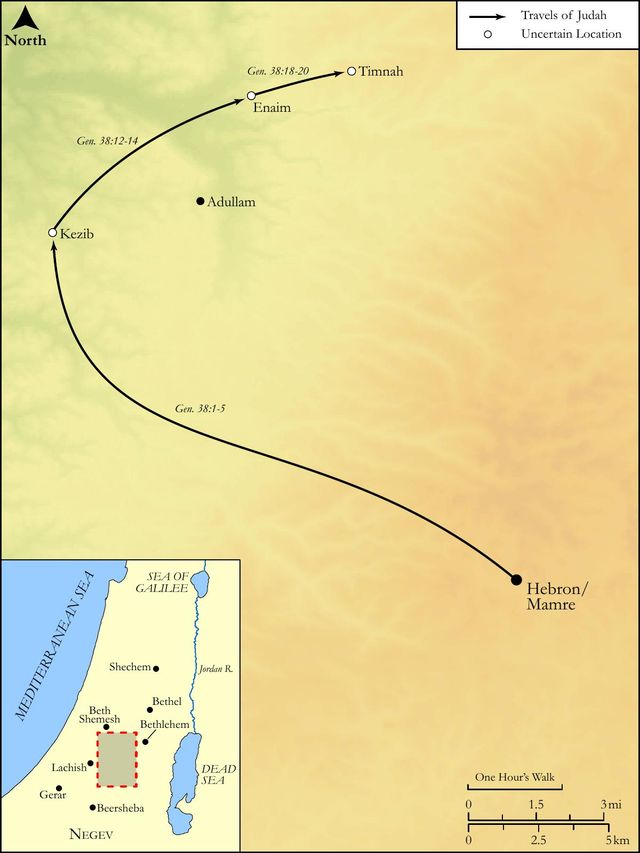
See on the biblical-era map


Study this verse
Public-domain commentary
Matthew Henry
From his Commentary on the Whole Bible. Henry comments on passages, not single verses — this entry covers Genesis 38:1–11.
Here is, 1. Judah's foolish friendship with a Canaanite-man. He went down from his brethren, and withdrew for a time from their society and his father's family, and got to be intimately acquainted with one Hirah, an Adullamite, Gen 38:1. It is computed that he was now not much above fifteen or sixteen years of age, an easy prey to the tempter. Note, When young people that have been well educated begin to change their company, they will soon change their manners, and lose their good education. Those that go down from their brethren, that despise and forsake the society of the seed of Israel, and pick up Canaanites for their companions, are going down the hill apace. It is of great consequence to young people to choose proper associates; for these they will imitate, study to recommend themselves to, and, by their opinion of them, value themselves: an error in this choice is often fatal. 2. His foolish marriage with a Canaanite-woman, a match made, not by his father, who, it should seem, was not consulted, but by his new friend Hirah, Gen 38:2. Many have been drawn into marriages scandalous and pernicious to themselves and their families by keeping bad company, and growing familiar with bad people: one wicked league entangles men in another. Let young people be admonished by this to take their good parents for their best friends, and to be advised by them, and not by flatterers, who wheedle them, to make a prey of them. 3. His children by this Canaanite, and his disposal of them. Three sons he had by her, Er, Onan, and Shelah. It is probable that she embraced the worship of the God of Israel, at least in profession, but, for aught that appears, there was little of the fear of God in the family. Judah married too young, and very rashly; he also married his sons too young, when they had neither wit nor grace to govern themselves, and the consequences were very bad. (1.) His first-born, Er, was notoriously wicked; he was so in the sight of the Lord, that is, in defiance of God and his law; or, if perhaps he was not wicked in the sight of God, to whom all men's wickedness is open; and what came of it? Why, God cut him off presently (Gen 38:7): The Lord slew him. Note, Sometimes God makes quick work with sinners, and takes them away in his wrath, when they are but just setting out in a wicked course of life. (2.) The next son, Onan, was, according to the ancient usage, married to the widow, to preserve the name of his deceased brother that died childless. Though God had taken away his life for his wickedness, yet they were solicitous to preserve his memory; and their disappointment therein, through Onan's sin, was a further punishment of his wickedness. The custom of marrying the brother's widow was afterwards made one of the laws of Moses, Deu 25:5. Onan, though he consented to marry the widow, yet, to the great abuse of his own body, of the wife that he had married, and of the memory of his brother that was gone, he refused to raise up seed unto his brother, as he was in duty bound. This was so much the worse because the Messiah was to descend from Judah, and, had he not been guilty of this wickedness, he might have had the honour of being one of his ancestors. Note, Those sins that dishonour the body and defile it are very displeasing to God and evidences of vile affections. (3.) Shelah, the third son, was reserved for the widow (Gen 38:11), yet with a design that he should not marry so young as his brothers had done, lest he die also. Some think that Judah never intended to marry Shelah to Tamar, but unjustly suspected her to have been the death of her two former husbands (whereas it was their own wickedness that slew them), and then sent her to her father's house, with a charge to remain a widow. If so, it was an inexcusable piece of prevarication that he was guilty of. However, Tamar acquiesced for the present, and waited the issue.
Continue studying Genesis 38:7 across the web’s major study libraries — every link below opens this exact verse, chapter, or book on the destination site.
Read & Compare
 BibleGatewayThis verse in more than 200 translations and 70 languages.
 Bible.comThe YouVersion reader — hundreds of translations, reading plans, and highlights.
 ESV.orgCrossway's official English Standard Version reader.
 NET BibleThe NET translation with 60,000+ translators' notes on every rendering decision.
 STEP BibleTyndale House's free study tool — original text, vocabulary, and scholarly resources.
 BibliaLogos Bible Software's free web reader.
 USCCBThe New American Bible (Revised Edition) with the U.S. bishops' study notes.
Commentaries
 BibleHub CommentariesDozens of classic commentaries on this verse, gathered on one page.
 StudyLightMore than 100 commentary sets — the largest collection on the web.
 BibleRefPlain-English commentary on what this verse means, verse by verse.
 Enduring WordDavid Guzik's free commentary on this chapter, widely used by Bible teachers.
 Bible Study ToolsVerse commentary alongside Greek and Hebrew study aids.
Original Language & Research
- BibleHub InterlinearThe verse word by word — original language, transliteration, and English.
- BibleHub LexiconEvery word's original-language definition and Strong's entry.
 Blue Letter BibleDeep-study tools — Strong's numbers, concordance, and word studies.
 SefariaThe Hebrew text with Rashi and centuries of Jewish commentary.
Sermons, Hymns & Audio


TrulyRandomVerse is not affiliated with these sites and doesn’t control their content. They’re linked because they’re genuinely useful.
Summary
Genesis 38:7 succinctly records the divine judgment upon Er, Judah's firstborn son, stating that he "was wicked in the sight of the LORD; and the LORD slew him." This brief but potent verse underscores God's absolute holiness, His intolerance for sin, and His sovereign authority over life and death, serving as a stark reminder of the serious consequences of moral depravity and the unwavering nature of divine justice.
Context
ShowHideLiterary Context
Genesis chapter 38 serves as a striking narrative interlude, strategically placed between the accounts of Joseph's sale into slavery (Genesis 37) and his rise in Egypt (Genesis 39-50). This abrupt shift in focus to Judah, one of Jacob's sons, is not merely a digression but a crucial development in the patriarchal narrative. It highlights the moral landscape of Jacob's family and, more significantly, establishes the lineage through which the messianic promise will ultimately come. The immediate context of verse 7 introduces Er as Judah's firstborn, setting the stage for the dramatic events involving Tamar and the subsequent perpetuation of Judah's line, which is foundational to the covenant promises and the future of Israel. The concise declaration of Er's wickedness and immediate demise serves as a stark precedent for divine judgment within this foundational family.
Historical & Cultural Context
In the patriarchal period, the firstborn son, like Er, held immense significance, inheriting a double portion of the family's wealth and carrying the primary responsibility for the family's legacy and the continuation of its name. This status also implied a greater responsibility to uphold the family's honor and the nascent covenant relationship with God. The concept of "wickedness in the sight of the LORD" indicates that Er's actions were not merely socially unacceptable but a direct offense against God's moral standards. During this early period, God often intervened directly and visibly in human affairs to establish His holiness and justice, particularly within the chosen family line. The patriarchal society also valued the perpetuation of the family name, making the death of a firstborn without issue a profound crisis, which sets the stage for the levirate marriage custom later in the chapter.
Key Themes
ShowHideGenesis 38:7 contributes significantly to several overarching themes within the book of Genesis and the broader biblical narrative. Firstly, it powerfully illustrates the theme of Divine Judgment and Holiness, demonstrating God's active involvement in human affairs and His absolute intolerance for sin, even within the families of His chosen people. The swiftness of the judgment underscores its gravity and God's righteous character, affirming that God is holy and will not tolerate unrighteousness in His presence. Secondly, it highlights the Consequences of Sin, showing that rebellion against God's standards carries severe, often immediate, repercussions, echoing the principle that the wages of sin is death. Thirdly, the verse reinforces God's Sovereignty over Life and Death, emphasizing His ultimate authority and power, as seen in passages like 1 Samuel 2:6. Finally, the phrase "in the sight of the LORD" underscores God's Omniscience, revealing His perfect knowledge of all things, including the hidden thoughts and intentions of the human heart, leaving no doubt that His judgment is perfectly just and informed.
Exposition and Analysis
ShowHideThe verse presents a stark and direct account of divine judgment: "And Er, Judah's firstborn, was wicked in the sight of the LORD; and the LORD slew him."
Key Word Analysis
ShowHideFrom the root raʻaʻ, this term comprehensively denotes badness, evil, moral corruption, or displeasure. It describes a pervasive character flaw or a profound state of moral depravity rather than a singular, isolated transgression. In this context, Er's wickedness was not merely a human failing but an offense against the divine standard.
Literally meaning "eye," this word is used metaphorically here to convey presence, perception, or judgment. The phrase "in the sight of the LORD" emphasizes God's perfect omniscience and omnipresence, indicating that Er's wickedness was fully known and observed by God, implying a divine assessment based on complete understanding of his heart, motives, and actions.
A primitive root meaning "to die" or, causatively, "to kill." In this context, it explicitly states that God was the direct agent of Er's death. This is not presented as a natural consequence or an accident but as a deliberate act of divine judgment, highlighting God's active intervention and sovereign authority over life and death.
Verse Breakdown
ShowHide"And Er, Judah's firstborn,"
This clause identifies the subject of the divine judgment. Er's status as Judah's firstborn is significant, as it highlights his prominent position within the patriarchal family and the lineage destined to become the tribe of Judah, from which the Messiah would eventually come. His failure, therefore, carries broader implications for the family's spiritual integrity and future.
"was wicked in the sight of the LORD;"
This is the divine indictment. The brevity of the description of Er's wickedness suggests that its nature was so profound or self-evident to God that further elaboration was deemed unnecessary for the narrative's purpose. The crucial phrase "in the sight of the LORD" emphasizes God's perfect knowledge and righteous judgment. Unlike human judgment, which is often based on limited perception, God's assessment of Er's wickedness was based on complete knowledge of his heart, motives, and actions, underscoring that God is the ultimate witness and righteous judge, whose standards are absolute and whose gaze penetrates all hidden things.
"and the LORD slew him."
This direct statement unequivocally attributes Er's death to God's immediate action. It is not presented as a natural consequence or an accident but as a deliberate act of divine judgment. The swiftness and directness of this judgment highlight God's intolerance for sin, particularly within the nascent covenant community. It demonstrates that God actively intervenes in human affairs to uphold His holiness and righteousness, serving as a powerful deterrent and a clear declaration of God's sovereign authority over life and death.
Literary Devices
ShowHideGenesis 38:7 employs several powerful literary devices. The most prominent is Direct Narration, where the text states the facts of Er's wickedness and God's action without elaboration or explanation, lending an air of absolute authority and finality to the divine judgment. This Conciseness makes the verse impactful, emphasizing the severity of the offense and the swiftness of the consequence. The phrase "in the sight of the LORD" also functions as a form of Divine Omniscience, highlighting God's perfect knowledge and righteous discernment, implying that no sin, however hidden from human eyes, escapes His notice. Finally, the verse demonstrates Divine Intervention, portraying God as an active, sovereign agent in human affairs, directly executing justice.
Theological and Thematic Connections
ShowHideGenesis 38:7 serves as a profound theological statement on God's character and His relationship with humanity, particularly within the context of His chosen lineage. It unequivocally declares God's absolute holiness and His unyielding opposition to sin. The swift and direct judgment upon Er underscores that sin, especially within the covenant community, is not merely a human failing but a direct offense against a holy God, demanding a righteous response. This event establishes a clear precedent for divine justice, demonstrating that God is not a passive observer but an active upholder of His moral order, exercising His sovereign authority over life and death to maintain His purity and righteousness among His people.
Reflection and Application
ShowHideGenesis 38:7 stands as a sober and enduring warning across generations, reminding us that God sees all things, even those hidden from human eyes and public scrutiny. Our actions, character, and inner motives are continually "in the sight of the LORD." This verse profoundly encourages a life of righteousness, integrity, and reverence for God, knowing that He is just and will hold all accountable for their conduct. It underscores the profound importance of living a life pleasing to God, understanding that His standards are absolute and His judgment is ultimate. The narrative of Judah and his sons highlights the critical importance of spiritual integrity within families and the serious nature of sin against a holy God, compelling believers to walk in humility and justice before God, recognizing that true flourishing comes from aligning our lives with His perfect will.
Questions for Reflection
ShowHideFAQ
ShowHideWhy isn't the specific nature of Er's wickedness detailed in the Bible?
ShowHideThe Bible often focuses on the theological implications of an event rather than exhaustive forensic details. In Er's case, the primary emphasis is on the fact that his wickedness was "in the sight of the LORD," highlighting God's perfect knowledge and righteous judgment, rather than providing a comprehensive list of his sins for human understanding. The brevity underscores the severity and undeniable nature of his offense from God's perspective, serving as a powerful demonstration of divine justice without needing to specify the exact transgression. This stylistic choice directs the reader's attention to God's character and authority rather than human curiosity.
Does God still directly "slay" individuals today as a form of judgment?
ShowHideWhile God's character and justice remain unchanged, His methods of intervention and judgment have evolved throughout redemptive history. In the Old Testament, particularly during the establishment of His covenant people, direct divine intervention, including physical judgment, was often more evident as God demonstrated His power and established His moral law. Under the New Covenant, God's primary mode of judgment for sin is through the spiritual consequences of separation from Him, and ultimately, eternal judgment for those who reject Christ. Although God remains sovereign over life and death, and His ultimate justice will be perfectly executed (Romans 12:19), immediate physical judgment in the manner of Er is not the typical pattern observed in the New Testament era. The ultimate judgment for sin has been decisively dealt with on the cross for believers, while for unbelievers, it awaits the final judgment.
Christ-Centered Fulfillment
ShowHideGenesis 38:7, with its stark portrayal of divine judgment against Er's wickedness, powerfully foreshadows the ultimate consequence of sin and humanity's desperate need for a perfect sacrifice. Er's death, directly inflicted by the LORD, illustrates God's unyielding holiness and the unwavering truth that "the wages of sin is death" (Romans 6:23). This severe judgment highlights humanity's desperate need for a redeemer who could satisfy God's righteous demands and bear the penalty for sin. Jesus Christ fulfills this need perfectly. As the sinless Son of God, He absorbed the full wrath and judgment for humanity's wickedness on the cross, becoming sin for us (2 Corinthians 5:21) and dying in the place of sinners. Through His atoning sacrifice, the curse of sin and its death-dealing power are broken for all who believe, offering not judgment but eternal life and reconciliation with a holy God (John 3:16). Thus, Er's judgment points to the profound grace found in Christ, who, by shedding His own blood, provided the ultimate and sufficient sacrifice for the forgiveness of sins (Hebrews 9:22), turning God's righteous wrath away from those who trust in Him.