


Genesis 38:11
- וַיֹּאמֶרvai·Yo·merand he saidH559Conj-w ¦ V-Qal-ConsecImperf-3msVerb Qal Consecutive Imperfect 3rd Singular Masculineוַandיֹּאמֶרhe said
- יְהוּדָהye·hu·DahJudahH3063N-proper-mNoun Proper Masculine
- לְתָמָרle·ta·Marto TamarH8559Prep-l ¦ N-proper-fNoun Proper FeminineלְtoתָמָרTamar
- כַּלָּתוֹka·la·Tohis daughter-in-lawH3618N-fsc ¦ 3msNoun Singular Feminine Constructכַּלָּתdaughter-in-lawוֹhis
- שְׁבִיshe·VidwellH3427V-Qal-Imp-2fsVerb Qal Imperative 2nd Singular Feminine
- אַלְמָנָה'al·ma·Naha widowH490N-fsNoun Singular Feminine Absolute
- בֵיתveit[the] house ofH1004N-mscNoun Singular Masculine Construct
- אָבִיךְ'a·Vikhyour fatherH1N-msc ¦ 2fsNoun Singular Masculine Constructאָבִיfatherךְyour
- עַד'aduntilH5704PrepPreposition
- יִגְדַּלyig·Dalhe will grow upH1431V-Qal-Imperf-3msVerb Qal Imperfect 3rd Singular Masculine
- שֵׁלָהshe·LahShelahH7956N-proper-mNoun Proper Masculine
- בְנִיve·Nimy sonH1121N-msc ¦ 1csNoun Singular Masculine Constructבְנִsonיmy
- כִּיkiforH3588PrtParticle Conditional
- אָמַר'a·Marhe saidH559V-Qal-Perf-3msVerb Qal Perfect 3rd Singular Masculine
- פֶּןpenlestH6435PrtParticle Conditional
- יָמוּתya·Muthe should dieH4191V-Qal-Imperf-3msVerb Qal Imperfect 3rd Singular Masculine
- גַּםgamalsoH1571AdvAdverb
- הוּאhu'heH1931Pro-3msPronoun Personal 3rd Singular Masculine
- כְּאֶחָיוke·'e·Chavlike his brothersH251Prep-k ¦ N-mpc ¦ 3msNoun Plural Masculine Constructכְּlikeאֶחָיbrothersוhis
- וַתֵּלֶךְva·Te·lekhand she wentH1980Conj-w ¦ V-Qal-ConsecImperf-3fsVerb Qal Consecutive Imperfect 3rd Singular Feminineוַandתֵּלֶךְshe went
- תָּמָרta·MarTamarH8559N-proper-fNoun Proper Feminine
- וַתֵּשֶׁבva·Te·shevand she dweltH3427Conj-w ¦ V-Qal-ConsecImperf-3fsVerb Qal Consecutive Imperfect 3rd Singular Feminineוַandתֵּשֶׁבshe dwelt
- בֵּיתbeit[the] house ofH1004N-mscNoun Singular Masculine Construct
- אָבִיהָ'a·Vi·haher fatherH1N-msc ¦ 3fsNoun Singular Masculine Constructאָבִיfatherהָher
English is a literal word-by-word gloss of the Hebrew, not the KJV's wording. Why?
This is the original text the KJV's translators worked from — each Hebrew word with its own literal English meaning in this verse, prepared by scholars at Tyndale House, Cambridge. The KJV translates whole sentences, not word by word, so its wording differs: one Hebrew word can become several English words, and the KJV may choose “the LORD” where the gloss reads “Yahweh”. Both are faithful — they answer different questions. For the KJV's own rendering, switch to the KJV text.
Details
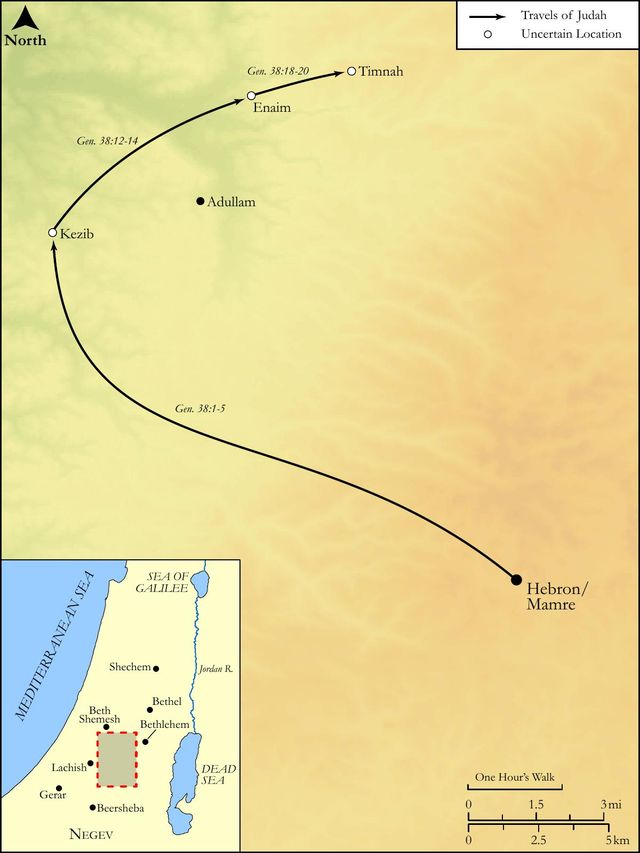
See on the biblical-era map


Study this verse
Public-domain commentary
Matthew Henry
From his Commentary on the Whole Bible. Henry comments on passages, not single verses — this entry covers Genesis 38:1–11.
Here is, 1. Judah's foolish friendship with a Canaanite-man. He went down from his brethren, and withdrew for a time from their society and his father's family, and got to be intimately acquainted with one Hirah, an Adullamite, Gen 38:1. It is computed that he was now not much above fifteen or sixteen years of age, an easy prey to the tempter. Note, When young people that have been well educated begin to change their company, they will soon change their manners, and lose their good education. Those that go down from their brethren, that despise and forsake the society of the seed of Israel, and pick up Canaanites for their companions, are going down the hill apace. It is of great consequence to young people to choose proper associates; for these they will imitate, study to recommend themselves to, and, by their opinion of them, value themselves: an error in this choice is often fatal. 2. His foolish marriage with a Canaanite-woman, a match made, not by his father, who, it should seem, was not consulted, but by his new friend Hirah, Gen 38:2. Many have been drawn into marriages scandalous and pernicious to themselves and their families by keeping bad company, and growing familiar with bad people: one wicked league entangles men in another. Let young people be admonished by this to take their good parents for their best friends, and to be advised by them, and not by flatterers, who wheedle them, to make a prey of them. 3. His children by this Canaanite, and his disposal of them. Three sons he had by her, Er, Onan, and Shelah. It is probable that she embraced the worship of the God of Israel, at least in profession, but, for aught that appears, there was little of the fear of God in the family. Judah married too young, and very rashly; he also married his sons too young, when they had neither wit nor grace to govern themselves, and the consequences were very bad. (1.) His first-born, Er, was notoriously wicked; he was so in the sight of the Lord, that is, in defiance of God and his law; or, if perhaps he was not wicked in the sight of God, to whom all men's wickedness is open; and what came of it? Why, God cut him off presently (Gen 38:7): The Lord slew him. Note, Sometimes God makes quick work with sinners, and takes them away in his wrath, when they are but just setting out in a wicked course of life. (2.) The next son, Onan, was, according to the ancient usage, married to the widow, to preserve the name of his deceased brother that died childless. Though God had taken away his life for his wickedness, yet they were solicitous to preserve his memory; and their disappointment therein, through Onan's sin, was a further punishment of his wickedness. The custom of marrying the brother's widow was afterwards made one of the laws of Moses, Deu 25:5. Onan, though he consented to marry the widow, yet, to the great abuse of his own body, of the wife that he had married, and of the memory of his brother that was gone, he refused to raise up seed unto his brother, as he was in duty bound. This was so much the worse because the Messiah was to descend from Judah, and, had he not been guilty of this wickedness, he might have had the honour of being one of his ancestors. Note, Those sins that dishonour the body and defile it are very displeasing to God and evidences of vile affections. (3.) Shelah, the third son, was reserved for the widow (Gen 38:11), yet with a design that he should not marry so young as his brothers had done, lest he die also. Some think that Judah never intended to marry Shelah to Tamar, but unjustly suspected her to have been the death of her two former husbands (whereas it was their own wickedness that slew them), and then sent her to her father's house, with a charge to remain a widow. If so, it was an inexcusable piece of prevarication that he was guilty of. However, Tamar acquiesced for the present, and waited the issue.
Continue studying Genesis 38:11 across the web’s major study libraries — every link below opens this exact verse, chapter, or book on the destination site.
Read & Compare
 BibleGatewayThis verse in more than 200 translations and 70 languages.
 Bible.comThe YouVersion reader — hundreds of translations, reading plans, and highlights.
 ESV.orgCrossway's official English Standard Version reader.
 NET BibleThe NET translation with 60,000+ translators' notes on every rendering decision.
 STEP BibleTyndale House's free study tool — original text, vocabulary, and scholarly resources.
 BibliaLogos Bible Software's free web reader.
 USCCBThe New American Bible (Revised Edition) with the U.S. bishops' study notes.
Commentaries
 BibleHub CommentariesDozens of classic commentaries on this verse, gathered on one page.
 StudyLightMore than 100 commentary sets — the largest collection on the web.
 BibleRefPlain-English commentary on what this verse means, verse by verse.
 Enduring WordDavid Guzik's free commentary on this chapter, widely used by Bible teachers.
 Bible Study ToolsVerse commentary alongside Greek and Hebrew study aids.
Original Language & Research
- BibleHub InterlinearThe verse word by word — original language, transliteration, and English.
- BibleHub LexiconEvery word's original-language definition and Strong's entry.
 Blue Letter BibleDeep-study tools — Strong's numbers, concordance, and word studies.
 SefariaThe Hebrew text with Rashi and centuries of Jewish commentary.
Sermons, Hymns & Audio


TrulyRandomVerse is not affiliated with these sites and doesn’t control their content. They’re linked because they’re genuinely useful.
Summary
Genesis 38:11 records Judah's instruction to his daughter-in-law, Tamar, to return to her father's house and remain a widow until his youngest son, Shelah, was old enough to marry her. Judah's stated reason, "Lest peradventure he die also, as his brethren [did]," was likely a deceptive excuse, masking his fear of a perceived curse on Tamar or, more accurately, his unwillingness to fulfill the levirate marriage obligation. This command placed Tamar in a vulnerable and uncertain state, setting the stage for her later decisive actions to secure her rightful place within the family lineage and highlighting Judah's moral failure within the broader narrative of God's sovereign and often surprising plan.
Context
ShowHideLiterary Context
Genesis chapter 38 serves as a striking narrative interlude, abruptly shifting focus from the unfolding story of Joseph's trials and triumphs (Genesis 37, 39-50) to the personal life and moral failings of Judah, one of Jacob's elder sons. This chapter, far from being a mere digression, provides a stark contrast between Judah's ethical compromises and Joseph's unwavering integrity, underscoring themes of human sin, divine providence, and the complex path of the messianic lineage. Verse 11 specifically follows the tragic deaths of Judah's first two sons, Er and Onan, both of whom were married to Tamar and died without providing an heir. Judah's command to Tamar in this verse directly addresses the predicament of a childless widow and his perceived obligation under the ancient custom of levirate marriage.
Historical & Cultural Context
In the ancient Near East, the social and economic security of women, particularly childless widows, was inextricably linked to their family and the continuation of the male lineage. The custom of levirate marriage (from the Latin levir, meaning "husband's brother"), later codified in Mosaic Law (as seen in Deuteronomy 25:5-10), obligated a deceased man's brother to marry his widow to "raise up offspring for his brother." This ensured the deceased's name and inheritance continued and provided for the widow's welfare. Judah's command to Tamar in Genesis 38:11 to "remain a widow" and return to her father's house, rather than immediately being given to Shelah, was a significant departure from this expectation. It effectively left Tamar in a state of indefinite limbo, denying her the social and economic security that a new marriage and children would provide, and betraying the spirit of the custom designed to protect her.
Key Themes
ShowHideThis verse, and indeed the entire chapter, contributes to several overarching themes in Genesis and the broader biblical narrative. Firstly, it powerfully illustrates human failure and deception, particularly through Judah's actions. His fear and unwillingness to uphold his family obligation reveal a pattern of moral compromise that contrasts with the faithfulness of God. Secondly, it highlights the vulnerability of women in ancient patriarchal societies, especially those without male protectors or heirs. Tamar's precarious position underscores the societal pressures and injustices faced by childless widows. Thirdly, and perhaps most profoundly, the chapter demonstrates divine sovereignty amidst human imperfection. Despite Judah's attempts to thwart the natural course of lineage and his own moral shortcomings, God's overarching plan for the messianic line, specifically through Judah, remains intact. This theme is crucial for understanding how God works through imperfect vessels and challenging circumstances to achieve His redemptive purposes, ultimately leading to the birth of the Messiah (as foreshadowed in Genesis 49:10).
Exposition and Analysis
ShowHideKey Word Analysis
ShowHideThis term refers to a woman whose husband has died, often implying a state of desolation and vulnerability. In ancient Near Eastern society, a childless widow was particularly precarious, lacking a male protector or provider, and often dependent on the goodwill of her deceased husband's family. Judah's instruction for Tamar to "remain a widow" was a pronouncement of her continued, indefinite state of vulnerability, denying her the security and lineage that levirate marriage was intended to provide.
This verb means "to be (causatively make) large" in various senses, including physical growth, maturity, or to become great. In this context, it refers to Shelah reaching an age of maturity suitable for marriage. Judah's use of this word implies a future, yet undefined, point in time, which, given his underlying motives, was likely a delaying tactic rather than a genuine promise for Tamar's future security.
This primitive root means "to die (literally or figuratively)" or "to kill." Judah's stated fear that Shelah might "die also, as his brethren did," reveals his superstitious belief that Tamar was somehow cursed or that her presence brought death. This fear, however, conveniently served as an excuse to avoid his obligation, ignoring the fact that Er and Onan died because of their own wickedness in the sight of the Lord, not due to Tamar.
Verse Breakdown
ShowHide"Then said Judah to Tamar his daughter in law"
This phrase establishes the speaker and the recipient of the command, highlighting the familial relationship and Judah's patriarchal authority over Tamar, who is now a vulnerable member of his extended household.
"Remain a widow at thy father's house, till Shelah my son be grown"
This is Judah's direct command. "Remain a widow" condemns Tamar to an indefinite state of social and economic insecurity, contrary to the custom designed to protect her. Sending her "at thy father's house" removes her from Judah's immediate responsibility and control. The phrase "till Shelah my son be grown" presents a conditional promise, implying a future marriage that Judah likely had no intention of fulfilling, effectively leaving Tamar in limbo.
"for he said, Lest peradventure he die also, as his brethren [did]"
This clause provides Judah's stated rationale. The repetition of "he said" (referring to Judah's internal thought or perhaps what he told others) underscores his underlying motive. His fear that Shelah might "die also" suggests a superstitious belief in a curse on Tamar, or more plausibly, a convenient and deceptive excuse to avoid his levirate duty, given that Er and Onan's deaths were attributed to their own wickedness by God, not Tamar.
"And Tamar went and dwelt in her father's house"
This final clause describes Tamar's immediate, obedient response. Her compliance highlights her initial powerlessness and dependence on Judah's word, setting the stage for her later, proactive, and unconventional actions to secure her lineage and rights, as detailed in the subsequent verses of Genesis 38.
Literary Devices
ShowHideThe verse employs several literary devices to convey its meaning and emotional weight. Dialogue is central, as Judah's direct command to Tamar reveals his character and intentions. The irony is palpable: Judah, meant to be a protector and upholder of family custom, becomes the one who denies Tamar her rightful security. His stated reason, "Lest peradventure he die also," serves as a form of euphemism or pretext, masking his true, selfish motive to avoid his obligation. The phrase "as his brethren [did]" functions as a foreshadowing of Judah's later realization that the problem was not Tamar, but the wickedness of his sons and his own failure. Finally, Tamar's simple act of going and dwelling in her father's house, presented without further comment on her feelings, creates a sense of pathos, emphasizing her vulnerability and the injustice she endures, which ultimately sets the stage for her determined and dramatic actions later in the chapter.
Theological and Thematic Connections
ShowHideGenesis 38:11 powerfully illustrates the tension between human fallibility and divine faithfulness. Judah's command to Tamar, rooted in fear, superstition, or deliberate deception, represents a significant moral failure within the patriarchal line. It highlights how personal convenience and a lack of integrity can lead to the neglect of solemn obligations and the oppression of the vulnerable. Yet, even in this moment of human brokenness, the narrative subtly foreshadows God's unwavering commitment to His covenant purposes. Tamar's subsequent actions, born out of a desperate desire for justice and the continuation of her deceased husband's name, ultimately become a surprising means through which God's plan for the messianic lineage is preserved, demonstrating His ability to work through and even redeem human sin and unconventional circumstances.
Reflection and Application
ShowHideGenesis 38:11 offers profound lessons for contemporary believers. Judah's actions serve as a stark reminder that even those in positions of authority or spiritual heritage are susceptible to fear, self-interest, and moral compromise. His willingness to deny Tamar her rights, based on a flimsy excuse, challenges us to examine our own motives when faced with obligations, especially towards those who are vulnerable or dependent on us. Are we quick to rationalize our failures or prioritize our comfort over justice and compassion? This narrative calls us to a higher standard of integrity, urging us to fulfill our promises and responsibilities, not just when convenient, but as a reflection of God's own faithfulness. Furthermore, it underscores the enduring biblical charge to care for the widow and the fatherless, whose cause God Himself upholds. As followers of Christ, we are called to show them compassion and faithful care, bearing their burdens and upholding righteousness in all our dealings, trusting that God can work His purposes even through our imperfections.
Questions for Reflection
ShowHideFAQ
ShowHideWhy did Judah tell Tamar to remain a widow?
ShowHideJudah's stated reason was his fear that his youngest son, Shelah, would die if he married Tamar, just as his two older brothers, Er and Onan, had died. However, the biblical text attributes the deaths of Er and Onan to their wickedness in the sight of the Lord, not to Tamar. Therefore, Judah's fear was likely either a superstitious misinterpretation of events or, more probably, a deliberate deception and excuse to avoid fulfilling his obligation under the levirate marriage custom. By sending Tamar back to her father's house indefinitely, he effectively denied her the security and lineage that was her right, breaking his implicit promise as the head of the household.
What was Tamar's status and what did Judah's command mean for her?
ShowHideAs a childless widow, Tamar was in an extremely vulnerable and precarious position in ancient society. Her social standing, economic security, and honor were dependent on having an heir to carry on her deceased husband's name and provide for her. Judah's command to "remain a widow" meant she was left in a state of indefinite limbo, unable to remarry and secure her future within Judah's family line, and effectively denied the opportunity for a new family and security. This was a cruel pronouncement, directly contrary to the spirit of the levirate law which was designed to protect such women and ensure the continuation of family lines. Her compliance, as recorded in Genesis 38:11, underscores her initial powerlessness and dependence on Judah's word.
Christ-Centered Fulfillment
ShowHideThe seemingly scandalous and morally complex events of Genesis 38, particularly Judah's failure and Tamar's unconventional actions, are remarkably woven into the very fabric of Christ's lineage. Despite Judah's moral failings and his attempt to deny Tamar her rightful place and the continuation of her deceased husband's line, God's sovereign plan for the Messiah's coming through Judah's tribe remained steadfast. Tamar, through her determined and ultimately righteous pursuit of the levirate obligation, becomes one of the few women explicitly named in the genealogy of Jesus Christ (as recorded in Matthew 1:3). This narrative powerfully illustrates that God's redemptive plan is not derailed by human sin, imperfection, or even deliberate obstruction. Instead, He demonstrates His profound grace and faithfulness by working through brokenness, unconventional means, and even human sin to achieve His perfect will, ultimately bringing forth the perfect Son, Jesus Christ, who would redeem humanity from all sin and fulfill all righteousness (as seen in Romans 5:8 and Hebrews 4:15).